
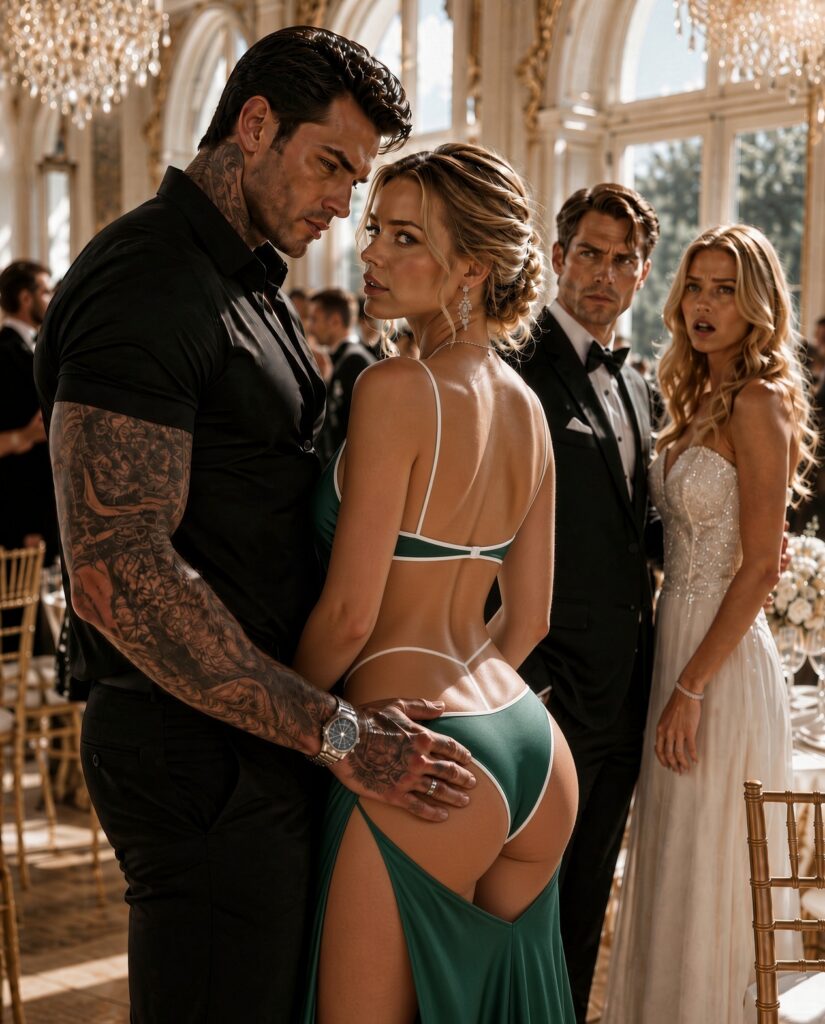
“I’m proposing because my brother made a decision that changes the balance of several families.”
“That sounds romantic.”
“It isn’t meant to be.”
At least he was honest.
Nikolai leaned one shoulder against the wall opposite me, giving me the same careful distance he had maintained since approaching. He didn’t crowd me. He didn’t lower his voice into something intimate or persuasive. He simply waited.
That irritated me more than pressure would have.
I was used to men wanting something from me. Julian wanted the polished Hart name. My father wanted a daughter who would strengthen an alliance. My mother wanted a family that looked perfect from across a ballroom.
Nikolai, at least, had the decency to admit he wanted something.
“What exactly would this marriage secure?” I asked.
“Not a marriage. An agreement.”
“Then you should have led with that.”
“I assumed you would refuse if I called it an agreement.”
“I’m considering refusing either way.”
“I expected that.”
I gave a short, disbelieving laugh. “You expected me to consider marrying the man everyone in Chicago whispers about?”
“Everyone in Chicago whispers about my family. Very few people know what they’re talking about.”
“Are the whispers wrong?”
“Some are.”
“And the rest?”
He looked toward the closed service door.
“My family has built its reputation on being difficult to challenge. That reputation has protected us for decades. It has also made it convenient for people to believe the worst.”
The answer was polished, but not evasive. That unsettled me.
I had grown up hearing stories about the Morettis. Their shipping company had started with a single truck and now controlled warehouses, freight routes, hotels, and private security contracts throughout the Midwest. Their name appeared beside politicians, judges, and charity foundations.
It also appeared in rumors.
Deals made in dark rooms. Favors collected years later. Men who changed their minds after meeting Nikolai.
I had never known which stories were true.
Tonight, I wasn’t sure I wanted to know.
“You’re asking me to marry into a family with a reputation you won’t explain,” I said.
“I’m asking you to marry into a family that is being forced to choose between its past and its future.”
“That sounds like a problem for your family.”
“It was. Until Julian brought Serena into the ballroom.”
The mention of my sister tightened something in my chest.
“Don’t blame Serena for his choice.”
“I don’t.”
The answer came too quickly to be rehearsed.
I studied him. “You don’t?”
“Your sister accepted a ring in front of half the city. Whether she understood the consequences or not, the announcement gave my brother the appearance of choosing love over strategy.”
“Is that what he did?”
“No.”
The certainty in his voice made me look up.
Nikolai took a slow sip of whiskey, his gaze fixed on the amber liquid.
“Julian has been trying to secure his position on the council since our father’s health began to decline. The council consists of five family trustees. Three of them believe the company should remain under Moretti control. Two believe expansion requires a public alliance with the Harts.”
I almost smiled bitterly.
“So my family is a business asset.”
“To some of them.”
“And you?”
“I believe people should be more valuable than what their names can purchase.”
It was the first thing he had said that sounded personal.
Before I could respond, the service door opened.
Penny slipped through, carefully closing it behind her. Her cheeks were flushed, and she held two glasses of water.
“I told your mother you were checking your makeup,” she said. “She believed me because she wanted to.”
She handed me a glass, then looked at Nikolai.
“Are you the reason my best friend looks like she might either cry or commit a felony?”
“Nikolai Moretti.”
“I know who you are.”
“Then you know I’m not worth committing a felony over.”
Penny glanced at me. “That remains to be determined.”
For the first time that night, something resembling normal life returned to the corridor. Penny stood beside me, solid and familiar, her shoulder brushing mine. She had been my friend since college, long before my family began measuring relationships by usefulness.
She took a sip of water.
“What did he say?”
“He proposed,” I answered.
Penny nearly choked.
Nikolai’s face remained unreadable.
“You proposed to Evelyn?” Penny asked.
“To be precise, I proposed a marriage.”
“That precision does not improve the situation.”
“I’m aware.”
Penny turned to me. “Do you want me to get your coat?”
“Yes.”
“No.”
We both spoke at once.
Penny blinked. “Which one of you am I listening to?”
“I’m not leaving yet,” I said.
Nikolai’s gaze shifted to me, attentive but not triumphant.
That mattered. He didn’t look as though he believed my hesitation meant agreement.
“I want to hear the offer,” I continued. “Not accept it. Hear it.”
Penny’s mouth tightened. “Evelyn—”
“I’m not making a decision tonight.”
“I know. I’m reminding you that he may be very good at making decisions sound like they were yours.”
Nikolai nodded once. “Your friend is right to be cautious.”
Penny looked briefly annoyed that he agreed with her.
He reached into his jacket and removed a slim black card. He offered it to me without touching my hand.
“Tomorrow morning, nine o’clock. My office. You’ll meet my attorney and receive the full proposal in writing. No hidden conditions. No expectation that you sign anything.”
I didn’t take the card immediately.
“What happens if I refuse?”
“Then you refuse.”
“And the council?”
“They’ll vote based on whatever information they have.”
“That sounds like a threat.”
“It’s a consequence, not a threat.”
“Convenient distinction.”
“An important one.”
I took the card.
His fingers did not brush mine, but I noticed how carefully he avoided it.
“Nine o’clock is too early.”
“Ten, then.”
“I have nothing to wear.”
“Wear what you wore tonight.”
I glanced down at my ivory dress, the one I had chosen months ago after deciding that white belonged to brides and ivory belonged to women who had learned not to trust happy endings.
“I’m not meeting your attorney dressed for my sister’s engagement.”
“Then wear something that belongs to you.”
The words were simple.
They stayed with me.
Penny pulled my coat from the hook near the door. “We’re leaving.”
I looked once more at Nikolai.
“You knew this would happen?”
“Not exactly.”
“You expected Julian to abandon me?”
“I expected him to choose the path that made him look least like himself.”
“That makes no sense.”
“It will tomorrow.”
He stepped aside, allowing us to pass.
I paused at the door. “If this is some kind of game—”
“It isn’t.”
“If you’re using me to punish your brother—”
“I’m not.”
“If you think I’ll stand beside you and smile while your family tears itself apart—”
“I don’t.”
His voice softened.
“I think you’ve spent your whole life being told where to stand. I’m offering you the chance to decide whether you want to stand anywhere near us at all.”
I didn’t answer.
Penny opened the door, and the distant sound of the ballroom rushed toward us. Laughter. Music. Applause.
The celebration was still going on.
I walked through it without looking back.
My father stood near the bar when I entered the ballroom. His face was pale with the controlled concern he reserved for public situations. My mother remained beside him, one hand resting against Serena’s arm.
Serena had removed the white gloves that matched her dress. The ring glittered beneath the chandelier lights.
Julian was speaking with two reporters near the stage.
When he saw me, his smile disappeared.
“Evelyn,” my father said. “Where have you been?”
“Getting air.”
“You should come home with us.”
“I’m going to the hotel entrance with Penny.”
My mother’s eyes flicked toward the corridor behind me.
“Was someone with you?”
There it was.
Not concern. Calculation.
“Why?”
“Because people are asking questions.”
“Then answer them.”
Her lips pressed into a thin line. “This is not the time to be difficult.”
“Tonight seems to be the time for everyone to be honest.”
Serena stepped forward.
“Evelyn, I’m sorry.”
I looked at her.
She seemed genuinely miserable now. The tears were gone, leaving her eyes red and uncertain.
For one fleeting second, I saw my little sister at eight years old, hiding beneath the kitchen table after our parents had argued. I had crawled underneath with her and given her half of my sandwich. Serena had held my hand until the shouting stopped.
That memory made this worse, not better.
“You should be,” I said.
Her face crumpled.
My mother inhaled sharply. “Evelyn.”
I turned to her. “You told me not to embarrass the family. I didn’t. Julian did. Serena did. You did, when you decided protecting the appearance of this evening mattered more than what happened to me.”
“That is unfair.”
“Maybe.”
My father finally spoke.
“We can discuss this privately.”
“You had months to discuss my engagement privately. You chose to announce your support publicly.”
His eyes lowered.
That was answer enough.
Penny touched my elbow.
“Come on.”
I allowed her to guide me toward the entrance. We had taken only a few steps when Julian approached.
“Can we talk?”
“No.”
His jaw tightened. “You owe me that much.”
I stopped.
The words were so absurd that I almost laughed.
“I owe you?”
“We were together for three years.”
“And you owed me honesty.”
“I didn’t plan for this to happen.”
“You brought my sister to our engagement party wearing my dress and carrying my ring.”
“I didn’t know how to tell you.”
“Try words. They’re useful.”
His eyes moved toward the crowd. “Not here.”
“You’re right. The ballroom has already heard enough.”
He lowered his voice. “Serena and I didn’t mean to hurt you.”
“Intent doesn’t erase consequences.”
“She loves me.”
“Then you should have told me before tonight.”
“I was going to.”
“When?”
He had no answer.
Behind him, Serena stood motionless, listening.
Julian’s expression changed. “Nikolai spoke to you.”
It wasn’t a question.
I held his gaze. “Yes.”
“What did he say?”
“That he’s better at timing than you are.”
Anger flashed across his face, quickly contained.
“Don’t let him use you.”
The irony was almost unbearable.
“You don’t get to warn me about being used.”
“I know my brother.”
“So do I. I’ve known him for fifteen minutes. And somehow he’s been more direct with me than you were in three years.”
Julian glanced toward the dark windows overlooking Michigan Avenue.
“Nikolai doesn’t offer anything without wanting something in return.”
“Neither do you.”
“That’s different.”
“Of course it is.”
I walked away before he could answer.
Outside, the November air struck my face with clean, cold force. The hotel’s entrance glittered behind us, rows of black cars waiting beneath the awning.
Penny opened the passenger door of her car.
“You’re coming home with me,” she said.
“I should go to my parents’ house.”
“No.”
“I need clothes.”
“You can buy clothes.”
“I need my passport.”
“You can get that tomorrow.”
I sat in the passenger seat and stared through the windshield.
For years, I had imagined leaving my family as an act of rebellion. I had never imagined it would happen while still wearing the dress my mother approved.
Penny started the engine.
“Do you want to talk about him?”
“Which him?”
“The tall, intimidating one who looks like he was carved out of expensive furniture.”
I looked down at the black card in my hand.
“Nikolai says the marriage would affect a council vote.”
“That part I heard.”
“He says Julian chose Serena because he wanted to appear romantic, but the decision may cost him control of the Moretti company.”
“And you would somehow fix that?”
“I don’t know.”
“Did he explain why you?”
“Because the council expected Julian to marry a Hart.”
Penny turned onto Wacker Drive. The city lights blurred against the windows.
“That’s not enough.”
“No.”
“What else?”
I thought of his expression when he said people should be more valuable than what their names could purchase.
“I don’t know yet.”
Penny glanced at me. “You’re going.”
“To his office?”
“Yes.”
“Why do you sound disappointed?”
“Because I was hoping you’d say you were going to cancel the wedding, move to Paris, and become a woman who never answers emails.”
“I might still do that.”
“Good. Keep options open.”
At her apartment, I changed into borrowed pajamas and sat at the kitchen island while Penny made tea. She didn’t ask whether I wanted wine. She knew me well enough to understand that wine would make the night feel like a story I could avoid remembering in the morning.
Instead, she placed a mug in front of me and sat across from me.
“Tell me what you really think,” she said.
“I think my fiancé left me for my sister.”
“That’s what happened.”
“I think my mother cares more about appearances than she cares about me.”
“That’s also what happened.”
“I think a man I barely know has offered me a marriage that may be nothing more than a business arrangement.”
“Probably.”
I wrapped both hands around the mug.
“And I think part of me wants to know why he looked at me tonight as if I were the only person in that room who had been honest.”
Penny’s expression softened.
“That part worries me.”
“It worries me too.”
“You don’t have to decide what he means tonight.”
“I know.”
“But you can decide what you mean.”
I looked at her.
She continued, “You walked out of that ballroom because you refused to let them define the evening. Don’t let Nikolai define what happens next either.”
The advice was simple. It settled something inside me.
At ten the next morning, I arrived at Moretti Holdings wearing a navy suit I had bought two years ago and never worn because my mother said the cut made me look severe.
I decided I liked looking severe.
The Moretti headquarters occupied the upper floors of a restored limestone building overlooking the river. Its lobby was quiet, modern, and unexpectedly warm. There were no intimidating men in dark coats, no whispered warnings, no locked doors.
A woman at the reception desk greeted me by name.
“Miss Hart. Mr. Moretti is expecting you.”
“Which one?”
Her smile remained professional. “Nikolai.”
She led me to a private elevator.
The top floor contained offices, conference rooms, and a long wall of windows. Chicago stretched beyond the glass, gray and silver beneath the winter sky.
Nikolai stood beside a conference table covered with neatly arranged folders. He wore a charcoal suit, no tie, and held a cup of coffee.
“You came,” he said.
“I’m still capable of making questionable decisions before noon.”
“That’s reassuring.”
There were two other people in the room.
A silver-haired woman stood near the window with a tablet tucked beneath one arm. A younger man sat at the table, reviewing documents.
“Nora Bell, general counsel,” Nikolai said. “Daniel Ruiz, chief financial officer.”
Nora offered her hand. “I want to be clear from the beginning. This is not a binding proposal. You may take these documents to any attorney of your choosing.”
I shook her hand.
Daniel stood as well. “And for what it’s worth, I advised Nikolai to wait at least forty-eight hours before approaching you.”
“Daniel,” Nikolai said.
“What? I’m trying to establish credibility.”
Despite myself, I smiled.
Nikolai gestured toward a chair. “Please sit.”
I did. He took the seat opposite me, while Nora placed a folder in front of me.
The first page contained no romantic language.
It outlined a twelve-month marriage agreement, separate finances, independent residences if desired, no expectation of children, and a mutual confidentiality clause. Either party could end the arrangement after the council vote without financial penalty or public blame.
I read the page twice.
“You’ve done this before?”
“No.”
“You drafted an agreement for a marriage that ends in twelve months?”
“I asked Nora to prepare a framework that protects you.”
“Why protect me?”
“Because the Moretti family has enough history with women being treated as extensions of men’s decisions.”
The room grew still.
I looked up. “What does that mean?”
Nora and Daniel exchanged a brief glance.
Nikolai leaned back.
“My mother was married to my father for twenty-three years. When he died, she discovered that most of the properties she had managed were held through companies she didn’t know existed. She spent the last decade of her life trying to recover what she had built.”
“I’m sorry.”
“She wasn’t helpless,” he said. “That’s the point. She was capable, intelligent, and still denied information because everyone assumed my father knew best.”
His voice remained calm, but something beneath it had hardened.
“I won’t repeat that mistake with anyone who stands beside me.”
I lowered my gaze to the agreement.
The words looked different now.
Not tender. Not romantic.
But deliberate.
“What does the council vote decide?” I asked.
“Whether I become chairman of Moretti Holdings.”
“Your brother is competing against you?”
“Yes.”
“And my family’s support determines the outcome?”
“Your father controls two voting shares held through Hart Development. Your mother sits on the advisory board. The council expected Julian to merge the families through marriage.”
“Expected?”
Nora spoke carefully. “There is a longstanding understanding between the Harts and the Morettis. Nothing legally binding. But it has influenced several business decisions.”
I felt cold despite the warmth of the room.
“Was my engagement arranged?”
“No,” Nikolai said.
The answer was immediate.
“But it was encouraged,” I said.
He didn’t deny it.
“Julian and I began dating before I knew anything about the council.”
“I believe you.”
“Do you?”
“I believe you didn’t know about the details. I’m not sure I believe nothing was expected of you.”
His eyes held mine.
“That’s fair.”
The admission took some of the force out of my suspicion.
I turned another page. “If I marry you, my father’s voting shares remain with him?”
“Yes.”
“Then how does this help you?”
“It changes the council’s perception. They can no longer argue that Julian has secured the Hart alliance.”
“But if my father supports Julian anyway?”
“Then he does.”
“And you still want this?”
“I want a decision based on what each of us chooses now, not on what our families assumed we would choose.”
That sounded noble.
I distrusted noble explanations. They tended to hide the inconvenient details.
“What are you not telling me?”
Nikolai’s gaze shifted briefly toward the folder.
“There is one matter you need to understand before deciding.”
He reached for a second envelope, separate from the legal documents.
It was cream-colored, sealed with a plain black line of wax.
“Last month,” he said, “my father requested a private review of the family trust.”
I waited.
“During that review, we discovered that someone had been transferring money from one of the company’s charitable foundations into an account connected to Hart Development.”
The room seemed to contract around me.
“What?”
“I’m not accusing your father.”
“Who is?”
“We don’t know.”
“Then why bring it to me?”
“Because the transfers began six months ago.”
Six months.
The exact time Julian had started making excuses about delayed meetings. The exact time my mother had begun insisting that our engagement be announced before the holidays. The exact time Serena had started appearing at Moretti family dinners without me.
I looked at the sealed envelope.
“What’s inside?”
“Copies of the records. And a letter from my father.”
“Why would he write to me?”
“He didn’t.”
Nikolai slid the envelope across the table.
“The letter is addressed to Julian.”
My hand hovered above it.
“Then why do you have it?”
“Because Julian never received it.”
I looked up.
Nikolai’s expression had changed. The controlled calm was still there, but beneath it was something more cautious.
“My father wrote that he had evidence someone inside both families was manipulating the engagement for reasons neither Julian nor I understood.”
My pulse began to quicken.
“Someone inside both families?”
“He intended to confront the person privately before the council meeting.”
“What happened?”
“He suffered a stroke two weeks ago.”
The room fell silent.
Nikolai did not dramatize the words. He simply stated them, allowing the weight to settle on its own.
I stared at the envelope.
“Why didn’t you tell the council?”
“Because the evidence is incomplete. If I make an accusation without proof, I could destroy innocent people and give the real person time to disappear.”
“And you think I can help?”
“I think you may already know something you were never told to notice.”
A memory surfaced.
My mother at the breakfast table six months earlier, asking whether Julian had ever mentioned a company called Bellwether Logistics.
Julian changing the subject when I asked why he had suddenly begun meeting with my father.
Serena borrowing my laptop and returning it with the browser history cleared.
Little moments. Separate and meaningless.
Until now.
I opened the envelope.
Inside was a photocopy of a bank transfer authorization bearing the Hart Development seal.
And beneath it, a handwritten note in a familiar script.
My father’s.
Ask Evelyn why the ring was replaced.
I stopped breathing.
Nikolai watched my face.
“What does that mean?” he asked.
I turned the page over with shaking fingers.
There was one more line.
The ring Julian gave her was never the ring chosen for her.
PART 3
I turned the page over with shaking fingers.
There was one more line.
The ring Julian gave her was never the ring chosen for her.
For several seconds, I could only hear the soft hum of the heating system and the distant traffic below the windows.
Nikolai leaned forward. “Evelyn?”
I read the sentence again.
The handwriting was unmistakable. My father’s letters had always slanted slightly to the left, as though every word were reluctant to move forward. I had seen that handwriting on birthday cards, legal documents, and notes left beside my breakfast when he traveled.
This was his.
“What does it mean?” Nikolai asked.
“I don’t know.”
The words came out too quietly.
He didn’t reach for the paper. He didn’t ask me to explain before I was ready. He simply waited, giving me the silence I needed to search through memories that had seemed ordinary until now.
The ring.
Julian had proposed six months earlier at a restaurant overlooking the river. I had expected a proposal eventually, but not that evening. He had told me he wanted to show me a place that mattered to his family. After dinner, he led me onto the terrace, where the city lights trembled on the dark water.
He had knelt.
I had cried.
The ring had been a narrow platinum band with a square-cut diamond surrounded by tiny blue sapphires. It was elegant, understated, and unlike anything I would have chosen for myself.
But I had loved it because Julian had said it belonged to his grandmother.
“I need to see the ring,” Nikolai said.
I looked up. “It’s at my parents’ house.”
“Why?”
“I left it there last night.”
That was not entirely true. I had taken it off before leaving Penny’s apartment and placed it in the small velvet pouch I kept inside my handbag. When I woke that morning, I couldn’t bear to look at it. I had left the pouch in the guest room at my parents’ house after stopping there for my passport.
I had forgotten it until now.
Nora folded her hands on the table. “Do you know whether the ring had any identifying marks?”
“Not that I saw.”
“Family jewelry often has engravings inside the band.”
“I never checked.”
The shame of that surprised me. I had worn the ring for half a year and never looked closely enough to wonder what it carried beneath the surface.
Julian had told me the ring was sentimental. I had accepted that explanation because I wanted to believe the sentiment was his.
Nikolai’s phone vibrated.
He glanced at the screen, then answered.
“Moretti.”
He listened for a moment.
“Understood. Don’t move anything until I arrive.”
He ended the call.
“What happened?” I asked.
“Nothing urgent. My father’s nurse called to say he was awake.”
I hadn’t expected the information to affect me. Yet relief moved through me, unexpected and sincere.
“Can he speak?”
“Some days. His speech is improving, but his memory comes and goes.”
“Does he know about Julian and Serena?”
“He knows Julian made an announcement. He doesn’t know the details.”
“Why not?”
“Because the doctors believe emotional stress could slow his recovery.”
Nora rose and gathered the documents. “You should take these with you.”
I looked at her. “All of them?”
“Every page. We’ve made copies.”
Daniel slid a card across the table. “My private number is on the back. If you remember anything about the transfers, the engagement, or the ring, call me. Even if you think it’s insignificant.”
I tucked the card into my purse.
Nikolai stood. “I’ll drive you to your parents’ house.”
“No.”
His brows lifted slightly.
“I appreciate the offer, but I can manage.”
“I didn’t doubt that.”
“Then why offer?”
“Because I need to examine the ring too.”
“That sounds like a reason to accompany me, not a reason to drive me.”
A faint smile touched his mouth.
“You’re right.”
“I know.”
He looked at the documents in my hand. “Then I’ll ask properly. May I come with you?”
I should have said no.
The sensible answer was no. I had known Nikolai for less than a day. I was investigating my family with him, carrying a suspicious bank transfer and a letter from his incapacitated father, and considering a marriage arrangement with a man who had been a stranger until last night.
Nothing about the situation was sensible.
Yet the thought of facing my mother and father alone made my stomach tighten.
“You may come,” I said. “But you’re not allowed to speak for me.”
“I won’t.”
“And you’re not allowed to assume my father is guilty because of a document with his company seal.”
“I won’t do that either.”
“Or decide that my sister is involved because she accepted Julian’s ring.”
“I haven’t decided anything about Serena.”
His answer was so calm that I believed him.
We left the office through a private entrance. In the elevator, Nikolai stood beside me without touching me, his reflection appearing pale and distant in the polished metal.
“Your father’s house,” he said. “Is your mother there?”
“Probably.”
“And Serena?”
“I don’t know.”
“Do you want to go alone?”
I turned toward him.
“You just agreed to come.”
“I agreed because you asked me not to let you face them alone. That doesn’t mean you have to invite me inside.”
The reminder stopped me.
He wasn’t making himself necessary. He was offering a choice and leaving it in my hands.
“I want you inside,” I said. “But only because I want witnesses if my mother starts rewriting the past.”
“I understand.”
The elevator opened into the lobby.
Outside, a dark sedan waited by the curb. The driver opened the rear door, but Nikolai paused.
“Front or back?”
I looked at him.
“Do you always ask this many questions?”
“When the answer belongs to someone else.”
“Front.”
He nodded and opened the passenger door for me. I got in, and he walked around to the driver’s side.
“You drive yourself?” I asked.
“Usually.”
“I assumed men like you were driven everywhere.”
“Men like me?”
“Men who have private elevators and offices overlooking the river.”
“Those men are often driven by people they trust more than themselves.”
I glanced at him as he started the engine.
“Is that a joke?”
“An observation.”
The city moved past us in muted November colors. For several blocks, neither of us spoke.
Then he said, “The ring may not prove anything.”
“I know.”
“It may have been replaced for a harmless reason.”
“Julian told me it was his grandmother’s.”
“Perhaps it was.”
“Then why would your father write that it wasn’t the ring chosen for me?”
“I don’t know.”
His honesty had become both reassuring and frustrating.
“What did you think when you saw that note?”
“That my father had been investigating something without telling me.”
“And that doesn’t concern you?”
“It concerns me deeply. But concern isn’t proof.”
I turned the folder over in my lap. “You’re very careful.”
“I’ve learned that certainty is expensive.”
I wanted to ask what had taught him that, but we had already reached my parents’ neighborhood.
The Hart residence occupied a wide corner lot in Lincoln Park, its limestone facade softened by ivy and immaculate winter landscaping. I had grown up behind those windows. I had learned to ride a bicycle on the quiet side street, practiced piano in the music room, and spent countless evenings at the dining table listening to my parents discuss people as though they were investments.
The house looked exactly as it always had.
That was the problem.
Nikolai parked at the curb instead of pulling into the driveway.
“You don’t have to wait,” I said.
“I’m coming inside.”
“I know. I meant you don’t have to come back out if this becomes uncomfortable.”
“I’m not going anywhere.”
The words were not possessive. They were steady.
I opened the door.
My mother answered before I rang twice. She was wearing a cream sweater and tailored trousers, her hair arranged perfectly despite the early hour. Her gaze moved from me to Nikolai, then to the folder in my hand.
“You brought him here?”
“I brought myself here,” I said. “He came with me.”
Her expression tightened. “Your father is in the study.”
“Good.”
“Evelyn, this is not the time for—”
“Where is my ring?”
The question silenced her.
For the first time since I had entered the house, my mother looked uncertain.
“What ring?”
“The one Julian gave me.”
“It’s in the guest room.”
“Bring it to me.”
Her eyes flicked toward Nikolai.
He remained just behind my shoulder, silent.
“I don’t understand why this is necessary,” she said.
“Neither do I. That’s why I’m asking.”
My mother’s mouth formed a thin, displeased line. “You should not make decisions while you’re upset.”
“I’m not making a decision.”
“You’re involving strangers in family matters.”
“Nikolai is Julian’s brother.”
“That doesn’t make him family.”
“No,” I said. “Apparently being family doesn’t make someone trustworthy either.”
A shadow crossed her face.
For one second, I regretted the sharpness of the words. Then I remembered her whispering *Don’t embarrass us* while my future collapsed in front of her.
She turned away. “I’ll get the ring.”
While she was upstairs, I walked toward the study.
My father sat near the window in a dark cardigan, a blanket over his legs. He looked older than he had yesterday. His stroke had weakened the left side of his face, and his right hand rested against the arm of the chair, fingers curled loosely.
When he saw me, his expression softened.
“Evelyn,” he said.
His voice was rough but clear.
I crossed the room and kissed his cheek. He smelled faintly of cedar and the peppermint tea he drank when his stomach was unsettled.
“I’m sorry I didn’t come sooner.”
He shook his head.
His gaze moved to Nikolai.
“Moretti.”
“Nikolai Moretti,” he said. “It’s good to see you, Mr. Hart.”
My father’s eyes narrowed with recognition. “Your father.”
“Yes.”
A faint tremor passed through my father’s hand. “He knows.”
“Knows what?” I asked.
My mother entered carrying the velvet pouch.
“Evelyn,” she said quietly.
I turned.
She held it out, but did not release it immediately.
“Your father has been under considerable strain,” she said. “You shouldn’t question him about business matters.”
“I’m not questioning him. I’m showing him a note he wrote.”
Her face changed.
Not dramatically. My mother had spent her entire life mastering her expressions. But the color left her cheeks.
Nikolai noticed. I knew he did because his posture altered by a fraction.
I took the pouch from her and opened it.
The ring lay inside.
At first glance, it appeared unchanged. Platinum, square diamond, blue sapphires.
I carried it toward the window where the light was stronger.
Nikolai stopped beside me. “May I?”
I handed it to him.
He examined the setting, turning it slowly between his fingers. Then he looked inside the band.
“There’s an engraving.”
I leaned closer.
Tiny letters had been etched beneath the diamond.
M.M. 1987.
My stomach twisted.
“Your grandmother?” I asked.
Nikolai shook his head.
“My mother’s initials are L.M. My father’s are Antonio Moretti.”
“Then whose are M.M.?”
He looked at me.
“I don’t know.”
My father made a strained sound from the chair.
We both turned.
He was trying to speak. My mother moved toward him, but he lifted his hand.
“Michael,” she said gently. “Don’t push yourself.”
He looked at her with an expression I had never seen before.
Not anger.
Fear.
“Ask,” he managed.
“Ask what?”
His eyes moved to the ring.
“Not… Moretti.”
Nikolai stepped closer, but kept his voice low. “Mr. Hart, are you saying the ring does not belong to my family?”
My father closed his eyes.
My mother reached for the ring. “This is absurd. Jewelry changes hands. It may have been purchased from an estate.”
“By whom?” I asked.
She didn’t answer.
My father opened his eyes again. His gaze fixed on me.
“Your grandmother,” he said.
I frowned. “My grandmother?”
He nodded with effort.
“My mother’s?”
Another nod.
My maternal grandmother had died when I was eleven. She had been a quiet woman who embroidered table linens and kept old letters in a cedar chest. I remembered almost nothing about her jewelry. My mother had never talked about it.
“Why would her ring have Moretti initials?” I asked.
My father looked toward my mother.
She said nothing.
“Because it was never your grandmother’s,” he whispered.
The room seemed to shift.
“What does that mean?”
My mother crossed the space between us and took the ring from Nikolai.
“Your father is confused.”
“I’m not confused,” he said.
“You’re tired.”
“I remember.”
The words were weak, but they carried.
I looked from one parent to the other. “What do you remember?”
My father’s breathing became uneven. He pressed his fingers against the armrest as though gathering strength.
“1987,” he said.
Nikolai’s attention sharpened.
“What happened in 1987?” I asked.
My mother’s eyes filled with something that looked almost like grief.
“It was before you were born,” she said.
“That doesn’t answer me.”
“Your father and Antonio were not business partners then.”
“Were they friends?”
My mother shook her head.
“Rivals,” my father said.
The word fell into the room like a dropped glass.
Nikolai stared at him. “Why?”
My father’s gaze remained on the ring.
“Because of her.”
“Who?” I asked.
His lips trembled.
My mother closed her eyes.
“Your aunt,” she said.
I turned toward her.
“My aunt?”
“You never knew her.”
“I have an aunt?”
She looked at Nikolai, then back at me.
“No,” she said. “You had one.”
My father’s hand tightened around the armrest.
“Maria,” he whispered.
Nikolai went very still.
“Maria Moretti?” he asked.
My mother did not answer.
She didn’t need to.
The initials inside the ring were no longer a mystery.
M.M.
I looked at Nikolai. The controlled expression had vanished from his face. In its place was a stunned, searching disbelief.
“My father had a sister,” he said slowly. “Maria.”
“What happened to her?” I asked.
No one spoke.
Then my mother walked to the writing desk, opened the bottom drawer, and removed a small envelope yellowed with age.
She placed it on the table between us.
“It was supposed to stay buried,” she said.
My father looked at me.
“But someone has started digging.”
Inside the envelope was a photograph.
A young woman stood beside a river, dark hair blowing across her face, a ring identical to mine shining on her hand.
She was smiling at the camera.
Beside her stood my father, much younger, his arm around her shoulders.
And on the back, in my father’s handwriting, were six words:
Maria left because of the Harts.
PART 4 (THE END)
My mother’s words settled over the room.
“But someone has started digging.”
I looked at the photograph again. Maria’s smile was open and unguarded, nothing like the carefully composed expressions worn by everyone in my family. My father’s arm rested around her shoulders with an ease I had never seen between him and my mother.
Nikolai reached for the picture but stopped before touching it.
“Who is she to you?” he asked my father.
My father closed his eyes.
“My sister,” Nikolai answered for him.
“No,” my mother said. “She was your father’s sister.”
Nikolai’s face tightened. “That distinction doesn’t explain why she was standing beside Mr. Hart.”
My father’s breathing grew uneven. I moved toward him, but he raised a trembling hand.
“Let me,” he whispered.
My mother remained beside the desk, pale and still.
“Maria and I were friends first,” my father said. “Then more than friends.”
Nikolai looked at the photograph again.
“How much more?”
My father swallowed. “We intended to marry.”
The silence that followed was not dramatic. It was worse than that. It was the quiet of a family realizing that its history had been built around a story no one had been willing to tell.
I looked at my mother.
“Did you know?”
She lowered her gaze.
“Yes.”
The answer hurt more than it should have. I had expected denial, some careful explanation that would make everything less intimate and less real.
“How long have you known?”
“Since before you were born.”
“Did you know Maria?”
“We met twice.”
“Twice?”
“After your father and I were married.”
My father turned toward her. “Claire—”
“No,” she said softly. “She deserves to hear it.”
My mother came to the table and rested both hands against its edge.
“Your father and Maria were young. Their families were involved in competing businesses, and neither family approved of their relationship. When Maria became pregnant, everyone assumed the child was your father’s.”
Nikolai’s head lifted.
“Was it?”
My father’s face changed.
“No,” he said.
The answer was so quiet that I almost missed it.
Nikolai stared at him.
“Maria wasn’t pregnant with my father’s child?”
“She wasn’t pregnant at all,” my mother said. “That was the story created to explain why she left Chicago. It was easier for both families to accept that she had gone away because of a secret than to admit the real reason.”
“What was the real reason?” I asked.
My father looked at the ring in my hand.
“Your grandfather discovered that Maria and I had found irregularities in the Hart and Moretti accounts. Money was being moved through companies neither of us controlled. We thought it was one corrupt accountant. It was more complicated than that.”
“Who was involved?”
“We never proved it.”
My mother’s voice was quiet. “Maria wanted to go to the authorities. Your father wanted to gather more evidence first. Their disagreement became a family argument. When Maria threatened to expose everything, both families turned against her.”
My father’s fingers curled against the chair.
“My father told Maria that if she spoke publicly, he would accuse her of stealing from the company. He had enough influence to make the accusation believable.”
“And you let her leave?” Nikolai asked.
“I thought I could protect her by finding proof.”
“You thought,” Nikolai repeated.
There was no anger in his voice. Only disappointment, and somehow that seemed to wound my father more deeply.
“I was twenty-six,” my father said. “I believed patience was the same as wisdom. By the time I understood what was happening, Maria had gone.”
“Where?”
My mother looked toward the envelope.
“She left a letter.”
My father gave a strained laugh. “A letter that never reached me.”
“You never told me you had it,” I said.
“I didn’t know until years later.”
My mother opened the envelope again and removed a folded sheet of paper. The edges were fragile, the ink faded but legible.
She handed it to me.
The letter was addressed to Michael.
I read it standing beneath the gray light of the window.
*I am leaving because I no longer know which part of our lives is real and which part was arranged by people who believe love is another kind of ownership.*
*I found records in both companies. The money was not taken for personal gain. It was used to cover losses created by men who believed the families would always protect one another. If I stay, they will make me the explanation for everything.*
*I am returning the ring. It belonged to my mother, but she gave it to me when I chose you. Keep it only if you can one day give it to someone without asking her to carry our history.*
*If you find me, come because you want the truth—not because you need me to repair what we broke.*
There was no signature.
Only a single initial.
M.
I lowered the page.
“Where did you find this?”
“Your father’s desk,” my mother said. “After he had his stroke, I began organizing his papers. I found the letter tucked inside an old account book.”
“Why didn’t you give it to him?”
“I was afraid.”
The admission sounded unlike her. My mother had always seemed afraid of nothing except being judged.
“Of what?”
“That the truth would destroy whatever remained of this family.”
I looked at my father. “Did you know about the ring?”
His eyes filled.
“I knew Maria returned it. I didn’t know where it went.”
My mother’s voice broke slightly. “I found it years later in a box of your father’s things. When Julian proposed, I gave it to him.”
I stared at her.
“Why?”
“Because he asked whether there was a Moretti family piece that could symbolize the engagement. Your father wanted the families united again. I thought…” She stopped and pressed her lips together. “I thought giving him Maria’s ring would make the old history meaningful instead of painful.”
“You told him it belonged to my grandmother.”
“I told him it came from the Moretti family.”
“That is not the same thing.”
“No,” she said. “It isn’t.”
My hands began to shake.
“Why did my father write that the ring was never the one chosen for me?”
“Because it wasn’t the ring Julian originally selected.”
My mother sat down.
“Julian chose a simple diamond band. He showed it to me before he proposed. I told him the family council expected something more significant. I gave him Maria’s ring instead.”
“And he accepted it?”
“He believed it would strengthen his position.”
There it was. Not a grand conspiracy. Not a hidden romance designed to destroy me.
A series of selfish, frightened choices made by adults who had decided that symbolism mattered more than honesty.
“What about the transfers?” I asked.
My mother closed her eyes.
“I don’t know.”
My father made a low sound.
“Michael?” I said.
He pointed toward the desk.
I opened the top drawer and found a leather notebook beneath several unopened letters. The first pages contained dates, company names, and amounts. Near the back, my father had written a list of initials.
H.B.
J.M.
S.R.
D.V.
I recognized the first two.
Hart Bellwether. Julian Moretti.
The third made my breath catch.
Serena.
Nikolai came to stand beside me.
“What is S.R.?” he asked.
“My sister’s initials.”
My mother rose quickly. “Serena had access to the foundation accounts?”
“Through her internship,” I said. “She started working with Hart Development six months ago.”
The memory of my laptop returned—the cleared browser history, the questions about Bellwether Logistics, her sudden invitations to Moretti dinners.
But the notebook held no proof, only suspicion.
“We need to speak with her,” I said.
My mother shook her head. “She’s at the Moretti residence with Julian.”
Nikolai took out his phone.
“I’ll call.”
“No,” I said. “I want to go.”
He studied me. “Are you sure?”
“I’m tired of everyone deciding what I can survive.”
His expression softened.
“Then we’ll go together.”
My father reached for my hand before I left. His grip was weak, but deliberate.
“I failed you,” he said.
The words stopped me.
“You failed Maria,” I replied. “You failed my mother. You failed yourself. But you didn’t make Julian put that ring on Serena’s finger.”
His eyes lowered.
“No,” he said. “But I taught you to believe family loyalty mattered more than truth.”
I squeezed his hand.
“Then help me change that.”
At the Moretti residence, Serena met us in the library.
She looked exhausted. Her hair was pulled into a loose knot, and she wore a sweater far too large for her. Julian stood near the fireplace, his face guarded.
When he saw the notebook in my hand, his expression shifted.
“What did you find?” he asked.
“Enough to know you lied to me.”
Serena flinched.
“I didn’t know about the ring,” she said.
“Did you know about the transfers?”
Her eyes filled immediately.
Julian turned toward her. “Serena.”
“Don’t,” she whispered. “She deserves the truth.”
She came to the center of the room and clasped her hands together.
“I found the transfers three months ago. I was helping review the foundation accounts because my father asked me to organize some old files. The money was being routed through Bellwether Logistics.”
“Who owns Bellwether?” Nikolai asked.
“Daniel Ruiz found the company first. It was registered under a trustee connected to Hart Development, but the invoices were approved by a Moretti consultant.”
“Who?”
“David Vale.”
Nikolai’s expression hardened. “One of the council trustees.”
Serena nodded. “I told Julian.”
“And he told you to keep quiet,” I said.
Julian looked at me. “I wanted to understand what was happening before I made an accusation.”
“You wanted to use it.”
His jaw tightened.
“I wanted leverage. If I could prove Vale was diverting money, the council would support me.”
“You knew people might be harmed.”
“No one was being harmed. The foundation funds were being restored.”
“By whom?”
He said nothing.
Serena answered for him. “Julian was moving money back through a second account.”
Nikolai stared at his brother.
“You were interfering with an active investigation.”
“I was trying to protect the company.”
“You were trying to win the vote.”
Julian’s shoulders dropped.
“Yes.”
The admission held no triumph. Only the weary recognition of a man who had finally heard himself clearly.
Serena stepped toward me.
“I should have told you. I knew Julian was going to end the engagement, but I didn’t know he would do it like that. I thought if I stayed quiet, everything would settle down.”
“You wore my dress.”
Her face crumpled.
“I know.”
“You accepted the ring in front of everyone.”
“I know.”
“And you let me believe I was the only person in the room who didn’t understand what was happening.”
“I was afraid,” she said. “Not of you. Of losing Julian. Of becoming the daughter my parents could dismiss. I thought if I chose him, someone would finally choose me.”
The words struck me because I understood them.
That had been the story of my entire life too.
I had spent years earning approval from people who treated affection like a reward. Serena had simply reached for hers in a different direction.
“I’m not ready to forgive you,” I said.
She nodded through her tears. “I understand.”
“But I don’t want to hate you.”
Her face tightened, and she looked away.
“That may be enough for now.”
Julian approached slowly.
“I’m sorry,” he said.
I had imagined hearing those words and feeling vindicated. Instead, I felt tired.
“I believe you’re sorry.”
“I never meant to humiliate you.”
“You meant to avoid an uncomfortable conversation. The humiliation was the consequence.”
He nodded.
“I did love you.”
“I loved the person I thought you were.”
“That’s fair.”
I looked at the ring on my finger. “Take it.”
He hesitated.
“Evelyn—”
“I don’t want it.”
Serena moved to the desk and brought back the velvet pouch. I removed the ring and placed it inside.
Nikolai watched me, but he said nothing.
Julian accepted the pouch.
“I’ll return it to my father,” he said.
“No,” Nikolai replied. “Return it to Maria.”
Julian looked confused.
Nikolai turned to me.
“Your father’s letter said she left. It didn’t say she died.”
My heart began to beat faster.
Daniel had traced the financial accounts. Nora had found the old letter. The envelope had no return address, but the photograph had a date written on the back and, beneath it, the name of a town in Oregon.
A place Maria had gone before disappearing from the family records.
Three days later, Daniel found a current address.
Maria Moretti had spent thirty years running a small bookstore in Astoria.
She had never changed her name.
My father asked me to call her.
I did it from his study, with my mother seated across from me and Nikolai waiting quietly by the window.
The phone rang four times.
Then a woman answered.
“Hello?”
Her voice was older, but I recognized something in it from the photograph. A warmth. A steadiness.
“Is this Maria Moretti?”
There was a pause.
“Yes.”
“My name is Evelyn Hart.”
Silence.
Then Maria exhaled.
“Michael’s daughter.”
It wasn’t a question.
I looked at my father. He was crying openly now, without trying to hide it.
“Yes,” I said. “My father would like to speak with you.”
Another pause.
“Does he remember?”
“He remembers enough.”
Maria’s breath trembled.
“I wondered whether he ever would.”
I handed the phone to my father.
He held it with both hands.
“Maria,” he said.
The room seemed to hold its breath.
I couldn’t hear her response, but I saw my father’s face change. Grief moved through it, followed by relief, then something gentler.
He listened for a long time.
Finally, he said, “I’m sorry.”
His eyes closed.
“I should have come after you.”
Another pause.
“No,” he whispered. “You were right. I was afraid.”
When the call ended, he kept the phone against his chest.
“She’s coming,” he said.
My mother covered her mouth.
“Here?” I asked.
He nodded.
“Not for you,” he added. “For herself.”
That was exactly what Maria’s letter had asked for.
The council met two weeks later.
Nikolai did not win because he married me. He won because Daniel and Nora presented the evidence, because David Vale resigned before the vote, and because Nikolai admitted that the company’s old habits had allowed the fraud to continue.
Julian withdrew his candidacy and accepted a position overseeing the foundation’s audit, under supervision he could not control himself.
My father transferred the Hart voting shares into an independent trust.
My mother resigned from the advisory board.
Serena began working with the foundation instead of hiding behind it.
Nothing was repaired in a single afternoon. Families did not become honest simply because secrets had been named.
But the truth gave us somewhere to begin.
Maria arrived in Chicago in early December.
She and my father spoke privately for an hour. When they came out of the study, my father looked lighter, though older. Maria held no bitterness in her expression.
She embraced my mother first.
It was not forgiveness exactly.
It was an acknowledgment that both women had spent decades living inside a story written by other people.
Then Maria turned to me.
“You have your father’s eyes,” she said.
“I’ve heard that before.”
“You also have my ring.”
“I don’t want it.”
She smiled gently. “Then don’t keep it.”
She placed the ring in my palm.
“It was never meant to bind anyone to the past. I gave it to Michael because I thought love meant promising never to leave. I was young.”
“What does love mean now?”
Maria looked toward the window, where snow had begun to fall over the city.
“Choosing the truth even when it changes the shape of your life.”
That evening, I found Nikolai waiting outside the hotel where everything had begun.
The ballroom was being prepared for another event. White roses lined the entrance, and through the glass doors I could see chandeliers glowing above neatly arranged tables.
“I thought you disliked this place,” he said.
“I dislike what I believed it represented.”
“And now?”
I looked at him.
“Now I think buildings are innocent. People are the problem.”
He smiled.
For a moment, neither of us spoke.
The marriage agreement had expired without ever being signed. The council no longer required my name. My family no longer needed to use me as a bridge between two houses.
That should have made the decision easy.
Instead, it made it honest.
“I’m not marrying you for the council,” I said.
“I know.”
“I’m not marrying you to punish Julian.”
“I know.”
“I’m not marrying you because you rescued me.”
His expression grew serious.
“I would never want that.”
“I’m not even sure I’m ready to marry you.”
“That’s all right.”
I studied him. “You’re not going to propose?”
“I already did. Poorly, according to you.”
“You proposed a contract.”
“It was a very carefully prepared contract.”
“It was not romantic.”
“I can do better.”
He reached into his coat pocket and removed a small velvet box.
My breath caught, though I tried not to let him see it.
He opened the box.
Inside was a simple ring: a narrow gold band with a small diamond set beneath a smooth arc of silver.
“It belonged to no one,” he said. “I had it made last week.”
I looked at the ring, then at him.
“No family history?”
“None.”
“No council significance?”
“Absolutely none.”
“No hidden accounts?”
“Not that I’m aware of.”
I laughed, and the sound felt like mine.
Nikolai held out the box.
“I’m not asking you to decide tonight,” he said. “I’m asking whether you would consider choosing me when there is nothing left to gain from it.”
The city moved beyond us, bright and restless.
For the first time in my life, the answer did not belong to my parents, my sister, a council, or a family name.
It belonged to me.
I took the ring from the box.
“Yes,” I said. “I would consider it.”
His smile was slow and genuine.
“That’s not quite an answer.”
“No,” I agreed. “But it’s an honest beginning.”
And when he took my hand, there was no audience to impress, no family alliance to secure, and no past asking us to repeat it.
Only the choice in front of us.
For once, that was enough.


