
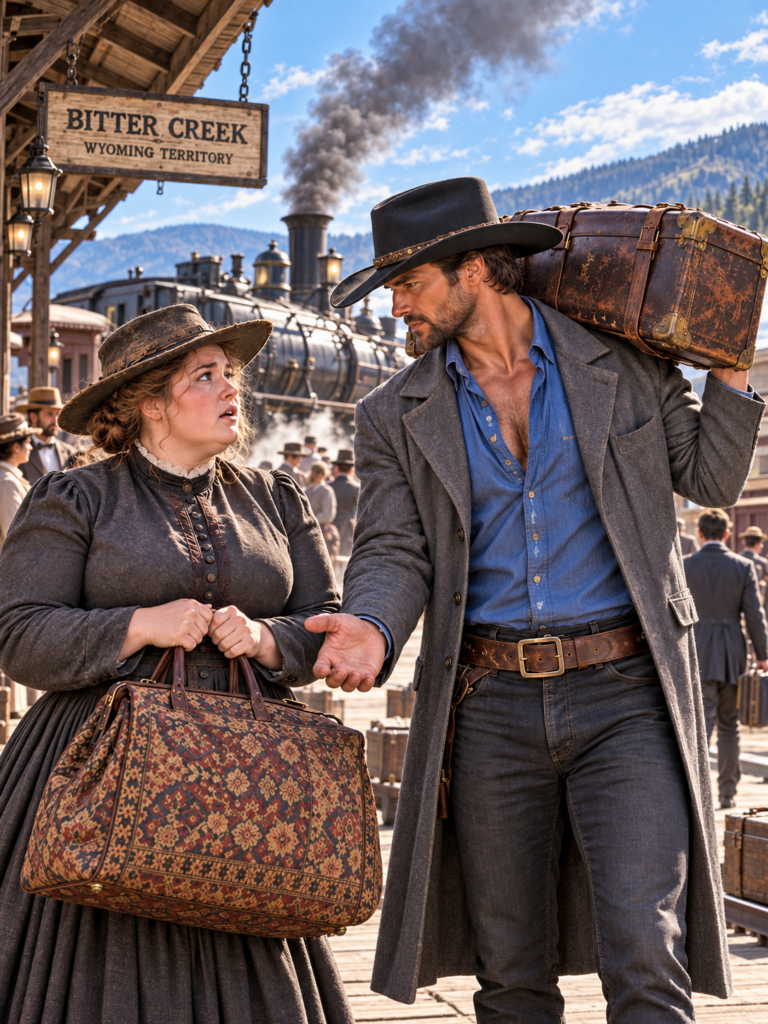
Dust choked the Wyoming station platform, but it was the sudden, vicious humiliation that truly stole Clementine’s breath.
The man she had traveled a thousand miles to marry took one look at her heavy, rounded figure and spat, “I ordered a bride, not a plow horse.”
Then a deep, gravelly voice broke through the cruel laughter of the bystanders.
“Good, because my twins need a mother exactly like you.”
The Union Pacific locomotive hissed out a final exhausted breath of steam, blanketing the platform of Bitter Creek in a thick haze of coal smoke.
Clementine Ford stepped down from the passenger car, her knees trembling beneath the heavy folds of her dark wool travel dress.
She was 28 years old, carrying an extra 70 pounds of weight that had made her a fixture of cruel neighborhood gossip back in Chicago, and entirely alone in the world.
She gripped her worn carpet bag, her knuckles white.
In her pocket rested a crinkled tintype photograph of a man with neatly parted hair and a rigid jaw.
Josiah Miller, a prosperous hardware merchant who had paid for her ticket west.
Their letters over the past six months had been practical, yet touched with a formal kindness.
She had been honest with him.
“I am not a small woman, Mr. Miller,” she had written by the flickering light of her boarding house candle. “I am sturdy, broad, and accustomed to heavy work.”
He had replied that the frontier required a strong constitution, and he eagerly awaited her arrival.
As the steam cleared, Clementine spotted him.
He matched the photograph, though his eyes were narrower, darting nervously over the disembarking passengers.
Clementine took a deep, steadying breath, smoothing her bodice.
She knew she was not the slender, fragile ideal of a dime novel heroine. She had a broad, soft face, thick arms, and a heavy waist.
But her clothes were impeccably tailored. She was a master seamstress, and her heart beat with a desperate, wild hope for a home of her own.
“Mr. Miller?” she asked, stepping into his line of sight.
Josiah’s gaze snapped to her.
He looked her up and down, from her sensible leather boots to the wide brim of her hat.
His face flushed a dark, angry crimson.
The polite merchant from the letters vanished in an instant.
“You’re Clementine?”
His voice cracked with a mixture of disbelief and sheer outrage.
He pulled her own tintype from his breast pocket, a tight crop of just her face, the only photograph she had been able to afford.
“This is a deceit, an outright lie.”
“I wrote to you, sir,” Clementine said, her voice remarkably steady despite the sudden freezing sensation in her chest. “I told you I was a stout woman. There is no deceit here.”
“Stout?”
Josiah laughed, a harsh, barking sound that drew the attention of the surrounding cowboys, merchants, and frontier wives.
“Stout is a polite word for a healthy farm girl. You, madam, are monstrous. You expect me to parade you down Main Street, to have my customers see me wed to a mountain of a woman?”
The platform went dead silent.
The wind whistled through the wooden eaves of the station.
A woman in a blue gingham dress pulled her young son a step back, as if Clementine’s size were something contagious.
Clementine felt the familiar, crushing weight of public shame bearing down on her shoulders.
It was the same shame that had driven her out of Chicago, the same snickers that echoed in the dressmaker shop when she tried to sew something beautiful for herself.
But the frontier was supposed to be different.
The frontier was supposed to value substance over a cinched waist.
“Mr. Miller,” she said, lowering her voice, fighting the tears that pricked the corners of her eyes. “I have exactly three dollars to my name. You promised me a marriage and a home. I held up my end of the bargain. I am a hard worker, an excellent cook, and a devoted companion.”
“I promised a home to the woman I imagined, not the one standing before me.”
Josiah sneered, taking a deliberate step backward.
“You can keep the trunk. Consider the train fare a loss on a bad investment, but I will not make a mockery of my life by taking you to the altar.”
He turned on his heel and marched toward the boardwalk, leaving her completely stranded in the harsh midday sun.
Clementine stood frozen.
The whispers of the crowd washed over her like cold water.
“Look at the size of her.”
“Josiah was right to leave her.”
“How did she even fit in the train seat?”
She closed her eyes, clutching the handle of her carpet bag until her palms ached.
She would not cry.
She absolutely refused to give them the satisfaction of her tears.
She calculated her meager options.
Three dollars could perhaps buy her a week at a cheap boarding house.
But then what?
She could wash clothes, sew, scrub floors. She had the physical strength for all of it.
She turned to collect her heavy travel trunk, bending down to grasp the thick leather handles.
But before her fingers could close around them, a large, calloused hand wearing a worn leather work glove reached down and took the handle instead.
Clementine looked up, her breath catching.
The man standing over her was tall, with shoulders broad enough to block out the harsh Wyoming sun.
He wore a dust-coated Stetson, a canvas coat faded by years of harsh weather, and a pair of scuffed leather boots.
His face was deeply tanned, etched with lines of grief and hard labor, and his jaw was covered in a rough, dark beard.
But it was his eyes that caught her off guard.
They were a striking, piercing gray, holding not a shred of pity, but rather a sharp, evaluating intensity.
“Josiah Miller is a prideful fool,” the stranger said, his voice a low, resonant rumble that seemed to vibrate through the wooden platform.
He effortlessly hoisted her heavy trunk onto his shoulder as if it weighed no more than a sack of feathers.
“And he wouldn’t know a good, strong foundation if it collapsed on him.”
Clementine straightened up, her heart hammering against her ribs.
She was a large woman, taller and heavier than most men in the territory.
But this man made her feel entirely proportionate.
“Excuse me, sir. I don’t believe I need your charity. I can carry my own trunk.”
“I don’t offer charity, miss,” the cowboy replied, stepping closer so the crowd couldn’t hear them. “I offer a proposition. My name is Caleb Wyatt. I run the Whispering Pines Ranch about 10 miles north of here. I’ve been standing against the station wall for the past hour trying to figure out how I’m going to keep my cattle fed and my children alive at the same time.”
He looked her dead in the eye, unapologetic and bold.
“Good, because my twins need a mother. Exactly like you.”
Clementine stared at him, sure that this was some cruel extension of Josiah’s joke.
“Like me?” she echoed, a defensive edge sharpening her tone. “A woman the whole town just mocked? A woman who is too heavy to be considered a proper bride?”
Caleb Wyatt didn’t flinch.
He didn’t offer a polite, patronizing denial of her size.
Instead, his gray eyes swept over her solid frame with absolute practical approval.
“I buried a fragile bride two years ago,” Caleb said quietly, the raw honesty in his voice stripping away Clementine’s defenses. “She was tiny, delicate. The winter winds out here terrified her. The isolation broke her mind, and the fever took her body. She left me with a boy and a girl, five years old, wild as coyotes and grieving a mother they barely remember.
“I don’t need a china doll, miss. I need a woman with roots deep enough to hold fast in a storm. I need a woman who can command a room, stand her ground, and not blow away when life gets brutal.”
He shifted the trunk on his shoulder.
“You didn’t cry when Miller humiliated you. You didn’t faint. You squared your shoulders and reached for your heavy baggage to carry it yourself. That’s the woman I want raising Samuel and Clara.”
Clementine’s mind raced.
The sheer pragmatism of the offer was jarring, yet profoundly comforting.
There were no false promises of sweeping romance, no lies about eternal passion.
He saw her exact reality—her size, her weight, her physical presence—and deemed it not just acceptable, but necessary.
“And what exactly does this proposition entail, Mr. Wyatt?” she asked, lifting her chin.
“A legal marriage,” Caleb said immediately. “My name, my protection, half of everything the Whispering Pines produces, and a roof over your head that no man can ever take from you. In exchange, you bring order to my house, raise my twins with a firm but kind hand, and stand as my partner in running the homestead.”
He paused, a flicker of vulnerability passing through his hardened features.
“I can’t promise you romance, Clementine, but I can promise you absolute respect. I will never speak to you the way that merchant just did. You will be the lady of my house in every sense of the word.”
Clementine looked past him toward the dusty streets of Bitter Creek.
She had no money, no family, and no reputation left to protect.
She looked back at the tall, weathered rancher, who saw her not as a burden, but as a lifeline.
“Where is the magistrate, Mr. Wyatt?” she asked.
A slow, genuine smile broke through the thick stubble of Caleb’s beard.
“Right across the street. Judge Parker owes me a favor.”
Within an hour, the ink was dry on a hastily drafted marriage certificate.
Clementine Ford was now Clementine Wyatt.
She sat rigid on the wooden bench of Caleb’s buckboard wagon, her wide hips pressing slightly against his thigh on the narrow seat.
Every time the wagon hit a rut in the dirt road, she braced herself, mortified by her own weight, apologizing under her breath.
“Stop that,” Caleb commanded gently, keeping his eyes on the road.
“Stop what?”
“Apologizing for taking up space,” he said, his voice gruff but kind. “This is a wide country, Clementine. There’s plenty of room for you in it, and there’s certainly enough room on this wagon.”
The 10-mile ride north dissolved the flat, dusty town into a breathtaking, rugged landscape of rolling green foothills, jagged granite peaks, and vast oceans of sagebrush.
When they finally crested the last hill, the Whispering Pines Ranch came into view.
It was a sprawling, beautiful piece of land nestled against a rushing river, but the homestead itself was in a state of chaotic neglect.
The porch railings were broken. Half-washed laundry blew wildly on a frayed line, and a broken window was boarded up with rough pine.
As Caleb pulled the team of horses to a halt, the front door banged open.
Two small, feral-looking children burst out onto the porch.
They were caked in mud, their dark hair a tangled mess of leaves and dirt, and they stared at Clementine with wide, mistrustful eyes.
But they were not alone.
Following closely behind them was a slender, sharp-featured woman in a pristine, high-collared dress.
She carried a riding crop in one hand, slapping it rhythmically against her skirt.
Her eyes locked onto Clementine, and her upper lip curled in profound, undisguised disgust.
“Caleb,” the woman snapped, her voice like cracking ice. “What in God’s name is this?”
Caleb secured the reins and let out a long, weary sigh.
“Clementine, allow me to introduce Martha, my late wife’s sister.”
Martha stalked down the porch steps, her gaze raking over Clementine’s large frame, lingering cruelly on her wide waist and thick arms.
“I told you I was going to town to file the custody papers tomorrow. Caleb, you cannot raise Samuel and Clara in this filth. And bringing home some massive, slow-witted circus attraction to play house is not going to convince the judge that you provide a suitable home.”
Martha sneered, turning to the twins.
“Look at her, children. She’s liable to crush you if she steps on you.”
The twins shrank back, their little faces pale with anxiety.
Clementine felt the old familiar sting, the instinct to shrink away, to hide her body, to apologize for her existence.
But then she felt the rough leather of the wagon seat beneath her hands.
She remembered Caleb’s words at the station.
I need a woman who can command a room.
She wasn’t a rejected mail-order bride anymore.
She was a wife.
She was a mother.
She was a legal partner to a sprawling Wyoming ranch.
Clementine stood up in the wagon.
Her physical presence was imposing, casting a long, heavy shadow over the dusty yard.
She didn’t look down at her boots.
She looked directly into Martha’s vicious eyes.
“My name is Clementine Wyatt,” she said, her voice carrying a deep, resonant authority that silenced the howling Wyoming wind. “I am the lady of this house now, and the first rule of my house is that nobody speaks to my children with a poisoned tongue. Now you can step out of my way, Martha, or I will gladly walk right through you.”
Caleb, still sitting in the driver’s seat, slowly leaned back, a quiet rumble of laughter shaking his chest.
For the first time in two years, the heavy, suffocating gloom over the Whispering Pines Ranch began to lift.
Martha stared at Clementine, her sharp, bird-like features twisting in shock.
She was accustomed to intimidating the fragile and the weak, using her late sister’s memory as a weapon to maintain control over Caleb and his property.
But standing before her was a woman who could not be bullied, pushed aside, or made to feel small.
Clementine’s broad, unyielding figure completely blocked the doorway of the homestead.
An absolute fortress of a woman standing between Martha and the terrified twins.
Without another word, Martha turned on her heel, her silk skirts whipping furiously in the wind, and marched toward her own buggy.
“You will regret this, Caleb,” she shrieked over her shoulder. “Judge William Carter in Fort Bridger is a close personal friend of mine. I will have a decree of unfitness drawn up by the end of the month, and I will take those children away from this squalor.”
As Martha’s buggy rattled out of the yard, the heavy, tense silence returned to the Whispering Pines.
Caleb stood by the wagon, his chest heaving slightly, staring at Clementine with a mixture of raw awe and profound relief.
Clementine did not wait for a thank you.
She turned her attention to the two filthy, trembling children huddled on the porch.
Slowly, she lowered her heavy frame down to the dusty wooden steps, ensuring she was at their eye level.
She did not reach out to grab them.
She simply sat, radiating a calm, solid warmth.
“I am Clementine,” she said, her voice dropping to a soft, melodic hum that felt entirely at odds with her imposing size. “And I know I am a stranger, but I also know how to make brown sugar biscuits that melt in your mouth, and I know how to patch a shirt so you can’t even see the seam. Would you two like to help me find the flour?”
Little Clara, her face streaked with dirt and old tears, took a hesitant step forward.
She reached out a tiny, grimy hand and pressed it against Clementine’s thick, soft arm.
Clara’s eyes widened.
For two years, the child had been surrounded by the sharp angles of a grieving father and the bony, pinching grip of her aunt Martha.
Clementine’s arm was soft, yielding, and incredibly warm.
“You’re soft,” Clara whispered, her voice barely audible over the rustling pines. “Like a feather bed.”
A sudden lump formed in Clementine’s throat.
All her life, her softness had been a curse.
It had been the punchline of cruel jokes in Chicago, the reason she was left standing on the Bitter Creek platform in shame.
But to this motherless child, it was a sanctuary.
“I am, sweetheart.” Clementine smiled, a stray tear escaping down her cheek. “I’m soft enough to hug and strong enough to keep the bad things away.”
Over the next month, the Whispering Pines underwent a miraculous transformation.
Clementine’s physical strength, long viewed as a masculine flaw by high-society dressmakers, became the very lifeblood of the ranch.
Her broad shoulders made quick work of hauling heavy loads of firewood and buckets of river water.
Her thick, capable hands scrubbed the soot-stained walls until the pine gleamed, patched the broken windows, and turned Caleb’s meager rations into rich, hearty stews that filled the homestead with the scent of rosemary and roasted beef.
She did not try to replace their mother, but she became their absolute anchor.
When thunder echoed off the granite peaks, terrified Samuel and Clara would rush to Clementine, burying their faces in her voluminous skirts, enveloped by her steady, rhythmic heartbeat and the vast, safe expanse of her lap.
And Caleb watched it all.
He watched the way the sunlight caught the golden strands of her hair as she hung laundry on the line, her thick arms lifting the heavy, wet wool with effortless grace.
He watched the way she laughed, a deep, full-bellied sound that chased the haunting silence from his home.
Slowly, the pragmatic contract they had forged at the train station began to burn away, replaced by a quiet, fierce, and consuming devotion.
He didn’t just respect Clementine.
He was falling deeply, irrevocably in love with her.
But the peace of the Whispering Pines was a fragile glass waiting to be shattered.
Ten miles away in Bitter Creek, Josiah Miller sat in the dark, smoky back room of his hardware store, nursing a glass of cheap whiskey.
Across the table sat Martha, her eyes gleaming with malice.
“Caleb has fortified the place,” Martha hissed, slamming her gloved hand on the table. “That monstrous woman has completely brainwashed the children. They won’t even look at me. And Judge Carter requires proof of neglect or financial ruin before he will sign over custody and grant me control of the ranch’s water rights.”
Josiah swirled his whiskey, his bruised ego still throbbing from the humiliation of seeing the woman he discarded scooped up by a respected rancher.
“Financial ruin, you say?”
Josiah smirked, a cruel idea taking root in his mind.
“Caleb Wyatt runs his cattle near the northern ridge. It’s isolated. If a few dozen head of his prime beef were to suddenly go missing, or worse, if a fire were to wipe out his winter feed barn, the bank would foreclose in a heartbeat. He wouldn’t have a dime to his name, and Judge Carter would have no choice but to hand the children to you.”
Martha’s smile was like a razor blade.
“Then I suggest you buy some matches, Mr. Miller.”
The harvest moon hung low and heavy over the Wyoming Territory, casting a pale, eerie glow across the frost-kissed sagebrush.
Clementine was up late, sitting by the hearth, her thick fingers deftly repairing a tear in Caleb’s heavy canvas winter coat.
Upstairs, the twins were fast asleep, tucked safely under the thick quilts she had sewn from scraps.
Caleb had ridden out to the northern ridge to check on a sick calf and wouldn’t be back until morning.
Suddenly, the frantic, panicked whinny of horses echoed from the yard, followed immediately by the harsh, unmistakable crackle of burning timber.
Clementine dropped the coat and rushed to the window.
Her heart slammed against her ribs.
The massive winter feed barn, the absolute lifeblood of the ranch’s survival for the coming snows, was engulfed in roaring orange flames.
She didn’t scream.
She didn’t freeze.
Panic was a luxury a frontier woman could not afford.
She bolted to the door, grabbing Caleb’s heavy shotgun from the mantle on her way out.
As she burst onto the porch, the intense heat of the fire hit her like a physical blow.
But it wasn’t just the fire that stopped her in her tracks.
Standing in the yard, holding a kerosene lantern and a rusted crowbar, was Josiah Miller.
He was out of breath, his face smeared with soot, attempting to pry open the main corral gate to scatter the frightened horses into the wild night.
“Josiah.”
Clementine’s voice boomed across the yard, carrying the sheer, terrifying force of a thunderclap.
Josiah jumped, dropping the crowbar.
He turned, his eyes widening as he saw Clementine striding off the porch.
In the fiery glow of the burning barn, she looked like an ancient, avenging goddess.
Her heavy frame was imposing, her broad shoulders squared, and the shotgun in her massive hands was leveled directly at his chest.
“You,” Josiah stammered, his false bravado crumbling instantly.
He reached for the revolver at his hip, but his hands were shaking violently.
“This ain’t your business, Clementine. Martha legally deserves this land. You’re just a mistake Caleb made to spite me.”
“You are a coward, Josiah Miller,” Clementine roared, stepping closer, the firelight dancing in her furious eyes. “You judge the worth of a woman by the size of her waist and the worth of a man by the depth of his pockets. But you don’t know the first thing about strength.”
Josiah panicked.
He drew his revolver, pointing it at her with trembling hands.
“Get back. I’ll shoot. I swear it.”
Clementine didn’t flinch.
She didn’t stop.
She marched directly toward the barrel of the gun.
“Shoot me, then,” she challenged, her voice cold as Wyoming ice. “But I promise you, Josiah, you’d better aim true. Because if I am still standing after you pull that trigger, I will break you in half with my bare hands.”
Josiah backed up, terrified by the absolute lack of fear in her eyes.
He tripped over the rusted crowbar, stumbling backward into the mud.
Before he could scramble away, the thunderous sound of galloping hooves shook the ground.
Caleb charged into the yard on his black gelding.
Having seen the smoke from the ridge, he leapt from the saddle while the horse was still moving, tackling Josiah into the dirt and wrenching the revolver from his grip with a sickening crack of bone.
Josiah screamed in pain, completely subdued.
Caleb dragged Josiah to his feet by the collar, throwing him roughly against the fence.
“Sheriff Dalton has been looking for cattle rustlers. Looks like he just found his arsonist, too.”
Caleb tied Josiah to the fence post with absolute, ruthless efficiency.
Then he turned to the barn.
The roof was collapsing, but the horses were safely secured in the far corral.
He turned back, his chest heaving, his face black with soot, and looked at Clementine.
She stood in the mud, the shotgun resting easily on her heavy hip, her hair blowing wildly in the fierce wind.
She was breathing hard, her broad chest rising and falling, a magnificent, unmovable force of nature.
Caleb walked slowly toward her, ignoring the dying flames of the barn, ignoring the whimpering merchant tied to his fence.
He stopped just inches away from her, his gray eyes shining with an emotion so deep it threatened to break him.
He reached out, his calloused hands gently cupping her soft, wide face.
“When I met you at the station that day, I told you I needed a woman who wouldn’t blow away when life got brutal,” Caleb whispered, his voice thick with emotion. “I asked you to be a foundation for my children. I asked you for your strength.”
He leaned his forehead against hers, his breath mingling with hers in the cold night air.
“I was a fool. I didn’t just need your strength, Clementine. I needed you. I love your courage. I love your massive, beautiful heart. I love every single inch of you exactly as you are. You are the only true bride of the Whispering Pines.”
Clementine let the shotgun slip to the dirt.
She threw her thick, strong arms around Caleb’s neck, pulling him against her.
For the first time in her life, she didn’t try to make herself smaller.
She didn’t apologize for taking up space.
She held him with all of her weight, all of her love, and all of her fierce, magnificent presence.
Martha was arrested the next morning in Bitter Creek as a conspirator to arson.
Judge William Carter, far from supporting her, publicly condemned her actions and granted Caleb and Clementine permanent, unassailable custody of the twins, declaring the Wyatt homestead a model of frontier resilience.
Clementine never became small.
She remained a grand, imposing figure in the Wyoming Territory.
A woman whose heavy footsteps commanded absolute respect, whose wide lap was a permanent refuge for her children, and whose strong, sturdy heart proved that true beauty is built to withstand the storm.


