
Part 1
“Sell the land.”
Brent Kesler said it as if he were recommending a new set of tires.
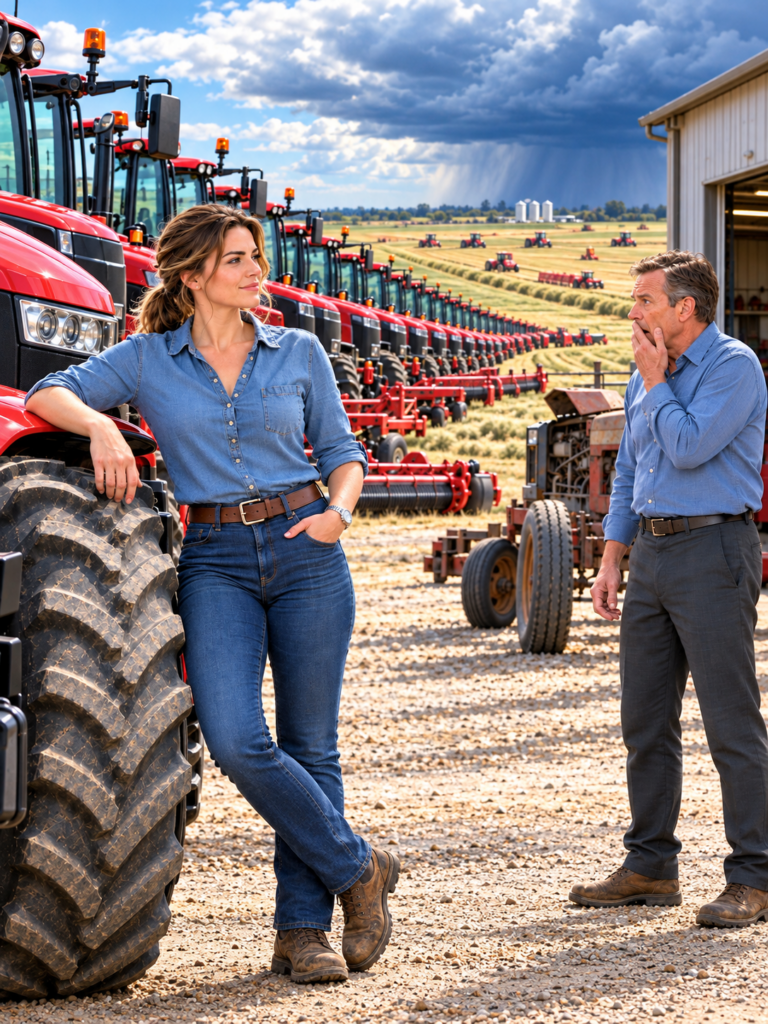
Lenora Vance stood across the counter from him at Kesler Farm Equipment, one hand resting on the edge of the scuffed laminate, the other curled around the inspection receipt she had carried in with her. Through the office window, she could see her tractor sitting in the same patch of gravel where it had been unloaded six days earlier.
Six days.
Not in a service bay.
Not torn down for diagnosis.
Not waiting on a part.
Just sitting there beneath a Kansas sun that had bleached the dust pale around its tires.
“I already paid you to inspect it,” she said. “I need to know what’s wrong with it.”
Brent leaned back.
“Oh, we know what’s wrong.”
For half a second, Lenora thought the conversation might finally become useful.
Then Brent smiled.
“The question is whether you can afford to fix it.”
Behind him, the air conditioner rattled hard enough to vibrate the blinds. Somewhere beyond the wall, an impact wrench barked twice and stopped.
Lenora did not move.
Brent slid a folder across the counter.
“The way I see it, you’ve got one option worth taking. Trade in the old fleet, sign onto a new equipment package, and we move forward together.”
She looked at the folder without opening it.
“That isn’t why I brought the tractor here.”
“Then you brought it here for nothing.”
He nodded toward the yard.
“I’m not tying up one of my technicians on a machine that belongs in a salvage yard.”
The office went quiet.
Lenora had grown up around men who confused certainty with authority. She knew the sound of it. She also knew there was little point arguing with someone who had already decided that his version of the situation mattered more than the facts.
What Brent did not know was that Lenora had spent the spring arranging a $330,000 equipment financing line through an agricultural lender.
She had not touched a dollar of it.
The plan had been to finish the season first, see which machines survived it, and replace equipment afterward without a harvest clock running over her shoulder.
That plan had made sense six days ago.
Now two thousand acres of grass were moving toward peak condition, and the forecast showed nine workable days before a multi-day rain system rolled across the county.
Lenora pushed the folder back.
“I want my tractor.”
Brent gave a small shrug.
“You move it somewhere else, you’re paying transport.”
“Fine.”
“And that package price expires.”
“I heard you.”
She turned toward the door.
Lenora Vance had been running farm equipment since she was twelve. Not because anybody thought a twelve-year-old girl belonged on a tractor, but because on the Vance place there had always been more work than money.
Her father, Dale, believed machinery had no respect for convenience.
Neither did weather.
Neither did debt.
When something broke, you fixed it. When hay was ready, you cut it. When rain was coming, you worked until the last field disappeared behind you in the dark.
Three years earlier, Dale Vance had died and left Lenora the responsibility he had spent his life refusing to call a burden.
Four hundred sixty acres of family ground.
And Vance Fieldworks.
The harvesting business had started small, taking on work for neighbors who owned land but lacked enough equipment to cut and bale it efficiently. By that summer, Lenora was responsible for roughly two thousand acres across Brier Junction and the surrounding Kansas county.
Four hundred sixty belonged to the Vance family.
Another 1,540 acres belonged to neighboring landowners who contracted Vance Fieldworks to cut, ted, rake, and bale their grass.
The hay flowed toward one major customer: Crosswind Feed Supply.
Crosswind’s checks covered payroll, fuel, repairs, loan payments, warehouse costs, and all the other expenses that turned a field of grass into a business.
And the entire operation ran on machinery that had already lived hard lives.
Lenora knew the tractors the way some people knew relatives. She knew which one needed a longer warm-up on cool mornings. Which hydraulic lever stuck when dust worked beneath the boot. Which transmission complained before it failed. Which machine could run another week if treated gently and which one was only pretending.
Her primary tractor had stopped pretending on a Tuesday morning.
The hydraulic system failed forty-eight hours before the first cutting was expected to hit ideal condition.
She had loaded it onto a flatbed and taken it to Kesler Farm Equipment because Kesler was the only full-service dealer within a practical distance.
Colin Ree had met her in the yard.
Colin was one of those mechanics who wasted very few words because he trusted measurements more than conversation. He walked around the machine with a clipboard, asked what Lenora had heard and felt before the failure, checked the hydraulic connections, and wrote everything down.
“Thirty-six hours,” he had told her. “I should have a diagnosis.”
Thirty-six hours became two days.
Then three.
Every time Lenora called, Brent supplied a different explanation.
They were backed up.
The crew had not gotten to it.
There was uncertainty about a part number.
He could not promise a repair timeline.
By day six, Lenora stopped calling.
She drove to the dealership.
Her tractor had not moved.
Colin was standing near the service yard when she arrived, and his face changed as soon as he saw her.
She walked straight to him.
“What did you find?”
“The fault’s identified. There’s a replacement assembly that—”
The side door opened.
Brent stepped out.
“Colin.”
The mechanic stopped.
It was not what Brent said that caught Lenora’s attention.
It was what Colin did.
He went completely still.
Then Brent took over the conversation, guiding Lenora inside and presenting his equipment package as though the repair had never been an option at all.
The trade values in the proposal were low.
The attached financing was substantial.
Brent described it as the only sensible path if Lenora wanted to keep operating.
She left without signing.
By the time she reached the farm, another offer was waiting.
Stonebridge Acre Partners wanted to buy the Vance family land.
The company had been circling the property for two seasons. Its representatives had written before. They had called. They had made clear that if the Vances ever wanted out, Stonebridge was ready to move quickly.
Lenora had always said no.
What bothered her now was the timing.
She could not prove that the offer arriving the same day Brent had told her to sell was anything more than coincidence.
So she did not call it anything else.
But she noticed.
That evening, she showed the offer to her younger brother, Russell.
Russell managed warehouse operations and logistics for Vance Fieldworks. He had inherited Dale’s tolerance for long hours but not his faith that hard work eventually defeated arithmetic.
He read Stonebridge’s offer twice.
Then he set it down.
“Dad always thought he was one good season away.”
Lenora looked across the kitchen table.
“Away from what?”
“You know.”
She did.
Ahead.
Clear.
Safe.
Whatever word a farmer used for the point where next month’s expenses were no longer being paid with next season’s hope.
Dale had spent years believing the next crop, the next contract, the next weather break might finally give the operation room to breathe.
Russell had watched him work himself down to nothing waiting for that season.
“I don’t want to watch this place do the same thing to you,” he said.
He was not telling her to sell.
That made it harder.
If he had demanded she accept Stonebridge’s offer, Lenora could have argued with him.
Instead, Russell was telling her what he feared.
She understood the fear.
She simply could not agree with the conclusion.
The forecast gave her nine days.
Nine days to restore enough capacity to cut and bale what could be cut.
Nine days to get enough product to Crosswind to protect the contract.
Nine days before rain took the decision away from her.
That night she called Ardan Pike.
Prairie Lantern Machinery sat sixty-seven miles south of Brier Junction. It was smaller than Kesler’s dealership and less polished. Ardan dealt in machinery other people often overlooked—trade-ins, clean repossessions, equipment from farms changing operations, older machines with plenty of useful hours left.
Lenora explained what had happened.
Ardan did not tell her everything would be fine.
That was one reason she trusted him.
Instead he asked, “Do you need one tractor back, or do you need a harvest operation that can finish what you started?”
Lenora sat quietly at the kitchen table.
Through the window, she could see the dark outline of the equipment shed.
“I need to finish the season.”
“All right.”
A pause.
“I’ll start calling in the morning.”
After they hung up, Lenora took out a legal pad.
She drew five boxes.
Then she pulled the season calendar toward her.
For years, Vance Fieldworks had operated around a bottleneck so familiar that nobody had bothered naming it. The tractors were constantly changing jobs. A machine might cut one field in the morning, return to the yard to change implements, rake somewhere else that afternoon, then pull a baler the next day.
The equipment worked.
The transitions did not.
Every implement change cost time.
Every move across the county cost time.
Every crew waiting for a tractor cost time.
And during peak dry weather, time had value.
Lenora began calculating acreage and crew hours.
She stopped thinking about replacing one broken tractor.
That would restore the old system.
The old system was precisely what had left one mechanical failure capable of paralyzing the harvest.
What if she removed the bottleneck instead?
Five crews.
Five zones.
Three tractors per crew.
One tractor committed to cutting.
One to tedding and raking.
One to baling.
No waiting for a machine to finish in another field.
No switching equipment back and forth all day.
Fifteen tractors.
Lenora checked the arithmetic again.
Same answer.
Vance Fieldworks had four tractors she considered reliable enough to place into continuous service.
She needed eleven more.
At six the next morning, she called Ardan.
“I need eleven.”
Silence.
“Eleven tractors?”
“Eleven working tractors.”
“That’s different from one.”
“It is.”
“How much time?”
“Not enough.”
Ardan exhaled.
“All right.”
For two days, he worked the phones.
He called farms that were replacing equipment but had not advertised the outgoing machines. He checked repossession inventories. He contacted other dealers. One dealer two states away had three Massey Ferguson tractors sitting in a back lot since the previous fall.
None of the machines were new.
That was not Lenora’s requirement.
Her requirement was simple.
They had to run.
Before she committed, she brought Colin Ree in to inspect them.
He came after hours.
Lenora did not ask what arrangement he had made with Kesler or whether Brent knew.
Colin crawled beneath tractors with a flashlight, checked hydraulic lines, examined fluid, listened to engines at idle and under load, and wrote down everything he saw.
Only after the final inspection did Lenora ask him the question she had been carrying since the dealership yard.
“My tractor. You knew what was wrong with it, didn’t you?”
Colin wiped his hands on a shop towel.
“Yes.”
“How early?”
He looked at her.
“First day.”
That was all he said.
It was enough.
The equipment transaction totaled $615,000.
Two hundred ten thousand dollars came from trading older machines that still had residual value.
Seventy-five thousand came from company reserves.
The final $330,000 came from the financing line Lenora had arranged in the spring.
When the deal closed, Vance Fieldworks had about $28,000 left in operating reserves.
Lenora stared at the figure on the screen.
Twenty-eight thousand dollars sounded like a lot of money until it had to fuel fifteen tractors, cover payroll, absorb repairs, move hay, and keep a harvesting business alive through the most important days of the season.
There was almost no room left for anything to go wrong.
Four days before the weather window was expected to close, five Vance Fieldworks crews rolled out at once.
Lenora stood beside her truck and watched the machines split toward different roads.
For the first time in the history of the business, five harvest zones were active simultaneously.
Fields that had always waited on one another no longer had to wait.
The first two days were rough.
Drivers arrived at the wrong gates.
A rake needed adjustment.
One property took longer than projected.
Russell spent hours rerouting transport.
Lenora bounced from crew to crew, solving problems as quickly as they appeared.
By the third morning, something changed.
The system began to work.
Cutters moved ahead.
Tedders and rakes followed.
Balers came behind them.
Loads started reaching the warehouse on schedule.
For the first time since the hydraulic failure, Lenora allowed herself to think they might actually outrun the weather.
Then her phone rang.
It was Joseline Mercer from Crosswind Feed Supply.
And before Joseline finished her first sentence, Lenora knew the problem had changed again.
Part 2
“Several of the moisture readings are uneven,” Joseline said.
Lenora stood between two stacks of baled hay inside the Vance warehouse, phone pressed against one ear while a forklift reversed somewhere behind her.
“How uneven?”
“Some are within tolerance. Some are over.”
Lenora closed her eyes.
Crosswind was pausing acceptance of the next shipment until it completed a quality review.
Joseline was not threatening her. That almost made the conversation worse.
Crosswind had taken a quality hit from another supplier the previous season. Its buyers were watching moisture specifications more closely now, and Joseline could not accept hay that she could not defend downstream.
If the loads failed specification, Crosswind would reduce the price per ton.
Lenora thanked her for calling and ended the conversation.
Then she stood still while the warehouse continued moving around her.
For days, every decision had been about speed.
How many acres before dark?
How quickly could the crews turn a field?
How many loads could Russell move?
How many hours remained before rain?
Now the obvious truth finally forced its way through the schedule.
Speed meant nothing if the hay did not meet contract quality.
A warehouse full of wet hay was not success.
It was inventory she could not sell at the expected price, attached to revenue she had already planned to spend.
Lenora drove straight to the fields.
Two zones had grass that had not dried long enough.
She shut them down.
One crew leader stared at her.
“We lose most of a day if we wait.”
“I know.”
“The forecast moved up.”
“I know that too.”
He glanced toward the windrow.
“So we leave it?”
“Until it’s ready.”
Lenora changed the inspection process that afternoon. Instead of relying on one moisture reading per load, crews sampled multiple points field by field.
The additional checks slowed them down.
Almost a full day disappeared from the schedule.
But the hay coming behind those checks was better.
It was the right decision.
And right decisions did not guarantee easy consequences.
During a night shift, one of the newly purchased tractors developed a hydraulic leak.
A driver called Lenora under field lights, voice tight with worry.
Ardan had a technician moving within minutes.
The technician arrived in under three hours.
The tractor returned to work.
But the affected crew lost most of a morning.
Then the forecast changed.
The rain was coming eighteen hours earlier.
By afternoon, landowners had begun calling.
They were watching the same sky and the same weather reports Lenora was.
One wanted to know if her crew would still reach his field Thursday.
Another had heard the rain might arrive overnight.
A third wanted assurances she could not honestly give.
Then the rumors started.
Someone in Brier Junction was saying Lenora had bought a fleet of repossessed machinery because she could not qualify for ordinary financing.
It was not true.
The business had used a financing line approved months earlier.
But small-town rumors did not require complete facts. They required only enough detail to sound possible.
A farmer named Gerald Hoffstead called about his 120 acres.
“I’m thinking maybe I ought to find somebody else before the weather shuts this down.”
Lenora looked at the field schedule pinned to the wall of the operations office.
“You can do that, Gerald.”
There was a pause.
“That all you’ve got to say?”
“No. I’m saying I understand why you’re calling. But I won’t tell you I can be somewhere at a time I can’t guarantee.”
“Well, everybody’s hearing things.”
“I know.”
“About the equipment.”
“I know about that too.”
“So?”
“The financing was approved in spring. The machines were bought because I needed capacity.”
Gerald said nothing.
Lenora continued.
“I’ll call you when I have a schedule I can stand behind.”
That evening, Colin drove out to the field where Lenora was coordinating crews.
He parked beside her truck and walked over carrying a folded piece of paper.
“I made you a copy.”
She unfolded it.
Kesler Farm Equipment.
Inspection report.
Her tractor.
The date it had arrived.
The hydraulic fault was documented clearly.
Below it was the viable repair pathway using a replacement assembly.
Lenora read the page once.
Then again.
Everything Brent had described as uncertain had been identified on the first day.
The machine had not spent six days waiting for a diagnosis.
The diagnosis had existed.
The delay had come after it.
“Is this your report?” she asked.
“Yes.”
“And this was filed the day I brought it in?”
“Yes.”
“Why give it to me?”
Colin looked past her toward a tractor moving across the field.
“My name’s on it.”
Nothing more.
Lenora folded the copy and put it into the inside pocket of her vest.
For the first time, she had documentation that transformed suspicion into something measurable.
Dates.
Findings.
A repair procedure.
A record.
She could challenge Kesler.
Maybe she should have done it immediately.
But behind her, grass was still standing.
The rain was less than a week away.
Fighting Brent now would not cut one acre.
So Lenora left the report in her pocket and went back to work.
The next morning brought another problem.
Crosswind held payment on the first delivery pending its quality review.
Then Vance Fieldworks’ fuel supplier called.
The account needed to be settled before another delivery could be released.
Lenora stared at the fuel figure on her spreadsheet.
Fifteen tractors.
Five crews.
Thousands of acres.
All of it reduced to something brutally simple.
No fuel, no harvest.
The $28,000 cushion left after the equipment purchase had been eaten down by operating costs faster than Lenora wanted to admit.
By the end of the week, reserves were near zero.
Russell called that night.
“I’ve gone through it three times.”
Lenora sat in the darkened office. Most of the warehouse lights were off behind her.
“And?”
“We don’t have enough to carry fuel and payroll through the rest of this window unless Crosswind releases money.”
“They haven’t.”
“I know.”
She heard papers moving on Russell’s end.
“There is one option.”
Lenora knew before he said it.
“No.”
“You don’t even know what I was going to say.”
“Stonebridge.”
Silence.
“They’d put down a deposit.”
“I’m not selling the farm.”
“I’m telling you what the spreadsheet says.”
“And I’m telling you what I’m not doing.”
Russell’s voice remained calm.
“That deposit would bridge the operation.”
“And then what?”
“We finish the harvest.”
“And lose the land.”
“We keep the business alive.”
Lenora stood.
“No. We keep a business called Vance Fieldworks alive after selling the Vance ground to do it. Those aren’t the same thing.”
Russell did not answer immediately.
When he spoke again, his voice had lost its edge.
“I don’t see another exit, Lenora.”
Neither did she.
That was the problem.
She walked outside.
Fifteen tractors sat in the equipment yard.
Machines she had just financed.
Machines designed to solve the problem that had threatened the harvest.
And now they could all become useless for lack of diesel.
Lenora climbed onto the open tailgate of her truck.
She brought the season calendar.
The delivery log.
The field map.
The latest weather forecast.
The spreadsheet.
For days, she had been trying to preserve the original schedule.
Every acre.
Every customer.
Every commitment.
In order.
No exceptions.
That plan had been created before the payment hold.
Before the hydraulic leak.
Before the moisture problem.
Before the weather moved up.
Trying to force an old plan onto new facts was not discipline.
It was denial.
So Lenora stopped asking how to save everything.
She started asking what could still be saved.
Field by field, she calculated equipment hours, drying time, distance, crew capacity, and contract priority.
Some fields were impossible before the storm.
Wanting them to be possible did not change that.
She set them aside.
Others could be completed.
She circled those.
When she finished, the marked fields were enough to protect the core of the Crosswind contract and satisfy the highest-priority landowner obligations.
The rest would wait until the weather passed.
There would be lost yield.
There would be unhappy customers.
There would be money left in the field.
But the plan was physically possible.
That mattered more than a perfect schedule that existed only on paper.
Then Lenora addressed Crosswind.
Instead of arguing that the hay should pass, she hired an independent quality inspector.
The inspector went through inventory already in the warehouse, checking bales and organizing moisture results by load and sampling point.
Lenora waited for the report knowing the result might hurt her.
The next morning it arrived.
Most of the inventory met Crosswind’s contract specification.
A smaller portion exceeded the moisture threshold.
Those bales would need to be discounted.
Lenora could have stared at the failed portion.
Instead she looked at what the report gave her.
Separation.
Good product and compromised product were no longer mixed together under one unanswered question.
She put the report in her truck and drove to Crosswind.
Joseline Mercer met her in an office with stacks of purchasing documents along one wall.
Lenora laid the independent inspection report on the table.
“I’m not asking you to ignore your readings.”
Joseline opened the report.
Lenora pointed to the first section.
“This inventory cleared.”
Then the next.
“This portion didn’t.”
Joseline read silently.
“I’ll take a reduction on the product that’s over specification,” Lenora said. “But I want payment released on the inventory that independently cleared at the contract rate.”
Joseline looked up.
“You had somebody go through all of it?”
“Load by load.”
“And these are the sampling points?”
“Yes.”
Lenora sat back.
She did not tell Joseline how desperately Vance Fieldworks needed the money.
She did not need to.
The question was whether Crosswind had enough documentation to pay for good inventory without accepting bad product.
That was a business question.
And Lenora had brought a business answer.
Joseline spent years dealing with suppliers.
She knew the difference between somebody trying to explain away a problem and somebody putting evidence on the table.
“This I can work with,” she said.
By the end of the day, Crosswind released payment on the inventory that had passed inspection.
Lenora sent the fuel supplier what was owed.
Fuel deliveries resumed.
The next morning, the five crews returned to the fields.
Then Lenora called the landowners whose schedules had changed.
She did not hide behind Russell.
She did not blame the weather as if the forecast had made every decision for her.
She told each customer what Vance Fieldworks could accomplish before the rain and what would be delayed.
Where the business failed to meet the original service timeline, she offered a reduction in the service fee.
Gerald Hoffstead took the longest conversation.
“So you’re telling me you’re not getting all 120 before the rain.”
“I’m telling you I can get the portion on the revised schedule. What’s left will be finished once conditions allow.”
“What if I find somebody who says they’ll do the whole thing?”
“Then you need to decide whether you believe them.”
Gerald went quiet.
Lenora continued.
“I’ll send the schedule in writing. I’ll also put the fee adjustment in writing.”
“You really think you can hold to it?”
“Yes.”
That answer was different from a promise that everything would be perfect.
It was a promise attached to numbers she had already checked.
Gerald stayed.
So did most of the others.
Russell stopped talking about Stonebridge.
Instead, he started moving deeper into the harvest.
He coordinated trucks.
Updated load manifests.
Tracked warehouse space.
Checked bay temperatures.
At eleven at night, drivers called him instead of Lenora when they needed route changes.
Something shifted between them.
Russell had spent years looking at the farm from the position of someone afraid it would eventually consume his sister the way he believed it had consumed their father.
Now he was inside the decisions.
He could see Lenora was not simply grinding herself down in the hope that effort would make the numbers work.
She was changing the plan when the numbers said it had to change.
The final four days before the storm became a controlled sprint.
Five crews worked the circled fields.
Cutters moved first.
Tedders and rakes followed.
Balers rolled behind them.
Loads came off ground that had already been cut.
Moisture readings were checked repeatedly.
Nobody pretended the system was elegant.
It only had to work.
When the first wall of weather appeared in the west, Lenora was standing beside a field that had already been cleared.
There were still acres left standing elsewhere.
She knew exactly how many.
Those acres would lose yield.
They would cost her revenue.
But she had made that decision before the rain arrived instead of allowing the rain to make it for her.
The crews pulled in.
The storm crossed Brier Junction.
And for the first time in more than a week, the machines went quiet.
Part 3
The rain did not destroy Vance Fieldworks.
It did not save it either.
It simply passed.
When the ground and grass were ready again, Lenora sent the crews back out.
They finished what had been left standing.
The delayed acreage produced less than it would have under ideal conditions, and the margins reflected it. There was no miracle recovery hidden in the second half of the harvest.
There was only work.
By the time the final load rolled into the Crosswind warehouse, all two thousand acres had been harvested.
Not according to the original schedule.
Not at the original profit.
But harvested.
Documented.
Delivered.
Paid.
Once the books were settled, Lenora saw exactly what survival had cost.
Profit for the year was thin.
The equipment debt would follow Vance Fieldworks for years.
Most of the $28,000 operating reserve that remained after the fleet transaction was gone.
Some hay had been discounted.
Some acreage had produced less after the storm.
Some service fees had been reduced because Lenora had missed original schedules.
Nothing about the result looked like a clean victory on a spreadsheet.
But the business still existed.
The landowner relationships remained intact.
Crosswind still had Vance Fieldworks as a supplier.
And not one acre of Vance family ground had been sold to Stonebridge.
Only after the harvest equipment had been serviced and prepared for storage did Lenora return to the folded photocopy Colin had given her.
She laid it on her desk.
Kesler Farm Equipment.
Her tractor.
Day one.
Hydraulic fault identified.
Repair pathway documented.
She pulled her phone records and reconstructed the days that followed.
The calls.
The delays.
The shifting explanations.
She added the inspection fee.
The proposal Brent had placed in front of her.
She did not write that Brent had conspired with Stonebridge.
She had no evidence of it.
The timing of Stonebridge’s offer still bothered her, but being suspicious was not the same as knowing.
Lenora had spent the season learning the value of separating what she feared from what she could document.
She was not going to forget the lesson simply because Brent Kesler had given her a reason to be angry.
So her complaint contained only what she could prove.
The tractor arrived.
Colin inspected it.
A viable repair was recorded.
The machine sat untouched.
Brent told her the repair situation was uncertain and pushed her toward a higher-cost equipment package.
Those were facts.
Lenora submitted the documentation to the dealer network’s regional oversight office.
She did not call the newspaper.
She did not start telling people around Brier Junction that she was about to ruin Brent Kesler.
She filed the complaint and went back to work.
The review took six weeks.
When the finding arrived, Lenora read it alone.
The regional review concluded that Kesler Farm Equipment had declined to proceed with a documented viable repair while attempting to pressure the customer toward a higher-margin equipment transaction.
Lenora set the letter down.
For a long time, she felt less satisfaction than she expected.
The finding did not return the lost six days.
It did not refund the hours she spent wondering whether the harvest would collapse.
It did not erase the equipment debt.
It did not put hay back onto acres caught by the storm.
But it did something she valued more than revenge.
It created a record.
Brent was required to refund inspection fees that had been collected without corresponding work being performed.
His service operation was placed under formal audit.
Only after the review became final did Lenora make her experience public.
She did not decorate it with accusations.
She did not claim Brent had wanted her farm.
She did not claim Stonebridge had worked with him.
She posted the documents.
Dates.
Reports.
Findings.
Then she let people decide what those documents meant.
In Brier Junction, people read them.
And they remembered.
Over the following months, Prairie Lantern Machinery picked up several accounts in the county.
Kesler lost them.
Ardan never celebrated that fact around Lenora.
The first time she mentioned the shift in business, he only said, “People like knowing whether you’re going to fix the machine they brought you.”
Then he returned to an invoice sitting on his desk.
The original tractor was eventually repaired.
The same tractor Brent had dismissed as unworthy of a technician’s time returned to Vance Fieldworks.
Lenora did not put it back at the center of the operation.
That would have missed the entire lesson.
She designated it as a backup.
A useful machine.
A proven machine.
But no longer a single point of failure.
If it went down, harvest continued.
The changes reached beyond equipment.
Lenora began setting aside a fixed percentage of every season’s profit into a dedicated emergency fund.
Not expansion money.
Not money for new acreage.
Not money to improve the office or make the fleet look better.
Repair and fuel money.
Money designed to do one thing: keep the operation moving when a machine failed or cash flow tightened at the worst possible time.
She also made sure Vance Fieldworks maintained access to a second service provider.
Never again would one dealer have the power to decide whether a broken tractor became a repair, a sales opportunity, or a harvest-ending delay.
The farm did not become easy after that season.
Machines still broke.
Forecasts still changed.
Customers still called wanting answers before Lenora had them.
Debt still had to be paid.
The land still demanded work before anybody knew exactly what the season would return.
But the structure underneath the business was different.
Three seasons later, Lenora stood in the equipment yard before the first crews went out.
Morning light reached across a line of tractors waiting beside the sheds.
Russell walked toward her carrying a crew schedule.
Lenora held out a set of keys.
He looked at them.
“The old one?”
“The old one.”
Russell took the keys without ceremony.
The tractor Brent Kesler had once left sitting untouched for six days was now the backup machine assigned to Russell’s side of the operation.
He glanced down at the schedule.
“You planning to add acreage this year?”
There had been a time when Lenora would have answered the question by looking toward the fields.
More ground meant more work.
More work meant more revenue.
And more revenue had always looked like progress.
Now she looked at the cost sheet.
“Only if we can handle it.”
Russell waited.
“And only if we have reserves.”
He nodded.
No argument.
No speech about Dale.
No Stonebridge offer sitting between them on the kitchen table.
He went back to the schedule.
Outside, fifteen tractors stood fueled and ready.
They were not symbols of some effortless triumph.
Lenora still owed money on them.
They still required maintenance.
Some were old enough to have habits of their own.
But they represented something the operation had not possessed before that difficult season.
Options.
If one tractor stopped, fourteen others existed.
If a repair shop said no, another service provider was on call.
If weather changed, crews could be reassigned.
If cash flow tightened, emergency reserves existed for fuel and repairs.
If a schedule became impossible, Lenora no longer treated changing it as failure.
The lesson had been expensive.
That did not make it less valuable.
She thought sometimes about the afternoon Brent Kesler told her to sell.
Maybe he had expected fear.
Maybe he believed a broken tractor, a shrinking weather window, and an exhausted farmer would make his equipment package look less like pressure and more like rescue.
What he could not have known was that Lenora had already spent most of her life learning that farms rarely offered rescue.
Her father had taught her that.
The weather had taught her again.
So had Crosswind.
So had the fuel account.
So had the numbers she had faced on the tailgate of her truck when fifteen tractors sat waiting and none could work without diesel.
Lenora had not survived that season because every gamble succeeded.
Some did not.
She lost time.
She lost margin.
She accepted reduced prices.
She accepted delayed acreage.
She took on debt that would remain for years.
She stopped trying to make the harvest look like the plan she had written before everything went wrong.
That was the part Brent had misjudged.
He had assumed pressure would leave Lenora with fewer choices until she eventually accepted his.
Instead, pressure forced her to determine which choices were actually hers.
She chose not to sign his package.
She chose not to sell the land.
She chose to rebuild harvest capacity around five crews instead of one bottleneck.
She chose to slow the operation when Crosswind’s moisture readings showed that speed was damaging quality.
She chose documentation over argument.
She chose to admit which fields could not be finished before the storm.
She chose to pay for those decisions rather than pretend they carried no cost.
And when the season was finally over, she chose facts over rumor when she challenged the dealer who had stalled her repair.
That was why, three seasons later, nobody at Vance Fieldworks talked much about revenge.
Revenge had never fueled a tractor.
It had never cleared a field.
It had never made wet hay dry or an overdue fuel account disappear.
What saved the operation was harder and less dramatic than that.
Capacity.
Reserves.
Records.
People who did what they said they would do.
And the willingness to change course before pride turned a bad situation into a fatal one.
Lenora watched Russell climb into the repaired tractor.
The engine turned over.
It settled into a steady idle.
Once, that sound had represented nearly everything Vance Fieldworks depended on.
Now it was only one engine among many.
Russell raised a hand through the cab window.
Lenora returned the gesture.
Then the first crews began rolling out of the yard.
One tractor after another turned toward the road, carrying cutters, rakes, tedders, and balers toward fields beginning another season on their own schedule.
Lenora checked the cost sheet one final time and folded it beneath the clipboard.
Beyond the road, the Kansas grass moved beneath the morning wind.
It would be ready when it was ready.
Weather would come when it came.
Something would eventually break.
That had never changed.
What had changed was the farm waiting for it.


