
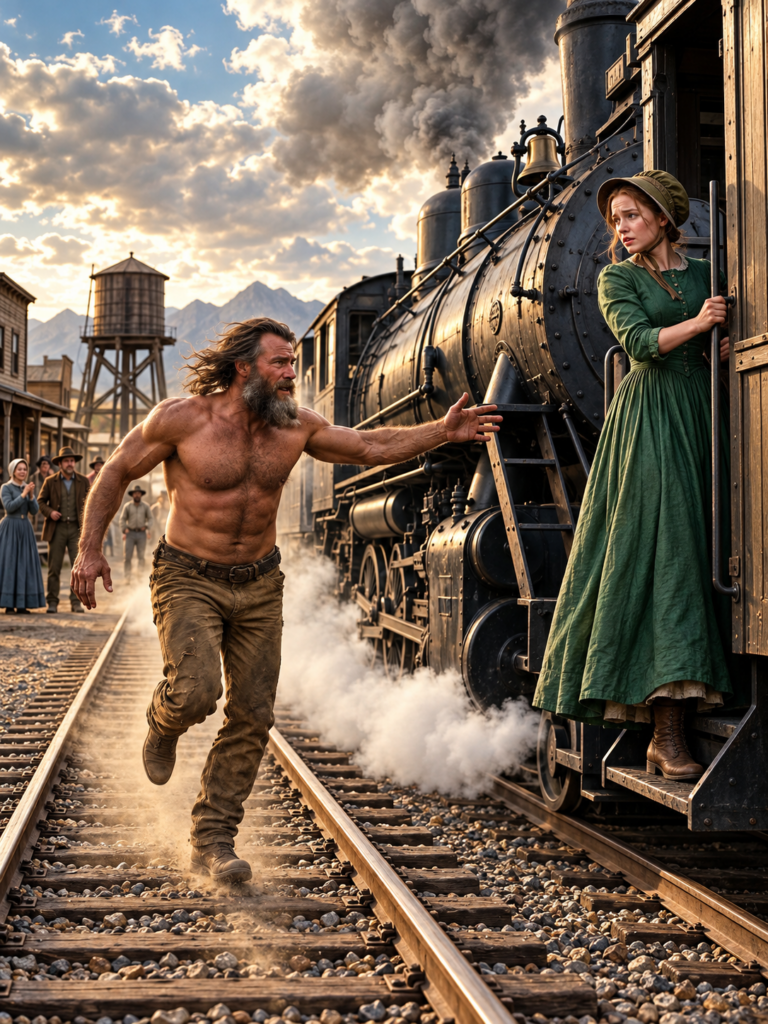
He wrote her beautiful letters for six months. She fell in love with every word. Then she saw the man behind them—scarred, enormous, old. She decided to leave.
His voice reached her through the wind.
“One chance, please.”
The Idaho Territory in the spring of 1874 was a place that carved men into shapes the civilized world would not recognize.
The mountains did not polish. They stripped.
They removed everything unnecessary—manners, softness, the particular kind of grooming that Eastern society considered essential—and left behind something raw and functional and honest in a way that made most people uncomfortable.
Boone Garrity had been carved by these mountains for 26 years.
He was 48 years old, the kind of tall that made doorways irrelevant and ceilings a personal insult. Six feet and four inches of bone and muscle and scar tissue arranged in the general shape of a man, but more accurately resembling something the forest had assembled from its spare parts.
His face had been rearranged by time and incident into a landscape that told stories he never volunteered.
A scar that ran from his left temple to his jaw, earned from a falling branch during a winter storm. A nose that had been broken and reset imperfectly, giving it a slight westward lean. Hands the size of small shovels, permanently darkened at the knuckles from decades of work that did not involve desks or paper.
His hair was dark brown going gray at the edges, worn long because barbers required towns and towns required social interaction, and social interaction required a tolerance for other people’s opinions that Boone had never successfully cultivated.
He was not an ugly man.
He was an alarming one.
There is a difference.
Ugly is a judgment of features.
Alarming is a reaction to scale.
Boone Garrity occupied space the way a boulder occupies a creek bed. Unavoidably, permanently, with the quiet suggestion that moving him would require more effort than most people possessed.
He lived in a cabin 12 miles above the town of Silver Falls, in a valley where the elk outnumbered the people and the silence was so complete that his own heartbeat sometimes startled him.
He trapped. He hunted. He cut timber and sold it at the mill twice a year. He grew what the short mountain summers allowed and preserved what the long winters demanded.
He was self-sufficient in the way that lonely men described themselves when the truth that they are simply alone and have stopped believing the condition is temporary feels too heavy to speak aloud.
He had never been married.
Not because he had not wanted to be, but because the opportunities available to a man who lived 12 miles above civilization and looked like a mountain that had learned to walk were limited in ways that required no explanation.
He had resigned himself to this the way a person resigns themselves to weather.
You do not argue with January.
You simply endure it and wait for something warmer.
The letters were not his idea.
A man named Crawford, who ran the timber mill, mentioned that his own wife had come from the East through a correspondence service. Mentioned it casually, the way men mention things they know will lodge in another man’s mind like a splinter.
“Good women looking for honest men,” Crawford said. “They do not care about looks. They care about land and character and whether a man can provide.”
“I have land,” Boone said.
“You have more than land. You have a good cabin and steady work and a heart you have been hiding from the world for 48 years. Write a letter. The worst that happens is silence, and you are already an expert at silence.”
Boone wrote the letter that night.
It took him four hours.
His handwriting was clumsy. His grammar was uncertain. But his honesty was absolute because dishonesty required a sophistication he did not possess.
He described his land.
The valley.
The mountains that turned purple at sunset.
The creek that sang in spring and whispered in summer and went silent under ice in winter.
He described his cabin. The fireplace he had built from creek stones. The porch that faced west toward the colors that happened every evening without anyone charging admission.
He described himself with painful accuracy.
Forty-eight. Large. Scarred. Rough in appearance and manner. Not educated beyond what the frontier required. A man who talked to his horses more than he talked to people because horses did not judge his grammar or his face.
He did not include a photograph because he did not own one and because he suspected that a photograph would end the correspondence before it began.
The letter went east.
Six weeks of silence followed.
Then a response arrived from a woman named Adelaide Pierce in Boston.
Her handwriting was elegant. Her words were precise and warm simultaneously, the way good teachers write because they understand that clarity and kindness are not opposites.
She was 31 years old, a seamstress, unmarried because, she wrote with a directness that made Boone smile, the men in Boston were interested in decorative women who agreed with everything, and Adelaide had never been decorative or agreeable.
She asked about the mountains.
Were they truly purple at sunset, or was he exaggerating for romantic effect?
He wrote back that he had never exaggerated anything in his life because exaggeration required imagination and he was a man of literal description.
The mountains were purple.
Sometimes they were also orange.
On rare evenings they were the color of a bruise healing.
He did not know the proper words for colors. He only knew what he saw.
She asked about the silence.
Was it lonely or was it peaceful?
He wrote that it was both simultaneously and that he had stopped being able to tell the difference.
She wrote that she understood this, that a person could live in the noisiest city in America and experience the same condition, surrounded by sound and entirely alone within it.
Six months of letters.
Twenty-three total.
In those letters, Boone discovered that he could write things he could never say.
He wrote about the way morning light entered his cabin through the east window and made the dust motes look like tiny golden planets, about the sound a river makes under ice in January, a deep, slow hum that sounded like the earth breathing in its sleep, about the loneliness that lived in his chest like a second heartbeat, constant and quiet and so familiar he had stopped noticing it until her letters made him notice everything again.
Adelaide wrote about Boston’s cobblestone streets and the way rain made them shine like the city was wearing jewelry, about her small room above the seamstress shop where she sewed wedding dresses for other women and wondered if the universe found this ironic, about her parents who had passed within a year of each other and the particular emptiness of being the last person who remembered a family’s private language of jokes and references that now had no audience.
In the fifth month she wrote, “I find myself reading your letters beside the window where the light is best, and when I finish, I hold the paper against my chest as if the words might transfer through the page into my heart. I suspect this is foolish. I suspect I do not care.”
Boone read that sentence 17 times.
He knew because he counted.
In the sixth month, she agreed to come.
The train was scheduled to arrive in Silver Falls on a Thursday in May.
Boone spent the week before in a state that resembled preparation, but was actually controlled panic.
He cleaned the cabin until the wood complained.
He washed his two shirts and hung them to dry and chose the one that made him look slightly less like a man who lived in the woods, which was difficult since he was a man who lived in the woods.
Crawford offered to lend him a proper coat.
Boone declined, then accepted.
The coat was too small in the shoulders and the sleeves stopped three inches above his wrists, but it was made of wool instead of animal skin, and that felt like progress.
He rode to Silver Falls on Thursday morning.
He arrived four hours early because the alternative was sitting in his cabin calculating all the ways this could go wrong, and the cabin’s walls were not thick enough to contain that much anxiety.
He stood on the platform.
The mountains rose behind the town.
The wind carried the scent of pine and snowmelt and the particular nervousness of a man who had spent 26 years avoiding situations exactly like this one.
The train arrived at 2:00 in the afternoon.
It came around the bend with a sound that announced itself to the entire valley.
Steam and iron and the mechanical confidence of a machine that did not care about the fragile human dramas waiting at its stops.
Passengers descended.
A family, two miners, a preacher with a carpet bag.
Then she stepped off.
Adelaide Pierce wore a green traveling dress that matched her eyes.
Her brown hair was pinned beneath a hat that the wind immediately began negotiating with.
She carried two bags, one in each hand.
She was neither tall nor short, neither plain nor beautiful in the way that word is typically deployed.
She was something else, something that existed outside of those categories.
She was present.
Vividly, completely, absolutely present, as if every cell in her body was paying attention to the world simultaneously.
She stepped onto the platform.
She looked around.
Her green eyes scanned the faces with the focused attention of a woman searching for a specific person.
Her gaze found Boone.
He watched it happen, the exact moment her eyes reached him and registered what they were seeing.
The height, the width, the scarred face and broken nose and hands like shovels and hair that no barber had shaped and a borrowed coat that fit like a costume on a man who would never be costumed.
Something moved across her face.
Not disgust.
Not cruelty.
Something closer to the recalibration of a person whose imagination has just collided violently with reality.
The letters had not prepared her.
How could they?
Letters do not have height or scars or hands that could wrap entirely around a fence post.
Letters are words on paper, and words on paper can build any face the reader imagines.
She had imagined a different face.
Boone saw it.
He saw the moment the man in her imagination was replaced by the man on the platform, and he saw the distance between the two, and he felt that distance like a physical blow to the center of his chest.
Adelaide set down one bag, then the other.
She stood still for three seconds that lasted approximately four years.
Then she picked up her bags again, turned around, and began walking back toward the train.
The conductor was still standing beside the door.
The steps were still down.
The whistle had not blown.
She had time.
She could step back aboard and ride the train back east and spend the rest of her life telling friends about the mountain man who looked nothing like his letters and the trip she was wise enough to cut short.
Boone watched her walk away.
Every step she took drove something deeper into his chest that felt like the opposite of breathing.
She was 10 feet from the train door.
Then eight.
Then five.
He should have let her go.
A man with pride would have let her go.
A man who understood that you cannot force someone to see past your face would have stood in silence and watched the train carry away the only person who had ever made his loneliness feel temporary.
But Boone Garrity was not a man of pride.
He was a man of letters.
Letters he had written by lamplight with clumsy hands and uncertain grammar and absolute honesty.
Letters that had made a woman in Boston hold paper against her chest.
Letters that had carried something true across 2,000 miles of distance and somehow arrived intact.
He stepped forward.
“Please.”
His voice came out rough and breaking and too loud for the platform.
Several people turned to look.
He did not care.
“Please don’t get on that train.”
Adelaide stopped.
Her hand was on the railing.
One foot on the first step.
She did not turn around.
“Just give me a single chance,” he said.
His voice cracked on the word chance the way wood cracks under weight.
It was not expecting.
“One chance. That is all. If you look at my face and still want to leave after that, I will buy your ticket myself. I will put you on the train and I will never write another letter. But please, before you go, just look at me. Not at what I look like. At me.”
She stood with her hand on the railing.
The train hummed beneath her fingers.
The conductor watched with the patient detachment of a man who had witnessed every human drama the rails could produce.
Adelaide turned around.
She did not look at his face first.
She looked at his hands.
Those enormous, scarred, impossible hands that had written 23 letters in handwriting so clumsy it looked like a child’s, but so honest it made her cry on a Tuesday evening in her small room above the seamstress shop.
She looked at his eyes, dark brown, nearly black, and carrying something she recognized, the same thing she had felt reading his words by the window where the light was best.
The ache of a person who has something to give and no one to give it to.
She looked at the borrowed coat that did not fit him.
At the sleeves that stopped above his wrists, revealing arms that could lift an elk, but had cradled words like tiny golden planets and the earth breathing in its sleep with the gentleness of a poet trapped in a body built for labor.
She was quiet for a long time.
Long enough that the conductor asked if she was boarding.
“No,” she said.
Not to the conductor.
To the wind, to the platform, to the 23 letters that had traveled 2,000 miles to bring her to this exact moment.
She picked up her bags.
She walked back toward him.
She stopped three feet away.
The same distance that had separated them when she first saw him and turned to leave, but the distance felt different now.
Smaller.
Crossable.
“The mountains,” she said.
Her voice was steady, but her eyes were bright.
“You wrote that they turn purple at sunset.”
“They do,” he said.
“And you said the creek sings in spring.”
“It does.”
“And you wrote that the dust in your cabin looks like tiny golden planets when the morning light comes through.”
“Yes.”
She looked at him.
All of him.
Not past the scars.
Not through the size.
At him.
The way his letters had asked her to.
“I held your letters against my chest,” she said. “Every single one. Because the man who wrote them saw the world in a way I had never encountered. Gentle and honest and completely unaware of how beautiful his words were.”
She took one step closer.
“I did not come 2,000 miles for a face, Boone Garrity. I came for the man who described dust motes as tiny golden planets, and that man is standing right in front of me.”
He could not speak.
He tried.
His mouth opened and nothing emerged except a sound that might have been the beginning of a word or the end of 26 years of silence breaking apart all at once.
She smiled.
Not broadly.
Gently.
The way morning light enters a room.
“Show me the mountains,” she said.
He picked up her bags.
She walked beside him to the wagon.
When he helped her up, his enormous hand engulfed hers completely, every finger disappearing inside his palm.
She looked at their hands together and did not pull away.
“Your hands are exactly the size I imagined,” she said.
“You imagined my hands?”
“I imagined everything, Boone. Everything except your face. And I have decided your face is the only part that is better than what I imagined.”
They rode toward the valley in late afternoon light.
The mountains were beginning their evening performance.
Purple at the peaks.
Orange at the ridgeline and lower, where the sun caught the granite at its most generous angle.
The color of a bruise healing.
Exactly as he had described.
Adelaide watched the mountains the way she had read his letters.
With her entire body leaning toward them.
Present.
Completely present.
Then she turned and watched him instead.
They married in June.
On the porch he had built facing west, Crawford stood as witness.
The preacher from the train platform performed the ceremony and admitted afterward that he had been praying for this outcome since he watched the whole scene unfold beside his carpet bag.
Adelaide kept every letter.
All 23.
She placed them in a wooden box Boone carved from cedar and set them on the shelf above the fireplace he had built from creek stones.
She added to the collection notes he left on the kitchen table before dawn when he went to check trap lines.
Observations scratched onto scraps of bark when paper was not available.
“The elk crossed the north meadow today. Twelve of them. They moved like a sentence being written across the grass.”
“You hummed while making bread this morning. I stood outside the door listening for 10 minutes. I was late to the timber line. I did not care.”
“You asked if I was happy. I have never understood that word. I understand it now. It sounds like you humming while making bread.”
Adelaide sewed him a proper coat that fit his shoulders and his wrists and his impossible dimensions.
She sewed it from the best wool she could order from the trading post, and she lined it with flannel.
And when he put it on for the first time, he stood in the cabin looking at his arms and sleeves that actually reached his hands, and something crossed his face that she had never seen before.
Wonder.
The wonder of a man who had never had anything made specifically for him, who had spent his entire life fitting himself into spaces and garments and social expectations that were not designed for his body or his heart.
“It fits,” he said.
“Of course it fits,” she replied. “I made it for you. Not for the man I imagined. For you.”
Years passed in the valley the way years pass when people are content.
Slowly when you are inside them and quickly when you look back.
They had two children.
A boy with his size and her eyes.
A girl with her precision and his gentleness.
Both of them grew up believing their father was the most handsome man in the territory.
Because Adelaide told them so every evening.
And because children believe their mothers.
And because in the light of that particular cabin, with those particular mountains visible through those particular windows, she was not wrong.
Travelers who passed through Silver Falls sometimes heard the story.
About the mountain man who begged a woman not to board a train.
About the two words that stopped her.
About the borrowed coat and the letters held against a chest.
And the dust motes described as tiny golden planets by a man who did not know he was a poet.
The story grew the way frontier stories grow.
Through repetition and warmth.
And the human need to believe that the right words, spoken at the right moment, can stop a person from walking away from the best thing that could ever happen to them.
The train still runs through Silver Falls.
The platform is the same.
The mountains still turn purple at sunset.
And if you stand in the spot where Boone Garrity stood on a Thursday in May and said two words that changed his life, you can almost hear them.
“One chance.”
Spoken by a man too rough for the world and too honest for his own good.
Heard by a woman who almost left and answered by a love that fit perfectly.
Every shoulder.
Every sleeve.
Every impossible dimension of two people who should not have worked together, but did.
Because she did not come for a face.
She came for the words behind it.
And the words were beautiful.


