
Part 1
“Do you still think this place is worth half a million dollars?”
Warren Pike stood on Mara Sutton’s porch with muddy water stretching behind him where a pumpkin field had been the day before.
His boots were clean.
That was the first thing Mara noticed.
Not the contract in his hand. Not Grant Danner, the bank officer, standing beside him with the patient expression he wore whenever he was about to explain why something unpleasant was supposedly inevitable.
Warren’s boots.
The road from the county blacktop to Mara’s house was a half mile of wet gravel and churned clay. Anybody who had driven in that morning and walked across the yard should have carried half the farm on his soles.
Warren looked as though he had stepped out of an office.
Grant opened the folder he was holding.
“We’ll settle the debt directly with the bank,” he said. “Today, you walk away clean.”
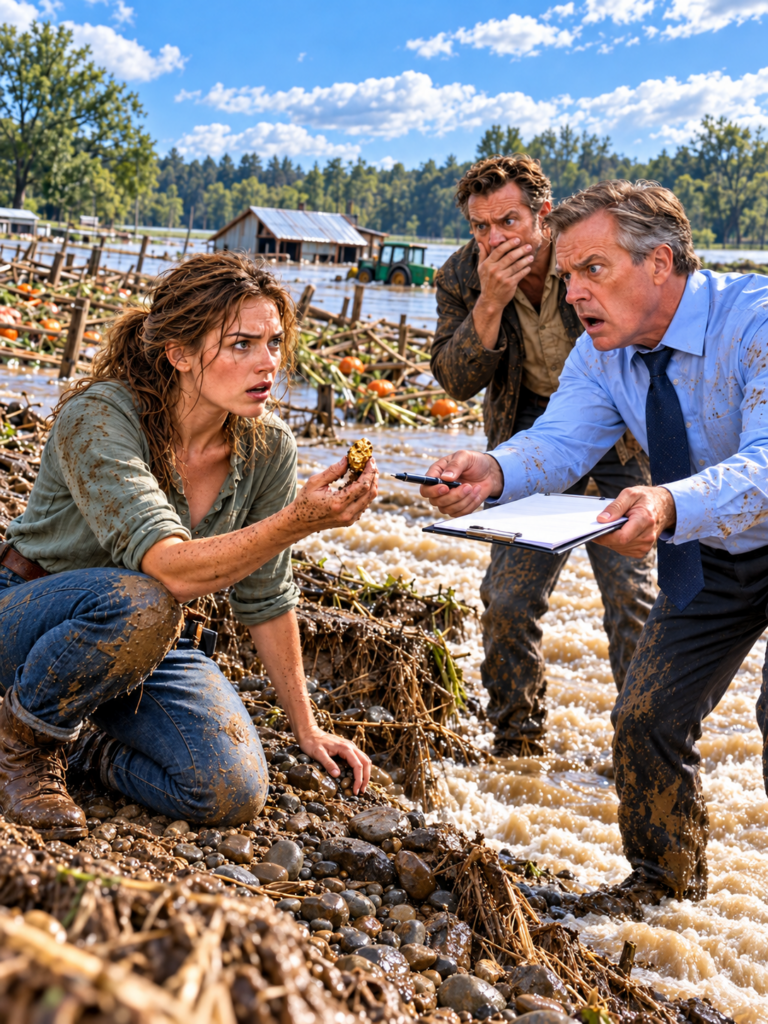
Behind them, the lower acreage looked like a shallow lake.
Fence posts rose from brown water. The roof of the equipment shed reflected weakly in the flood. Somewhere beneath that water sat a ruined pumpkin crop, tools, feed, and machinery Mara had spent the last three years nursing along because she could not afford to replace them.
Warren laid the purchase agreement on the porch rail.
“This is a fair offer.”
Mara looked at the first page without touching it.
Two hundred twenty-eight thousand dollars.
The number had not changed.
Neither had the fact that an independent appraisal fourteen months earlier had put the property at five hundred forty thousand.
Grant tucked his chin slightly.
“Take it or lose everything.”
Mara lifted her eyes from the contract.
For eight months, Grant had been telling her that selling was the practical choice.
For almost as long, Warren had been waiting to buy.
Now her farm was underwater, her debt was pressing against its limits, and both men had arrived before the mud had even settled with signatures already waiting on their side of the page.
It was almost neat.
Too neat.
Mara looked beyond them toward the creek.
The rain had ended before dawn.
The creek was still rising.
She had spent too many years repairing irrigation pumps, hydraulic lines, valves, and agricultural equipment not to understand what water did.
Rain stopped.
Runoff peaked.
Water found the lowest route and moved on.
It did not continue climbing hour after hour under a clearing sky unless something upstream was still feeding it.
“What happened at the reservoir?” she asked.
Warren barely paused.
“Emergency release. Storm came in heavy. We had to protect the structure.”
“How much did you release?”
“Enough to keep the reservoir safe.”
“And why is it still coming down?”
Grant shifted his weight.
“Mara, that’s a separate issue. Right now we’re trying to give you a way out.”
She looked at him.
The phrase stayed with her.
A way out.
As though they had not arrived at the exact moment every exit except theirs seemed to have disappeared.
Mara pushed the contract back toward Warren.
“I’m not signing.”
Warren studied her for several seconds.
There was no explosion. No threat. No theatrical anger.
Only a change in his face so slight another person might have missed it.
Impatience.
Then it was gone.
“Think carefully,” he said.
“I have.”
Grant closed his folder.
“Your loan terms don’t stop because your property flooded.”
“I know.”
“The next payment is still due.”
“I know that too.”
Warren picked up the contract.
Neither man offered to help with the water, the goats, the shed, or the field.
They walked back toward their vehicle while Mara watched the creek continue to rise.
The Sutton farm sat on eighty-four acres along Alder Creek Road outside Bell Ridge, where farmland rolled westward into timber country and the first long shoulders of the mountains.
The land had belonged to Mara’s family since 1954.
Her grandfather, Leon Sutton, had worked it.
Then her mother, Doreen.
Then, three years earlier, Doreen had died and left it to Mara.
Mara had never intended to become a farmer.
Most of her adult working life had been spent as an agricultural equipment mechanic. She understood diesel engines better than crop markets and could rebuild a hydraulic cylinder faster than she could talk to a seed salesman.
But land had a way of assigning duties whether a person felt ready for them or not.
So she learned.
She learned the pumpkin fields first because pumpkins had been Doreen’s dependable regional-market crop. She learned the goats because livestock did not care whether grief had ruined your sleep. They wanted hay on schedule.
She learned that farming meant making a hundred decisions before breakfast and hoping sixty of them were right.
The operation did not make much money.
But for a while, it worked.
Then came two bad harvests.
The first left her thin.
The second left her with sixty-seven thousand dollars in outstanding loan debt and no cushion behind it except land, equipment, and the stubborn belief that one decent season could still pull the farm upright.
That was when Grant Danner’s manner toward her had begun to change.
Grant was fifty-seven and handled agricultural credit at Cedar Vale Bank. He never sounded threatening. He sounded reasonable.
That made him harder to argue with.
The first time he suggested selling, he did it over coffee in a small office with a framed photograph of a wheat field behind his desk.
“You could clear the debt and start over without this hanging over you.”
Mara had asked, “Sell to who?”
He had hesitated just long enough for the answer to matter.
“Ridgecrest Aggregates has expressed interest.”
Warren Pike.
Forty-nine years old, owner of Ridgecrest Aggregates, operating out of a converted warehouse at the edge of Bell Ridge.
Over the previous several years, Warren had bought parcel after parcel along Alder Creek while expanding his sand and gravel operation.
His company controlled most of the land adjacent to Mara’s property.
It also controlled a small reservoir upstream.
He had approached Mara twice before Grant became the middleman.
The first conversation happened beside the south fence.
The second happened in town.
Both times Mara said no.
She did not invite a third discussion.
Then the bank started presenting the same offer.
Two hundred twenty-eight thousand.
For a property appraised at more than twice that.
Mara had asked Grant why the offer was so low.
Grant had talked about agricultural market conditions, operating risk, and the cost of transitioning rural land to industrial use.
Mara had stopped listening halfway through.
Low offers did not interest her.
The reason behind them did.
She simply had not found it yet.
The night of the flood, rain came hard enough to rattle the windows.
Bell Ridge got storms like that. Water crossed the low road once or twice most years, and the upper field shed runoff in silver sheets whenever the ground was already saturated.
Mara woke to a different sound.
Water striking metal.
She sat upright in the dark.
For a moment she listened.
Then it came again.
A heavy slosh against the equipment shed.
She was out of bed before she was fully awake.
Boots. Coat. Flashlight.
Outside, the rain cut sideways across the yard.
Mara swept the beam toward the lower field and stopped.
Water was moving across it with force.
Not pooling.
Moving.
A broad brown current rolled through the pumpkin rows, dragging vines, stalks, and loose boards toward the access road.
The creek had spilled before.
Never like this.
She climbed onto the utility tractor and went first for the goats.
By the time she got them moved to the upper pasture, water had already reached the lower shed.
There was no safe way to retrieve the equipment inside.
She stood in the rain and watched water slam into the walls.
All she could do was remember what was there.
Compressor.
Welding unit.
Parts cabinets.
A rebuilt pump she had promised back to a neighboring farm by Friday.
The current forced itself beneath the shed doors.
Then the rain weakened.
Before dawn, it stopped.
The water did not.
By sunrise, the farm had taken damage that two years of bad harvests had not managed to accomplish.
And still the creek climbed.
That was the fact Warren’s explanation could not make Mara forget.
After he and Grant left her porch that morning, she did not go inside.
She walked south.
Mud pulled at her boots as she followed the lower fence line toward the access road. Water had already begun finding channels through the field, leaving mats of vines and yellowed grass against the wire.
Near the southwest corner of the property, a secondary drainage culvert passed beneath the road.
Mara expected to find it overwhelmed.
Instead, she found it blocked.
She crouched at the mouth.
Rock and compacted dirt had been packed into the opening.
Not branches.
Not branches tangled with leaves.
Not trash shoved there by a current.
Rock.
Gravel.
Soil.
Layered tightly enough to restrict the opening.
She touched the edge of the material.
Fresh.
Mara stood.
Across the road, tire marks cut deep into the mud.
Wide wheelbase.
Heavy vehicle.
She pulled out her phone and began taking pictures.
The culvert mouth.
The packed material.
The tire tracks.
The shoulder of the road.
Then wider shots showing where everything sat in relation to her property.
She did not disturb the blockage.
Instead, she walked to the neighboring property and found Tom Hadley.
“Come look at something.”
Tom followed her without asking much.
He stood beside the culvert, hands on his hips.
“You think somebody did that?”
“I think water didn’t stack rock and dirt this evenly by itself.”
Tom bent down.
“No.”
“I want you to see it before anybody touches it.”
He looked at her.
“You calling the county?”
“I am now.”
By the time Mara managed to get anyone official interested, the obstruction was gone.
Ridgecrest had already sent a crew through the area.
Warren told people the crew had been clearing storm debris from drainage points.
The culvert ran clean.
The tire tracks had softened under passing vehicles.
What remained were Mara’s photographs and Tom’s memory.
Not enough.
But not nothing.
She began keeping a notebook.
Dates.
Times.
Calls from Grant.
Vehicles she saw moving along the road.
Names of people she spoke with.
Anything Warren said publicly about the flood.
She sold her second truck the following week.
Then she took repair work wherever she could find it.
Hydraulic hose one day. Tractor starter the next. A baler repair that left her hands cut and black with grease until nearly midnight.
The money kept the immediate bills moving.
It did not restore the field.
Grant called once.
His voice remained calm.
“A dispute with Ridgecrest doesn’t alter the bank agreement.”
“I didn’t say it did.”
“I’m trying to be clear.”
“So am I.”
She ended the call first.
A few days later, Mara walked the creek bank to photograph erosion for her insurance records.
The flood had bitten deeply into the southern edge of the property.
Along one stretch, nearly two feet of topsoil had vanished.
Forty yards of bank had been peeled open.
Mara moved slowly, taking pictures.
Then sunlight hit something in the exposed gravel.
She stopped.
A small yellow glint sat inside a crevice.
At first she thought it was a piece of foil.
She dug it free with a screwdriver from her belt.
It was irregular.
Heavy for its size.
The yellow ran through it, not across the surface.
Mara rolled it between her fingers.
She had seen enough ore samples and mineral specimens over the years to know what it might be.
But knowing what something might be and knowing what it was were different things.
She looked at the bank.
The flood had exposed a dark gravel layer beneath the ordinary soil. It ran parallel to the creek, coarser than the sediment around it.
Mara stared at it for a long time.
Then she remembered Leon’s box.
Her grandfather had kept old rock samples in a wooden crate in the barn.
After Doreen died, Mara had moved the crate into the house along with several notebooks because she could not bear to throw away anything written in Leon’s hand.
She had never opened most of them.
That evening, she did.
Leon’s field notebook smelled of dust and old paper.
Dates from the early 1970s filled several pages.
Water levels.
Fence repairs.
Crop notes.
Then Alder Creek.
Mara sat straighter.
Leon had noticed that the modern creek channel appeared to overlap an older buried watercourse.
He described a dark gravel band visible during dry periods along the southern bank.
He had collected samples.
He had suspected placer deposition.
Gold carried by ancient moving water and concentrated over years inside particular layers of gravel.
Leon had never paid for a geological survey.
The farm could not afford one.
At the bottom of the entry, in his compact handwriting, was a final sentence.
Worth knowing before selling.
Mara read it twice.
Then a third time.
The next morning, she returned to the creek.
She collected six samples from separate points along the exposed bank.
She marked each location with flagging tape.
She recorded coordinates on her phone.
Then she drove two counties away and shipped the samples to an independent assay laboratory under her own name.
She paid cash.
For eleven days, she told no one in Bell Ridge what she had found.
The laboratory report arrived electronically on a Thursday afternoon.
Mara opened it at the kitchen table.
Every sample contained natural gold.
Three samples showed concentrations significant enough for the laboratory to flag them specifically.
The report warned that surface sampling could not establish commercial viability.
Further geological assessment would be required.
Mara understood.
A few bright stones did not make a mine.
Still, she looked across the kitchen toward Leon’s notebook.
Then she thought about Warren Pike.
About all the land he had bought along Alder Creek.
About an offer less than half the appraised value.
About Grant’s sudden interest in solving her financial problems by transferring her farm to Ridgecrest.
And about the flood that had stripped two feet of earth from the one part of the property Warren seemed most determined to acquire.
For the first time since the water rose, Mara wondered whether ruining the farm had only been part of the plan.
Maybe Warren had known something about her land that she had not.
Maybe he had known it long before the flood.
And if that was true, then two hundred twenty-eight thousand dollars had never been a rescue offer.
It had been a price placed on her ignorance.
Part 2
Celia Hart arrived at the Sutton farm carrying a field bag, a hand lens, and none of the excitement Mara had half expected from a geologist being shown possible gold.
That reassured her.
Celia was forty-three and worked independently. She spent nearly an hour on the exposed bank before offering anything resembling an opinion.
She looked at the gravel.
Measured sections.
Studied its composition.
Asked Mara exactly where each assay sample had come from.
Finally, she stood and brushed dirt from her gloves.
“It looks like an ancient alluvial channel.”
Mara glanced at the creek.
“Meaning?”
“Meaning water used to run through here differently than it does now. Channels like that can sort heavy minerals over a very long period.”
“Gold.”
“They can concentrate placer gold.”
“How much?”
Celia shook her head.
“I can’t tell you that from one afternoon on the surface.”
“Enough to matter?”
“Enough to justify finding out.”
That was all Mara wanted.
Facts before conclusions.
Evidence before hope.
She had already learned what happened when men with more money controlled the story people heard first.
A few days later, she went to the county planning office and began searching public records.
She was not looking for gold.
She was looking for Ridgecrest.
What she found was an expansion application filed ten months earlier.
Mara opened the survey map.
The proposed extraction corridor followed the southern bank of Alder Creek.
She leaned closer.
The corridor ran toward her land and stopped precisely at the Sutton property line.
The filing date was two months before Grant Danner had first formally encouraged her to sell to Ridgecrest.
Mara printed everything.
Then she called Audra Keene.
Audra handled property disputes and business damage claims from an office in the next town. She was forty-six, practical, and unimpressed by theories unsupported by documents.
Mara appreciated her immediately.
She spread everything across Audra’s conference table.
The assay results.
Celia Hart’s preliminary geological assessment.
The Ridgecrest expansion filing.
The flood photographs.
The appraisal.
Loan documents.
Grant’s offer.
Leon’s notebook.
Audra spent most of an hour reading before she spoke.
“This isn’t one problem.”
Mara sat opposite her.
“I know.”
“No. I mean legally.”
Audra tapped the assay report.
“This is a mineral issue.”
She tapped the culvert photographs.
“This could be property damage or intentional interference, depending on what we can prove.”
Then the bank correspondence.
“And this is financial pressure that may or may not be connected.”
“They’re connected.”
“I believe you think they are. That’s different from proving they are.”
Mara said nothing.
Audra pulled the chain-of-title documents closer.
“I checked the mineral rights.”
“And?”
“No severance.”
Mara waited.
Audra looked directly at her.
“If there’s gold under your land, it belongs to you.”
For a moment Mara felt something inside her chest release.
Audra saw it.
“Don’t celebrate.”
The relief disappeared.
“Why?”
“Because gold in the ground isn’t cash in your account.”
Audra explained the rest.
More geological work.
Permits.
Environmental review.
Water planning.
Commercial feasibility.
An extraction partner with capital.
Time.
Everything Mara did not have.
The bank did not care whether a valuable deposit might exist below the creek bank.
The bank cared about a loan in distress.
Audra agreed to defer most of her legal fee against any future recovery, but goodwill could not stop a default clock by itself.
So Mara hired Russell Voss.
He was sixty-one and specialized in hydraulic engineering.
For three days he studied rainfall data, elevations, drainage routes, the reservoir, high-water marks on the shed, and photographs from the property.
He walked the culvert twice.
On the third afternoon, he sat at Mara’s kitchen table and laid out his preliminary findings.
“The rainfall doesn’t explain the surge.”
Mara folded her arms.
“How sure are you?”
“Sure enough to put my name on that sentence.”
“And the reservoir?”
“The timing and volume are consistent with a controlled release upstream.”
Mara looked toward the window.
“And the culvert?”
Russell slid one of her photographs across the table.
“If this blockage was placed where you photographed it before the peak discharge, it would have reduced the drainage route here.”
He traced a line with his finger.
“Water that should have moved away from the lower field would have backed up and redirected across your property.”
“Can you prove they put it there?”
“No.”
The answer came immediately.
Russell did not soften it.
“I can explain what the obstruction would have done. I can’t tell you who placed it from a photograph.”
Ridgecrest refused to turn over the reservoir’s operational logs voluntarily.
Warren’s attorney instead produced a statement from another engineer describing the flood as a severe but ordinary weather event.
Grant Danner called again.
The tone stayed professional.
The message did not.
“The bank can’t delay its process indefinitely because you’re pursuing a civil dispute.”
Mara stood in the lower shed while talking to him.
Panels had been removed. Mud lines ran across the interior walls.
“When did I ask you to?”
“I’m making sure expectations are realistic.”
“You’ve been doing that a lot.”
“Mara—”
“Did Warren know about Ridgecrest’s expansion filing when you first approached me?”
Silence.
Then, “I don’t discuss another client’s business matters.”
“That wasn’t what I asked.”
“I think this conversation has gone as far as it can.”
“On that we agree.”
The loan entered formal default.
Collection proceedings followed.
Then Warren tried again.
He did not call Mara.
He called Audra.
The offer increased slightly.
The conditions mattered more than the money.
Mara would transfer all land rights.
She would withdraw her records requests.
She would end the dispute.
Audra delivered the message without recommending anything.
Mara answered immediately.
“No.”
“You don’t want to hear the exact number?”
“No.”
Audra watched her.
“You understand the bank situation?”
“Yes.”
“You understand litigation could go badly?”
“Yes.”
“And you’re certain?”
Mara thought about the floodwater striking the shed.
About the blocked culvert.
About Leon’s note.
About Ridgecrest’s survey corridor stopping at her boundary.
“I’m not selling the ground to the people who tried to make me too desperate to know what it was worth.”
Audra nodded once.
“Then we keep going.”
What they needed was evidence from inside Ridgecrest.
For a while, none came.
Then a man named Dale Richter approached Mara in the parking lot of a hardware store.
He was a reservoir-control employee.
He had worked for Ridgecrest for six years.
Mara recognized him vaguely but did not know him.
Dale waited until two other customers drove away before speaking.
“The gate was opened manually.”
Mara stopped beside her truck.
“What gate?”
“You know what gate.”
“Say it.”
Dale glanced toward the store windows.
“The primary reservoir outflow.”
“When?”
“The night your place flooded.”
“Who ordered it?”
Dale swallowed.
“Warren.”
Mara’s heartbeat changed.
“Will you tell my attorney?”
“No.”
“Why not?”
“My daughter starts college this fall.”
His voice had gone tight.
“I lose this job, we’ve got a problem I can’t fix.”
“You know what he did to my farm.”
“I know.”
“Then help me prove it.”
Dale shook his head.
“I shouldn’t have said anything.”
“Did the storm require that release?”
“No.”
The word was barely above a whisper.
“Then why did Warren order it?”
Dale did not answer.
He walked to his truck.
Mara stood in the parking lot until he drove away.
When she called Audra, the attorney listened without interruption.
“A private conversation we can’t verify isn’t testimony,” Audra said.
“I know.”
“But it tells us where to push.”
They filed the civil complaint.
Ridgecrest Aggregates and Warren Pike were named in connection with the flooding, culvert blockage, and pressure campaign surrounding the property.
Audra also asked the court for a temporary restraining order preserving Mara’s ownership while the dispute was being litigated.
The request was not guaranteed.
If the court refused and the bank’s collection process continued, Mara could lose the farm before she ever got the chance to prove why others had been so determined to take it.
The order was granted.
The collection process stopped.
For the first time in months, the clock slowed.
Not forever.
Long enough.
Mara went home and opened every photograph from the morning after the flood.
She enlarged them one by one.
Culvert.
Tracks.
Mud.
Road.
Again.
Again.
On the third image, she noticed something at the lower-right edge.
A vehicle.
Only part of it was visible.
Rear quarter panel.
A sliver of plate.
Mara zoomed in until the image broke into pixels.
The color and body shape looked familiar.
Ridgecrest used similar wide-body trucks for spreading gravel.
She sent the image to Audra.
A professional enhancement could not recover the full plate, but enough characters became visible to narrow the vehicle registration.
The truck belonged to Ridgecrest Aggregates.
Audra called Tom Hadley.
“Any cameras on your property?”
Tom had a motion-activated camera on a gate post facing his driveway.
He had never checked footage from the flood night because it did not point toward Mara’s farm.
The road, however, passed through the far edge of the frame.
He searched the archived files.
Two recordings mattered.
The first was timestamped forty minutes before floodwater reached Mara’s lower field.
A wide-body truck moved slowly past Tom’s gate toward the culvert.
Ninety minutes later, the same truck returned.
Audra used the photograph and gate footage to compel Ridgecrest’s vehicle dispatch records.
The company log identified the truck.
It also identified the crew.
Two workers had been assigned that evening to what Ridgecrest described as a routine drainage inspection.
The driver received a subpoena.
When questioned separately from Dale Richter, he confirmed the assignment.
He said he had been instructed to inspect drainage.
He claimed he did not know why.
He said he had not asked questions.
That alone did not prove the culvert had been intentionally blocked.
But another subpoena went to the company that manufactured the reservoir’s gate-control equipment.
Its maintenance and system records contained a timestamp.
Manual override.
Primary outflow gate.
The night of the flood.
The command occurred forty-seven minutes earlier than the time shown in Ridgecrest’s operational log.
For the first time, Ridgecrest had a contradiction that did not depend on Mara’s memory, her photographs, or a neighbor’s observation.
Their record said one thing.
The manufacturer’s independent system said another.
Audra called Mara.
“We have the override.”
Mara was in the goat enclosure repairing a hinge.
She straightened slowly.
“What exactly do we have?”
“A manufacturer timestamp showing a manual command at the gate.”
“And Ridgecrest?”
“Reported it forty-seven minutes later.”
Mara gripped the fence rail.
“Can they explain that?”
“They’re going to try.”
“Will it work?”
Audra paused.
“They have a bigger problem now.”
“What?”
“I’m going back to Dale.”
This time, Dale Richter agreed to sit for a formal deposition.
He entered the room looking like a man who had slept badly for weeks.
Audra kept her questions narrow.
“Did Warren Pike contact the reservoir-control station on the night of the flood?”
“Yes.”
“What did he instruct you to do?”
Dale stared at the table.
“Open the primary outflow gate.”
“To what level?”
“Maximum discharge.”
“Had rainfall reached the threshold requiring that action under Ridgecrest’s emergency protocol?”
“No.”
“Was the release necessary to prevent reservoir failure?”
“No.”
Mara sat beside Audra and did not move.
Dale continued.
Ninety minutes later, Warren called again.
A drainage crew had completed its assignment near the culvert.
Two days after the flood, Warren instructed Dale to alter the operational log.
Instead of showing an early manual override, the revised log made the discharge appear gradual and responsive to worsening weather conditions.
Audra asked, “Did you make the change?”
“Yes.”
“Does the log Ridgecrest produced in this case contain that change?”
“Yes.”
“Do you still possess the original record?”
Dale looked up.
“Yes.”
The room became very quiet.
Audra leaned forward.
“Where is it?”
“At home.”
“Why did you keep it?”
Dale’s face tightened.
“Because I knew someday somebody might ask me what really happened.”
The original printout matched the gate manufacturer’s independent timestamp.
Exactly.
After that, Ridgecrest’s position began to fracture.
Document production widened.
Emails and internal messages followed.
Among them were communications between Warren Pike and Grant Danner from the four months before the flood.
Grant had flagged Mara’s loan as vulnerable after the second bad harvest.
In one message, he suggested that the timing could become useful.
Warren replied that accelerating financial pressure would improve their position.
Then came a message sent the week before the flood.
A major weather system was expected.
Warren referenced the reservoir.
Not as an emergency risk.
As an opportunity.
Mara read the messages inside Audra’s office.
She had expected vindication to feel like triumph.
It did not.
It felt cold.
Grant had sat across from her behind a bank desk while speaking about financial responsibility.
He had advised her to be practical.
He had presented Ridgecrest’s offer as a way to escape hardship.
All the while, he had been discussing the weakness of her position with the man trying to buy her property.
Warren’s interest had not been casual.
The cheap offer had not been opportunistic.
They had been waiting for her to break.
When nature did not do enough damage on its own, someone had helped it.
Russell Voss received the gate records, Dale’s deposition, and the vehicle evidence.
He revised his hydraulic report.
Now the chain could be described mechanically.
The gate was overridden.
The discharge exceeded what normal drainage could handle.
The culvert was obstructed.
The obstruction redirected water.
The lower Sutton field took the force.
Cause.
Effect.
Timing.
Physical evidence.
Witness testimony.
Independent machine records.
The flood was no longer a theory.
It was a system.
And for the first time since the water rose, Warren Pike was not controlling the story.
Part 3
Sixteen months after the flood, the civil case ended in settlement.
The amount was nine hundred sixty thousand dollars.
It covered property damage, lost agricultural income, and additional amounts negotiated during the litigation.
Mara sat in Audra’s office with the final papers in front of her.
Nearly everything about the settlement seemed unreal.
The dollar amount.
The signatures.
The fact that the same farm Warren had once tried to buy for two hundred twenty-eight thousand dollars was still legally hers.
Audra slid the final page across the table.
“You understand the terms?”
“Yes.”
“You’ve read the confidentiality provisions that apply?”
“Yes.”
“You’re ready?”
Mara looked down at her name.
Sixteen months earlier, Warren and Grant had arrived at her porch with a contract already signed on their side.
They had expected her name beneath theirs.
Now she signed a different agreement.
One that did not transfer the farm.
One that paid for what had been done to it.
Mara set down the pen.
“That’s it?”
“For the civil case.”
Audra closed the file.
“For this part.”
The first thing Mara did was pay the remaining loan balance.
Not refinance it.
Not renegotiate it.
Pay it.
She wanted Cedar Vale Bank’s interest in the Sutton farm reduced to history.
Legal fees and engineering costs came next.
Then the equipment shed.
The old structure had survived, but Mara did not trust it.
She rebuilt.
The drainage culvert was replaced with reinforced pipe designed to handle significantly higher flow.
Mara stood beside the crew on the morning the new section went in.
One of the workers asked if she wanted the old pipe left on the property.
“No.”
She looked at the excavated trench.
“Get it out of here.”
Cedar Vale Bank placed Grant Danner on administrative leave within a week of the settlement becoming public.
The internal review centered on his handling of Mara’s account and his coordination with Warren Pike while the bank was applying pressure for a sale.
Grant was terminated.
Mara heard about it from someone in town.
She did not celebrate that either.
Bell Ridge had spent more than a year doing what small towns did best and worst.
People speculated.
People chose sides.
People claimed to have known the truth before the evidence existed.
Some quietly admitted they had believed Warren when he called the flood a weather event.
Others insisted they had never trusted him.
Mara stopped caring who revised their memories afterward.
The documents were enough.
The evidence concerning the reservoir override, altered operational log, and blocked culvert was referred to the county district attorney.
Audra reminded Mara more than once that a civil settlement was not a criminal conviction.
Mara understood.
She had learned to be precise about what evidence proved and what it did not.
The legal case had answered one question.
It had not answered the one Leon Sutton had written in a notebook half a century earlier.
What was under the creek bank?
With the debt gone and the farm repaired, Mara could finally afford to find out properly.
She commissioned a full independent geological survey.
Celia Hart returned as part of the assessment.
This time, there were more instruments, more sampling locations, and more people walking the southern corridor.
Mara refused to build expectations around rumors.
She waited for the report.
The results confirmed the ancient alluvial formation.
The gold-bearing gravel layer extended far enough along the southern bank—and at sufficient depth—to support commercial extraction.
Mara read that sentence twice.
Then she went outside.
The creek moved quietly behind the house.
Nothing about it looked wealthy.
Nothing about it looked dangerous.
Water slid over rock exactly as it had when Leon Sutton had stood there decades before wondering what the darker gravel meant.
Mara thought about Warren’s expansion application.
He had proposed a corridor that followed the same bank.
Maybe he had not known exactly how much gold was there.
Maybe he had only known enough to believe there was something worth acquiring.
Either way, his low offer made more sense now than it ever had when he was pretending to rescue her.
A cheap price could be information.
Leon had understood that much.
Worth knowing before selling.
Several extraction companies made contact after word of the geological results spread through professional channels.
Mara rejected Ridgecrest without discussion.
She ultimately negotiated with an operator that had no prior relationship with Warren Pike or his company.
The agreement was structured around royalties.
Mara retained full ownership of the property.
The cultivated fields stayed outside the extraction zone.
Operations would be limited to the creek corridor identified through the geological work.
Permitting took time.
So did environmental review.
Water-management planning.
Surface-reclamation agreements.
There was no moment where somebody found gold and a truck full of money appeared the next morning.
That was not how land worked.
It was not how mining worked.
It was not how anything worth protecting seemed to work.
The first royalty payment arrived quietly.
Mara saw the deposit while sitting at the kitchen table with farm invoices spread around her.
For nearly a minute she only looked at the number.
Then she opened Leon’s notebook.
The pages had become softer at the edges from being handled.
She found the entry again.
The old channel.
The dark gravel.
The samples he could not afford to test properly.
The final line.
Worth knowing before selling.
Mara closed the book and left it on the shelf above the table.
Three years after the flood, the Sutton farm was producing again.
Pumpkins grew along the north side of the property, away from the creek.
The goat herd had been rebuilt.
Regional market sales resumed.
The farm did not become some fantasy estate where money solved every problem.
Tractors still broke.
Goats still found absurd ways to get through fences.
Pumpkin prices still moved in directions nobody could predict.
Invoices still arrived.
Rain still mattered too much.
The difference was that one bad harvest no longer threatened to erase three generations of family ownership.
Royalty income came every quarter.
Not as a windfall.
As stability.
Mara still took repair work occasionally, partly because she enjoyed it and partly because a person who knew how to fix machinery in farm country rarely stopped being useful.
People in Bell Ridge treated her differently after the case.
Some with respect.
Some with curiosity.
Some with an awkwardness that came from remembering what they had said when they believed she was simply a desperate woman refusing a reasonable offer.
Mara did not keep score.
She had too much work.
On a Tuesday morning in late October, she walked south along the fence.
The air had the hard, clean smell of late harvest.
Beyond the creek corridor, equipment sat idle while a scheduled environmental inspection was underway.
Farther north, the harvest crew moved through the pumpkins.
Mara followed the fence until she reached the repaired culvert.
Water passed through the reinforced pipe in a clean, steady stream.
No backup.
No brown surge spreading across the field.
No gravel and dirt packed into the mouth.
Just water going where it was supposed to go.
She stood there with her hands in her jacket pockets.
For years she had replayed pieces of that first night.
The sound against the shed.
The goats fighting the lead rope because they were frightened.
The flashlight beam catching floodwater moving through the rows.
Grant’s folder.
Warren’s clean boots.
Take it or lose everything.
At the time, Mara had thought the threat was about debt.
Later, she understood it had been about urgency.
They needed her to decide before she could ask better questions.
Before the floodwater receded.
Before she inspected the culvert.
Before she opened Leon’s notebook.
Before the exposed gravel made her wonder what Warren already knew.
Before a laboratory could test six samples.
Before a county filing showed Ridgecrest’s expansion corridor running straight toward her property.
Before a camera showed a Ridgecrest truck near the culvert.
Before a gate manufacturer’s independent records contradicted the company log.
Before Dale Richter found the courage to tell the truth under oath.
The whole plan depended on speed.
Pressure narrowed people’s vision.
A person worried about losing everything tomorrow did not always investigate why someone was so eager to buy today.
That was what Warren and Grant had counted on.
Mara walked across the road.
The drainage ditch was dry except for a few yellow leaves.
She remembered kneeling there with her phone while floodwater soaked through her jeans.
At the time, those photographs had seemed almost pathetic compared with the scale of what had happened.
A blocked pipe photographed by one woman.
A few tire marks.
A neighbor standing beside her.
That was all.
But evidence did not need to look important when it was collected.
It only needed to be real.
One photograph led to a vehicle.
One vehicle led to dispatch records.
The dispatch records connected to a crew.
A reservoir record contradicted the official log.
A frightened employee became a sworn witness.
Internal messages revealed a campaign of financial pressure.
Russell’s engineering analysis connected every piece through water and gravity.
No single fact had saved the farm.
The chain had.
Mara turned toward home.
From where she stood, she could see the rebuilt shed roof and the top of the kitchen chimney.
The house was not large.
The barn needed paint.
One fence line sagged near the north pasture and would have to be tightened before winter.
Nothing about the place looked like treasure.
That was what she loved about it.
Its value had never been only what could be extracted from beneath it.
Leon had known that.
Doreen had known it.
Mara knew it now in a way she had not understood when the farm first became hers.
She had once believed inheritance meant receiving property.
It did not.
Inheritance was also receiving unfinished questions.
Responsibilities.
Warnings.
Work somebody else had started and never completed.
Leon had collected samples but never had them analyzed.
Doreen had kept the land through years when keeping it made little financial sense.
Mara had inherited both decisions without understanding either one.
Then a flood tore open the creek bank.
The men who caused the destruction had meant to reduce the farm’s value in Mara’s eyes.
Instead, the water exposed what had been hidden below the surface.
Not only gold.
Intent.
Records.
Contradictions.
The difference between an offer and a trap.
By the time Mara reached the northern field, workers were loading pumpkins into bins.
One of them lifted a hand.
Mara returned the gesture.
Then she looked back once toward the creek.
The gold had changed the financial future of the Sutton farm.
The settlement had repaired what the flood destroyed.
But neither was the reason the land remained hers.
The farm remained hers because on the morning two men arrived expecting desperation to make the decision for her, Mara Sutton noticed the water was still rising after the rain stopped.
She had asked why.
And when their answer did not fit what she could see with her own eyes, she kept looking.
That had been the beginning of everything.
Not the gold.
Not the lawsuit.
Not the settlement.
Attention.
A woman refusing to make a permanent decision inside a crisis someone else had created for her.
Mara crossed the field toward the harvest crew.
Behind her, Alder Creek moved through the valley the way it had for generations.
Quietly.
Persistently.
Carrying its history beneath the surface.
And this time, the people who had tried to use that water against her had taught Mara Sutton exactly how much could be revealed when the surface was stripped away.


