
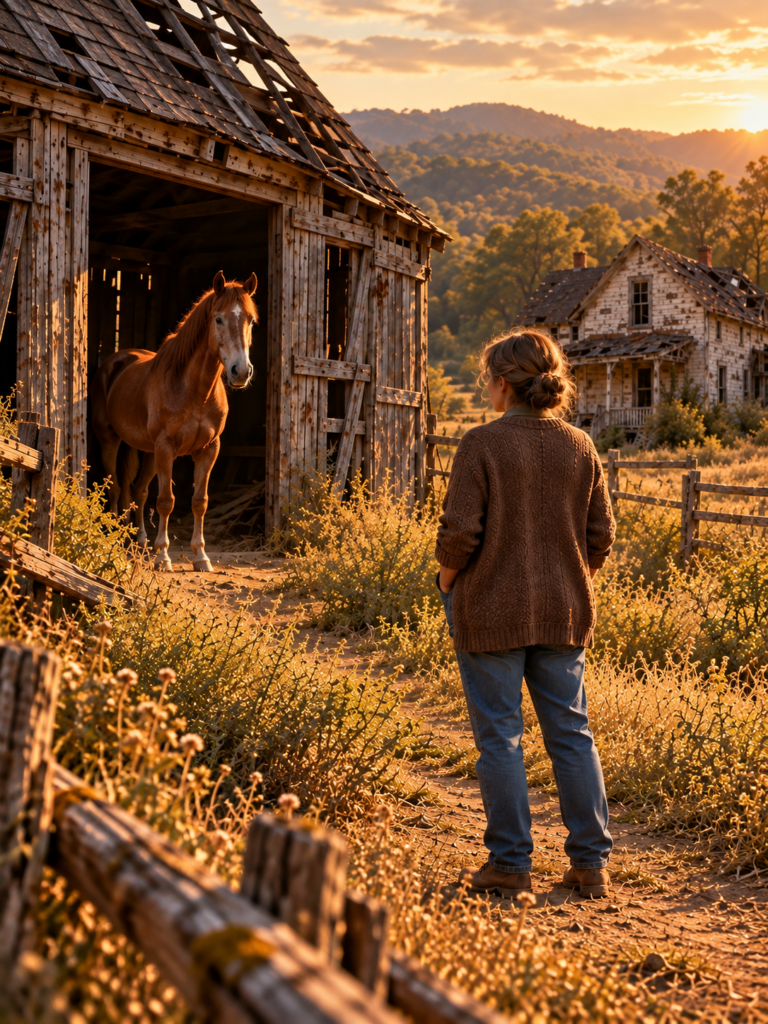
Part 1
Every evening, the old horse waited at the gate for someone who never came.
Nora Whitfield did not know that on the morning she bought the farm. She knew only what was printed on a notice pinned outside the grocery store in Millstone Creek, Kentucky.
PROPERTY AVAILABLE THROUGH MUNICIPAL RESTORATION PROGRAM.
Purchase price: one dollar.
The paper had curled at the corners from weeks of damp weather. Most people passing the bulletin board barely slowed. One man carrying a sack of potatoes read the price aloud and laughed.
“Dollar house,” he said to his wife. “That’ll cost somebody fifty thousand before it’s worth two.”
They kept walking.
Nora stayed.
At fifty-eight, she had learned there was usually a reason something cheap had been left for someone else. She also knew that expensive things could disappoint you just as easily.
For nearly twenty years she had earned her living with a sewing machine in the back of an aging station wagon. She mended cuffs for mechanics, replaced zippers in winter coats, altered Sunday dresses, shortened curtains, repaired work pants, and sometimes accepted vegetables or homemade preserves when money was scarce.
She had rented rooms above garages, in converted attics, behind kitchens, and once in a narrow trailer where the front door stuck every time it rained.
Her possessions fit into three suitcases.
She had never stopped telling herself that was temporary.
In an old cookie tin beneath her clothes, she kept her savings. On a strip of masking tape across the lid she had written SOMEDAY.
Someday she would have a kitchen where she could leave a cup beside the sink.
Someday she would plant flowers without wondering whether the landlord planned to sell.
Someday she would unpack the third suitcase.
Lately, however, the word had begun to embarrass her.
So she copied the telephone number from the notice.
By noon she was sitting across from Orson Pike at the county clerk’s office.
Orson pushed his glasses higher on his nose and spread photographs across the desk.
The house looked worse in every picture.
The porch leaned toward the yard. Paint had peeled from the siding in long strips. Rain stains darkened an upstairs ceiling. Honeysuckle had swallowed part of the railing, and the stable behind the house had a roof that sagged deeply at one end.
“You understand,” Orson said, “the dollar isn’t the expensive part.”
“I assumed there was a catch.”
“Several.”
He slid a packet toward her.
The property had been donated to the town and placed in a restoration program. Whoever took ownership had to live there and complete required repairs on a schedule. The plumbing needed work. Electricity had to be reconnected safely. The porch required reinforcement. Parts of the roof could not be ignored.
Nora read every page.
Orson watched her reach the final sheet.
“Most people see the photographs and decide the dollar was already too much.”
Nora picked up one of the pictures.
It showed the kitchen.
The walls were stained. A cabinet door hung crooked. The floor looked worn gray around the table.
But the wooden frame around the kitchen window had once been painted yellow.
Not cream. Not beige.
Yellow.
Someone had wanted that room cheerful.
“What happened to the family?” Nora asked.
“The original family left years ago. There were other arrangements and owners after that, but nobody stayed.”
“Water?”
“Can be restored.”
“Electric?”
“Same.”
She looked again at the yellow window.
Orson sighed.
“You’re still considering this.”
“I am.”
“You could spend every dollar you have.”
“That’s possible anywhere.”
He gave her a look that suggested he had no argument against a philosophy that inconvenient.
Nora counted what she could afford to risk, read the conditions one more time, and signed her name.
By late afternoon, her station wagon was rattling along a gravel lane beneath an enormous oak tree.
The farm covered twelve neglected acres.
Weeds stood high along the fence. One shutter hung by a single hinge. The porch steps complained under Nora’s weight, and when she opened the torn screen door, the house greeted her with the odor of damp lumber, dust, and old rooms shut too long.
She entered anyway.
“Home,” she said, testing the word.
It sounded too large.
She carried in her suitcases, a folding cot, two lamps, a box of dishes, and finally the sewing machine.
That went onto the kitchen table.
The faded yellow window stood above it.
Nora rested both hands on the machine.
“You and me,” she whispered.
A hollow knock came from behind the house.
She froze.
Another knock followed.
Not the sharp sound of a person at a door. Something heavier. Wood against wood.
Nora went back outside.
A path nearly disappeared beneath waist-high weeds leading toward the stable. Daylight showed through gaps in the weathered boards. Part of the roof had collapsed inward.
She stepped carefully over fallen timber.
The knock sounded again.
Under the portion of roof still standing, an old chestnut mare had pushed her nose against the latch of an empty stall.
Nora stopped.
Gray hairs covered the horse’s face. One ear carried a small notch. Her coat had lost its shine, and the angles of her hips showed more clearly than they should have.
“Hello, sweetheart.”
The mare turned her head but did not approach.
Nora remained where she was.
“Where’s your person?”
There was water in a trough. A little hay lay nearby. A brush leaned beside a bucket, and fresh hoofprints crossed the mud.
So somebody had been tending the horse.
Just not enough.
On a peg near the stall hung a faded leather halter. Nora lifted it and rubbed dirt from a small brass plate.
BELLE.
“Belle,” she said.
The mare’s ear moved.
Boots scraped outside.
Nora spun around.
An elderly man stood in the entrance carrying feed. He leaned more heavily on one leg than the other.
“Didn’t mean to scare you,” he said.
“You succeeded.”
“Sorry about that. Hollis Van. I live across the creek.”
He raised the feed sack slightly.
“I thought the town told you about the horse.”
“They did not.”
Hollis’s face tightened.
Nora looked at Belle.
“Is she yours?”
“No.”
“Does she belong to someone?”
“Not anymore, far as I know. After the last owner left, neighbors kept an eye on her.”
He set the feed down.
“A woman nearby was doing most of it until she moved. I’ve been bringing water and hay, but…” He shifted his weight, and pain crossed his expression. “My hip’s not helping matters.”
Nora heard shame in his voice and did not add to it.
“She needs a veterinarian.”
“I know.”
“Can you call one?”
“I can bring Dr. Mercer tomorrow.”
Before Nora could answer, Belle lifted her head.
The daylight outside had begun to fade.
The horse stepped past them.
Slowly, she crossed the yard.
Nora and Hollis followed.
Belle stopped inside the front gate.
She faced the road.
A truck appeared in the distance.
The mare’s ears rose.
The engine grew louder. Headlights swept briefly across the fence and Belle’s gray-marked face.
Then the truck passed.
Her ears lowered.
Nora looked at Hollis.
“Who is she waiting for?”
He rubbed his palms together.
“Couldn’t tell you what’s in a horse’s head.”
“But you’ve seen her do this before.”
“Whenever I’m here around sundown.”
“How long?”
“Folks say years.”
Hollis left after promising to return with the veterinarian in the morning.
Belle remained by the gate.
Smoke from someone’s chimney drifted across the fields. Cold gathered rapidly after sunset, but the horse seemed unwilling to leave.
Nora brought out her folding chair.
“All right, Belle,” she said. “A little longer.”
She sat beside the fence.
The old halter rested across her knees.
Near the buckle, she noticed something she had missed inside the dark stable: a thin blue ribbon tied in a small, uneven knot. Time had faded it nearly white.
Another car passed.
Belle listened.
It did not turn in.
Nora knew something about waiting for noises that did not mean what you hoped they meant.
There had been holidays when she had checked a telephone that never rang. Birthdays when she had convinced herself she preferred the quiet. Years of packing lightly so departure could look like practicality instead of loneliness.
She did not know whom Belle expected.
But she understood the posture.
Eventually the road disappeared into darkness.
Belle turned away.
Nora followed with a flashlight that flickered whenever she moved too quickly.
In the stable, the mare returned to the same empty stall and rested her nose near the latch.
There was no feed inside. No bedding. Nothing to explain her attachment to the place.
“Everybody has somewhere they remember,” Nora said.
That night, she lay on her cot in the kitchen listening to water drip through the ceiling into a metal pan upstairs.
She had bought the farm because she wanted somewhere quiet enough to stay.
Instead, she spent her first night listening for a horse.
Frost covered the weeds the next morning when Hollis arrived with Dr. Elspeth Mercer.
The veterinarian was a gray-haired woman in a wool cap who approached Belle without hurry. She allowed the mare to smell her hand before beginning the examination.
Nora stood nearby, winding a loose thread around her finger.
Finally she asked the question she had been holding.
“Can we help her?”
Elspeth examined Belle’s mouth.
“Yes.”
Nora released a breath.
“But patiently.”
The mare’s teeth needed attention. Her hooves required trimming. She was underweight, but increasing feed too quickly would create its own problems.
Elspeth wrote out measurements and schedules.
“Small steps,” she said. “Consistency matters.”
Nora glanced toward the gate.
“She stands out there every evening. Hollis says she’s done it for years. Could she be confused?”
“Possibly. Older horses can become attached to familiar routines. They can associate places, sounds, people.”
“So she might be expecting somebody.”
Elspeth closed her bag.
“We can’t know exactly what she expects.”
Nora understood the warning.
Do not turn uncertainty into a comforting story simply because you want one.
After the veterinarian left, she and Hollis worked in the stable.
They removed loose boards from the safe section. Nora spread fresh bedding. Hollis secured a door until pain in his hip made him stop and brace himself against the wall.
“You shouldn’t be doing this,” Nora said.
He looked at her.
“Neither should you.”
She laughed before she could stop herself.
For that moment, the work felt lighter.
Over the next week, Belle’s care reorganized Nora’s days.
Measured feed in the morning. Fresh water. Medication and appointments as directed. Gentle brushing when Belle accepted it.
Then Nora sewed.
The grocery store owner brought shirts belonging to his family. A woman from town needed curtains shortened. Another customer brought two pairs of trousers.
Nora divided every payment into three envelopes.
HOUSE.
BELLE.
FOOD.
The HOUSE envelope remained painfully thin.
At the county office, Orson confirmed that the prior owner had surrendered Belle along with responsibility for the neglected property. He arranged the documents allowing Nora to assume care legally.
When she finished signing them, Nora looked up.
“Why was none of this mentioned before I bought the farm?”
Orson had no useful answer.
That irritated her more than if he had offered a bad one.
Still, the paperwork meant Belle would not exist in some bureaucratic gap where everybody assumed somebody else was responsible.
At sunset, Belle kept returning to the gate.
Nora began carrying her folding chair with her.
Headlights appeared.
Belle’s ears rose.
Vehicles passed.
Her ears lowered.
Again and again.
Word about Nora’s purchase traveled through Millstone Creek.
At the hardware store, a man beside her at the counter noticed the nails, roofing patches, and fence staples piled near her register.
“You’re the woman who bought the old farm.”
“I am.”
He shook his head.
“That place will swallow every penny you’ve got.”
Nora counted money from her purse.
“Then I’d better keep sewing.”
She said it lightly.
The sentence followed her home.
That afternoon rain found a new opening in the roof.
Water began dripping near the kitchen.
A contractor’s estimate sat folded beside Nora’s sewing machine.
She could not afford it.
She sat at the table with the paper in front of her while rain tapped the yellow window.
For the first time since signing, she allowed herself to imagine leaving.
Nothing prevented her from loading the sewing machine back into the station wagon. She could find another room. She could say the house had been worse than expected.
Nobody sensible would blame her.
Outside, Belle called.
Nora did not move.
Rain hit the roof.
The horse called again, softer.
Nora closed her eyes.
Belle had no station wagon.
No suitcase.
No rented room to move into.
When Nora stepped outside, the mare was standing near the pasture opening facing the house.
Nora approached slowly.
Belle touched her muzzle to the sleeve of Nora’s coat.
She left it there.
No neighbor saw it.
There was no audience to make the moment larger than it was.
An old horse simply decided, for a few seconds, to lean into the presence of a woman who had been considering leaving.
Nora placed her hand against Belle’s warm cheek.
“All right,” she whispered.
The tightness in her chest eased.
On Sunday, rain kept both of them beneath the stable roof for most of the afternoon.
Belle ate while Nora sorted through old tools and broken containers piled along one wall.
Behind several rusted implements, she discovered a narrow cupboard.
The door resisted.
She pulled harder.
Dust fell from the top.
Inside were old brushes, scraps of leather, and a cracked picture frame.
Nora wiped the glass with her sleeve.
A man stood in the photograph beside a much younger Belle.
Next to him grinned a little girl missing both front teeth.
A blue ribbon held the child’s hair back.
Nora stared at it.
Then she looked at the faded strip tied to Belle’s halter.
Behind the people in the photograph, a wooden star had been fastened to the stall door.
Nora turned.
On Belle’s empty stall, two old nail holes remained in the wood.
Around them was the pale outline of a star.
She telephoned Hollis.
He recognized the photograph immediately.
“That’s Everett Calder.”
“And the girl?”
“His daughter. Leora.”
“What happened to them?”
Hollis hesitated.
“Bad winter drove them out. Couldn’t keep the house warm, from what my sister told me.”
“Where did they go?”
“Don’t know.”
Nora heard him sigh.
“And don’t build too much out of town talk, either. Half the things people remember after ten years never happened the way they tell them.”
After hanging up, Nora returned to the cupboard.
She reached behind the upper shelf.
Her fingers touched metal.
A small tin box had become wedged against the back.
Inside lay a child’s drawing.
A wooden star.
And several envelopes tied with string.
Some had been mailed to the farm.
Across them were stamped words:
RETURN TO SENDER.
Nora untied the string.
One envelope was dated ten winters earlier.
She unfolded the letter.
The first line stopped her.
Dear Daddy,
You said we would go back before she forgot us.
Nora looked toward Belle.
Rain blurred the pasture beyond the stable.
An engine sounded on the road.
Belle raised her head.
She listened until the sound disappeared.
Then she returned to her hay.
Nora lowered her eyes to the letter.
Someone had once promised to come back for the horse waiting at that gate.
And somewhere inside the box in Nora’s hands was the reason they never had.
Part 2
Nora sat on an overturned bucket and read.
Leora’s letter did not sound dramatic.
That made it harder.
She asked whether Belle still liked apples sliced thin.
She asked whether the mare was still frightened by thunder.
She reminded her father that he had said they would return when he had saved enough.
Near the bottom of the page, she had drawn three figures beside a gate.
A man.
A girl.
A horse.
Other papers in the box slowly filled the empty spaces.
Everett Calder’s wife had died in the autumn before the family left the farm. Medical bills had arrived alongside losses the property could no longer absorb.
Then came a bitter winter.
The pipes froze.
The furnace failed.
Everett sent seventeen-year-old Leora to stay with her aunt, Dorothea.
It was supposed to be temporary.
He found work repairing machinery two counties away. A neighbor agreed to look after Belle. In a letter to Dorothea, Everett wrote that his first spare wages would go toward bringing Leora home.
Nora read that line twice.
The next paper was a hospital notice.
A workplace accident.
Beneath it, Dorothea had written a short explanation.
Everett died from his injuries.
Nora leaned back against the cupboard.
Rain drummed on the stable roof.
Belle stood only a few yards away.
There were more letters from Leora.
After Everett’s death, she kept writing to the farm.
She knew her father could not answer.
Still she addressed the envelopes to him.
Some grief wanted a destination, even an impossible one.
The letters came back.
Return to sender.
Return to sender.
Return to sender.
Dorothea saved them.
Years later, she brought the bundle to the old farm with relatives, hoping that whoever eventually lived there would preserve them.
According to her note, she had also asked about Belle and had been assured the mare was being fed.
That promise, at least in its loosest sense, had been kept.
Someone had always brought enough hay or water to prevent the old horse from being entirely abandoned.
But between being kept alive and being properly cared for lay a great distance.
Nora looked at Belle’s thin body.
Promises could fail by inches instead of all at once.
She studied the old photograph again.
A detail caught her attention.
Behind the stall door, nearly hidden by little Leora’s skirt, stood a low stool.
Perhaps the girl had sat there while her father worked.
Perhaps Belle had come to that doorway often enough that the place itself had become part of what the mare remembered.
Nora placed the wooden star beside the photograph.
On Monday morning, she tried the telephone number written beneath Dorothea’s signature.
Disconnected.
The return address was old, but it was the only remaining possibility.
Nora wrote a letter.
She explained who she was.
She said she had recently taken ownership of the farm through Millstone Creek’s restoration program.
She described the photograph, the wooden star, the returned letters.
Then she paused.
For a long moment, her pen rested over the paper.
Finally she added:
Belle is still here at the farm. She is receiving veterinary care now.
Nora reread that sentence.
She did not promise that Belle was perfectly well.
She did not promise that anybody would answer.
She did not promise a reunion.
She had learned enough from the papers in the tin box to be careful with promises.
She sealed the envelope.
Then she went back to work.
Waiting for an answer did not stop the roof from leaking.
A stack of trousers appeared beside the sewing machine. The carpenter’s estimate remained beyond Nora’s reach.
Hollis eventually found a man willing to repair the worst section in trade.
His wife ran a boarding house and needed curtains for several rooms.
Nora agreed.
For nights afterward, cloth spread across the kitchen.
She measured panels beneath a borrowed lamp, hemmed long edges, unpicked one crooked seam, and began again.
Past midnight one evening, her eyes refused to focus.
She stopped.
Her shoulders burned.
Her fingertips ached.
For years, exhaustion had always meant one thing: keep working because rent was due.
Now it meant something different.
If she injured her hands, there would be no money for feed.
No money for boards.
No money for the house.
Nora switched off the machine.
“That’s enough,” she told herself.
Outside, she checked on Belle.
The mare was lying comfortably in clean bedding.
That alone felt like progress.
In the following weeks, winter loosened its hold on Kentucky.
Grass returned slowly.
Belle’s thick coat came away beneath the brush in dusty clumps. Her stride steadied. Her ribs became less visible.
One morning, before Nora reached the stable, Belle greeted her with a low nicker.
Nora stopped halfway across the yard.
“Well,” she said. “Good morning to you too.”
The sound became part of their routine.
Yet each evening, Belle still wandered toward the road.
The body was recovering faster than whatever habit had rooted itself in her memory.
Nora continued sitting beside her.
Some nights they waited five minutes.
Some nights twenty.
The folding chair squeaked every time Nora shifted her weight.
Two weeks after she mailed the letter, an envelope arrived.
Nora recognized none of the handwriting.
Dorothea’s son had answered.
His mother had died the year before.
He knew where Leora lived.
He would pass Nora’s message along.
Nothing else was promised.
Nora placed the response beside the old photograph and returned to sewing.
She told herself that was the end of what she could do.
Yet every time the telephone rang, she looked up too quickly.
Miles away, Leora Calder sat in an apartment above a laundry with Nora’s letter open across her knees.
She was twenty-seven now.
Ten years had passed since she left the farm.
For much of that time, she believed Belle was gone.
As a teenager, she had asked about the mare repeatedly. Her aunt had said the property changed hands and the horse was supposed to be cared for.
Later the answers became less certain.
Leora stopped asking.
At eighteen she still depended on Dorothea for a place to live and for rides to work. The world beyond that apartment had seemed larger and harder to navigate than it did from the distance of adulthood.
By the time Leora could have searched on her own, fear had replaced helplessness.
She postponed it.
One winter.
Then one spring.
Then another year.
Nobody had forbidden her from returning.
That was the part she had trouble forgiving in herself.
She told herself Belle must have been sold.
Then she told herself Belle must have died.
Each imagined ending protected her from discovering the real one.
Now a stranger’s letter lay in her hands.
Belle is still here at the farm.
Leora read the sentence again.
Her throat tightened.
She looked toward the small table where her car keys rested.
For years she had treated the farm as though it existed only behind her.
Now it had an address again.
On Saturday morning, Nora was carrying an empty bucket toward the stable when a small blue car turned into the driveway.
It stopped near the gate.
A young woman climbed out.
She wore a plain brown coat.
For several seconds she did not move.
Then she looked toward the house.
“Mrs. Whitfield?”
Nora set down the bucket.
The woman held a folded piece of paper in one hand.
Her eyes were already moving past Nora toward the pasture.
Nora knew.
“Leora?”
She nodded.
“I meant to call. I kept thinking I should. I didn’t know what to—”
“You don’t need to.”
Nora opened the gate.
Leora walked into the yard.
Halfway to the stable, she stopped.
Belle stood beneath the doorway where sunlight reached across her shoulders.
The gray around the mare’s face was unmistakable.
Leora’s hand rose to her mouth.
“Oh.”
Belle looked toward her.
“You’ve gotten old,” Leora whispered.
Her face folded.
For a moment, neither moved.
Nora held her breath without intending to.
Then Leora made a small clicking sound with her tongue.
Soft.
Familiar.
“Come here, my Sunday girl.”
Belle’s ears came forward.
The mare gave a deep nicker.
Nora had heard Belle call at dawn. She had heard her answer from the pasture and complain when breakfast seemed late.
She had never heard that sound.
Belle stepped from the stable.
She crossed the yard slowly.
Age shortened her stride, but she did not hesitate.
Leora remained where she was.
Tears ran freely down her face.
When Belle reached her, the mare pushed her muzzle into Leora’s hands, breathed against her cheek, then pressed beneath her chin.
Leora gave a broken laugh.
She buried her face in the horse’s mane.
“I’m sorry.”
Belle stood still.
“I asked about you,” Leora whispered. “I did. I didn’t know where to turn.”
Her fingers found the notch in Belle’s ear.
“I’m sorry it took so long.”
Nora backed away.
There were moments made smaller by witnesses.
At the gate, Hollis appeared carrying feed.
He saw Leora and stopped.
After a second, he wiped his eyes with the back of his hand.
Neither he nor Nora spoke.
The bucket Nora had set down had tipped onto its side.
She picked it up because ordinary tasks sometimes rescued people from emotions too large to hold gracefully.
Leora remained with Belle until sunset.
At the gate where the mare had waited so many evenings, the young woman rested one hand against Belle’s neck.
This time, when they turned toward the stable, they turned together.
After Belle settled for the night, Leora approached the porch.
“Could I stay until morning?”
Nora thought about the upstairs bedroom she had not yet used.
A clean quilt remained folded in one of her suitcases.
The kitchen still had only one proper chair.
“Yes,” Nora said. “We’ll make room.”
She carried the quilt upstairs.
Leora hovered in the doorway as though waiting to be told how much space she was allowed to occupy.
Nora spread the quilt across the foot of the bed.
“You can close the window if it sticks.”
“I remember that window.”
“You do?”
“It stuck when I was little too.”
That made Nora smile.
Downstairs, pipes knocked when Leora ran water.
The bedroom window shut firmly now.
Before going to bed, Nora left the hallway light on.
She did not mention doing it.
The next morning there were two cups beside the stove.
Nora brought down an extra chair from upstairs. One leg was short, so Leora folded a piece of cardboard and tucked it underneath.
Neither woman mentioned when she planned to leave.
Belle grazed outside the open kitchen window.
The scrape of grass between the mare’s teeth drifted into the room.
Nora made the coffee stronger than usual.
Leora drank it anyway.
“That picture you found,” Leora said eventually. “I was much younger when it was taken. I was seventeen when Daddy and I actually left.”
Nora nodded.
“The stall?”
“Daddy made a little place there for me when I was small. That stool in the picture was mine. I’d sit while he worked.”
“And Belle came to the door.”
“Every time.”
Leora smiled faintly.
“She knew where I kept apple slices.”
Nora set her cup down.
“The later letters were after your father died?”
Leora looked through the window.
“Yes.”
She was quiet for several seconds.
“Writing to the farm was the closest I could get to talking to him. I knew it made no sense.”
“It didn’t have to.”
“My aunt saved every one.”
“She did.”
“Eventually I stopped writing. Then I convinced myself coming back would only hurt.”
Her fingers tightened around the cup.
“After that I thought I’d waited too long.”
Nora placed one hand on the table near Leora’s, not touching her.
“You’re here now.”
The following Saturday, the blue car returned.
This time Leora brought work gloves.
And groceries.
The weekend after that she arrived with paintbrushes and stayed through Sunday afternoon.
Soon Nora began listening for the car without admitting she was doing it.
Belle always heard it first.
Her head would lift before the vehicle appeared beyond the trees.
By June, Leora had found work at a feed store nearby.
A few days later, boxes appeared in the upstairs hallway.
Nora helped hang curtains.
Drawers that had sat empty began opening and closing.
Shoes remained beside the stairs overnight.
Two coats hung near the door.
For the first time in years, neither woman kept a suitcase packed beneath her bed.
It did not turn them instantly into a family.
Healing proved less orderly than that.
Some mornings Leora woke from dreams about Everett and went directly to the stable without speaking.
Some weeks Nora counted her cash twice before buying something as small as new socks.
Habits built during years of insecurity did not disappear because the kitchen now contained two coffee cups.
Still, flowers appeared beside the porch.
Laughter started carrying through the yellow-framed window.
There were two pairs of hands for evening chores.
Belle no longer stood alone at the gate.
During one of Elspeth’s visits, the veterinarian mentioned another horse.
An elderly gelding.
His owners had moved away. He had temporary shelter, but the woman currently feeding him could not keep doing so.
Nora’s first instinct was immediate.
Then she looked around the stable.
“We’ve barely managed one.”
Elspeth nodded.
“Which is why I’m not asking for an answer today. Think about it.”
That night Nora and Leora covered the kitchen table with bills.
They counted wages.
Savings.
Feed costs.
Veterinary care.
Fencing.
Hay.
Repairs.
An emergency reserve.
Nora thought about the way Belle had been “cared for” before she arrived—enough good intentions scattered among enough people that nobody had noticed when the actual standard of care slipped.
She would not repeat that mistake.
“Wanting him isn’t the same as being able to keep him,” Nora said.
Leora drew a line beneath the figures.
“No.”
“We need shelter first.”
“And fencing.”
“Regular hay delivery.”
“A reserve we don’t touch for curtains or paint.”
Nora looked at her.
Leora nodded.
“We start small. Only what we can care for.”
Nora opened the drawer where she kept the envelopes.
HOUSE.
BELLE.
FOOD.
She took out a fourth.
Across the front she wrote:
HORSES.
The word felt larger than the envelope.
For the next six weeks, they prepared before promising anything.
Hollis located sound used fencing.
Elspeth advised them on keeping a new arrival separate at first.
Nora accepted several quilt orders for the coming winter.
Hay deliveries went onto the calendar.
They calculated again.
And again.
By August, they were ready.
The gelding’s name was Amos.
He stepped from the trailer with his head low.
Belle watched from the adjoining pasture.
She called softly.
Amos lifted his ears.
Nobody rushed them.
For days the horses remained separated, able to see and smell one another across the dividing fence.
Eventually Belle began grazing close to it.
Amos did the same from his side.
That was enough.
The farm that had once seemed unable to hold one future was quietly making room for another.
Part 3
The word sanctuary began as something Leora said one evening while closing the stable.
Not a grand plan.
Not a sign hung over the gate.
Just a description of what the place was becoming.
Nora resisted it at first.
“Sounds expensive.”
Leora laughed.
“It already is.”
But they took the idea seriously enough to ask what responsibility would come with it.
They spoke with people who knew more than they did.
They worked through paperwork.
They built a budget.
Neighbors offered to help with chores.
And before accepting another animal, Nora and Leora established a rule:
They would keep only as many horses as they could properly support.
The rule mattered almost immediately.
Someone called about three horses that needed a place.
Nora wanted to say yes.
She could picture them in the field before the conversation even ended.
Instead she looked at their figures.
They did not have the money.
They did not have enough shelter.
They did not have enough dependable labor.
So she said no.
After the call, Nora sat on the porch and cried.
Leora sat beside her.
“I hate this.”
“I know.”
“They need somewhere.”
“I know.”
Nora wiped her eyes angrily.
“What kind of sanctuary refuses horses?”
“The kind that feeds the ones it already promised to feed.”
Nora stared toward the pasture.
Belle and Amos grazed near the fence.
Leora slipped an arm around her shoulders.
“A promise has to fit what we can do.”
The words stayed with Nora.
They found another rescue that had room for the three horses.
It was not the heroic answer Nora wanted.
It was the responsible one.
Upstairs, Everett’s old letters remained protected in their box.
Sometimes Nora thought about the careful plans he had written down before the accident.
He had intended to earn money.
Repair what was broken.
Bring Leora home.
Keep Belle.
He had not abandoned those intentions.
Life had simply ended before he could carry them out.
Nora could not control accidents, illness, weather, aging, or the price of hay.
What she could control was whether pride stopped her from asking for help.
So she began asking.
When the porch needed extra hands, she asked.
When fencing required a stronger back than hers, she asked.
When costs rose, she admitted it.
Hollis came when his hip allowed.
Neighbors brought tools.
Elspeth continued guiding them.
The farm improved one unremarkable repair at a time.
Then October arrived.
Orson Pike returned carrying a clipboard.
Nora had spent the morning pretending she was not nervous.
He inspected the house from foundation to roofline.
He stepped carefully onto the porch.
It no longer shifted under his weight.
He examined the rail.
The repaired ceiling.
The restored utilities.
He checked his papers.
Nora followed him from room to room with her hands clasped too tightly.
Finally he stopped in the kitchen.
Sunlight came through the yellow-framed window.
Her sewing machine stood beneath it.
There were two mugs in the dish rack.
A grocery list was pinned near the stove.
Work gloves lay on the back step.
The room no longer looked like a photograph of an abandoned property.
Orson made one final note.
“You’ve met the repair requirements.”
Nora did not answer immediately.
She realized she had been holding her breath.
At the front door, Orson rested a hand against the frame.
“I was wrong about this place.”
Nora looked past him toward the stable.
Belle and Amos stood beneath the oak while October leaves drifted into the pasture.
“It needed work,” she said.
“So did my opinion.”
After he drove away, Nora remained on the porch.
The property was no longer something she might lose because she had failed its restoration requirements.
It was hers.
The realization arrived without trumpets.
No sudden fortune.
No buried treasure.
No miraculous disappearance of expenses.
Just a legal certainty attached to a place she had repaired board by board and bill by bill.
Leora came outside.
“Well?”
Nora handed her the inspection paper.
Leora read it.
Then she hugged her.
Nora stood stiffly for half a second before returning the embrace.
Over Leora’s shoulder, she saw Belle raise her head.
Once, Nora had thought owning a home meant having walls no landlord could take away.
Now that seemed incomplete.
A home was also people who knew which cupboard held the coffee.
Someone whose car you recognized before it reached the driveway.
A horse who called when she heard your footsteps.
The next spring, Belle’s story traveled farther than Millstone Creek.
With Leora’s permission, a local newspaper printed an article about the mare who had remained on the farm long after the Calder family disappeared from it.
People responded.
Not with enormous checks.
Mostly with useful things.
Hay money.
Buckets.
Fence boards.
Small donations.
One person left a note saying she could only afford five dollars but wanted it to help.
Nora wrote a thank-you message to every donor.
She knew what carefully protected money meant.
For years she had guarded her someday fund coin by coin.
Now strangers were placing pieces of their own somedays into envelopes for horses they had never met.
On Saturdays, volunteers came to the farm.
Nora and Leora refused to let enthusiasm replace routine.
New helpers learned how much each horse ate.
They learned which gates had to remain closed.
They checked the notebook Leora kept near the stable door.
Nobody guessed.
Nobody assumed someone else had done a job.
When rain ruined an afternoon of repairs, several neighbors returned the following weekend carrying tools and dry gloves.
Hollis sat on a folding chair and gave instructions until Nora accused him of enjoying the authority.
“I’ve waited years for people to appreciate my expertise.”
“You mean your ability to point?”
“Highly specialized skill.”
Even Nora laughed.
Months passed before they considered adding another horse.
They reviewed donations.
Hay costs.
Veterinary costs.
Volunteer schedules.
Only when regular contributions covered the additional expense and a dependable helper committed to morning chores did they agree.
The sanctuary grew to three horses.
Then it stopped.
Their written limit remained posted inside the feed cupboard.
Nora saw it every morning.
Three.
There was humility in a number.
Opening the sanctuary had not created more acreage.
It had not made feed cheaper or winter shorter.
It had simply turned responsibility from something two women carried alone into something a small community could share.
At the first open afternoon, families came through the gate.
Nora recognized the man from the hardware store.
Months earlier, he had predicted the farm would swallow every penny she owned.
Now he was carrying two feed tubs.
He looked over the repaired porch.
“Hasn’t swallowed you yet.”
Nora took one handle of a tub.
“Give me a hand with these.”
He did.
Near the stable, Leora hung the wooden star that had once marked her childhood corner.
The old photograph stood nearby.
The blue ribbon had been protected behind glass.
Leora did not hide what the objects represented.
She also did not turn them into a legend more perfect than the truth.
Her father had loved her.
He had planned to return.
Then an accident ended the plan.
She had stayed away too long because grief and fear were easier to postpone than to confront.
Belle had remained.
That was the story.
Children gathered near the fence while volunteers showed them how to approach safely.
Small palms opened flat.
The horses watched.
Belle carried no riders.
Nobody asked her to perform.
At her age, a quiet field, regular care, familiar voices, and an evening beside the stable were enough.
As the afternoon ended, cars disappeared one by one down the road.
Golden light spread across the pasture.
Leora stood beside Belle at the gate.
The old mare’s gray face rested near her shoulder.
Nora joined them.
For a while, none of them spoke.
Then Leora looked toward the stable where the wooden star now hung again.
“Do you think Daddy would understand?”
Nora put one hand on the weathered fence rail.
There were easy answers people gave when they wanted grief to become tidy.
She had no interest in giving one.
So she considered the question.
“I think,” Nora said slowly, “he’d be glad you found your way back past the gate.”
Leora looked down.
Her hand moved over Belle’s neck.
The other horses were settling farther out in the pasture.
Lights glowed through the farmhouse windows.
Supper waited inside.
Belle turned toward the road.
The old habit had never vanished completely.
For a few seconds she watched the empty stretch beyond the fence.
Years ago, she might have remained there until darkness.
Leora made the familiar clicking sound.
“Come along, my Sunday girl.”
Belle’s ears turned first.
Then her head.
Then her whole body.
She followed Leora toward the stable at the slow pace age required.
Nora stayed behind to fasten the gate.
Her hand rested on the latch.
She remembered her first evening there.
A broken house.
Twelve acres of weeds.
A nearly empty savings tin.
An old chestnut mare watching headlights pass without turning into the driveway.
Back then, Nora had believed she was the one taking the risk.
She thought she had bought a ruin because she was tired of temporary rooms.
She had not understood that the farm held its own unfinished waiting.
A child’s stool.
A wooden star.
Returned letters.
A faded blue ribbon.
A promise made by a father who had intended to keep it.
A daughter who thought she had waited too long.
A horse who kept returning to the gate.
Nora fastened the latch.
The metal clicked securely into place.
Across the yard, Leora waited beneath the stable light with one hand resting against Belle’s neck.
The farmhouse behind them was no longer silent.
There were groceries in the cupboards.
Two bedrooms in use.
Boots beside the door.
Bills on the kitchen table.
A sewing machine under the yellow window.
Three horses whose care had been measured before it was promised.
There were neighbors who knew the feeding schedule and volunteers who came back after the rain.
There were people at Nora’s table now.
There were animals who recognized her footsteps.
And the old mare no longer needed to face the road alone.
Nora crossed the yard toward them.
After ten years of waiting, Belle’s family was home.


