The Duke Gave Her a Ruined Estate to Be Rid of Her — She Made It the Finest in the County
Part 1
By the time Edmund Vale, Duke of Ravensmere, offered Lady Clara Renford Hawthorne Grange, Clara had learned that generosity and dismissal could arrive wrapped in the same ribbon.
The conveyance papers lay between them on the broad mahogany desk in Edmund’s library, tied neatly in blue and stamped with the seal of Ravensmere. Beyond the tall windows, November rain had reduced the gardens to gray shapes behind streaked glass.
“The property would be transferred to you outright,” Edmund said. “The house, the surrounding farmland, and the associated leases.”
Clara kept her attention on the documents.
For nearly two years, since the death of her husband, she had lived at Ravensmere because everyone involved had agreed it was sensible. She possessed limited independent income. Edmund was her late husband’s cousin and head of the family. Ravensmere had rooms enough to accommodate a widow without inconvenience.
At least, that had been the theory.
Edmund had never treated her cruelly. Cruelty might almost have been easier to understand. He paid the expenses that properly fell to him, ensured her rooms were comfortable, saw that a carriage was available when needed, and addressed her with unfailing courtesy.
He treated her, Clara sometimes thought, exactly as a conscientious man treated a responsibility he intended to discharge correctly.
Courtesy could make a person nearly as invisible as contempt.
“Why Hawthorne?” she asked.
“Because it is unoccupied.”
She looked at him then.
Edmund leaned back.
He knew perfectly well that she would wait.
“And,” he added, “because maintaining the present arrangement indefinitely benefits neither of us.”
There it was.
His widowed aunt disliked Clara’s habit of noticing household accounts. The steward disliked being asked why expenditures repeated year after year without apparent justification. Guests occasionally mistook Clara’s position within the family and then became embarrassed when the relationship was explained.
Clara herself had grown tired of occupying handsome rooms in which every polished table, warmed fireplace, and folded linen reminded her that nothing around her belonged to her.
Apparently Edmund had grown tired as well.
“What condition is Hawthorne in?”
“The house has been closed for several years.”
“That wasn’t my question.”
A faint tightening appeared around Edmund’s mouth.
“Some repairs will be necessary.”
Clara almost smiled.
Edmund’s phrase some repairs had once been used to describe a stable roof that needed to be replaced almost entirely.
“And the land?”
“Marginally productive.”
“Tenants?”
“Several.”
“Income?”
A pause.
“Limited.”
His hesitation answered more accurately than the word.
Clara placed two fingers against the blue ribbon.
“You are giving me an estate that costs more than it earns.”
“I am transferring property without mortgage, together with funds sufficient for essential repairs.”
“Because you believe it will give me independence.”
“Would you prefer that it did not?”
Something had entered his voice now—not anger, exactly, but impatience at having a practical arrangement examined for motives.
Clara studied him.
“Independence and exile can look remarkably similar from the house doing the sending.”
His expression changed by less than most people would have noticed.
“No one is exiling you.”
“Of course not. You are transferring property.”
She did not accuse him further because, unexpectedly, she found she no longer cared enough about his motive.
For years, the important decisions of her life had arrived already settled. Her marriage settlement. Her household. Her widow’s allowance. Her rooms at Ravensmere. The invitations suitable for her. The amount considered appropriate for her comfort.
Hawthorne might be damp, unprofitable, and half ruined.
It might even be a burden disguised as generosity.
But the documents contained one fact none of those earlier arrangements had contained.
Hawthorne would be hers.
“May I see the estate accounts?”
Edmund’s eyebrows rose.
“Before you decide?”
“Before I decide what needs to be done.”
Silence passed between them.
“Then you accept?”
Clara untied the ribbon.
“I accept the property. I make no promises about remaining grateful for the manner in which it was given.”
Three weeks later, her carriage passed between leaning stone gateposts bearing the weathered name HAWTHORNE GRANGE.
The first sight of the house justified nearly everything Edmund had neglected to say.
The drive had almost disappeared beneath encroaching growth. Dead leaves choked the gutters. One shutter hung crooked beside an upstairs window, moving slightly in the wind. The eastern roofline sagged enough to be visible even through the rain.
Beyond the manor, neglected hedges had swallowed stretches of old boundary wall.
An elderly man waited beneath the entrance portico.
He watched Clara’s modest luggage being unloaded with the solemn expression of someone witnessing a temporary inconvenience.
“Mr. Pritchard?” Clara asked.
“Yes, my lady.”
He had served as Hawthorne’s steward for years.
Clara looked at the manor, then at the fields beyond it.
“Where are the ledgers?”
His expression changed.
Not much.
Enough.
The estate books were kept in a room that had once been used for breakfast and now smelled of damp paper, soot, and old apples. Mr. Pritchard removed them from a locked cabinet after wrestling twice with the rusted key.
Clara spent the rest of the afternoon beside a smoky fire turning pages.
By dusk she understood why Edmund had chosen the phrase marginally productive.
It was almost charitable.
Three tenant cottages stood empty because their roofs had failed. Two occupied farms were months behind on rent. The dairy herd had been repeatedly reduced after winters of poor feed. Sheep losses appeared year after year beneath explanations no more precise than weather.
The orchard income had declined steadily.
There was no corresponding record of serious pruning, replanting, or drainage.
A millstream crossed Hawthorne land. The mill itself had been inactive for nearly ten years.
Clara looked up.
“How many men does Hawthorne employ directly?”
Mr. Pritchard hesitated.
“Regularly?”
“Regularly.”
“Nine.”
“And five years ago?”
“Closer to twenty.”
“Where did the others go?”
“Railway works. Town. Seasonal employment elsewhere.”
Clara looked again at the wage columns.
“Or they stopped finding employment here.”
The steward’s mouth tightened.
She understood his resentment. He had served Hawthorne longer than she had been married. Now a woman he barely knew had arrived with two trunks, mud on the hem of her traveling dress, and questions about accounts he had managed under men who had rarely asked any.
Understanding his resentment did not require submitting to it.
The next morning, Mr. Pritchard suggested a carriage.
Clara refused it.
If she was going to own Hawthorne, she wanted to know what its roads felt like under her boots.
Frost silvered the grass. The cold stung her cheeks. Hedges had grown so far over one lane that two carts would have struggled to pass.
At the first occupied cottage, she found three children wearing boots that had plainly served older siblings before them.
The roof had been patched.
At another cottage, an elderly tenant showed her a wall blackened by moisture where rain entered around a cracked chimney.
No one complained dramatically.
That disturbed Clara more than anger would have.
People spoke with the measured resignation of those who had learned that reporting a problem and having someone care about it were separate things.
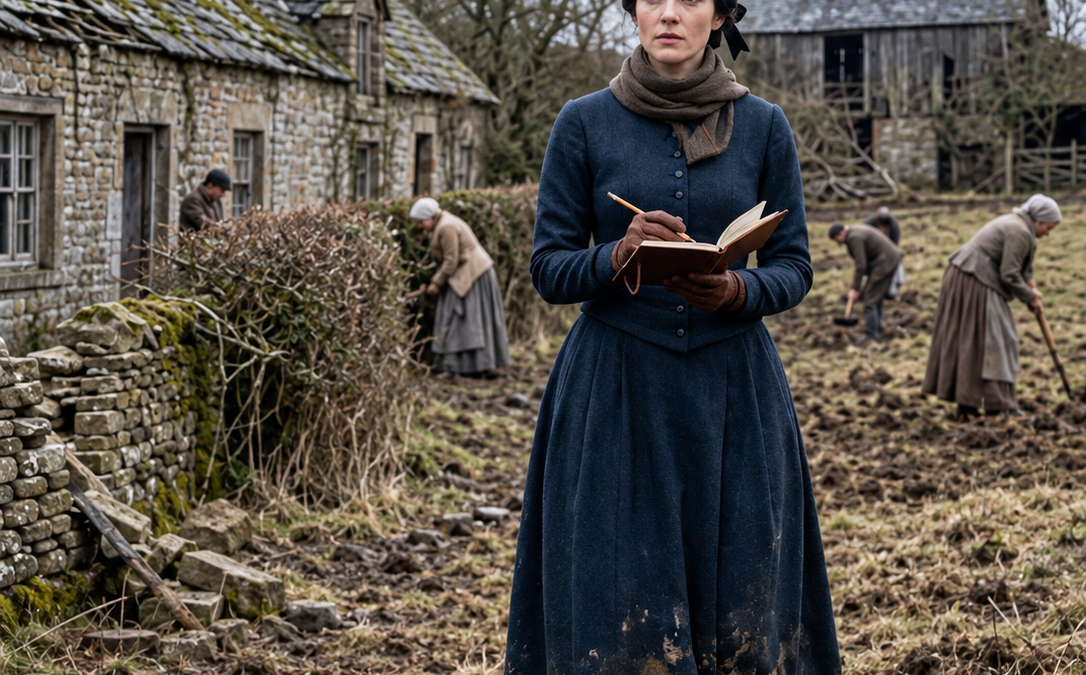
Clara took out a small notebook.
She asked which fields flooded first.
When rents came due.
How far produce traveled to market.
Which orchards still bore good fruit.
How much feed was needed through winter.
Which young men had left for railway work.
Which women took in sewing to supplement farm income.
By the time she returned to the manor, her hem was brown with mud and her gloves were damp through.
Mr. Pritchard waited in the hall.
“My lady, if you intend to sell the estate, I could provide a more useful summary than all this wandering.”
Clara removed one glove finger by finger.
“Do you expect me to sell?”
“Most owners would.”
“Most owners did not request the ledgers before taking possession.”
He seemed uncertain whether he had been criticized.
“Hawthorne has not paid its way in years,” he said.
“Then I need to determine whether the problem is the land, the management, or both.”
Over the following days, she began separating neglect from necessity.
The eastern roof could not wait through another winter.
The empty cottages needed estimates before deterioration made repair uneconomical.
Some tenants owed rent they had no realistic means of paying under their current arrangements. Others appeared to have treated delayed payment as a habit rather than a hardship.
Clara ordered no grand restoration.
She dismissed no one.
She asked for costs.
Names.
Dates.
Alternatives.
Mr. Pritchard seemed almost more unsettled by this than he would have been by extravagance.
On her fifth evening, Clara found an older estate map folded behind a stack of leases.
She carried it to the table and opened it beneath the lamp.
Along the southern slope, six acres were labeled as orchard.
Beside them ran the millstream, with a channel marked toward a stone structure she remembered passing at a distance.
When Mr. Pritchard entered, she tapped the map.
“Tomorrow I want to see the old mill.”
For the first time since her arrival, his face showed something besides caution.
The mill stood half concealed behind alder and bramble at the lower edge of the southern fields. Moss covered the wheel. Damp had darkened the stone walls.
Mr. Pritchard seemed prepared for Clara to look inside, pronounce it a ruin, and move on.
Instead she followed the channel back toward the stream.
“When was the sluice gate last repaired?”
“I couldn’t say exactly.”
“Where does the flow weaken?”
“It doesn’t greatly. The race is clogged.”
“Who mills the local grain now?”
“Mostly farmers cart it elsewhere.”
“How far?”
“About eight miles for some.”
Clara stopped.
“Eight miles?”
“Yes, my lady.”
Before noon she knew three things.
The water supply remained usable.
The main stone structure was sound.
And a former millwright named Thomas Bell lived less than two miles from Hawthorne.
“Why was this never restored?” she asked as they climbed toward the manor.
Mr. Pritchard chose his words carefully.
“The trustees considered the expense unjustified given Hawthorne’s income.”
Clara looked toward the orchard.
Even in winter, neglect had a visible shape. Branches crossed one another in dense tangles. Fallen leaves had filled drainage channels. Some trees were dead.
Many were not.
“Perhaps Hawthorne produced what everyone expected it to produce,” she said.
She began with decisions that did not require gambling the estate on optimism.
Two cottage roofs were replaced before the harshest winter weather.
The cracked chimney was rebuilt.
Rent accounts were reviewed family by family.
One household received additional time after Clara learned illness had reduced its earnings.
Another tenant, who had fallen equally far behind despite selling wool profitably, received no such concession.
Mr. Pritchard questioned the difference.
“Would it not appear more generous to treat them alike?”
“Generous, perhaps. Fair, no.”
He frowned.
Clara closed the ledger.
“One cannot pay because his household lost income. The other chose not to pay while meeting every expense he considered more important. If I treat those circumstances as identical, I am not being compassionate. I am refusing to pay attention.”
Something changed after that.
Mr. Pritchard stopped bringing her neat summaries.
He brought original records.
When she noticed that sheep losses were consistently higher in one pasture, he did not merely tell her the weather had been severe. He took her to the field.
They found the lower boundary poorly drained and the pasture exposed to northern winds.
Repairing an old stone shelter and moving the flock sooner when bad weather threatened cost comparatively little.
Losses declined.
The orchard was more difficult.
Clara hired two local men who had once worked fruit trees before leaving Hawthorne for seasonal labor. Diseased branches came down. Drains were reopened. Healthy trees were identified for grafting.
Some rows would require years to replace.
Others had been pronounced exhausted when they were merely uncared for.
Thomas Bell inspected the mill in January.
He spent nearly two hours inside.
When he emerged, dust coated one shoulder of his coat.
“The wheel needs rebuilding,” he said. “Gearing’s worn. Race needs clearing.”
Mr. Pritchard folded his arms as if waiting for the inevitable conclusion.
Thomas looked back at the building.
“But the stonework is better than it appears.”
Clara asked, “Could it serve Hawthorne farms again?”
“Hawthorne and three neighboring farms, if they wished to use it.”
“How much?”
Thomas named a rough figure.
Clara did not authorize the work.
Not yet.
She asked for timber costs, stone repairs, expected grain volume, probable tolls, and the expense local farms currently incurred transporting grain eight miles elsewhere.
Only when the numbers supported the investment did she approve restoration.
By early spring, no visitor would have mistaken Hawthorne for a transformed estate.
The manor still needed paint.
The eastern wing remained closed.
Several fields showed the effects of years of poor rotation.
Yet the place had begun to behave differently.
Men who previously left for seasonal work now had paid repair work close to home.
Tenants came to the estate office with questions instead of apologies.
Emergency costs decreased.
Receipts became more regular.
One March evening, Mr. Pritchard entered the dining room while Clara was reviewing accounts beside the rain-darkened windows.
He placed a report near her hand.
“The dairy cleared a surplus this month.”
Clara looked up.
“How much?”
He told her.
It was not a large number.
Once, living at Ravensmere, she might have considered it almost trivial.
Now she knew how many roof slates could be hidden inside a modest surplus. How much winter feed. How many days’ wages.
“And the mill?”
“Bell says three weeks.”
Clara wrote the date in the margin.
Mr. Pritchard remained beside the table.
She glanced up again.
“Something else?”
He hesitated.
“I believe the orchard may bear better than we expected.”
Clara closed the ledger.
“So do I.”
Hawthorne was not prosperous.
Not yet.
But the estate Edmund had given away because he thought it burdensome had begun, quietly and unmistakably, to answer back.
Part 2
Edmund first realized Hawthorne was changing when his steward placed the quarterly reports on the Ravensmere library desk and left one sheet separate from the others.
“Hawthorne Grange,” the steward said. “Lady Clara’s accounts.”
Edmund looked down with little interest.
Then he looked again.
Repair expenses were substantial, though not reckless. Rent collection had improved. Livestock losses had fallen. The dairy had produced a small surplus.
Then he found the note about the mill.
“She authorized this?”
“Yes, Your Grace.”
Edmund studied the projected costs.
“And the orchard?”
“Being restored.”
When Edmund transferred Hawthorne to Clara, he had imagined the property would give her something to occupy her attention while putting enough distance between them to settle the discomfort at Ravensmere.
He had expected maintenance.
Perhaps a few redecorated rooms.
Some repaired cottages.
He had not expected a strategy.
By late April, curiosity had developed into concern. On paper, Clara’s program of repairs looked ambitious. Edmund decided to inspect the estate before enthusiasm consumed whatever income Hawthorne possessed.
The first surprise appeared before he reached the manor.
The drive had been cut back sufficiently for two carts to pass.
Boundary walls had been repaired.
New slate showed against older stone on several cottages.
Edmund noticed these things precisely because he had expected to see deterioration.
Clara met him outside the manor in a practical walking dress. Soil marked her gloves.
“You might have written,” she said.
“I did.”
“Your letter arrived this morning.”
“Then technically I did write.”
Her expression informed him how little value she placed on technical victories.
She took him first toward the mill.
The wheel was turning.
Water struck its paddles in a steady rhythm while Thomas Bell and two younger men worked inside around the restored gearing.
Sacks of grain stood beneath a newly built lean-to.
Edmund stopped.
“How much did this cost?”
Clara gave him the figure.
It was lower than he had expected.
“And the return?”
“If neighboring farms continue using it, the repairs should be recovered within four years. Possibly sooner if grain prices are favorable.”
She did not speak as someone defending an indulgence.
She spoke like someone who knew the numbers because the numbers mattered.
They continued uphill.
The orchard looked almost bare compared with its former tangle. Pruned limbs had been stacked between rows. Clean drainage channels followed the slope.
Edmund touched the trunk of an old tree.
“I was told these orchards were exhausted.”
“They were neglected.”
“The distinction appears expensive.”
“Less expensive than abandoning productive land because nobody bothered to examine it.”
The rebuke landed cleanly.
Edmund looked across Hawthorne.
He had expected Clara to make the estate comfortable.
Instead, she had made it function.
Tenants addressed her directly as they passed. One asked about fencing timber. Another reminded her of a meeting over grazing rights.
Nobody performed gratitude for her.
That impressed Edmund more than gratitude might have.
They treated Clara as a person whose decisions mattered because she understood what those decisions affected.
“You have changed a great deal here,” he said.
Clara turned.
“No. I changed what was failing.”
“That sounds like a distinction designed to avoid praise.”
“It is a distinction designed to avoid misunderstanding.”
He waited.
“Hawthorne was not worthless before I arrived,” she said. “The land was here. The water was here. The people were here. The skills were here.”
She nodded toward the mill below.
“What was missing was attention.”
Edmund had no answer.
Months before, he had transferred Hawthorne because removing Clara from Ravensmere had seemed simpler than reconsidering the assumptions governing his household.
Standing now among working fields and repaired walls, he realized he had made the same mistake about the estate and the woman who owned it.
He had seen neglect and assumed lack of value.
Clara followed his gaze toward the turning mill wheel.
“You did not give me something valuable because you recognized its worth,” she said. “You gave me what you had stopped looking at.”
By midsummer, neighboring landowners had begun speaking of Hawthorne as though its improvement had occurred overnight.
Clara knew differently.
There had been nothing sudden about arguments over timber costs, calculations of mill tolls, drains reopened foot by foot, trees pruned one branch at a time, or rent arrears reviewed household by household.
The dairy’s improvement came from ordinary decisions about feed, breeding, and transport.
Those decisions were too dull for dinner-table conversation.
Their results were not.
Sir Malcolm Avery visited ostensibly to inspect the mill and spent much of the afternoon asking Clara how she had negotiated better prices for fruit shipments.
Mrs. Fenwick from Easton Park requested the name of her orchard foreman.
Two neighboring farmers asked to bring grain to Hawthorne.
Clara agreed.
Mr. Pritchard looked over the proposed rates.
“You could charge them more.”
“Why?”
“They have nowhere closer.”
“Then proximity is already our advantage.”
“They would pay it.”
“That doesn’t mean they should.”
Mr. Pritchard waited.
Clara returned the paper.
“The same fee for everyone.”
The mill became profitable before the end of summer.
Its value extended beyond the money entering Hawthorne’s accounts. Tenants no longer spent as much transporting their grain. Regular traffic returned to a corner of the estate that had stood nearly deserted.
The orchard rewarded them more slowly.
Then came the first serious harvest.
It exceeded even Mr. Pritchard’s revised estimates.
Hawthorne had traditionally sold through one merchant at terms no one had challenged for years.
Clara invited three buyers to bid.
She negotiated transportation separately.
Mr. Pritchard stared at the resulting figures.
“We have never received this much.”
“That does not mean the apples suddenly became better.”
“No.”
“It means we discovered what someone was prepared to pay for them.”
The increased revenue repaired two more cottages and replaced fencing along the western pasture.
At the August market, a gentleman Clara barely knew congratulated her on her “charming experiment.”
Another asked whether she planned to continue personally managing Hawthorne when the novelty faded.
Clara answered, “I imagine I shall continue as long as the property requires management. Estates are inconsiderate that way.”
Mr. Pritchard turned his face away before anyone could see him smile.
The remarks no longer wounded Clara as they once might have.
The ledgers had become more useful measures of reality than strangers’ opinions.
Success, however, produced complications as surely as failure did.
Two families from neighboring properties requested Hawthorne tenancies after hearing that Clara handled rent difficulties individually.
She refused to consider either until satisfied that no existing Hawthorne household would be displaced.
A merchant offered favorable terms in exchange for exclusive rights to future orchard harvests.
The immediate offer was tempting.
Clara calculated what it would mean over several seasons and declined.
“Too restrictive?” Pritchard asked.
“In three years we would regret the first year’s convenience.”
She was learning that desperation tempted people into bad decisions by offering immediate relief.
Prosperity tempted them by calling the same decisions opportunity.
Edmund heard about Hawthorne increasingly from other people.
Letters from neighboring estates mentioned Clara’s methods.
Ravensmere tenants began comparing drainage improvements and rent practices with those at Hawthorne.
At a county dinner, Sir Malcolm Avery raised his glass toward Edmund.
“Ravensmere, you discarded the one estate everyone now wishes he owned.”
The table laughed.
Edmund did too, because courtesy required something.
The remark followed him home.
Several days later he asked for Hawthorne’s latest figures.
The numbers had ceased being merely encouraging.
They were disciplined.
Orchard receipts had increased sharply. Mill income was steady. Repairs were being funded without new borrowing. Tenant arrears were falling.
Hawthorne had not become rich.
It had become resilient.
Then autumn brought weeks of rain.
The grain harvest suffered across the county. Prices weakened. At Ravensmere, several farms required drainage work that had been postponed too long.
One morning Edmund’s steward placed estimates on his desk.
“Three northern tenants have requested reductions.”
“And the lower marsh fields?”
“Another poor season unless the main drains are cleared before winter.”
Individually, the problems were manageable.
Together, they showed Edmund something he had not previously wished to see.
Several Ravensmere farms had been operated according to arrangements nobody had questioned because Ravensmere possessed enough wealth to absorb inefficiency.
Fixed rents ignored differences between holdings.
Repairs were delayed until their cost became unavoidable.
Produce went to the same merchants year after year because it always had.
Edmund recognized the pattern.
He had already watched another estate escape it.
“How is Hawthorne handling the same grain prices?”
His steward hesitated.
“Better.”
There was no graceful way to improve the answer.
Hawthorne’s orchard income provided diversification, but that was not the only difference. Drainage completed months earlier had prevented losses. Mill receipts continued. Clara’s revised rent arrangements reduced arrears without simply cutting rents across the estate.
Edmund looked at the rain tracing the window.
“You think we should use her methods.”
“Some of them, Your Grace.”
The qualification was diplomatic.
Edmund heard its meaning anyway.
Two days later he rode to Hawthorne.
Clara received him in the estate office rather than the drawing room.
Maps, merchant correspondence, and ledgers occupied one end of the table.
She glanced at his wet coat.
“This is becoming a habit. You appear whenever the weather is unpleasant.”
“England gives me ample opportunity.”
She indicated a chair.
“What do you need?”
The direct question saved him from pretending his visit was social.
He placed one of Ravensmere’s tenancy schedules on the table.
“Advice.”
Clara looked at the document.
Then at him.
“Mine?”
“That is generally what one seeks when asking you.”
“You did not always.”
“No.”
Edmund left the admission undefended.
She opened the schedule.
Within minutes the conversation became practical.
“Which farms flood?”
He answered.
“Which rents are consistently late?”
He answered again.
“Who controls transport contracts?”
His confidence weakened.
“Do you track repair expenditure by individual holding?”
The answer displeased her.
“You cannot tell whether a farm is genuinely unproductive if its expenses disappear into a general estate account.”
“We know the overall costs.”
“Yes, and that tells you almost nothing about why one property fails while another succeeds.”
She turned another page.
“Reducing every rent equally would be foolish.”
“I thought you favored flexible rents.”
“I favor accurate decisions.”
She tapped one line.
“This tenant may be struggling because his land floods. That tenant may simply be inefficient. If you lower both rents by the same amount, you punish the competent farmer whose holding requires real work and reward the man who refuses to improve his.”
“What would you do?”
“Inspect them separately.”
“All of them?”
“The troubled holdings first.”
Clara leaned back.
“Numbers without circumstances are merely tidy.”
Edmund nearly smiled.
It sounded precisely like something she would have said years ago at Ravensmere if anyone had bothered to ask.
For the next hour she marked his schedule.
She refused to pretend Hawthorne offered a universal solution.
Different soil required different treatment.
Different tenants carried different obligations.
Different markets created different risks.
At last Edmund gathered the papers.
“Would you come to Ravensmere?”
Clara became still.
“Why?”
“To review the northern farms with my steward.”
“To be heard, or to be agreed with politely and ignored afterward?”
“To be heard seriously.”
“Those are not the same thing.”
“No.”
He met her gaze.
“If your conclusions are inconvenient, I will still require reasons before rejecting them.”
Clara considered him for several seconds.
Then she closed the ledger.
“Very well.”
For the first time, Ravensmere was not offering Clara an allowance, a room, an obligation, or protection.
It was asking for something she had made entirely her own.
Her judgment.
The northern farms taught Clara more about Edmund than all the years she had spent eating at his table.
For three days they crossed wet fields, examined blocked ditches, reviewed old leases, and questioned assumptions nobody had examined in years.
Clara did not soften her conclusions because Ravensmere belonged to him.
Standing beside a waterlogged meadow, she studied an estimate.
“This assumes the lower field is worth preserving as pasture.”
“It isn’t?”
“It may not be.”
“You would abandon it?”
“I would stop spending money trying to make the land become something it resists becoming.”
Edmund looked across the marshy grass.
“What instead?”
“Willow, perhaps. Seasonal grazing once proper channels are cut.”
“That isn’t what you did at Hawthorne.”
“No.”
She folded the map.
“Because this isn’t Hawthorne.”
He looked at her.
“You speak as though fields have opinions.”
“They do. Owners are simply very good at interrupting them.”
Edmund laughed.
Not the polished laugh he used at dinners.
A brief, surprised sound.
Clara noticed.
Then she returned to the map.
Their work developed a rhythm.
He challenged her figures when they deserved challenging.
She demanded evidence when he disagreed.
Sometimes she was right.
Sometimes he was.
More importantly, Edmund had stopped treating disagreement as disobedience.
Clara discovered something in return.
His earlier detachment did not come from stupidity or complete indifference. Ravensmere’s wealth had simply allowed him to trust systems that seemed to work because their failures were affordable.
Once he saw those failures clearly, he did not defend them merely because they were his.
One evening they remained in the estate office after the last tenant meeting.
A low fire burned nearby.
Clara reviewed proposed lease revisions while Edmund studied repair estimates.
“You have reduced this one too far,” she said.
“Which?”
She pointed.
“Mr. Hale’s western acreage.”
“His harvest was poor.”
“Because of flooding. His dairy income increased.”
Edmund moved his chair nearer.
“At Hawthorne you would adjust only the damaged acreage.”
“Yes.”
He made a correction.
Then he glanced at her.
“You enjoy telling me when I am wrong.”
“Only because you provide such varied opportunities.”
One corner of his mouth moved.
“There was a time you would not have said that to me.”
Clara lowered her eyes to the papers.
“There was a time you did not ask what I thought.”
The silence that followed was quiet rather than hostile.
At last Edmund closed his ledger.
“I thought providing for you was the same as knowing what you needed.”
“Most people do when provision is easier than attention.”
He accepted the words.
“And Hawthorne?”
“Hawthorne required attention whether I wished to give it or not.”
“You gave it more than that.”
Clara looked at him.
“Do not turn Hawthorne into a story about me proving you wrong.”
“I wasn’t going to.”
“Good.”
“I was going to say I had mistaken competence I had never bothered to observe for dependence.”
The sentence was so plain that she could not dismiss it as manners.
“That was your mistake.”
“Yes.”
No excuse followed.
Their work continued.
Some meetings ended in agreement.
Others did not.
Clara returned to Hawthorne each time.
Edmund remained at Ravensmere.
Neither gained any claim on the other’s time merely because mutual respect had begun replacing old resentment.
What changed between them was quieter than reconciliation and more durable than politeness.
They had begun to recognize each other accurately.
Part 3
The county agricultural gathering had always been better at celebrating inheritance than innovation.
That year, Hawthorne Grange made the distinction difficult to maintain.
Landowners, tenant farmers, merchants, livestock breeders, and stewards crowded beneath canvas awnings among produce displays, equipment, and estate reports.
Clara arrived with Mr. Pritchard and Thomas Bell.
They brought mill accounts, orchard yields, dairy figures, drainage comparisons, and tenant statistics.
Clara expected questions.
She did not expect people already to know the numbers.
“Your orchard receipts nearly doubled,” one gentleman said.
“After correcting for the poor first season, yes.”
Another studied the tenancy figures.
“Your arrears fell because you reduced rents?”
“Not generally.”
Clara pointed to the relevant column.
“We changed how difficulty was assessed. We stopped pretending every holding failed for the same reason.”
By afternoon the Hawthorne display had become one of the busiest.
A county inspector praised the drainage.
A neighboring steward requested information about the mill arrangements.
Mrs. Fenwick spoke approvingly of Clara’s refusal to surrender future orchard harvests to an exclusive merchant agreement.
Clara enjoyed the attention for perhaps five minutes.
After that, it became work.
She corrected exaggerations wherever she heard them.
When someone called Hawthorne’s improvement miraculous, she described the months of pruning, clearing, repairs, accounting, and negotiation required to produce it.
Nothing irritated her more than praise that erased the labor being praised.
Edmund observed much of this from elsewhere in the hall.
He had seen Hawthorne’s accounts before nearly everyone present.
Still, public recognition affected him differently.
Men who once described the estate as a burden now debated whether its practices should be copied.
During a formal luncheon, Sir Malcolm Avery raised the subject.
“Ravensmere,” he said, smiling toward Edmund, “we owe you congratulations. Placing Lady Clara at Hawthorne may be the shrewdest decision any landowner here has made in years.”
Several people laughed approvingly.
Farther down the table, Clara became very still.
The compliment sounded harmless.
It was not.
In one polished sentence, two years of her work had become Edmund’s foresight.
The neglected estate he had given away to settle an awkward obligation was being recast as a brilliant act by a duke clever enough to recognize Clara’s talent and place her exactly where she belonged.
Edmund could easily have accepted the praise.
No one would have questioned him.
He placed his glass on the table.
“I cannot accept that compliment.”
The conversation faded.
Sir Malcolm looked puzzled.
Edmund continued without raising his voice.
“I gave Lady Clara Hawthorne because I considered the estate troublesome and believed transferring it would resolve an inconvenient family obligation.”
A few expressions altered.
Clara did not move.
“I did not recognize its potential,” Edmund said. “And I did not anticipate what she would accomplish.”
Now the room was fully quiet.
“Whatever Hawthorne has become is the result of her judgment, her management, and the people she chose to trust with the work.”
He paused.
“I deserve credit only for having been wrong in a particularly useful direction.”
A softer laugh moved through the room.
Clara looked at him across the long table.
Edmund did not look away.
He had not apologized.
The moment did not require an apology.
He had done something more relevant.
He had refused to accept admiration purchased by rewriting the truth.
Later, Clara stood near the exhibition doors beside several crates of Hawthorne apples.
Late sunlight caught the red and gold fruit.
Mr. Pritchard approached carrying a folded notice.
“They want a full inspection.”
Clara took it.
“For what?”
“Read it.”
The County Agricultural Society had placed Hawthorne Grange under consideration for its highest annual distinction in estate management.
Clara read the notice again.
Around her, the gathering continued in a confusion of voices, carts, animals, and paperwork.
Nothing had been won.
But something had changed.
For years, Hawthorne had been measured against decline.
Now it would be measured against the finest estates in the county.
The inspectors arrived the following April when Hawthorne’s orchards were in bloom and the millrace ran high with spring water.
Clara prepared no performance.
She showed them the repaired cottages.
She showed them drainage works.
They examined mill accounts and dairy records.
They inspected orchards.
They also saw the fields that remained poor.
One inspector looked at a troublesome acreage and then back at Clara.
“Many owners would have omitted this from the tour.”
“Would the soil improve if I omitted it from the report?”
The man gave her a brief smile.
“No.”
“Then I see little advantage.”
Beside her, Mr. Pritchard looked pleased enough to have forgotten the existence of discretion.
The inspection lasted two days.
Tenants were interviewed without Clara present.
Receipts were matched against accounts.
Repairs were examined not for appearance but for durability.
Thomas Bell demonstrated the mill machinery and explained how neighboring farms now used it.
The inspectors found imperfections.
Clara expected them to.
Hawthorne still possessed weak fields.
Several cottages required future work.
Some orchard rows needed gradual replacement.
That mattered to her.
She had never wanted to prove Hawthorne perfect.
She wanted it capable of sustaining itself without disguising failure as tradition.
Three weeks later, an envelope bearing the seal of the County Agricultural Society arrived at the manor.
Clara carried it to the dining-room table.
It was the same table where, two years before, she had listened to Mr. Pritchard announce the dairy’s first modest monthly surplus.
She broke the seal.
Mr. Pritchard stood opposite her.
Clara read silently.
Then she returned to the beginning and read it again.
“Well?” he asked.
She handed him the letter.
Hawthorne Grange had received the society’s highest distinction for estate management.
The citation praised its increased productivity, restoration of neglected assets, improved tenant conditions, diversification of income, and long-term improvements completed without unsustainable borrowing.
Mr. Pritchard read the letter once.
Then again.
He removed his spectacles and polished them, though they did not require polishing.
“Well,” he said.
Clara smiled.
“A stirring speech, Mr. Pritchard.”
By evening, word had spread beyond the estate.
County papers began describing Hawthorne as one of the best-managed properties in the district.
Some called it the finest.
Clara disliked the exaggeration but accepted what lay beneath it.
The work had been examined.
Not admired from a distance.
Examined.
The following afternoon Edmund arrived without ceremony.
He found Clara near the southern orchard where several men were checking young grafts against late frost.
For a while they spoke about the trees.
Then Edmund said, “The county appears to have reached the conclusion you began with.”
Clara glanced at him.
“Which conclusion?”
“That Hawthorne was worth the trouble.”
“I wasn’t certain of that when I arrived.”
“You behaved as though you were.”
“No.”
She looked down the row of blossoming trees.
“I behaved as though uncertainty was not a reason to neglect it.”
Edmund was silent.
He had become better at recognizing when her distinctions mattered.
“They are calling it the finest estate in the county.”
“They are being generous.”
“You dislike praise almost as much as you dislike bad accounting.”
“Praise is less useful.”
They walked between the rows.
Above them, pale blossoms shifted in a cool breeze.
The manor stood beyond the orchard. The eastern roof had finally been repaired. Windows that had once remained shuttered were open to the spring air.
After several yards, Edmund spoke again.
“I have been thinking about the day I gave you this place.”
“That seems dangerous.”
“It probably is.”
Clara waited.
“It was easier then to believe I was solving a practical problem.”
She said nothing.
“I thought I understood what would make your life simpler,” he continued. “I did not understand that I had never seriously asked what kind of life you intended to make.”
Clara kept walking.
“You were not required to understand me.”
“No.”
He stopped near the old stone wall overlooking the millstream.
“But I was required not to mistake assumption for understanding.”
Clara turned toward him.
Below them, the mill wheel moved steadily in the water.
Edmund looked toward it.
“I was wrong about Hawthorne.”
His gaze returned to her.
“And about you.”
There was no demand hidden inside the admission.
No request that she comfort him.
No suggestion that acknowledging his mistake canceled its consequences.
That made it easier to accept.
“You were,” Clara said.
Edmund laughed quietly.
“I should have expected nothing gentler.”
“You have improved your expectations.”
For a moment they stood beside the wall in companionable silence.
Their relationship had changed.
Neither tried to make it more sentimental than it was.
Edmund had not rescued Clara by giving her Hawthorne.
Clara had not rebuilt the estate merely to prove him foolish.
She owed him no romantic gratitude for finally recognizing qualities she had possessed before he learned to see them.
And his willingness to learn did not erase the years in which courtesy had substituted for attention.
What existed between them now had been earned differently.
He respected her judgment.
She trusted him to hear unwelcome truths more seriously than he once had.
Each knew the other could be wrong.
Each had discovered that being corrected need not be an injury.
Edmund returned to Ravensmere that evening.
Clara remained at Hawthorne.
There were leases waiting in the estate office.
Young orchard trees needed watching.
The mill machinery would require maintenance.
A western pasture still needed new fencing, and the next season would certainly bring some difficulty no inspector had predicted.
Awards did not free land from weather.
Praise did not repair roofs.
Recognition did not balance accounts.
Hawthorne would continue demanding what it had always required.
Attention.
That night Clara returned to her study.
On the mantel rested the county certificate.
Nearby lay the first ledger she had opened on the evening of her arrival, its pages still carrying the figures of empty cottages, declining orchards, livestock losses, unpaid rents, and an abandoned mill.
She picked it up.
Two years earlier those numbers had looked like proof that Hawthorne was failing.
Now she understood them differently.
They had never been proof that nothing of value remained.
They were evidence of what happened when people stopped looking closely enough to distinguish exhaustion from neglect.
The orchard had not needed a miracle.
The mill had not required a fortune.
The tenants had not needed indulgence without judgment.
Even Edmund, in the end, had not needed humiliation.
All of them had needed someone willing to examine what everyone else had learned to dismiss.
Clara closed the ledger and looked through the window.
Lights shone from cottages that had once stood dark.
Farther down the slope, the outline of the mill could still be made out beside the stream.
Hawthorne Grange had become the county’s finest estate, people said.
Perhaps it had.
But Clara knew the better truth.
A duke had given Hawthorne away because he considered it troublesome.
He had given it to a widow because he wanted to settle an obligation and create distance.
Neither the estate nor the woman who received it had seemed especially important to him then.
Clara had not transformed Hawthorne by discovering some hidden fortune beneath its floors or some secret inheritance among its papers.
She had found something less dramatic and more valuable.
Land that could still produce.
Water that could still turn a wheel.
Trees that could still bear fruit.
People who still knew useful work.
Accounts that could reveal the difference between hardship and carelessness.
And, for the first time in years, the authority to make decisions without waiting for someone else to decide what was appropriate for her.
Hawthorne had become valuable because someone finally treated its neglected value as worth the trouble of understanding.
So had Clara’s own life.
And in the end, that was why she kept the old ledger beside the county certificate.
One showed what everyone had believed Hawthorne to be.
The other showed what happened when she refused to believe that being overlooked meant being without worth.
You Might Also Enjoy

The Auctioneer Sold Her the Wrong Townhome By Mistake—Its Key Opened Every Door in the City
Homeless at 19, Chloe Inherited a Dying Dairy Farm—Then Found a Locked Bunker Under the Silo

She Bought an Injured Horse Nobody Wanted — Then He Led Her to Her Father’s Hidden Canyon