
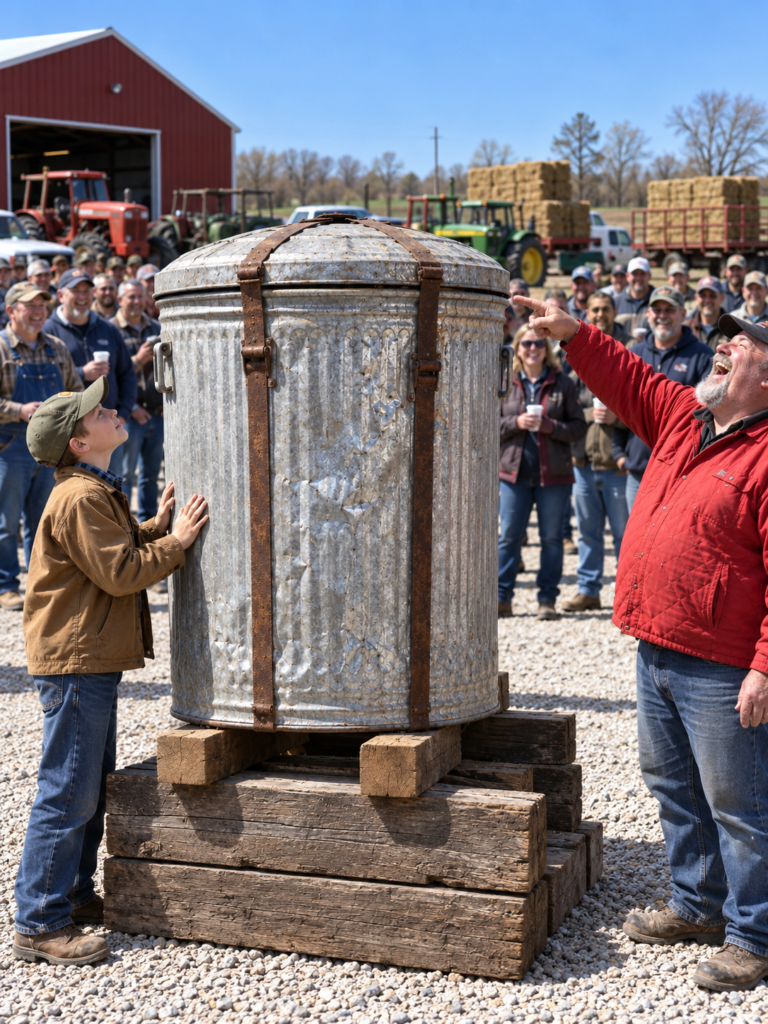
the whole auction laughed when a 12-year-old farm boy paid $20 for a sealed foundry can—then his grandfather realized what had been hidden inside for 51 years
Part 1
By nine o’clock that Saturday morning, half of Halvard County seemed to be standing behind Arvid Lindquist’s machine shed.
Pickup trucks lined both sides of the gravel lane. Farmers in canvas coats moved between hay racks covered with tools, tractor parts, old kitchen furniture, chains, milk cans, steel wheels, and boxes of things nobody had opened since the Eisenhower administration.
The frost was only beginning to leave the ground.
Every boot heel left a dark print in the wet gravel.
Twelve-year-old Nolan Ferris had already spent most of the morning following his grandfather through the sale.
Walt Ferris was seventy-nine and walked with a stiffness he pretended not to notice.
He had worked metal most of his life.
Even after retirement, his hands still looked like a working man’s hands—thick fingers, scarred knuckles, one thumbnail permanently flattened from an accident involving a mold flask in 1967.
Whenever Nolan asked about that thumb, his grandfather gave him a different story.
Sometimes a runaway bull had stepped on it.
Sometimes a freight train had run over it.
Once Walt claimed he had lost the thumb entirely in Korea and grown another one.
Nolan had stopped asking.
The estate auction belonged to Arvid Lindquist, who had died in August at eighty-eight.
His farm sat outside a small Iowa town surrounded by cornfields, machine sheds, windbreaks, and gravel roads.
Arvid had never married.
He had spent most of his life repairing machinery and keeping pieces of his father’s old foundry scattered in barns and sheds.
Now those pieces were being sold.
Nolan had come because his grandfather insisted.
“You ought to see where things go after people are done needing them,” Walt had said over breakfast.
Nolan had not understood what that meant.
He mostly hoped to find an old vise or socket set cheap enough for the twenty-dollar bill folded inside his wallet.
He had earned that twenty walking bean fields for the Hostetler family during the summer.
It represented blistered heels, sunburn, mosquitoes, and several mornings when he had wanted to pretend he was sick.
His mother, Dana, had told him not to spend it foolishly.
Walt had told him almost exactly the opposite.
“A boy ought to waste at least one paycheck while he’s young,” he had said. “Otherwise he’ll waste much bigger ones later.”
The strangest object in the entire auction stood behind one of the hay racks.
It looked like an oversized galvanized garbage can.
But it was nearly as tall as Nolan.
Four oak blocks kept it off the wet ground.
Two flat steel bands ran over its domed lid, crossed at the top, and wrapped down around its body.
They had been crimped shut decades earlier.
Rust had formed where the bands touched the lid.
A lot number had been chalked on the side.
The auction clerk’s handwritten description contained only three words.
CAN. BANDED. UNKNOWN.
Most people walked past it.
Gordon Pruitt did not.
Gordon ran Pruitt Iron & Metal along County Road 8.
He was a broad man in his fifties with a gray goatee and a voice that could carry across three acres without assistance.
That morning he wore a bright red quilted jacket.
Nobody could miss him.
Before the auctioneer reached the lot, Gordon had already turned the can into entertainment.
He brought a platform scale from his truck.
With help from two brothers named Tom and Lester Teague, he managed to weigh the thing.
One thousand forty pounds.
The number drew a small crowd.
Gordon slapped the lid with one palm.
Metal rang across the yard.
“Whatever’s inside,” he announced, “you’re paying to move it before you even know whether it’s worth moving.”
Someone asked what he thought it contained.
“Foundry sweepings. Broken cast. Sand. Maybe forty-year-old work boots.”
People laughed.
Gordon grinned.
“Could be a dead cat.”
That earned another laugh.
Nolan stood behind the crowd.
He did not laugh.
An hour earlier, while everyone else was examining tractors, he had walked around the can.
One of the straps had pulled the lid slightly crooked.
Under one edge was a narrow crescent-shaped gap.
Almost nothing.
But Nolan had crouched in the gravel and looked through it.
Inside, he saw the broken end of a short gray bar.
Fine-grained iron.
Pale along the fracture.
And near the end was a stamped capital letter.
That letter was why Nolan was still standing there.
On his grandfather’s workbench at home sat another broken iron bar.
Walt used it as a paperweight.
Nolan had handled it dozens of times.
A letter and a date were stamped into its side.
Whenever Nolan asked where it came from, Walt always answered the same way.
“Lindquist Gray Iron Works.”
Then his voice would change slightly.
Not sad.
Not exactly.
Just older.
Walt had worked there from 1963 until the foundry shut down in 1975.
He called the little iron piece a test bar.
The auctioneer, Ray Dunwoody, finally arrived at lot 194.
Sixty-some farmers and Saturday dealers gathered around.
Ray stood on a hay wagon and pointed toward the huge sealed can.
“All right, gentlemen, who’ll start me at ten dollars?”
Nothing.
“Five?”
Silence.
Gordon Pruitt raised one thick finger.
“One dollar. I’ll save the county the trouble of hauling it away.”
The crowd chuckled.
Ray shook his head.
“You are a generous public servant, Gordon.”
Then a boy’s voice came from the back.
“Twenty dollars.”
The laughter stopped.
Ray leaned forward.
“Who said that?”
Nolan raised the bill.
Heads turned.
His grandfather turned too.
Walt’s face did not move.
Ray squinted.
“Nolan Ferris?”
“Yes, sir.”
“You understand the current bid is one dollar?”
“Yes, sir.”
“And you’re bidding twenty?”
“Yes, sir.”
Gordon began laughing before Ray could say anything else.
Within seconds the whole crowd joined him.
Nolan felt heat climb up his neck.
His fingers tightened around the twenty-dollar bill.
He considered lowering his hand.
Then he looked at his grandfather.
Walt still said nothing.
But he did not shake his head.
Ray waited.
“Twenty dollars once.”
Gordon wiped his eyes.
“Let the boy have his treasure.”
“Twenty twice.”
Nolan swallowed.
“Sold.”
The gavel came down.
People laughed again.
At twelve years old, Nolan Ferris had just paid twenty dollars for more than half a ton of sealed foundry refuse.
Gordon Pruitt walked over before Nolan could move.
He rested one hand on the lid.
“Tell you what, kid. I’ll give you twenty-five right now.”
Nolan looked at him.
“You’ll make five bucks without lifting anything.”
“No, thank you.”
“Thirty.”
“No, sir.”
Someone shouted from behind the crowd, “Take it, Nolan!”
Another man called, “Hold out for forty!”
More laughter.
Gordon leaned closer.
He did not sound angry.
That somehow made it worse.
He sounded patient.
Almost fatherly.
“Son, you spent your bean-walking money on somebody else’s trash. There’s no shame in learning cheap.”
Nolan’s jaw tightened.
Gordon pointed toward his truck.
“I’ve got cutters. We can open it right here.”
People began gathering again.
That was what they wanted.
The joke needed an ending.
A twelve-year-old boy had spent twenty dollars on a sealed garbage can.
Now they wanted to see his face when it contained nothing but worthless iron.
Nolan looked at the bands.
Then at his grandfather.
Walt remained quiet.
Nolan had expected him to intervene.
Tell Gordon to leave him alone.
Tell the crowd to move on.
Instead, the old man simply watched.
Nolan finally shook his head.
“I’m not opening it here.”
Gordon laughed.
“Why not?”
“Because whoever strapped it shut wanted it shut.”
“That man’s dead.”
“I know.”
“So what difference does it make?”
Nolan placed one hand on the cold galvanized side.
“When I open it, I want to do it right.”
For the first time that morning, Gordon’s smile faded slightly.
Only for a second.
Then he slapped the lid.
“You hear that? The boy’s going to open garbage correctly.”
The crowd laughed and drifted away toward the next lot.
Nolan stood beside his purchase.
His stomach hurt.
He heard a man near the hay wagon say, “Garbage Can King.”
That name traveled faster than the auctioneer.
By lunch, three people had used it.
Nolan pretended not to hear.
His grandfather finally approached.
Walt examined the can.
Walked around it once.
Then again.
He crouched, slowly because of his knees, and looked through the same narrow gap Nolan had found.
For a long moment, the old man said nothing.
Then he stood.
“How much money do you have left?”
Nolan blinked.
“Nothing.”
“All right.”
“Are you mad?”
“No.”
“Mom’s going to be.”
“Probably.”
Walt looked toward the sealed lid.
Then he asked quietly, “What did you see?”
“A broken bar.”
“What kind?”
“Like yours.”
Walt’s face changed.
“Stamped?”
“A letter.”
Walt stared at the can.
The laughter of the auction faded around them.
“Show me.”
Nolan crouched.
Walt lowered himself beside him.
Nolan pointed at the gap.
The old man put one eye against it.
He stayed there long enough that Nolan began to worry.
Finally Walt pushed himself upright using the can for support.
“How many bars?”
“I could only see one.”
Walt removed his cap.
Ran his palm over his white crew cut.
Put the cap back on.
“Lord Almighty.”
“What?”
His grandfather looked at the steel bands.
“Nolan.”
“What?”
“I think I know what you bought.”
Getting the can home took nearly an hour.
Walt backed his old green flatbed toward the oak blocks.
They laid heavy planks from the bed to the ground and rigged a hand winch to the can’s riveted handles.
The load moved one painful inch at a time.
Steel groaned.
Wood bowed.
Gordon Pruitt sat on his tailgate drinking coffee.
“Careful, Walt,” he called. “You drop it, that dead cat’ll sue.”
Walt ignored him.
When the can was finally chained against the headache rack, Gordon approached Nolan one last time.
“My offer stands.”
“No, sir.”
“Fine. When you get tired of looking at it, bring it to my yard. I pay four cents a pound for mixed broken cast.”
He glanced toward the scale.
“Little over forty bucks. You’ll double your money.”
Nolan climbed into the truck without answering.
Walt drove.
For the first two miles, neither spoke.
The sealed can filled nearly half the view through the rear window.
At the stop sign beside Trinity Lutheran Church, Walt finally said, “Did I ever tell you about the Marlowe can?”
Nolan shook his head.
Walt stared through the windshield.
“No. I suppose I wouldn’t have.”
“Whose can?”
“Gus Lindquist’s.”
Arvid’s father.
The man who had owned the foundry.
Walt’s former boss.
His grandfather gripped the steering wheel.
“Back when I worked there, Gus kept something nobody else thought was worth keeping.”
“What?”
Walt glanced at Nolan.
“The truth.”
Part 2
The old Lindquist foundry had disappeared before Nolan was born.
A grain elevator stood near the site now.
But Walt remembered every corner.
The furnace.
The molding floor.
The shakeout.
The smell of hot sand.
The whistle that sounded before a pour.
The way winter air turned orange when the furnace doors opened.
From 1958 until 1975, Lindquist Gray Iron Works produced ordinary castings that kept the lights on—tractor weights, grates, rings, brackets, sash weights.
But the job Gus Lindquist cared about most came from a piano company in Moline, Illinois.
Marlowe Brothers.
They built concert grand pianos.
Inside every grand piano was a cast-iron plate.
It held the tremendous tension created by hundreds of tightly stretched strings.
Poorly made iron could ruin an instrument.
Too brittle, it could crack.
Too soft, it could absorb vibration differently.
The exact mixture mattered.
Gus had developed a formula that Marlowe loved.
For seventeen years, Lindquist poured their plates.
“Every heat,” Walt explained as the truck bounced along the gravel road, “Gus poured a little test bar from the same ladle.”
“Like the one on your bench?”
“Exactly.”
“What did he do with it?”
“Next morning he broke it.”
“Why?”
“To see what kind of iron he’d made.”
Walt described how Gus stamped each half with a heat letter and pour date matching the plate.
The company kept production books.
Gus kept the broken iron.
“You can write whatever you want in a notebook,” Walt said. “But the iron itself tells you what went into the melt.”
Nolan twisted around to look at the can through the rear window.
“What happened?”
“Marlowe moved the work.”
“Why?”
“Money.”
Walt said the word without bitterness.
Just fatigue.
A larger Ohio foundry offered lower prices.
Marlowe transferred the contract.
Lindquist Gray Iron Works lost most of its business in one decision.
Within months, the furnace went cold.
Walt had been thirty-eight.
He had a wife.
A mortgage.
Two children.
One of them was Nolan’s mother.
“I thought we were finished,” Walt said.
“What did you do?”
“Anything that paid.”
Repair work.
Seasonal welding.
Farm equipment maintenance.
Eventually a job at a municipal machine shop.
He survived.
But Walt never forgot the final afternoon at Lindquist.
The furnace was cold.
Men were carrying personal tools to their cars.
Some swore.
Some cried when nobody was looking.
Gus Lindquist stood near the loading door beside a huge galvanized foundry can.
Inside were bundles of broken test bars.
Seventeen years of them.
Gus ordered the lid closed.
Two men ran steel bands across it.
Then he told Arvid, his son, not to sell the contents for scrap.
“Why?” Nolan asked.
Walt’s voice softened.
“Because Gus believed somebody would want them one day.”
“For what?”
“To figure out the old iron.”
“Did anyone?”
“Not while Gus was alive.”
Walt glanced toward the load again.
“After the foundry closed, I never saw that can. I assumed it got scrapped or buried under junk.”
“And Arvid kept it.”
“Looks that way.”
Nolan stared ahead.
“Are the bars worth money?”
Walt smiled.
“That’s the first question every twelve-year-old asks.”
“You’d ask too.”
“At twelve? Absolutely.”
“Well?”
“As scrap? Gordon isn’t far off.”
Nolan’s heart sank.
Walt noticed.
“That doesn’t mean they’re only scrap.”
Nolan thought about that.
They pulled into the Ferris yard shortly before noon.
The farm was small by modern standards.
Forty-two acres rented out for corn and beans, a weathered barn, an old machine shed, a white farmhouse with peeling paint along the porch rail.
Dana Ferris stood on the back steps.
She was still wearing her co-op work shirt.
She had come home early after a neighbor called.
Word had traveled.
Nolan climbed down.
His mother looked at the enormous can.
Then at him.
“You spent all twenty dollars.”
“Yes.”
“On that.”
“Yes.”
She closed her eyes.
Walt climbed down slowly.
“Dana—”
“Dad, please don’t tell me you encouraged this.”
“I didn’t.”
“You stopped him?”
“No.”
“That’s not better.”
Nolan braced himself.
His mother looked tired more than angry.
Since Nolan’s father had left six years earlier, Dana had worked full-time and picked up extra shifts whenever she could.
Money mattered in their house.
Twenty dollars was not nothing.
It bought groceries.
Gas.
School supplies.
“I earned it,” Nolan said quietly.
“I know you did.”
“Grandpa thinks there’s something important inside.”
Dana looked toward Walt.
Walt nodded.
Her expression changed.
“What?”
“I think it’s Gus Lindquist’s Marlowe test archive.”
Dana stared at him.
“The one from the foundry?”
“You remember me talking about it?”
“Barely.”
Walt looked toward the can.
“If that’s what it is, we don’t open it casually.”
Nolan stepped closer.
“I want to open it tonight.”
Walt raised an eyebrow.
Dana said, “After all this, you want to wait until tonight?”
Nolan nodded.
“In front of witnesses.”
His mother studied him.
“Why?”
“That’s what Mr. Lindquist wanted.”
Walt looked at his grandson for a long time.
Something in his expression softened.
“Who?”
“Mr. Dunwoody. The Teagues. Mrs. Gunderson.”
“The piano tuner?”
“She’d know if the iron means something.”
Nolan swallowed.
“And Mr. Pruitt.”
Dana frowned.
“The man who spent all morning making fun of you?”
“Yes.”
“Why invite him?”
Nolan stared at the ground.
“Because he should see it too.”
Walt nodded once.
“Fair enough.”
By seven o’clock the machine shed looked almost ceremonial.
Walt had swept the concrete.
Work lights hung from the rafters.
The sealed can stood in the center on its oak blocks.
Eight folding chairs borrowed from Trinity Lutheran faced it.
The people Nolan invited actually came.
Ray Dunwoody arrived wearing the same auctioneer’s cap.
Tom and Lester Teague brought coffee.
Dana sat in the front row.
Mrs. Ilsa Gunderson came wearing a long wool coat.
She was seventy-four, had played church organ for more than half a century, and tuned pianos throughout three counties.
She knew old Marlowe instruments the way some men knew tractors.
At seven-fifteen, another pickup turned into the yard.
Pruitt Iron & Metal was painted on the door.
Gordon stepped out in his red jacket.
He carried a horseshoe magnet.
“Thought we might need scientific equipment.”
Nobody laughed as loudly this time.
Nolan pulled on leather gloves.
Walt gave him clear safety glasses.
On the workbench lay long-handled cutters.
Nolan approached the first band.
His stomach tightened.
The entire day came back to him.
The laughter.
Garbage Can King.
Twenty dollars.
Dead cat.
Gordon’s offers.
Walt stood beside him.
“You want me to do it?”
Nolan shook his head.
“It’s mine.”
“Then take your time.”
Nolan placed the jaws over the band.
He pushed.
Nothing.
He pushed harder.
His arms shook.
Walt placed one scarred hand over his grandson’s grip.
Together they leaned.
The steel snapped.
The loose end whipped across the lid with a gunshot crack.
Everyone flinched.
Gordon laughed.
Nolan moved to the second strap.
That one broke easier.
Now only rust held the lid.
Walt and Nolan worked around the edge using pry bars.
The metal groaned.
Rust dust fell.
Finally the lid lifted.
A smell escaped.
Old oil.
Dry iron.
Foundry sand.
For Walt Ferris, the years disappeared.
He was thirty-eight again.
He could almost hear the furnace blower.
Almost hear Gus Lindquist shouting across the molding floor.
Almost see men who had been dead for decades.
His eyes watered.
Nolan looked inside.
Bundles.
Dozens.
Brown paper.
Wire ties.
Grease-pencil markings.
Each package marked by year.
Nolan reached for the first.
Walt stopped him.
“Slow.”
Together they lifted it onto the bench.
The paper was stiff with age.
Walt cut the wire.
Nolan folded it back.
Gray iron bars appeared.
Broken ends.
Stamped letters.
Dates.
The exact objects Nolan had seen through the gap.
Nobody spoke.
Mrs. Gunderson moved closer.
Gordon picked one up.
His magnet clicked against it.
He smiled.
“Well.”
The Teague brothers waited.
Gordon held up the piece.
“Iron.”
He dropped it back onto the paper.
“Broken iron.”
Ray Dunwoody shifted awkwardly.
Gordon looked at Nolan.
“You paid twenty dollars for half a ton of busted test pieces.”
One of the Teague brothers gave a nervous laugh.
Nolan felt something collapse inside him.
He looked at Walt.
His grandfather was not smiling.
But he was not disappointed either.
Mrs. Gunderson picked up one bar.
She examined the fracture.
Then removed a tuning fork from her purse.
Gordon stared.
“You brought that?”
“I bring tools where I expect ignorance.”
Dana covered a smile.
Mrs. Gunderson struck the fork gently and touched it against the bar.
The iron rang.
Not a dull clank.
A clear, sustained tone.
It floated through the metal shed.
Gordon’s expression changed.
Mrs. Gunderson listened.
“That,” she said quietly, “is not ordinary scrap.”
“How do you know?”
She looked at him.
“Because I have listened to a 1966 Marlowe grand every Sunday for thirty years.”
Gordon scoffed.
“You’re identifying a foundry formula by ear?”
“No.”
She set the bar down.
“I’m telling you the sound is familiar.”
They counted until nearly midnight.
Eighteen bundles.
The final year only partially filled.
1,412 bars.
Dates from 1958 through 1975.
When Nolan turned the lid over, he found a small metal plate riveted underneath.
Its lettering was worn.
But legible.
MARLOWE PLATE IRON.
EVERY HEAT.
ASK BEFORE MELTING.
G. L.
Walt sat down.
For the first time that night, he looked old.
Nolan moved beside him.
“You all right?”
His grandfather nodded.
“I haven’t seen Gus’s handwriting in fifty years.”
Gordon leaned over Nolan’s shoulder and read the plate.
Then he straightened.
“Gus Lindquist’s been dead thirty years.”
Nobody answered.
“What are we supposed to ask him?”
He laughed.
Then Gordon reached into his wallet.
“Fifty bucks.”
Nolan looked at him.
“For the whole thing. You more than double your money.”
“No, thank you.”
“Boy, this is getting silly.”
“No, sir.”
Gordon shook his head.
“You’re going to learn eventually.”
He walked toward the door.
Before leaving, he turned.
“Four cents a pound when you’re ready.”
The truck disappeared into the night.
Nolan stood beside the open can.
He should have felt triumphant.
Instead he felt uncertain.
They had found exactly what his grandfather suspected.
But Gordon was right about one thing.
A pile of old iron did not become valuable just because a dead foundry owner had cared about it.
Nolan looked at Walt.
“What do we do now?”
His grandfather touched the nearest test bar.
“We find out whether Gus was right.”
Part 3
By Monday morning, the story had changed.
At the auction, people had laughed because Nolan had not opened the can.
Now they laughed because he had.
Someone placed an empty soup can on his desk at school.
Two strips of duct tape crossed the lid.
GARBAGE KING was written on the side.
A few kids laughed when he found it.
Nolan carried it home in his backpack.
His mother saw it.
Her face tightened.
“I’m calling the school.”
“No.”
“Nolan.”
“Please.”
“They don’t get to—”
“I know.”
He picked at a loose thread on his jacket.
“I don’t want everybody thinking my mom had to make them stop.”
Dana wanted to argue.
Instead she kissed the top of his head.
When Walt found the soup can later, he did not mention it.
He carried it to the machine shed.
Set it beside the old Lindquist test bar on his bench.
Nolan followed.
“Why’d you keep it?”
Walt shrugged.
“Looks like somebody put work into it.”
“That’s not funny.”
“A little funny.”
Nolan leaned against the bench.
“What if Mr. Pruitt’s right?”
“About what?”
“That it’s just iron.”
Walt took off his glasses.
“I worked beside Gus Lindquist for twelve years.”
“That doesn’t make him right.”
“No.”
“What if nobody cares?”
“Possible.”
“Then I wasted twenty dollars.”
“Also possible.”
Nolan frowned.
Walt folded his arms.
“You want me to tell you it’s secretly worth a fortune?”
“Maybe.”
“I don’t know that.”
Nolan looked disappointed.
Walt continued.
“But you noticed something sixty adults walked past.”
“That doesn’t mean it was smart.”
“No.”
“You’re not helping.”
Walt smiled.
“Thinking for yourself does not guarantee you’ll be right.”
“Then what’s the point?”
“The point is you’ll know why you were wrong.”
Nolan considered that.
His grandfather tapped the old test bar.
“Now, if you want to find out whether this matters, stop worrying about Gordon Pruitt.”
“What should I do?”
“Ask somebody who might need what you have.”
That evening Nolan sat at the kitchen table with lined notebook paper.
Mrs. Gunderson found the current address for Marlowe Brothers Piano Company.
The company still existed in Moline.
She told Nolan something else.
Collectors and rebuilders prized Marlowe concert grands made during the Lindquist years.
Some technicians claimed the newer instruments never sounded quite the same.
Nolan began a letter.
He ruined the first page.
Then another.
Then another.
On the fourth attempt, he wrote plainly.
His name was Nolan Ferris.
He was twelve.
He had purchased a sealed foundry can from the estate of Arvid Lindquist.
The can contained more than fourteen hundred broken iron test bars dated from 1958 through 1975.
His grandfather had worked at Lindquist Gray Iron Works.
The stamped letters and dates appeared connected to Marlowe piano plates.
The can had remained sealed until opened in front of witnesses.
Nolan did not tell them the collection was valuable.
He did not know that.
He simply asked whether anyone at Marlowe wanted to see it.
Walt read the letter.
“You wrote this?”
“Yes.”
“Dana help?”
“No.”
“Mrs. Gunderson?”
“With the address.”
Walt read it again.
“Good.”
“That’s it?”
“What do you want? A parade?”
“I don’t know.”
Walt handed it back.
“Mail it.”
For nineteen days, nothing happened.
Nolan checked the mailbox after school.
Advertisements.
Bills.
A farm magazine.
Nothing from Moline.
The soup-can joke lasted about six days.
Garbage Can King lasted longer.
Nolan began wishing he had accepted Gordon’s thirty dollars at the auction.
At least then he would have made ten.
On the twentieth day, the kitchen phone rang.
Dana was at work.
Walt was repairing a hydraulic cylinder in the shed.
Nolan answered.
“Ferris residence.”
A woman asked for Mr. Ferris.
“Which one?”
There was a pause.
“The gentleman who wrote Marlowe Brothers about Lindquist test bars.”
“That’s me.”
Another pause.
The woman introduced herself as Catherine Ashby.
Director of manufacturing.
Nolan sat down.
“I’m calling about your letter.”
“Yes, ma’am.”
“Is your grandfather available?”
“He’s in the machine shed.”
“I would like to speak with both of you.”
Something in her voice made Nolan run.
Walt returned wiping his hands with a shop rag.
Nolan put the phone on speaker.
Catherine explained what had happened.
In 1981, a warehouse fire destroyed most of Marlowe’s foundry-development records from the Lindquist era.
Formulas.
Metallurgy notes.
Production records.
Heat chemistry.
Much of it disappeared.
The company retained one important artifact.
A leather-bound serial ledger matching individual pianos to their plate heat letters and pour dates.
But the metallurgical data behind those heats was gone.
For decades Marlowe had tried to recreate the character of the old plates.
Different silicon levels.
Different phosphorus.
Carbon variations.
Cooling times.
Hundreds of trial pours.
Good iron.
Sometimes excellent iron.
But never exactly the same.
Walt sat down.
“You’re saying you lost Gus’s formula.”
Catherine replied, “We lost the evidence needed to reconstruct it confidently.”
Nolan looked at the can visible through the kitchen window.
“What if we have it?”
Silence.
Then Catherine said, “That is why I’m calling.”
She explained that a properly preserved test archive could allow metallurgists to analyze the original heats.
If the stamps matched the serial ledger, the can might represent something Marlowe had thought permanently lost.
“We would like to inspect it.”
“When?”
“As soon as you allow.”
Nolan glanced at Walt.
His grandfather nodded.
“There’s one condition,” Nolan said.
Catherine sounded surprised.
“What is it?”
“When you inspect it, people have to be there.”
“People?”
“Witnesses.”
Nolan explained Gus Lindquist’s instruction.
If the can was ever opened for its real purpose, it should happen openly so nobody could claim the material had been altered.
Catherine was quiet.
Then she said, “I think Mr. Lindquist would approve of you.”
Nolan felt his ears grow hot.
They arranged the inspection for the following month.
Mrs. Gunderson insisted on Trinity Lutheran’s fellowship hall.
Her reason was simple.
The church owned a 1966 Marlowe concert grand.
A farm family had donated it decades earlier in memory of a daughter who died young.
If the test bars really corresponded to old Marlowe plates, they could compare them to a known instrument.
Word spread.
This time people were not laughing.
Not exactly.
Some were curious.
Others skeptical.
Gordon Pruitt heard too.
Nolan invited him personally.
Gordon stared across the counter at his scrapyard office.
“You serious?”
“Yes, sir.”
“You want me there?”
“Yes.”
“Why?”
Nolan thought.
“Because you were there at the beginning.”
Gordon rubbed his goatee.
“You trying to embarrass me?”
“No.”
“Then why?”
“So nobody can say later that only people who believed us were watching.”
Gordon’s expression became difficult to read.
“All right.”
The inspection took place on a cold Saturday.
Walt and Nolan hauled the can to Trinity Lutheran on the flatbed.
They sealed it again with a new steel strap.
The church hall smelled of coffee, floor wax, and radiator heat.
The same folding chairs from the machine shed stood near the stage.
More had been added.
Pastor Halverson attended.
So did Ray Dunwoody.
The Teague brothers came.
A county reporter sat near the aisle with a notebook.
Gordon arrived wearing the red jacket.
Catherine Ashby came from Moline carrying Marlowe’s surviving leather serial book.
With her was Dr. Samuel Okafor, a metallurgist from the state university.
The third visitor introduced himself as Martin Cassell.
He appraised industrial archives, musical-instrument collections, and technical historical materials.
Gordon leaned toward Nolan.
“They brought an appraiser before they even know what you’ve got.”
Nolan shrugged.
Gordon smiled.
“Don’t spend your fortune yet.”
Mrs. Gunderson opened the 1966 Marlowe grand.
She removed the music desk and pointed toward the iron plate near the tuning pins.
Raised in the casting were a letter and a date.
R.
May 12, 1966.
Catherine opened the leather ledger.
She found the instrument’s serial number.
Then read the corresponding entry.
Heat R.
May 12, 1966.
Lindquist.
Everyone looked toward Nolan.
His mouth went dry.
Walt placed a hand on his shoulder.
Nolan cut the new strap from the foundry can.
They opened the lid.
He found the bundle marked 1966.
Untied it.
Dozens of bars.
One by one, Nolan read stamps.
Letters.
Dates.
Then he saw it.
R.
May 12, 1966.
He held the bar up.
Nobody laughed.
Dr. Okafor received it with both hands.
He examined the fracture under magnification.
Then placed it inside a portable analyzer.
Numbers appeared.
He tested another bar.
Then another.
Catherine selected six piano records from different years.
Nolan found matching bars.
Every date aligned.
Every heat letter matched.
Dr. Okafor worked silently for nearly an hour.
Finally he removed his glasses.
“This archive is extraordinary.”
Gordon folded his arms.
“It’s still iron.”
Dr. Okafor looked at him.
“Yes.”
Gordon smiled.
Then the metallurgist added, “The way a Stradivarius is still wood.”
The smile disappeared.
Dr. Okafor explained.
The iron chemistry was unusual.
Deliberate.
Consistent enough to show control, but varied enough to reveal how Lindquist adjusted individual heats.
Silicon.
Phosphorus.
Carbon.
Trace elements.
Cooling characteristics.
The broken test faces preserved information no surviving document could provide.
Catherine sat down.
For a moment she looked overwhelmed.
“With these,” she said, “we can finally see what Gus Lindquist was doing.”
Walt lowered his head.
Nolan saw his grandfather’s eyes fill.
“What?” Nolan whispered.
Walt wiped one eye roughly with his thumb.
“Nothing.”
“Grandpa.”
The old man looked at the rows of iron.
“When the foundry closed, people said we were just a little shop that couldn’t compete anymore.”
Nolan waited.
“Maybe they were right.”
Walt breathed out.
“But Gus always said the work mattered.”
He looked at his grandson.
“I guess he wasn’t wrong.”
Part 4
Martin Cassell had been writing throughout the inspection.
After Dr. Okafor finished, the appraiser stood.
The fellowship hall quieted.
Nolan suddenly felt nervous again.
He realized no one had discussed ownership.
Price.
Insurance.
What happened next.
Martin looked toward Catherine.
Then Walt.
Then Nolan.
“I’ve been asked to provide a preliminary valuation for the collection as a complete technical and historical archive.”
Gordon shifted near the coffee table.
Martin continued.
“The value is not based on scrap weight.”
A few people smiled.
“It derives from completeness, provenance, technical significance, surviving witness history, linkage to existing Marlowe serial records, and direct utility to a currently operating manufacturer.”
Nolan barely understood half the sentence.
Martin looked at him.
“As preserved, I would insure this collection for two hundred thirty-eight thousand dollars.”
Nobody moved.
The furnace switched on beneath the floor.
The sound seemed enormous.
Nolan thought he had misheard.
“What?”
Martin repeated it.
“Two hundred thirty-eight thousand dollars.”
Dana covered her mouth.
Ray Dunwoody slowly removed his auctioneer’s cap.
Tom Teague whispered something Nolan could not hear.
At the back of the room Gordon Pruitt held his red cap in both hands.
For the first time since the estate sale, he had nothing to say.
Nolan looked at Walt.
His grandfather appeared almost annoyed.
“That’s ridiculous.”
Martin smiled slightly.
“It may prove conservative.”
Walt shook his head.
“They’re broken bars.”
“Yes.”
“Gus would laugh himself sick.”
“Possibly.”
Catherine Ashby stood.
“Marlowe Brothers is prepared to purchase the collection at the appraised figure.”
Dana made a small sound.
Nolan’s knees suddenly felt weak.
He sat.
Two hundred thirty-eight thousand dollars.
At twelve, money came to him in smaller units.
Five dollars for mowing.
Twenty for walking beans.
Three dollars for lunch.
He could not picture $238,000.
He knew it was more than their house had cost when his mother bought out his father’s share after the divorce.
More than Walt’s old farm machinery.
More than anything Nolan had ever touched.
Catherine sat across from him.
“We would preserve the original bars, document them, analyze samples non-destructively where possible, and use the chemistry to reconstruct Lindquist-era plate iron.”
Nolan stared at the floor.
His mother knelt beside him.
“You don’t have to decide this second.”
Walt nodded.
“She’s right.”
Catherine said, “Absolutely.”
Gordon finally spoke.
“Boy.”
Everyone turned.
He stood slowly.
“You remember my forty-one-dollar offer?”
A nervous laugh moved through the room.
Nolan looked at him.
“Yes, sir.”
Gordon rubbed the back of his neck.
“Well.”
He glanced at Martin’s clipboard.
“Suppose I was off a little.”
People laughed.
This time Nolan did too.
Gordon smiled awkwardly.
Then Nolan became serious.
“I’ll sell.”
Dana looked at him.
“But I want three things.”
Catherine nodded.
“Tell me.”
“My grandfather keeps one.”
Walt frowned.
“Nolan—”
“You gave your test bar back?”
“No.”
“Then you keep another one.”
Walt began to object.
Catherine interrupted.
“Agreed.”
Nolan continued.
“I want Lindquist’s name on the new plates if you actually make them the old way.”
Catherine leaned back.
“You want the foundry credited.”
“Yes.”
Walt stared at his grandson.
Catherine thought for a moment.
“Agreed.”
Nolan took a breath.
“And the church piano.”
Mrs. Gunderson’s head lifted.
“What about it?”
“It should go to your factory.”
Catherine glanced toward the 1966 grand.
“For study?”
“For restoration.”
Mrs. Gunderson looked shocked.
Nolan hurried to explain.
“You said it needs work.”
“It does.”
“So restore it.”
“That could cost—”
“And then bring it back.”
Catherine smiled.
“That’s your third condition?”
“Yes.”
“Done.”
The room applauded.
Nolan hated it.
His ears burned so badly he wanted to crawl under the piano.
When the noise died, he turned.
Gordon was still standing at the back.
Nolan walked toward him.
For a second Dana looked worried.
So did Walt.
Nolan stopped in front of the scrapyard owner.
“At the auction, you said four cents a pound.”
Gordon sighed.
“I remember.”
Nolan had done the calculation on a scrap of church bulletin while Martin spoke.
“At two hundred thirty-eight thousand dollars, it works out to around two hundred twenty-nine dollars a pound.”
The room erupted.
Ray Dunwoody laughed so hard he slapped his knee.
The Teague brothers nearly spilled coffee.
Even Pastor Halverson laughed.
Gordon stood still.
Nolan immediately regretted saying it.
The laughter felt too familiar.
For weeks he had hated being the person everyone laughed at.
Now he had turned the whole room against Gordon.
The man’s face reddened.
He looked toward the door.
Then something unexpected happened.
Nolan held out his hand.
Gordon stared at it.
The laughter gradually stopped.
“I didn’t mean—”
Gordon shook his hand.
His grip was firm.
“No.”
He looked at Nolan carefully.
“I earned that one.”
Nolan said nothing.
Gordon glanced toward the opened can.
“You did one thing smarter than all of us.”
“What?”
“You looked before you laughed.”
He put his cap on.
Then he turned toward Walt.
“You taught him that?”
Walt smiled.
“No.”
Gordon nodded.
“That figures.”
Before leaving, he rested one palm against the galvanized side.
“You opened it right, kid.”
Then he walked out into the cold.
The following weeks became strange.
A photograph of Nolan beside the can appeared in the county newspaper.
Then a Des Moines paper called.
Then a radio station.
Dana refused several television interviews.
“He is twelve,” she kept saying. “He still has homework.”
School changed too.
The name Garbage Can King did not disappear.
It simply changed tone.
Kids who had laughed now wanted to ask questions.
A boy who had placed the soup can on Nolan’s desk asked whether he could see the real can.
Nolan said yes.
Walt kept the soup can on the workbench.
“You can throw that away now,” Nolan told him.
“No.”
“Why?”
“History.”
“That isn’t history.”
“Everything becomes history if you leave it on a shelf long enough.”
The money caused its own problems.
People had suggestions.
Cars.
Land.
Investments.
A new house.
One distant relative Dana had not heard from in years called twice.
Dana ended the discussion quickly.
Most of the money went into protected accounts for Nolan’s education and future.
Some paid taxes and legal expenses.
A small portion was set aside for one purchase Nolan requested.
Not a truck.
Not a motorcycle.
Not a gaming system.
A new set of professional piano-tuning tools for Mrs. Gunderson.
She refused.
Nolan ordered them anyway.
When the case arrived, she cried.
“I had the old set since 1989.”
“That’s why.”
“You cannot spend this kind of money on me.”
“They cost less than Grandpa spends fixing tractors that should’ve died.”
Walt objected from across the room.
“My tractors are investments.”
Mrs. Gunderson laughed through her tears.
Marlowe technicians transported the church grand to Moline.
When the fellowship hall stood empty without it, Mrs. Gunderson walked through the room several times as if a family member were missing.
“It’ll come back,” Nolan told her.
“I know.”
She touched the bare space where the piano had stood.
“I’m old enough to dislike temporary emptiness.”
Nolan did not fully understand.
Walt did.
The months passed.
Winter settled across Iowa.
The roads turned white.
Wind pushed snow against the Ferris machine shed.
Nolan returned to ordinary life.
School.
Chores.
Homework.
The occasional argument with his mother.
The money existed mostly as numbers he was not allowed to touch.
The can remained in Moline with most of the bars.
Researchers cataloged each one.
Dr. Okafor’s team ran analyses.
Marlowe began experimental melts.
They sent updates.
First trial too brittle.
Second too soft.
Third promising.
Walt followed every report.
He kept one original test bar beside the old one on his workbench.
Two pieces of gray iron.
Fifty years apart in his life.
One afternoon Nolan found him sitting in the shed holding both.
“You okay?”
Walt nodded.
“You keep asking that.”
“You keep looking weird.”
“That’s age.”
Nolan sat beside him.
“Do you miss the foundry?”
Walt took his time answering.
“I miss the men.”
“Not the job?”
“Parts of it.”
“Wasn’t it hot?”
“Terrible.”
“Dirty?”
“Very.”
“Dangerous?”
“Yes.”
“Then why miss it?”
Walt looked at him.
“Because you can hate the work and still miss who you were when you did it.”
Nolan thought about the estate auction.
Twenty dollars felt like years ago.
Walt turned the newer bar in his hand.
“When that foundry closed, I thought a whole piece of my life had disappeared.”
“But it didn’t.”
“No.”
His eyes moved toward Nolan.
“It sat in an old man’s shed for fifty years waiting for some fool kid to buy it.”
Nolan smiled.
“Smart kid.”
“Let’s not rewrite history.”
By March, Marlowe announced that they had replicated a Lindquist-era alloy closely enough to pour a full concert-grand plate.
Catherine invited Walt and Nolan to Moline.
Dana took three days off work.
Mrs. Gunderson came too.
Gordon Pruitt surprised everyone by donating the use of his enclosed equipment trailer to transport the restored church piano home afterward.
He did not attend.
“Too much music for me,” he said.
Walt knew better.
Gordon had changed after the auction.
Not dramatically.
He was still loud.
Still joked too much.
Still negotiated scrap prices like every penny came from his own blood.
But Walt heard that Gordon had begun offering local high-school shop students better prices for sorted metals and letting them tour the yard.
Maybe embarrassment taught something too.
Not every lesson required punishment.
Part 5
The Marlowe factory in Moline did not look like Nolan expected.
He imagined something enormous.
Instead, much of the work happened in long brick buildings where craftspeople still performed jobs by hand.
Wood was selected.
Soundboards shaped.
Rims formed.
Actions assembled.
Technicians moved carefully around instruments that cost more than houses.
The foundry area occupied a separate building.
Safety regulations kept visitors behind a rail.
Nolan wore protective glasses and hearing protection.
Walt stood beside him.
The old man seemed younger the moment he smelled hot metal.
Workers had prepared the first full-size plate using the reconstructed Lindquist chemistry.
Not an approximation based on old company memories.
Not another experimental recipe.
This melt was informed by the actual surviving test bars Gus had preserved.
Catherine stood nearby.
Dr. Okafor joined them.
The furnace door opened.
Orange light filled the building.
Molten iron moved like something alive.
Nolan stared.
He finally understood why his grandfather talked differently about foundry work.
It was violent and precise at the same time.
Dangerous.
Hot.
Ugly.
Beautiful.
Men in protective equipment guided the pour.
Iron entered the mold.
Walt gripped the rail.
Nolan noticed tears on his face.
He pretended not to.
Afterward, while the casting cooled, Catherine took them to another room.
Trinity Lutheran’s 1966 Marlowe stood there.
Restored.
Its black case gleamed.
Old scratches had been repaired carefully rather than erased completely.
The action had been rebuilt.
The strings replaced.
The original Lindquist plate remained inside, cleaned but not altered.
Mrs. Gunderson walked toward it slowly.
“Oh,” she whispered.
Catherine nodded toward the bench.
“Would you like to play?”
Mrs. Gunderson sat.
She placed both hands on the keys.
The first chord filled the room.
Nolan had heard the piano hundreds of times.
Never like that.
The tone seemed larger.
Warmer.
It stayed in the air.
Walt closed his eyes.
Mrs. Gunderson played a hymn she had performed at Trinity Lutheran for decades.
No one spoke until the last note disappeared.
Then Walt opened his eyes.
“That’s Gus.”
Mrs. Gunderson turned.
“That’s a lot of people.”
He nodded.
She was right.
A piano was wood.
Iron.
Felt.
Wire.
Craft.
But also hands.
People who poured.
People who tuned.
People who built.
People who played.
People who remembered.
Later that afternoon, they returned to the foundry.
The new plate had cooled enough for preliminary examination.
It hung from lifting equipment.
The casting was enormous.
Near the tuning-pin area, Nolan noticed raised lettering.
MARLOWE BROTHERS.
Below it, smaller.
LINDQUIST HERITAGE IRON.
Walt stopped walking.
He stared.
Catherine watched him.
“Your grandson negotiated hard.”
Walt swallowed.
“Gus would pretend not to care.”
“And would he?”
“No.”
Catherine handed Nolan a small rawhide mallet.
“What’s this?”
“Go ahead.”
“Hit it?”
“Once.”
Nolan looked at his grandfather.
Walt nodded.
Nolan tapped the iron plate.
A tone rang through the factory.
Clear.
Long.
Not music yet.
But capable of becoming music.
Nolan looked at Walt.
His grandfather smiled.
“Not bad.”
Nolan waited.
Walt added, “For garbage.”
They both laughed.
The restored church piano returned to Iowa that spring.
People gathered at Trinity Lutheran to welcome it home.
Nolan found the celebration embarrassing.
Mrs. Gunderson loved every second.
She played until her hands grew tired.
The Marlowe company placed a small plaque beside the instrument explaining the connection between the piano, Lindquist Gray Iron Works, the recovered test-bar archive, and the reconstruction of the historic alloy.
Nolan’s name appeared near the bottom.
He asked Pastor Halverson whether they could make the letters smaller.
The pastor refused.
Life slowly became ordinary again.
That pleased Nolan.
Thirteen arrived.
Then fourteen.
The story no longer followed him everywhere.
New students entered school who had only vaguely heard about the auction.
The sealed can itself eventually went into Marlowe’s company archive.
They preserved the original steel bands.
The lid.
The small riveted instruction plate.
Even the auction lot number.
Walt kept one test bar.
And he kept the soup can.
Years passed.
The twenty-dollar bill Nolan once held became part of family folklore.
Dana would occasionally tell the story when someone complained about her son wasting money.
“He bought garbage,” she would say.
Nolan always corrected her.
“Industrial research material.”
“You bought garbage.”
“For twenty dollars.”
“Yes.”
“And?”
Dana would roll her eyes.
Nobody needed the ending repeated.
Walt began slowing down.
By Nolan’s seventeenth birthday, the old man no longer climbed onto tractors without help.
At eighty-four, his knees finally won their argument with pride.
He still went to the machine shed every morning.
He still sharpened blades.
Still complained that younger mechanics used too many electronic tools.
Still insisted that machines usually told you what was wrong if you listened properly.
One cold November evening, Nolan found him sitting beside the workbench.
Two Lindquist test bars lay before him.
The original one Walt had taken from the foundry in 1975.
And the one Nolan saved for him.
Beside them stood the soup can.
Walt looked tired.
Nolan pulled up a stool.
“You all right?”
“There you go again.”
“You’re old. I’m allowed to check.”
Walt smiled.
“Fair.”
They sat quietly.
Finally Walt tapped one test bar.
“Know why Gus kept these?”
Nolan smiled.
“You’ve told me about four hundred times.”
“Tell me.”
“Because books can burn.”
“And?”
“Records can be wrong.”
“And?”
“Iron tells the truth.”
Walt nodded.
Then he pointed at the soup can.
“What does that tell?”
“That middle schoolers are idiots.”
“True.”
He pointed toward the original Lindquist bar.
“This?”
“That you worked in the foundry.”
“Partly.”
Then the second.
“And that?”
Nolan thought.
“The auction.”
Walt shook his head.
“No.”
“What, then?”
“That you didn’t let a room full of people decide what you had before you knew yourself.”
Nolan looked at him.
Walt leaned back.
“That’s harder than it sounds.”
“I was scared.”
“I know.”
“I nearly sold it to Pruitt.”
“I know.”
“You would’ve let me?”
Walt took a long breath.
“Yes.”
Nolan was surprised.
“Why?”
“Because it was yours.”
“You knew what might be inside.”
“I suspected.”
“You’d have let me sell it for thirty dollars?”
Walt smiled faintly.
“It would’ve been an expensive lesson.”
“Grandpa.”
“I’m serious.”
Nolan stared.
Walt continued.
“If I had told you what to do, then every good thing that came after would have belonged partly to my judgment.”
He touched Nolan’s chest lightly.
“You made the choice.”
Nolan looked at the test bars.
“That’s why you didn’t defend me at the auction.”
“I was ready if Gordon crossed the line.”
“He made me look stupid.”
“Yes.”
“You could’ve stopped him.”
“Probably.”
“Why didn’t you?”
Walt thought for a moment.
“Because there are days a boy needs to discover whether he can stand there by himself.”
Nolan said nothing.
“I knew you were embarrassed.”
“I hated him.”
“I know.”
“For a while.”
“I know.”
“Did you?”
“Hate him?”
Nolan nodded.
“No.”
“Why not?”
“Because Gordon wasn’t really laughing at you.”
Nolan frowned.
“Sure sounded like it.”
“He was laughing at the possibility he might have missed something.”
Walt smiled.
“Loud men do that sometimes.”
The next spring, Walt’s health declined.
Nothing dramatic happened.
There was no great crisis.
Age simply began collecting what it had postponed.
He tired easily.
He stopped driving at night.
Dana took him to appointments.
Nolan started doing more of the machine-shed work.
That summer, on a warm afternoon, Walt asked Nolan to drive him to Trinity Lutheran.
The church was empty.
Mrs. Gunderson, now in her eighties, let them inside.
She sat at the restored Marlowe grand.
“What do you want?”
Walt shrugged.
“Something familiar.”
She played.
Walt sat in the front pew.
Nolan beside him.
Halfway through the hymn, Walt whispered, “Hear that?”
“The piano?”
“No.”
Nolan listened.
“What?”
“The plate.”
Nolan smiled.
“I can’t hear the plate.”
“Yes, you can.”
“It’s all one sound.”
“Exactly.”
Nolan remembered those words for the rest of his life.
Walt Ferris died the following winter.
He was eighty-five.
The funeral filled Trinity Lutheran.
Farmers came.
Retired foundry workers came.
People from Marlowe drove in from Moline.
Catherine Ashby attended.
Dr. Okafor sent flowers.
Gordon Pruitt sat near the back wearing a dark coat instead of his red jacket.
Mrs. Gunderson played the 1966 grand.
When the service ended, Nolan remained in the fellowship hall.
Gordon approached.
“You doing all right?”
Nolan nodded.
“Grandpa liked you.”
Gordon looked genuinely surprised.
“He had a funny way of showing it.”
“He said you were loud because you were afraid of missing things.”
Gordon stared.
Then laughed softly.
“Old man had me figured out.”
He reached into his coat pocket.
“I brought something.”
He handed Nolan a folded piece of paper.
It was the original auction receipt.
LOT 194.
CAN, BANDED, UNKNOWN.
$20.00.
NOLAN FERRIS.
Nolan stared at it.
“How did you get this?”
“Ray Dunwoody.”
“Why?”
“Thought you should have it.”
Nolan looked at Gordon.
The scrapyard owner nodded toward the piano.
“Your grandpa told me once that the whole story wasn’t about the money.”
“He told you that?”
“Yep.”
“When?”
“Couple years ago.”
“What did he say it was about?”
Gordon smiled.
“He said I’d have to figure that out myself.”
Then he walked away.
Nolan did eventually figure it out.
Not at twelve.
Not at seventeen.
Not even at twenty-five.
He understood it much later.
The two hundred thirty-eight thousand dollars mattered.
It paid for college.
It gave him opportunities Dana and Walt never had.
But money was the easiest part of the story to explain.
People loved that number because numbers made neat endings.
Twenty dollars became $238,000.
A child proved adults wrong.
A man who laughed went silent.
That was the version newspapers liked.
But that was never the whole story.
The real value of the can had been preserved long before Nolan was born.
Gus Lindquist kept evidence because he believed work deserved to be remembered.
Arvid spent decades moving an inconvenient half-ton container from shed to shed rather than cutting it open for scrap.
Walt carried one broken test bar through fifty years because a small piece of iron reminded him that the years he spent in a vanished foundry had mattered.
Mrs. Gunderson recognized a sound others dismissed.
And Nolan, with twenty dollars and more stubbornness than certainty, simply became the next person in a chain of people who refused to throw something away before understanding what it was.
Years later, after Dana sold the old Ferris place, Nolan took possession of his grandfather’s workbench.
He moved it carefully into his own shop.
On the corner sat three objects.
The old Lindquist test bar.
Its matching companion from the recovered archive.
And a ridiculous soup can wrapped with duct tape.
Nolan kept all three.
His own children eventually asked about them.
“Why do you have garbage on your workbench?”
His daughter pointed at the soup can.
Nolan laughed.
“That one actually is garbage.”
“Then throw it away.”
“No.”
“Why not?”
“Because once, when I was twelve, a whole crowd thought they knew what was inside something without bothering to look.”
His son picked up one of the gray bars.
“This was worth all that money?”
Nolan shook his head.
“Not by itself.”
“Then what made it worth so much?”
He considered how Walt would have answered.
Finally he said, “Context.”
The children stared blankly.
Nolan smiled.
“History. Proof. Memory. And somebody needing the information.”
His daughter pointed toward the soup can again.
“What’s that worth?”
“Probably nothing.”
“Then why save it?”
Nolan ran one finger over the old duct tape.
“Because it reminds me of the day everybody laughed.”
“That doesn’t sound like a good memory.”
“It wasn’t.”
“Then why keep it?”
Nolan looked toward the two test bars.
“Because if you only keep the parts of your life that made you look smart, eventually you’ll start believing you were never foolish, scared, embarrassed, or wrong.”
He smiled.
“And that makes people dangerous.”
Years after Walt was gone, Marlowe still produced a limited line of concert grands using an alloy derived from the Lindquist archive.
Inside every instrument, near the tuning pins, small raised letters remained.
LINDQUIST HERITAGE IRON.
Most musicians never knew the story.
They did not need to.
They only knew how the pianos sounded.
Sometimes Nolan attended concerts where one was played.
He would sit quietly near the back.
When the hall grew still and the pianist struck the first chord, Nolan would listen to the sound expand beneath the ceiling.
And in that sound he could hear things that were not technically there.
An old Iowa foundry.
A furnace opening.
His grandfather’s voice.
A crowd laughing in a gravel lot.
Steel bands snapping.
Mrs. Gunderson’s tuning fork.
His mother telling him twenty dollars was still twenty dollars.
Gordon Pruitt offering four cents a pound.
And Walt Ferris saying iron could tell the truth long after the men were gone.
Nolan never corrected the people who still called him Garbage Can King.
Eventually, he came to like the name.
Because everybody remembered the garbage can.
But Nolan remembered something else.
He remembered the moment before the gavel fell.
A thin gap under a rusted lid.
A pale broken piece of iron.
One stamped letter.
And sixty adults who had already decided there was nothing worth seeing.
At twelve years old, Nolan Ferris did not know what was inside that can.
He did not know it was worth hundreds of thousands of dollars.
He did not know it contained half a century of industrial history.
He did not know it might help bring back the lost voice of an American piano.
He knew only one thing.
He had looked closer.
And sometimes, that is where every important story begins.


