
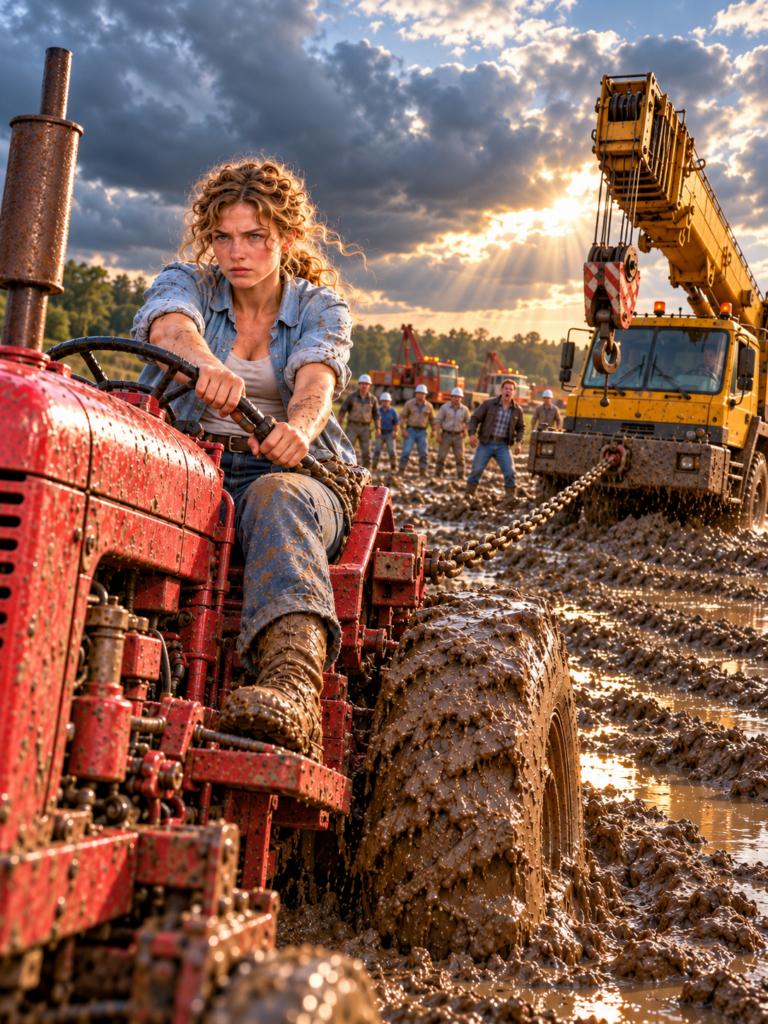
three tow companies gave up on the 76,000-pound rig—then a grieving farmer’s daughter started her father’s 1950 farmall
Part 1
Six weeks after Thomas Bennett died, his daughter was still finding pieces of him in places where she did not expect grief to be waiting.
A pair of cracked work gloves lay on the shelf beside the mudroom door.
His coffee mug, brown ceramic with BENNETT FEED & SEED printed across the side in faded yellow letters, still sat upside down beside the kitchen sink.
A grease pencil remained tucked behind the calendar in the barn office.
And every morning, when Clare Bennett woke in the upstairs bedroom where she had slept as a girl, she still expected to hear her father’s boots crossing the porch before sunrise.
Thomas had been seventy-two when his heart stopped.
No hospital drama.
No long goodbye.
No final speech.
He had fed the cattle, checked the south fence, come inside around four in the afternoon, and sat down in his chair beside the window.
The neighbor found him there after dark.
Clare had been living in Minneapolis for almost eighteen years.
She was forty-two now, divorced, childless, and accustomed to a life made of elevators, parking ramps, conference calls, grocery deliveries, and apartments where nobody noticed if you disappeared for three days.
Bennett Farm was different.
On the farm, absence had weight.
The empty chair mattered.
The silent tractor mattered.
The fact that no light came on in the barn at 4:30 every morning mattered.
Everyone in Cedar County assumed Clare would sell.
Nobody said it cruelly.
They brought casseroles after the funeral.
They stood in her kitchen holding paper plates and murmured that eight hundred acres was a lot for one woman.
They reminded her that grain prices had been rough.
They mentioned that the roof on the north machine shed needed replacing.
They mentioned taxes.
They mentioned equipment costs.
They mentioned how difficult it was to find dependable hands.
Even Rebecca Sloan, the attorney handling Thomas Bennett’s estate, had gently placed a folder of comparable land sales on the edge of her desk.
“You don’t have to decide today,” Rebecca had said.
Clare had looked at the folder.
Then she had pushed it back.
“I already decided.”
Rebecca studied her. “You’re staying?”
Clare nodded.
She could not explain why without sounding sentimental, and Thomas Bennett had raised her to distrust sentiment when work needed doing.
The answer had come to her the first evening after the funeral.
She had walked into the main barn and found the old red Farmall sitting beneath a hanging bulb.
A 1950 model her grandfather had bought used when Thomas was still a boy.
The paint had faded almost pink in places. Rust marked the wheel rims. The seat had been patched twice with black tape.
Its engine leaked enough oil to stain the concrete beneath it permanently.
It was obsolete by every reasonable standard.
Thomas had refused to sell it.
Clare had laughed at him about that tractor for years.
Now she stood beside it and remembered sitting on his lap at seven years old while his hands guided hers around the steering wheel.
She remembered his voice.
Easy.
Not so hard.
Machines tell you what they need if you quit trying to prove you’re stronger than them.
Clare had put one hand on the steering wheel.
The barn had become very quiet.
And in that silence, something inside her settled.
She would stay.
So six weeks after burying her father, Clare Bennett was repairing fence posts, learning which suppliers Thomas still owed, trying to understand his handwritten ledgers, and waking every morning before dawn.
Then Grant Mercer arrived.
It was Tuesday.
Four days of heavy rain had softened the fields until every step left a dark print in the soil.
Clare was carrying mineral blocks toward the west pasture when she heard diesel engines on the county road.
Not one truck.
Several.
She set the block down.
A white pickup marked HORIZON PIPELINE GROUP turned through the gate, followed by another company truck and a survey vehicle.
Beyond them, stopped on the county road, sat a massive transport rig carrying industrial equipment.
Clare wiped her muddy hands on her jeans.
A man in a gray field jacket stepped from the first truck.
He looked to be in his late forties, clean boots despite the mud, expensive watch, close-cut hair going silver at the temples.
He carried a rolled map under one arm.
“Ms. Bennett?”
“Who’s asking?”
“Grant Mercer. Regional project director for Horizon.”
“I know who you are.”
That seemed to surprise him.
Thomas had mentioned Horizon once or twice years before, usually with the same expression he used when discussing coyotes near calving season.
Grant walked to the hood of his truck and unrolled a laminated map.
A thick red line crossed the northern section of Bennett Farm.
“We hold historic access rights through this corridor,” he said. “Our engineering crews are scheduled to begin preliminary movement today.”
Clare stared at the line.
“That crosses my best grazing ground.”
“The right-of-way predates your ownership.”
“My ownership started when my father died.”
“Yes.”
“Then show me the easement.”
Grant tapped the map.
“This is the recorded corridor.”
“That’s a map. I asked for the easement.”
A small change occurred in his face.
Not anger.
Impatience.
The kind of impatience a man showed when a conversation lasted longer than his schedule allowed.
“Our legal department can provide the documentation.”
“Then your equipment can move after I see it.”
Grant glanced at his watch.
“There are substantial delays attached to this project, Ms. Bennett.”
“My cows don’t care.”
“I understand this is a difficult time.”
“No, you don’t.”
He stopped.
Clare felt the heat rise in her face, but she forced her voice down.
“My father is dead. You came six weeks later with a convoy and a map telling me what you’re doing on his land. If you have a legal right, show it to me. Until then, nothing crosses that field.”
Grant rolled the map halfway closed.
“I’m trying to avoid unnecessary conflict.”
“So am I.”
“If you refuse access, our attorneys will become involved.”
“Then I’ll learn their names too.”
For the first time, the practiced calm left his expression.
Only for a second.
Then he nodded.
“Very well.”
He walked back toward his truck.
Clare assumed the convoy would leave.
Instead, Grant lifted a radio.
She could not hear every word.
She heard enough.
“Advance the rig toward the north field.”
Clare stepped forward.
“Grant.”
He did not look at her.
The transport began moving.
It came through the gate slowly, enormous tires throwing wet gravel behind it.
Clare walked toward Grant.
“I told you not to move that rig.”
“We have documented access.”
“You haven’t shown it.”
“The operator has his instructions.”
The rig turned.
Not onto the old farm lane.
Not along the fence.
Directly toward the northern field.
Clare felt something colder than anger.
“Tell him to stop.”
Grant said nothing.
The rig entered the grass.
For the first hundred feet, nothing happened.
Then the rear tires sank.
The driver accelerated.
Mud sprayed.
The trailer dropped another six inches.
The engine roared.
Clare watched the tires dig themselves into the earth.
“Stop!” she shouted.
The driver finally let off.
For several seconds there was only the rumble of the diesel.
Then came a deep groan from beneath the trailer.
The left side settled lower.
The rig was stuck.
Grant stared at it.
Clare folded her arms.
“You wanted to cross my field,” she said quietly.
“You crossed it.”
The first towing company arrived before noon.
Their heavy wrecker backed into position while rain began falling again in thin gray sheets.
The operator was a broad man named Curtis who walked around the rig twice before setting his outriggers.
Clare stood beneath the barn awning.
Grant remained beside the field with two Horizon employees.
Curtis connected the winch line.
The cable tightened.
The wrecker growled.
Nothing moved.
Then one outrigger began sinking into the ground.
Curtis immediately released tension.
He repositioned.
Tried again.
The same thing happened.
He climbed down, removed his gloves, and walked over to Grant.
Clare could not hear the whole conversation, but she heard the final sentence.
“I’m not burying two trucks for you.”
He packed up and left.
The second company brought two recovery vehicles.
They tried pulling from opposing angles.
The trailer shifted less than a foot.
That was enough to make the left axle sink deeper.
Their supervisor called the attempt off.
“Frame damage becomes a real possibility from here,” he told Grant. “You want excavation, matting, maybe a crawler. That’s what you need.”
Grant rubbed his forehead.
“Bring it.”
“No,” Clare said.
Everyone looked at her.
She walked from the barn into the rain.
“That field has drainage lines my father spent nine years rebuilding. Nobody excavates anything until I know exactly where they’re digging.”
Grant’s patience finally broke.
“Ms. Bennett, your refusal is making a difficult situation substantially worse.”
Clare looked at the seventy-six-thousand-pound machine buried on her property.
“You drove it there.”
The third recovery crew arrived near three o’clock.
They did not even connect a cable.
Their site manager walked the ruts, tested the ground with a steel probe, and shook his head.
“Excavation or ground reinforcement. Those are your options.”
By late afternoon, three professional towing companies had come and gone.
The rig had not moved.
Horizon employees stood in small groups.
One of them looked toward the barn.
Through the open doors, the faded red Farmall could be seen beneath the hanging lights.
A younger worker laughed.
“Maybe the lady can pull it out with that.”
Two men chuckled.
Clare heard them.
She looked toward the Farmall.
Then she looked at the field.
The laughter faded from her awareness.
Because suddenly she was remembering something Thomas Bennett had told her when she was twelve years old and furious at a fence post that refused to come out of frozen ground.
Don’t fight the weight, Clare.
Fight what’s holding it.
She walked into the rain.
Not toward the men.
Toward the tire tracks.
Part 2
Clare began at the place where the rig had entered the field.
Grant watched her for several minutes before calling out.
“What are you doing?”
She ignored him.
Mud clung to her boots.
Rain ran from the brim of her father’s old canvas cap.
She followed the tracks slowly.
The first hundred feet were shallow.
Then the soil changed.
The ruts deepened.
But something bothered her.
She crouched and touched the edge of one track.
Thomas Bennett had taught her soil before he had taught her multiplication.
Good ground had layers.
Clay behaved differently from loam.
A field after four days of rain did not fail evenly.
Machines did not simply become stuck.
They told you why.
Clare stood.
She looked toward the road.
Then toward the rig.
All three towing companies had attempted essentially the same thing.
They had tried to pull backward along the machine’s path.
That made sense.
It was also wrong.
The rig’s tires had compressed the wet soil as they entered. Repeated spinning had formed deep trenches behind and beneath the axles.
Every straight pull dragged the tires against the same compacted walls.
The harder they pulled, the more resistance the earth created.
Clare looked northeast.
A faint strip of darker grass crossed the field diagonally.
Her father’s old equipment lane.
Nobody used it anymore.
Modern tractors entered from the south.
But Clare remembered riding beside Thomas on that lane when she was a child.
“What’s under there?” she whispered.
And then she remembered.
Limestone.
Truckloads of it.
Thomas had laid the lane decades earlier.
The grass had grown over it, but beneath a few inches of soil lay a compacted gravel base.
Firm ground.
Clare turned toward the barn.
Behind her, one of the workers laughed again.
She kept walking.
Inside, the Farmall smelled exactly as it always had—oil, dust, metal, old gasoline.
She opened the fuel valve.
Checked the choke.
Climbed onto the seat.
Her hands stopped on the steering wheel.
For a moment she could not move.
She saw Thomas beside her.
Not sick.
Not old.
Her father at fifty.
Strong forearms browned from summer.
Baseball cap pulled low.
Grease on one cheek.
Easy, Clare.
Listen first.
She swallowed.
Then she pressed the starter.
The engine turned but did not catch.
She tried again.
Nothing.
Outside, she could hear voices.
On the third attempt, the old Farmall coughed.
Once.
Twice.
Then the engine came alive in a rough uneven rhythm that shook the steering column beneath her hands.
Clare closed her eyes.
It sounded like home.
She eased the tractor from the barn.
The Horizon workers turned.
Several phones appeared.
Grant walked toward her.
“Please tell me you’re not planning what I think you’re planning.”
Clare drove past him.
He followed.
“That machine isn’t rated for anything close to this load.”
“I know.”
“You could damage the tractor.”
“I know.”
“You could damage our equipment.”
She stopped.
“That concern would mean more if your equipment wasn’t buried in my pasture.”
Grant stepped closer.
“I’m serious.”
“So am I.”
Clare parked beside the stuck rig and climbed down.
She approached the driver.
He was a quiet man in his fifties named Ray.
Unlike the others, he had not laughed.
He had spent most of the afternoon studying the ground.
“Which way did you enter?” Clare asked.
Ray pointed.
“Southeast.”
“Exactly where?”
He walked with her to the first tracks.
Grant followed several yards behind.
Clare traced the route again.
Then she noticed something else.
The tracks did not follow the red corridor Grant had shown her.
They curved west.
Significantly west.
She stopped.
“You were told to come this way?”
Ray looked at Grant.
Grant’s face hardened.
“We’re trying to recover the equipment, Clare.”
“I asked him.”
Ray hesitated.
“Yes.”
“Who told you?”
Another silence.
Grant answered.
“The route was chosen based on field conditions.”
Clare almost laughed.
“Field conditions? You chose the wettest part of the property.”
“It was an operational decision.”
Clare looked at the tracks.
Something about that answer sat wrong.
She filed it away.
First, she needed the rig gone.
She drove the Farmall onto the old gravel lane.
The tires sank through the grass perhaps an inch.
Then stopped.
Firm.
Exactly as she remembered.
Grant stood watching.
“What are you doing?”
“Changing the direction of force.”
“The towing crews already tried different angles.”
“Not this one.”
She took a heavy chain from the barn.
The towing crews had connected high on the frame.
Clare crawled beneath the rear portion of the trailer and located a lower structural mounting point.
Her knees sank into mud.
Her jacket became soaked.
Ray crouched nearby.
“You sure about that attachment?”
“No.”
He raised an eyebrow.
Clare looked at him.
“I’m sure enough.”
That made him smile for the first time.
She secured the chain.
Then she positioned the Farmall diagonally at roughly forty-five degrees from the trailer.
Grant shook his head.
“This is ridiculous.”
Clare climbed into the seat.
“No,” she said.
“What your crews did three times was ridiculous.”
She eased forward until the chain tightened.
The Farmall’s engine note changed.
The tractor was laughably small beside the transport.
Clare knew that.
Everybody knew that.
She was not trying to overpower seventy-six thousand pounds.
She pressed the throttle.
The chain tightened.
Nothing happened.
She eased off.
Again.
Tension.
Release.
Tension.
Release.
One of the Horizon workers muttered something.
Another laughed.
Clare ignored them.
Again.
Nothing.
Again.
The rear tires of the Farmall dug lightly into the gravel lane.
Clare felt the tractor strain.
She released before the wheels spun.
Thomas’s voice returned to her.
Machines tell you what they need.
She tried again.
On the fifth pull, a wet sucking sound came from beneath the trailer.
The laughter stopped.
Clare looked back.
One rear tire had shifted sideways perhaps half an inch.
Not backward.
Sideways.
Exactly what she wanted.
Ray saw it too.
He ran toward the cab.
“You keep doing that,” he shouted. “I’ll help when it breaks free.”
Clare tightened the line again.
Released.
Again.
The trapped wheel rose slightly as compressed mud lost its seal.
Grant moved closer.
“Ray, don’t engage until—”
Ray shut his door.
Clare pulled again.
The rig shifted.
This time everyone saw it.
The Farmall engine barked.
The old tractor rocked beneath Clare.
She eased off.
Again.
The trailer moved sideways several inches.
Ray started the rig.
The diesel engine thundered.
Clare kept tension on the chain.
Ray feathered the throttle.
One wheel climbed.
Mud poured from the tread.
Then the second axle moved.
Suddenly the trailer began rolling.
Slowly first.
Then steadily.
The giant machine crawled toward firmer ground under its own power.
The chain went slack.
Clare stopped the Farmall.
Nobody spoke.
Rain tapped against the tractor hood.
Three towing companies had spent hours trying to free the rig.
The Farmall had needed less than ten minutes.
Ray climbed from his cab laughing in disbelief.
“I’ll be damned.”
Clare shut off the tractor.
The sudden silence felt enormous.
She climbed down.
Her legs were shaking, though she hoped nobody noticed.
The younger worker who had joked about the old tractor stared at the mud.
Grant approached.
His expression contained several things at once—embarrassment, anger, calculation.
Clare removed the chain.
“Get it off my land.”
Grant said nothing.
She coiled the chain.
Right to left.
Loop over loop.
The way Thomas had taught her.
Then she carried it back to the barn.
For a few minutes, she believed the confrontation was over.
She believed the strange, exhausting day would become a story people told in Cedar County diners for years.
Thomas Bennett’s daughter pulled a Horizon rig out with that ancient tractor.
She might even have laughed about it someday.
But when Clare came back outside, she saw the tire tracks again.
That deliberate curve west.
And a colder thought entered her mind.
The rig had not simply gone where it was easiest.
Someone had wanted it there.
She walked to Ray before he left.
“One more question.”
He looked tired.
“Sure.”
“Who gave you the exact route?”
Ray glanced toward Grant.
Clare waited.
Finally he lowered his voice.
“Mercer did.”
“Before you entered the property?”
“Yes.”
“He specifically told you to leave the marked corridor?”
Ray hesitated.
Then nodded.
“He said the updated route had been cleared.”
Clare looked across the field.
The ruts now appeared different.
Not damage.
Evidence.
Grant had not merely ignored her objection.
He had ordered the machine through land outside the route Horizon claimed to control.
Why?
That evening, Clare sat alone at her father’s kitchen table.
Thomas’s coffee mug rested beside her elbow.
She called Rebecca Sloan.
“I need you to find out everything Horizon claims it owns on this farm.”
Rebecca heard something in her voice.
“What happened?”
Clare looked through the window toward the northern field.
“They made a mistake.”
“What kind?”
“The kind I don’t think they wanted me to notice.”
Part 3
Rebecca arrived the next morning carrying two legal pads, a laptop, and enough coffee for both of them.
She was fifty-six, practical, sharp, and had handled property disputes in Cedar County for nearly thirty years.
She stood at the northern field studying the tire tracks.
“They drove outside the corridor?”
“Ray says Grant ordered it.”
“Did he say that in front of anyone?”
“No.”
“Would he repeat it?”
“I don’t know.”
Rebecca photographed everything.
Entry point.
Ruts.
Distance from fence markers.
Damage.
Recovery tracks.
Then she opened Grant’s laminated map, which Clare had photographed before he left.
Rebecca zoomed in.
“He’s claiming historic access.”
“That’s what he said.”
“I handled your father’s estate. I don’t remember a permanent pipeline easement.”
“Could you have missed one?”
Rebecca gave her a look.
“Possible. I dislike the idea.”
They spent the next several days pulling county records.
What emerged was worse than Clare expected.
Horizon Pipeline Group had spent years planning a regional connection route.
The northern boundary of Bennett Farm bordered a critical junction where two future pipeline sections were designed to meet.
Without passage across Bennett land, Horizon would have to reroute miles of planned infrastructure.
That meant new surveys.
New environmental reviews.
New negotiations with other landowners.
Possible permit amendments across multiple counties.
Months of delay.
Millions of dollars.
“They don’t want your field because it’s convenient,” Rebecca said.
They were sitting at the kitchen table after dark.
“They need it.”
Clare stared at the project map.
“How badly?”
Rebecca turned the laptop.
“Badly enough that their engineering design assumes they already have it.”
Clare felt something in her stomach tighten.
“My father knew?”
“Possibly.”
“He never told me.”
Rebecca said nothing.
That hurt more than Clare expected.
Thomas had been private, but not secretive.
At least she had believed that.
They had spoken every Sunday.
Sometimes for ten minutes.
Sometimes for an hour.
He asked about work.
She asked about cattle.
Neither of them ever said what they actually missed.
But surely a corporation trying to cross the family farm was worth mentioning.
Then Horizon’s attorneys sent their response.
Rebecca called immediately.
“They found a document.”
Clare drove to her office.
A scanned survey map lay on Rebecca’s desk.
At the bottom appeared Thomas Bennett’s signature.
Clare recognized it instantly.
Tight letters.
Heavy T.
Small final t.
Her heart dropped.
“What is it?”
“Horizon says your father authorized access years ago.”
“Permanent?”
“They’re implying it.”
Clare sat.
For a long moment she stared at the signature.
Thomas had signed something.
He had known.
And said nothing.
Horizon’s position strengthened overnight.
Grant stopped calling Clare directly.
Attorneys began sending letters.
The farm accumulated legal bills.
Harvest approached.
Two pieces of equipment needed repair.
A cattle buyer offered less than Thomas would have accepted.
Then the roof on the north shed began leaking after another storm.
Money became real in a way it had not been while Clare lived in Minneapolis.
There, numbers existed on screens.
Here, money became diesel fuel.
Feed.
Fence wire.
Property tax.
Veterinary calls.
Hydraulic hoses.
Seed.
Roofing.
Every dollar had a physical shape.
One afternoon, a collector from Iowa stopped by to look at the Farmall.
Clare had not called him.
Apparently Thomas had once mentioned the tractor at an equipment show.
The man walked around it reverently.
“Original block?”
“Yes.”
“Transmission?”
“Far as I know.”
He made an offer.
Clare nearly laughed.
Then she realized he was serious.
The money would cover months of legal expenses.
She told him she needed time.
That evening she stood in the barn doorway looking at the tractor.
Selling it would be practical.
Thomas had taught her practicality.
Machines were tools.
A tractor was steel.
Memory was memory.
She repeated those sentences until none of them sounded convincing.
The next morning, Clare began clearing the workshop.
She told herself she needed space.
In truth, she did not want the collector seeing the building exactly as Thomas had left it.
Old parts covered shelves.
Coffee cans held bolts.
Lengths of chain hung from nails.
Receipts from the 1980s sat inside drawers beside spark plugs that fit machines no longer on the farm.
Thomas threw away almost nothing if it might someday be useful.
Clare worked for hours.
Near the back wall stood a cabinet he had built from oak plywood.
She emptied it.
When she tried to move it, one corner caught.
She pulled harder.
The cabinet shifted.
Something metallic scraped behind it.
Clare froze.
She dragged the cabinet forward.
A narrow steel document box sat against the wall.
Dust covered the lid.
No lock.
Inside were folders.
Deeds.
Survey records.
Letters.
Maps.
Correspondence.
The oldest documents dated back to Clare’s grandfather.
Then she saw a familiar blue logo.
Horizon Pipeline Group.
Clare lowered herself onto an old stool.
The first letter was more than eleven years old.
Horizon had offered Thomas Bennett money for a permanent easement.
Thomas declined.
The second offer was higher.
He declined again.
The third made Clare stop breathing.
It was enough money to eliminate every major debt the farm had carried at the time.
Enough to replace equipment.
Enough to let Thomas retire comfortably.
He had rejected it.
Why?
Clare kept reading.
More letters followed.
Requests.
Counterproposals.
Survey permissions.
Legal correspondence.
Then she found a thin folder with a yellowed sticky note on the front.
CLARE.
Only her name.
Her father’s handwriting.
Her hands began trembling.
Inside was a copy of a letter Thomas had written to his attorney.
She read slowly.
Thomas explained that Horizon’s offer was financially sensible.
He acknowledged that selling the easement would make his life easier.
He also acknowledged that Clare might never return permanently to the farm.
Then came the sentence that broke something open inside her.
If I sell it now, she inherits money.
Thomas had left a blank line beneath it.
Then:
If I keep it, she inherits the right to choose.
Clare read the words again.
The workshop blurred.
For weeks she had wondered whether Thomas believed she would stay.
Now she understood that he had refused to answer that question for her.
He had not preserved the land because he expected obedience from his daughter.
He had preserved her ability to decide.
That difference struck Clare harder than any declaration of love could have.
Thomas Bennett had never been a man who said much.
He fixed things.
He showed up.
He kept promises nobody else knew he had made.
Clare put both hands over her face.
For the first time since the funeral, she cried without trying to stop.
Not quietly.
Not neatly.
She cried for the Sunday calls that should have been longer.
For the Christmases she skipped because flights were expensive.
For the times Thomas said everything was fine when maybe it was not.
For the farmhouse getting smaller in her memory while his life continued here without her.
And she cried because a dead man had left her one final act of respect.
Not money.
Not instructions.
Choice.
The next morning Clare carried the entire box into Rebecca Sloan’s office.
Rebecca began reading.
Within twenty minutes her expression changed.
Within an hour she had stopped answering her phone.
By afternoon she found it.
Thomas’s signature.
The exact document Horizon had cited.
Rebecca placed the original beside the scanned version Horizon’s attorneys had sent.
“Look at the heading.”
Clare leaned closer.
TEMPORARY SURVEY ACCESS AUTHORIZATION.
Not easement.
Not right-of-way.
Temporary access.
One season.
Restricted boundaries.
Survey purposes only.
Rebecca turned the page.
“And this.”
A clause stated plainly that temporary survey access created no permanent right-of-way, property interest, future access privilege, or implied easement.
Clare stared at it.
“They knew?”
“Someone knew.”
“Horizon sent us this document as proof.”
“They sent us one page of it.”
Clare looked up.
Rebecca’s mouth tightened.
“That may become important.”
They spent another day reconstructing the record.
Thomas had allowed surveyors onto a limited portion of the field more than a decade earlier.
Then he rejected every permanent easement offer that followed.
Horizon had never obtained what it needed.
Yet somewhere during years of engineering and planning, temporary access had hardened into an assumption.
An assumption had become a route.
A route had become millions of dollars in planning.
And now the entire project depended upon convincing Clare Bennett that what Horizon needed was something Horizon already owned.
The 76,000-pound rig had exposed more than mud beneath its wheels.
It had exposed desperation.
That night, Clare walked to the barn.
She climbed onto the Farmall and sat without starting it.
Moonlight entered through the open doorway.
“I found it,” she whispered.
She felt foolish speaking aloud.
Then she remembered how often Thomas had talked to cattle, tractors, broken gates, stubborn engines, and weather systems that could not hear him.
She smiled through tears.
“You old man.”
Her hand rested on the steering wheel.
“You knew exactly what you were doing.”
Part 4
Rebecca requested a formal meeting with Horizon.
Grant Mercer arrived at Bennett Farm four days later with two attorneys.
No convoy this time.
No giant rig.
No laminated map spread confidently across a hood.
They came in one black SUV and parked beside Clare’s mud-covered pickup.
Clare watched from the kitchen window.
Grant looked tired.
Not defeated.
Tired.
There was a difference.
He had probably spent the previous week explaining to executives why a rural landowner who had been expected to sign routine documents was suddenly represented by an attorney holding ten years of correspondence.
Clare poured coffee.
Her hands were calm.
That surprised her.
The kitchen table had belonged to her grandparents.
Thomas had done taxes there.
Clare had done homework there.
Her mother, dead twelve years now, had rolled pie crust there every Thanksgiving.
Horizon’s attorneys arranged their folders on that same scarred oak surface.
One attorney was a woman named Melissa Crane.
The other, older man, introduced himself as Daniel Roth.
Rebecca sat beside Clare.
Grant sat opposite them.
For several seconds nobody spoke.
Then Grant began.
“We all understand this situation has become unnecessarily adversarial.”
Clare almost smiled.
Rebecca did not.
Grant continued.
“Horizon wants a reasonable resolution that respects the Bennett property while allowing an infrastructure project of significant regional importance to proceed.”
Clare listened.
He spoke for five minutes.
Compromise.
Economic development.
Construction schedules.
Mutual benefit.
Historical cooperation.
When he finished, Clare looked at Rebecca.
Rebecca opened a folder.
She placed Thomas’s temporary survey authorization on the table.
Then the letters rejecting permanent easements.
Then the county property records.
Then photographs of the rig’s actual route.
Finally, she placed copies of the towing recovery reports beside them.
Melissa Crane’s expression changed first.
Daniel Roth began reading.
Grant did not touch the papers.
Clare spoke.
“When you came here, you told me Horizon had the right to cross my land.”
Grant answered carefully.
“That was our understanding based on the project record.”
“You told your driver to use a route outside the corridor you showed me.”
Grant’s jaw tightened.
“The route was adjusted for operational reasons.”
“Through ground softer than the marked corridor?”
No answer.
“Your driver told me you gave him the route before he entered.”
Daniel Roth looked at Grant.
That was the first moment Clare knew the company’s attorneys had not heard every detail.
Rebecca leaned forward.
“The route matters because physical use can be relevant in certain access disputes. Your client sent heavy equipment through contested property after the owner explicitly objected and before producing documentation supporting permanent access.”
Melissa closed one folder.
“We’re not here to litigate hypothetical intent.”
“Good,” Rebecca said. “Neither are we.”
She tapped Thomas’s document.
“We’re here because Horizon does not possess a permanent easement.”
Silence.
Grant finally picked up the temporary permit.
He read the title.
Then the restrictive clause.
Clare watched his face.
Whatever he had been told internally, this was not how he expected the meeting to go.
Daniel Roth cleared his throat.
“We’re prepared to make a substantial offer.”
He slid a document across the table.
Clare looked down.
The number was larger than anything she had ever personally owned.
Large enough to make the farm comfortable.
Large enough to replace machinery.
Large enough to erase every debt.
Large enough that six months earlier, arriving home from Minneapolis exhausted after her father’s funeral, she might have signed before dinner.
Grant watched her.
“This represents an extremely favorable valuation for a limited section of property.”
Clare kept looking at the number.
She thought of her apartment in Minneapolis.
Central heat.
No frozen waterers.
No broken fences.
No calves arriving at two in the morning.
No property tax on hundreds of acres.
No roof leaking over old machinery.
She imagined selling the corridor.
Then perhaps the cattle.
Then perhaps leasing the fields.
Eventually selling everything.
She could buy a house anywhere.
Travel.
Rest.
Nobody could accuse her of failure.
The offer was rational.
Thomas himself had written that Horizon’s offer was financially sensible.
Clare looked through the kitchen window.
From where she sat she could see part of the barn.
The Farmall was inside.
Her father had not refused Horizon so that she would be forced to refuse them too.
That was the point.
He had preserved choice.
Real choice included the possibility of saying yes.
Clare looked back at the contract.
Then she pushed it away.
Grant’s shoulders lowered slightly.
“You haven’t read the terms.”
“I read the important one.”
“Which is?”
“You want ownership rights.”
“A permanent easement.”
“Permanent means somebody I’ll never meet can tell whoever owns this farm fifty years from now what can happen on that strip of ground.”
“It’s standard.”
“I’m not interested.”
Grant leaned back.
“Then I’m not sure there’s a productive path forward.”
“There is.”
Clare took another document from Rebecca’s folder.
She placed it at the center of the table.
“Access.”
Grant frowned.
“That’s what the easement provides.”
“No. You keep confusing two things because it benefits you.”
Clare heard Thomas in her own voice now.
Plain.
Slow.
No unnecessary words.
“You told me you had a right to this land. You don’t. But you do need to cross it. Those are different problems.”
Nobody interrupted.
“I won’t sell you permanent control,” she continued. “But I’ll negotiate limited construction and maintenance access under conditions that protect the farm.”
Melissa Crane picked up the document.
It was a proposed limited-use agreement Rebecca had prepared.
The corridor would be precisely defined.
Horizon would pay significant compensation upfront.
All documented legal fees would be reimbursed.
Crop damage would be separately compensated.
Topsoil removed during construction would be segregated and restored.
Drainage tile would be mapped before work and repaired at Horizon’s expense.
Construction dates would avoid critical livestock and planting periods.
Environmental damage would trigger additional remediation obligations.
Horizon would receive access only for defined purposes.
No expansion without a new agreement.
No transfer into a broader permanent property interest.
Title to every square foot would remain with Bennett Farm.
Daniel Roth read silently.
Grant looked at Clare.
“You understand these conditions substantially increase our cost.”
“Yes.”
“Some of these restoration requirements exceed industry norms.”
“Yes.”
“And the upfront payment is considerably higher than what would ordinarily be offered for temporary use.”
Clare nodded.
“That’s because you’re not negotiating from an ordinary position.”
Grant stared at her.
For the first time since she had met him, Clare saw something almost like respect.
Not kindness.
Not friendship.
Recognition.
“You know rerouting would be expensive,” he said.
“I know you already designed your project around land you never acquired.”
Grant said nothing.
Rebecca folded her hands.
“Horizon can negotiate with Ms. Bennett, or Horizon can redesign.”
The meeting lasted more than two hours.
Voices rose only once.
Melissa objected to the drainage guarantee.
Rebecca produced agricultural engineering records Thomas had kept.
Daniel requested a broader maintenance corridor.
Clare refused.
Grant asked for a longer access term.
Clare offered one tied specifically to defined infrastructure.
They stopped for coffee.
Then started again.
At one point Grant stood beside the kitchen window.
He looked toward the field where the rig had sunk.
“You know,” he said quietly, “none of this would be happening if that trailer had stayed on firm ground.”
Clare stood beside him.
“No.”
He glanced at her.
“If it hadn’t gotten stuck, we would have crossed the property and been gone by evening.”
Clare looked at the dark ruts still visible in the distance.
“That’s what you were counting on.”
Grant did not deny it.
After a moment he said, “Projects like this develop momentum.”
“That’s a convenient word.”
“It’s the truth.”
“You mean people stop checking whether the next step is legal because too much money has already been spent.”
His mouth tightened.
“I mean hundreds of decisions are made over years. Personnel changes. Documents get interpreted. Assumptions become embedded.”
“And eventually somebody drives a seventy-six-thousand-pound rig across a widow’s—”
She stopped.
She was not a widow.
The word had come because she was thinking of her mother.
Of Thomas alone after her death.
Of the years Clare had imagined the farm continuing effortlessly because her father was here.
Grant looked back toward the field.
“I should have stopped the convoy.”
The admission surprised her.
Clare said nothing.
Grant continued.
“I believed our access position was stronger than it was.”
“You also thought I would back down when you mentioned lawyers.”
He looked at her.
“Yes.”
There it was.
Not villainy.
Not some dramatic confession.
Something smaller and more ordinary.
He had underestimated her.
That was all.
Sometimes enormous damage began with nothing more complicated than a powerful person assuming the quieter person would move.
“Why the route through the field?” Clare asked.
Grant looked away.
For a moment she thought he would refuse.
Then he spoke.
“Our counsel wanted evidence of active operational use.”
Clare’s stomach hardened.
“So I was right.”
“I didn’t say it was handled correctly.”
“You tried to create facts on the ground before I could challenge you.”
Grant turned toward her.
“I’m not asking you to forgive it.”
“Good.”
“I’m telling you why.”
Clare studied him.
For weeks she had imagined the moment she would learn the truth.
She thought it would feel victorious.
Instead it felt sad.
A man under deadline pressure.
A corporation protecting sunk costs.
A dead farmer whose caution had outlasted all of them.
No mastermind.
No grand conspiracy.
Just greed, momentum, fear, convenience, and the belief that the person standing in the way would eventually become tired.
Clare had been tired for six weeks.
They had simply mistaken tiredness for weakness.
By sunset, Horizon agreed to nearly every major term.
The following week, after additional revisions, both sides signed.
When Clare placed her name beneath the agreement, she thought of Thomas.
He had rejected more money years earlier.
His decision had not made him rich.
It had not made his life easier.
But it had left his daughter sitting at the kitchen table as the owner of her own answer.
That evening, after Rebecca drove away, Clare walked alone through the northern pasture.
Cold wind moved across the grass.
The ruts from the rig were beginning to soften around the edges.
Soon they would disappear.
Clare stopped near the place where the trailer had sunk deepest.
She had spent most of her adult life believing leaving the farm had meant rejecting it.
Now she understood that Thomas had never believed that.
He had let her leave.
Then, decades later, he had left the gate open for her to return.
Part 5
Four years later, Bennett Farm looked nothing like a property that had once been weeks away from becoming somebody else’s construction problem.
The northern pasture had been restored.
Horizon replaced damaged drainage lines under independent inspection.
Topsoil was returned.
Compacted areas were repaired.
Grass came back.
The pipeline crossing itself was almost invisible except for discreet markers near the defined corridor.
Clare used part of the compensation to pay down farm debt.
Another portion modernized grain storage.
She replaced the failing roof on the machine shed.
She bought a used tractor instead of a new one because Thomas’s voice still lived somewhere in the back of her mind reminding her that shiny paint was not the same thing as useful machinery.
But the project Clare became proudest of stood on the eastern edge of the property.
A repair workshop.
At first she intended it only for Bennett equipment.
Then neighbors began asking whether she could look at a hydraulic leak.
A transmission.
An old baler.
A generator.
Clare hired a mechanic.
Then another.
Within three years, six people worked there.
She also started an apprenticeship program for young people from rural families who wanted to remain in agriculture but did not necessarily want to inherit the exact life their parents had lived.
Some learned equipment repair.
Some learned farm accounting.
Some learned soil management.
Some learned welding.
Clare insisted they learn more than machines.
“You can rebuild an engine perfectly and still lose a farm if you don’t understand a contract,” she told them.
That lesson always made Rebecca Sloan smile.
Grant Mercer never returned.
Horizon sent different supervisors once construction began.
Clare heard that he had moved to another regional office.
She did not wish him harm.
That surprised her too.
She had spent months believing justice would feel like watching someone else lose.
Instead, justice felt quieter.
A roof that no longer leaked.
Employees earning decent wages.
Grass growing over damaged ground.
Bills paid on time.
A deed still carrying the Bennett name.
Thomas’s old coffee mug remained beside Clare’s kitchen sink.
She used it every morning.
The Farmall remained in the barn.
People continued offering to buy it.
Clare continued saying no.
She never restored it.
She never repainted it.
The rust stayed.
The patched seat stayed.
The oil stain beneath the engine stayed.
Because restoring it into a showpiece would have turned it into something Thomas never intended it to become.
It was a tractor.
It worked.
That was enough.
One October afternoon, an apprentice named Dana Ruiz stood inside the barn staring at it.
Dana was eighteen and came from a cattle family two counties west.
She was smart, impatient, mechanically gifted, and deeply suspicious of anything manufactured before she was born.
Clare was replacing a worn belt on a grain auger when Dana spoke.
“Can I ask you something?”
“You usually do.”
“Why do you still keep that thing?”
Clare looked over.
“The Farmall?”
Dana gestured toward the yard.
A modern tractor sat outside, clean cab, climate control, GPS guidance, more horsepower than Thomas Bennett could have imagined owning.
“You have actual equipment now.”
Clare smiled.
“That is actual equipment.”
“You know what I mean.”
“I do.”
Dana walked around the Farmall.
“My grandpa has an old Deere he won’t sell either. It barely starts.”
“This one barely starts.”
“He says old machines have character.”
“They have carburetors.”
Dana laughed.
Then she became serious.
“Is it because it was your dad’s?”
Clare wiped her hands on a rag.
The easy answer was yes.
But Thomas had rarely given easy answers.
Clare had learned to respect that.
She walked toward the tractor.
“My father could have sold part of this farm years before he died.”
Dana leaned against the workbench.
“He didn’t?”
“No.”
“Why?”
“He wanted me to have the decision.”
Dana frowned slightly.
“That sounds like the same thing.”
“It isn’t.”
Clare rested one hand on the steering wheel.
“If somebody leaves you money, they’re giving you what they decided had value. If they leave you a choice, they’re saying they trust you to decide what has value.”
Dana looked at the old tractor.
“So the Farmall is the choice?”
“No.”
Clare smiled.
“The Farmall just helped me understand it.”
She climbed onto the seat.
Dana shook her head.
“You’re actually going to start it?”
“I need to move a hay wagon.”
“We have two other tractors.”
“This one’s closer.”
Dana laughed.
Clare opened the fuel valve.
Pulled the choke.
Pressed the starter.
The engine turned.
Nothing.
Dana folded her arms.
Clare tried again.
A cough.
Nothing.
Dana raised an eyebrow.
“Character?”
“Quiet.”
Third attempt.
The old engine caught.
The barn filled with its uneven mechanical rumble.
Clare felt the vibration travel through the steering wheel into her hands.
For an instant she was seven years old again.
Thomas behind her.
His arms around hers.
The field ahead wide and bright.
Easy.
Not so hard.
Listen first.
Clare looked toward the barn doors.
Late afternoon sunlight stretched across the yard.
Dana climbed onto the drawbar step beside her.
“You ever think about retiring it?”
Clare put the Farmall into gear.
“No.”
“Why not?”
The tractor rolled forward.
Clare looked at the fields.
She thought about the rig.
The rain.
The attorneys.
The steel box behind the cabinet.
Her name on a yellow sticky note.
She thought about eighteen years away from home and four years learning that returning did not erase the leaving.
It simply gave the leaving a different meaning.
Her father had never needed her to become him.
That might have been the greatest gift he gave her.
Thomas Bennett had spent his life working the same land where he had been born.
Clare had needed to leave before she could choose it.
Neither life was more faithful than the other.
The Farmall rolled into the sunlight.
Dana still waited for an answer.
Clare glanced at her.
“Because old doesn’t mean finished.”
Dana looked at the tractor.
Then at Clare.
After a moment, she nodded as though she understood more than the sentence itself.
They crossed the yard toward the hay wagon.
Behind them stood the barn Thomas Bennett had repaired a dozen times.
Beyond it stretched the northern field, green again, the soil healed where seventy-six thousand pounds of steel had once sunk deep enough to expose a corporation’s mistake.
Horizon had believed the farm was an obstacle on a map.
Grant Mercer had believed Clare was an inexperienced daughter passing through grief.
Three towing companies had believed the only way to move something heavy was to pull harder.
They had all been wrong for versions of the same reason.
They had looked at what stood in front of them and measured only the obvious strength.
They had not seen what lay underneath.
Packed limestone beneath grass.
Old knowledge beneath grief.
A legal right beneath forgotten paper.
A father’s trust beneath silence.
Clare had once believed inheritance meant receiving whatever remained after someone died.
Now she knew better.
Sometimes inheritance was a burden.
Sometimes it was a question.
Sometimes it was an old machine everyone else had dismissed.
Sometimes it was a piece of ground powerful people assumed they could take because the person protecting it did not appear powerful enough to stop them.
And sometimes the most valuable thing a parent could leave behind was not an answer at all.
It was the freedom to choose one.
Clare guided the Farmall across Bennett Farm while the evening sun lowered behind the fields.
The engine missed once, recovered, and kept running.
She did not look back.
Everything she needed from the past was already traveling with her.


