A Young Stranger Was Given Four Keys to a Lonely Ranch—Then the Owner’s Sons Came to Take Control
Part 1
By the last week of October 1888, Beatrice Mercer had run out of places to go.
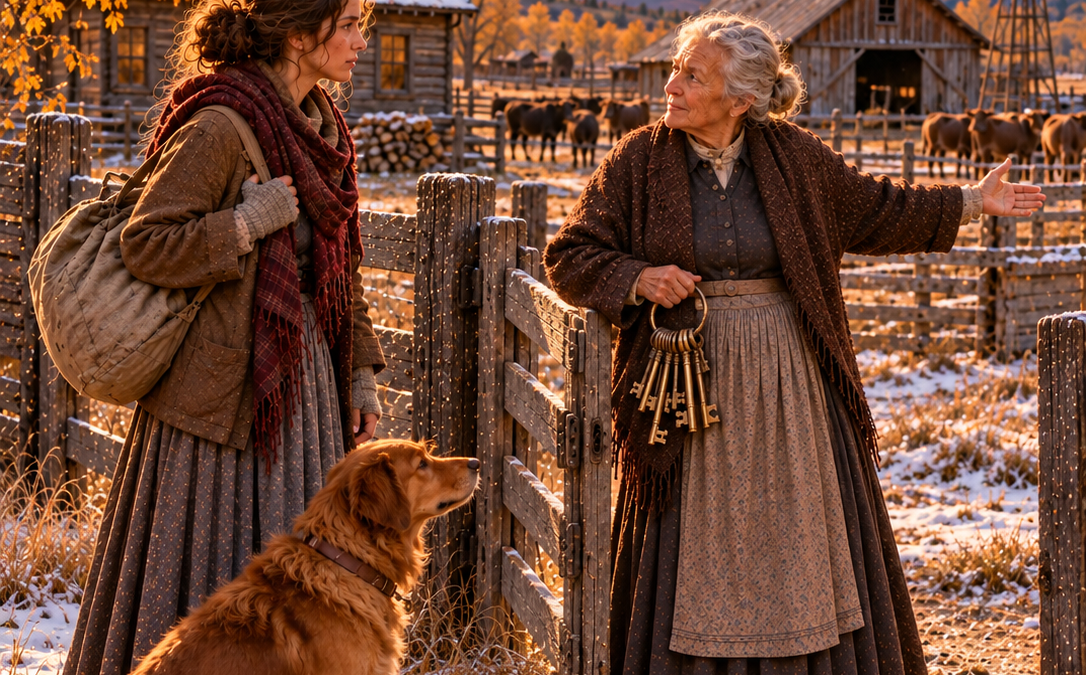
She was twenty-four years old and walking alone through Painted Creek Basin with a canvas bag over one shoulder and a red-brown dog pacing close to her left boot. The road had hardened beneath several nights of frost. Dry grass hissed along the fence lines whenever the wind came down from the northwest.
Bee had two changes of clothes in her bag, a pair of patched gloves, her mother’s old shawl, and a few coins she had been careful not to spend.
Copper had even less.
He carried dust in his coat and a permanent suspicion of strangers.
Until a few weeks earlier, Bee had worked at a freight station. The station had not burned, failed, or gone bankrupt. The freight route had simply changed, and the work had moved with it. No one had been cruel enough to fire her. The world had merely rearranged itself without asking what would happen to the people left standing in the old place.
A freighter headed east had mentioned Willow Bend Ranch.
“Old woman owns it,” he’d said. “More land than help, from what I hear.”
That was enough to make Bee walk.
She reached Willow Bend near sundown.
The ranch did not look prosperous in the polished way of places built all at once. The house sat low against the land. A barn stood beyond it, with sheds, fences, cattle lots, and paths added wherever years of necessity had put them. Smoke rose from the chimney and flattened beneath the cold sky.
Bee stopped at the gate.
A woman came onto the porch.
Hester Calder was seventy-six, narrow through the shoulders but still straight-backed. A heavy ring of keys hung at her hip. She looked first at Bee, then at Copper.
Bee kept both hands visible.
“I’m looking for work.”
Hester waited.
“I can cook. Wash. Milk. Tend horses. Clean stalls. Mend fence.” Bee swallowed. “Whatever two willing hands can manage.”
“What wages?”
Bee looked down the road she had just walked.
“Supper tonight. Somewhere dry to sleep.”
Hester studied her another moment.
She did not ask about Bee’s family. She did not ask why a young woman was walking alone in October, or whether the dog belonged to her, or what sort of trouble might be following.
Instead, she opened the gate.
“Work can be discussed after supper.”
The meal was stew, cornbread, and milk.
Bee sat near the edge of her chair, as if ready to be told she had misunderstood and should leave. Copper remained outside until Hester carried a bowl onto the porch and put it beside the door.
Bee noticed that.
She said nothing.
When supper was finished, Bee gathered the dishes without being asked. She hauled water, swept ash from the hearth, and heard a loose shutter knocking against the side of the house. She went outside, tightened the latch, then returned to the kitchen.
Hester watched all of it.
She offered Bee the old sewing room at the end of the hall.
Bee slept in most of her clothes.
Her boots stood within reach of the bed. Her canvas bag remained beneath one hand. Copper stretched across the doorway.
Long before daylight, Hester heard the pump handle creaking outside.
When she entered the kitchen, the stove was already lit. Kindling had been stacked beside it. The chickens had been fed.
Through the window she saw Bee crouched beside the yard gate, examining a sagging hinge.
Hester did not praise her.
At breakfast, she poured a second cup of coffee and pushed it across the table.
Bee understood.
She pulled her chair closer.
Over the next two weeks, Willow Bend gave her more work than she could possibly invent for herself.
She milked before sunrise, changed damp straw, cleaned the chicken house, split kindling, patched harness leather, carried water, checked cattle troughs when the temperature fell, and helped Hester with the ranch tally in the evenings.
Figures were not Bee’s strength.
She counted slowly, sometimes following a column with her fingertip.
Hester never mocked her.
More importantly, Hester never pretended not to notice when Bee worked.
She saw Bee carry the same load whether anyone watched or not. She saw her put tools back where she found them. She saw her check a gate twice after a repair and return to a chore she had done badly enough the first time to bother her conscience.
One morning, Hester took four keys from the heavy ring at her hip.
She placed them in Bee’s palm.
“The pantry. Tack room. Springhouse. Feed shed.”
Bee looked at the keys.
“If you carry a key,” Hester said, “you answer for what’s behind the door.”
Bee closed her fingers around them.
“Yes, ma’am.”
After that, Willow Bend changed in Bee’s mind.
Before, the ranch had been a list of chores. A bucket here. Hay there. Wood from one shed, water from another. Now she began seeing the distance between those chores.
She watched where people walked.
She watched where water froze.
Most of all, she watched the wind.
Every morning wood traveled from the shed to the kitchen. Hay traveled from the feed shed to the barn. Water came from the pump and springhouse. Milk traveled back toward the house.
None of the trips was especially long.
Too many crossed open ground.
The feed shed stood on the windward side, making every armload of hay a fight against the northwest wind. Runoff from the northern slope crossed the springhouse path and collected in a low throat where it froze hard. Anyone carrying full buckets had to step directly over the worst ice.
The barn was another problem.
Its main door opened toward a shallow draw that gathered the northwest wind and drove it faster between the buildings. A strong gust could wrench the door from a person’s grip.
Bee finally asked Rufus Trent about it.
Rufus was sixty-three and had worked Willow Bend long enough to remember when some of the fences were new. He carried a folding rule, distrusted unnecessary improvements, and had learned that winter punished confidence faster than ignorance.
“Why’d they put the buildings this way?” Bee asked.
Rufus glanced across the yard.
“They didn’t.”
Bee waited.
“Isaac built the first barn when there wasn’t much ranch here. Then came another shed. Then more cattle. Then another lot. Then another fence.” He shrugged. “Place grew.”
“So Isaac built it wrong?”
Rufus’s expression tightened.
“No. There just wasn’t this much ranch when he started.”
Bee looked from the barn to the springhouse and then toward the feed shed.
That was the answer.
Willow Bend did not need more buildings.
The buildings it already had needed to work together.
“The ranch changed,” she said.
Rufus looked at her.
“The wind didn’t.”
That evening Bee spread paper across Hester’s kitchen table.
She did not suggest moving the barn or tearing down sheds. Instead, she marked out the paths people walked every day.
A wind screen could be built from lodgepole pine already available on the ranch. Willow slats could be fastened between the posts, not tightly, but with narrow openings.
“Why gaps?” Hester asked.
“So some wind passes through,” Bee said. “If we stop it dead, it’ll drop whatever it’s carrying.”
Rufus unfolded his rule.
Bee continued.
They could move hay access to the lee side. River cobble and coarse gravel could improve the icy section near the springhouse. A shallow diversion above the path could turn runoff aside before it reached the low spot. Part of the wood reserve could be kept closer to shelter.
“How much?” Hester asked.
“Mostly labor, if we use what’s here.”
Rufus tapped Bee’s sketch.
“And where do you suppose the snow goes after your screen stops the wind?”
Bee looked at him.
It was a fair question.
A windbreak did not destroy snow. A wall too solid or badly placed could make the drifting worse by slowing the air until it dumped snow exactly where people needed to walk.
“It has to go somewhere,” Bee admitted.
Rufus nodded once.
No one had defeated anyone.
Hester removed her key ring and placed it on the table beside the folding rule.
“Build a piece first,” she said. “Then watch it.”
Bee nodded.
Hester held her gaze.
“A key lets you open something. It doesn’t make you right.”
Bee remembered that.
She and Rufus set lodgepole posts, then fixed willow slats between them with deliberate gaps. The first section stood six feet eight inches high.
Bee placed it eleven feet from the barn.
She believed keeping it close would protect the doorway.
Rufus measured the distance.
He said nothing.
They shifted the feed gate toward the lee side, filled the worst part of the springhouse approach with cobble and gravel, and cut a shallow drainage channel above the path. Bee left the barn vents alone.
Then they watched.
That night the temperature fell to seventeen degrees.
The next morning the springhouse path had less ice. The barn door still moved, but the wind no longer snapped it out of Bee’s hands. The new feed approach shortened the exposed route.
Copper discovered the protected side of the screen almost immediately.
Hester discovered the improved footing at the springhouse.
Bee saw the old woman cross with a pail without reaching for the rail.
She did not point it out.
The changes appeared to be working.
Then snow came.
Wet flakes crossed Painted Creek Basin under a hard northwest wind. At first, the screen seemed to prove Bee right. Snow no longer drove straight into the barn opening.
Then the slowed air began surrendering what it carried.
A drift formed behind the screen.
By afternoon, packed snow was rising between the barn and milk room door.
Bee opened the door once.
An hour later it dragged against the drift.
Rufus arrived with a shovel.
He did not remind her of the question he had asked at the kitchen table.
Instead, he cut into the drift and left one face standing so they could see the layers.
Bee fetched his folding rule.
Eleven feet.
She stared at the snow.
“I put it wrong.”
That was all she said.
The following morning, they dismantled their own work.
Posts came out of the frozen ground. Willow slats were stacked. Bee’s shoulders ached from repeating labor she had already done once.
They moved the line outward.
Eighteen feet.
Bee opened more relief near the southern end and corrected the grade where snow had collected.
Hester watched from the porch without blame.
Near dusk, Bee was struggling with a post that refused to come free. Rufus walked over carrying his crowbar.
He held it toward her.
Bee took it.
From that day, Rufus stopped watching to see whether Bee knew what she was doing.
He began working with her.
A few days later, Bee rode into Painted Creek Settlement for salt, lamp oil, and liniment for Hester’s joints.
Lenora Fitch kept the general store. At fifty-nine, she knew nearly every family in the basin and enough about the rest to make people careful around her counter.
She was filling Bee’s order when she noticed the keys at Bee’s belt.
“Mrs. Calder letting you handle things now?”
“Some things.”
Lenora entered the purchases in Willow Bend’s account book.
“Those changes at the barn hers too?”
Bee placed Hester’s written account note beside the receipt.
“She approved them.”
A man near the stove turned.
“Victor and Nolan know a stranger’s running their mother’s place?”
Bee folded the receipt.
“I’m working there.”
She gave them nothing else.
By the time she left, no accusation had been made.
None was necessary.
Painted Creek had enough pieces to invent its own version.
A young woman had arrived with almost nothing. Now she lived under Hester Calder’s roof. She carried keys. She purchased goods against Willow Bend’s account and helped alter the ranch.
On the ride home, the iron keys struck against Bee’s hip.
For the first time, they felt heavy.
At supper she began removing the ring.
Hester noticed.
“Did the springhouse open when you needed it?”
“Yes.”
“Feed shed?”
“Yes.”
“Then keep the key.”
Later that evening, Hester carried a walnut box to the table.
She opened it with a key from her own ring.
Inside lay a faded photograph of her late husband, Isaac, his brass pocket watch, old papers, and a hand-drawn sketch of Willow Bend in its early years.
The drawing showed little more than the house, a small barn, one fenced lot, and a hay meadow.
Hester ran one finger along the paper.
“We didn’t plan a ranch,” she said. “We built what we needed. Then needed something else.”
She showed Bee several letters.
Victor Calder, her older son, was forty-seven and involved in trade in Cheyenne. Nolan, forty-one, moved from one job to another and accumulated debts that never seemed fully paid.
Their letters had once come irregularly.
Recently, they had become more frequent.
One asked how many cattle Willow Bend carried.
Another asked what nearby acreage had sold for.
Another wanted to know whether Hester might reduce the herd and lease pasture.
Hester never told Bee her sons did not love her.
The letters did not prove that.
But the dates were far apart, while the questions inside them all pointed toward the ranch.
Hester lifted Isaac’s brass watch.
Her thumb moved across the worn case.
Then she placed it back in the walnut box.
Bee closed the lid gently.
She checked the latch before bed.
Then, without knowing why, she checked it again.
Word reached Cheyenne.
Victor arrived at Willow Bend with Nolan and Victor’s wife, Camille.
Victor was controlled at first.
He asked Bee where she had come from, how long she had been at Willow Bend, what Hester paid her, and why she carried keys.
Then he asked who had authorized the use of lodgepole timber.
“Your mother,” Bee said.
“Did she understand the cost?”
“Yes.”
Rufus confirmed it.
Outside, Victor inspected the wind screen.
“You’ve been here a few weeks,” he said to Bee. “People have worked this ranch for decades.”
Rufus leaned against a post.
“She didn’t know better.”
Victor looked at him.
Rufus pointed toward the corrected line.
“First time she put it wrong.”
Victor’s expression changed with satisfaction.
“Then she moved it,” Rufus finished.
The satisfaction disappeared.
There was little to argue with.
Bee had been wrong.
The mistake had been exposed.
She had torn out her own work and corrected it.
So Victor stopped arguing about wind and snow.
He began arguing about authority.
“This is family property.”
Hester had been listening from the porch.
“Family is a word,” she said. “This ranch is work.”
Later, Victor put money on the kitchen table.
It was enough to cover several weeks of wages and fare back to town.
“You’ve worked,” he told Bee. “You’ll be paid.”
Bee stared at the money.
Leaving would have been simple.
She had come with one canvas bag. She could leave with the same one.
Whatever stood between Hester and her sons had begun years before Bee walked through the gate.
Bee reached toward the coins.
“Did I dismiss you?” Hester asked.
Bee stopped.
“No.”
Victor turned toward his mother.
“You’re seventy-six.”
Hester’s expression changed.
Victor continued.
“Anyone your age can become dependent on the person nearest to them. Decisions made under influence can become decisions you regret.”
Hester did not raise her voice.
That made what she said more final.
“If you’re determined to say I cannot speak for myself, then I’ll put my wishes on paper while no one can mistake them.”
Victor’s face hardened.
He picked up the money.
Camille followed him outside.
Nolan remained at the threshold for a moment, looking toward the wind screen and sheltered lane.
Then he followed his brother.
That evening Bee asked Hester the question she had been avoiding.
“Would it make things easier if I left?”
Hester said nothing.
“If you tell me to go, I’ll go,” Bee continued. “But it should come from you.”
Hester removed the heavy key ring from her hip and set it between them.
She did not push it toward Bee.
She did not ask for Bee’s smaller ring.
That night Bee placed her old canvas bag beside the bed.
At dawn it was still there.
So was she.
Part 2
Victor did not need to return to Willow Bend to make his displeasure felt.
Lenora Fitch stopped extending store credit.
A grain delivery that had always arrived on time was suddenly delayed. A ranch offered Rufus better wages. A wagon hauler refused a lumber run because, as he put it, he wanted no part of a Calder family fight.
Rufus stayed.
“Winter won’t wait for them to settle this.”
Bee stopped wasting strength on arguments she could not control.
She and Rufus measured the hay stacks and checked the wood reserve. Emergency feed was shifted into the lee-side shed. They reopened the drainage above the springhouse and added stone where footing remained uncertain.
Bee checked the stovepipe draw.
At the barn, she made certain the high vents remained open.
There was no sense protecting livestock from wind only to trap damp air around them.
They planted tall marker poles along the main chore route and at fence corners. In a whiteout, a building could disappear at a distance that would seem ridiculous on a clear day. One pole could lead to the next.
Bee also began keeping two records.
Wood used.
Feed remaining.
She did not want Willow Bend to look efficient.
She wanted to know how much margin it possessed when winter stopped forgiving mistakes.
One afternoon Hester found Bee counting hay for the second time.
The old woman walked to the next stack.
Without asking why, she touched the first bale and began counting with her.
Victor’s accusations had settled something in Hester.
She sent for Edwin Marlow, a seventy-one-year-old territorial notary who had known the Calders for decades.
Edwin arrived carrying a leather case and an expression suggesting that family drama impressed him far less than incomplete paperwork.
He listened to Hester privately.
Then he explained what would be required.
“If you intend to make an unusual decision,” he said, “then the record ought to be unusually careful.”
There would be an independent examination of Hester’s competency.
There would be witnesses.
There would be an inventory of property and debts.
Only then would he prepare the final will if Hester still wanted it.
Dr. Milton Reeve, fifty-two, examined Hester without Bee in the room.
Arthur Penrose, the fifty-eight-year-old schoolmaster, agreed to serve as an independent witness.
Hester answered every question put to her.
She knew what she owned.
She knew what she owed.
She knew who her sons were.
She knew what she intended.
The inventory came next: cattle, hay, acreage, buildings, debts, household goods.
Isaac’s brass pocket watch was listed among the personal effects.
Then Edwin read the proposed will.
Victor and Nolan were not erased.
Each son would receive a smaller lawful share and selected family possessions.
After Willow Bend’s debts were satisfied, the greater part of the ranch would pass to Beatrice Mercer.
Bee sat very still.
Edwin finished reading.
Hester looked at her.
Bee did not thank her.
Instead, she turned to Edwin.
“I want something added.”
Edwin raised his eyes.
“If Mrs. Calder changes her mind later, while she’s still competent, I want the paper to say plainly she can change it again.”
Hester studied Bee.
Edwin did the same.
Then the notary nodded.
“I can make that clear.”
He added the language.
The will was signed, witnessed, sealed, and stored.
Afterward, there was no embrace.
No promise that Bee would one day own Willow Bend.
Hester gathered the inventory sheets, placed her key ring beside them, and looked through the window.
“North lot watered?”
Bee rose.
“I’ll check.”
She put on her coat and went outside.
Edwin watched her cross the yard toward the cattle.
Whatever question had remained in his mind seemed to lose some of its urgency.
News of the will reached Victor.
The legal ground was no longer easy to challenge. A physician had examined Hester. Independent witnesses had signed. Edwin had documented the inventory and Hester’s intentions.
But Nolan still had debts.
And Victor knew how to use his brother’s weakness.
Not long afterward, Nolan approached Tessa Reed.
Tessa was twenty-two and survived by carrying eggs, sewing, mending, and taking whatever respectable work Painted Creek offered a woman without much money.
Nolan offered her payment for a small theft.
At least, that was how he described it.
Isaac Calder’s brass watch.
But taking the watch was only the first part.
Tessa was supposed to hide it inside Bee’s trunk.
Later, when the watch was “found,” Bee would look like a woman already stealing family possessions from the old rancher who had named her in a will.
Tessa entered Willow Bend on an ordinary errand.
She had been there before.
No one immediately found her presence unusual.
She slipped away from the kitchen, found the walnut box, and took the watch.
Then fear interrupted the plan.
Copper usually slept near Bee’s doorway in the afternoon.
When Tessa came from the hall instead of the kitchen, the dog lifted his head.
A low growl came from his chest.
Tessa froze.
She still had to enter Bee’s room.
She could not make herself do it.
She left with the watch hidden on her person.
Later, Rufus noticed a muddy heel mark near the back stair.
Neither Copper’s growl nor a muddy mark proved anything.
Then Hester opened the walnut box.
The brass watch was gone.
For several seconds she stared at the empty place where Isaac’s watch had rested.
Bee felt the meaning of the theft immediately.
Not because she knew who had taken it.
Because she knew who would be blamed if the wrong person controlled the search.
She did not accuse Victor.
She did not accuse Nolan.
She did not search Tessa’s belongings.
And when someone suggested looking through Bee’s room, she stopped them.
“Not without witnesses.”
Hester looked at her.
“Lock this room,” Bee said. “Then we find out who was where.”
Hester closed the walnut box.
Her hand remained on the lid a moment longer than necessary.
Bee moved quickly.
Rumor traveled faster than evidence in Painted Creek, and if people heard that a family heirloom had disappeared after Hester named Bee in her will, the story would be decided before the watch was ever found.
Bee asked Arthur Penrose to accompany her.
The schoolmaster had no financial interest in Willow Bend. That mattered.
Together they found Tessa.
At first, the young woman denied everything.
Bee did not threaten her.
“The watch hasn’t been found in my room,” Bee said. “No one’s accused you publicly. And I’m not choosing a thief because it’s convenient.”
Tessa’s face began to change.
Bee continued.
“We find what happened first.”
Tessa broke.
She still had the watch.
She had taken it from Hester’s walnut box.
But Copper had frightened her before she could enter Bee’s room, and she had never completed the second half of the plan.
Then she gave them Nolan’s name.
The watch was returned to Willow Bend in front of Arthur and Rufus.
Nolan was summoned.
There was little room left for denial.
He admitted approaching Tessa.
He admitted paying her.
Then came the part Hester did not want to hear.
Victor had suggested making Bee appear dishonest.
Nolan had arranged the theft.
The watch was supposed to be discovered among Bee’s possessions.
Hester sat at the kitchen table with Isaac’s watch in front of her.
Nolan stood across from her.
He looked younger than forty-one.
Not innocent.
Just smaller.
Hester did not shout.
That would have been easier for him.
“You’ll make good the trouble you’ve brought on Tessa,” she said.
Nolan lowered his head.
“You’ll correct every lie you helped spread.”
He nodded.
“You’ll repair what trust you can.”
Nolan looked toward the watch.
“Do you think you’ll ever forgive me?”
Hester picked it up.
She opened the walnut box and returned the watch to its place.
“That depends on what you do after today.”
Bee’s keys remained at her belt.
No one asked for them.
Arthur told the truth when people questioned him.
There was no public spectacle. No dramatic confession in the street.
The facts simply moved through Painted Creek.
Lenora restored Willow Bend’s credit without mentioning why it had disappeared.
A neighbor returned a wagon chain he had borrowed months earlier.
One man continued to say Bee had been too lucky for someone who had arrived with nothing.
But the questions around her began changing.
Outside the store, a rancher stopped Rufus.
“That screen really help with the drifting?”
“It helps.”
That mattered more to Bee than praise.
Camille sent Hester a private letter.
She did not defend Bee. She did not condemn Victor.
She wrote only that her husband had gone too far.
Nolan chose a slower answer.
Every few days he came to Willow Bend.
He did not ask for wages.
He repaired fence. Hauled stone. Moved feed. Stood in frozen mud beside Rufus doing work that would never be admired.
Bee did not trust him.
Hester did not trust him.
But they let him work.
Then the basin began giving its own warnings.
Cattle turned their backs toward the northwest.
Frost appeared inside the pump handle before sunrise.
High clouds stretched into thin bands over the northern horizon.
Copper stopped wandering far from the barn.
Asa Boone, a freight hauler who knew the roads and weather better than most, brought the final warning.
A northern blow was coming.
Hard.
That evening Hester watched Nolan through the kitchen window while he finished repairing a fence in the frozen yard.
She did not call him inside.
She simply took another plate from the cupboard and set it on the table.
Storm preparation began the next morning.
Bee, Rufus, and Nolan started with water.
Troughs were filled.
Emergency barrels were moved into protected space.
Hay sufficient for several days was transferred to the lee-side access so a major drift could not bury the main supply.
The wood reserve was divided.
One pile might disappear behind snow.
Two piles gave them another chance.
At the barn, Rufus checked the high vents.
Bee secured the doors, but did not seal the building tight.
Marker poles were inspected between the house, springhouse, and barn.
Shovels were placed at both ends of the sheltered lane.
The runoff cut was cleared.
Nolan braced a weak gate before the ground froze harder.
Blankets, rope, and lanterns were placed where hands could find them in darkness.
Nothing depended upon one clever improvement.
The wind screen weakened the gusts.
The sheltered lane shortened exposure.
Drainage improved footing.
The relocated feed protected access.
Split reserves gave them alternatives.
Rufus compared Bee’s wood tally to Hester’s records from the previous winter.
The shorter chore routes meant doors stood open for less time. The stove did not have to be driven as hard to replace lost heat.
They did not have abundance.
They had margin.
Hester sat at the kitchen table while Bee checked the inventory line by line.
When they finished, Bee removed her smaller key ring.
She placed it near Hester’s hand.
For a moment neither woman spoke.
Then Hester closed Bee’s fingers around the keys.
Outside, Copper lifted his head.
The wind had changed.
Before dawn, the storm struck.
Part 3
The temperature fell toward twenty-four degrees below zero.
By morning, gusts reached forty-two miles an hour.
Then forty-six.
Snow traveled sideways across Willow Bend.
The north road vanished before noon.
From the house, the barn sometimes disappeared completely behind moving white.
Bee tied her coat tight and stepped outside.
The cold attacked any skin she left exposed.
She followed the marker poles.
One.
Then another.
Then the next.
The willow screen took the first force of the northwest wind.
It bent.
Air passed through the gaps exactly as intended, slowed but not stopped.
Beyond it, the sheltered lane remained violent by ordinary standards.
Compared with the open yard, it was manageable.
The barn door shook beneath the gusts.
It did not slam.
That difference was enough.
The storm continued into a second day.
Drifts formed where Bee and Rufus had expected them after moving the screen to eighteen feet.
The milk room door stayed clear.
Snow piled beyond the useful lane instead of sealing it.
The springhouse approach became slick, but boots still found grip among the river cobble and gravel.
Feed could be carried from the lee-side access without forcing a person to lean his whole weight into every gust.
Nolan worked without complaint.
Rufus watched him, but no longer with the particular suspicion reserved for a man whose apology had not yet been tested by inconvenience.
There was little room in a storm for speeches about redemption.
Either a man picked up the shovel or he did not.
Nolan picked it up.
By the third day, Willow Bend’s careful preparations began encountering problems they had not solved.
Bee went toward the southern relief and saw snow rising higher than expected.
Too high.
The storm had shifted just enough to build a ridge where the protected lane needed an exit.
Bee did not waste time deciding whether the original plan had been right.
“Rufus!”
He came through the white carrying a shovel.
They began cutting the passage open before the drift could close.
Snow filled parts of the trench almost as quickly as they removed it.
Then Copper started barking.
Not his ordinary warning at strangers.
A sharp, urgent bark from the stock side.
Bee dropped her shovel.
They followed him.
A frightened heifer had pushed a fence panel out of line.
Another animal crowded behind her.
If the panel failed completely, they could have cattle loose in a storm where a person could barely see ten yards.
Nolan and Rufus reached the fence first.
They leaned their weight into it.
Bee cleared enough packed snow from the base to let them reset and brace the panel.
A gust struck.
The world disappeared.
Bee bent forward and waited for enough visibility to find the marker pole again.
Beneath her coat, the keys hit one another with a small metallic sound.
She thought of the first morning Hester had placed four of them in her palm.
If you carry a key, you answer for what’s behind the door.
At the time, Bee had thought Hester meant rooms.
Now she understood that the key had never been the important part.
Responsibility was.
By the fourth day, everyone at Willow Bend was exhausted.
The storm did not care.
But the wood reserve remained sufficient.
Feed remained accessible.
The water source had not frozen.
No livestock had been lost.
The stove had not needed to be driven dangerously hard.
Small things failed.
A passage narrowed.
A fence panel shifted.
The springhouse became slippery.
A drift grew where they had hoped it would not.
But no failure was large enough to become catastrophe.
That was what the work had accomplished.
Winter was not harmless.
It was manageable.
During one trip between buildings, Bee stopped behind the wind screen.
Snow moved in curtains beyond it.
She looked along the posts.
Once, she had built that screen eleven feet from the barn.
Once, she had watched snow bury the very passage she had meant to protect.
She had pulled the posts out with aching hands.
She had rebuilt what she had already built.
Now the corrected screen bent under the storm.
For a second, the posts leaned.
Then they straightened.
Bee moved on.
When the sky finally cleared, silence arrived so suddenly it felt unnatural.
Painted Creek Basin began counting losses.
Barn entrances on neighboring ranches had disappeared under drifts. Windward haystacks had to be dug out before livestock could be fed. Several troughs froze solid. Some households burned far more firewood than expected because doors and chore routes had remained exposed.
Willow Bend had damage too.
A fence rail had broken.
Roof shingles were missing.
The southern relief required more digging.
But the ranch was functioning.
When the road became passable, Asa Boone arrived with several men.
They walked through Willow Bend slowly.
None called Bee brilliant.
She would not have trusted them if they had.
Instead, they asked questions.
“How far’s that screen from the barn?”
“Why leave gaps in the slats?”
“Why’d you put the feed gate on that side?”
“Those marker poles—why aren’t they in a straight line?”
“Stone really help at the springhouse?”
Rufus answered several questions.
Then one rancher wanted the screen distance measured.
Rufus reached for the folding rule he had carried through years of work at Willow Bend.
He stopped.
Then he held it toward Bee.
She took it.
They walked to the corrected line.
“Eighteen feet,” Bee said.
A few days later, a sack of flour arrived from Lenora Fitch’s store.
It was entered against Willow Bend’s account.
No one demanded cash.
Victor came after the roads improved.
He arrived without the force he had brought the first time.
He walked through the yard.
He inspected the sheltered lane, the feed under cover, and the snow deposited safely beyond the corrected screen.
He looked toward the barn.
“It held.”
Hester stood beside him.
“No.”
Victor turned.
“It was corrected until it could.”
For a moment, he looked as though he might argue.
He did not.
The distinction mattered to Hester.
Willow Bend had not survived the storm because Bee had possessed some gift for being right.
She had been wrong.
The ranch survived because being wrong had become useful information.
Spring returned gradually.
Snow withdrew from fence lines and settled into shaded hollows.
Water began moving through the diversion above the springhouse instead of freezing across the path.
The wind screen remained beyond the barn, with the marks of winter plainly visible.
Nolan continued coming to Willow Bend.
He never became the son Hester might once have imagined.
Some failures could not be repaired by pretending they had never happened.
But Nolan learned to show up.
He hauled, mended, shoveled, and worked.
Hester did not offer easy absolution.
She gave him something more difficult.
Time in which his future conduct could mean something.
Victor remained more distant.
He stopped applying pressure to the ranch and accepted the will Hester had made.
He and his mother did not repair every old distance between them.
Life was not as neat as a ledger.
But the fight over Willow Bend ended.
The following year, Hester weakened.
The change came gradually.
She still noticed everything. She still knew when a gate had been left wrong or when someone used more stove wood than necessary.
But her hands stiffened.
Her steps shortened.
One quiet afternoon, Hester asked Bee to sit with her on the porch.
Cattle rested beyond the lot.
Copper, older now, slept beneath the steps.
Farther out, replaced willow slats marked the places where weather had continued testing the screen.
Hester removed the heavy ring of keys from her belt.
Bee looked at them.
“My hands don’t like carrying this anymore,” Hester said.
Bee did not reach out.
“The papers still say Willow Bend is yours.”
Hester turned the ring once in her palm.
Then she placed it in Bee’s hand.
“Paper tells who owns it.”
Bee looked at her.
“Work tells who keeps it.”
The keys felt heavier than the four Hester had given her after those first weeks.
Bee looked across the ranch.
The gate.
The springhouse.
The barn.
The sheds.
The fences that would fail again.
The cattle that would need feeding tomorrow morning whether anyone felt hopeful or tired.
She closed her fingers around the ring.
Then she sat beside Hester.
Years passed.
Willow Bend remained a working ranch.
It never became a monument to Bee’s good fortune.
Cattle still got sick.
Fences still broke.
Roofs still lost shingles.
Winter still arrived each year with no interest in anyone’s reputation.
The wind screen needed repairs more than once.
Bee made them.
Sometimes she changed the spacing of a slat.
Sometimes a post had to be replaced.
Sometimes snow showed her that last year’s answer would not work exactly the same way this year.
She learned not to resent that.
Willow Bend had taught her better.
The gate also remained open.
Not to everyone without question.
Bee had learned too much about trust for that.
But when someone reached Willow Bend in genuine need—a hired hand between jobs, a widow with a broken wagon, a freighter caught ahead of bad weather—Bee remembered an October evening when she herself had stood outside that gate with a canvas bag over one shoulder.
She rarely asked where a person had failed.
She asked something simpler.
“Can you work?”
If the answer was yes, there was usually supper.
Usually a dry place to sleep.
And, in time, perhaps a key.
Copper was gone by then.
Another dog slept beneath the same porch.
Hester’s old key ring rested beside Bee when she sat at the kitchen table going over the ranch figures slowly, still following difficult columns with one finger.
Beyond the window stood the barn.
Beyond the barn stood the wind screen.
It had been repaired many times.
Some of the original slats were gone. Several posts had been replaced. Nothing about it was untouched.
That was why it remained standing.
Willow Bend had survived not because no one made mistakes, not because family names guaranteed loyalty, and not because a set of papers could decide who deserved a home.
A frightened young woman had once arrived with nowhere else to go.
An old rancher had opened a gate.
Then, little by little, she had given the stranger something more demanding than charity.
Work.
Trust.
Responsibility.
And keys.
Bee spent the rest of her life answering for what was behind the doors.
Because wisdom was never proved by keeping something untouched.
It was proved by knowing what was worth maintaining.
You Might Also Enjoy

The Auctioneer Sold Her the Wrong Townhome By Mistake—Its Key Opened Every Door in the City
Homeless at 19, Chloe Inherited a Dying Dairy Farm—Then Found a Locked Bunker Under the Silo
She Bought an Injured Horse Nobody Wanted — Then He Led Her to Her Father’s Hidden Canyon