
My fingers closed around the old flip phone.
The plastic casing was scratched and dull.
Clara watched as I carried it to the kitchen counter and connected a charger I had kept for exactly this reason.
“Does it still work?”
“I don’t know.”
The screen stayed black.
Then flickered.
A tiny battery symbol appeared.
Clara pulled out the chair beside me.
For years, I had kept that phone because throwing it away felt like throwing away the only written proof that I hadn’t imagined what happened.
Now, for the first time, I needed it for someone other than myself.
The screen finally lit.
There was one locked message saved inside.
From Mom.
I opened it.
Do not call your father again. Nobody can ever know she is Vanessa’s. You keep her or leave her somewhere else, but you do not bring her back here.
Clara read it twice.
Then again.
Her face changed slowly.
Not relief.
Something colder.
“She said leave me somewhere else?”
I hated that line most.
For fifteen years, I had avoided saying it aloud.
“Yes.”
“Like what?”
“I don’t know.”
“A hospital?”
“I don’t know.”
“A church?”
“Clara.”
“She didn’t care?”
I looked at her.
“I cared.”
Her eyes came back to mine.
“That’s not what I asked.”
There it was.
The same directness she used when a volleyball coach gave her an answer she didn’t accept.
I forced myself not to soften reality.
“No,” I said. “At that moment, I don’t think she cared what happened as long as you didn’t come back.”
Clara looked away.
I photographed the phone screen.
Then I backed the image up in three places.
Not because I was planning some revenge campaign.
Because my mother had just begun publicly rewriting fifteen years of my life, and I was no longer willing to let the truth depend on a dying piece of plastic.
A few days later, Mom entered Vanessa’s public story herself.
She claimed she had spent years begging me to return her granddaughter.
Then she said something that made my stomach turn.
She said she had letters proving it.
Letters.
The word followed me all day.
Because I had written letters.
Not to Mom.
To Dad.
At first, I sent them through the family house.
Then I tried his workplace.
Birthday updates.
Pictures.
One page telling him Clara had started walking.
Another saying she had lost her first tooth.
I never received an answer.
Eventually I stopped.
I had spent years believing Dad chose silence too.
Then Clara told me something she had hidden.
We were sitting in the car outside volleyball practice when she said, “I talked to Vanessa.”
I turned toward her.
“What?”
“Twice.”
“When?”
“After the wedding invitation.”
“How?”
“She messaged me.”
Every muscle in my body tightened.
“What did she say?”
Clara stared through the windshield.
“She cried.”
I waited.
“She said we had the same laugh.”
That sounded exactly like Vanessa.
Not because it was necessarily false.
Because she always knew how to make one emotional detail carry an entire performance.
“Did she ask about school?”
Clara shook her head.
“Volleyball?”
“No.”
“Your friends?”
“No.”
“What did she ask?”
Clara swallowed.
“She wanted me to come to Columbus.”
“Alone?”
“She said she could arrange everything.”
My hands tightened around the steering wheel.
“What else?”
“She wanted us to film the first time we saw each other.”
For a moment I didn’t understand.
“Film?”
“She said it would help people understand what happened.”
I turned fully toward her.
“Clara.”
“I said no.”
“Good.”
“She told me what clothes to wear.”
I felt sick.
“What?”
“Softer colors.”
Her voice cracked.
“She said they would look better on camera.”
That was when my daughter began crying.
Not loudly.
Clara rarely cried loudly.
She wiped both cheeks angrily.
“I thought maybe she wanted me.”
I reached for her hand.
She let me take it.
“She doesn’t even know what music I like.”
“I’m sorry.”
“She didn’t ask what position I play.”
“I know.”
“She wanted me to come back like a prop.”
I squeezed her hand.
“She may have feelings she doesn’t know how to deal with.”
Clara looked at me sharply.
“Don’t do that.”
“What?”
“Don’t make it nicer.”
I stopped.
She was right.
For years, I had believed protecting her meant keeping my anger away from her.
But now she was old enough to recognize when I softened someone else’s choices at her expense.
So I said the truth.
“What she asked you to do was wrong.”
Clara breathed out slowly.
“She wanted a reunion.”
“She wanted a filmed reunion.”
“That’s different.”
“Yes.”
Clara had saved every message.
Her final response to Vanessa was short.
I’m not making a video. You can talk to me at the wedding. No camera.
Vanessa did not reply.
A week later, another Ohio number appeared on my phone.
I almost let it go to voicemail.
Then I answered.
“Hello?”
“Betty.”
My father.
The sound of his voice took fifteen years away from me so quickly I had to sit down.
“Please don’t hang up.”
I couldn’t speak.
“I found your letters.”
My hand tightened around the phone.
“What?”
“Diane said she had letters proving you kept Clara away.”
He sounded tired.
“Something didn’t make sense.”
“What did you do?”
“I looked.”
Mom had gone out.
Dad searched the attic.
Inside a plastic container labeled Christmas Lights, beneath old extension cords and tangled bulbs, he found envelopes.
Mine.
Still sealed.
Years of them.
There was another envelope too.
From Cole.
Dad started crying.
“I didn’t know.”
I closed my eyes.
“I wrote you.”
“I know.”
“I thought you ignored me.”
“I know.”
“You let me think that for fifteen years.”
“I didn’t know you were writing.”
My anger shifted.
Not gone.
Just redirected.
“Why didn’t you come after me?”
He had no good answer.
That mattered.
“I believed your mother,” he said.
“You believed I disappeared with a baby and never asked why?”
“I was angry.”
“At me?”
“Yes.”
“Because she told you to be.”
Silence.
“I should have looked for you.”
“Yes.”
“I should have asked questions.”
“Yes.”
“I’m sorry.”
He breathed shakily.
“I’m coming to see you.”
When he arrived in Spokane three days later, I met him at the door.
He looked older than I expected.
Smaller somehow.
Clara came down the hallway behind me.
Dad saw her.
The envelope in his hand slipped to the floor.
For several seconds, he just stared.
Then he whispered, “You named her after my mother.”
Clara’s middle name was Rose.
His mother’s name.
I nodded.
Dad covered his mouth.
Then he asked Clara, “May I hug you?”
She looked at me.
I said nothing.
This was hers.
She nodded.
He held her carefully.
Not like someone reclaiming property.
Like someone afraid he had already lost too much.
Afterward, he placed the old envelopes on my table.
My handwriting.
My stamps.
My attempts to reach him.
Still sealed.
Beside them was Cole’s letter.
Dad had not opened it.
“It’s his,” he said.
So I called Cole.
A few days later, before Cole had even made it to Spokane, another message came.
This one was from Kelsey.
Vanessa’s former assistant.
I recognized the name from the phone call.
Her email was short.
I no longer work for your sister. I think you should see the attached file.
The file was video.
Unedited.
Recorded the day Vanessa received the wedding invitation.
I clicked play.
Vanessa appeared inside what looked like her home office.
Kelsey was filming promotional material.
Someone handed Vanessa mail.
She opened Cole’s invitation.
Her expression changed.
She read Clara’s name.
Then the performance vanished.
“She was supposed to stay gone!”
My father gripped the table.
Clara went completely still.
On the screen, Vanessa threw the invitation onto her desk.
“Mom promised me she’d stay gone!”
Then she said something even worse.
“Mom said that phone died years ago!”
My skin went cold.
She knew about the phone.
Or at least she knew enough to fear it.
Seconds later, the video captured her grabbing her own phone.
Then my clinic conversation began.
“What did you do?”
The exact call.
No editing.
No interpretation.
No one telling viewers what they were supposed to believe.
Vanessa’s own panic connected Clara, Mom, the old phone, and fifteen years of concealment.
My father lowered himself into a chair.
“Oh my God.”
Clara watched the screen to the end.
Then she closed the laptop.
“Does Cole know?”
“Not yet.”
“Tell him.”
When Cole arrived, Dad handed him the old letter from the Christmas box.
Cole recognized his handwriting immediately.
He opened it.
His eyes moved across the page.
Then stopped.
Fifteen years earlier, after Mom told him the baby had died, Cole had written asking where his daughter was buried.
He wanted to bring flowers.
He wanted to know whether she had been named.
He wanted to know where to go.
Dad’s face collapsed.
“She read this.”
Cole stared at the page.
“She knew I thought Clara was dead.”
“Yes.”
“And she hid it.”
Dad looked at the floor.
“Yes.”
That was when the full shape of what my mother had done became impossible to minimize.
She had not simply sent me away.
She had maintained two separate realities.
To my father, I was the daughter who disappeared.
To Cole, his child was dead.
To Vanessa’s future husband, apparently there had been no living daughter worth mentioning.
To the world, Vanessa eventually became the grieving mother abandoned by her sister.
And somewhere inside all those stories was Clara, alive the entire time.
Then Grant called.
Vanessa’s husband.
His voice was controlled.
Too controlled.
“I found the wedding invitation in her desk.”
I didn’t answer.
“I started checking old emails.”
“Why are you telling me?”
“Because the dates don’t match what she told me.”
“What did she tell you?”
“That she had been sick. That there had been a pregnancy. That the baby didn’t survive.”
I looked at Clara.
She couldn’t hear Grant, but she watched my face.
Grant continued.
“Is Clara okay?”
“Yes.”
“I need to know what really happened.”
“I can show you what I have.”
He breathed out.
“Thank you.”
“But understand something.”
“What?”
“I am not helping you win a divorce.”
Silence.
“I’m not helping you punish Vanessa.”
“I understand.”
“I’m ending a lie.”
“Yes.”
“That is all.”
“Yes.”
By May, the wedding was a week away.
Cole and Hannah still wanted Clara there.
Clara still wanted to go.
I asked her three separate times whether she was sure.
Finally she looked at me.
“Mom.”
“What?”
“If you ask again, I’m going to think you want me to say no.”
That stopped me.
“I don’t.”
“Then let me go.”
So we flew to Ohio.
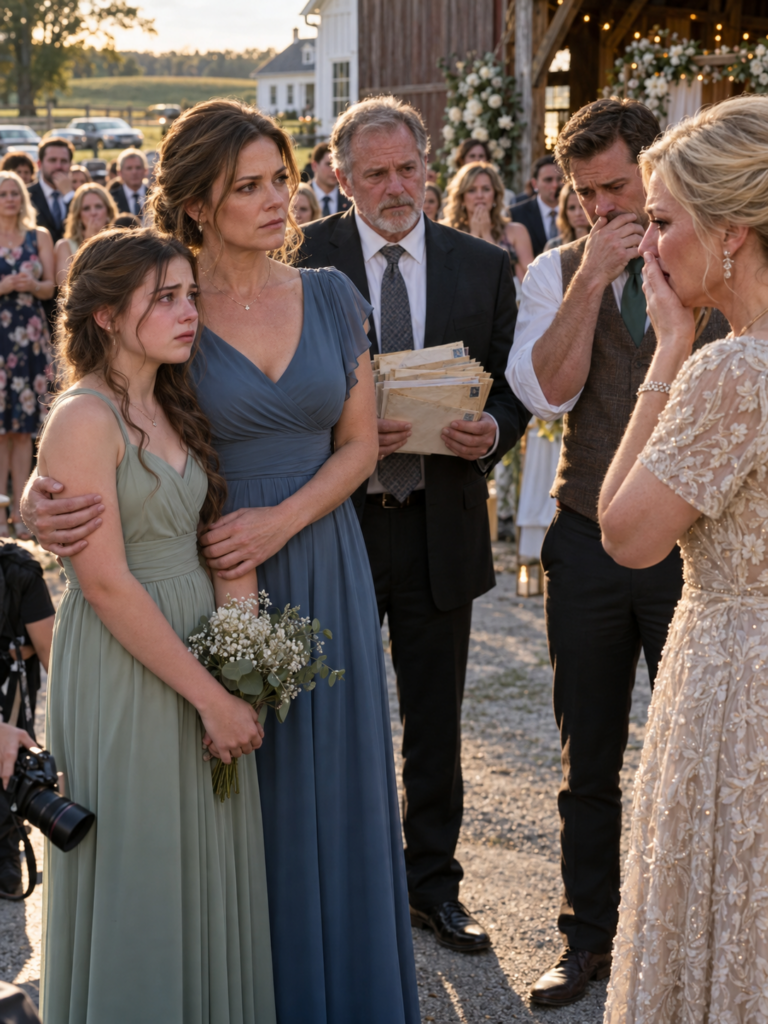
Hannah’s family farm was green and bright, with a red barn behind the ceremony lawn.
Near the driveway, Hannah had placed a large unplugged-wedding sign.
No phones.
No cameras.
Clara had made that her one condition.
She stood beside me before the ceremony wearing her bridesmaid dress.
“Nervous?”
“Very.”
“You can change your mind.”
She gave me a look.
“Sorry.”
Cole found us before guests arrived.
He looked at Clara for a long moment.
Then said, “I missed your first fifteen years.”
His voice broke.
“I’m asking for the rest.”
Clara hugged him.
Later, during the reception, music drifted from the barn.
For the first time all day, I thought maybe Vanessa wasn’t coming.
Then gravel cracked beneath tires.
A white SUV turned into the driveway.
Clara’s hand found mine.
The vehicle stopped.
Mom stepped out first.
Vanessa followed.
Then a cameraman climbed out carrying professional equipment.
Already recording.
Vanessa saw Clara.
Her face transformed.
She began crying before she had crossed half the lawn.
“My baby!”
Clara didn’t move.
Vanessa came closer, arms opening.
Clara looked past her.
At the camera.
Then back at Vanessa.
“Can he stop filming?”
Vanessa kept smiling.
“It’s for us.”
Clara’s fingers slipped out of mine.
She stood straighter.
“No.”
The cameraman hesitated.
Vanessa’s smile tightened.
“Sweetheart, this is an important—”
“No.”
Clara’s voice remained steady.
“It’s my life.”
More than a hundred wedding guests had turned toward them.
The cameraman looked around.
Slowly, he lowered the camera.
The red recording light went dark.
And the instant it did, Vanessa stopped crying.
Vanessa’s face hardened.
The change was so immediate that even people standing twenty feet away could see it.
She pointed at me.
“You turned her against me!”
I took one step forward.
Before I could answer, Mom raised her voice.
“My daughter was sick! Betty took that baby and disappeared!”
People had stopped eating.
The band had gone silent.
Clara stood beside me, staring at the woman who had once paid twenty thousand dollars to make the problem go away without having to face it.
I could feel fifteen years pressing against my ribs.
For years, I had imagined what I would say if I ever stood in the same place with all of them.
In those fantasies, I screamed.
I exposed everything.
I forced them to feel what I had felt.
But standing there beside Clara, none of that mattered.
This was not my opportunity to destroy my family.
It was Clara’s right to exist without being rewritten.
So I spoke quietly.
“My mother gave Clara to me.”
Mom laughed sharply.
“Listen to her.”
“She told me to leave.”
“You ran away.”
“I mailed photographs every year.”
Mom’s mouth tightened.
“More lies.”
“Every envelope came back marked refused.”
Vanessa looked at me.
For the first time, fear crossed her face.
Then a chair scraped behind us.
Dad stood.
He had attended the ceremony quietly and kept his distance from Mom.
Now he carried the stack of old envelopes.
“These were addressed to me.”
Mom turned.
“Walter.”
“They were hidden in your Christmas box.”
Her face changed.
“Those weren’t—”
“They were sealed.”
Dad’s voice shook, but he didn’t sit down.
“For years.”
He held them up.
“She tried to reach me.”
Mom stared at him.
“Walter, this is not the place.”
“No.”
He looked at her.
“That’s what I kept telling myself every time something didn’t make sense. Not now. Not here. Don’t embarrass the family.”
He glanced at Clara.
“I’m done doing that.”
Cole walked forward next.
He carried the letter Dad had found.
“You told me my daughter was dead.”
Vanessa’s eyes widened.
Mom said, “That was a complicated—”
“No.”
Cole’s voice was flat.
“You stood in your doorway and told me Vanessa lost the baby.”
He lifted the old letter.
“I wrote asking where she was buried.”
Mom said nothing.
“You hid that too.”
Vanessa turned sharply toward Grant.
“Grant!”
He stood near the barn entrance.
For fifteen years, Vanessa had been able to direct rooms by calling someone’s name in exactly that tone.
This time, Grant did not move toward her.
He walked closer, but stopped several feet away.
“You told me there had been no surviving baby.”
Vanessa’s mouth opened.
“You knew I was sick.”
“I knew what you told me.”
“That isn’t the same—”
“I saw Kelsey’s video.”
Everything stopped.
Even Mom looked at Vanessa.
Grant continued.
“The unedited one.”
Vanessa’s face emptied.
“The one where you said your mother promised Clara would stay gone.”
“Grant.”
“And the part where you said the old phone was supposed to be dead.”
He reached toward his left hand.
Slowly, he removed his wedding ring.
Vanessa stared.
“Don’t do this here.”
Grant held the ring for a second.
Then placed it in his pocket.
“I’m not doing anything here except refusing to pretend I don’t know.”
He stepped away from her.
Not dramatically.
He did not announce a divorce.
He did not call her names.
He simply moved to another part of the lawn.
That physical distance said more than a speech would have.
Vanessa looked around.
Her husband was no longer beside her.
Her father was holding Betty’s letters.
Cole was standing beside the daughter he had mourned as dead.
And the cameraman she had brought for her reunion had lowered his equipment.
For the first time, Vanessa had no audience she controlled.
Then she looked at Clara.
Her face softened again.
“Sweetheart.”
Clara flinched slightly.
Vanessa noticed.
“I know this looks terrible.”
Clara didn’t respond.
“There are things you don’t understand.”
“Then tell me.”
“I was twenty-one.”
“I know.”
“I was scared.”
“I know.”
“I wasn’t well.”
Clara nodded.
“Okay.”
Vanessa seemed encouraged.
“I was surrounded by people making decisions for me.”
That part may even have been true.
I had seen how Mom controlled that hospital room.
But Clara asked the question Vanessa could not escape.
“Did you ever look for me?”
Vanessa froze.
“Of course.”
“When?”
“Every day.”
Clara’s face didn’t change.
“Where?”
Vanessa swallowed.
“What?”
“Where did you look?”
“I thought Betty had hidden you.”
“Did you call police?”
I felt my stomach tighten.
Clara had not warned me she would ask that.
Vanessa looked toward me.
“I was trying to protect everyone.”
“That isn’t what I asked.”
Clara pointed toward the envelopes in Dad’s hands.
“She sent you pictures.”
Vanessa’s mouth tightened.
“You don’t know the whole context.”
“You refused them.”
“I was young.”
“For fifteen years?”
Silence.
Clara took a breath.
“I know your handwriting.”
Vanessa stared at her.
“You put the same R on your mugs.”
For one brief second, something almost absurd passed through the scene.
The logo Vanessa had built into her carefully curated merchandise line had become the thing her daughter recognized on rejected envelopes.
Clara continued.
“You say you looked for me every day.”
Her voice trembled now, but she didn’t stop.
“Mom mailed you my face.”
“You sent it back.”
Vanessa’s performance finally broke.
Not loudly.
Not spectacularly.
She simply stopped trying.
Her shoulders lowered.
She looked at Clara.
“I didn’t want to be found.”
No one moved.
Clara’s eyes filled.
Vanessa kept going, as though once the first sentence escaped, the rest no longer mattered.
“I wanted a different life.”
Mom whispered, “Vanessa.”
Vanessa didn’t look at her.
“I wanted a life where you didn’t exist.”
The sentence seemed to pass through Clara physically.
She took one small step backward.
I wanted to grab her.
I didn’t.
She had asked for the truth.
She deserved enough room to stand inside it.
After several seconds, Clara nodded.
“Okay.”
Vanessa began crying again.
This time, I couldn’t tell whether it was performance.
Maybe it wasn’t.
Human beings can do terrible things and still grieve the consequences.
Clara looked at her.
“I’m not your content.”
Vanessa’s mouth trembled.
“I’m not your secret.”
Clara wiped one cheek.
“I’m Clara.”
Then she turned around.
And walked toward me.
I opened my arms.
She stepped into them.
Behind us, I heard movement.
When I looked up, several guests had raised phones.
My entire body tensed.
I released Clara and stepped forward.
“She is fifteen.”
The lawn quieted.
“Please don’t record this.”
One woman immediately lowered her phone.
Another followed.
“This belongs to her.”
Slowly, screens disappeared.
That mattered to Clara.
I felt it in the way her shoulders loosened.
For fifteen years, adults had made decisions about her story without her permission.
I would not let the truth become another thing taken from her.
Mom approached Dad.
“We need to leave.”
He looked at her.
“No.”
She stared at him.
“What?”
“I’m staying.”
“Walter.”
“I’m staying for the wedding.”
“This is humiliating.”
He looked toward Clara.
“So was discovering my granddaughter was alive after fifteen years.”
Mom’s face flushed.
“You think this is all my fault?”
“No.”
That answer surprised her.
Dad continued.
“I think I spent fifteen years letting you answer questions I should have asked myself.”
He looked at Vanessa.
“And I let you decide who was easier to blame.”
His eyes came to me.
“I participated by not looking.”
That was the first time Dad had taken responsibility without hiding behind Mom.
He did not claim innocence.
He had been deceived.
He had also chosen the comfort of that deception because questioning it would have required him to act.
Mom turned and walked toward the SUV.
Vanessa stood where Clara had left her.
The cameraman had packed his equipment.
Finally she followed Mom.
Grant did not.
Neither did Dad.
The SUV rolled back down the gravel drive.
Nobody applauded.
Thank God.
This wasn’t a victory scene.
A fifteen-year lie had just collapsed in front of a girl who had spent her entire life inside it.
Hannah came over slowly.
“Do you want us to stop everything?”
Clara wiped her face.
“No.”
“Are you sure?”
“Yes.”
Hannah touched her arm.
“Whatever you want.”
Clara looked toward the barn.
Then at Cole.
“Can we just go back inside?”
Cole nodded.
“Absolutely.”
Music started again carefully.
Not because everyone had forgotten what happened.
Because Clara had asked for the wedding to continue.
Inside the barn, strings of warm lights hung from the beams.
Guests talked more softly.
For a while, Clara sat beside me.
Then she stood.
She looked at Cole.
Then at Dad.
Then at me.
“Come on.”
“Where?”
“Dance.”
“I don’t dance.”
“You absolutely do.”
“That is slander.”
She grabbed my hand anyway.
Then Cole’s.
Then Dad’s.
The four of us moved onto the floor while the sun lowered behind the open barn doors.
None of us danced well.
Dad was terrible.
Cole wasn’t much better.
Clara laughed for the first time since the SUV arrived.
At one point she leaned toward me.
“You asked if I was ever going to choose her.”
My chest tightened.
I remembered asking that months earlier, when she first began speaking to Vanessa.
I had regretted it instantly.
“I shouldn’t have asked you that.”
“I know.”
She smiled faintly.
“I chose you when I was twelve, Mom.”
I stared at her.
“You just didn’t know it.”
My eyes burned.
Before I could answer, she spun away toward Cole.
The wedding ended after dark.
The next morning, my phone was full.
Messages.
Requests.
People asking whether I would respond to Vanessa’s video.
People sending screenshots.
People wanting details.
For fifteen years, I had been powerless because other people controlled the narrative.
Now I had evidence.
That meant I could destroy their version publicly.
The temptation was real.
Then Clara came into the hotel room wearing an oversized sweatshirt and asked:
“Are you going to post the video?”
“Kelsey’s?”
She nodded.
I looked at her.
“No.”
“Why?”
“Because it has you in the middle of a story you didn’t choose.”
She thought about that.
“What are you going to do?”
“I don’t know yet.”
She sat beside me.
“Can you prove she refused the pictures without showing me?”
“Yes.”
“How?”
I pictured the envelopes.
The handwriting.
The dates.
The return marks.
“I can show what she did without showing who you became.”
Clara nodded.
“Do that.”
So a few days later, I made one public statement.
No video.
No footage of the wedding.
No screenshots of Clara’s private messages.
No photograph of her face.
I posted only the returned envelopes.
The ones Vanessa had personally refused.
I explained that I had mailed photographs of Clara over the years.
I explained that they came back unopened.
Then I stopped.
Vanessa eventually deleted her video.
Not because I forced her.
Because the central claim could no longer survive contact with the evidence.
The story she had built began collapsing under its own contradictions.
Grant did not announce what would happen to his marriage.
He only told me he was making decisions privately.
That seemed right.
Dad returned to Ohio for several weeks.
Then, at the end of May, he called.
“I’m coming to Spokane.”
“For how long?”
He hesitated.
“Maybe the summer.”
“With Mom?”
“No.”
That single word told me more than I wanted to ask over the phone.
Dad had separated from Diane.
He didn’t present it as punishment.
He didn’t ask me to celebrate.
He said simply:
“I need to figure out who I am when I stop letting someone else make the hard decisions.”
Two weeks later, he arrived at my door with two suitcases.
Clara opened it.
“Grandpa?”
“I was told Spokane has a summer.”
“Debatable.”
He smiled.
“I’m willing to investigate.”
That evening, after dinner, Clara stood in front of our refrigerator holding the wedding invitation.
The same invitation that had shattered fifteen years of silence.
She smoothed it flat.
Then attached it beside her school schedule with a magnet.
For several seconds, she stared at it.
“What?” I asked.
She pointed toward her name.
“It’s the first time my name has ever been printed beside the word ‘daughter.’”
My throat tightened.
She smiled.
“And nobody had to lie.”
Then she went upstairs.
Dad stepped into the backyard.
I remained alone in the kitchen, staring at the invitation.
Fifteen years earlier, Mom had pushed a newborn into my arms and called her my problem.
Now Clara’s name was hanging on my refrigerator.
Not hidden.
Not changed.
Not erased.
And for the first time, I realized the wedding invitation had never really been an invitation to Vanessa.
It had been a declaration that Clara existed.
But one thing still bothered me.
Clara had heard what Vanessa said on that lawn.
I wanted to believe surviving the truth had ended the damage.
It hadn’t.
And one evening in June, she finally asked me the question I had been dreading.
“If she didn’t want me, why did you?”
Clara asked the question while standing barefoot in the kitchen.
No warning.
No dramatic setup.
Dad was outside pulling weeds badly enough that I was considering rescuing the flower bed.
I was rinsing strawberries at the sink.
“If she didn’t want me,” Clara said, “why did you?”
The water kept running over my hands.
I turned it off.
“What do you mean?”
“You were twenty-four.”
“Yes.”
“You didn’t have a house.”
“No.”
“You were still in school.”
“Yes.”
“You had five hundred dollars.”
“Technically, Mom gave me five hundred dollars.”
“That’s worse.”
“A little.”
Clara crossed her arms.
“So why?”
I looked at her.
For years, I had told the story of her birth as the moment something terrible was done to both of us.
That was true.
But it wasn’t the whole truth.
“I didn’t know what I was doing.”
“That’s not an answer.”
I smiled despite myself.
“You really like saying that.”
“Mom.”
“All right.”
I dried my hands.
“When the nurse gave you to Vanessa, she turned away.”
Clara looked down.
“When Mom put you in my arms, you were screaming.”
“I sound charming.”
“You were extremely loud.”
“Still true.”
“You stopped after maybe thirty seconds.”
Clara looked back at me.
“You just stared at me.”
I could still see it.
Her tiny face.
Her dark hair flattened against her head.
The hospital bracelet around one ankle.
“I was terrified.”
“Of me?”
“Of everything.”
I leaned against the counter.
“I knew Mom was doing something wrong.”
“Then why did you leave?”
“Because she made it sound like there were only two choices.”
“What choices?”
“Take you and go, or leave you behind with people who were already talking about you as a problem.”
Clara’s expression tightened.
“I chose the option where I could see what happened to you.”
“That sounds awful.”
“It was.”
I let the silence sit.
“But something happened on the bus.”
“What?”
“You started crying outside Indianapolis.”
“How do you remember that?”
“Because you cried for nearly an hour.”
“Again, charming.”
“I had no idea what you needed. The formula was too cold. I was crying too.”
Clara smiled faintly.
“I finally got you to sleep against my chest.”
I looked at her.
“And I remember thinking that whatever had happened before that moment, nobody was putting you somewhere else.”
Her eyes filled.
“It wasn’t because I was noble.”
“I was angry.”
“I was scared.”
“I thought my life was over.”
“I resented Mom.”
“I resented Vanessa.”
“For a while, part of me even resented that I had to make decisions because everyone else refused to.”
Clara swallowed.
“But never you.”
“No.”
I walked closer.
“You were a baby.”
“You hadn’t done anything.”
“So why did I want you?”
She nodded.
“Because after about three days, I stopped thinking of you as Vanessa’s baby.”
I touched her cheek.
“You were Clara.”
Her mouth trembled.
“And after a few months, when people asked if I had children, I stopped hesitating.”
“You became my daughter before I found language for it.”
Clara leaned into me.
For fifteen years, I had believed the greatest danger was that she would someday discover biology and decide blood mattered more.
But that fear had always been mine.
Not hers.
That summer, Dad settled into a strange rhythm in Spokane.
He found a furnished apartment two neighborhoods away because I refused his offer to “stay out of the way” in our spare room for three months.
“You would not stay out of the way,” I told him.
“I can be unobtrusive.”
“You reorganized my pantry in forty-eight hours.”
“It lacked logic.”
“You’re proving my point.”
He laughed.
We were learning each other again.
Not rebuilding fifteen lost years in one summer.
That would have been impossible.
Dad had missed too much.
He had not attended my graduation.
He had not seen me learn to raise a child while trying to pass anatomy exams.
He had not been there when Clara had pneumonia at three.
Or when she lost her first tooth.
Or when she broke her wrist.
Those absences did not disappear because he discovered the letters.
Some of them belonged to Mom’s deception.
Some belonged to his own failure to question her.
He understood that.
The first time he tried to say, “If I had known—”
I stopped him.
“You didn’t know because you didn’t look.”
His face fell.
But he nodded.
“You’re right.”
That became our rule.
No rewriting.
Mom called occasionally.
At first, I didn’t answer.
Then one evening, I did.
Her voice was smaller.
“Betty.”
“Yes.”
“Is your father there?”
“No.”
Silence.
“I don’t know what he wants.”
“You should ask him.”
“He won’t talk to me.”
“That’s between you and Dad.”
Another silence.
“I miss Clara.”
I closed my eyes.
“You don’t know Clara.”
“That’s unfair.”
“No. It’s accurate.”
“I’m her grandmother.”
“Biologically.”
Mom inhaled sharply.
I continued before she could redirect the conversation.
“If you ever have a relationship with her, it will happen because she wants one.”
“She’s a child.”
“She’s fifteen.”
“She doesn’t understand everything.”
“She understands enough to know adults lied about her.”
Mom began to cry.
Once, that sound would have made me retreat.
This time, I waited.
“I was trying to protect Vanessa.”
“I know.”
“I thought if she could get through school and build a life—”
“By erasing a baby?”
“I panicked.”
“For fifteen years?”
She went silent.
That was the problem with the truth.
It separated one terrible decision from the thousands required to maintain it.
A frightened choice in a hospital could perhaps be explained.
Hiding letters was another choice.
Telling Cole his daughter was dead was another.
Hiding his letter was another.
Returning photographs was another.
Inventing a public version of me was another.
Offering me money was another.
Calling Clara a misunderstanding was another.
Bringing a cameraman to her father’s wedding after Clara explicitly said no was another.
“I don’t know how to fix this,” Mom whispered.
“You may not be able to.”
“Then what am I supposed to do?”
“For once, stop asking the person you hurt to solve the consequences for you.”
She went quiet.
I didn’t hang up angrily.
I simply said goodbye.
Vanessa contacted Clara twice that summer.
The first message was long.
An explanation.
She wrote about being young.
About fear.
About Mom’s influence.
About depression after childbirth.
Some of those things may have been true.
Clara read the message.
Then placed the phone down.
“Are you going to answer?” I asked.
“Not yet.”
“Okay.”
The second message was shorter.
I am sorry I said I wanted a life where you didn’t exist.
I can’t take that back.
I understand if you never want to speak to me again.
Clara showed it to me.
“What do you think?” I asked.
“She finally didn’t ask me for anything.”
That was exactly what I noticed too.
No request for a call.
No meeting.
No forgiveness.
No camera.
No demand to understand.
Just acknowledgment.
“Does that change anything?”
Clara thought for a long time.
“It changes the message.”
“Not the past?”
“No.”
She did not reply that day.
Or that week.
I didn’t push.
Grant eventually separated from Vanessa.
I learned about it from him, not through gossip.
He did not give me details.
I didn’t ask.
“I’m not doing this because of Clara,” he told me.
“I know.”
“I’m doing it because I realized I don’t know which parts of my marriage were real.”
That consequence belonged to Vanessa and Grant.
Not to me.
Not to Clara.
Dad remained separated from Mom.
He returned to Ohio at the end of August to deal with practical matters.
Before leaving, he came to our house for dinner.
After dessert, Clara disappeared upstairs.
Then returned carrying a small yellow object.
One of the booties.
Cole had kept the pair together after I returned them to him, but later he gave Clara one and kept one himself.
Dad took it carefully.
“Cole’s mother made these?”
“Yes,” I said.
Dad rubbed his thumb over the yellow yarn.
“She thought her granddaughter was dead.”
Clara nodded.
Dad’s eyes filled.
“So many people were grieving someone who was alive.”
That sentence stayed with me.
Because that was what lies had cost.
Cole grieved a dead daughter who wasn’t dead.
Dad grieved a daughter who had supposedly abandoned everyone.
I grieved parents I believed had chosen never to contact me.
Clara grew up believing half her biological family simply didn’t exist in her life.
And Vanessa spent fifteen years protecting a version of herself that required her own daughter to remain absent.
Nobody had won.
That mattered.
Justice was not watching Vanessa lose her marriage.
It was not watching Mom lose control of Dad.
It was not seeing their public story collapse.
Those things were consequences.
Justice was different.
Justice was Clara knowing the truth.
Justice was Cole getting Sundays with his daughter.
Justice was my father finally reading the letters addressed to him.
Justice was my daughter saying no to a camera and having the adults around her respect it.
Justice was my being able to tell the story without begging anyone to believe me.
In September, Clara started her sophomore year.
The wedding invitation stayed on the refrigerator.
Eventually the corners curled.
One morning I suggested replacing it with a cleaner copy.
“No.”
“It’s getting destroyed.”
“That’s the point.”
I looked at her.
She adjusted her backpack.
“I like that it looks used.”
Then she left for school.
A week later, another envelope arrived.
This one was addressed to Clara.
Vanessa’s handwriting.
Clara carried it around unopened for two days.
Finally, on Sunday morning, she sat at the kitchen table and opened it.
I stayed at the other end.
Inside was one sheet.
No photographs.
No return envelope.
No request.
Clara read silently.
Then folded it.
“What did she say?”
“She said she won’t contact me again unless I contact her first.”
I waited.
“And?”
“She said Mom pushed her to hide everything at first.”
I felt myself tense.
“But she said she chose to keep hiding it after she became an adult.”
That stopped me.
Clara looked at the paper.
“She said she could blame Grandma for the beginning, but not fifteen years.”
I sat down.
“That’s a more honest sentence than I expected.”
“Me too.”
“Are you going to write back?”
“Maybe someday.”
She placed the letter in a drawer.
Not the shoebox where I kept evidence.
Her drawer.
Her choice.
That distinction mattered.
At Christmas, Dad visited.
Mom did not.
Cole and Hannah came for two days after New Year’s.
Hannah fit into Clara’s life without demanding a title.
That was one of the reasons Clara liked her.
She didn’t insist on becoming anything.
She simply showed up.
They baked cookies badly.
They watched volleyball.
Hannah asked Clara about school and actually listened to the answers.
Once, I walked past the living room and heard Clara explaining a complicated friend drama to her.
Hannah looked completely invested.
I smiled and kept walking.
No jealousy.
No fear.
I had finally understood that love was not reduced when another safe person entered Clara’s life.
The family I had spent years thinking had been taken from me was returning in pieces.
But not in the old arrangement.
Dad was not automatically forgiven because he was my father.
Vanessa was not automatically welcomed because she gave birth to Clara.
Mom was not automatically entitled to access because she was a grandmother.
Cole was not automatically called Dad because DNA matched.
Every relationship had to be built.
That felt healthier than blood deciding everything in advance.
The following spring, almost one year after the wedding invitation arrived, Clara turned sixteen.
We didn’t throw a huge party.
She wanted pizza, six friends, and enough cake to feed thirty people.
Cole flew in.
Dad came.
Hannah came.
At the end of the evening, Clara handed me a small wrapped box.
“What’s this?”
“My birthday. Why are you giving me presents?”
“Open it.”
Inside was a silver keychain.
Attached to it was a tiny metal plate.
One side held her birthdate.
The other had one word.
Mom.
I stared at her.
“You’re trying to make me cry.”
“Obviously.”
“You’re terrible.”
“Genetics.”
I laughed through tears.
Then she hugged me.
Later that night, after everyone left, I found the old shoebox in the hall closet.
For fifteen years, I had treated it like a survival kit.
Hospital bracelet.
Returned envelopes.
The old phone.
Copies of messages.
Documents.
Every object existed because someday I believed I might have to prove what happened.
That fear had shaped me more than I admitted.
I sat on the floor and opened the box.
The hospital bracelet was still there.
So were the envelopes.
I did not throw them away.
Truth did not need to be destroyed once it was believed.
But I moved the box.
Out of the hall closet where I could reach it quickly.
Into a storage bin upstairs.
Not hidden.
Not worshipped.
Archived.
Then I went back to the kitchen.
The wedding invitation was still on the refrigerator.
Curled corners.
A faint stain from something Clara had spilled near it.
Her name remained visible beside the word daughter.
That was the object I chose to leave out.
Fifteen years earlier, Diane had placed a newborn in my arms and said:
“You’re the one we can afford to lose.”
She was wrong twice.
I was not disposable.
And Clara was never a burden I carried because everyone else refused her.
She became my daughter because I stayed.
Because I fed her on buses and studied with her sleeping beside me.
Because I sat through fevers.
School concerts.
Volleyball tournaments.
Bad haircuts.
Friend breakups.
Math homework.
Because when she was twelve and learned the biological truth, she looked at me across the kitchen table and asked whether I was her aunt.
And I told her:
“I’m your mom. I’m also your aunt. Only one of those is a job.”
Years later, I understood something I hadn’t known then.
Motherhood wasn’t the job.
Choosing was.
Choosing to stay.
Choosing to tell the truth when it was ugly.
Choosing not to turn a child into proof, punishment, content, or a weapon.
Choosing to let her build relationships I did not control.
Choosing to respect no.
Choosing to admit when love did not erase harm.
Vanessa gave birth to Clara.
Cole was her biological father.
Diane was her biological grandmother.
Walter was her grandfather.
Those facts mattered.
But none of them automatically decided who got access to her life.
Clara did.
That was the justice my family had denied her from the beginning.
Choice.
One Sunday evening, almost exactly a year after the wedding, I found Clara standing in front of the refrigerator.
She was staring at the invitation again.
“Still like it?” I asked.
She smiled.
“Yeah.”
“Even with the stain?”
“Especially with the stain.”
She traced one finger beneath her printed name.
Then she looked at me.
“Mom?”
“Yeah?”
“You know what’s weird?”
“What?”
“If they had just told the truth when I was born, everyone’s life would have been harder for a while.”
“Probably.”
“But not for fifteen years.”
I looked at her.
“No.”
She nodded.
“People act like lying avoids pain.”
She shrugged.
“It just moves it.”
Then she grabbed an apple and went upstairs.
I stayed in the kitchen.
That sentence sounded like something older than sixteen.
But maybe children who inherit adults’ secrets learn certain things early.
I looked at the invitation.
For years, my family had treated truth like the dangerous thing.
The truth might ruin Vanessa’s future.
The truth might embarrass my parents.
The truth might destroy a marriage.
The truth might make people angry.
So they built lie after lie around one newborn girl.
In the end, the truth did hurt.
Dad’s marriage changed.
Grant’s marriage changed.
Vanessa lost control of a public identity she had carefully constructed.
Mom lost the power to decide which version of the past everyone repeated.
I lost the illusion that my father had been entirely powerless.
Clara lost the hope that her biological mother had secretly spent fifteen years longing for her.
But truth also gave us something the lie never could.
A life that no longer required anyone to disappear.
Clara’s name stayed on the refrigerator.
Cole called every Sunday.
Dad learned to ask questions before accepting answers.
Vanessa respected Clara’s silence.
Mom, for the first time, had to live with consequences she could not organize away.
And I stopped carrying evidence as if I might be exiled again tomorrow.
The night Clara was born, my mother shoved her into my arms and told me she was my problem.
She had been wrong.
Clara was never my problem.
She was my daughter.
And fifteen years later, when the whole family finally had to face the truth, the most important thing Clara did was not expose anyone.
It was stand in the middle of a wedding lawn, look directly at the woman who had erased her, and say exactly who she was.
Not content.
Not a secret.
Not a mistake.
Clara.
And nobody got to change her name again.


