
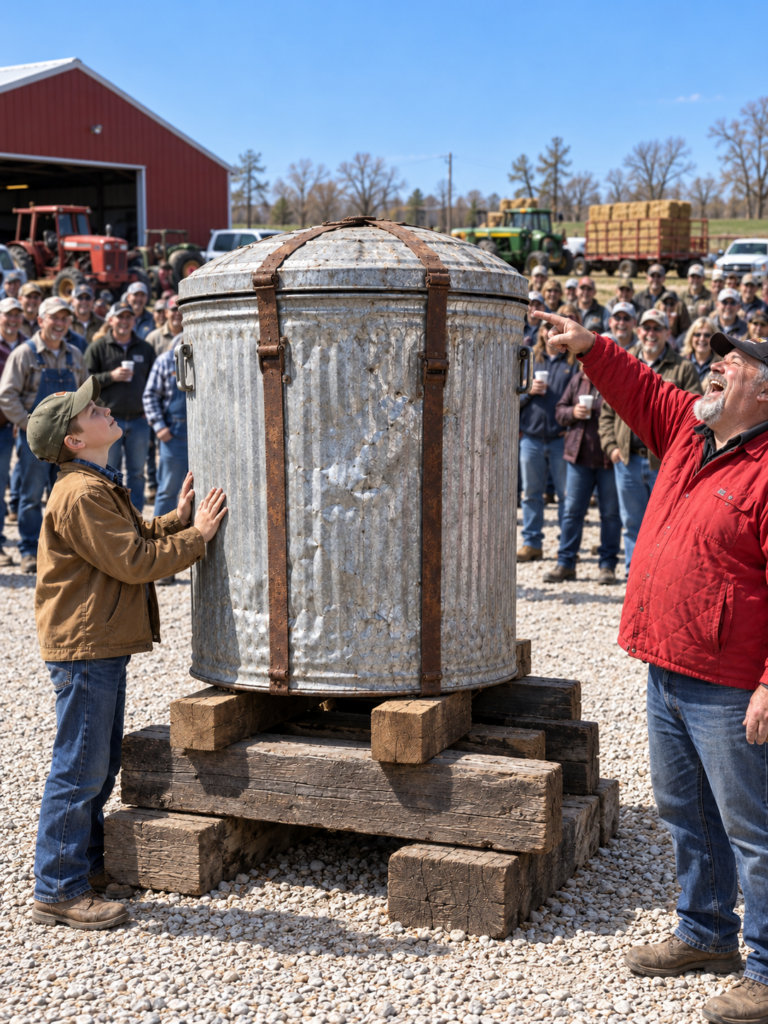
the whole auction laughed when a 12-year-old farm boy paid $20 for a sealed foundry barrel — then his grandfather saw the mark on the iron inside
Part 1
By the time Nolan Ferris raised his twenty-dollar bill, nearly everybody at the farm auction had already decided what kind of boy he was.
Poor.
Stubborn.
Too young to know the difference between treasure and junk.
Gordon Pruitt made sure they knew it.
“One thousand forty pounds of foundry garbage!” Gordon shouted, slapping the domed metal lid so hard the sound rang across the frozen gravel lot. “And young Mr. Ferris here just paid twenty dollars for the privilege of hauling it home.”
The crowd laughed.
More than sixty farmers, mechanics, bargain hunters, scrap dealers, and neighbors had gathered behind Arvid Lindquist’s machine shed that Saturday morning. Most had come looking for tools, tractors, fence posts, fuel cans, or something useful from the old man’s estate.
Nobody had come for Lot 194.
It was an enormous galvanized foundry can nearly as tall as Nolan, sitting on four oak blocks with two heavy steel straps running across its lid.
The auction clerk had written only three words beside it.
CAN. BANDED. UNKNOWN.
That had been enough for most people.
Unknown usually meant worthless.
Gordon Pruitt, however, had turned the thing into entertainment.
He owned the biggest scrapyard in three counties and wore a bright red quilted jacket that made him impossible to miss.
Before the auction began, he had ordered two men to roll out a platform scale.
They had wrestled the can onto it.
The dial stopped at 1,040 pounds.
Gordon whistled.
“Four cents a pound if it’s cast iron,” he announced. “Could be sand, though. Could be broken molds. Could be fifty years of sweepings. Could be old Lindquist’s daddy in there for all we know.”
People laughed.
Nolan had not.
At twelve years old, he was thin enough that his grandfather said a hard wind could mail him to Nebraska. His brown canvas chore coat had belonged to Walt when Walt was young. The sleeves were rolled twice, and the lining had been repaired by Nolan’s mother with pieces cut from an old flour sack.
Twenty dollars was not pocket money to Nolan.
He had earned it the previous summer walking soybean rows for the Hostetlers.
Ten hours a day under the July sun.
He had pulled volunteer corn, chopped weeds, and carried a gallon jug of water that always became warm by noon.
His mother wanted him to save the money.
Nolan intended to.
Until he saw the can.
An hour before the auctioneer reached Lot 194, Nolan had circled it while everyone else inspected an old John Deere tractor.
One steel strap had pulled the lid slightly crooked.
Beneath the rim was a gap no wider than a pencil.
Nolan crouched.
He put one eye close to the opening.
At first he saw darkness.
Then something gray.
Not scrap.
Not ordinary scrap, anyway.
It was the snapped end of an iron rod.
Fine-grained.
Pale.
Broken cleanly across.
And near the break was a stamped capital letter.
Nolan knew that stamp.
His grandfather kept a piece of iron almost exactly like it on his workbench at home.
Walt Ferris called it his paperweight.
Nolan had handled it hundreds of times.
“What is it?” Nolan had asked when he was six.
“A test bar.”
“Test for what?”
“Iron.”
Nolan had frowned.
“Isn’t iron just iron?”
Walt laughed.
“No, son. Iron can be mean, brittle, soft, stubborn, strong, weak, dirty, clean, forgiving, or useless. Sort of like people.”
The test bar had come from Lindquist Gray Iron Works.
Walt had worked there from 1963 until 1975.
He was seventy-nine now.
His back was bent.
Two fingers on his left hand no longer straightened completely after a molding accident.
But every time he picked up that test bar, his eyes became younger.
“Gus Lindquist broke one for every important heat we poured,” Walt had told Nolan. “Said iron always told the truth if a man knew how to listen.”
Now, staring through the gap beneath the barrel lid, Nolan had seen a stamped test bar.
Maybe there was one inside.
Maybe ten.
Maybe nothing else.
But he had also noticed something nobody in the laughing crowd seemed interested in.
Someone had strapped that lid shut carefully.
Not recently.
Decades ago.
Why strap garbage shut?
When auctioneer Ray Dunwoody finally reached the lot, he stood on a hay wagon with his microphone.
“Who’ll give me ten dollars?”
Silence.
“Five?”
Nothing.
Gordon raised one finger.
“One dollar, Ray. I’ll save the county the hauling fee.”
Laughter.
Then Nolan heard himself speak.
“Twenty.”
Ray stopped.
Even Gordon looked surprised.
Ray leaned forward.
“Who said that?”
Nolan lifted the bill.
“I did.”
“Son, Gordon bid one.”
“Yes, sir.”
“You don’t have to jump to twenty.”
“I know.”
Ray gave him an opportunity to reconsider.
Nolan did not.
“Twenty dollars.”
Gordon threw his head back.
The laughter started before the gavel fell.
“Sold!”
Ray pointed.
“To Nolan Ferris for twenty dollars, and may God bless youthful optimism.”
More laughter.
Nolan walked to the can and put both hands on the cold steel.
His palms were sweating inside his gloves.
Gordon came over.
“Tell you what, Junior.”
Nolan looked up.
“I’m feeling charitable. I’ll give you twenty-five dollars right now.”
“No, thank you.”
“Thirty.”
“No, sir.”
“Thirty-five.”
Nolan shook his head.
Gordon glanced toward the crowd.
“You hear that? Thirty-five dollars for a garbage can and he turns me down.”
Someone called, “Keep it, Nolan! Maybe there’s a Cadillac inside!”
Another man shouted, “Garbage Can King!”
That drew the biggest laugh.
Gordon leaned closer.
His voice softened.
That somehow made it worse.
“Son, I’m trying to help you. There isn’t anything in this thing worth more than what I’m offering.”
Nolan looked at the steel bands.
“I think I’ll keep it.”
Gordon sighed like a patient father.
“All right. Then open it.”
The crowd quieted.
Gordon pointed toward his truck.
“I’ve got bolt cutters. Cut those bands. We’ll settle it right now.”
Nolan felt every eye on him.
He wanted to.
His heart was pounding.
If there were dozens of test bars inside, he could prove he had not been foolish.
If there were only two or three, the laughter would get worse.
Then he remembered something else Walt had taught him.
If you do not know why an old man protected something, do not destroy the protection just because you are curious.
Nolan removed his hands from the lid.
“No.”
Gordon blinked.
“No?”
“I’m not opening it here.”
“Why?”
“Because Mr. Lindquist strapped it shut.”
“So?”
“So I figure he had a reason.”
A few people stopped smiling.
Nolan continued.
“When I open it, I’m going to open it right.”
Gordon stared at him.
Then he slapped the lid.
“You hear that? He’s going to open his garbage correctly.”
The laughter followed Nolan even after the auction moved on.
Getting the can home required Walt’s old green flatbed truck.
Walt backed up to the oak blocks and examined the barrel.
“You bought this?”
“Yes, sir.”
“For twenty dollars?”
“Yes.”
Walt glanced toward the crowd.
“Did you lose a bet?”
Nolan lowered his voice.
“I saw a test bar inside.”
Walt stopped smiling.
“Stamped?”
“Yes.”
“What stamp?”
“Couldn’t see the whole thing. Just a letter.”
Walt stared at the can.
For several seconds he did not move.
Then Gordon shouted from his tailgate.
“Careful, Walt! That treasure might run away.”
Walt ignored him.
He ran the hand-winch cable beneath the heavy handles and showed Nolan where not to stand.
The can groaned as they dragged it up the planks.
Once it was chained to the truck, Walt climbed behind the wheel.
Nolan got in beside him.
They drove almost two miles without speaking.
Finally Walt asked, “How many bars did you see?”
“One.”
“Anything else?”
“Couldn’t tell.”
Walt rubbed his chin.
“Was the break light gray?”
“Yes.”
“Fine grain?”
“Yes.”
“And stamped?”
“Yes.”
Another mile.
Then Walt whispered something Nolan did not understand.
“The Marlow can.”
“What?”
Walt looked straight ahead.
“Well, I’ll be damned.”
He drove more slowly.
“I thought that thing was melted down forty years ago.”
“What is it?”
Walt kept both hands on the wheel.
“That, boy, might be the last honest record of the best iron I ever poured.”
And for the rest of the ride home, while more than half a ton of sealed steel rode behind them, Walt Ferris told his grandson a story Nolan had never heard in full.
Part 2
Lindquist Gray Iron Works had not looked impressive.
Walt said that was the first thing Nolan needed to understand.
It had been one long brick building beside the railroad spur, blackened by furnace smoke and surrounded by piles of sand, coke, broken castings, and rusting patterns.
In winter, men froze before the first pour.
In summer, the furnace made the building feel like the inside of an oven.
“My first week there,” Walt said, “I burned the hair off both arms.”
Nolan glanced at him.
“That bad?”
Walt smiled.
“Best job I ever hated.”
The foundry made whatever people paid for.
Tractor weights.
Drain grates.
Pulley housings.
Stove parts.
Municipal castings.
But one contract kept the lights on.
Marlowe Brothers Piano Company of Moline, Illinois.
From 1958 until 1975, Lindquist produced the great cast-iron plates used inside Marlowe concert grand pianos.
Nolan knew almost nothing about pianos.
Walt explained.
“Strings inside a grand piano pull with tremendous force. Tens of thousands of pounds together. Wood can’t hold that alone. So there’s a cast-iron plate inside. Looks beautiful when it’s painted gold, but underneath it’s just iron.”
“Your iron.”
“Our iron.”
“Why was yours special?”
Walt took his time answering.
“Because Gus Lindquist was stubborn.”
That was apparently the explanation for many things.
Gus adjusted the foundry mixture constantly.
Silicon.
Phosphorus.
Carbon.
Scrap ratios.
Pouring temperature.
Cooling time.
He treated iron almost like a baker treated dough.
For every important furnace heat used in a Marlowe plate, Gus poured a small test bar from the same ladle.
The next morning the bar was broken.
The fractured surface told an experienced foundryman things machines could not always say quickly in those days.
Gus stamped one half with the heat letter and date.
The plate received matching identification.
He recorded everything in books.
And he kept the broken samples.
“Why?”
Nolan asked.
Walt smiled.
“I asked him exactly that.”
“What did he say?”
“He said paper burns.”
Walt drove another hundred yards.
“Then he said men lie.”
Nolan waited.
“And iron?”
“Iron remembers.”
The contract ended in 1975.
Marlowe moved production to a larger Ohio foundry offering lower prices.
Lindquist lost most of its revenue in one letter.
Orders dried up.
By November, Gus announced the furnace would go cold permanently.
Walt still remembered the final afternoon.
Men cleaned tools.
Some cursed.
Some drank behind the pattern shed.
One man sat on an overturned mold box and cried because he had four children and no idea where his next paycheck would come from.
Gus Lindquist did something strange.
He told two workers to gather every surviving Marlowe test bar.
Seventeen years of samples.
They packed them by year in heavy paper.
Wrapped them with wire.
Loaded them into the largest galvanized foundry can available.
Then Gus himself supervised the steel strapping.
Walt could still hear him.
“This isn’t scrap.”
Gus had rested one soot-black hand on the lid.
“Nobody melts this by the pound.”
Someone asked what good broken bars could possibly do.
Gus answered.
“Someday somebody may want to know why those old Marlowe plates sounded the way they did.”
He tapped the lid.
“When that happens, this gets opened in front of witnesses.”
Then the foundry closed.
Gus died.
Buildings were eventually demolished.
The property changed hands.
Walt assumed the can had disappeared with everything else.
But Gus’s son Arvid apparently preserved it.
For forty years.
Moving it from shed to shed.
Never cutting those bands.
Then Arvid died at eighty-eight.
And somebody organizing his estate wrote UNKNOWN beside the lot number.
Nolan twisted around in the truck seat, looking through the rear window.
The can sat chained behind them.
“Grandpa.”
“Yes?”
“I want to open it.”
Walt kept driving.
“Figured you might.”
“But not alone.”
Walt glanced at him.
Nolan explained.
“Mr. Lindquist said witnesses.”
“He did.”
“We should do it that way.”
Walt nodded slowly.
“Who?”
“Mr. Dunwoody because he sold it. The Teague brothers because they helped load it. Mrs. Gunderson because she knows pianos.”
“And Gordon Pruitt?”
Nolan hesitated.
Walt watched him.
“You want him there?”
“He told everybody it was garbage.”
“That a reason to invite him or a reason not to?”
Nolan thought about it.
“He should see.”
Walt smiled faintly.
“That answer makes me prouder than if you’d said you wanted to embarrass him.”
When they reached home, Nolan’s mother was waiting on the porch.
Dana Ferris worked at the county agricultural cooperative.
She had been raising Nolan alone since his father left when Nolan was five.
Money was not desperate in their house.
But it was never comfortable.
The furnace needed replacing.
The roof over the back bedroom leaked.
Their truck had 216,000 miles on it.
Dana took one look at the enormous barrel.
Then at Nolan.
“What did you buy?”
“Something from the Lindquist sale.”
“I can see that.”
“It cost twenty dollars.”
Dana closed her eyes.
“That was all your bean-walking money.”
“Not all.”
“Almost all.”
Walt climbed down.
“Let him explain.”
Nolan did.
Dana listened.
Then she looked at Walt.
“Is this real?”
“The story is.”
“That isn’t what I asked.”
Walt nodded toward the can.
“I don’t know what’s inside.”
Dana rubbed her forehead.
“Nolan, if that thing contains rusty bolts—”
“Then I’ll have twenty dollars’ worth of rusty bolts.”
She wanted to stay angry.
Nolan could tell.
Instead, her shoulders dropped.
“You sound exactly like your grandfather.”
“That isn’t always a compliment,” Walt said.
They arranged the opening for seven that evening.
Walt borrowed eight folding chairs from Trinity Lutheran Church.
Mrs. Ilsa Gunderson arrived first.
She was seventy-four and had tuned pianos across northeastern Iowa for nearly fifty years.
She also played organ at Trinity every Sunday.
When Walt told her about the Marlowe test bars, she had become silent.
Then she said, “Do not touch that can until I get there.”
Ray Dunwoody arrived still wearing his auction jacket.
The Teague brothers came.
Dana came directly from work.
At seven-fifteen, Gordon Pruitt’s truck pulled into the yard.
Gordon stepped out wearing the same red jacket.
He carried a large horseshoe magnet.
“Thought we should bring scientific equipment.”
Nobody laughed very much.
The can stood in the center of Walt’s machine shed beneath bright work lights.
Nolan wore leather gloves and clear safety glasses.
Walt placed the long bolt cutters in his hands.
“Ready?”
Nolan nodded.
The first steel band fought him.
He leaned until his arms shook.
Walt placed one hand over Nolan’s.
Together they squeezed.
The band snapped like a rifle shot.
Everyone jumped.
Even Gordon.
The second broke easier.
Then came the lid.
Fifty years of rust held it tight.
Walt and Nolan rocked it.
Once.
Twice.
Again.
Finally it lifted with a long metallic groan.
Air escaped from inside carrying the smell of machine oil, old paper, iron dust, and foundry sand.
Nolan looked in.
Bundles.
Dozens.
Heavy brown paper darkened by oil.
Each bundle tied with wire.
On the first, written in faded grease pencil:
Walt inhaled sharply.
“Good Lord.”
Nolan lifted the package to the bench.
Walt cut the wire.
They opened the paper.
Gray test bars lay packed together.
Each snapped cleanly at one end.
Each stamped with a letter.
Each marked with a date.
Nobody spoke.
Not even Gordon.
Walt picked one up.
His hand trembled.
“I poured this heat.”
Nolan looked at him.
“You remember?”
“No.”
Walt laughed softly.
“But I remember the men who did.”
Mrs. Gunderson approached.
She selected a bar and suspended it by a loop of binding wire.
From her purse she removed a tuning fork.
Gordon finally spoke.
“Ma’am, that’s still broken iron.”
Ilsa tapped the bar.
A clear note rang through the shed.
Not a dull clank.
A bell-like tone.
Everyone listened until it faded.
Ilsa looked at Gordon.
“I have heard iron like this every Sunday for thirty years.”
Gordon frowned.
“In church?”
She nodded.
“The 1966 Marlowe grand.”
Gordon touched his magnet to one bar.
It stuck.
“There you go.”
He smiled again.
“Iron.”
Nobody answered.
They counted until nearly midnight.
Eighteen bundles.
From 1958 through the final 1975 production.
One thousand four hundred twelve test-bar halves.
Nolan discovered a small plate riveted beneath the lid.
Most of the lettering had been painted over, but Walt rubbed it carefully with an oily rag.
The words emerged.
MARLOWE PLATE IRON
EVERY HEAT
ASK BEFORE YOU MELT
G.L.
Walt sat down.
For a long moment he simply stared at the plate.
Gordon read over his shoulder.
“Ask who?”
Walt looked at him.
“Anyone smart enough to understand the question.”
Gordon did not like that.
He reached into his wallet.
“Fifty dollars, Nolan.”
Dana looked at her son.
“For what?” Nolan asked.
“The whole thing.”
“You said it was garbage.”
“Still is. But you’ve had your fun. Fifty gets you thirty dollars profit.”
Nolan looked at Walt.
His grandfather said nothing.
The decision belonged to him.
“No, thank you.”
Gordon laughed.
“All right.”
He pulled on his gloves.
“Just remember my offer when you get tired of storing half a ton of broken sticks.”
At school on Monday, somebody left an empty soup can on Nolan’s desk.
Two strips of duct tape had been wrapped around it.
GARBAGE CAN KING was written across the side.
The class laughed.
Nolan picked it up.
Put it in his backpack.
And said nothing.
That evening Walt found the soup can.
Nolan expected him to throw it away.
Instead, Walt placed it on the workbench beside his old test bar.
“Why’d you keep it?” Nolan asked.
Walt looked at the can.
“Because there are two kinds of things a man should remember.”
“What kinds?”
“The people who believed in him.”
He touched the soup can.
“And the people who taught him why belief matters.”
Part 3
For nineteen days, nothing happened.
That was harder than Nolan expected.
He had written a letter to Marlowe Brothers Piano Company.
Three drafts went into the trash.
Dana corrected his spelling.
Mrs. Gunderson helped him find the company address.
Walt refused to dictate.
“Tell them what you know.”
“What if I sound like a kid?”
“You are a kid.”
“What if they don’t take me seriously?”
Walt shrugged.
“Then writing like a fifty-year-old won’t fix it.”
So Nolan wrote plainly.
He explained the auction.
The sealed can.
Gus Lindquist.
The dated bars.
He described the witnesses.
He mentioned Walt’s employment at the foundry.
At the bottom he wrote:
Nolan Ferris
Age 12
Halvard County, Iowa
Then the house phone number.
They mailed it.
And waited.
At school, Garbage Can King became Nolan’s nickname.
Most students did not intend cruelty.
That almost made it worse.
The joke had become easy.
Teachers heard it.
Adults heard it.
Even one of the bus drivers used it.
Dana wanted to speak to the principal.
Nolan refused.
“Then they’ll know it bothers me.”
“It does bother you.”
“I know.”
“So why pretend?”
Nolan did not have an answer.
Walt did.
Later that evening, while Nolan helped sharpen mower blades, the old man said, “Being bothered doesn’t mean you owe everybody a reaction.”
Nolan looked up.
“I hate when they laugh.”
“Course you do.”
“You ever get laughed at?”
Walt smiled.
“Son, I worked thirty-five years around foundry men. If nobody laughed at you by nine in the morning, they assumed you were sick.”
“That’s different.”
“Somewhat.”
Walt set down the file.
“But here’s something you ought to learn early. Being right and being respected don’t always arrive on the same day.”
Nolan remembered that.
The twentieth day after he mailed the letter, he came home from school and found Dana standing beside the kitchen phone.
“You have a call.”
“Who?”
“A woman from Marlowe Brothers.”
Nolan froze.
Dana held out the receiver.
“Hello?”
“Mr. Ferris?”
A woman’s voice.
“Yes, ma’am.”
“Am I speaking with Walter Ferris?”
“No. Nolan.”
A pause.
“The younger Mr. Ferris.”
“Yes.”
“My name is Catherine Ashby. I’m director of manufacturing for Marlowe Brothers.”
Nolan sat down.
Walt appeared in the doorway.
Catherine had Nolan repeat certain details.
Was every bar stamped?
Yes.
Years?
1958 through 1975.
Had the can remained sealed until the auction?
As far as Walt knew.
Witnesses?
Seven.
Original identification?
Yes.
Then Catherine became quiet.
“Nolan, I need to explain why your letter matters.”
Nolan gripped the receiver.
In 1981, she said, Marlowe Brothers had suffered a warehouse fire.
Many old technical records had been destroyed.
Among them were foundry specifications from the Lindquist years.
The company still possessed one leather-bound serial book.
It listed every piano.
Serial number.
Foundry heat letter.
Pour date.
But it did not contain the complete metallurgy.
For decades, Marlowe had attempted to reproduce the characteristic response of the old Lindquist plates.
“What response?”
Nolan asked.
“The way they ring.”
He looked at Mrs. Gunderson’s tuning fork sitting on the kitchen table.
Catherine continued.
Collectors valued older Marlowe grands.
Concert halls kept repairing them.
Technicians said their sound was different.
Marlowe engineers had tested countless formulas.
Nothing quite matched.
“If your samples are authentic,” Catherine said, “we may be able to reconstruct every heat used during those seventeen years.”
Nolan looked at Walt.
His grandfather had stopped pretending not to listen.
“What do you want to do?”
Nolan asked.
“We’d like to inspect the collection.”
“When?”
“As soon as possible.”
“With Grandpa?”
“Certainly.”
“And Mrs. Gunderson.”
“All right.”
Nolan hesitated.
“And people need to be there.”
“What people?”
“Witnesses.”
Catherine paused.
“Why?”
“Mr. Lindquist wanted it opened in front of people so nobody could say anything had been changed.”
“I see.”
“There’s somebody else I want to invite.”
“Who?”
“Mr. Pruitt.”
Walt smiled.
Catherine did not know who Gordon Pruitt was.
She would.
The inspection was scheduled for the following Saturday at Trinity Lutheran’s fellowship hall because the church owned a 1966 Marlowe grand.
The can was reclosed.
Walt placed one new strap around it.
They marked the strap.
Ray Dunwoody signed across the mark.
So did Mrs. Gunderson and Dana.
Nobody could remove the lid without breaking the signatures.
On Saturday morning, Walt and Nolan winched the can onto the flatbed.
The Teague brothers helped roll it into the fellowship hall.
The church’s black Marlowe concert grand sat on the raised platform.
Mrs. Gunderson had polished it.
Nolan had heard the instrument hundreds of times.
He had never really looked inside.
Now its cast-iron plate seemed almost alive.
Three visitors arrived from Illinois.
Catherine Ashby was in her fifties, tall and serious, with silver beginning at her temples.
Dr. Samuel Okafor came from a university foundry laboratory and carried portable testing equipment.
The third man introduced himself as Martin Cassell.
“Industrial collections appraiser.”
Nolan frowned.
“Why do we need an appraiser?”
Catherine answered.
“Because if the collection is what we think it is, I don’t want Marlowe deciding its value.”
Nolan liked her immediately.
Gordon Pruitt arrived ten minutes later.
Red jacket.
Coffee cup.
Loud voice.
“Heard we’re finally getting a professional opinion on the famous garbage.”
Walt said nothing.
The county newspaper sent a reporter.
That made Nolan nervous.
He sat beside his mother.
Dana squeezed his shoulder.
Mrs. Gunderson began.
She lifted the lid of the church piano.
Near the tuning pins, partly hidden beneath strings, was a raised identification mark cast directly into the plate.
R
MAY 12 1966
Catherine opened the surviving Marlowe serial book.
She found the piano.
Read the entry.
Heat R.
May 12, 1966.
Lindquist Gray Iron Works.
Every face turned toward Nolan.
His stomach tightened.
What if that bar was not there?
What if the old men had remembered wrong?
What if decades of humidity had ruined the stamps?
He cut the new strap.
Opened the lid.
Found the 1966 bundle.
Walt stood beside him.
Nolan untied the wire.
He examined one bar.
Another.
Another.
Three minutes passed.
Gordon shifted impatiently.
Then Nolan found it.
R.
MAY 12 1966.
His hands shook.
Dr. Okafor took the bar carefully.
First he studied the fracture with a magnifying loupe.
Then he used a portable analyzer.
Numbers appeared on a small screen.
Silicon.
Phosphorus.
Carbon.
Trace elements.
He selected six additional Marlowe dates.
Nolan found the corresponding bars.
Every stamp matched Catherine’s surviving serial book.
Every one.
Dr. Okafor tested them.
His expression changed.
“This is very unusual.”
Gordon crossed his arms.
“In what way?”
Okafor looked at him.
“The chemistry varies deliberately.”
“So?”
“So whoever ran that foundry was controlling the iron much more precisely than would be expected from a small rural shop of that period.”
Walt smiled.
“That sounds like Gus.”
Dr. Okafor picked up another sample.
“The phosphorus content is particularly interesting. Enough to affect fluidity and probably acoustic behavior, but controlled. Silicon shifts. Carbon equivalent shifts. These are not random furnace results.”
Catherine asked the question Nolan had been waiting for.
“Could we reproduce the old Marlowe plate from these?”
Okafor nodded.
“With systematic testing, yes.”
“How certain?”
“These bars are physical records of the actual heats.”
He looked around the room.
“You could lose every notebook ever written and still have the metal itself.”
Walt whispered, “Iron remembers.”
Nolan heard him.
So did Catherine.
She turned.
“What?”
Walt looked embarrassed.
“Something Gus used to say.”
Catherine repeated it quietly.
“Iron remembers.”
At the back of the room, Gordon Pruitt had stopped smiling.
For the first time Nolan could remember, the man looked uncertain.
But the biggest surprise had not yet come.
Martin Cassell had spent the morning documenting everything.
The sealed history.
Witnesses.
Matching dates.
Industrial provenance.
Connection to surviving instruments.
Completeness of the seventeen-year run.
He finally stood.
“I’ve completed a preliminary valuation.”
Gordon muttered, “Here we go.”
Martin ignored him.
“This is not being valued primarily as scrap metal.”
Someone laughed.
Gordon did not.
“It is a complete industrial archive consisting of more than fourteen hundred physical metallurgical samples tied to a historically significant American musical-instrument manufacturer.”
Nolan barely understood half the sentence.
Martin continued.
“Because the collection may allow Marlowe Brothers to reproduce a lost process, the commercial research value is substantial.”
Dana reached for Nolan’s hand.
“For insurance and acquisition purposes, I would place the collection at two hundred thirty-eight thousand dollars.”
Nobody moved.
The furnace beneath the fellowship hall clicked on.
Warm air whispered through the vent.
Nolan thought Martin had said twenty-three thousand.
Then Dana whispered, “Two hundred thirty-eight?”
Martin nodded.
Gordon Pruitt lowered his coffee.
His mouth opened slightly.
Catherine stood.
“Marlowe Brothers will purchase the collection at that valuation today.”
Nolan could hear his own heartbeat.
Twenty dollars.
He had paid twenty dollars.
Then he looked at Walt.
His grandfather was not smiling.
Tears stood in the old man’s eyes.
Not because of the money.
Nolan understood that.
This was about men whose foundry had been demolished.
Men whose names almost nobody remembered.
Men who had gone home covered in black dust and raised families on wages from iron poured in a building that no longer existed.
Gus Lindquist had been right.
The iron had outlived them.
And it had told the truth.
Part 4
Every person in the fellowship hall expected Nolan to say yes immediately.
Two hundred thirty-eight thousand dollars sounded impossible to a twelve-year-old farm boy.
It sounded impossible to his mother.
Dana earned less than a quarter of that in a year.
Their mortgage was not fully paid.
Their roof leaked.
Her car needed brakes.
Walt’s medical bills from a winter hospitalization still sat in a kitchen drawer.
But Nolan did not answer.
Catherine waited.
“You don’t have to decide this second.”
Nolan looked at his grandfather.
“What should I do?”
Walt shook his head.
“No.”
Nolan frowned.
“No what?”
“I’m not deciding.”
“But you know more.”
“Doesn’t matter.”
Walt leaned toward him.
“That can belongs to you because everybody else thought it was worthless and you looked twice.”
Nolan swallowed.
“I want to sell it.”
“Then sell it.”
“But I want conditions.”
Catherine smiled slightly.
“What conditions?”
Nolan had thought about them since the phone call.
He raised one finger.
“Grandpa keeps one test bar.”
Walt stared at him.
“You already have one.”
“I want it to have company.”
A few people laughed.
Catherine nodded.
“Done.”
“Second, if Marlowe starts making plates from this iron recipe again, Lindquist has to be on them.”
Catherine considered.
“The foundry name?”
“Yes.”
“Every plate?”
“Every one that comes from this work.”
She nodded.
“Done.”
Nolan looked toward Mrs. Gunderson.
“The church piano gets restored.”
Ilsa’s hand flew to her mouth.
Nolan continued.
“Everything it needs. Strings, hammers, whatever. It comes back here afterward.”
Catherine looked at the old grand.
“That may cost twenty thousand dollars.”
Nolan’s stomach tightened.
Then Catherine smiled.
“Done.”
Applause filled the hall.
Nolan should have felt ten feet tall.
Instead, he suddenly remembered Gordon.
The man stood near the coffee urn.
His cap was in his hands.
Nolan could humiliate him.
Everyone expected it.
For weeks, Gordon had laughed.
At the auction.
At the shed.
At the cafe.
The nickname at school had started with him.
Nolan looked at the man in the red jacket.
“Mr. Pruitt?”
Gordon looked up.
Nolan spoke politely.
“You offered me four cents a pound.”
Somebody chuckled.
Gordon’s face reddened.
Nolan calculated what he had practiced the night before.
“It comes out to about two hundred twenty-nine dollars a pound.”
Laughter exploded.
Not at Nolan this time.
At Gordon.
Gordon looked around.
For one long second Nolan enjoyed it.
Then he saw something uncomfortable.
Gordon looked smaller.
Not physically.
Something else.
He looked like the only person in the room without a place to stand.
Walt had once told Nolan that revenge often feels better from a distance than it does after you get close enough to see another person’s face.
The laughter faded.
Gordon walked toward Nolan.
Dana stiffened.
Walt did not.
Gordon stopped beside the can.
He stared inside.
“I was wrong.”
Nobody spoke.
Gordon looked at Nolan.
“I mean it.”
Nolan nodded.
Gordon extended his hand.
“You opened it right.”
Nolan shook it.
“Yes, sir.”
Gordon turned toward Walt.
“Guess you knew.”
Walt shook his head.
“Nope.”
“You didn’t?”
“I suspected. That’s different.”
Gordon sighed.
Then looked at Nolan.
“You know what bothers me most?”
“What?”
“I’ve bought scrap for thirty years.”
He tapped the barrel.
“And I never asked why this one was strapped.”
Nolan remembered his first thought at the auction.
Why strap garbage shut?
Gordon pulled on his cap.
“That’s worth remembering.”
He left before lunch.
The newspaper article appeared the following Wednesday.
TWENTY-DOLLAR AUCTION FIND MAY RESTORE LOST AMERICAN PIANO SOUND.
There was a photograph of Nolan, Walt, Catherine, and the barrel.
At school, Garbage Can King changed meaning overnight.
Kids who had mocked Nolan suddenly wanted to know how he knew.
Some claimed they had believed him all along.
One boy who had drawn a garbage truck on Nolan’s locker asked whether Nolan would buy a new truck.
Another wanted to know whether he was rich.
Nolan hated those questions more than the jokes.
Dana handled the money.
“That is not negotiable.”
“I know.”
“College.”
“I know.”
“Some invested.”
“I know.”
“Roof.”
Nolan smiled.
“Definitely roof.”
They paid debts first.
Dana replaced the leaking shingles.
They repaired the furnace.
Walt refused every offer Nolan made to buy him something expensive.
Finally Nolan bought him a new workbench stool because the old one had a cracked leg.
Walt complained it cost too much.
Then sat on it every day.
Nolan bought Mrs. Gunderson professional tuning tools she had been wanting for years.
She cried and told him he was ridiculous.
The rest went into the bank.
Months passed.
Marlowe engineers analyzed sample after sample.
Dr. Okafor sent Walt letters describing the work.
He asked questions about mold sand.
Pouring temperatures.
How Gus treated returns and scrap.
Which men handled the ladles.
Walt answered what he could.
Sometimes memory came quickly.
Sometimes he sat at the kitchen table for an hour before remembering a detail.
The project gave him something Nolan had not realized he needed.
A reason to speak about his working life.
For decades, people had asked Walt about retirement, farming, family, weather.
Almost nobody asked about the foundry.
Now engineers wanted to know everything.
How did Gus judge a heat?
What color did the iron look when ready?
Did he inoculate in the ladle?
How long between tapping and pouring?
Walt became useful to strangers two states away.
It changed him.
Dana noticed too.
“He stands straighter when those letters come.”
Nolan nodded.
Winter deepened.
Then Walt got sick.
It began as a cough.
He dismissed it.
“I’ve breathed foundry dust. A cough and me are old friends.”
Three days later he could barely cross the kitchen.
Dana drove him to the hospital.
Pneumonia.
At seventy-nine, it became serious.
Nolan sat beside the hospital bed.
Walt looked smaller beneath white blankets.
For the first time in Nolan’s life, his grandfather seemed old.
Not old in the joking way.
Actually old.
Fragile.
Nolan hated it.
“You have to get better.”
Walt opened one eye.
“That your medical opinion?”
“Yes.”
“Good. Doctor seemed uncertain.”
Nolan tried to smile.
Walt coughed.
Then rested.
After a while he said, “Marlowe wrote.”
“What?”
“They think they got it.”
“The iron?”
Walt nodded.
“They’re planning a trial pour in spring.”
Nolan leaned closer.
“You’re coming.”
“If the Lord and Medicare permit.”
“I mean it.”
Walt studied him.
“Nolan.”
“What?”
“Sometimes you don’t get to make conditions.”
The words frightened him.
Walt saw it.
He reached for Nolan’s hand.
“Hey.”
Nolan looked down.
“You did good with that can.”
“It was luck.”
“No.”
“I just saw a bar.”
“That part was luck.”
Walt squeezed his hand weakly.
“Looking was not.”
Nolan did not answer.
“Remember that.”
Walt recovered.
Slowly.
By March he was walking to the mailbox.
By April he was back on his new stool, complaining about the price of seed corn.
Then Catherine Ashby called.
The first full Marlowe plate based on reconstructed Lindquist data would be poured in May.
She wanted Nolan and Walt there.
Walt hung up.
He looked at Nolan.
“Well.”
“What?”
“Seems that garbage can has one more trip in it.”
Part 5
Marlowe Brothers arranged transportation to Illinois.
Walt complained about that too.
“I have a truck.”
“You have a truck that makes noises vehicles are not supposed to make,” Dana said.
“It’s expressive.”
“It’s dying.”
“It has character.”
“You’re taking their car.”
So Walt and Nolan rode to Moline in a company sedan.
Mrs. Gunderson came too.
The restored church piano was already at Marlowe.
When they entered the factory, Nolan stopped.
The place smelled different from a farm.
Oil.
Wood.
Metal.
Varnish.
Hot machinery.
Workers guided them through departments where piano rims were bent, soundboards fitted, actions assembled.
Then they reached the foundry partner’s pouring floor.
Safety glasses.
Hard hats.
Protective coats.
Walt became quiet.
Nolan noticed his hands.
They were shaking.
“You okay?”
Walt nodded.
“Haven’t smelled hot iron in forty-eight years.”
The furnace opened.
Orange light filled the building.
Molten iron moved like something alive.
Even from behind the safety barrier Nolan felt the heat.
Dr. Okafor stood with the foundry crew.
Catherine joined Walt and Nolan.
“We ran several test heats first.”
“Good,” Walt said.
“Today’s chemistry is within the reconstructed Lindquist range.”
Walt smiled.
“Don’t tell me. Tell the casting.”
The mold waited.
The ladle tilted.
A stream of white-orange iron poured down.
Nolan stopped breathing.
He imagined Gus Lindquist.
The old foundry.
Men in leather aprons.
His grandfather at twenty.
The last day in 1975.
The strapped can.
The estate auction.
Gordon laughing.
The soup can on his school desk.
All of it had led here.
When the mold filled, Walt wiped his eyes.
Nolan pretended not to see.
The plate needed time to cool.
They returned the following day.
Workers removed sand.
Cleaned the casting.
Lifted the enormous piano plate.
Near the tuning-pin area was a new raised inscription.
MARLOWE BROTHERS
LINDQUIST HERITAGE IRON
Walt touched the letters.
Nobody hurried him.
Several weeks later the plate was installed in a new concert grand.
The instrument sat in Marlowe’s testing room beside the restored 1966 Trinity Lutheran piano.
Mrs. Gunderson was given the first seat.
She played the old piano.
A slow hymn.
Warm.
Deep.
Clear.
Then she moved to the new instrument.
Same melody.
The first chord sounded.
Walt closed his eyes.
Nolan looked at Catherine.
She was crying.
Mrs. Gunderson played through the hymn.
When the final note faded, Dr. Okafor whispered, “That’s it.”
Catherine nodded.
“That’s what we lost.”
Walt opened his eyes.
“No.”
Everyone looked at him.
He smiled.
“You didn’t lose it.”
He rested one hand on Nolan’s shoulder.
“You just stopped knowing where it was.”
Afterward Catherine gave Nolan a small rawhide mallet.
The new iron plate had not yet been fully enclosed.
“Go ahead.”
“Do what?”
“Your grandfather will know.”
Walt laughed.
“Hit it.”
Nolan tapped the plate.
The note rang out.
Clear.
Long.
Pure.
It seemed to hang in the air longer than physics should have allowed.
Walt listened until it disappeared.
“Not bad.”
Nolan grinned.
“For garbage?”
Walt nodded.
“For garbage.”
The restored 1966 piano returned to Trinity Lutheran that summer.
The church held a special service.
Mrs. Gunderson played.
People filled the pews.
Even Gordon Pruitt came.
He sat in the back.
Afterward, he found Nolan outside.
“I brought you something.”
From his truck Gordon produced the old steel platform scale used at the auction.
Nolan laughed.
“What am I supposed to do with that?”
“Figured you might want the instrument that proved your fortune weighed exactly 1,040 pounds.”
“I don’t have room.”
“Your grandfather does.”
Walt, overhearing, said, “Absolutely not.”
The scale remained on the Ferris farm for the next twenty years.
So did the soup can.
Nolan never threw it away.
Neither did Walt.
The money helped.
Of course it did.
It paid for Nolan’s education years later.
It protected Dana from debt.
It fixed the house.
But that was not what Nolan remembered most.
He remembered his grandfather becoming important again.
Not because Walt had been unimportant before.
But because an old man who thought the world had forgotten his work suddenly had engineers calling him for advice.
He remembered Mrs. Gunderson hearing a new piano ring like the old one.
He remembered Gus Lindquist’s name cast permanently into iron.
He remembered Gordon Pruitt walking forward and admitting he had been wrong.
Most of all, he remembered the lesson inside that ridiculous sealed can.
Useful things were often hidden beneath ugly surfaces.
Old people sometimes carried knowledge no book preserved.
What looked like scrap to one generation could be history to the next.
And crowds were not automatically right simply because they laughed together.
Walt Ferris lived another nine years.
When he died at eighty-eight, Nolan found two iron bars on his workbench.
The old sample Walt had carried home in his lunch pail in 1975.
And the one Nolan had kept for him from the auction collection.
Beside them sat the dented soup can with duct tape still wrapped around it.
GARBAGE CAN KING.
The letters had faded.
Nolan picked it up.
For the first time in years, he cried.
At Walt’s funeral, the church was full.
Mrs. Gunderson had died two years earlier, so another organist played the Marlowe grand.
Afterward Nolan remained alone in the fellowship hall.
Sunlight fell across the black piano.
He opened the lid.
The restored plate gleamed beneath the strings.
R.
May 12, 1966.
One small date.
One heat of iron.
One record that had survived fire, bankruptcy, demolition, death, neglect, and laughter.
Nolan thought about the morning of the auction.
If he had arrived fifteen minutes later, he might never have seen the gap beneath the lid.
If Gordon had bought the barrel for a dollar, the contents might have gone directly into a scrap furnace.
If Arvid Lindquist had cut the straps sometime during those forty years, the history of the opening would have been weaker.
If Gus had trusted only paper, there would have been nothing left after Marlowe’s records burned.
Life was full of moments that looked small while they were happening.
A boy kneeling on gravel.
An old man saving a broken iron bar.
A foundry owner strapping shut a barrel.
A woman carrying a tuning fork in her purse.
Sometimes decades passed before anyone understood what those moments were worth.
Nolan closed the piano.
He walked outside carrying Walt’s two test bars.
Years later, when people asked how he had known there was something valuable inside Lot 194, Nolan always gave the same answer.
“I didn’t.”
That disappointed them.
They wanted a secret.
Some trick.
Some extraordinary instinct.
Nolan would explain.
“I knew one thing inside looked familiar. That’s all.”
Then he would smile.
“The important part wasn’t knowing what the whole thing was worth.”
“What was it?”
“Looking carefully enough to notice everybody else had stopped looking.”
And whenever someone called the purchase the greatest twenty-dollar bargain in county history, Nolan corrected them.
Because the most valuable thing he carried away from that auction had never been worth two hundred thirty-eight thousand dollars.
It was something his grandfather had spent seventy-nine years learning.
A crowd can laugh.
A rich man can dismiss you.
An expert can miss what sits directly in front of him.
An old trade can disappear.
A building can fall.
A book can burn.
But truth has a stubborn way of surviving in whatever material people respected enough not to throw away.
Sometimes that material is memory.
Sometimes it is work.
Sometimes it is family.
And sometimes it is 1,040 pounds of broken iron sealed inside what everyone else was certain was just a garbage can.


