
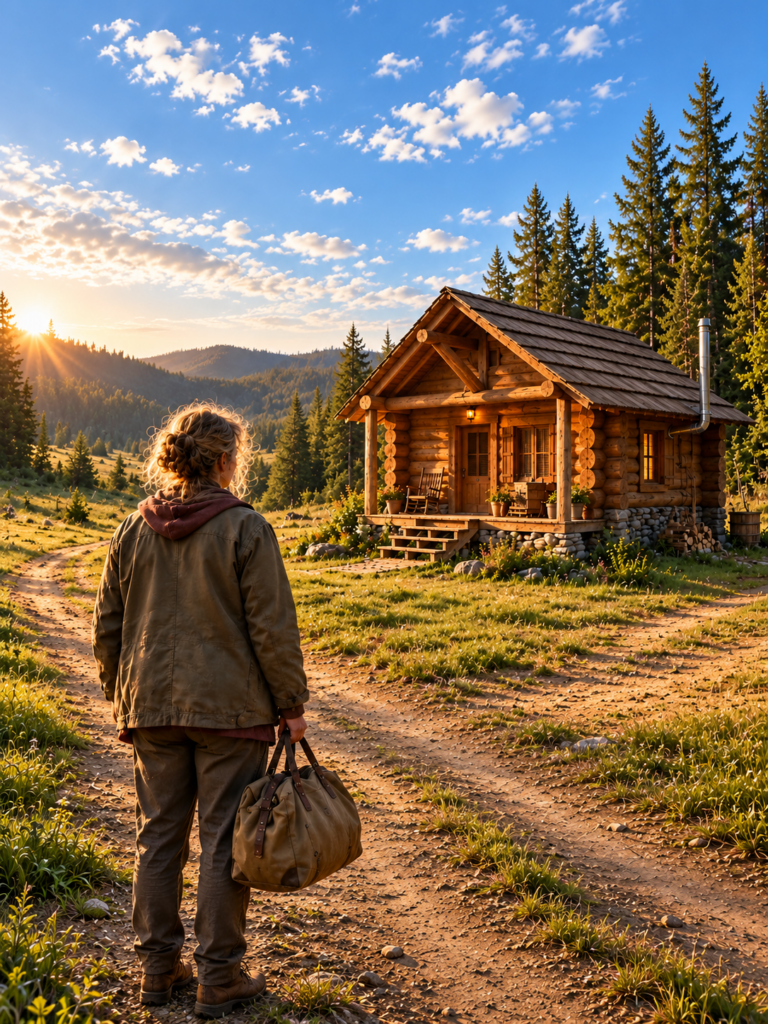
her family said all she deserved was a $50 cabin in the west virginia hills—then they saw what had been hidden beneath it for a century
Part 1
The first time Claire Bennett saw the cabin, it was in a single blurry photograph on a county tax-sale website.
The porch had collapsed.
The roof sagged in the middle.
Vines covered half the front wall.
The description beneath it was only four lines long.
THREE-QUARTER ACRE.
IMPROVEMENTS UNKNOWN.
STRUCTURE CONDEMNED.
MINIMUM BID: $50.
Not fifty thousand.
Fifty dollars.
Claire stared at the screen from the little bedroom she rented in a four-bedroom house outside Charleston, West Virginia. At forty-two, she owned a folding desk, an eight-year-old Honda, two plastic storage bins of clothes, a coffeemaker, and a laptop that paid her bills when clients remembered to pay theirs.
She had spent twenty years doing what people told her was sensible.
She married young.
She worked in an accounting office.
She helped her husband through two years of technical school.
She postponed vacations.
She saved.
Then the marriage ended.
The house stayed with him because refinancing it in her name would have been impossible.
The savings disappeared through lawyers, deposits, moving costs, and the thousand little expenses nobody warns you about when a life is divided into two piles.
For the past two years, Claire had worked remotely as a freelance bookkeeper and rented one room because even a modest one-bedroom apartment in her area cost more than twelve hundred dollars a month.
Then she found the cabin.
Her family thought the idea was ridiculous from the beginning. Her sister, Rebecca, laughed when Claire told her the price and repeated, “All you deserve is a fifty-dollar cabin,” first over the phone and then again at Sunday dinner, while Rebecca’s husband warned that the county was probably trying to unload some dangerous old mining property.
Claire smiled when they said it.
That was the habit she had developed after the divorce.
Smile.
Do not argue.
Do not give anyone the satisfaction of knowing the words landed.
Her mother, Evelyn, was kinder.
“Is there even a road?”
“Technically.”
Rebecca laughed again.
“Technically?”
“It’s a seasonal county road.”
“What does that mean?”
“It means they maintain it from spring through fall.”
“And winter?”
Claire took a bite of mashed potatoes.
“Four-wheel drive.”
“You don’t have four-wheel drive.”
“I know.”
Rebecca stared at her.
“Claire, this is exactly what I mean. You keep making plans as though wanting something badly enough makes the facts disappear.”
Claire put down her fork.
Her sister had a way of saying cruel things in the tone of someone offering useful advice.
Rebecca lived twenty minutes away in a four-bedroom subdivision house with granite counters, matching appliances, and a husband who replaced vehicles before they needed new tires.
She was not evil.
That almost made it harder.
She truly believed Claire had become a person who needed managing.
Ever since the divorce, every family conversation carried the same unspoken conclusion.
Claire had failed once.
Therefore Claire’s judgment was suspect.
Her brother-in-law, Mark, leaned back in his chair.
“Did you even look at the property?”
“Not yet.”
“So you’re thinking about buying a condemned cabin you haven’t seen?”
“For fifty dollars.”
“That isn’t the point.”
“It’s part of the point.”
Rebecca shook her head.
“Why do you always do this?”
Claire looked at her.
“Do what?”
“Turn everything into some kind of stubborn independence performance.”
The room went quiet.
Their mother stared at her plate.
Claire felt the familiar heat behind her eyes.
She would not cry.
Not here.
She had cried enough in bathrooms, parking lots, and the laundry room of the shared house after everyone else went to bed.
She folded her napkin.
“I’m going to look at it Saturday.”
Rebecca sighed dramatically.
“Fine. Go look.”
Claire rose.
Her sister added, “Maybe it suits you.”
Claire stopped.
“What does?”
“A fifty-dollar cabin.”
Mark gave Rebecca a warning glance.
But the damage had already been done.
Claire picked up her coat.
“Maybe it does.”
She drove south Saturday morning.
The final two miles were exactly as bad as the county website suggested.
The road became gravel, then rougher gravel, then something that seemed to be held together by weeds and stubbornness.
The Honda scraped twice.
Claire gripped the wheel as the road climbed.
When she finally found the parcel marker, she parked beside a drainage ditch and continued on foot.
The old wagon path climbed through tulip poplar, oak, maple and tangled grapevine.
Then she saw the roof.
She stopped.
The photograph had lied.
Not by making the cabin look worse.
By making it look larger.
The building might have been six hundred square feet.
Maybe less.
The porch was not sagging.
It was gone.
What remained had collapsed into weeds.
A section of roof dipped so low at the center that Claire understood why the county had condemned it.
She stood with both hands in her coat pockets.
“You drove two hours for this.”
Her voice sounded small among the trees.
She almost turned around.
Then she noticed the logs.
They were dark.
Some nearly black with age.
But the corners were fitted in dovetail joints, each log locked into the next.
Claire did not know construction.
She knew numbers.
But numbers had taught her something important.
Appearances mattered less than structure.
She stepped carefully through the doorway.
A six-foot section of floor had rotted away beneath the leaking roof.
She could see earth through the opening.
But farther inside, the floor looked different.
Dry.
Thick.
She tested one board with her boot.
Solid.
Another.
Solid.
She pressed her hand against the rear wall.
Nothing moved.
She pushed harder.
Still nothing.
Claire stood there listening to the woods.
The building smelled like damp leaves, old timber and cold dirt.
She imagined Rebecca standing behind her.
All you deserve is a fifty-dollar cabin.
Claire put both palms against the wall again.
“Maybe.”
She returned the following weekend with pruning shears, a machete, gloves, contractor bags, and the kind of enthusiasm that only exists before somebody understands how much work is ahead.
She cut vines.
Dragged brush.
Pulled young saplings away from the walls.
By noon her shoulders burned.
By three she had blisters.
By five she could finally walk behind the cabin.
That was when she found the first stone.
It was not loose.
It belonged to a wall.
Claire pulled aside more kudzu.
Another stone appeared.
Then another.
The wall extended into the hillside.
She stopped working.
There was a doorway almost completely hidden beneath vines.
Four feet high.
Maybe three feet wide.
Cut sandstone framed the opening.
Claire crouched.
She could see darkness beyond it.
Every warning Mark had given her came back at once.
Mine shaft.
Collapse.
Snakes.
Black mold.
Contamination.
Common sense told her to leave.
Claire turned on her phone flashlight.
Then ducked inside.
The temperature changed immediately.
Outside, the October afternoon had been mild.
Inside, the air was cool enough to raise gooseflesh on her arms.
Her beam moved across dry-stacked stone walls.
No mortar.
The room extended farther than expected.
Twelve feet wide.
Perhaps sixteen deep.
Flagstones covered the floor.
Stone shelves had been built directly into the back wall.
And on those shelves were jars.
Dozens.
Claire walked closer.
Then counted.
She lost track at eighty.
Started again.
One hundred twenty-three.
Some had glass lids.
Some had strange metal closures.
All were coated with dust.
Their contents had darkened into shapes she had no intention of identifying.
Claire stood in the center of that underground room and felt something shift inside her.
This was not debris.
Someone had designed this.
Someone had cut into a West Virginia hillside, moved stone by hand, shaped shelves, laid a floor, managed drainage, and built a room that had survived perhaps a century.
She pointed her light toward the entrance.
A shallow trench ran along the base of the walls.
Water would flow toward the doorway.
No pump.
No wiring.
No machinery.
Just gravity.
Claire whispered, “What are you?”
The cellar offered no answer.
But when she climbed outside and looked back at the cabin, she no longer saw what Rebecca had seen.
She saw a question.
And for the first time in two years, Claire wanted badly enough to find the answer that being afraid of looking foolish no longer mattered.
She went home that night.
Opened the county auction page.
And entered a bid.
Fifty dollars.
Nobody bid fifty-one.
Part 2
The email arrived Monday morning.
CONGRATULATIONS.
Claire read it three times.
Then she laughed.
It was not a triumphant laugh.
It was the nervous laugh of a woman who had just paid fifty dollars for a condemned building while possessing less than four thousand dollars in savings.
She printed the documents.
Signed everything.
Paid the taxes.
And told nobody until the deed was recorded.
Rebecca found out from their mother.
The phone rang before Claire finished her first cup of coffee.
“You actually bought it?”
“Good morning to you too.”
“Claire.”
“Yes.”
“You bought the cabin?”
“Yes.”
“For fifty dollars?”
“Plus recording fees.”
Rebecca went silent.
Then came the sigh.
“You are unbelievable.”
“I’ve heard.”
“What are you going to do with it?”
“Fix it.”
“With what money?”
“Mine.”
“What experience?”
“I’ll learn.”
“You think YouTube makes you a carpenter?”
“No.”
“Then what is the plan?”
Claire looked around her rented bedroom.
The room barely contained the narrow bed and desk.
A stranger’s television played downstairs.
Someone’s dog barked in the hallway.
“My plan is to stop spending fourteen thousand dollars a year renting one room.”
Rebecca’s tone softened slightly.
“Claire, I know the divorce wrecked things.”
“Don’t.”
“I’m trying to help.”
“No. You’re trying to explain me.”
“I’m your sister.”
“That doesn’t mean you get to keep treating me like the worst thing that ever happened to me is proof of what I’m worth.”
There was silence.
Claire surprised herself.
Rebecca recovered first.
“You’re taking what I said personally.”
“You made it personal.”
“I was joking about the fifty-dollar cabin.”
“You said it twice.”
Rebecca exhaled.
“Fine. I’m sorry.”
But it sounded like the kind of apology offered to end a conversation rather than understand it.
Claire accepted anyway.
She had work to do.
The first person who taught her anything useful about the cabin was a seventy-year-old man named Walter Pruitt who owned a portable sawmill twelve miles away.
Claire had found his number on a handwritten sign outside a hardware store.
Walter drove out the following Saturday.
He walked around the structure once without speaking.
Then twice.
He scraped a pocketknife across one of the logs.
Stopped.
Scraped again.
“Where’d you say you got this?”
“County tax sale.”
“How much?”
“Fifty dollars.”
Walter laughed.
Not cruelly.
He looked delighted.
“Ma’am, you know what these logs are?”
“No.”
“Chestnut.”
Claire waited.
Walter looked at her as though expecting a stronger reaction.
“American chestnut.”
“I’m going to need you to explain why that matters.”
Walter leaned against the doorway.
“When I was a boy, old barns around here still had chestnut boards in them. Trees used to cover these mountains. Blight near wiped them out. You can buy reclaimed chestnut now, if you can find it, but nobody’s cutting timber like this new.”
He tapped the wall.
“Hard. Stable. Rot resistant. Bugs don’t care for it much. This cabin’s standing because whoever built it knew what he had.”
Claire looked around differently.
“What about the roof?”
Walter’s smile faded.
“Roof’s bad.”
“How bad?”
“Bad enough you don’t sleep under it.”
“Can it be fixed?”
He walked inside, studied the ridge, then climbed carefully onto a ladder Claire had brought.
Twenty minutes later he came down.
“Ridge beam bowed. Rafters around the leak are gone. Walls are still carrying.”
“So…”
“You need a beam. Eight rafters. Deck repair. Roofing.”
“How much?”
“If you pay a contractor?”
Claire braced herself.
“Ten, maybe fifteen thousand by the time somebody bothers driving equipment out here.”
She almost laughed.
“I don’t have that.”
“I figured.”
Walter scratched his cheek.
“If you’re willing to work and you don’t mind ugly before pretty, I can cut you a beam and rafters.”
“How much?”
“Six hundred.”
Claire stared at him.
“Why?”
“Because that’s what the wood and saw time are worth.”
“No. Why help me?”
Walter shrugged.
“Because I like old buildings and dislike people who tear them down because calculators tell them new is cheaper.”
He looked toward the cellar.
“You seen what’s back there?”
Claire nodded.
Walter went down with a flashlight.
When he returned, he had the expression Mark would later wear.
“Whoever built this place wasn’t poor in skill.”
“What does that mean?”
“It means don’t confuse lack of money with lack of wealth.”
That sentence stayed with Claire.
She began keeping a notebook.
Every expense.
Every measurement.
Every problem.
She created columns the same way she did for clients.
ROOF.
FLOOR.
WATER.
HEAT.
ELECTRICITY.
ACCESS.
NECESSARY.
LATER.
IMPOSSIBLE FOR NOW.
The numbers made the project less frightening.
A broken life became overwhelming when viewed whole.
A broken roof could be divided into materials and tasks.
Walter delivered the ridge beam in November.
He also brought his grandson Caleb.
Claire paid them for two days of labor despite Walter protesting that she did not have to.
“I’m not accepting charity.”
Walter pointed toward the cabin.
“You paid fifty dollars for a house and now you’re proud?”
“Yes.”
“Fair enough.”
They jacked the sagging roof slowly.
The cabin groaned.
Claire stood outside watching the roofline rise inch by inch.
Walter replaced the beam.
They installed rafters.
Claire learned to drive structural screws.
She learned that ladders become more frightening after three hours.
She learned that gloves prevent some blisters, not all.
Most importantly, she learned she could be tired without being defeated.
The roof straightened.
The transformation was not dramatic.
There were still holes.
No porch.
No utilities.
No bathroom.
But the cabin no longer looked like it was kneeling.
Rebecca saw a photograph and texted:
Looks slightly less condemned.
Claire did not answer.
Instead she searched salvage listings.
A farmer down the valley was demolishing a barn.
The oak floorboards were free if Claire hauled them herself.
She made six trips.
She removed nails one by one.
Planed the roughest edges.
Used the sound pieces to patch the rotted cabin floor.
For roofing, she bought corrugated metal panels.
Eight hundred dollars.
The biggest single expense yet.
The day the final panel went on, rain came after dark.
Claire drove out just to hear it.
She sat inside the cabin on an overturned bucket while November rain hammered against the metal roof.
No water entered.
For two years, she had measured every place she lived by what belonged to someone else.
Someone else’s refrigerator.
Someone else’s rules.
Someone else’s noise.
Someone else’s mortgage.
Now she sat inside a six-hundred-square-foot condemned cabin with no electricity, no plumbing, no legal occupancy approval yet, and felt richer than she had felt in years.
Then winter arrived.
The road became mud.
Mud became frozen ruts.
Her Honda could not climb the last hill.
For six weeks Claire parked below and walked nearly a mile carrying tools, groceries, lumber, and once a used woodstove piece by piece.
There were mornings she questioned everything.
One December afternoon, freezing rain began earlier than forecast.
Claire was inside patching gaps around a window opening when she realized the road had iced.
Her phone had seven percent battery.
Darkness came by five.
She packed quickly.
Outside, the temperature dropped.
The footpath was slick.
Halfway down the ridge she slipped.
Her knee struck rock.
Pain exploded through her leg.
Claire lay there in freezing rain, staring upward through bare branches.
For ten seconds she wanted somebody to rescue her.
Her ex-husband.
Her mother.
Walter.
Anyone.
Then she began laughing.
“You wanted independence.”
She pushed herself upright.
The knee could bear weight.
Barely.
She used a fallen branch as a cane and continued down.
By the time she reached the Honda, her jeans were soaked and her fingers numb.
She turned the heater to maximum and sat shivering.
Her phone showed three missed calls.
Rebecca.
Claire called back.
“Where are you?”
“At the cabin.”
“You sound awful.”
“I fell.”
“What?”
“I’m okay.”
Rebecca’s voice sharpened.
“This is what we were trying to tell you.”
Claire closed her eyes.
Of course.
Not Are you hurt?
Not Do you need me?
This is what we were trying to tell you.
“You know what?” Claire said.
“What?”
“I have to drive.”
“Claire—”
She ended the call.
That night, alone in the rented room, Claire cried harder than the fall deserved.
Because somewhere underneath the bruised knee, the cold road, the unfinished roof trim and dwindling savings was the fear Rebecca had planted months earlier.
Maybe this was all she deserved.
A fifty-dollar ruin.
Maybe the cabin was not evidence of courage.
Maybe it was evidence she had lost perspective.
The next morning Claire opened her expense notebook.
$50 PROPERTY.
$600 BEAM AND RAFTERS.
$800 ROOFING.
$0 RECLAIMED FLOOR.
$46 FASTENERS.
$27 SEALANT.
$83 GAS.
She looked at the numbers.
Then at the photograph of the cabin before repairs.
Then one from after.
The walls were straight.
The roof was straight.
The floor was nearly whole.
Numbers had never lied to Claire.
People did.
Fear did.
Shame did.
But the numbers said one thing clearly.
The cabin was improving.
So she kept going.
Part 3
The spring changed everything.
Claire returned after the thaw expecting damage.
Instead she found the cabin dry.
The roof had held through snow.
The repaired floor remained solid.
The cellar temperature was fifty-three degrees.
Exactly where it had been in October.
She began researching Appalachian root cellars.
The more she learned, the more remarkable the structure became.
It did not merely survive without electricity.
It functioned because it had none.
Earth insulated three sides.
The hillside stabilized temperature.
The drainage channel removed seepage by gravity.
The flagstone floor moderated moisture.
The shelves were stone because stone would not rot.
Modern homeowners spent thousands trying to recreate systems the original builder had created with slope, rock and patience.
Claire cleaned the cellar carefully.
She photographed every old jar before removing it.
Several antique dealers told her the jars had modest collectible value.
A few were unusual.
Most were not.
Together, they might bring between five hundred and two thousand dollars.
Rebecca heard this from their mother.
Her message arrived immediately.
Sell them.
Claire typed:
Why?
Rebecca replied:
Because for once something about that place might actually make money.
Claire stared at the screen.
Then set the phone facedown.
She sold six duplicate jars.
Kept the rest.
Not because they were valuable.
Because she liked knowing someone had once filled them.
Green beans.
Apples.
Tomatoes.
Corn relish.
Maybe peaches.
Maybe blackberry preserves.
A family had once survived winters partly because that cellar existed.
Claire wanted to use it again.
She planted a small garden behind the cabin.
Walter helped break the ground.
Potatoes.
Beans.
Tomatoes.
Onions.
Squash.
She knew almost nothing about gardening.
Her first lettuce bolted.
Rabbits destroyed peas.
A late frost killed six tomato plants because she ignored Walter’s warning.
“You keep treating the mountain like a spreadsheet,” he said.
“Spreadsheets behave better.”
“The mountain doesn’t care.”
“I’ve noticed.”
One April morning Claire was clearing farther behind the cellar when she heard water.
Not rain.
Running water.
She climbed around a sandstone outcrop.
There, beneath ferns and leaves, a narrow seep emerged from a crack in the hill.
Water collected in a shallow basin lined with stones.
Not random stones.
Placed stones.
Someone had built the catchment.
Claire crouched.
Cold clear water flowed continuously.
Walter came that afternoon.
He studied it.
“Spring.”
“Enough to use?”
“Depends on flow.”
They measured.
Slow.
Roughly a gallon or two each hour.
Not much by suburban standards.
Plenty when collected all day.
The spring sat fifteen feet above the cabin floor.
Claire saw the possibility immediately.
“Gravity.”
Walter smiled.
“Now you’re learning.”
She bought a food-grade 275-gallon tank.
Black polyethylene pipe.
Fittings.
A used utility sink.
Total cost under three hundred fifty dollars.
They placed the tank near the spring.
Ran pipe downhill.
Claire opened the faucet for the first time.
Water came out.
No pump.
No power.
No monthly bill.
She laughed so loudly Walter’s grandson heard her from outside.
“You’d think she struck oil,” Caleb said.
“I struck plumbing.”
“That’s not plumbing.”
“It’s water coming out where I want it. That counts.”
Electricity came next.
Utility extension was impossible on her budget.
A contractor estimated more than ten thousand dollars depending on poles and right-of-way.
Claire closed that folder immediately.
Instead she bought one hundred watts of solar panel, a charge controller, deep-cycle battery and small inverter.
Two hundred sixty dollars.
Enough for lights.
Phone.
Laptop.
Occasional fan.
Not enough for a microwave.
Not enough for electric heat.
Not enough for pretending she still lived in town.
Perfect.
She installed a used woodstove for one hundred fifty dollars.
Built a hearth from stone collected on the property.
Walter inspected the chimney connection twice.
“You scared?”
Claire asked.
“Of fire? Yes. Smart people are.”
By May, Claire had a functioning cabin.
Not finished.
Functioning.
There was an outdoor composting arrangement while she worked through septic options.
Bathing meant heated spring water and a galvanized tub.
Internet came through a cellular hotspot whenever the mountain allowed.
But Claire could work.
Cook.
Sleep.
Heat the building.
Store food.
Use water.
Live.
The county inspector who returned to review the condemnation order stood inside for twenty minutes.
He looked at the new ridge.
Roof.
Floor.
Stove installation.
Exit windows.
Then he sighed.
“I hate when people make me change paperwork.”
“That sounds promising.”
He smiled.
“Conditional occupancy. Finish the railing. Correct two stove-clearance issues. I’ll sign the final.”
Claire drove back to the shared house that evening.
Packed everything she owned.
It fit inside her Honda and Walter’s pickup.
Her roommates watched from the porch.
“You’re really moving into the mountain cabin?” one asked.
“Yes.”
“What if you hate it?”
Claire looked at the boxes.
“Then I’ll hate something I own.”
The first night alone was unsettling.
Every sound seemed intentional.
Branches scraped the roof.
Owls called from below the ridge.
Something moved outside around two in the morning.
Claire sat upright with a flashlight.
Then laughed at herself.
“There are animals in the woods, Claire. Shocking.”
She went back to sleep.
Morning changed the mood.
Sunlight entered through the east window and turned the cleaned chestnut walls reddish brown.
Steam rose from coffee.
Fog sat in the valley.
There were no car doors.
No upstairs footsteps.
No roommate arguing over speakerphone.
Only wind in the leaves.
Claire carried coffee onto the half-built porch.
She sat on a temporary step.
For the first time since the divorce, she was not waiting for her real life to restart.
She was in it.
But the cabin was rebuilding more than Claire understood.
Her relationship with her mother changed first.
Evelyn began calling once a week.
Not to warn.
To ask.
“How are the tomatoes?”
“Being eaten.”
“By you?”
“Mostly wildlife.”
“What do you need?”
Claire always said nothing.
Then one Saturday her mother arrived carrying curtains.
Claire stared at the Honda parked below.
“You drove up?”
“Very slowly.”
“You hate mountain roads.”
“I hated childbirth too. Still had two daughters.”
Evelyn stepped inside.
She touched the log wall.
Looked at the stove.
Opened the faucet.
Claire showed her the cellar.
Her mother walked through the stone doorway and stopped.
“My grandmother had one.”
“A root cellar?”
“Smaller. We kept apples there.”
Evelyn touched the stone shelf.
“I haven’t smelled cold stone like this since I was a girl.”
They sat outside afterward.
Her mother looked toward the valley.
“Your father would have liked this.”
Claire had not expected that.
Their father had died eight years earlier.
He fixed lawnmowers even when buying new ones made more financial sense.
Saved bent nails.
Stored screws in coffee cans.
Never threw away wood longer than eighteen inches.
Claire smiled.
“He would’ve told me every single thing I did wrong.”
“Yes.”
“And then fixed it when I went inside.”
Evelyn laughed.
“That too.”
Then her face became serious.
“I should have defended you.”
Claire looked at her.
“When?”
“At dinner. When Rebecca said what she said.”
“You don’t have to.”
“Yes, I do.”
Evelyn folded her hands.
“After your marriage ended, we all started treating you like being alone meant you had become fragile.”
Claire stared toward the garden.
“It felt worse than fragile.”
“How?”
“Like I’d become disappointing.”
Her mother reached for her hand.
“You were never disappointing.”
Claire swallowed.
“Maybe not to you.”
“No. Not to me.”
They sat there until afternoon.
Before leaving, Evelyn hung the curtains.
They were yellow.
Part 4
By late summer, the cabin had become recognizable as a home.
Claire rebuilt the porch with pressure-treated boards.
For railings, she cut locust saplings from the property, peeled the bark and fitted the branches between posts.
She found a six-panel door at a Habitat ReStore for fifteen dollars.
Sanded it.
Sealed it.
Installed a new lock.
The original chestnut logs took days to clean.
Claire refused to sand away the ax marks.
Those marks were fingerprints.
Whoever built the cabin had stood beside each tree.
Swung an ax.
Shaped every face.
Lifted every log.
Claire brushed the walls and applied linseed oil.
The wood changed immediately.
Dark gray became deep reddish brown.
Straight grain appeared beneath decades of dust.
Walter stood in the doorway watching.
“Now you see it.”
Claire stepped back.
Light moved across the grain.
“This was underneath the whole time.”
“Usually is.”
She looked at him.
“You talking about the logs?”
Walter shrugged.
“Sure.”
Her garden eventually produced more food than wildlife ate.
Tomatoes.
Beans.
Squash.
Potatoes.
Onions.
Apples came from an abandoned tree near the lower boundary.
Claire learned to can.
Her first batch of tomatoes nearly became soup.
Her second sealed properly.
She put the jars in the same cellar where one hundred twenty-three others had waited for decades.
New glass beside old glass.
The sight affected her more than expected.
For months she had been thinking about restoration as repair.
Fix the roof.
Patch the floor.
Bring back water.
But standing in that cellar, Claire understood restoration differently.
The goal was not to return the cabin to a museum version of its past.
The goal was to make old knowledge useful again.
The root cellar did not need admiration.
It needed potatoes.
The spring did not need a historical marker.
It needed a pipe.
The cabin did not need somebody saying, Look how quaint.
It needed somebody living inside it.
Then Rebecca announced she was coming.
Claire almost said no.
Her sister had not visited once.
She had sent occasional messages.
Some polite.
Some skeptical.
A photograph of the solar panel received:
Cute.
A picture of the porch received:
Did you check building codes?
When Claire mentioned the cellar remaining fifty-three degrees during summer, Rebecca replied:
Still not air conditioning.
Then in September their mother apparently showed Rebecca photographs.
Her sister called.
“Mark wants to see it.”
“Mark?”
“Yes.”
“Why?”
“He’s curious.”
“About my contaminated mine shaft?”
Rebecca sighed.
“He admitted he might have been wrong.”
“Might?”
“Claire.”
She almost refused.
Then she remembered the dinner.
All you deserve is a fifty-dollar cabin.
Some part of her wanted Rebecca to see.
That frightened her.
Because wanting someone who diminished you to witness your success can quietly make them the owner of it.
Claire did not want the cabin to become revenge.
So she said, “Come Saturday.”
Saturday morning brought perfect autumn weather.
Blue sky.
Cool air.
Leaves beginning to turn.
Claire heard engines below the ridge.
Two cars.
Rebecca had brought Mark and their mother.
They walked the final stretch because Mark refused to risk his SUV on the upper track.
Claire watched from the porch.
Rebecca emerged through the trees first.
Then stopped.
The expression on her face was almost enough.
Almost.
The porch stretched across the cabin.
Four sturdy posts.
Locust railing.
Metal roof.
Clean windows.
The salvaged front door.
A stack of split firewood beside the chimney.
Bean vines climbed fencing near the garden.
Rebecca said nothing.
Mark came beside her.
“Well.”
Claire stood.
“Road too much?”
“I’m not destroying an eighty-thousand-dollar vehicle proving a point.”
“That’s probably wise.”
Their mother walked past them carrying a pie.
“I told them.”
Claire kissed her cheek.
Rebecca slowly approached the porch.
“This is the same place?”
“No. I secretly bought another fifty-dollar cabin.”
Rebecca gave her a look.
Then smiled despite herself.
Inside, her reaction changed.
The chestnut walls glowed in afternoon light.
A braided rug covered part of the oak floor.
The used woodstove stood on the stone hearth.
Claire’s desk occupied one corner beneath a window overlooking the valley.
A small kitchen counter held the gravity-fed sink.
Solar lights hung discreetly overhead.
Rebecca touched the wall.
“What did you do to this wood?”
“Cleaned it.”
“This was here?”
“Yes.”
“What kind?”
“American chestnut.”
Mark turned.
“Seriously?”
Claire nodded.
Walter had told her enough that she could explain confidently now.
“Old-growth chestnut. Probably early twentieth century. You basically can’t buy new material like this anymore because the blight wiped out most mature trees. Reclaimed chestnut is valuable.”
Mark examined a dovetail corner.
“This whole building?”
“As far as we can tell.”
He whistled.
Rebecca glanced at him.
“What?”
“This is good material.”
Claire resisted smiling.
Instead she opened the back door.
“You haven’t seen the part underneath.”
They followed her.
At the cellar entrance, Rebecca hesitated.
“You go into that?”
“Daily.”
Mark ducked first.
Claire handed him a flashlight.
He walked the entire room.
Touched the sandstone walls.
Inspected the flagstone floor.
Ran his light along the drainage trench.
He stayed below long enough that Rebecca finally called, “Mark?”
“I’m looking.”
When he emerged, he shook his head.
“What?”
Rebecca asked.
Mark looked at Claire.
“This is solid.”
Three words.
Nothing dramatic.
But Claire remembered his warning about contaminated mine workings.
She nodded.
“Yeah.”
He pointed behind the cellar.
“And the water?”
Claire showed them the spring.
The collection tank.
Gravity line.
Then the solar equipment.
The garden.
The stored firewood.
The newly stocked cellar shelves.
Rebecca became quieter with every stop.
Finally Evelyn carried coffee onto the porch.
They sat overlooking the valley.
Wind moved through red and yellow leaves.
For several minutes nobody spoke.
Then their mother said softly, “This is yours.”
Claire looked around.
“Yes.”
Rebecca stared into her coffee.
“What did everything cost?”
Claire had expected the question.
She went inside.
Returned with the notebook.
“Total so far?”
“Yes.”
Claire opened to the final page.
“Three thousand four hundred twenty dollars, including the fifty-dollar purchase price, gas for every trip, materials, stove, solar setup, water system, tools, everything.”
Rebecca’s eyes widened.
“That’s impossible.”
“It’s bookkeeping.”
Claire handed her the notebook.
Every expense had a date.
Receipt reference.
Category.
Rebecca read page after page.
“You kept all this?”
“I keep books for a living.”
Mark laughed.
The county had recently completed a reassessment.
Claire had not told her family.
She took the letter from inside the notebook and handed it to Rebecca.
Her sister read it.
Then read it again.
“Thirty-eight thousand?”
“That’s the assessed value.”
“For this?”
“For the improved parcel and structures.”
Rebecca looked toward the cabin.
Then the garden.
Then the ridge.
“That doesn’t even include what the chestnut could be worth as reclaimed material.”
“I’m not tearing it apart.”
“I know.”
Mark leaned back.
“You bought fifty dollars of taxes.”
Claire nodded.
“And got all this.”
Rebecca looked at her sister.
Something complicated passed through her face.
Admiration.
Embarrassment.
Perhaps shame.
She closed the notebook.
“You were right.”
Claire had imagined that sentence.
Many times.
In several versions, she answered brilliantly.
Something sharp.
Something unforgettable.
Now that the words were actually spoken, she discovered she did not want revenge.
“No,” Claire said.
Rebecca frowned.
“I wasn’t?”
“You were right about some things.”
“Such as?”
“The road is terrible.”
Mark laughed.
Claire continued.
“The cabin was dangerous. I didn’t know what I was doing. I could have wasted every dollar.”
“Then why did it work?”
Claire looked through the open door toward the chestnut walls.
“Because I stopped treating what I didn’t know as proof I couldn’t learn.”
Rebecca’s eyes lowered.
After a moment she said, “I shouldn’t have said what I said.”
Claire waited.
Rebecca looked directly at her.
“The fifty-dollar cabin thing.”
“I know what you meant.”
“That makes it worse.”
Claire said nothing.
Rebecca continued.
“I was angry at you after the divorce.”
“Why?”
“Because you scared me.”
Claire had not expected that.
Rebecca looked toward the valley.
“You did everything right. You married. You saved. You worked. And it still fell apart. I think I needed your divorce to be your mistake.”
Claire stared.
Rebecca’s voice tightened.
“Because if it was your mistake, then things like that only happen when somebody makes bad choices.”
Mark became very still.
Rebecca rubbed her hands together.
“So I kept judging every decision afterward. Like if I could prove you were reckless, then what happened to you made sense.”
Claire felt something inside her loosen.
Not disappear.
Just loosen.
“That was cruel.”
“I know.”
“You made me feel like I had become less valuable.”
Rebecca’s eyes filled.
“I know.”
“No. I don’t think you did.”
Her sister looked up.
Claire pointed toward the cabin.
“When you said all I deserved was a fifty-dollar cabin, I believed you for about five minutes.”
Rebecca began crying.
Claire’s own throat tightened.
“But then,” Claire continued, “I realized something.”
“What?”
“You were looking at the price.”
Claire turned toward the wall behind her.
“I was learning to look at what was still standing.”
Part 5
Rebecca returned alone two weeks later.
No Mark.
No mother.
She brought work gloves.
Claire raised an eyebrow.
“What’s this?”
“I thought you might need help.”
“Can you use a post-hole digger?”
“No.”
“Excellent. Today is educational.”
They spent four hours repairing fencing around the garden.
Rebecca complained about her shoulders.
Claire reminded her she deserved only a free fence.
Rebecca threw a glove at her.
It was the first time they had laughed naturally together in years.
Their relationship did not magically become perfect.
That would have been easier than truth.
Rebecca still gave unsolicited advice.
Claire still became defensive too quickly.
Old roles do not vanish because somebody apologizes once.
But now they noticed.
And when they noticed, sometimes they stopped.
Winter returned.
This time Claire was ready.
She bought tire chains.
Stored food.
Stacked firewood.
Insulated the water line.
Added a second battery to the solar system.
The first heavy snow arrived in December.
By evening eight inches covered the ridge.
Claire lit the stove.
Made soup.
Turned on two small LED lamps.
Outside, the world disappeared into white.
The road became impassable.
For three days she remained alone.
A year earlier that would have terrified her.
Now she knew exactly how much wood she needed overnight.
How slowly the battery discharged.
Which section of the spring line might freeze.
How much food sat beneath the hill.
She walked to the cellar with a lantern.
Potatoes.
Onions.
Apples.
Canned tomatoes.
Green beans.
Apple butter.
Food she had grown.
Preserved.
Stored.
She stood among the stone walls.
The temperature remained steady.
Fifty-three degrees.
Outside, the mountain was frozen.
Inside the earth, almost nothing changed.
Claire touched one of the old shelves.
Somebody had understood this long before her.
Not through technology.
Through attention.
Watch the hill.
Watch the water.
Watch the seasons.
Build accordingly.
Claire thought about the price that night.
Fifty dollars.
The county had not priced the chestnut.
Had not priced the spring.
Had not priced the cellar.
Had not priced the craftsmanship.
Had not priced the view.
The figure represented only unpaid taxes and administrative impatience.
It was not value.
It was merely price.
Claire understood the difference now because for years she had made the same mistake about herself.
Divorced.
Renting a room.
Forty-two.
No children.
No house.
Savings diminished.
Those were facts.
But she had used them as valuation.
She had looked at the circumstances of her life and mistaken them for what she was worth.
Other people had helped.
But she had done most of the damage herself.
Spring came late.
By April, the mountain softened.
Rebecca and Mark drove up again.
This time they brought lumber.
“What’s that?” Claire asked.
“Deck boards.”
“I already have a porch.”
Mark pointed toward the side of the cabin.
“You don’t have steps down there.”
“I have a slope.”
“You have a lawsuit.”
Claire smiled.
“Fine.”
Their mother came every few weeks.
Evelyn claimed one chair on the porch as hers.
Walter visited often enough that Claire eventually stopped asking whether he wanted coffee and simply poured it.
Caleb helped expand the solar array.
A neighbor three miles away traded eggs for bookkeeping help.
Another traded firewood for canned tomatoes.
The cabin was remote.
Claire was not isolated.
That difference mattered.
By the second summer, she had enough freelance clients to stop worrying every month.
Her housing cost had collapsed.
Taxes were modest.
Water came from the hill.
Heat came mostly from deadfall and locally purchased wood.
Electricity came from sunlight.
Her life required labor.
But less money.
And Claire discovered she preferred that exchange.
One afternoon, the same county inspector who had signed the occupancy approval returned.
“Problem?”
“No.”
He held out an envelope.
“What is it?”
“The historical society has been asking questions.”
Claire stared.
“About?”
“Your cabin.”
Apparently photographs from the reassessment had reached a county archivist.
The dovetail joinery and chestnut construction attracted attention.
Records suggested the cabin had been built between 1905 and 1915 by a family named Mercer who had lived on the ridge for three generations.
The cellar might be older.
The spring appeared on a handwritten agricultural map from 1898.
Claire spent the next month searching courthouse records.
She found names.
Jacob Mercer.
Anna Mercer.
Four children.
Then grandchildren.
Tax records.
Land transfers.
One old census.
No dramatic fortune.
No secret gold.
No hidden inheritance.
Just people.
People who cut timber.
Planted gardens.
Stored food.
Carried water.
Raised children.
Buried parents.
Survived winters.
The discovery made Claire love the property more.
Not because it had become historically important.
Because ordinary lives had passed through it.
The old jars were no longer objects.
They were evidence of meals.
The ax marks were work.
The cellar was preparation.
The spring was survival.
A house could contain wealth without containing luxury.
By October, nearly two years had passed since Claire first saw the auction photograph.
Her mother suggested dinner at the cabin.
“Everybody?”
Claire asked.
“Everybody.”
So Claire set up a long folding table partly inside and partly across the porch because the cabin was too small for the entire family.
Rebecca brought casserole.
Mark brought chairs.
Walter came with pie.
Caleb brought his girlfriend.
Two neighbors came.
Evelyn arrived carrying flowers.
The table was mismatched.
The glasses did not match.
Some chairs came from yard sales.
Others folded.
Dinner was loud.
At one point Claire stepped away from the table and stood near the garden.
Through the open cabin door she could see people crowded beneath the chestnut walls.
Rebecca was laughing.
Mark argued with Walter about roofing screws.
Her mother sat beside the stove.
For years Claire had imagined success as returning to the life she lost.
Another suburban house.
A respectable address.
A conventional marriage.
Enough money that nobody worried about her.
Instead success looked like this.
A cabin someone else had abandoned.
A gravel road.
A root cellar.
A gravity-fed faucet.
A garden that produced crooked carrots.
A sister who had learned how to apologize.
A mother who no longer asked whether Claire was safe every time she called.
And Claire herself, no longer asking permission to trust her own judgment.
After dinner, Rebecca helped wash dishes.
She glanced toward the old expense notebook sitting on a shelf.
“You still keep that?”
“Of course.”
“You know exactly what you’ve spent?”
“To the penny.”
Rebecca smiled.
“How much now?”
Claire told her.
The number had grown.
There were new batteries.
Tools.
Garden fencing.
A small septic installation.
More insulation.
Repairs.
But still nowhere near what Claire would have spent renting a modest apartment during those two years.
Rebecca dried a plate.
“Remember what I said?”
“Yes.”
“I wish you didn’t.”
“I don’t.”
Her sister looked worried.
Claire smiled.
“I mean I remember the words. I just don’t carry them anymore.”
Rebecca set down the towel.
“That sounds like something Mom would put on a decorative sign.”
“Never say that again.”
They laughed.
Later, after everyone drove away, Claire carried the old tax-sale photograph outside.
She had printed it and kept it inside the notebook.
The original cabin looked exhausted.
Collapsed porch.
Sagging roof.
Dark walls.
Brush everywhere.
If she saw the image now without knowing what lay behind it, would she recognize the cellar?
No.
The spring?
No.
Chestnut?
Probably not.
Structure?
Maybe.
Potential?
Only if she was willing to walk through the door.
Claire went inside and placed the photograph on the table.
Then she opened her laptop.
She had one bookkeeping report to finish.
Numbers filled the screen.
Assets.
Liabilities.
Cash flow.
Depreciation.
Value could be calculated in many ways.
But not all of it fit into columns.
The following spring, the county sent another assessment notice.
The property value had increased again.
Claire smiled at the number.
Then filed the letter away.
She no longer needed it to prove anything.
That afternoon, a young woman drove up the gravel road.
She was thirty, recently separated, looking exhausted and embarrassed.
Walter had sent her.
“You’re Claire?”
“Yes.”
“Mr. Pruitt said you might know about cheap properties.”
Claire laughed.
“That sounds like Walter.”
The woman looked toward the cabin.
“He said you bought this for fifty dollars.”
“I did.”
“Is that actually true?”
“Yes.”
The woman stared.
“I saw a tax listing for an old farmhouse twenty miles east.”
“How bad?”
“Bad.”
“Roof?”
“Part gone.”
“Foundation?”
“I don’t know.”
“Water?”
“Maybe a well.”
“Road?”
“Terrible.”
Claire smiled.
The woman looked embarrassed.
“My family thinks I’m crazy.”
There it was.
Claire recognized the expression immediately.
The look of someone who had already started shrinking an idea because other people laughed at it.
“How much?”
The woman hesitated.
“Two hundred dollars.”
Claire nodded gravely.
“Expensive.”
The woman laughed despite herself.
Then Claire became serious.
“Don’t buy it because you’re angry.”
“I’m not.”
“Don’t buy it because you want to prove your family wrong.”
The woman nodded.
“And don’t buy it because mine worked.”
“Okay.”
Claire pointed toward the cabin.
“This could have collapsed. I could have discovered major foundation failure. The spring could’ve been contaminated. The roof could’ve cost more than I could afford. Cheap land can become very expensive.”
The woman’s shoulders fell slightly.
Claire continued.
“But don’t walk away just because they laughed either.”
The woman looked up.
“What should I do?”
“Go look.”
“That’s it?”
“Walk the property. Look underneath. Look behind things. Ask someone who knows buildings. Check title, access, water, taxes, flood maps, old mining records. Learn what is broken.”
Claire rested a hand on the chestnut wall.
“And learn what isn’t.”
The woman smiled.
“Walter said you’d say something like that.”
“Walter talks too much.”
After she left, Claire walked around back.
She entered the cellar.
Fresh jars lined the shelves now.
Tomatoes.
Beans.
Peaches.
Apple butter.
Potatoes sat in wooden bins.
Garlic hung overhead.
The oldest collectible jars occupied one shelf at the back, cleaned but otherwise untouched.
Claire ran a hand across the sandstone.
A hundred years earlier, someone had fitted those rocks together without mortar.
They never knew Claire Bennett.
Never knew about online auctions.
Remote bookkeeping.
Solar panels.
Divorce lawyers.
Twelve-hundred-dollar apartments.
But they understood uncertainty.
Winter came every year.
Food had to last.
Water had to be found.
Roofs had to hold.
A person built what they could and trusted someone after them to recognize its usefulness.
Claire climbed out.
Late sunlight struck the metal roof.
The garden waited for planting.
The chestnut walls stood dark and straight.
Her mother’s yellow curtains moved inside the windows.
From the front porch, Claire could see miles across the Appalachian hills.
She thought about the sentence that had once wounded her so deeply.
All you deserve is a fifty-dollar cabin.
Rebecca had meant the price as humiliation.
But years later, Claire sometimes smiled at the irony.
Because Rebecca had been wrong about only one word.
It was never all she deserved.
But the fifty-dollar cabin?
That part had turned out to be far more than anyone knew.
It held timber from trees that had nearly vanished from America.
A stone cellar that needed no electricity.
A spring that kept flowing whether Claire succeeded or failed.
A roof she learned to repair.
Food she learned to grow.
A family relationship damaged by judgment and repaired by humility.
And, eventually, a quiet certainty that could not have been purchased at any ordinary market price.
Claire had gone into the hills looking for cheap land.
What she found beneath the vines and broken boards was proof that value could survive years of neglect.
Sometimes decades.
Sometimes a century.
And sometimes the thing everyone else had already decided was worthless was simply waiting for one person willing to look closely enough to see what was still standing.


