
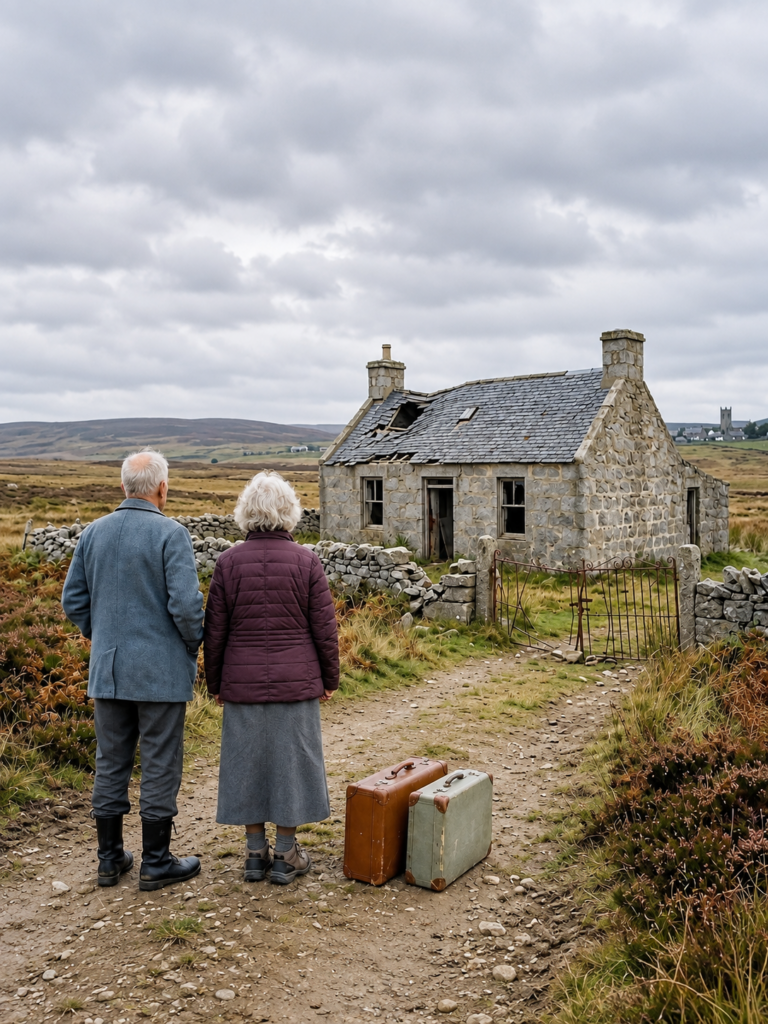
they bought a condemned stone cottage for $11 after losing everything—then the old walls revealed why someone wanted it buried
Part 1
The wind came hard off the quarry hills that Tuesday morning, cutting through Hollis Coyle’s old canvas coat as if the fabric had forgotten its purpose.
At seventy-four, Hollis had learned there were some things a man could no longer argue with. Winter was one. Bad knees were another. And the look people gave you after you lost everything was a third.
Beside him, his wife, Naen, stood on the courthouse steps with both hands buried in the pockets of a coat that had once belonged to their daughter. At seventy-one, she was small enough that Hollis could block most of the wind simply by standing on the right side of her.
There were fifteen people at the county auction.
Most had come for useful things.
A repossessed utility trailer.
A pickup with a seized engine.
Three acres near the highway.
Nobody had come for Lot Eleven.
The clerk looked down at his paper.
“One-point-one acres on Old Quarry Road. Stone residential structure. Condemned. No warranty of habitability. Buyer assumes all liability. Opening bid, ten dollars.”
Someone laughed.
Hollis looked toward the road.
He already knew the property.
Everybody did.
The Pasco cottage had been abandoned for years. Half the roof had fallen in. Blackberry vines had swallowed the windows. Local children told stories about the old foreign mason who had died there alone.
The county had been trying to get rid of it since the back taxes exceeded what anyone believed the land was worth.
“Ten dollars,” the clerk repeated.
Nobody raised a hand.
Royce Tindall stood near the front in a clean wool coat. He owned the largest construction company in the county and held a seat on the county council.
Royce smiled.
“County ought to include the bulldozer for free.”
People chuckled.
Naen moved beside Hollis.
He felt it before he saw it.
Her hand came out of her pocket.
“Eleven.”
The clerk looked up.
“So I have eleven dollars?”
Naen nodded.
Royce turned.
His amusement sharpened when he recognized them.
“Well, would you look at that.”
A few people glanced toward Hollis.
They knew enough of his story to make the moment entertaining.
Hollis Coyle had laid stone and brick for fifty-eight years. He had helped build churches, schools, retaining walls, houses, fireplaces and the courthouse steps beneath his own boots.
And now he and his wife slept in a truck.
People never remembered the walls.
They remembered the fall.
“Anybody give twelve?” the clerk asked.
Nobody did.
Royce shook his head.
“Somebody ought to save them from themselves.”
The laughter hurt Naen more than she allowed anyone to see.
Hollis knew because after fifty-two years of marriage, he knew how her shoulders changed when she wanted to disappear.
He reached across and placed his hand between them.
The clerk brought his clipboard against his thigh.
“Sold. Eleven dollars.”
That was how Hollis and Naen Coyle became owners of a condemned cottage after losing their savings, their house, and almost all contact with the son whose failed business had taken those things from them.
Inside the courthouse, Naen paid with a ten-dollar bill and a single.
The clerk pushed a brass key across the desk.
“You folks understand the warning?”
“We understand.”
“You have somewhere safe to stay?”
Naen put the key in her pocket.
“We do now.”
Outside, Hollis did not start the truck immediately.
He sat behind the wheel, looking through the cracked windshield.
Naen held the brass key in one hand.
In the other she held something she carried everywhere—a smooth gray creek stone no bigger than an egg.
There was a carving on one side, so worn Hollis could barely make it out.
He had stopped asking about it decades ago.
“You regret it?” he asked.
“The eleven dollars?”
“The whole thing.”
She looked toward the courthouse.
“No.”
Then she smiled.
“It’s ours.”
Hollis started the engine.
The truck coughed twice before catching.
Once, they had owned a three-bedroom house beneath a red maple.
Naen had painted the kitchen yellow.
Hollis had built the fireplace himself.
Their children had measured their heights against the pantry doorframe. Thanksgiving meant folding tables running into the living room because there were too many people for one table.
Then their son Garrett had come to them with a business plan.
Automatic car washes.
Three locations to start.
Six within five years.
Garrett had been forty-three and desperate to prove himself.
“I only need your signatures,” he had said. “The bank wants collateral from someone established.”
Hollis had resisted.
Naen had seen their boy’s face.
They signed.
The first location struggled.
Then the second loan covered the first.
Then another loan covered both.
By the time Hollis understood the depth of it, their savings were gone.
Then their house.
Garrett did not steal from them.
In some ways, that made it worse.
He simply failed and was too ashamed to face what his failure had done.
For eighteen months, their son had barely spoken to them.
Hollis had become angry first.
Then tired.
After they lost the house, they rented a motel room until the money ran thin.
After that came the truck.
And now, for eleven dollars, they owned a ruin.
Twenty minutes outside town, pavement became gravel.
The hills narrowed around them.
Naen watched the landscape.
“I used to ride my bicycle out here.”
“You never told me that.”
“There’s plenty I haven’t told you.”
“That sounds threatening.”
She laughed.
That sound alone made the cottage worth eleven dollars.
Then they reached it.
Hollis stopped the truck.
Naen stared.
“Oh.”
Half the roof truly was gone.
A tree grew beside the front steps.
The door leaned inward.
One stone chimney remained straight while almost everything wooden had sagged around it.
“Well,” Hollis said.
“That bad?”
“Worse.”
She looked at him.
“You’re smiling.”
Hollis climbed out.
He crossed the wet grass slowly, favoring his left knee.
At the house, he placed his palm against the wall.
Then he stopped.
Naen came behind him.
“What?”
Hollis ran his fingers along the limestone.
He knew stone the way another man knew horses.
These stones had not been cut into uniform blocks. Whoever built the house had selected each irregular piece and fitted it according to weight, grain and shape.
The joints were narrow.
The corners remained true.
The foundation had barely shifted.
“Roof’s ruined,” Hollis said.
“I noticed.”
“But the walls…”
He stepped back.
“Whoever laid these knew things I don’t.”
Naen smiled gently.
“You’ve been doing this since you were sixteen.”
“That’s why I know.”
For the first time since the bank took their home, Hollis felt something inside him awaken.
Not hope exactly.
Recognition.
Somebody had put his life into these walls.
Hollis could feel it.
A movement came near the side of the cottage.
A gray dog stood among the weeds.
Old.
Thin.
Large.
Naen immediately returned to the truck and brought out half their remaining loaf of bread.
“We need that.”
“So does he.”
She broke off a piece and placed it in the grass.
The dog watched.
They waited.
Eventually he approached.
By sunset, he still would not let them touch him, but he remained near the door.
Naen named him Moss.
Their first night, Hollis stretched a tarp across the driest remaining room.
They swept away leaves, lit a camping lantern and spread their blankets across the stone floor.
Naen heated beans.
Moss settled outside the doorway.
“This is ridiculous,” she whispered.
“Yes.”
“We may freeze.”
“Possibly.”
“The county says the building could collapse.”
“The county also thinks a wall is only good if somebody paid a contractor enough money for it.”
She leaned against him.
For a few minutes they listened to the fire.
Then Hollis noticed something carved into the side of the hearth.
A little bird.
Tiny.
Round-bodied.
Tail lifted.
“What is it?” Naen asked.
“A wren, I think.”
She went still.
Hollis looked at her.
But Naen had already turned toward the fire.
That night, long after she slept, Hollis woke to a low sound.
Moss was standing across the room.
The dog faced the back wall.
A collapsed oak shelving unit blocked one corner.
Moss pressed his nose toward the stones beneath it and made the same strange sound again.
Not fear.
Not anger.
Something closer to pleading.
Hollis sat up.
“Moss.”
The dog scratched once at the floor.
Hollis stared toward the buried section of wall.
The lantern flame trembled.
And for the first time, he wondered whether the cottage had been abandoned because nobody understood it—or because somebody preferred it forgotten.
Part 2
Winter had no interest in mysteries.
Three mornings later, frost covered the grass.
Hollis decided the hidden corner would have to wait.
They needed shelter.
He salvaged timber from a collapsed shed. He scavenged roofing tin from a farm demolition outside town. He patched the worst opening with tarps, boards and roofing felt.
Naen cleaned.
She swept decades of dirt from the floors, hung blankets where windows had been and scrubbed the fireplace stones until their gray color returned.
Moss slowly moved indoors.
At first he slept across the threshold.
Then beside the hearth.
By the end of the week, he accepted scraps from Hollis’s hand.
People from town began driving past.
Some slowed.
Teenagers shouted from trucks.
One evening, a bottle shattered against the gate.
Naen swept the glass the next morning without saying anything.
“Leave it,” Hollis told her.
“Moss will cut his foot.”
That was Naen.
People could humiliate her.
She would still worry about the dog.
On the ninth day, Royce Tindall arrived.
His truck cost more than everything Hollis currently owned.
Moss stood when Royce approached.
Royce looked around the property.
“You’ve been busy.”
Hollis continued mixing mortar.
“What brings you out?”
“I thought maybe we could help each other.”
Royce produced an envelope.
“Two thousand dollars.”
Hollis stopped.
Naen appeared in the doorway.
“You paid eleven,” Royce continued. “I’m offering nearly two hundred times what you paid.”
“For a condemned house?”
“For the land.”
“Why?”
Royce smiled.
“Does it matter?”
“It does if you’re offering two thousand dollars for something you called worthless ten days ago.”
Royce’s expression tightened.
“I own several parcels nearby. Development opportunity. Your lot complicates the plan.”
“What plan?”
“New homes. Commercial space. Jobs.”
“And you need this?”
“I prefer clean boundaries.”
Hollis stood.
“No.”
Royce seemed surprised.
“You haven’t considered it.”
“I just did.”
Naen watched the envelope.
Two thousand dollars could buy months of food.
Maybe a motel during the coldest weather.
Maybe repairs for the truck.
Royce noticed.
“Mrs. Coyle, you understand what winter does out here.”
Naen lifted her eyes.
“I do.”
“You understand that roof may not survive snow.”
“Yes.”
“And you still think this is smart?”
Naen looked at Hollis.
Then at the cottage.
“No,” she said. “I don’t think it’s smart.”
Royce smiled.
“I think it’s ours.”
The smile vanished.
Royce returned the envelope to his coat.
“You might want to check your condemnation papers.”
“Is that a threat?”
“It’s information.”
He walked away.
Before climbing into his truck, Royce turned.
“You’ve had bad luck, Hollis. Sometimes refusing help turns bad luck into stupidity.”
After he left, Naen sat at the table.
“You think he can take it?”
“He can make trouble.”
“That wasn’t my question.”
Hollis looked through the missing window toward the road.
“Yes.”
The next morning he went into town for lime and nails.
At Vera Bell’s diner, the owner recognized him immediately.
“You’re the cottage people.”
“Apparently.”
Coffee appeared before he ordered.
Vera was seventy and built like she had spent her life carrying trays through crowds that refused to move.
“You knew Pasco?” Hollis asked.
Her face changed.
“Jory Pasco?”
“That was his name?”
“You bought Jory’s place and nobody told you who he was?”
“Mostly they told us he was crazy.”
Vera snorted.
“That’s what towns call men they use but never invite to dinner.”
She sat opposite him.
“Cornish immigrant. Stone carver. Came here before the war. Built half the things people brag about in this county.”
“The courthouse?”
“Steps.”
“The church?”
“Foundation.”
“The war memorial?”
“Every letter.”
Hollis leaned forward.
“He carved a bird.”
Vera smiled.
“The wren.”
“You know it?”
“His mark.”
Hollis thought of Naen’s river stone.
Vera continued.
“Jory put that bird somewhere on everything important he made. Most people never knew. He didn’t sign his work big.”
“Why’d he die poor?”
“Same reason plenty of good craftsmen do. He charged too little and trusted people too much.”
“Family?”
“None anybody knew.”
Hollis looked toward the window.
“What about the land behind his cottage?”
Vera followed his gaze.
“The old county home field?”
“Naen walks down there.”
Vera’s face became guarded.
“That ground has history.”
“What kind?”
“The poorhouse used to stand beyond those trees. People died there. Some had family. Some didn’t.”
“Cemetery?”
“Not officially.”
Hollis frowned.
Vera lowered her voice.
“They buried people in that field when nobody could pay for proper plots.”
That evening, Hollis found Naen standing at the fence.
The field stretched beyond her under brown grass.
Low rises appeared everywhere once a person knew what to see.
“You knew,” Hollis said.
Naen did not turn.
“I worked at the county home when I was nineteen.”
“You never said.”
“You never asked.”
He approached.
Her hand was in her coat pocket.
Around the little stone.
“There’s somebody here,” Hollis said.
Naen’s shoulders tightened.
“Hollis.”
“Who?”
For a long while, she did not answer.
Then she said, “Not tonight.”
He respected that.
On the walk home, Moss ran ahead.
At the cottage, the dog immediately went to the back wall.
He scratched.
Once.
Twice.
Hollis looked at the shelving.
“Fine.”
It took an hour to shift the fallen oak.
Behind it, Hollis found stonework that looked correct until he touched it.
The mortar was different.
Newer.
Softer.
He pressed.
A whole section moved.
Naen brought the lantern.
Hollis chipped away mortar until a disguised stone panel swung inward.
Behind it stood a wooden door.
A wren had been carved at chest height.
Naen whispered, “Oh, Lord.”
Hollis forced the door open.
Cold air escaped.
Moss rushed past him.
The lantern illuminated chisels.
Mallets.
A grinding wheel.
Stone dust.
A workshop.
Then Hollis raised the lantern.
Dozens of limestone slabs stood against the far wall.
Some tall.
Some short.
Some no higher than a child’s knee.
Every one carried a name.
Naen covered her mouth.
Hollis walked toward the nearest.
ELIZA HALDANE.
Dates beneath.
And near the bottom—
the little wren.
Another stone.
Another name.
Another.
There had to be more than a hundred.
On a workbench lay a thick ledger.
Hollis opened it.
The first page contained Jory Pasco’s handwriting.
A statement.
A promise.
Pasco had learned that the county home’s dead were buried without markers.
At sixty years old, he had begun carving them stones.
One by one.
A name for everyone he could identify.
A marker for every grave he could locate.
Nobody had commissioned him.
Nobody paid him.
He had simply decided forgotten people should not remain forgotten.
Naen walked among the stones.
Then she stopped beside a small unfinished marker.
Her hand entered her pocket.
“Hollis.”
Something in her voice frightened him.
She removed the river stone.
Under the lantern, he saw the worn carving clearly.
A wren.
Hollis stared.
“Where did you get that?”
Naen sat on the edge of Pasco’s workbench.
Her face seemed suddenly much older.
“We had a daughter before Garrett and the others.”
“I know.”
“She lived four days.”
He sat beside her.
“We were nineteen,” she continued. “We had no money. Not enough for a church plot. The county buried her out there.”
Hollis looked toward the darkness beyond the workshop.
“I went back in spring,” Naen said. “I couldn’t find the place. Everything looked the same.”
Her fingers closed around the little stone.
“But this was lying in the dirt near where I thought she was.”
Her eyes moved across the carved markers.
“For fifty years I wondered who put it there.”
Hollis looked at the wren.
Then at the hundreds of names.
“Pasco.”
Naen nodded.
“The man everybody called crazy remembered our baby when we couldn’t even afford to give her a stone.”
They sat quietly.
Moss lay at their feet.
Then Hollis closed the ledger.
“We finish what he started.”
Neither of them knew that Royce Tindall had already started something of his own.
Part 3
The county notice arrived two days later.
DEMOLITION REVIEW.
Hollis read it twice.
A code officer stood beside his county sedan looking embarrassed.
“I’m only delivering it.”
“Who requested the review?”
“I couldn’t tell you.”
“You could.”
The man sighed.
“Tindall Development is clearing adjoining parcels. They raised concerns about structural hazards.”
Naen came outside.
“How long?”
“Council meeting in twelve days.”
“And if they approve demolition?”
“The cottage comes down.”
Hollis folded the notice.
“What about the field?”
The officer hesitated.
“What field?”
“The graves.”
“Sir, officially there is no cemetery on that parcel.”
“There are people buried there.”
“I don’t make those decisions.”
“Who owns it?”
The answer came quietly.
“Tindall Development.”
Hollis almost laughed.
Of course.
Royce did not merely want the cottage.
His planned subdivision extended through the forgotten burial ground.
That night Hollis and Naen sat beside the fire with Pasco’s ledger.
Hundreds of names.
Some had completed stones.
Others had only notes.
County record numbers.
Dates.
Fragments of lives.
A railroad laborer found frozen near a bridge.
An elderly laundress.
Seven children who died during an influenza outbreak.
A veteran.
A woman whose family never returned for her.
Naen recognized names.
“Orin Tucker.”
“You knew him?”
“He lost both legs. Diabetes. He used to wait by the kitchen because I slipped him bread.”
Pasco had written beside the name:
served overseas. no visitors came.
Naen pressed her fingers against the page.
“I never knew he was a soldier.”
She looked at Hollis.
“Pasco did.”
The next morning, they carried the first marker outside.
It weighed nearly a hundred pounds.
Hollis’s back protested immediately.
Naen insisted on helping.
“We’re too old for this.”
“We were too poor for the house.”
“That didn’t stop you.”
They laughed.
It felt good.
They could not legally place markers on Tindall’s field.
So they stood them upright in their own yard.
Facing the road.
Eleven stones the first day.
Seventeen the second.
Drivers began stopping.
At first they came to stare.
Then to read.
Vera arrived from the diner.
She walked among them.
At one marker she froze.
“Caleb Sutter.”
“You know him?” Hollis asked.
“Everybody did. Swept the church for thirty years.”
She touched the engraved letters.
“One winter he just disappeared.”
“He died at the county home,” Naen said.
Vera looked toward the field.
“All this time?”
Naen nodded.
Vera removed her apron.
“What needs lifting?”
That afternoon three more people came.
The next morning there were nine.
A young reporter from the county weekly photographed Pasco’s workshop and interviewed Hollis.
“Why did you buy the cottage?”
“Because nobody else wanted it.”
“Did you know about the stones?”
“No.”
“Do you think they’re valuable?”
Hollis looked offended.
“They’re headstones.”
“I mean historically.”
“That depends whether history values the people whose names are on them.”
The reporter printed the story.
Everything changed.
Flowers appeared at the gate.
Families came carrying scraps of information.
“My grandmother said she had a brother who died here.”
“My father remembered a woman named Elsie.”
“Can you check for David Merrill?”
Naen searched Pasco’s ledger.
Often she found them.
People cried.
Some apologized to dead relatives they had never known.
One elderly man drove ninety miles after seeing the article.
His mother had spoken once about a younger brother who vanished into county care during the Depression.
Naen found the boy.
The man stood before the stone for nearly an hour.
He finally touched the wren.
“My mother died thinking nobody remembered where he went.”
Naen stood beside him.
“Somebody remembered.”
Word spread farther.
That was when Garrett returned.
Hollis saw his son standing at the gate on a cold afternoon.
Garrett had gained weight.
Gray filled his beard.
Beside him stood his daughter Sadi, thirteen and tall.
Hollis had not seen his granddaughter since the bank proceedings.
Garrett approached slowly.
“Dad.”
Hollis continued wiping stone dust from his hands.
Naen came around the cottage.
When she saw Garrett, she did not hesitate.
She walked directly to him and wrapped both arms around her son.
Garrett broke.
Hollis watched him cry against his mother’s shoulder.
“I saw the article,” Garrett said.
Naen held his face.
“You look tired.”
“I’ve been tired a long time.”
Hollis said nothing.
Garrett looked toward the patched roof.
Then at the crude door.
Then the blanket covering one window.
“You’re living here because of me.”
“We’re living here because it belongs to us,” Hollis said.
“I lost your house.”
“Yes.”
The answer struck harder than anger.
Garrett swallowed.
“I kept thinking I would fix it before I came back.”
“You couldn’t.”
“No.”
“So you stayed gone.”
Garrett looked down.
“I was ashamed.”
Hollis approached him.
“You think your mother and I needed a successful businessman?”
Garrett looked up.
“We needed our son.”
For several seconds neither man moved.
Then Hollis put a hand behind Garrett’s neck.
“You lost money.”
Garrett began crying again.
“I thought you hated me.”
“I tried.”
A broken laugh escaped his son.
“I wasn’t very good at it.”
Sadi cleared her throat.
“Grandpa?”
Hollis looked at her.
“What are all the gravestones?”
So he showed her.
Sadi read every name.
She asked about Pasco.
She asked why the county had not marked the graves.
She asked why Royce wanted the field.
And when Hollis explained the council meeting, Sadi stared at him.
“They can’t bulldoze dead people.”
“Apparently grown adults need reminding.”
“Then remind them.”
Garrett stayed.
He rented a small motel room but spent every day at the cottage.
The two men moved stones together.
Sadi cleaned the carvings with soft brushes and water.
Naen taught her to search the ledger.
One evening, Sadi found her great-aunt’s entry.
Not the grave.
Only the record.
COYLE, INFANT FEMALE.
Hard winter.
Four days.
The mother returned in spring but could not locate burial.
Naen had to sit down.
There were three words beneath it.
marker completed.
Hollis stood.
“Completed?”
They searched the stones already in the yard.
Nothing.
Then the hidden workshop.
Row after row.
Dusty slabs.
For two hours they looked.
They did not find it.
“It could have broken,” Naen said.
“We keep looking.”
“What if it’s gone?”
Hollis took her hands.
“Pasco wrote completed. I believe him.”
Outside, snow began falling.
The first real snow of the year.
And the roof Hollis had patched began to strain beneath it.
Part 4
The storm lasted two days.
By midnight the first night, Hollis knew the eastern roof brace was failing.
He and Garrett climbed into the rafters while wind pushed snow through every opening.
“Dad, you should be down.”
“Then stop talking and hand me that brace.”
Garrett wedged timber beneath the sagging beam.
The cottage groaned.
Below them, Naen and Sadi moved the ledger and Pasco’s tools away from dripping water.
Moss paced nervously.
For six hours they worked.
By dawn, the roof held.
Barely.
Hollis climbed down and collapsed beside the hearth.
His hands shook from exhaustion.
Naen wrapped them around a cup.
“You can’t keep doing this.”
“Doing what?”
“Pretending you’re forty.”
“I never felt this bad at forty.”
Garrett sat nearby.
“I can pay for materials.”
Hollis looked at him.
“With what?”
“I sold the last car wash.”
Silence.
“There was one left?” Naen asked.
Garrett nodded.
“I’ve been trying to settle everything.”
He placed an envelope on the table.
“Not enough to replace what you lost. Never will be. But enough for a real roof.”
Hollis stared at the envelope.
“You keep it.”
“Dad.”
“You have Sadi.”
“I’m not asking.”
“Neither am I.”
Garrett’s frustration rose.
“Why won’t you let me fix anything?”
“Because some things don’t get fixed with money.”
Garrett flinched.
Hollis regretted it immediately.
He lowered his voice.
“But you showing up every morning? That fixes something.”
Garrett sat back.
After a while Hollis pushed the envelope toward him.
“We use it together. For the cottage. Not as repayment.”
Garrett nodded.
“Together.”
The morning after the storm, three county vehicles arrived.
Royce came with them.
Two engineers inspected the structure.
The council hearing was four days away.
Royce walked among Pasco’s markers.
He stopped before the children’s stones.
His expression revealed nothing.
“You’ve made this difficult.”
Hollis stood beside him.
“Dead people tend to complicate subdivisions.”
“There has never been a legally recorded cemetery.”
“Because they were poor.”
“That isn’t my fault.”
“No.”
Royce turned.
“And it isn’t yours.”
“Then why are you trying so hard to erase them?”
Royce’s jaw tightened.
“You think I’m some villain because I build houses.”
“I think you knew enough about that field to know nobody wanted to ask questions.”
Royce lowered his voice.
“This development employs forty men.”
“So?”
“Families depend on it.”
“So did the people buried there.”
“You don’t know how county government works.”
“I’ve spent fifty-eight years watching men like you explain why something wrong is unavoidable.”
Royce looked toward the cottage.
“I offered you an escape.”
“You offered to buy our silence before we knew what we were silent about.”
For once Royce had no answer.
After he left, Naen went inside.
She opened Pasco’s ledger again.
Sadi sat beside her.
“Grandma?”
“Yes?”
“Did you ever name the baby?”
Naen’s fingers stopped.
“Della.”
Sadi smiled softly.
“Della Coyle.”
“I never saw it written.”
“We’ll find her.”
Naen looked at her granddaughter.
“You believe everything can be found?”
“No.”
Sadi considered.
“But I think people deserve somebody still looking.”
Naen began crying.
Quietly.
Sadi wrapped an arm around her.
The night before the council meeting, Hollis returned to the hidden workshop alone.
He searched again.
Finished stones.
Unfinished stones.
Broken blanks.
Then Moss came in.
The dog sniffed around the floor before lying near the far corner.
Hollis stared.
“You started all this.”
Moss raised his head.
Behind him leaned three slabs covered by an old canvas.
Hollis had checked them, but not properly. He had assumed they were unused stock.
He dragged the canvas away.
The first stone belonged to a woman named Martha Bell.
The second was unfinished.
The third was small.
Child-sized.
Hollis wiped dust from it.
His chest stopped moving.
DELLA COYLE.
Four days.
And beneath the dates, the wren.
Hollis lowered himself onto the floor.
He touched his daughter’s name.
For more than fifty years she had existed in memory without a place.
No photograph.
No grave marker.
No birthday celebrations.
Only four days in January that he and Naen had trained themselves not to speak about because speaking about them hurt too much.
And here was proof that somebody had cared.
Somebody who never knew them.
Somebody the town had mocked.
Hollis remained there until Naen found him.
She saw his face.
Then the stone.
Her knees gave.
Hollis caught her.
They knelt together.
Naen traced every letter.
“Della.”
She said the name once.
Then again.
“Della.”
Her whole body shook.
Hollis held her.
“I thought losing the grave meant losing her twice,” she whispered.
“You didn’t.”
“I did in here.”
She pressed a hand against her chest.
“I packed her away because I had three other babies to raise and you had work and there were bills, and everybody told us we were young and would have more children.”
Hollis closed his eyes.
“I let them say that.”
“We both did.”
“I should’ve talked about her.”
“So should I.”
They stayed beside the stone.
Then Naen took the old river pebble from her pocket.
She placed it against Pasco’s carved marker.
The two wrens touched.
“We take her tomorrow,” Naen said.
“To the meeting?”
“Yes.”
“Are you sure?”
“For fifty years nobody asked to see my daughter.”
She lifted her chin.
“Tomorrow they’re going to.”
The council chamber was already full when they arrived.
Vera was there.
The reporter.
Families who had found relatives in Pasco’s ledger.
Laborers.
Farmers.
Church people.
Even some who had laughed at the auction.
Royce sat at the head of the council table.
Four other members sat beside him.
He called the meeting to order.
For forty minutes they discussed drainage permits, road maintenance and a library budget.
Then came the final item.
“Demolition of condemned structure on Old Quarry Road and confirmation of clearing authorization for the adjoining Tindall tract.”
The room changed.
Royce cleared his throat.
“We recognize recent public interest. However, the county must separate emotion from land-use law.”
Hollis stood.
Royce looked at him.
“Mr. Coyle, public comment comes after—”
Hollis and Garrett lifted a stone between them.
They carried it down the aisle.
One hundred pounds of limestone landed on the council table.
The sound silenced everyone.
Hollis looked at Royce.
“You wanted people to separate emotion from land.”
He rested one scarred hand on Pasco’s stone.
“First they need to know who’s in the land.”
Part 5
Naen opened the ledger.
Nobody interrupted her.
She began with Caleb Sutter, the church sweeper.
Vera stood in the audience.
“That’s him,” she said.
Naen read Orin Tucker.
A veteran.
A man who died with no visitors.
She read the names of the seven children lost during the fever year.
An old woman in the back covered her face.
“My mother talked about that summer.”
Another name.
A man stood.
“That was my grandfather’s brother.”
Another.
Someone whispered, “I knew her.”
Name after name returned to the room.
People who had existed only in county numbers became voices again.
Naen finally closed the ledger.
“There are more than three hundred.”
Nobody moved.
Royce leaned toward his microphone.
“Mrs. Coyle, nobody disputes that this is significant. The question is whether the graves can be legally verified.”
Hollis stepped forward.
“You know what verifies them?”
He lifted Pasco’s ledger.
“Record numbers. Burial rows. Dates. Names.”
He looked at the council.
“Your county recorded every person it buried. It just didn’t spend money putting their names above ground.”
One councilwoman asked, “Can locations be confirmed?”
“With ground survey,” Hollis said. “And Pasco mapped them.”
Royce rubbed his forehead.
“This still does not establish—”
“Wait.”
Naen’s voice stopped him.
She turned toward Garrett.
He and Sadi carried the small stone forward.
Della Coyle.
Naen placed it on the table.
“This is my daughter.”
The room fell silent.
“She lived four days.”
Naen showed them the worn river stone.
“When I was nineteen, I went looking for her grave. I couldn’t find it. This little stone was lying where I thought she’d been buried.”
She turned it.
The wren showed.
“I carried it for fifty years.”
Naen placed it beside the marker.
“The man whose house you want demolished made both.”
Royce stared.
Naen looked at him.
“And there’s another one you should see.”
She opened the ledger again.
“Abigail Tindall.”
Royce looked up.
“What?”
Naen repeated the name.
Abigail Tindall.
Infant.
A single year.
Royce’s face emptied.
“My mother…”
Nobody spoke.
Royce stared toward the children’s stones they had brought to the courthouse.
“My mother had a sister,” he said slowly. “A baby. She mentioned her once.”
Naen nodded.
“Pasco found her.”
“No.”
Royce stood.
“No one knew where she was buried.”
“He did.”
Hollis watched the man struggle.
Royce had spent weeks protecting acreage, permits, schedules and contracts.
Now the land had given him a sister.
Naen slid a photograph across the table.
The reporter had taken it the previous afternoon.
Abigail’s marker stood in the Coyle yard.
Royce sat down.
For perhaps the first time in his adult life, Hollis saw him without authority.
Just a man staring at proof that someone he belonged to had nearly disappeared.
Councilwoman Margaret Hayes leaned toward her microphone.
“I move that all demolition and clearing permits affecting the cottage and former county-home burial tract be suspended pending archaeological and historical survey.”
A second council member immediately said, “Second.”
Royce remained motionless.
The vote passed four to zero.
Royce abstained.
Nobody cheered.
It did not feel like victory.
It felt like a funeral finally beginning after seventy years of delay.
Outside the courthouse, Royce approached Hollis.
“I didn’t know.”
Hollis looked at him.
“You didn’t want to.”
Royce accepted that.
After a moment he said, “That’s fair.”
He looked toward Naen.
“Can I see Abigail’s stone?”
“Tomorrow.”
Royce nodded.
“I’ll come.”
He did.
Without the wool coat.
Without the county title.
Without anyone else.
He stood before his sister’s marker for a long time.
Then he helped Hollis lift it into the truck.
The county survey began two weeks later.
Ground-penetrating equipment confirmed what Pasco’s ledger had shown.
Hundreds of graves.
Rows stretching beneath the grass.
The development plan was redrawn.
The burial ground received protected status.
Royce donated the surrounding acreage necessary for access and paid for a low stone boundary wall.
He asked Hollis not to put his name on anything.
Hollis understood.
Pasco’s markers began moving from the Coyle yard to their intended places.
It took months.
People came from three counties.
Families.
Strangers.
Young men with strong backs.
Old women carrying flowers.
Church groups.
Construction crews.
Even employees from Tindall Development.
Vera closed the diner one Saturday and taped a handwritten notice to the door:
gone to carry stones.
They placed each marker carefully.
Names returned to the landscape.
Caleb Sutter.
Orin Tucker.
Eliza Haldane.
The seven children.
Abigail Tindall.
Every time a stone entered the earth, Hollis felt the field change.
Not physically.
Morally.
Ground that had been treated as empty was becoming crowded with memory.
Della’s stone was saved for last.
Garrett dug the hole.
Sadi packed the soil.
Hollis leveled the marker.
Naen knelt.
She removed the river stone she had carried for half a century.
Her thumb had worn the carving until the bird was barely visible.
She placed it at the base of the limestone marker.
“Well,” she whispered.
“You’ve got both now.”
Hollis knelt beside her.
Garrett stood behind them.
Sadi came last.
Three generations gathered around a fourth who had never lived long enough to know them.
Sadi touched Della’s name.
“Hi, Aunt Della.”
Naen laughed through tears.
That was all the ceremony they needed.
The cottage survived.
The county withdrew its demolition order after structural engineers discovered what Hollis had known the first morning.
The walls were extraordinary.
Local historians eventually documented Jory Pasco’s work across the county.
The church.
The memorial.
The bank steps.
Bridges.
Farm walls.
Old buildings.
Once people knew to search for the wren, they found him everywhere.
Pasco had built the town while the town forgot him.
Hollis repaired the cottage one section at a time.
Garrett paid for slate.
Hollis resisted until Naen informed both men that if they argued one more morning about who was allowed to buy roofing materials, she would hit them with Pasco’s wooden mallet.
The argument ended.
By summer, the cottage had a proper roof.
Glass returned to the windows.
Naen painted the kitchen pale yellow.
When Hollis saw the color, he stopped in the doorway.
“That looks familiar.”
“It should.”
“You trying to recreate the old place?”
“No.”
She looked around.
“I’m reminding this one we know how to make a home.”
Garrett began coming every weekend.
He never rebuilt the car-wash business.
He took a management job with a farm-equipment dealer and lived modestly.
Sometimes shame still returned to him.
Hollis could see it.
One afternoon, while father and son were rebuilding a section of fence, Garrett said, “You’d still have your old house if I hadn’t come to you.”
Hollis drove a staple into the post.
“Yes.”
Garrett waited.
Hollis looked at him.
“You want me to lie?”
“No.”
“Good.”
They worked another minute.
Then Hollis said, “We’d have the house.”
He looked toward the cottage, where Naen and Sadi were laughing through an open window.
“But maybe we wouldn’t have this.”
Garrett wiped his face with his sleeve.
“I don’t deserve you forgiving me.”
“Probably not.”
Garrett smiled faintly.
“Thanks.”
“Forgiveness isn’t wages, son. Nobody earns enough.”
The hidden workshop became Hollis’s place.
There were still names in Pasco’s ledger without stones.
Hundreds.
Pasco had died before finishing them.
Hollis studied the old man’s chisels.
He sharpened them.
Then one morning he selected a limestone blank and began.
Sadi watched.
“You know how to carve letters?”
“I know how to ruin stone until it teaches me.”
She grinned.
“Can I learn?”
“You’ll ruin more than I do.”
“I’m okay with that.”
He taught her.
At first her lines wandered.
She struck too hard.
She broke corners.
She complained about her hands.
Hollis made her practice straight cuts until she hated straight cuts.
Then curves.
Then letters.
Finally the wren.
“The bird goes last?” she asked.
Hollis shook his head.
“Pasco put it first on unfinished stones.”
“Why?”
“I think it meant the person already mattered, even before the work was done.”
Sadi considered that.
Then carefully carved her first little bird.
It was crooked.
Its tail was too long.
She loved it.
So did Hollis.
Moss lived another three years.
He grew gray around the eyes and slept more than he guarded.
But every evening he still placed himself near the front door.
When strangers arrived looking for names, he watched them enter.
Many came.
A woman searching for her grandfather.
A veteran tracing an uncle.
A young mother looking for the father she had barely known.
Naen became keeper of Pasco’s ledger.
She sat visitors at the kitchen table.
Coffee first.
Questions second.
She searched patiently.
Sometimes she found the person.
Sometimes she did not.
When she did, the transformation on a stranger’s face never became ordinary.
One rainy afternoon a woman in her thirties arrived holding a toddler.
Her father had grown up in foster care and died young. She believed his own father had ended his life at the county home.
Naen found the name.
The woman began crying.
“I never even had a picture of him.”
Naen turned the ledger so she could read.
“Then start with his name.”
Hollis carved the marker the following week.
The young woman came back to help.
That was how the work continued.
A forgotten mason had rescued names.
The people whose names were rescued began rescuing others.
Thanksgiving returned to the Coyle house.
The first year there were fourteen around the table.
Their daughter flew in from Arizona.
Garrett brought Sadi.
Vera brought three pies despite being told one was enough.
Royce came only to drop off a box of apples.
Naen opened the door.
“You’re eating.”
“I wasn’t invited.”
“You are now.”
He hesitated.
Then entered.
Nobody talked about the courthouse.
Nobody needed to.
They ate in the cottage the county once considered worthless.
A fire burned inside Pasco’s hearth.
Moss worked methodically beneath the table.
Hollis looked around.
He remembered the Thanksgiving table in their old house.
For years, he had thought losing it meant losing the life attached to it.
But a family was not a room.
It was not a mortgage.
It was not an address.
Family was who came back.
Who stayed.
Who lifted the other side of the stone.
Years later, a newspaper reporter from Richmond came to interview Naen.
She asked whether Naen regretted losing their original home.
Naen looked out toward the field.
Markers stood in long quiet rows.
Beyond them, Sadi—older now—was carrying stone toward the workshop.
“I miss my maple tree,” Naen said.
The reporter smiled.
“That’s all?”
“No.”
Naen thought.
“I miss who we were before some things happened.”
She folded her hands.
“But I don’t want that life back.”
“Why?”
“Because I’d have to give this one away to get it.”
She glanced toward Hollis.
He was in the workshop, working under the same window where Jory Pasco had once carved names alone.
“We bought this house for eleven dollars because nobody else wanted it. Everybody thought we were buying a ruin.”
“And what did you buy?”
Naen looked toward Della’s field.
“A place where people stopped disappearing.”
The reporter wrote that down.
Hollis never liked the article much.
Too much attention.
He preferred the workshop.
He preferred the sound of Sadi’s hammer.
He preferred Moss snoring near the door.
Most of all, he preferred evenings.
At sunset, he often walked to the cemetery.
He read names.
Not every one.
A few each time.
He eventually understood something about Pasco.
The man had not believed stone defeated death.
Stone could crack.
Names could erode.
People still died.
Pasco had simply believed forgetting was a second death nobody deserved.
One autumn evening, Hollis stopped at Della’s marker.
The little river stone remained at its base.
Weather had darkened it.
He crouched slowly.
His knees were worse now.
He placed one hand against the top of his daughter’s stone.
The same hand he had placed against the cottage wall years before.
Back then, he had recognized another craftsman.
Now he understood the man.
Pasco had known there were jobs a person could never finish.
So you did your part anyway.
You laid one wall.
Carved one name.
Saved one memory.
Loved one person.
Then trusted somebody else to continue when your hands stopped.
Across the field, hundreds of small wrens caught the last light.
At the cottage, a lamp came on.
Naen was calling him for supper.
Sadi’s hammer had stopped for the evening.
Moss was waiting near the door.
Hollis stood.
“Good night, baby girl.”
He touched Della’s stone once more.
Then he walked home.
Behind him, the field settled into darkness.
But nobody there was nameless anymore.


