
Part 1
In the spring of 1879, the Llano Estacado seemed less like a country than the edge of one.
There were places west of the settled line where the land flattened so completely that distance lost its usefulness. A rider could spend half a day approaching a low rise and feel no nearer to it at sunset. The wind came across the caprock without obstruction, scraping dust against leather, canvas, skin, and bone. Creeks disappeared into cuts of red earth. Mesquite grew where it could. Cottonwoods gathered wherever water still remembered the surface.
Men who lived there learned not to trust scale.
A ridge that looked 3 miles away might take a day to reach.
A patch of darkness on the horizon might be a storm, a herd, or nothing more than heat.
That was the country into which Texas Ranger Cases Holloway rode alone in April of 1879.
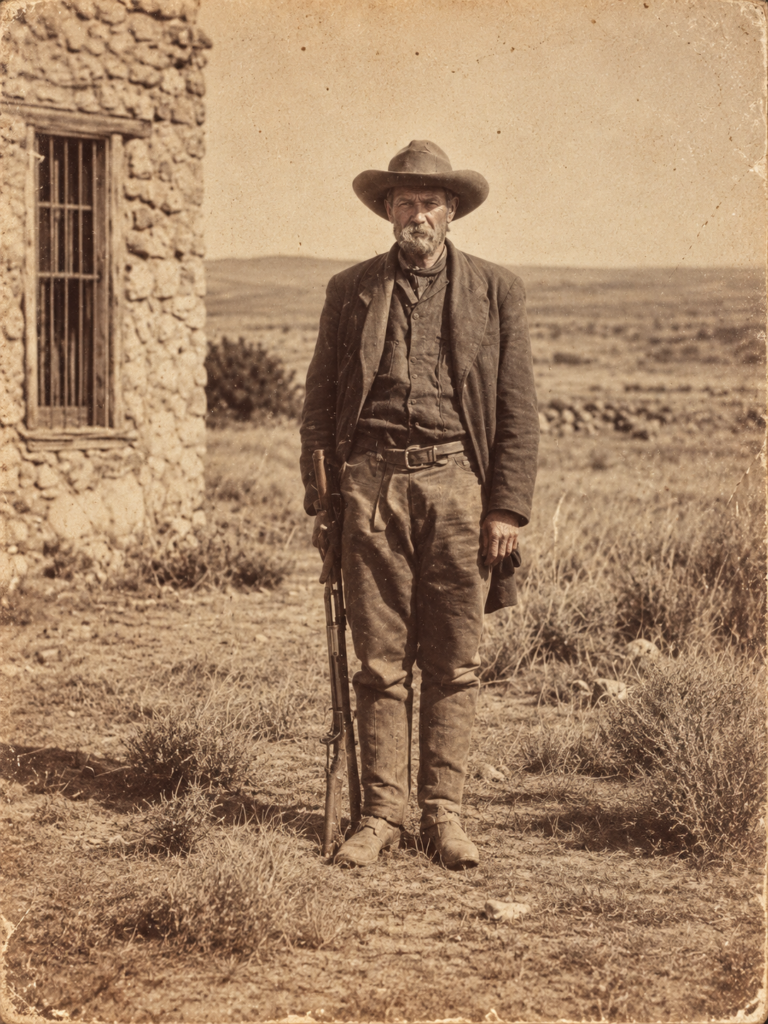
He was 41 years old, 6 ft 1 in tall, and lean in the way of men who had spent too many years in saddles and too few around tables. A pale scar ran from the corner of his left ear along the line of his jaw. He had carried it since Adobe Walls, though he did not discuss the fight or the man who had given it to him.
His hair had begun turning silver before he was 35.
His hands looked older still.
By then Holloway had served with the Texas Rangers for 18 years. He had begun as a young man riding out of Austin in 1861 with a company whose members had gradually been buried, crippled, drunk into uselessness, or scattered beyond contact.
By his own private accounting, he was the last still wearing the badge.
That fact did not make him sentimental.
It made him tired.
The reports that brought him onto the caprock had accumulated slowly.
For almost a year, homesteaders and line riders had spoken of a solitary figure seen near remote settlements.
Never close for long.
Never in daylight if it could be helped.
Cattle disappeared.
Not butchered.
Not dragged away.
There were no blood trails, hides, bones, or signs of wolves.
Animals simply went missing.
One family woke to find 6 head gone from a fenced pasture whose gate remained chained.
Another rancher found deep tracks near his water trough and refused to describe them to the sheriff except to say that they were not made by boots.
There were stories of a tall man moving along the ridges near dusk.
The descriptions were inconsistent.
Some witnesses said he wore hides.
Others insisted he wore nothing above the waist.
One said he carried a rifle.
Another swore he carried only a long knife.
But every account agreed on one detail.
He was enormous.
A settler west of Tascosa claimed he had watched the stranger stand beside his barn near sundown.
The stranger had not approached the house.
Had not threatened anyone.
Had not even appeared to notice the settler watching from behind a window.
He had stood there for perhaps a minute, facing south.
Then he walked away.
The settler told the local sheriff that the man’s shadow had stretched across the barn longer than the building was wide.
1 week later the settler loaded his wife and children into a wagon and left Texas.
He settled in Missouri.
According to the sheriff, he never willingly discussed Texas again.
Holloway believed very little of that.
Men alone on the frontier enlarged things.
Fear was a kind of weather.
A strange rider became an outlaw.
An outlaw became an Apache.
An Apache became something 8 ft tall by the time the story crossed 2 counties.
What Holloway did believe was simple.
The Red River War had ended.
Most of the Comanche had been forced onto the reservation near Fort Sill.
Not all had gone willingly.
A man could refuse surrender.
A man could live in broken country.
A man could steal cattle.
If that was what had happened, then someone eventually had to ride out and find him.
The army did not volunteer.
Local sheriffs had neither the men nor the appetite.
So the work arrived with the Rangers.
And because Holloway was unmarried, experienced, and had no one in Austin likely to object if he disappeared, it arrived specifically with him.
He left Coldwell Junction on a Monday morning late in April.
His mare was a roan called Oho.
He carried a Sharps rifle, 2 pistols, 3 weeks of hardtack and dried meat, spare ammunition, a blanket, coffee, salt, and a set of heavy irons designed for men strong enough to break ordinary shackles.
The marshal watched him pack.
“You expecting trouble?”
“I’m expecting a man.”
“Same thing, sometimes.”
Holloway secured the irons behind his saddle.
The marshal glanced at them.
“You bring him back?”
“If I find him.”
“And if you don’t?”
Holloway mounted.
“I’ll be back inside a month.”
The marshal waited.
Holloway looked west.
“Or I won’t.”
For 11 days, he found almost nothing.
He crossed old buffalo country where the bones lay white among grass and dust.
He followed water when he could.
Twice he stopped at abandoned dugouts.
Once he found the ruins of a camp.
The fire ring bothered him.
He did not know why at first.
The stones had been set too carefully.
Not in the rough circle a traveler used to contain coals.
They formed a pattern.
4 larger stones placed at uneven intervals.
Smaller stones between them.
A second ring beyond the first.
No ashes remained except a gray stain in the soil.
Holloway studied it.
He had seen Comanche camps.
Kiowa camps.
Army camps.
Hunters, buffalo skinners, drovers, prospectors, Mexicans, thieves.
He did not recognize the arrangement.
He left it untouched.
2 days later he found tracks in a dry wash.
They appeared human.
That was the problem.
The stride was too long.
The prints themselves were broader than Holloway’s boots.
There were no heel marks suggesting cavalry footwear and no clear moccasin edge.
The ground was poor for tracking, but he measured anyway.
Then measured again.
He sat in the shade of the wash and looked at them.
After a while he stood, mounted, and continued west.
On the 12th night the wind stopped.
Holloway woke instantly.
The caprock wind was so constant that after days in it a man ceased to hear it.
Its absence was louder.
He opened his eyes under a sky crowded with stars.
Nothing moved.
His mare stood with her head up.
The small cooking fire whispered in the stillness.
Holloway listened.
No insects.
No coyote.
No grass.
His own pulse seemed indecently loud.
Then he saw the other fire.
It was far away.
3 miles, perhaps 4.
A small orange point on a flat shelf near the black edge of a canyon.
A careful fire.
Not a signal.
Not large enough for a group.
Holloway sat beside his own flames until they burned low.
He did not feed them.
He watched the distant fire for hours.
Whoever had built it did not move in front of it.
At least Holloway saw no silhouette.
Shortly before dawn, the flame vanished.
He saddled Oho as the eastern sky began to pale.
The ride took longer than he expected.
When he reached the shelf, the fire was dead.
The ashes were cold enough to touch.
He found no bedroll impression.
No discarded food.
No cartridges.
No horse sign.
Only tracks.
They led toward the canyon.
Holloway dismounted.
The tracks were enormous.
He had seen the same size in the dry wash.
Now the ground held them more clearly.
A man had made them.
A very large man.
Holloway tied Oho well back from the rim.
He took the Sharps and 1 pistol.
The irons stayed behind.
He descended on foot.
The canyon narrowed quickly.
Red sandstone rose on either side, shaped by wind and water into shelves, pillars, hollows, and leaning walls.
Some formations looked almost deliberate.
A doorway.
A crouching animal.
A face.
The creek at the bottom was narrow but running.
Cottonwoods followed it.
Birds moved in the branches.
As Holloway advanced, the birds fell silent.
Not all at once.
The silence traveled with him.
He noticed that.
He noticed other things too.
A footprint near water.
A broken branch shoulder high.
A place beneath an overhang where someone had rested.
No discarded bone.
No ash.
No waste.
Whoever lived there knew how to pass lightly through country.
Holloway followed the creek for almost 1 hour.
Then he saw the man.
He was sitting on a flat rock with his back against the canyon wall.
His knees were raised.
A bone-handled knife lay across his thigh.
He was not asleep.
He was looking directly at Holloway.
Waiting.
Holloway stopped 30 paces away.
He raised the Sharps.
The man did not move.
Holloway spoke slowly.
“Texas Ranger.”
No response.
“You understand English?”
The man’s eyes remained on him.
Holloway continued.
“You are under arrest.”
Still no movement.
“You reach for that knife, I will shoot you.”
Then the man stood.
Years later, Holloway would write a description of that moment in pencil inside the cover of a Bible.
The handwriting was small and controlled.
The sentence began:
He stood, and he kept standing.
Holloway had faced large men.
Soldiers.
Drovers.
Comanche fighters.
Buffalo hunters built broad enough to carry a quartered carcass.
This man was different.
Holloway estimated him at 6 ft 9 in, perhaps 6 ft 10.
Not unnaturally proportioned.
Not swollen or grotesque.
Simply immense.
Long arms.
Deep chest.
Heavy shoulders.
Hands hanging low beside his thighs.
He was built, Holloway later wrote, the way an old oak is built—not fat, not thick in any useless place, but made to remain where lesser things had fallen.
His hair hung loose to his shoulders and had gone half silver.
His face confused Holloway.
It was lined like an old man’s.
The eyes were older than the face.
He might have been 40.
He might have been 70.
For reasons Holloway could not defend, he believed the man was older still.
The giant looked at the rifle.
Then at Holloway.
He reached slowly for the bone knife.
Holloway tightened his finger against the trigger.
The man lifted the knife.
And set it gently on the rock.
Then he extended both hands.
Wrists together.
Holloway did not lower the Sharps.
“You surrendering?”
The man gave a single nod.
Holloway waited.
The canyon remained silent.
Finally he motioned with the rifle.
“Walk.”
The giant obeyed.
It took Holloway nearly 20 minutes to get him back up the canyon.
At the rim, Oho saw the prisoner and stepped backward so violently the reins snapped tight around the scrub where Holloway had tied her.
“Easy.”
The mare trembled.
The giant stopped.
He did not approach.
He waited until Holloway calmed the horse.
Only then did he move.
Holloway took the irons from behind the saddle.
They looked less substantial than they had that morning.
He locked them around the man’s wrists.
The prisoner watched without complaint.
Holloway had brought a second horse for exactly this possibility.
A plain bay, patient and strong.
The giant mounted.
His legs seemed almost too long for the animal.
For the next 4 days, they rode east.
The prisoner did not speak.
Not once.
He ate what Holloway gave him.
Drank when water was offered.
Slept lightly.
Never tested the irons.
Never attempted escape.
Never asked where he was being taken.
That silence disturbed Holloway more than resistance would have.
He began to wonder whether the man had been waiting in the canyon specifically to be found.
The thought irritated him.
He dismissed it.
Then it returned.
On the fifth morning, Coldwell Junction appeared beyond a low rise.
Word traveled faster than they did.
By the time Holloway reached the first buildings, half the town had come outside.
Children stood behind mothers.
Men stepped off porches.
The blacksmith stopped working.
His hammer remained raised for a moment before he lowered it.
No one cheered.
No one laughed.
No one called out.
The woman who ran the general store crossed herself.
The marshal stood on the jail porch with his hand near his revolver.
Holloway dismounted.
He led the prisoner’s horse forward.
The giant came down from the saddle.
When his feet touched the street, people stepped backward.
Not dramatically.
Almost together.
The marshal swallowed.
“You brought him.”
“I said I would.”
The marshal stared up.
“That a Comanche?”
The prisoner looked at him.
The marshal’s hand tightened near his weapon.
Holloway said, “Don’t.”
The marshal glanced at him.
“He speak?”
“Not so far.”
The jail had 2 cells.
The giant could fit in 1 only because he sat.
When standing, his head nearly reached the rafters.
He settled against the back brick wall with his knees raised, much as Holloway had first seen him beside the creek.
The marshal locked the cell.
Checked the lock.
Checked it again.
Then stepped away.
He muttered something Holloway could not hear.
It sounded more like a prayer than profanity.
The marshal did not return to the cells for the rest of the day.
Holloway stayed.
He pulled a wooden chair into the corridor 6 ft from the bars.
He removed his hat and set it beside him.
The prisoner watched.
Holloway watched back.
Afternoon passed into evening.
The jail cooled.
Moonlight appeared through the barred window above the cell.
Then the prisoner spoke.
His English was clear.
“You did not shoot me.”
Holloway did not move.
“No.”
“You could have.”
“Yes.”
The prisoner waited.
“Why did you not?”
Holloway considered the question.
He would later admit that he never found an answer he entirely believed.
Perhaps curiosity.
Perhaps discipline.
Perhaps exhaustion.
Perhaps something in the canyon had told him that killing the man would be the greater mistake.
What he said was simpler.
“A man lays his knife down on a rock, I don’t shoot him.”
The prisoner regarded him for a long time.
Then he nodded.
“Then we have time to talk.”
Holloway leaned back in the chair.
“How much time?”
The prisoner’s expression did not change.
“4 nights.”
That answer stayed with Holloway.
Not several nights.
Not until the army came.
As though the number had already been decided.
The prisoner told Holloway his name.
“Takahote.”
He said it slowly.
Holloway repeated it.
“Takahote.”
The giant nodded.
Holloway eventually wrote the name in his Bible exactly as he heard it.
Beside it he added:
Not his true name, I think. The name he permits me.
Takahote told him that he was the last of a line.
Holloway misunderstood.
“The last Comanche?”
“No.”
There was no irritation in the correction.
“My people live.”
“Fort Sill?”
“Some.”
“Hills?”
“Some.”
“Then what line?”
Takahote looked toward the small barred window.
For a time he listened to the wind outside.
Then he said, “Older.”
“Older than what?”
“My people.”
Holloway said nothing.
“The line was here before the Comanche had horses.”
Takahote’s voice remained calm.
“Before the buffalo were many.”
Holloway almost smiled.
Takahote noticed.
“You think that is a story.”
“I think everything becomes a story if it’s old enough.”
“That is true.”
The answer disarmed him.
Takahote continued.
“There were people here before my people. People before them. The line moved through them.”
“What line?”
“One watched.”
“For what?”
“When one became old, another learned.”
Takahote placed his bound hands over his knees.
“My mother watched before me.”
“Your father?”
“No.”
“Her mother before her?”
“Yes.”
“How far back?”
Takahote looked at Holloway.
“Far enough that counting does not help.”
Holloway sat quietly.
Outside, somewhere along the street, a dog barked.
Then another.
Ordinary town sounds.
Comforting, though Holloway would not have said so.
“What did they watch?”
Takahote turned his face toward the window again.
“Tomorrow night.”
“Why not now?”
“Because tonight you would leave.”
Holloway almost laughed.
“I’m a Ranger.”
“I know.”
“You’re locked in my jail.”
Takahote’s eyes lowered to the irons.
“I know.”
“You think I’m afraid?”
“No.”
The answer came too quickly.
Holloway frowned.
Takahote closed his eyes.
“I think you are still able to become afraid.”
Within minutes his breathing deepened.
He appeared asleep.
Holloway remained in the chair.
The pistol stayed on the floor near his boot.
He had slept beside wounded men, dead men, prisoners, murderers, fever cases, horses, wolves, and once a corpse frozen upright against a tree.
He had known battle.
He had known grief.
He had known long stretches of loneliness that seemed almost physical.
But something about sitting near Takahote troubled him in a way he could not describe.
He wrote 1 word in the Bible before dawn.
Old.
He underlined it once.
Part 2
The next day, Coldwell Junction changed.
Nothing visible had happened.
There had been no storm.
No rider came in with bad news.
No shots were fired outside town.
The sun rose hot and clear.
Stores opened.
The blacksmith worked.
Men moved cattle through the south end of the street.
But the marshal stopped talking.
He kept looking through the front window of the jail.
At first Holloway ignored it.
By late afternoon he asked, “What are you looking for?”
The marshal did not answer.
Holloway poured coffee.
“Marshal.”
The man rubbed his mouth.
“The dogs.”
“What about them?”
“They quit.”
Holloway waited.
“Quit what?”
“Barking.”
Holloway listened.
The town was quiet.
Not empty.
Quiet.
“You’re worried because dogs aren’t barking?”
The marshal looked at him.
“You ever lived in a town?”
Holloway almost answered.
The marshal continued before he could.
“Not camped. Not rode through. Lived.”
“For a while.”
“Then you know.”
He pointed toward the window.
“They bark at everything. Wagons. Mules. Coyotes. Men they know. Men they don’t. Shadows.”
He lowered his voice.
“They haven’t made a sound since noon.”
Holloway went outside.
A yellow dog lay beneath the hotel porch.
Its eyes followed him.
Another sat near the hitch rail.
Farther down, 2 farm dogs rested beneath a wagon.
When Holloway opened the door, every dog he could see turned its head toward him.
Together.
None barked.
None stood.
They watched.
Then, almost as one, they looked upward.
Not toward the jail.
Toward the sky.
Holloway returned inside.
He locked the front door.
The marshal saw him do it.
Neither commented.
At sundown Holloway carried his chair back into the cell corridor.
Takahote opened his eyes before Holloway sat.
“It knows I am here.”
The Ranger set his hat on the floor.
“What does?”
Takahote studied him.
Holloway exhaled.
“You said tonight.”
“Yes.”
“You said you’d tell me what the line watches.”
“Yes.”
Holloway leaned forward.
“So tell me.”
For the first time since the canyon, Takahote seemed reluctant.
Not frightened.
Careful.
“There are things a man should not know completely.”
“Convenient.”
“No.”
Takahote looked toward the brick behind him.
“It is dangerous to carry some knowledge because a man begins to shape himself around it.”
Holloway waited.
“I will not tell you all.”
“Tell me enough.”
Takahote nodded.
“There is a place beneath the caprock.”
“Cave?”
“No.”
“A hole?”
“No.”
“Then what?”
“A place.”
Holloway’s mouth tightened.
Takahote raised one hand slightly.
“The words are wrong before I speak them.”
He thought.
“There is stone above it. Stone around it. A crack where there should be none.”
“Natural?”
Takahote did not answer.
“What’s under the crack?”
“A thing.”
Holloway stared.
Takahote continued before he could speak.
“Not a god.”
“I didn’t say it was.”
“White men call many things spirits.”
“Is it?”
“No.”
“What is it, then?”
“A presence.”
Holloway gave a humorless breath.
“That is not better.”
“No.”
“How long has it been there?”
“Before us.”
“Before Comanche?”
“Yes.”
“Before whoever came before you?”
“Yes.”
Takahote looked at the floor.
“Before people walked there.”
The jail seemed smaller.
The wind moved outside.
Holloway could hear no dogs.
“What does it do?”
“It wants to come up.”
“From underground?”
“Yes.”
“And your family stops it?”
“The watchers stop it.”
“How?”
“By watching.”
Holloway waited for more.
There was none.
“That is all?”
“No.”
Takahote’s eyes met his.
“They are present.”
Holloway frowned.
“They stand in the place.”
“For how long?”
“Until it sleeps again.”
“With guns?”
“No.”
“Fire?”
“No.”
“Medicine?”
“No.”
“Prayer?”
“No.”
“Then what?”
“They do not leave.”
Takahote’s voice remained almost gentle.
“They are awake.”
Holloway said nothing.
“They are not afraid.”
Outside the jail, something struck wood.
The marshal shifted in the front room.
Takahote continued.
“The first watchers learned that fear helped it.”
“Helped it how?”
“I do not know.”
“You’ve done this yourself?”
“Yes.”
“How many times?”
“More than 200.”
Holloway thought he had misheard.
“How old are you?”
“63.”
He studied the giant’s face.
That age was possible.
What bothered him was how little the number seemed to explain.
“When did you start?”
“19.”
“Your mother took you?”
“Yes.”
“What did she do?”
“Stood beside me.”
“What did she say?”
“Very little.”
“Useful family.”
Takahote almost smiled.
“Silence is useful there.”
He explained that he had walked to the place every season for most of his adult life.
Sometimes nothing happened.
Sometimes the stone remained cold and the crack seemed no more remarkable than any other break in the earth.
Other times the air changed.
Birds left.
Animals avoided the country.
The ground carried a vibration too faint to hear but impossible not to feel.
On those occasions the watcher remained longer.
No fire.
No deep sleep.
Little movement.
Water.
Dried meat.
A blanket if the nights were cold.
Nothing else.
“What happens if the watcher leaves?”
Takahote’s gaze hardened.
“It rises farther.”
“And if no watcher comes?”
“Then it comes up.”
Holloway let the words settle.
The Ranger part of him wanted measurements.
Locations.
Witnesses.
Evidence.
The older part understood why none would be offered.
“What happened this spring?”
Takahote looked toward the window.
The light had gone fully dark.
“My last walk was different.”
“How?”
“It came closer.”
“To the surface?”
“Yes.”
“How close?”
Takahote considered.
“Close enough to know I was alone.”
Holloway shifted in the chair.
“You are always alone.”
“Before, it remembered others.”
“What others?”
“My mother. Her mother. The line.”
Takahote’s hands tightened once.
“This time it knew the line had become 1 man.”
“What happened?”
“I stayed 3 days.”
“And?”
“3 nights.”
The giant lowered his voice.
“On the third night, it spoke.”
Holloway felt his shoulders tighten.
“What did it say?”
“I will not repeat it.”
“Why?”
“Because it said it to me.”
“That doesn’t answer me.”
“It is the answer.”
Holloway watched him.
Takahote was not theatrical.
That mattered.
A liar liked the effect of silence.
Takahote seemed to dislike the subject entirely.
“At dawn,” he continued, “I left.”
“You abandoned the watch?”
“I knew the line was ending.”
“Why?”
“Because it knew.”
“Knew what?”
“That there would be no child after me.”
Holloway glanced at him.
“You have no children?”
“Not for this.”
“What does that mean?”
“It cannot pass to anyone.”
Takahote’s voice carried no bitterness.
“My people are scattered. Hungry. Watched by soldiers. Told where to live and when to move.”
He paused.
“A watcher requires quiet.”
Holloway looked around the cell.
“You came north to find one?”
“Yes.”
“A Comanche watcher replaced by a white man.”
“Perhaps.”
“A Ranger.”
“Perhaps.”
Holloway stared at him.
“You were waiting on that rock.”
“Yes.”
“For me?”
“For someone.”
“How did you know?”
“I knew what kind.”
“And what kind is that?”
“A man with quiet inside him.”
Holloway finally laughed.
It was one short sound.
No humor in it.
“You picked poorly.”
“No.”
“You know nothing about me.”
Takahote’s gaze rested on the scar along Holloway’s jaw.
“Enough.”
Holloway leaned back.
“And I suppose that’s why you surrendered.”
“Yes.”
“Why not just talk to me in the canyon?”
“You would have thought I was trying to trick you.”
“I still think that.”
“Yes.”
“What’s changed?”
“You put me in iron.”
The Ranger frowned.
“That makes me more trusting?”
“It made you stay.”
Holloway had no answer.
He looked toward the front office.
No barking outside.
No growling.
Nothing.
“If the line ends?”
Takahote’s expression became very still.
“Then it comes up.”
He closed his eyes.
The second night ended there.
The dogs remained silent.
On the third night, Holloway sat sooner.
He had eaten little.
The marshal had begun drinking before noon.
The giant waited in darkness.
Holloway lit 1 lamp.
Takahote spoke before the chair legs settled.
“Holloway.”
It was the first time he had used the Ranger’s name.
“Yes.”
“You were at Adobe Walls.”
Holloway’s body went rigid.
The lamp hissed.
Takahote continued.
“There was a man with you.”
No answer.
“Younger.”
Holloway stared through the bars.
“He had a brother who could not ride.”
The Ranger’s hand moved unconsciously toward the scar on his jaw.
Takahote’s voice remained quiet.
“The man was shot in the chest.”
Holloway stood.
“Enough.”
“He did not die quickly.”
“I said enough.”
“You stayed with him.”
Holloway’s chair tipped behind him.
The sound echoed down the corridor.
Takahote did not move.
“He spoke to you.”
Holloway stepped toward the bars.
“No one knows that.”
Takahote watched.
“No one.”
“I know.”
“How?”
No answer.
“Who told you?”
Takahote’s face remained calm.
“That man was dead before sunset.”
“Yes.”
“I never reported what he said.”
“I know.”
“I never told my captain.”
“I know.”
“My wife—”
Holloway stopped.
He had never married.
The woman he had almost married had gone east in 1871 after years of waiting for him to become someone who could remain in 1 place.
He had not told her either.
“No one knows.”
Takahote repeated the last words of the dying man.
22 words.
A creek in West Texas.
A bend where cottonwoods crowded the bank.
A request to be buried there.
The apology of a young man who understood he would not be carried home.
Holloway’s face lost color.
The sentence was exact.
Not approximate.
Not the meaning.
The words.
The private words of a dying man spoken with blood filling his lungs while gunfire sounded outside.
Holloway stepped backward.
Takahote finished.
Silence filled the cell.
Then the giant said, “He has been waiting.”
Holloway’s throat felt dry.
“For what?”
“He thought you would come for him.”
Holloway walked out.
He passed the sleeping marshal.
Opened the jail door.
Stood in the street.
The moon was white above Coldwell Junction.
The dogs watched from porches and beneath wagons.
Not 1 barked.
Holloway remained there for a long time.
He remembered Adobe Walls.
Not the fight.
The hour afterward.
The weight of a man’s hand.
The creek name.
The promise Holloway had not kept because there had been no way to keep it.
He had buried the man where the ground allowed.
He had never gone to the creek.
When he returned to the jail, the marshal had fallen asleep at the desk.
The lamp in the front office had gone out.
The cell corridor was dark.
Holloway sat.
For several minutes he said nothing.
Then into the darkness:
“I believe you.”
Takahote answered.
“I know.”
The remainder of the night passed mostly without speech.
Near dawn, Takahote said, “Tomorrow they come.”
“Who?”
“Soldiers.”
Holloway looked toward the cell.
“For you?”
“Yes.”
“How do you know?”
“They have already been sent.”
“From where?”
“The fort.”
“Fort Concho?”
“Yes.”
Holloway rubbed his eyes.
“What do they want?”
“To take me.”
“They’ll take you.”
“No.”
The certainty in that single word made Holloway look up.
“You will be ordered to ride with them.”
“Maybe.”
“You must not.”
Holloway frowned.
“I don’t take orders from prisoners.”
“No.”
Takahote leaned forward.
“You must stay behind.”
“Why?”
“I will not reach the fort.”
Holloway felt the old instinct again.
“What happens?”
“I do not know.”
“You just said—”
“I know I will not arrive.”
“Escape?”
Takahote said nothing.
“Attack?”
Nothing.
“Then how can you know?”
The giant turned his face toward the wall.
“You must not go.”
That was all.
The wagon arrived the following afternoon.
2 officers.
6 enlisted soldiers.
A reinforced transport with iron-bound sides.
The larger irons they carried made Holloway’s seem ordinary.
The officer in command introduced himself as Captain Lockidge.
Neat uniform.
Trim beard.
Clean gloves despite the dust.
He shook Holloway’s hand.
“Excellent work, Ranger.”
Holloway disliked him immediately and knew that was unfair.
Lockidge had done nothing wrong.
“Captain.”
“We’ve been instructed to take custody of your prisoner.”
“By whom?”
Lockidge named a colonel Holloway knew by reputation.
“The individual has generated considerable interest.”
“Has he?”
“Reports of his size alone.”
Lockidge smiled politely.
“Doctors have been contacted in the East.”
Holloway looked at the wagon.
“Doctors.”
“Anthropological interest. Medical interest.”
“Meaning they want to measure him.”
Lockidge’s smile weakened.
“Among other things.”
“Fort Concho?”
“At first.”
Holloway looked through the jail door.
Lockidge followed his gaze.
“You are welcome to accompany us.”
“Am I?”
“Given your familiarity with the prisoner, it would be appropriate.”
“Appropriate.”
“Expected, frankly.”
Holloway met his eyes.
“I’ll consider it.”
Lockidge studied him for a moment.
“First light.”
The captain turned away.
Holloway watched the soldiers secure their horses.
He thought of Takahote’s words.
I will not arrive.
That evening, the marshal went home early.
Holloway entered the cell corridor alone.
Both lamps were lit.
Takahote sat against the rear wall.
Calm.
Waiting.
“It is time,” he said.
Holloway closed the door behind him.
“For what?”
“To remember.”
Then Takahote gave him directions.
South and west of Coldwell Junction.
Roughly 2 and a half days by horse.
A dry canyon running toward the Pecos.
At its head, a shelf of stone.
On that shelf, a crack.
“No wider than a hand,” Takahote said.
“How deep?”
“You will not know.”
“What am I looking for?”
“The place above it.”
“That’s where I stand?”
“Yes.”
“For how long?”
“9 days.”
Holloway stared.
“Nine.”
“Yes.”
“No fire?”
“No.”
“No sleep?”
“Not deeply.”
“What do I eat?”
“Dried meat.”
“Water?”
“Carry it.”
“Gun?”
“If you want.”
“Does it help?”
“No.”
Holloway rubbed his jaw.
“What do I do?”
“Remain.”
“That’s it?”
“Remain awake.”
“And?”
“Do not be afraid.”
Holloway laughed softly.
“You keep saying that like a man can decide.”
“He can.”
“How?”
Takahote’s eyes seemed darker in the lamplight.
“By understanding something.”
“What?”
“The thing beneath the stone has been afraid of you longer than you have been afraid of it.”
Holloway stopped breathing for a moment.
“What does that mean?”
“I do not know.”
“You just told me.”
“I told you what my mother told me.”
Takahote looked at him.
“I have thought about it all my life.”
The Ranger stood by the bars.
He would think about it for the rest of his own.
Then Takahote gave the final instructions.
“When the soldiers come in the morning, the cell will be empty.”
Holloway’s eyes narrowed.
“You planning something?”
“No.”
“You’re in locked irons.”
“Yes.”
“Door’s locked.”
“Yes.”
“You expect me to believe—”
“Do not be the man who finds it empty.”
Holloway fell silent.
“Be in the street before sunrise.”
Takahote continued.
“Be on your horse.”
“Why?”
“Ride south.”
“You want me to desert.”
“I want you to watch.”
Holloway looked away.
“If they catch you, they will hold you.”
“Army can’t hold me without cause.”
“They will find cause.”
“What will they ask?”
“Where I went.”
“I won’t know.”
“They will believe you do.”
Takahote’s gaze sharpened.
“And they will ask where you are going.”
Holloway understood.
“The place.”
“Yes.”
“You think the army shouldn’t find it.”
“No one should find it because they are curious.”
Holloway imagined Lockidge’s doctors.
Measurements.
Excavation.
Charges.
Men opening stone because the government had ordered a report.
He felt cold.
“Repeat the road.”
Holloway did.
Takahote corrected 1 turn near an arroyo.
Holloway repeated it again.
“Good.”
The giant leaned back.
“Go now.”
Holloway remained.
“That’s all?”
“Yes.”
“You knew I would come?”
“I hoped.”
“You knew I wouldn’t shoot you?”
“No.”
Holloway looked at him.
For the first time, Takahote’s face softened.
“That was yours to decide.”
The Ranger picked up his hat.
Neither man offered a hand.
Bars made that awkward.
Neither said goodbye.
They looked at one another in silence.
Then Holloway left.
Part 3
Cases Holloway saddled Oho shortly after 2 in the morning.
He packed lightly.
Canteen.
Sharps.
2 pistols.
3 days of food.
Blanket.
Bible.
He stood in the marshal’s office with his coat open.
For nearly 1 minute he looked at the Ranger badge pinned inside.
18 years.
Men buried.
Orders followed.
Long rides.
Weather.
Gun smoke.
Warrants.
Names forgotten by everyone except him.
He removed the badge.
Set it on the corner of the desk.
Beside it he placed a note.
Gone.
Do not follow.
He considered signing it.
Did not.
At 3 in the morning he rode south.
The town remained dark.
Every dog in Coldwell Junction watched him.
None barked.
As Oho passed the final building, Holloway looked once toward the jail.
The dogs stood.
All of them.
Not gradually.
Together.
They turned their heads toward the cell block.
Then they lay down.
Holloway did not look back again.
At first light, Captain Lockidge entered the jail.
The marshal arrived moments earlier, irritated and half dressed.
The soldiers had the transport ready.
Lockidge asked for Holloway.
The marshal noticed the badge on his desk.
Then the note.
He said nothing.
They went to the cell.
The door was locked.
The key remained on the marshal’s ring where it had hung overnight.
One soldier opened the outer corridor.
The marshal inserted the key into Takahote’s cell.
The door swung inward.
No prisoner.
The irons lay on the floor.
Locked.
The chain unbroken.
No filing marks.
No bent link.
The cell window was too narrow for a man’s shoulders, much less Takahote’s.
Its bars were mortared into old brick.
Untouched.
The rear wall was solid.
The floor was stone.
There was no ceiling opening.
No tunnel.
No loose masonry.
Captain Lockidge entered.
He stood in the center of the cell.
For a long time he said nothing.
The marshal remained outside.
Finally Lockidge turned.
“Where is he?”
The marshal looked at the irons.
“If I knew, Captain, I’d tell you.”
“Who was here last?”
“Holloway.”
“Where is Holloway?”
The marshal pointed toward the office.
Lockidge read the note.
His jaw tightened.
Soldiers searched Coldwell Junction for 2 days.
They questioned storekeepers.
Ranch hands.
Stable boys.
The blacksmith.
The woman who ran the general store.
No one claimed to know Holloway’s destination.
Several had seen him ride south before dawn.
That was all.
No search party found his trail for long.
Weather and hard country erased it.
Lockidge sent a rider to Fort Concho.
The report eventually entered army records.
3 sentences.
The prisoner is not at Coldwell Junction.
The means of his departure cannot be determined.
The Ranger Holloway has deserted.
On May 5, 1879, Cases Holloway was formally listed as a deserter by the Texas Rangers.
His name disappeared from payroll records.
He collected no pension.
He never returned his weapons.
His commanding officer objected privately.
In a letter to the governor, he wrote that Holloway had served honorably for nearly 19 years and that some event in the field appeared to have affected him in a manner neither the Rangers nor the army possessed sufficient knowledge to judge.
The governor agreed to let the matter close quietly.
Officially, Cases Holloway vanished.
In reality, he rode toward the Pecos.
For 2 days he followed Takahote’s directions.
The country became harder.
Settlements disappeared.
Water became uncertain.
On the afternoon of the third day, Holloway found the dry canyon.
At its head stood a shelf of pale stone.
He dismounted.
Oho refused at first to approach.
Holloway led her by the reins.
The mare’s ears flattened.
Her nostrils widened.
A tremor passed through her shoulders.
Holloway tied her far from the shelf.
Then climbed alone.
The crack was there.
Narrow.
Perhaps the width of his hand.
It ran through the stone in a line too straight in places and too irregular in others.
He knelt.
Air moved through it.
Cool air.
The day was hot.
The rock burned beneath his palm.
But the breath rising through the crack was cold enough to make the skin of his hand ache.
Holloway stood.
He wanted to look down.
He did not.
He set his blanket in the lee of a stone.
Placed his water beside it.
His dried meat.
The Sharps.
Then he waited.
Nothing happened.
For hours the only movement came from the sun.
Near evening, the wind died.
Holloway remembered his 12th night on the caprock.
The distant fire.
The canyon.
Takahote sitting by the creek as though he had known exactly when the Ranger would arrive.
The light left the shelf.
Holloway remained awake.
At some point after midnight, he felt the stone change.
Not move.
Not shake.
Change.
A pressure arrived beneath his feet.
He later struggled to describe it in the Bible.
It was like standing over a door while someone on the other side placed a hand against it.
No sound.
No impact.
Only presence.
His heart accelerated.
The pressure strengthened.
Fear came.
Not from an image.
He saw nothing.
Not from a noise.
He heard nothing.
Fear rose from somewhere older than thought.
Every part of him wanted distance.
Horse.
Open ground.
A town.
Other men.
He nearly stepped backward.
Then he remembered Takahote.
The thing has been afraid of you longer than you have been afraid of it.
Holloway planted both boots.
“You stay down.”
He said it aloud.
Immediately regretted the sound.
The pressure changed.
The crack seemed colder.
Holloway did not speak again.
He remained through the night.
At dawn, the feeling receded.
He ate.
Drank.
Slept briefly sitting upright against the stone.
By afternoon he understood why Takahote had spoken of quiet.
The place altered a man’s sense of time.
There was no task to perform.
No enemy to track.
No weapon to clean that mattered.
No report to write.
Only attention.
Night after night, Holloway stood or sat near the crack.
Sometimes nothing happened.
Sometimes he felt something below.
On the fourth night, Oho tore free.
He heard the reins snap.
The mare ran.
Holloway almost followed.
He did not.
At dawn he found her 2 miles away, trembling beside a dry wash.
He led her back only as far as she would willingly come.
On the sixth night, Holloway heard a voice.
Or believed he did.
He never recorded the words.
Perhaps there were none.
His Bible contained only:
It knows which dead to borrow.
Beneath that:
Do not answer.
On the ninth morning the pressure disappeared.
Not gradually.
Gone.
Birds returned to the canyon.
A lizard moved across the warm rock.
The wind resumed.
Holloway packed his things.
He rode east.
For 1 day.
Then returned.
He remained away 1 day, as Takahote had instructed.
Then he began another watch.
9 days.
1 away.
9 days.
1 away.
The rhythm became his life.
What happened to Takahote remained unanswered.
Holloway never saw him again.
He recorded no vision of the giant.
No meeting.
No evidence that Takahote survived the locked cell.
Yet there were passages in the Bible that suggested Holloway eventually understood the disappearance differently.
One entry read:
He did not escape the jail.
Another:
The bars were never for him.
Then, several pages later:
I think he was already leaving before I opened the canyon.
The meaning is unclear.
Perhaps Holloway believed Takahote had died.
Perhaps he believed the giant’s purpose had ended once the new watcher accepted the place.
Perhaps it meant something else entirely.
Years passed.
The Ranger became a rumor.
A peddler riding near the Pecos in 1884 reported seeing a tall man standing on a canyon rim at sundown.
At first he mistook the figure for a dead tree.
Then it turned its head.
The peddler called out.
The man did not answer.
He rode closer.
His mule refused to proceed.
The peddler turned around.
He later described the figure as enormous.
When asked whether the man was Indian or white, he admitted he could not tell.
In 1891, a survey crew refused to camp near a certain dry canyon.
The crew chief wrote that his men had become convinced someone watched them from the rocks.
The chief saw nothing.
His notes nevertheless included a peculiar observation.
The men insisted the watcher did not blink.
A cattle outfit passing through the country in 1904 reported no loss.
No attack.
No injury.
Yet the trail boss wrote that for 2 days every horse in the outfit moved with its ears laid flat.
When they finally cleared the canyon country, the lead mare stopped.
Turned.
Looked backward.
The drovers tried to move her.
She refused.
For nearly 1 minute she stared toward the rocks.
Then lowered her head and continued.
Those accounts proved nothing.
Frontier newspapers were full of exaggeration.
Men lied.
Men drank.
Men saw shapes in country that encouraged shapes.
But the stories continued for decades.
Always near the same region.
A tall figure.
Silent animals.
Campers leaving without explanation.
A sense of being observed from stone.
No confirmed deaths.
No discovered creature.
No thing rising from beneath the caprock.
And perhaps that absence was the point.
In 1896, a sheep rancher named Allard Crowley lost an animal near a dry canyon feeding toward the Pecos.
He climbed a shelf after hearing what he thought was movement in the rocks.
He did not find the sheep.
He found a tin box.
It had been wedged into a crack beneath an overhang and protected from rain.
Nearby lay several bone buttons.
Cleanly broken.
The type once used on a Ranger coat.
There was a folded blanket.
And the remains of a small fire.
The ashes were cold but recent.
Crowley estimated less than 1 week.
There were no human bones.
No grave.
No body.
Inside the tin box was a Bible.
The name Cases Holloway appeared near the front.
Much of the printed text was surrounded by pencil writing.
Margins.
Blank pages.
Inside covers.
Some entries were clear.
Others faded.
Some described the arrest of Takahote.
The jail.
The dogs.
The 4 nights.
Others dealt with the watch.
Weather.
Stone.
Fear.
Sleep.
Silence.
Crowley took the Bible to Coldwell Junction.
The old marshal was dead.
A younger sheriff occupied the office.
The sheriff read the book from beginning to end over 1 evening.
The next morning he returned it.
“Where’d you say you found this?”
Crowley told him.
The sheriff looked toward the west.
Then said, “Don’t.”
Crowley frowned.
“Don’t what?”
“Tell people.”
“Why?”
The sheriff placed the Bible on the desk.
“You found an old book.”
Crowley waited.
“That’s all you found.”
The rancher agreed.
He kept the Bible in his home.
Then his sons kept it.
The family rarely showed it.
After the last direct descendant died in 1941, the Bible was donated with other belongings to a small regional museum.
There it remained.
The earliest Holloway entries were written in a strong hand.
Later pages changed.
Letters became narrower.
The pencil lighter.
The hand unmistakably older.
That mattered.
Whatever happened to Cases Holloway after 1879, he did not simply ride into the canyon and die within weeks.
He lived long enough to age.
Long enough to write.
Long enough for his handwriting to become uncertain.
He also lived long enough to leave 1 final entry.
It carried no date.
No explanation.
No signature.
Only a sentence.
He was not lying about being afraid of me.
That was the last thing Cases Holloway wrote.
No one knows when he placed the Bible in the tin box.
No one knows whether the fire Crowley found belonged to Holloway.
If it did, the Ranger had survived at least 17 years after his official desertion.
He would have been nearly 60.
There were no remains.
That created more stories.
Some believed Holloway died somewhere in the canyon and scavengers scattered his bones.
Some said another watcher buried him.
Others claimed the absence of a body meant he had simply continued walking the caprock as Takahote had before him.
Those accounts grew stranger over time and are worth little as evidence.
More interesting is the question of succession.
Takahote described an ancient line.
Mother to child.
Watcher to watcher.
A responsibility moving through generations.
He believed the line ended with him.
Yet he also believed another kind of line could begin.
Not blood.
Choice.
A person with enough quiet to remain awake in the correct place.
Enough courage to stay when every instinct ordered retreat.
Holloway appears to have become that person.
If the Bible is accurate, he remained for years.
Perhaps decades.
But no man remains forever.
Somebody must have come after him.
No name appears.
No list.
No instruction survives beyond Takahote’s original description.
9 days watching.
1 day away.
Water.
Dried meat.
Blanket.
No unnecessary noise.
Do not sleep deeply.
Do not leave because of fear.
There are scattered accounts after Holloway’s likely death that suggest the place did not become abandoned.
Shepherds occasionally found recent boot tracks where no camps were visible.
Hunters described neatly stacked stones.
A deputy in the 1920s wrote about finding a water can hidden beneath an overhang.
A ranch family in the 1930s reported seeing smoke far from any known road, though a watcher was supposedly forbidden fire.
Perhaps that belonged to someone else.
Perhaps the rules changed.
Perhaps the stories have no connection.
That is the difficulty with old frontier mysteries.
The land keeps too little evidence and too many rumors.
Yet 1 fact remains difficult to ignore within the logic of Holloway’s own account.
Whatever Takahote feared had not emerged by the time Holloway stopped writing.
If the thing existed, someone succeeded.
Maybe Takahote.
Maybe Holloway.
Maybe another.
Perhaps there was never anything beneath the stone.
Perhaps Takahote was an old man carrying a family belief so deeply that it became indistinguishable from reality.
Perhaps Holloway, exhausted by war and isolation, inherited that belief because it gave shape to losses he could never resolve.
The man at Adobe Walls.
The company gone.
The woman who stopped waiting.
The badge he finally left behind.
A lonely Ranger could have found purpose in standing above a crack and telling himself the world depended on his refusal to leave.
That explanation is possible.
Perhaps even likely.
But it does not explain everything.
It does not explain how Takahote knew 22 words spoken by a dying man at Adobe Walls.
It does not explain the locked cell.
It does not explain the irons lying closed on the floor.
It does not explain why every dog in Coldwell Junction fell silent.
Or why Holloway, after nearly 19 years of service, abandoned his entire life in the hours following his fourth conversation with a prisoner.
And it does not explain the last sentence in the Bible.
He was not lying about being afraid of me.
Holloway did not write:
I am no longer afraid.
He did not write:
The thing is gone.
He did not write:
I defeated it.
The sentence concerned fear flowing in the opposite direction.
That was Takahote’s lesson.
The presence beneath the stone frightened the watcher.
But the watcher frightened it as well.
Perhaps that was why simple presence mattered.
Perhaps the line had never been guards standing above a prisoner.
Perhaps it was something closer to a siege in which neither side could understand why the other refused to surrender.
The thing waited below.
The watcher waited above.
Days became years.
People changed.
Languages changed.
Tribes rose and were broken.
Armies crossed the country.
Railroads came.
Towns grew.
The world became louder.
Still the crack remained.
If the old stories are correct, the watchers remained too.
Not necessarily Rangers.
Not necessarily Comanche.
Takahote had never said the line belonged to blood after him.
He had said the next watcher required quiet.
He had said the person had to remain awake.
Unmoved.
Unafraid.
He had not said man.
He had not said soldier.
He had not said there would only ever be 1.
That leaves the final question.
If Holloway began a new line in 1879, who inherited it?
No record says.
Perhaps no record should.
A duty built around secrecy survives only while people resist the urge to describe it.
Maybe there are places where the person doing the most important work is precisely the person whose name never reaches a file.
A figure on a stone shelf.
A canteen beneath an overhang.
Boot prints after rain.
A horse refusing to enter a canyon.
Dogs turning their heads toward something no one else can hear.
And beneath all of it, a crack no wider than a man’s hand.
The wind still crosses West Texas.
The caprock still holds country empty enough for a person to disappear.
There are still nights when the air becomes suddenly still.
There are still places where animals notice silence before people do.
And somewhere south and west of the town that once called Cases Holloway a deserter, stone still lies over older stone.
If Takahote told the truth, then beneath it is something that has spent longer fearing the watcher than any watcher has spent fearing it.
The old Ranger understood that eventually.
He wrote it down.
Then he closed his Bible.
Placed it in a tin box.
And, if the cold ashes found nearby belonged to him, returned once more to the work.


