
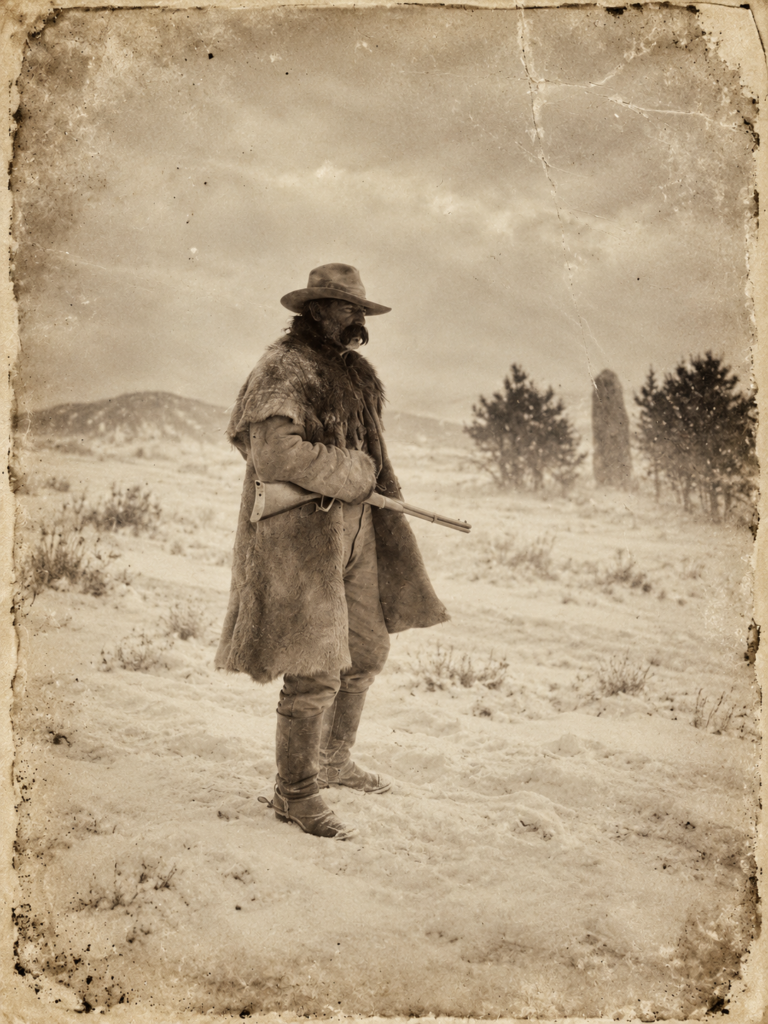
Part 1
By the winter of 1934, Absalom Rutledge had already outlived nearly everyone who had once known him well enough to notice that something in him had changed.
He was 82 years old when he came by rail to Belfry Springs, Wyoming, a small town with more wind than people and a scattering of buildings crouched against the plains. He arrived in summer carrying a single battered trunk, a heavy coat despite the heat, and enough money to rent a back room in a boarding house through the end of the year.
The boarding house belonged to Vera Holston, a widow who had learned over 20 years of renting rooms not to ask questions unless a tenant gave her reason.
Absalom gave her reason on the first afternoon.
He signed the register in a deliberate, old-fashioned hand.
Name: Absalom Rutledge.
Occupation: Retired.
Purpose of stay: To die here.
Vera read the final line twice.
She looked up at him.
He was tall even with age bending him slightly forward. His hair was white, his cheeks hollow, and there was an old hardness around his eyes that did not belong to sickness. His hands were large and scarred. The nails were carefully cut. His boots had been repaired many times.
“Is that meant as a joke, Mr. Rutledge?”
“No, ma’am.”
He closed the register.
That was all he said.
By December, Vera understood that he had told the truth.
His coughing had worsened through autumn. At first he still walked each morning, making his slow way to the edge of town and standing for long periods facing west. When snow came, he stopped walking. By the first week of December, blood appeared in his handkerchief. By the second, he could no longer stand without help.
On a Thursday afternoon, with the daylight fading gray beyond the frost-clouded windows, Absalom called Vera into his room.
“Mrs. Holston.”
She came to the bedside.
“I need a priest.”
Vera stared at him.
In all the months he had lived under her roof, she had never seen him attend church.
“I didn’t know you were Catholic.”
“I’m not.”
“Then why a priest?”
Absalom took several shallow breaths before answering.
“Because I need a man who will listen to what a dying man says without laughing at him, and without running from the room when it gets bad.”
He turned his head toward her.
“If there is another kind of man like that in town, fetch him instead.”
There was not.
The nearest Catholic priest was Father Ignatius Volk, whose parish lay in the next county. He was 38 years old, Wisconsin-born, the son of German farmers, and had been a priest for 11 years.
He arrived at the boarding house shortly after 9 that night.
Vera led him down the narrow hall.
The room smelled of lamp oil, medicine, and winter air leaking through the old window frame.
Absalom lay propped against 3 pillows. His face had the yellow-gray color of old paper. A glass of water stood beside the bed. His breathing was so thin that Father Volk sometimes had to watch the blanket to be certain the old man was still alive.
The priest sat beside him.
“I am told you asked for me.”
“I did.”
“I am also told you are not Catholic.”
“I’m not.”
Absalom managed the faintest smile.
“And I don’t intend to become one at this hour, Father. That would be a cheap bargain, and I’ve tried not to make cheap bargains.”
“Then what would you have me do?”
Absalom looked at him.
“I want you to hear something.”
His pale eyes held the priest’s.
“You may write it down. You may burn it. You may decide in the morning that an old man told you a fever story. I don’t care. I only want one Christian man to hear it before I go.”
Father Volk said nothing for several seconds.
Then he nodded.
“I will listen.”
“Then don’t interrupt me unless I ask you to. I don’t know that I’ll have the wind to begin twice.”
The priest folded his hands.
Absalom closed his eyes.
When he opened them again, the room seemed to have fallen away from him.
He was no longer looking at the priest.
He was looking 56 years backward.
“I was 26,” he began, “and I killed buffalo for money.”
In the autumn of 1878, the buffalo herds were already disappearing from country where they had once darkened the plains from horizon to horizon.
Absalom had been hunting commercially for 3 years. He owned a Sharps rifle bought secondhand in Yankton for $42 and had become skilled at the patient, ugly craft of the trade.
A good hunter did not charge a herd.
He crawled downwind, chose an outside animal, and put a bullet through its lungs. If the animal fell without alarming the others, he shot another. And another.
Buffalo often remained near a fallen member of the herd, bewildered rather than frightened.
On a good stand, 20 animals might die before the herd understood.
On a very good stand, 50.
Absalom had once been proud of such numbers.
At 82, lying beneath a thin quilt in Belfry Springs, he was not.
“We called them trusting animals,” he said. “That was our excuse for being good at killing them.”
That autumn, he had joined a party of 5 other men working west of the Black Hills.
Their leader was Merritt Yaws, 51, Kentucky-born, a Confederate veteran who had fought at Chickamauga and almost never spoke of the war. He had a long jaw, a quiet manner, and the missing tip of his left thumb, taken years earlier by a mule kick.
Absalom remembered him chiefly for his calm.
“I never knew another man so difficult to frighten,” he told Father Volk. “Remember that.”
Their tracker was Cathcart Neighbors, called Cath, a thin Missouri man in his 30s whose nose had been broken twice and badly set both times.
Cath could kneel over a patch of bent grass and tell what animal had passed, how long ago, and whether it had been moving fast.
The skinner was Dorsey Kilmartin, a towering man from the California goldfields with a scar across his neck and the habit of singing hymns while he worked. Dorsey disliked sleeping indoors and could skin a buffalo with astonishing speed.
The youngest was Owen Braswell, whom the men called O.
He was 22, from Kansas, quiet, and unnervingly accurate with a rifle. In the evenings he read from a small book of Psalms near the fire, always holding it so no one could see the page.
The sixth man was Kessler Vandergrift, a Dutch wagon driver and cook with a round red face, 4 patient mules, and a vocabulary of curses that seemed to expand whenever the weather worsened.
In late October, they followed buffalo sign west into Wyoming, traveling along the Powder River and into country that was empty in a way few places remained empty even then.
The fighting between the United States and the Plains tribes had driven many Native people from that region. Army patrols came and went. Homesteaders had not yet arrived in any number. A trapper might have a cabin along a river bend, but once winter settled over the country, a man could travel for days without seeing smoke.
They intended to hunt through the first snows and be home before Christmas.
“None of them came home,” Absalom said.
The old man coughed until his whole body shook.
Father Volk reached toward the glass.
Absalom waved him away.
When he could speak again, he continued.
On November 4, they made camp in a low draw roughly 30 miles northwest of the place where the town of Buffalo would grow.
Cath had found signs of a small herd beyond a western ridge.
There was snow in the high places and a crust of ice on shaded water. The grass had gone brown. At night, cold settled into the low ground like something poured.
The first strange thing was not something they saw.
It was something they stopped hearing.
Absalom woke after midnight.
He did not know what had disturbed him.
He lay inside his bedroll and listened.
Dorsey was snoring nearby.
A mule shifted against its tether.
The campfire cracked once.
Beyond those small sounds, there was nothing.
No wind.
No movement in the grass.
No wolves.
No creaking trees.
No distant ice breaking along the river.
The entire country seemed to have drawn one breath and held it.
Absalom sat up.
The silence was so complete that he could hear his own pulse.
He rose, pulled on his coat, and walked to the edge of camp.
The moon was pale above the ridge.
Behind him, a voice said, “You hear it too?”
Absalom turned.
Merritt stood in his stocking feet, coat thrown over his shoulders.
Absalom had not heard him approach.
They listened together.
After a while, Merritt said, “I heard a night this still once in Kentucky.”
“When?”
“When I was a boy.”
“What happened?”
Merritt looked toward the dark ridge.
“My father died the next day.”
He returned to his bedroll.
Absalom did not sleep again.
Neither did Merritt.
At first light, Cath went scouting.
He was gone 4 hours.
When he returned near midday, he unsaddled his horse but did not eat. He poured coffee, let it cool untouched, and sat looking at the ground.
Merritt finally asked, “What did you find?”
“Twelve buffalo.”
“Where?”
“About 2 miles west. Shallow bowl below the ridge.”
“Then why are you sitting here?”
Cath rubbed his hands together.
“They’re standing in a circle.”
Merritt waited.
“Facing outward,” Cath said.
“All 12?”
“All 12.”
“Maybe they scented wolves.”
“I got inside 100 yards.”
“And?”
“They didn’t move.”
Merritt’s expression changed slightly.
Cath continued.
“I could see their breath. They’re alive. But not one moved. Then I went closer and one turned its head.”
“One?”
“One.”
Cath looked toward the western ridge.
“It looked at me.”
Merritt gave a short, impatient breath.
“Buffalo do that.”
“Not like this one.”
“How, then?”
Cath’s eyes moved to him.
“Like a man who already knows your name.”
No one laughed.
Merritt suggested disease.
Cath shook his head.
“Sick buffalo lie down.”
They moved camp that afternoon.
Only 2 miles east, but it took most of the remaining daylight to load and drag the wagons over frozen ground.
When they reached another shallow draw, Cath refused to let anyone unpack.
He walked a complete circle around the new camp.
Then another farther out.
Only when he returned did he say, “Clean.”
That night Merritt ordered a watch.
They had not bothered with one for years. Six armed men around a fire had little to fear from wolves, and none expected hostile riders in that country so late in the season.
Still, no one objected.
Owen Braswell took the first watch.
Cath the second.
Dorsey the third.
Absalom was assigned the hour before dawn.
But sometime around 3, Owen entered Absalom’s tent and shook him awake.
His face was pale.
He put a finger to his lips.
“Come outside.”
Absalom pulled on his boots and followed.
Owen walked to the edge of the firelight and pointed toward the ridge.
There was something standing at the tree line.
At first Absalom thought it was a dead trunk.
Then he understood that it was too narrow.
Too tall.
The moon had risen high enough to throw silver light across the snow. The figure was nearly 200 yards away, but the night was clear.
It stood upright.
It was taller than a man.
Neither hunter spoke.
They watched.
A minute passed.
Perhaps 2.
The figure did not sway.
It did not shift its weight.
It did not move its head.
There was nothing in its posture that suggested breathing.
“It stood,” Absalom told Father Volk, “the way a fence post stands.”
Then it took a step.
The snow on the ridge had frozen hard enough that any boot, hoof, or paw should have cracked the crust.
There was no sound.
It took another step.
Then it vanished.
Not behind a tree.
Not into shadow.
One moment it occupied a place in the moonlight.
The next moment that place was empty.
Owen’s rifle was in his hands.
The barrel trembled.
“Did you see its head?” he whispered.
“I couldn’t make it out.”
Owen swallowed.
“That isn’t what I mean.”
Absalom looked at him.
“I couldn’t make it out either,” Owen said. “But not because it was dark.”
He struggled for words.
“I looked right at it. I just couldn’t tell what I was looking at.”
They remained awake until Cath came to relieve the watch.
Owen told him what they had seen.
Cath listened without comment.
Then he walked alone to the edge of camp and stared toward the ridge for several minutes.
When he returned, he sat by the fire and cleaned his rifle.
When he finished, he cleaned it again.
Then a third time.
At dawn, the 3 men climbed to the tree line.
Merritt came with them.
They found no prints where the figure had stood.
That was the first thing wrong.
The second lay 50 feet away.
A line of tracks approached from the east.
They were enormous, half again as long as a man’s boot.
Each print showed toes.
Too many.
Absalom would not tell Father Volk how many.
Not then.
Not after 56 years.
The tracks moved in a perfectly straight line.
They stopped 50 feet from the tree line.
Then they returned east over the same path, placed so precisely that at first it appeared there had been only one set.
Cath crouched beside the final print.
He studied it.
He did not touch it.
Merritt said, “Well?”
Cath remained kneeling.
After a while, he stood.
“We need to go.”
“We came a long way.”
“I know.”
“Kessler’s wages are in those wagons. So are mine. So are yours.”
“I know.”
“Then give me a reason.”
Cath looked toward the trees.
“I haven’t got one.”
Merritt’s jaw tightened.
“I’ve got a feeling,” Cath said. “That’s all.”
“A feeling.”
“I had the same feeling in ’63 at Vicksburg. Didn’t listen. Had it again in ’69 on the Republican River when the Cheyenne caught my brother. Didn’t listen then either.”
Cath faced him.
“I lived both times. Lived long enough to wish I hadn’t been so slow.”
Merritt stared at him.
“One more day.”
Cath shook his head.
“That’s a fool’s bargain.”
“One more day. If anything else happens, we leave.”
“If anything else happens, we may not be able to.”
Merritt said nothing.
Cath looked once more at the tracks.
Then at the tree line where Absalom and Owen had seen the figure standing without leaving any mark upon the snow.
“One more day,” Merritt repeated.
And because he was Merritt Yaws, because he had led them through worse country than this, because the wagons were expensive and the winter had already cost them time, the others followed him back to camp.
Absalom lay silent for several moments in the boarding house.
Father Volk thought perhaps the old man had exhausted himself.
Then Absalom reached for the water.
His hand shook badly enough that the glass clicked against the table.
“You still with me, Father?”
“I am.”
Absalom drank.
He returned the glass.
“It gets worse now.”
Part 2
They hunted the next day.
Cath found 9 buffalo 3 miles south of camp.
Normal buffalo.
That fact mattered to Absalom for the rest of his life.
They moved like animals. They grazed. Their ears flicked at sound. Their breath steamed in the cold. When the first bullet struck, the others shifted uncertainly rather than remaining fixed in some impossible arrangement.
Owen did most of the shooting.
Absalom spotted for him.
Seven buffalo went down.
The remaining 2 wandered away.
Dorsey arrived with Kessler and the wagon. Soon the skinner was working his knife beneath a hide, humming a hymn under his breath.
Absalom asked what song it was.
“My mother taught it to me.”
“What’s it called?”
Dorsey shrugged.
“Forgot.”
“You remember the tune.”
“Some things outlast words.”
They returned to camp by 4.
Merritt seemed relieved.
He poured coffee and looked at Cath.
“There. Clean day.”
Cath glanced at the western sky.
“Sun isn’t down.”
“You intend to argue with daylight now?”
“You said 1 more day. The day isn’t over.”
Merritt did not answer.
Owen volunteered for first watch again.
He had not opened his Psalms that evening.
He sat beside the fire with the Sharps across his knees, looking steadily toward the ridge.
Absalom slept.
At midnight he woke to wind.
Not ordinary wind.
It seemed to strike the camp from every direction.
Canvas snapped inward.
Smoke twisted down.
Cold air rushed from north, south, east, and west at once, converging upon the fire.
It felt less like weather than an enormous inhalation.
With it came a smell.
Old snow.
Burned hair.
And beneath both, something Absalom never learned to describe.
He had smelled dying buffalo.
Wolf dens.
Bear carcasses.
Hides rotting under summer heat.
Nothing resembled what moved through that camp.
The odor suggested age without decay, something mineral and buried, something that had never properly belonged to the world above ground.
Kessler came from his tent clutching a shotgun.
Dorsey was already awake.
Merritt stood beside the fire.
Cath appeared last.
No one asked what the others had smelled.
They did not need to.
The wind ceased as suddenly as it had begun.
The night became still again.
Father Volk poured water for Absalom when another fit of coughing seized him.
This time the old man allowed the priest to hold the glass.
When he could breathe, he whispered, “What came next is the part I never said aloud.”
Father Volk waited.
“I told it to myself every winter. Always stopped here.”
Absalom closed his eyes.
“For 56 years.”
Silence filled the small room.
Then he began again.
At dawn, Owen Braswell was gone.
His rifle stood upright in the snow beside the dead fire.
Butt planted downward.
Barrel pointing toward the colorless sky.
There were footprints leaving camp.
Owen’s.
Merritt found them first.
The men followed.
The prints went north for 30 yards.
Then they ended.
There was no rock.
No stream.
No exposed ground.
No second trail.
The last marks showed both of Owen’s boots side by side.
He had apparently stopped.
And from that point he had ceased leaving evidence that he existed upon the ground.
Cath made a circle.
Then a wider circle.
Then a third.
Nothing.
“No other tracks,” he said.
Merritt stared at the final prints.
“None?”
“None.”
“Then he doubled back.”
“Not on these.”
“He jumped.”
“To where?”
Merritt’s voice sharpened.
“Don’t make jokes.”
“I’m not.”
Cath pointed at the last impression.
“I said there are no tracks because I don’t know another way to tell you. There’s nothing after this.”
Merritt sat down in the snow.
The calmest man Absalom had ever known remained there a long time.
Then he rose.
“We leave now.”
Cath did not show satisfaction.
He only said, “I told you.”
“You did.”
Merritt looked at him.
“And I’m sorry.”
They turned toward camp.
A voice came from the west.
“I’m over here.”
Every man stopped.
It was Owen.
Clear.
Close.
Merritt spun.
“Owen!”
Nothing.
“Are you hurt?”
Silence.
Then Owen’s voice came from the east.
“I’m over here.”
Kessler crossed himself.
Dorsey whispered something.
Before anyone moved, the voice came a third time from a low draw behind a ridge they had crossed days earlier.
“I’m over here.”
Same voice.
Same tone.
Impossible distance.
Cath drew his revolver and fired 3 rounds straight into the sky.
The shots rolled away across the plains.
After that, Owen did not call again.
They returned to camp without speaking.
It took 3 hours to ready the animals.
Every horse fought the saddle.
Kessler’s 4 mules, usually dull and patient, rolled their eyes and kicked at anyone approaching.
One horse bit Dorsey through his coat.
Kessler’s lead mule nearly caught Absalom in the chest with both hind hooves.
Animals knew something.
That was what Absalom came to believe.
Whatever confusion afflicted men, the horses understood enough to be afraid.
By the time the wagons were hitched, darkness had fallen.
Merritt made another decision they later regretted.
“We leave at first light.”
Cath looked at him.
“You sure?”
“Not stumbling across unknown country in the dark.”
No one slept.
They sat around the fire with their backs toward one another, rifles and shotguns ready.
Cath sat behind Absalom’s left shoulder.
At midnight, Absalom could feel the other man breathing.
Sometime later, his eyes closed.
Perhaps he slept.
Perhaps only blinked.
When he opened them, there was nothing against his back.
He turned.
Cath was gone.
The tracker’s rifle lay across the log.
His bedroll rested 10 feet away.
Beside it stood his boots.
The laces were tied.
There were no footprints.
Not one.
Kessler began speaking rapidly in Dutch.
Merritt grabbed him by the shoulders.
“What did you see?”
Kessler’s face was wet.
“What?”
The wagon driver shook his head.
“You were looking at him?”
Kessler nodded.
“What happened?”
Kessler struggled for English.
“Was there.”
He blinked deliberately.
“Was not.”
“He stood up?”
“No.”
“He walked?”
“No.”
“He fell?”
“No.”
“Then what?”
Kessler looked at the empty place beside the fire.
“Was there.”
Another blink.
“Was not.”
Merritt released him.
“We ride now.”
No one argued.
They abandoned what they could not carry.
The wagons moved east.
All night they rode.
Then the stars stopped.
Absalom did not notice immediately.
At first he was grateful for clear sky. Stars meant direction.
But hour after hour, the same bright points remained fixed above the same places.
No slow wheeling toward morning.
No change.
He watched until doubt became certainty.
“Merritt.”
“I know.”
“The stars—”
“I know.”
Merritt never looked up.
“Don’t say it again.”
At dawn the sun rose in the wrong place.
Not completely wrong.
That would almost have been easier.
It appeared north of where it belonged.
Far enough that every man noticed.
No one discussed it.
They rode through morning.
The ground remained white and rolling.
Around midday they passed a formation of red sandstone shaped, from one side, like a clenched fist.
Absalom remembered it because Dorsey pointed at it.
“Looks like God fixing to hit someone.”
Hours later, they passed it again.
No man spoke.
By afternoon, the same red fist appeared for a third time.
Merritt reined in.
He had led them straight east.
No turns.
No circles.
Yet the rock had returned.
He stared at it for nearly a minute.
Dorsey finally asked, “What are we doing?”
Merritt answered without looking at him.
“We’re being turned.”
“By who?”
“I don’t know.”
He faced the trail.
“Don’t ask me again.”
Kessler had almost entirely stopped speaking.
He drove with his crucifix wrapped around one fist.
Near evening, they reached a rise.
Merritt halted so abruptly that Absalom nearly rode into him.
Below lay a shallow bowl of snow.
There were 12 buffalo.
They stood in a circle.
Facing outward.
None moved.
Cath had described their breath on the first day.
Now there was none.
No mist from their nostrils.
No flicking ears.
No shifting weight.
Nothing.
And in the center stood the figure.
At this point in his confession, Absalom’s voice weakened.
Father Volk asked if he should rest.
“No.”
The answer came immediately.
“If I stop now, I’m not finishing.”
The priest nodded.
Absalom continued.
He had spent 56 years deciding how much he would say about what he saw in the circle.
He had settled upon 3 things.
The first was that it was tall.
The second was that whatever covered its body was not skin, cloth, or fur.
The third was that it was looking at him.
Not Merritt.
Not Dorsey.
Not Kessler.
At Absalom.
Across the distance between ridge and basin, he felt the certainty of its attention.
“It knew my name.”
Father Volk remained silent.
“I never heard the name spoken. That’s the trouble. If I’d heard it, I could tell myself later it was the wind.”
Absalom’s fingers tightened around the blanket.
“But it knew.”
Beside him in the saddle, Merritt whispered, “Don’t look at it.”
Dorsey answered, “Too late.”
Merritt turned his horse.
“Ride.”
They rode.
Afterward, Absalom could remember pieces but not the whole.
Merritt began praying aloud.
The 23rd Psalm.
The 91st.
Others Absalom did not recognize.
The Kentucky drawl that Merritt normally suppressed returned as he prayed, and his voice stayed steady even when nothing else did.
Dorsey hummed the forgotten hymn.
Hour after hour.
Never stopping.
Kessler shouted at the mules as the wagon fell farther behind.
Absalom looked back once and saw its lantern swinging in the darkness.
Small.
Smaller.
Merritt refused to stop.
“He follows or he doesn’t.”
“Kessler can’t keep up.”
“We stop, we all stay.”
They continued.
Then Absalom heard his mother.
Her name had been Prudence Rutledge.
She died of fever in Indiana when he was 15.
By 1878 she had been in the ground 11 years.
Yet her voice came from ahead and slightly north of the trail.
“Absalom.”
His heart seemed to stop.
“Absalom, come home now.”
He knew the voice.
Not a likeness.
Not a resemblance.
His mother.
“Supper’s on.”
His horse began turning.
Absalom loosened the reins.
He wanted to go.
More than he had ever wanted anything.
For one impossible moment, the frozen plains disappeared and he remembered a doorway filled with yellow lamplight. A table. Cornbread. His mother wiping her hands upon an apron.
He leaned toward the voice.
Merritt seized his bridle.
“No.”
“My mother.”
“No.”
“She’s there.”
“No, she isn’t.”
Absalom fought him.
Merritt held on.
“Don’t listen.”
For the next 4 hours, Merritt rode with 1 hand controlling his own horse and the other clamped around Absalom’s bridle.
The voice kept moving.
Sometimes north.
Sometimes ahead.
Once behind.
“Come home now.”
Each time Absalom’s horse tried to turn, Merritt forced it back.
Absalom never knew what voice called Merritt.
He was certain one did.
Several times the older man turned toward sounds Absalom could not hear.
Each time Merritt’s face tightened.
Each time he continued east.
By dawn, Dorsey was gone.
One moment he rode behind them, still humming.
Less than a minute later, Absalom looked again.
The horse remained.
Dorsey did not.
His coat had been folded carefully across the saddle.
Not dropped.
Not tangled.
Folded.
Absalom started to rein back.
“Merritt.”
“Don’t.”
“We have to find him.”
“He’s already where he’s going.”
“Merritt—”
“So are we.”
The older man looked at him.
“Ride.”
They rode.
A high ringing began in Absalom’s ears.
Like a distant bell.
It continued for 3 days.
Kessler and his wagon were gone somewhere behind them.
Absalom never learned how.
He remembered, years later, that Kessler had a wife in Nebraska.
Of all the thoughts that troubled him, that was among the most ordinary and therefore among the hardest.
He wondered how long she waited.
Whether she watched roads.
Whether she believed he had abandoned her.
Whether someone finally told her that men vanished in country where maps gave no reason for a man to vanish.
Absalom hoped she married again.
By evening, only he and Merritt remained.
Dorsey’s riderless horse followed awhile, then wandered north.
They let it go.
The land finally began to change.
Not dramatically.
That would have frightened them less.
A bend in the river appeared where it should have.
Then willows.
Then smoke.
They crested a low rise and saw a cabin.
A trapper’s cabin.
Light showed through one small window.
Absalom stared at it until his eyes hurt.
A human light.
A chimney.
A door.
Something built by hands.
Something belonging to the world.
The trapper who opened that door was named Elias Prickett.
He was nearly 60 and missing 3 fingers from his right hand.
He looked first at Merritt.
Then at Absalom.
Then at the country behind them.
He asked no questions.
“Inside.”
They entered.
Elias locked the door.
He gave each man whiskey.
Merritt sat at the table.
He placed both hands flat upon the wood.
For the first time since Absalom had known him, the old soldier looked tired beyond recovery.
Not frightened.
Not wounded.
Finished.
Absalom drank.
Elias tended the fire.
Nobody spoke.
3 hours later, Merritt Yaws died without rising from the chair.
Part 3
There was no wound on Merritt’s body.
No fever.
No blood.
No sign of poison.
Elias Prickett examined him as thoroughly as a frontier trapper knew how.
He touched Merritt’s neck.
Pressed an ear to his chest.
Looked into his mouth.
Then he stepped back.
“This man stopped.”
Absalom remembered the exact phrase.
Not died.
Stopped.
Elias covered Merritt with a blanket but refused to move the body until morning.
“Bad luck moving a dead man in the dark.”
Under other circumstances Absalom might have laughed.
He did not.
Elias pushed the whiskey jar toward him.
“Drink.”
“I’ve had enough.”
“No.”
The trapper’s voice hardened.
“Drink it all.”
Absalom looked at him.
“Why?”
“Because you’re going to sleep tonight.”
“I don’t think I can.”
“You will.”
Elias pointed toward the door.
“Whatever you came out of, you’ve carried enough of it into this cabin. If you sit awake listening for it, you’ll be out of your mind before sunrise.”
Absalom drank.
He remembered the first half of the jar.
Little after that.
He woke near noon on the floor beside the hearth with a headache so fierce that opening his eyes hurt.
Merritt’s blanket-covered body remained in the chair.
Elias sat near the door.
A shotgun lay across his knees.
“You sat there all night?”
“Yes.”
“Did anything come?”
“No.”
Elias looked carefully at Absalom.
“I want you to know that. Nothing came to the door.”
Absalom pushed himself upright.
The ringing in his ears remained.
“What do I owe you?”
“Nothing.”
“For the whiskey.”
“Nothing.”
“For helping with Merritt.”
“Nothing.”
Elias’s face hardened.
“But you owe me one thing.”
“What?”
“You ride east.”
Absalom said nothing.
“You keep riding east, and you do not come back into this country.”
The trapper leaned forward.
“You hear me?”
“I hear you.”
“Say it.”
Absalom hesitated.
“I will not come back.”
“Say the rest.”
“I will not come back into this country.”
Elias nodded.
“Good.”
They buried Merritt the following day.
The frozen ground was too hard until Elias built a fire over the place where they intended to dig.
When the earth softened, the 2 men broke it with a mattock and shovel.
There was no priest.
No coffin.
They wrapped Merritt in a blanket.
Absalom knew only 1 prayer completely, so he recited the Lord’s Prayer while snow moved softly through the pines.
Elias made a cross from 2 pieces of wood.
With a hunting knife he carved:
Merritt Yaws
1878
Absalom left the next morning riding Merritt’s horse and leading his own.
He went east.
He never saw Elias Prickett again.
Years later, he heard that the trapper died in 1881 of a lung sickness.
Absalom never returned to that stretch of the Powder River.
Not for 56 years.
He worked railroads.
He married for a time in Iowa during the 1880s.
He buried his wife.
He lost contact with his brother.
He moved through states.
Held jobs.
Sat in churches.
Drank with working men who told every variety of story men tell when nights grow long.
He never spoke of the winter of 1878.
Not once.
Every winter, however, when snow reached a certain depth and the wind became unnaturally still, he remembered.
He would wake in dark rooms convinced he had heard his mother.
“Come home now.”
Sometimes he heard Owen.
“I’m over here.”
Sometimes nothing spoke, and that was worse.
He would lie awake until dawn listening for silence.
Eventually 1934 came.
Absalom was old.
His lungs were failing.
He knew he was dying.
He boarded a train west.
He did not return to the actual place.
He could not.
Instead he stopped in Belfry Springs because, as he told Vera Holston, it was as close to that country as he could force himself to go.
“I owe something to the ground out here,” he had told her. “I don’t intend to be buried east of the Missouri.”
Now, in the boarding house room, Father Volk watched him struggle to breathe.
Absalom had been talking for hours.
Outside, snow pressed pale against the window.
The lamp flame had shortened.
The priest finally asked, “May I ask you something?”
Absalom opened his eyes.
“One thing.”
“What do you think it was?”
For a long time, the old buffalo hunter said nothing.
When he finally answered, Father Volk had to lean close.
“Not a demon.”
The priest waited.
“A demon knows men.”
Absalom looked toward the ceiling.
“It may hate them. It may want them damned. But it understands the shape of a man and the shape a man makes in the world.”
He swallowed.
“This did not.”
“An animal?”
“No.”
“Why?”
“An animal has business here.”
Absalom lifted one thin hand.
“It eats. Sleeps. Breeds. Kills because killing feeds it or keeps it alive.”
His hand fell.
“This thing wasn’t hungry.”
He stared somewhere beyond Father Volk.
“It wasn’t angry either.”
The lamp gave a small hiss.
“I spent 56 years trying to find a name for what it was. Couldn’t.”
The priest remained silent.
“The closest I ever came is this.”
Absalom turned his head.
“There are places on this earth that were not made for people.”
Father Volk felt the room become very still.
“There are places where the ground remembers something older than us. Older than the people who lived there before we came. Older than whoever came before them.”
Absalom’s voice had weakened nearly to a whisper.
“Maybe older than anything that has ever walked upright.”
He stopped to breathe.
“And once in a while, when the snow is deep enough and the wind gets still enough, something in one of those places notices us.”
His eyes met the priest’s.
“And it looks.”
The silence lengthened.
“Then it takes what it wants.”
Absalom closed his eyes.
Father Volk thought the confession was finished.
Minutes passed.
The old man spoke again.
“One more thing.”
“Yes.”
“This is the worst part.”
Father Volk waited.
“I don’t think it was hunting us.”
Absalom opened his eyes.
“I think it was calling us home.”
The priest said nothing.
“I think whatever stood there believed we belonged to it.”
His breath caught.
“Like we had been gone too long.”
Owen had gone.
Cath had gone.
Dorsey had gone.
Kessler, Absalom believed, had gone as well.
Merritt had resisted.
“He kept himself in that chair,” Absalom said. “I believe that. I believe something was still calling him, and Merritt Yaws sat with both hands on that table and would not answer.”
“And you?”
“I’ve been answering no for 56 years.”
Snow whispered against the glass.
“Every winter,” Absalom continued, “when the weather turns a certain way, it calls again.”
His mouth trembled.
“Sometimes with my mother.”
The words came softer.
“Come home now, Absalom.”
Father Volk watched him.
“Supper’s on.”
The old man breathed in.
Slowly out.
“I don’t believe I’ll go when I die.”
His gaze moved toward the crucifix hanging from Father Volk’s neck.
“I believe the Lord will send me where I belong.”
Then something like doubt passed over his face.
“But I’ve been wrong about plenty.”
His fingers closed around the blanket.
“And if I’m wrong about that too—if when I die that thing takes me instead—I wanted somebody here to know.”
Father Volk leaned closer.
“To know what?”
“Why the last buffalo hunter never came home.”
Absalom closed his eyes.
“So it doesn’t win everything.”
He lay still.
“That’s why I told you.”
The room fell quiet.
“That’s all.”
Father Volk remained beside him for another hour.
He said prayers for the dying in Latin.
Absalom did not answer.
Around 3 in the morning, his breathing slowed.
Then stopped.
Father Volk waited.
He touched the old man’s wrist.
Nothing.
He crossed Absalom’s hands upon his chest and closed his eyes.
The priest removed the crucifix from around his own neck.
He hesitated.
Then placed it upon the pillow beside Absalom’s head.
He did not know why.
Perhaps, afterward, he was embarrassed by the gesture.
Perhaps not.
He sat down again.
Before sunrise, he took out a notebook.
He wrote.
He tried to preserve every detail he could remember.
The 6 hunters.
The silent night.
The circle of buffalo.
The figure.
Owen’s footprints.
Cath’s boots.
Dorsey’s folded coat.
The unmoving stars.
The repeated stone.
The voice of Prudence Rutledge calling her son to supper.
Merritt holding the reins.
Merritt stopping in a trapper’s chair.
Absalom’s belief that whatever had been in the snow was not chasing them.
Calling them.
When Father Volk finished, the window had begun to brighten.
Absalom Rutledge was buried in the small Catholic cemetery outside Belfry Springs.
No family came.
No next of kin claimed the body.
Vera Holston used what remained of his rent money to pay for the burial.
The grave marker carried only his name and years.
Father Volk conducted the service.
He told no one what Absalom had said.
For decades, the notebook remained hidden inside his personal Bible.
Father Volk occasionally took it out.
Read it.
Returned it.
He did not show it to another priest.
He did not send it to a newspaper.
He did not inform the authorities.
There was nothing for authorities to investigate.
More than half a century had passed.
The men were gone.
The landscape had changed.
And even if someone had found Owen Braswell’s rifle still standing in the snow, what report could have contained the rest?
Father Volk died in 1961 in Rock Springs, Wyoming.
He was 65.
His younger sister came from Wisconsin to settle his affairs.
Among his possessions, she found the Bible.
Inside it was the notebook.
She read the pages.
She kept them.
Nothing indicates that she understood what to do with them.
The notebook remained in her attic until her death in 1972, when family papers were sorted again.
According to later accounts, those papers eventually entered a small historical collection associated with Wyoming archival material.
Whether the original notebook still exists under the name by which the story later circulated is uncertain.
But one detail endured.
On the final page, below the transcription of Absalom Rutledge’s confession, Father Volk had added a sentence in a hand shakier than the rest.
God forgive me. I believed him.
There was another witness.
Vera Holston lived until 1947.
Years after Absalom’s death, a young woman preparing a newspaper piece about older buildings in Belfry Springs interviewed her.
The questions were ordinary.
How old was the boarding house?
Who had owned it before Vera?
Had anything interesting happened there?
“Once,” Vera said.
The reporter asked what.
“An old man died in the back room.”
There was nothing unusual in that.
Many boarding houses had death in their histories.
Vera continued.
“He died in December of 1934.”
The young woman waited.
“And every winter after that, when the snow gets deep and the wind goes still, I hear somebody in the back garden.”
“What do you hear?”
“A voice.”
“What does it say?”
Vera looked toward the window.
“Come home now.”
The reporter smiled uncertainly.
“Whose voice?”
“Usually a woman.”
“Usually?”
“Sometimes a man.”
Vera folded her hands.
“One winter it was a voice I didn’t recognize.”
“When?”
“1940.”
“What did it say?”
“My name.”
The young woman stopped writing.
Vera told her she had not gone to the window.
She had not moved the curtain.
She had not looked into the garden.
“Why not?”
“Because I’ve lived long enough to know there are invitations that aren’t invitations.”
The young reporter asked whether Vera believed someone was playing tricks.
The boarding-house keeper shook her head.
“Whatever is calling isn’t asking.”
She looked at the young woman.
“It’s telling you where it thinks you belong.”
The reporter did not include that exchange in her article.
Her editor considered it unsuitable for a piece about old buildings.
But she remembered.
She wrote the conversation in a private notebook.
Decades later, when she herself had become old, she gave that notebook to a granddaughter.
By then, Absalom Rutledge had been dead for nearly half a century.
Powder River country had roads.
Fences.
Ranches.
Telephone lines.
Towns marked on maps.
The vast buffalo herds were gone.
Men no longer rode commercial hunting wagons across empty plains.
Yet stories remained.
Hunters occasionally reported stretches of winter country where dogs refused to move.
Ranchers spoke of cattle found standing in strange arrangements after storms.
Travelers described voices where no people should have been.
There were accounts of tall shapes seen near tree lines, though none lasted long enough to become more than rumor.
In some versions, the figures walked.
In others, they simply stood.
A trapper supposedly told a railroad man that the worst thing a traveler could hear in winter was a familiar voice coming from a direction where no road ran.
A woman in Montana once claimed that her dead husband called her from a frozen creek.
A ranch hand near the Bighorns wrote to his brother that horses would sometimes refuse to cross certain patches of snow even when there was nothing visible ahead.
None of these stories proved anything.
Most could be dismissed.
Absalom himself might have dismissed them.
He had spent much of his life refusing explanations that depended upon ghosts or superstition.
He never claimed to understand what had happened.
That was perhaps the most disturbing element preserved in Father Volk’s account.
Absalom did not come to his deathbed with an answer.
Only a description.
Something stood among the buffalo.
Something left tracks that did not reach the place where it had stood.
Men disappeared without walking away.
Voices came from impossible directions.
The sky itself seemed to lose its proper movement.
A road east became a circle.
And in the end, 2 men reached a cabin.
One stopped.
One lived.
For 56 years, the survivor refused to return.
Then, knowing death was close, he traveled west until fear would allow him to go no farther.
He chose a room near the country he had fled.
He asked for a priest whose religion he did not share.
And before dying, he made certain that 1 other person carried the story.
Perhaps that was all he wanted.
Perhaps that was why Father Volk wrote it down.
Why he kept the notebook.
Why his sister kept it after him.
Why a newspaper woman kept her own version of Vera Holston’s recollection.
Not because any of them could prove what happened.
Because none of them wanted to be the last person holding it.
There is no reliable record of Owen Braswell returning to Kansas.
No known account of Cathcart Neighbors appearing again in Missouri.
No certain trace of Dorsey Kilmartin after 1878.
Kessler Vandergrift’s fate is equally obscure.
Men disappeared on the frontier for ordinary reasons every year.
Cold killed.
Horses fell.
Rivers took wagons.
Violence erased names.
Records were incomplete even when someone cared to make them.
A missing hunter rarely became history.
Merritt Yaws at least had a grave behind Elias Prickett’s cabin, if Absalom’s account was accurate.
Whether the marker survived is unknown.
Pine does not last forever.
Snow, rain, insects, and time would have erased the carving long ago.
Perhaps the most durable thing left of him was Absalom’s memory of a hand stretched across 2 moving horses, holding another man’s bridle while a dead woman called from the dark.
That, more than the figure in the snow, was what Absalom seemed to remember with gratitude.
Merritt had been afraid.
He had simply continued riding.
Absalom believed that decision saved his life.
He also believed something continued to call him afterward.
Not every night.
Not every winter.
Only under particular conditions.
Deep snow.
No wind.
The world quiet enough to hear something far away.
Come home now.
The phrase was ordinary.
That was why it frightened him.
Nothing in the words sounded monstrous.
Nothing threatened.
Nothing commanded violence.
A mother could say them.
A wife.
A brother.
Someone standing in a warm doorway while supper waited.
Come home now.
Perhaps Absalom’s final belief was only the shape trauma had taken inside an old mind.
Perhaps 4 men died in winter country and 2 survivors, exhausted and lost, gave terror a form they could carry.
Perhaps Cath’s tracks were misread.
Perhaps Owen wandered away.
Perhaps Dorsey fell behind unseen.
Perhaps Kessler’s wagon broke down.
Perhaps Merritt’s heart failed after days without sleep.
Perhaps the stars seemed still because frightened men lose track of time.
Perhaps navigation failed beneath clouded winter light.
Perhaps 12 buffalo sometimes stand strangely in storms.
There are explanations for pieces.
Absalom knew that.
He had 56 years to construct them.
Still, he returned west to die.
Still, he would not go farther than Belfry Springs.
Still, when Father Volk asked what the thing was, he did not call it an animal.
And he did not call it a ghost.
He said there were places not made for people.
That was as close as he ever came.
After Vera Holston’s death, the boarding house changed hands.
The back room was renovated.
Floorboards replaced.
Windows widened.
Walls repainted.
People who slept there later did not always know an old buffalo hunter had died in the room.
Most heard nothing.
That is worth saying.
Most winters were only winters.
Wind pushed dry snow along the street.
Pipes froze.
Roofs creaked.
People woke in darkness for ordinary reasons and returned to sleep.
But there were occasional stories.
A tenant waking near 3 in the morning because someone whispered outside.
A child asking why a woman was calling in the garden.
A man opening the back door after hearing his brother’s voice even though his brother lived in Colorado.
Nothing came of them.
No tracks.
No figures.
No disappearances anyone could connect to the old account.
Perhaps stories attract stories.
Perhaps once people know what they are expected to hear, silence supplies it.
That is possible.
It may even be likely.
Yet one detail appears repeatedly in versions of the story separated by years.
The wind stops first.
Not gradually.
Completely.
A person notices because some small sound inside the room suddenly becomes too clear.
A clock.
Breathing.
A bed frame shifting.
Then comes the feeling that the night outside is not empty.
Only quiet.
And after that, sometimes, the voice.
Usually familiar.
Usually gentle.
Calling from somewhere beyond the window.
There is no record that anyone followed it.
Or perhaps only those who did not follow remained to make records.
Powder River country still has winter.
The plains still flatten beneath snow until earth and sky can seem to join.
There are still stretches where the nearest light is miles away.
There are still nights when sound travels strangely.
And places where it does not travel at all.
Whether anything waits there is a question the surviving documents cannot answer.
That uncertainty is part of the story.
Absalom Rutledge carried his answer only as far as language allowed.
It was tall.
It wore something that was neither skin nor cloth nor fur.
It looked at him.
It knew his name.
Everything beyond that remained outside description.
Perhaps that was why Father Volk believed him.
Not because Absalom explained too much.
Because he refused to.
The old hunter never claimed to understand the shape in the basin, the disappearing men, or the voices.
He only claimed that they happened.
And when the priest asked for meaning, Absalom gave him the smallest meaning he could bear.
It had not been hunting them.
It had been calling them back.
One by one.
Owen.
Cath.
Dorsey.
Kessler.
Merritt resisted until his body simply stopped.
Absalom resisted for 56 years.
The final night in Belfry Springs, he resisted once more.
At approximately 3 in the morning, his heart ceased.
Father Volk remained with the body.
Outside, snow covered the garden.
The priest’s notebook does not say whether the wind was blowing.
It does not say whether he heard anything beyond the window.
It records only the death, the prayers, and the confession.
Yet after the priest left, Vera Holston began hearing something in winter.
A voice from behind the house.
Sometimes a woman.
Sometimes a man.
Come home now.
The words followed her through the remaining 13 years of her life.
She never went to the window.
If she was telling the truth, that may have been why she lived long enough to tell someone else.
And so the story passed again.
From hunter to priest.
From priest to notebook.
From boarding-house keeper to newspaper woman.
From newspaper woman to granddaughter.
One person handing the burden to another.
Perhaps Absalom was right about at least that.
Perhaps there are things a single person cannot hold forever.
And perhaps, somewhere beyond the settled roads of Wyoming, there is still a shallow basin where snow falls upon ground no map considers unusual.
Perhaps buffalo once stood there in a circle because they sensed what men could not.
Perhaps nothing happened there at all.
The land offers no testimony.
It keeps no register.
Snow covers tracks.
Wind erases snow.
Grass returns.
Another winter comes.
Then another.
But on certain nights, when the snow lies deep across the Powder River country and the wind disappears until the whole plain becomes as silent as a room with a closed door, an old warning survives.
If a voice calls from outside, do not answer.
If it sounds like someone you love, do not trust it more for that reason.
If it says your name, remain where you are.
And if it tells you to come home, remember Absalom Rutledge, who spent 56 years refusing to go.


