
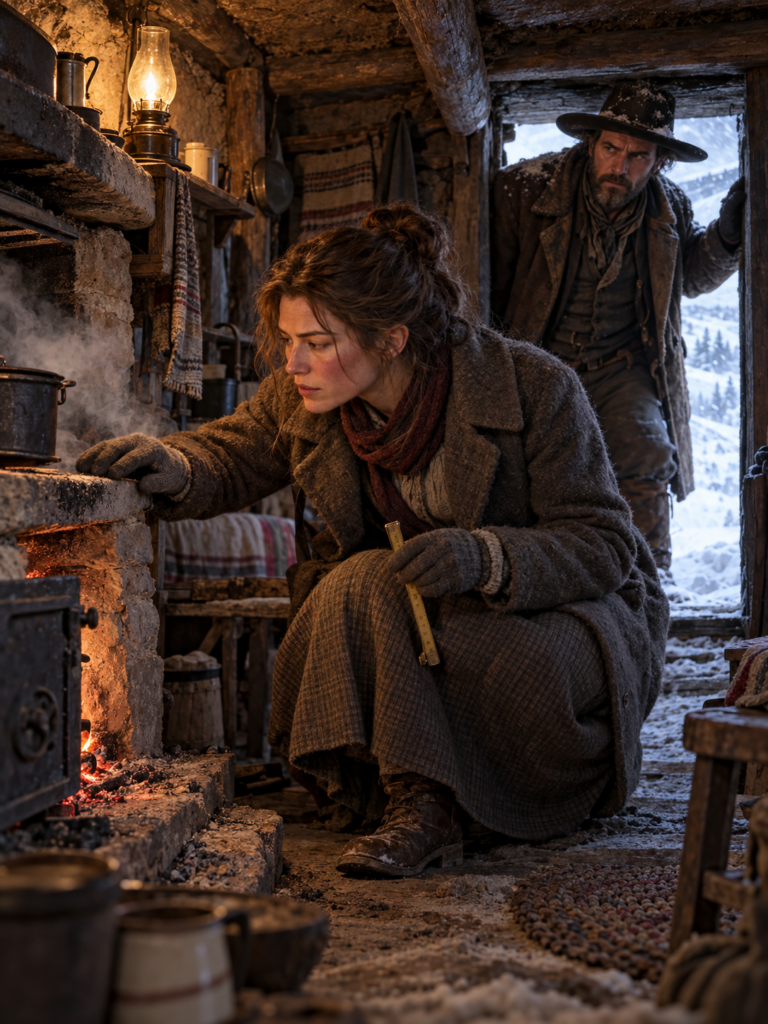
Jessa pushed the third pine split into the firebox and kept her eyes on the soot-blackened lip.
The flame caught.
Outside, northwest wind scraped over the granite.
Inside, smoke continued moving away from her.
She did not erase yesterday’s crescent.
A failure left visible was harder to forget.
For nearly three hours, Jessa tested the rebuilt outlet through changing gusts. She marked points along the stone bench with pencil, checking how steadily warmth traveled through the masonry after the flame had died.
No fresh soot appeared.
The draft held.
The next day she tested again.
Then once more.
Only after three successful burns did she allow herself to change the question.
Not whether the shelter worked.
Whether she could safely live in it.
Jessa began carrying supplies uphill.
Blankets first.
Then flour, dried apples, beans, coffee, lantern oil, tools, water, and part of the precious wood stacked beside her cabin.
She kept the shelter’s old provisions separate.
Emergency food was useful.
Unknown food was still unknown.
Her old bay mare, Bracken, remained below in the lean-to, which meant Jessa would still walk between the ridge and cabin morning and evening.
The first full night underground, she burned three short splits.
Then she let the fire die.
Hours later, Jessa woke and placed her palm against the stone bench.
Warmth remained.
The water was liquid.
Three unused pieces of wood still lay beside the heater.
At the cabin, such a night would have taken seven splits.
Maybe nine.
Jessa opened her fuel ledger.
For weeks, each calculation had told her the same thing.
Winter would outlast her wood.
This time, the numbers changed.
Not enough for certainty.
Enough for margin.
She almost smiled.
Then fine dust fell beside the downhill wall.
Jessa looked up.
One roof timber had shifted.
Barely.
Someone less watchful might never have noticed.
She opened Warren’s folding rule and measured from the dirt floor to the underside of the sill.
She marked the point.
The next morning she measured again.
The roof had dropped approximately one-eighth of an inch.
After more snow, nearly a quarter.
Jessa moved her cot immediately.
Then the food.
Then the lamp oil.
Warmth would not matter beneath a collapsed roof.
Outside, she cleared snow from the downhill side until she found the real problem.
The lodgepole itself was sound enough.
The stone supporting one end had settled.
Years of thaw, runoff, freezing, and shifting earth had weakened the bearing.
Jessa stood in the snow, studying the roofline.
The buried chamber protected her from wind.
It also carried the weight of winter above her head.
She needed timber.
At dawn she found a dead lodgepole in a drainage east of the ridge, cut it into a main shore and cap, and hauled the pieces uphill by handsled.
She left the old sill in place.
Removing a loaded support before replacing its strength made no sense.
Inside, she set flat shale on firm ground, stood the new shore beneath the weakened section, fitted the cap, and drove a wooden wedge.
Once.
Twice.
The timber rose only slightly.
Enough.
She added an angled brace.
Then measured.
The next morning, no change.
Another day.
Still none.
Forty-eight hours later, Warren’s rule showed the same distance.
Only then did Jessa trust the repair.
Several days afterward, someone knocked on the low timber door.
Jessa reached for her lamp.
“Who is it?”
“Amos Reddick.”
She opened the door.
The neighboring stockman ducked inside, brushing snow from his shoulders.
“I saw smoke where no chimney ought to be.”
His eyes moved around the chamber.
Stone bench.
Fuel pile.
Roof brace.
Soot crescent.
Water crock.
Amos removed one glove and pressed his palm against the bench.
“The fire’s out.”
“Eight hours.”
He looked at her.
Then at the wood.
“You built this?”
“Found it.”
His attention returned to the black mark above the heater.
“That yours?”
Jessa told him.
Not just that the heater worked.
She told him how smoke had pushed backward.
How she had misjudged the shale.
How she had rebuilt the outlet and tested it afterward.
Amos listened without interrupting.
Then he stepped outside.
Jessa followed.
He studied the entrance.
“In a real northwest blow, this drift line could bury your door.”
Jessa looked toward the slope.
Amos pointed lower.
“And runoff crosses near your intake. Ice builds there, you could lose air.”
She felt irritation first.
She had spent days proving the shelter.
Measured it.
Repaired it.
Tested it.
But Amos had not said the shelter was useless.
He had identified two things she had not prepared for.
Jessa looked at the entrance again.
He was right.
“The shelter has held,” she said.
“So far.”
She met his eyes.
There was no satisfaction in his expression.
Only concern shaped like practical judgment.
Jessa nodded.
Amos pulled on his glove.
“I’ll leave you to it.”
He walked downhill without trying to order her back to town, without offering to take over her repairs, without treating caution as proof that she could not manage alone.
After he disappeared beyond the ridge, Jessa picked up her shovel.
She carved a protected recess beside the doorway where the shovel could remain reachable even if snow packed against the entrance.
Then she drove a marker pole into the slope.
She cleared the runoff near the intake.
Sorted her firewood.
Carried more water uphill.
Strengthened Bracken’s lean-to.
By noon the following day, the warning signs had multiplied.
Smoke from the cabin flattened instead of rising.
Harness grease stiffened.
Bracken turned her rump northwest earlier than usual.
High clouds spread across the sky.
Then the wind stopped completely.
Lyle Mercer came along the freight road before turning back toward Harrow Creek.
“Road crew’s leaving the upper trail,” he called. “Hard front coming.”
Jessa looked toward the motionless pines.
The warning had already arrived.
Late that afternoon, she checked Bracken’s rope, water, hay, and windward boards.
Then she climbed toward the shelter.
Behind her, the first northwest gust struck the ridge.
By the time Jessa reached the low timber door, snow was already moving sideways.
She ducked inside, pulled the door shut, and reached for three dry splits.
Jessa laid the three dry splits in the firebox and struck flame to the kindling.
The heater drew immediately.
That mattered more than warmth.
She watched the smoke disappear beneath the bench, then checked the low intake.
Air moved.
Outside, the storm deepened so quickly that within an hour the world beyond the timber door had vanished into white pressure.
Jessa opened the door once.
The marker pole still stood clearly above the drift.
Later, only its upper portion remained.
Near midnight, she pushed at the door again.
It moved perhaps three inches.
Packed snow stopped it.
Jessa did not panic.
That was why she had dug the interior shovel recess.
Kneeling at the threshold, she cut packed snow away from inside until the door opened enough to breathe freely and give her an emergency exit.
Behind her, the fire had already fallen to embers.
The stone bench released its stored warmth slowly.
The chamber remained steady.
No rattling walls.
No screaming gaps between boards.
The earth absorbed what the cabin had always fought directly.
Jessa checked the roof mark.
Unchanged.
She checked the intake.
Clear.
Then came a dry click overhead.
Jessa lifted her head.
Dust drifted through the lamplight.
Another click.
Not wind.
Wood.
She raised the lamp.
A lodgepole beyond the section she had repaired had shifted against its stone bearing.
Half an inch at most.
The timber itself had not split.
Good.
The support beneath it had moved.
Bad.
Snow drifting over the ridge had changed the load above the chamber.
Jessa stared at the roof.
Outside, wind howled hard enough to make any attempt to clear snow from above foolish.
She could not remove the load.
She could only support it.
Her gaze moved to the rear wall.
The unused length of lodgepole from her earlier repair remained there.
She dragged it beneath the shifted beam.
Too short.
Jessa did not wedge it crooked and hope.
She stacked broad pieces of flat shale on firm earth, building a higher footing until the lodgepole reached the proper position.
Then she placed a short cap above it.
A gap remained.
She took a wooden wedge.
One strike.
Another.
The roof gave a long, low groan.
Jessa stopped instantly.
Mallet raised.
Waiting.
Nothing.
She lowered the tool.
Measured floor to timber.
Waited.
Measured again.
No change.
The new shore was carrying weight.
Jessa exhaled.
Then the lamp flame altered.
It had been leaning steadily toward the outlet.
Now it stood almost straight.
Jessa crouched beside the intake.
Frost had begun forming inside the channel.
Fine blowing snow and bitter cold were narrowing the passage.
She reached toward the fuel pile.
Stopped.
More fire with less air would solve the wrong problem.
The cabin stove had taught her to think in terms of heat.
The buried shelter demanded something more complicated.
Heat.
Air.
Load.
Fuel.
Water.
Each could fail separately.
Jessa set the split down.
Using a light tool, she carefully loosened frost from the intake until air moved again.
The lamp flame leaned.
Only then did she return to the heater.
The room had cooled.
But she was alive.
The roof stood.
The draft worked.
That was enough.
For the next two days, the storm reduced Jessa’s life to repeated measurements.
Clear the intake.
Check the braces.
Count wood.
Check water.
Eat carefully.
Clear enough snow from the entrance to preserve movement.
Sleep.
Wake.
Measure again.
Whenever the wind weakened enough, she worked toward Bracken’s lean-to.
The mare remained standing, coat rough with cold, frost gathering around her muzzle.
Jessa broke ice.
Added hay.
Checked the strengthened boards.
Returned uphill.
There was no grand act of survival.
Only dozens of small tasks done before they became emergencies.
By the third day, the cold had sharpened until iron hurt through gloves.
Jessa opened the shelter’s old emergency food.
A little hardtack.
Some beans.
Salt.
She combined them with her own provisions.
The old supplies did not save her from starvation.
She had never expected them to.
They stretched her margin.
So did the wood.
That mattered more.
Jessa counted the remaining pieces again.
At the cabin, this weather would have devoured them.
Underground, firing small loads into the masonry gave her hours of warmth afterward.
She studied the old black supply marks beneath the shelf.
E.P.
H.D.
Whoever they had been, they had counted too.
Jessa sharpened her pencil.
Beside their tallies, without covering them, she added her own.
On the fourth morning, the wind weakened.
The timber door still would not open.
Snow had packed hard outside.
Jessa began digging from the shovel recess.
Upward.
Forward.
Toward the marker pole.
The work took more than an hour.
Then her shovel broke through.
White daylight poured into the chamber.
Jessa stopped.
For several seconds she simply stood there, breathing air from outside.
Then she climbed through.
Winter had measured itself across North Fork.
The cabin chimney cap leaned crooked.
Part of the woodshed roof had collapsed.
A drift buried the side entrance.
Fence lines had disappeared.
Farther across the basin, part of another livestock shelter was down.
Jessa turned toward Bracken.
The mare stood.
Hungry.
Cold.
Alive.
The reinforced lean-to had held.
Jessa rested her forehead briefly against Bracken’s neck.
Then she worked.
Water first.
Feed.
Snow clearance.
Roof inspection.
Only after the mare was settled did Jessa return to the shelter.
A figure was coming over the ridge on snowshoes.
Amos.
He reached the entrance, ducked inside, and said almost nothing.
First he put his bare palm against the bench.
Then checked the water crock.
Then the woodpile.
His gaze traveled to the additional roof shore Jessa had installed during the storm.
“You had another shift.”
“Second night.”
“You went outside?”
“No.”
He nodded once.
“Good.”
Jessa almost challenged the word.
Then she saw his expression.
He was not praising obedience.
He was acknowledging judgment.
Amos looked at the cleared intake.
“How often?”
“Every few hours when the frost was worst.”
“How much wood?”
Jessa handed him the tally.
He read it.
Then read it again.
The amount was far below what the exposed cabin would have consumed.
Amos looked toward the door.
Outside, broken boards and buried trails showed what the storm had done above ground.
Inside, water remained liquid.
Fuel remained stacked.
The braces remained under load.
He placed his palm against the stone bench once more.
Jessa waited for him to say something about Harrow Creek being wrong about her.
He did not.
She was grateful.
Winter had answered that question already.
Instead, Amos gave the tally back.
“This place didn’t save you.”
Jessa’s eyes narrowed.
“No?”
He gestured around them.
“You found it. Tested it. Fixed the flue. Braced the roof. Kept the intake open.”
He glanced at the remaining wood.
“Someone less careful could have died in here and called it bad luck.”
Jessa looked at the soot crescent.
She had deliberately left it untouched.
Proof of the moment she had nearly trusted success too early.
“The shelter gave me margin,” she said.
Amos nodded.
“That’s more than winter usually gives.”
For the first time since he entered, something in Jessa loosened.
Not because Amos believed in her.
Because he understood the difference.
Survival had not come from discovering a miracle.
It had come from refusing to mistake possibility for certainty.
When the trail reopened days later, Harrow Creek began sending visitors.
Not crowds.
Just people who had heard.
Mabel Crowder came first.
She ducked through the low entrance with the same skeptical face she wore behind the dry-goods counter.
Her gaze moved to the soot mark.
The roof shores.
The tally.
The remaining fuel.
She pressed her hand against the bench.
“How long does this stay warm?”
Jessa almost smiled.
Mabel did not apologize for saying North Fork could break a healthy man.
She did not need to.
That question was enough.
Lyle Mercer came next.
He hauled freight camps through country where wood could become more valuable than money.
He wanted measurements.
“How thick is the bench?”
“Depends where.”
“How long is the flue?”
“Long enough to transfer heat before the outlet.”
“You could build another.”
“Maybe.”
Lyle frowned.
“That’s all?”
Jessa looked around.
“No single piece makes it work.”
She touched the earth wall.
“This stops wind.”
Then the stone bench.
“This stores heat.”
She pointed toward the intake.
“That has to stay open.”
Toward the roof.
“That has to carry snow.”
Then the woodpile.
“And none of it matters if you burn fuel faster than you can replace it.”
Lyle nodded slowly.
No miracle.
A system.
Days later, Amos arrived carrying a rough sketch.
Jessa was outside cutting kindling.
“What’s that?”
“Livestock warming room.”
She looked at him.
“You’re building one?”
“Thinking about it.”
“Underground?”
“Partly.”
“Roof load?”
“Still working on it.”
“Drainage?”
“Marked.”
“Air intake?”
“That’s why I’m here.”
Jessa set down the hatchet.
Amos held out the sketch.
“I want to measure your bench.”
Jessa reached automatically for the folding rule inside her coat.
Warren’s rule.
She opened it halfway.
Then stopped.
For months, the brass hinges had belonged only between her hands.
The rule had measured the wood disappearing from her stack.
The roof sinking toward her bed.
The narrow distance between enough and not enough.
Amos waited.
Jessa looked at him.
Then she folded the rule closed and placed it in his palm.
“Don’t drop it.”
His fingers curled carefully around the worn wood.
“I won’t.”
He unfolded it over the stone bench.
Jessa watched her father’s rule stretch across something another person now wanted to understand.
And for the first time since Warren’s death, the tool did not feel like proof of everything she had lost.
It felt like something still useful.
Amos measured the bench.
Then he stopped.
“Jessa.”
She looked up.
His attention had gone to the wall behind her.
Near the old supply marks, a thin line of moisture had appeared where no moisture had been before.
Jessa crossed the room.
The snow outside had begun softening under a rare afternoon rise in temperature.
Water was finding a path through the earth cap.
She touched the damp wall.
Cold.
Fresh.
The storm had ended.
The shelter had survived.
Now thaw was asking a different question.
Jessa moved the food containers first.
Then the lantern oil.
Then her blankets.
Amos set Warren’s folding rule safely on the stone shelf.
“Where’s it coming from?”
“Not sure yet.”
He reached toward the wet wall.
Jessa said, “Wait.”
Amos stopped.
She held the lamp close without touching the earth.
The damp line descended at an angle.
Not directly from the roof.
That mattered.
“If the cap were leaking straight through, we’d likely see it above us.”
Amos looked upward.
“So runoff.”
“Maybe.”
Jessa went outside.
Amos followed.
Snow still covered most of the ridge, but afternoon warmth had softened its surface. Meltwater moved beneath the upper crust in narrow channels.
Jessa walked the slope slowly.
She found a shallow depression above the shelter.
Water gathered there before spilling toward the granite.
Not much.
But enough.
She followed its line.
It crossed near the rear wall.
Amos crouched.
“You want me to trench it?”
Jessa considered.
“No.”
“Why?”
“Ground’s still frozen underneath. Cut too deep and we could send more water where we don’t want it.”
Amos nodded.
“What do you want?”
There it was again.
Not What are we doing?
Not Stand back.
What do you want?
Jessa pointed toward loose stone upslope.
“We divert only the surface flow. Shallow. Nothing near the roof until I know where the earth cap ends.”
Amos removed his gloves.
“Show me.”
They worked until evening.
Jessa set the line.
Amos moved stone where she directed.
The diversion was crude but controlled, guiding meltwater sideways before it reached the depression.
Inside, the damp line stopped growing.
Jessa marked its edge with pencil.
Another measurement.
Another thing not to trust too soon.
“You going back to the cabin tonight?” Amos asked.
“No.”
He looked at the roof.
“Because of the melt?”
“Because I want to know whether the line moves.”
“I could stay.”
Jessa glanced at him.
Amos added, “Outside. Or in the cabin. If you want another pair of hands nearby.”
The distinction mattered.
He had offered availability, not authority.
“I’ll be fine.”
“All right.”
No argument.
He picked up his gloves.
At the door, he looked back at Warren’s folding rule.
“You should keep that inside your coat.”
Jessa almost smiled.
“I usually do.”
Amos left before dark.
Jessa remained underground.
Every hour she checked the damp line.
No spread.
Near midnight, the temperature dropped again.
The melt slowed.
The line held.
By dawn, the wall had begun drying.
Jessa wrote another note in her small ledger.
Surface runoff after thaw. Divert upslope. Watch rear wall.
She closed the book.
Winter had stopped feeling like one enemy.
It was a series of conditions.
Wind.
Cold.
Snow load.
Smoke.
Ice.
Water.
Each demanded something different.
And she could answer only what she actually observed.
That lesson had saved her more than once.
Over the next several weeks, North Fork settled into a hard but manageable rhythm.
Jessa continued sleeping mostly in the shelter during severe weather.
She returned to the cabin when conditions allowed, aired bedding, repaired damage, and continued cutting whatever fuel she could safely gather.
Bracken remained her largest daily obligation.
The mare ate steadily.
The haystack shrank.
But unlike Jessa’s earlier firewood calculations, the winter feed still held a reasonable margin.
Harrow Creek changed slowly around her.
Not into admiration.
That would have embarrassed everyone involved.
Into curiosity.
Mabel began setting aside lamp oil before Jessa arrived in town rather than asking whether she intended to “keep fighting that ridge.”
Lyle brought her two pieces of sound lodgepole after a freight run.
“For braces,” he said.
Jessa looked at him.
“Payment expected?”
“No.”
“Then I owe you.”
“You can tell me how that heater behaves in March.”
That was acceptable.
Netty Voss, the boarding housekeeper who had once slipped two extra candles into Jessa’s sack without comment, listened to Jessa describe the shelter’s ventilation.
When Jessa finished, Netty said only, “Your father would’ve liked the measurements.”
The sentence struck harder than Jessa expected.
She looked down at the brass rule on the table.
Warren had died before spring.
His wheelwright shop had vanished into debt.
For months, grief had existed inside Jessa mostly as work.
File claim.
Repair roof.
Cut wood.
Count food.
Survive.
She had not allowed herself many thoughts about what remained after survival.
Netty poured coffee.
“You miss him.”
Jessa’s throat tightened.
“Yes.”
“Doesn’t mean you have to become him.”
Jessa looked up.
Netty had already turned toward the stove.
The words stayed.
Warren had taught Jessa precision.
Patience with wood.
Respect for load and grain.
The habit of measuring before cutting.
But he had also spent much of his life believing competence was something proven privately.
If work held, no explanation was needed.
If work failed, explanations were excuses.
Jessa had inherited more of that than she realized.
North Fork had intensified it.
She had answered Harrow Creek’s doubts by saying nothing.
She had accepted Netty’s candles without admitting gratitude.
Accepted Lyle’s warning without acknowledging it.
Listened to Amos identify flaws in the shelter while irritation rose before reason.
Self-reliance had kept her alive.
But there was a point where refusing all dependence became its own kind of pride.
Jessa carried that thought home with her.
A week later, Amos arrived with another sketch.
This one showed the warming shelter he planned for calves during hard weather.
Jessa examined it.
“Your exhaust is wrong.”
Amos leaned closer.
“How?”
“You’re putting it where wind crosses the barn corner.”
He frowned.
“That’s sheltered.”
“Usually.”
She took a charcoal pencil.
“Northwest gust hits here, curls around, pressure could drive backward.”
Amos watched her draw a line.
“You’re sure?”
“No.”
He raised an eyebrow.
Jessa looked at him.
“I’m sure enough to tell you to test it before you trust it.”
Amos smiled.
“Fair.”
She showed him how she had used wool threads around the granite bluff.
Amos took notes.
Then he looked at the shelter wall.
“You ever learn who E.P. and H.D. were?”
“No.”
“You curious?”
“Yes.”
“You ask Orin Bell?”
Jessa paused.
The land clerk.
When she had filed the North Fork claim, Orin had strongly advised against it.
He knew parcels.
Old filings.
Abandoned improvements.
Maybe previous occupants.
“No.”
Amos shrugged.
“Might be worth it.”
The next time Jessa went to Harrow Creek, she entered the land office.
Orin Bell looked up from his desk.
“Miss Ward.”
“Mr. Bell.”
He glanced toward the window, perhaps expecting North Fork to appear behind her as evidence of some disaster he had predicted.
“What can I do for you?”
Jessa placed her notebook on the desk.
“I found an old dugout under the granite shoulder.”
Orin stared.
“Where?”
She described the location.
His face changed.
“You’re sure?”
“Yes.”
“How large?”
“Twelve feet by seventeen, roughly. Stone bench heater. Low intake. Rear outlet. Timber roof.”
Orin leaned back.
“Well.”
“You knew?”
“No. But I know what might explain it.”
He went to a cabinet and pulled an old claim register.
Pages crackled under his fingers.
“There was an earlier filing near that ridge before the survey lines were corrected.”
“How early?”
“Sixties.”
He scanned the entries.
Then tapped two names.
“Elias Porter. Henry Dwyer.”
Jessa felt a small jolt.
E.P.
H.D.
“What happened to them?”
Orin read.
“Claim abandoned after two winters.”
“Why?”
“No detail.”
He turned another page.
“One note. Moved south.”
That was all.
No tragedy.
No bodies.
No buried fortune.
Two men had built a shelter, counted supplies, survived long enough to leave, and gone elsewhere.
Jessa found the simplicity unexpectedly moving.
She had been living inside another person’s unfinished solution.
Not a legend.
Not a miracle.
Work.
Human work.
Built for need.
Left behind.
Found again.
She returned to North Fork carrying copied names in her ledger.
That evening she sat beneath the black supply marks.
E.P.
H.D.
Below them, her own tally.
J.W.
She added the initials carefully.
Not over theirs.
Beside them.
By late February, daylight lingered longer.
The worst cold eased.
Snow remained deep, but winter had begun losing its absolute control.
Jessa’s original woodpile had not vanished.
That fact still surprised her.
Several times a week she measured the remaining stack.
Not because she feared the number anymore.
Because the number told a story.
The cabin might have consumed nearly everything.
The earth shelter had not.
She had burned less by using the masonry carefully.
She had also cut more whenever weather allowed.
Margin had become resilience.
One afternoon, Amos arrived carrying no sketch.
No tools.
Just a small sack.
“What’s that?”
“Coffee.”
“I have coffee.”
“This is better coffee.”
“According to whom?”
“Netty.”
Jessa considered.
“That improves its credibility.”
Amos ducked inside.
He sat on the end of the stone bench.
The heater had gone cold hours earlier, but warmth remained.
For a while neither spoke.
Then Amos said, “Mabel says you proved everybody wrong.”
Jessa groaned.
“She said that?”
“Not in those words.”
“What words?”
“She said she always thought the claim had potential.”
Jessa laughed.
Amos did too.
When the laughter settled, he looked toward the soot crescent.
“You going to leave that?”
“Yes.”
“Why?”
“Because the first test worked.”
He waited.
Jessa continued.
“And it still wasn’t safe.”
Amos nodded.
“You like remembering mistakes.”
“I like remembering incomplete conclusions.”
“That sounds less cheerful.”
“More useful.”
He turned the coffee sack in his hands.
“Spring comes, what then?”
Jessa looked toward the low doorway.
North Fork still needed repairs.
The cabin roof.
Woodshed.
Drainage.
Fence.
The shelter itself needed more permanent reinforcement once frozen ground released.
“I keep the claim.”
Amos did not look surprised.
“You ever consider moving back to town?”
“Yes.”
“And?”
“I don’t want to.”
He nodded.
Again, no persuasion.
Jessa studied him.
“Why do you ask questions you don’t intend to answer for me?”
Amos looked genuinely confused.
“Because they’re your questions.”
Something inside her shifted.
Small.
Quiet.
Not romance arriving like lightning.
Not dependence disguising itself as affection.
Just recognition.
This man did not need her to fail so he could rescue her.
He did not need her to agree so he could feel respected.
And he did not seem offended by competence that made him reconsider his own work.
Jessa looked away first.
“That warming room of yours?”
“Finished.”
“Tested?”
“Three times.”
“Wind?”
“Waited for northwest.”
“Smoke reversal?”
“None.”
“Roof?”
“Overbuilt.”
She smiled.
“Good.”
Amos rose.
At the doorway he paused.
“May I come by Saturday?”
“For what?”
“Coffee.”
“You just brought coffee.”
“I know.”
Jessa understood.
Amos understood that she understood.
Neither rushed to rescue the moment from silence.
Finally she said, “Saturday.”
His smile was restrained.
“All right.”
After he left, Jessa did not stand in the doorway imagining futures.
There was work to finish.
She repaired Bracken’s gate.
Split kindling.
Measured the roof shore.
Checked the intake.
Life did not stop because possibility had appeared.
By March, meltwater returned.
This time Jessa was prepared.
She widened the surface diversion carefully after locating the full edge of the earth cap.
She added stone where runoff concentrated.
She replaced one temporary support with a better seated post.
Amos helped only when asked.
Once, while carrying a cap timber, he stepped toward the location he thought best.
Jessa said, “Not there.”
He stopped.
“Where?”
She pointed.
He moved it.
No argument.
That ordinary moment mattered more to her than any declaration could have.
When warmer days finally exposed patches of brown grass, Jessa returned more fully to the cabin.
The hidden shelter remained stocked.
Not abandoned.
A storm refuge.
A root cellar possibility.
A place worth maintaining because she understood both what it could do and what it could not.
She found herself reluctant to remove the winter tally.
So she left it.
One clear morning, Amos arrived carrying the livestock-shelter sketch, now covered in measurements.
“I owe you something.”
Jessa looked at the paper.
“No.”
“Yes.”
“For what?”
He handed her a small wooden box.
Inside lay new brass hinge pins.
Jessa stared.
“For the folding rule,” Amos said. “The middle hinge is wearing.”
She looked sharply at him.
“You noticed?”
“When you let me use it.”
Jessa took out Warren’s rule.
The old hinge had begun loosening.
She had known.
Had not yet decided what to do.
Amos said, “I didn’t replace anything. Thought that should be your choice.”
Jessa looked at the pins.
Then at him.
“Thank you.”
He nodded.
She carried the rule to the workbench inside the cabin.
For years Warren had performed repairs like this himself.
Later, Jessa had.
This time she did something different.
She set the tool down between them.
“Hold this side.”
Amos placed two fingers against the wood.
“Here?”
“Yes.”
Jessa removed the worn hinge pin.
Cleaned the joint.
Set the new brass pin.
Tapped it carefully.
Then opened the rule.
Smooth.
Straight.
Still Warren’s.
Also hers.
Amos released it.
Jessa measured the workbench out of habit.
Then laughed at herself.
“What?”
“Nothing.”
She folded the rule.
Outside, North Fork was still rough.
The woodshed needed rebuilding.
Fence posts leaned.
Mud would come before grass.
Money remained tight.
Jessa was not suddenly prosperous.
Harrow Creek had not transformed into a town of believers.
And winter would return someday.
But stacked beside the shelter heater were three dry splits she did not need to burn.
Bracken grazed where snow had retreated.
The remaining fuel stood higher than Jessa had once believed possible.
The old black marks of Elias Porter and Henry Dwyer remained on the shelter wall.
Beside them sat hers.
Evidence that survival could pass from one set of hands to another without becoming ownership.
Amos stepped onto the cabin porch.
“Saturday still good?”
Jessa looked at him.
“It is Saturday.”
“I know.”
“You came early.”
“By three minutes.”
She removed Warren’s folding rule from her pocket.
“Unacceptable.”
“Should I leave?”
Jessa pretended to consider.
“No.”
Amos leaned against the porch rail.
He did not enter until she opened the door wider.
Inside, Jessa poured two cups of coffee.
Not because she needed help surviving the day.
Because she wanted company in it.
That distinction mattered.
Later, when Amos left, she walked alone to the hidden shelter.
Sunlight reached farther into the entrance now.
Jessa touched the soot crescent above the firebox.
Still there.
Then she placed her palm against the bench.
Cold today.
It did not frighten her.
She looked at Warren’s rule.
All winter it had measured danger.
Shrinking fuel.
Dropping roof beams.
Narrow margins.
Now she unfolded it across the stone bench where Amos had once measured his own plans.
Seven feet.
Same as before.
But the meaning had changed.
The rule no longer told Jessa only how close she was to losing something.
It could measure what remained.
What held.
What could be repaired.
What could be shared without being surrendered.
Jessa folded it and slipped it back into her coat.
Then she stepped outside beneath a clearing Wyoming sky and stacked three dry pieces of wood beside the door.
Wood she had.
Wood she had counted.
Wood she did not need to burn.
Not yet.


