
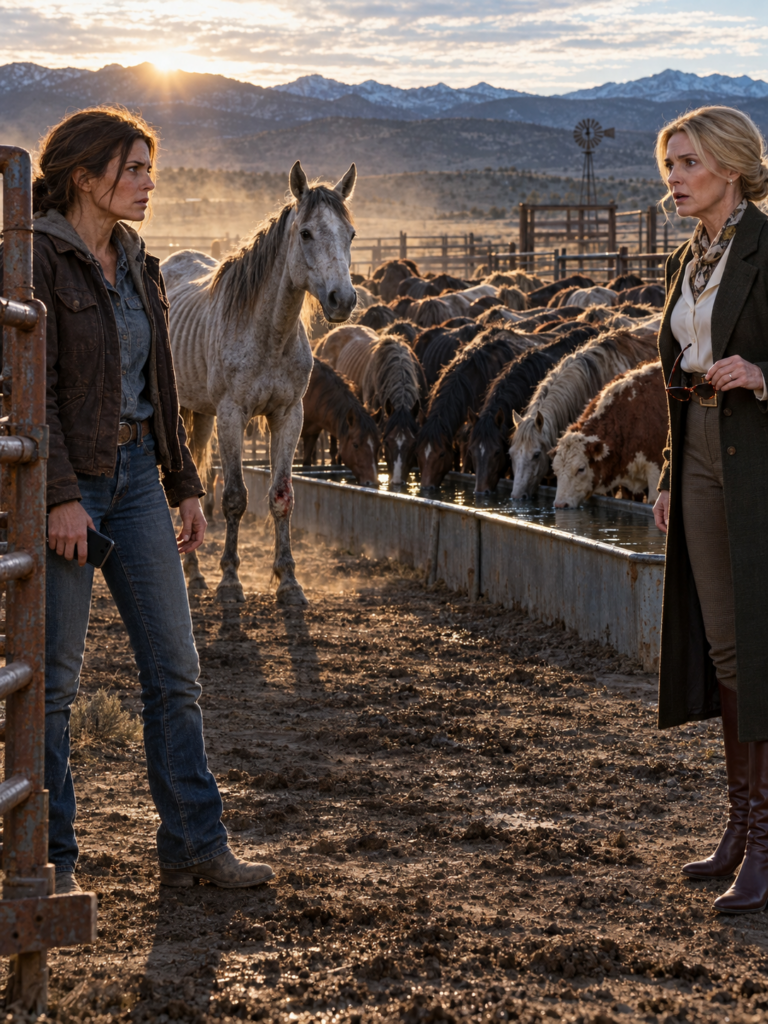
Mara swung into the saddle, turned west, and followed the fence until the afternoon sun threw every steel post into a long black shadow.
She did not cross the wire.
She stayed on the open side, photographing the wash, the hollow Juniper had crawled beneath, and the lines of fencing that appeared to funnel the basin toward the dry canyon.
Then something dull and round caught the light among a pile of stones.
Mara dismounted.
Sixty feet from the fence stood an old survey monument.
She wiped dirt from its aluminum cap.
Township.
Range.
Section.
A federal agency mark.
A date from the 1950s.
No Blackwood name.
Mara read it twice.
Then she looked at the fence again.
Preston had threatened to call the sheriff because she had supposedly trespassed on Blackwood land.
But if that monument stood where Mara thought it did, part of the fence might not be on Blackwood land at all.
For the next eleven days she traded saddle leather for fluorescent lights.
She sat in the county recorder’s office with plats, deed books, pencils, and a ruler.
Nobody handed her the answer.
She built it.
Parcel by parcel.
Blackwood Cattle and Land had assembled its western holdings over years, and at first glance the map looked solid.
It was not.
A narrow strip ran through the middle.
Federal ground.
Unsold.
Unbroken.
Reaching toward the canyon.
Mara sat very still.
The fence with the Blackwood signs crossed it.
That did not yet prove the horses had been deliberately trapped.
In fact, the deeper she looked, the less simple the story became.
The tank and pipeline had legitimate cattle-management purposes.
The fencing appeared designed to move Blackwood cattle efficiently between pastures.
Nobody had drawn “horse trap” on a plan.
But efficiency on paper had created something different on the ground.
Rimrock blocked the north side.
Broken lava blocked the south.
The new fences narrowed the remaining open country toward the canyon.
And the canyon spring—the water animals had used for generations—had largely been diverted into Blackwood’s storage system.
An animal entering the basin could follow feed and memory toward water.
Once inside, it could discover the water gone.
Then discover the exit narrowed behind it.
Wade studied Mara’s maps that evening.
“So nobody built a trap,” she said.
“No.”
“But they built one anyway.”
He looked at her.
“That’s closer.”
Mara’s stomach tightened.
Accidents could still have responsibility attached to them.
The next question was worse.
Had anyone known?
She found that answer indirectly.
A former Blackwood range hand named Dale Haskins had left the operation in July.
Mara did not corner him in public.
She called once.
He did not answer.
She left a message saying only that she was trying to understand what happened to the horses west of Red Hollow.
The next afternoon he called back.
His first words were, “I knew somebody would eventually ask.”
Mara gripped the phone harder.
Dale said he had ridden the fence in late June.
He had seen horses gathered at the narrow end.
Too thin.
Moving the wire repeatedly.
Trying to find a way through.
“You reported it?”
“In writing.”
“And then?”
Silence.
“Dale?”
“I was told not to cut fence until after fall cattle movement.”
Mara closed her eyes.
“How many people knew?”
“I don’t know.”
“Did Vivian?”
“I don’t know that either.”
That answer mattered.
Mara had spent days assuming Vivian’s pale face meant she had known everything.
Maybe it did not.
Maybe Vivian had known enough to be afraid, but not enough to understand why.
Which meant Mara could not afford to turn suspicion into accusation.
She needed proof.
Wade found the next piece.
Years earlier, the water district had mounted a wildlife camera near the canyon spring.
Funding had disappeared.
The monitoring program had been forgotten.
But the camera housing might still be there.
A district technician agreed to check.
Three days later Wade called Mara from the road.
“They found the card.”
Mara stopped walking.
“Does it work?”
“Yes.”
“What’s on it?”
A pause.
“Enough.”
That evening, frames spread across Mara’s kitchen table.
April: horses drinking from a full spring.
May: pipeline construction in the background.
Late May: the pool shrinking.
June: the horses returning again and again.
Thinner each time.
Then nothing.
Nineteen days of empty canyon.
Mara looked toward the dark window.
Beyond it, fourteen survivors stood somewhere near her corral because an old cow had remembered a route that corporations, survey maps, consultants, and fences had forgotten.
The county had scheduled a public meeting.
Vivian Blackwood would be there.
So would Preston.
Mara gathered the photographs, the plats, the monument image, and the camera frames into one cardboard box.
She did not know whether the room would believe her.
She did know one thing.
Preston had offered enough money to save her ranch if she stayed quiet.
Tomorrow night, Mara Ellison was going to carry his reason for wanting silence into a room full of people.
The next evening Mara carried the cardboard box through the elementary school doors and found every folding chair already taken.
Men stood along the back wall.
Ranch wives leaned together in the aisles.
County employees occupied a row near the front.
Cole sat beside Wade in the second row, long legs drawn back under his chair, watching his mother without saying anything.
Mara placed the box beneath her seat.
Across the room Vivian Blackwood arrived with an attorney and a range consultant.
Preston came separately.
That told Mara something.
Not enough to name.
Enough to notice.
Vivian wore a charcoal blazer and carried herself as though the meeting were another committee session she could manage by staying calmer than everyone else.
Mara had always hated that about her.
Tonight, she found herself respecting it.
Respect did not mean trust.
That distinction had become important.
The county chairman opened with a warning against personal accusations.
Mara agreed with him.
She had no intention of giving Preston the gift of making this sound like a feud between two ranching families.
When Vivian was recognized, she stood.
She was good.
For nearly twenty minutes she spoke about drought across the Great Basin, stressed wildlife, permitted water projects, and the dangers of turning a complicated range-management problem into a morality play.
She acknowledged the horses’ condition.
She called it regrettable.
She described Mara, without using the word reckless, as a financially strained neighbor who had become emotionally invested in an interpretation she did not fully understand.
Then Vivian looked toward the back of the room.
“Sometimes,” she said, “a cow is simply a cow that got out.”
Several people laughed.
Mara felt Cole shift in his chair.
She did not look at him.
She waited until Vivian sat down.
Then she stood.
“May I have four minutes?”
The chairman nodded.
Mara lifted the box onto the table.
She began with the survey monument.
No speech.
No accusation.
She held up the photograph and read the markings.
Then she laid down the historic plat.
A county employee leaned closer.
Mara placed the newer parcel map beside it.
“The fence marked Blackwood property crosses this corridor,” she said. “The corridor remains federal ground.”
Vivian’s consultant murmured something to the attorney.
Preston did not move.
Mara noticed.
Then she placed eighteen photographs on the table.
Fence.
Rimrock.
Lava.
The narrowing corridor.
The dry canyon.
The hollow beneath the wire with Juniper’s red-and-white hair caught in rust.
“This is where my cow crawled under.”
Someone in the back said, “Lord.”
Mara continued.
“She was born before those fences went up. Her mother used the old summer route toward the canyon spring. When water got short at my place, Juniper followed a route she remembered.”
She heard another murmur.
“She crossed into that basin. She found the horses. She later crawled back under the fence and headed east. The horses followed as far as they could. A post in loose wash gravel eventually failed. They got through.”
The chairman raised a hand.
“You’re saying the cow led them out?”
“I’m saying the cow knew where water had been and where water still was. The horses saw an animal leaving a dry basin with purpose and followed.”
Mara looked around the room.
“There was no miracle.”
That quieted them more effectively than claiming one would have.
Then Wade stood.
He carried a flash drive.
The wildlife-camera images appeared on the wall.
April.
Healthy horses.
Water.
May.
Construction.
Late May.
Less water.
June fourth.
The horses returned.
June ninth.
Thinner.
June fourteenth.
Thinner still.
June twenty-second.
A mare stood in the mud where the pool had been.
Then June twenty-ninth.
The last image with horses.
After that, empty canyon.
Nineteen days.
Mara did not watch the screen anymore.
She watched Vivian.
At first Vivian’s expression did not change.
Then a man stood four rows back.
Mara recognized Dale Haskins from his voice before she fully recognized his face.
“My name’s Dale Haskins.”
Preston turned.
For the first time that evening, his calm broke.
Only slightly.
But Mara saw it.
Dale swallowed.
“I rode range for Blackwood Cattle and Land nine years.”
Vivian looked at him.
Dale continued.
“I found those horses June twenty-seventh.”
The room tightened.
“I wrote it up that night.”
Vivian’s eyes shifted toward Preston.
Dale reached into his shirt pocket and unfolded a photocopy.
“I reported that the band was holding against the wire at the narrow end. I said they appeared water-stressed and asked permission to drop fence.”
The county chairman said, “And what response did you receive?”
Dale stared at Preston.
“To leave the fence in place until after fall movement.”
Vivian did not look at Mara.
She looked at her brother.
And Mara understood.
That reaction at Red Hollow had not meant what she had first believed.
Vivian had known there were horses west of the ranch.
She had known their appearance at Mara’s trough could expose a problem.
She had tried to control the public story.
She would have to answer for that.
But she had not known about the written order.
The decision that left the band inside the basin had not come from her.
Preston stood.
“Our operation manages eighteen hundred head through that rotation.”
His attorney touched his sleeve.
Preston ignored him.
“Dropping that fence mid-cycle would have scattered cattle across three pastures.”
Dale’s jaw tightened.
“They were dying.”
“No one knew that.”
“I wrote water-stressed.”
“That is not the same as dying.”
Mara heard the trap in the exchange.
Not a cartoon villain.
Not a man admitting he wanted animals dead.
Something colder.
A decision made quickly because one problem fit onto an operating calendar and the other did not.
Fourteen horses had become an inconvenience deferred until autumn.
Juniper had made the deferment visible.
The chairman called for order.
Vivian finally spoke.
“Preston.”
He looked at her.
“Did you receive his report?”
Silence.
The attorney leaned toward him.
Vivian repeated, “Did you receive it?”
“Yes.”
Every person in the room heard him.
Vivian went still.
Then she did something Mara had not expected.
She moved her chair away from her brother.
Only a few inches.
But it changed the room.
Preston saw it too.
The county chairman ended the exchange and said the documents would be referred to state and federal agencies.
The meeting broke into clusters.
Reporters—two local, one regional—approached Mara.
She refused to call what happened deliberate cruelty.
“We don’t know that,” she said.
One reporter blinked.
“You’re defending Blackwood?”
“No. I’m being accurate.”
That answer traveled faster than an accusation would have.
Outside, under the school’s security light, Vivian found Mara beside her truck.
Cole and Wade were nearby but stayed back.
Vivian looked older than she had two hours earlier.
“You could have made that much worse for me.”
Mara closed the truck door.
“I didn’t come here for you.”
Vivian’s mouth tightened.
“You think that makes you noble?”
“No.”
Mara faced her.
“I came because fourteen horses nearly died and your brother offered me enough money to pay my debts if I stopped asking why.”
Vivian’s eyes closed briefly.
“He offered to buy you out?”
“Twenty-five percent over your last number.”
“When?”
“Four days after the horses arrived.”
Vivian looked toward the building where Preston remained with the attorney.
“That was not authorized through me.”
Mara believed her.
Again, belief was not trust.
“You still came to my ranch and tried to make them disappear.”
Vivian’s gaze returned.
“Yes.”
No excuse.
The admission surprised Mara more than denial would have.
“Why?”
“Because I knew the water project was vulnerable to review. I knew there had been horses in that area. I knew if photographs spread, every permit and boundary line would be examined.”
“And you wanted them removed before that happened.”
“Yes.”
“You knew their condition.”
“I saw it when I got there.”
“And you still wanted them moved.”
Vivian’s face hardened, though not defensively.
“On that, I have no answer that makes me look better.”
Mara crossed her arms.
“You told me I wasn’t equipped to manage the problem.”
“I was trying to frighten you into handing it over.”
“At least now we’re using accurate words.”
Vivian looked at her for a long moment.
Then she nodded.
It was not an apology.
Mara would not have accepted one that easily anyway.
Vivian glanced toward Cole.
“What happens to your ranch if this review drags on?”
“That’s my problem.”
“It doesn’t have to be.”
Mara’s expression changed.
Vivian caught it.
“I’m not offering to buy it.”
“Good.”
“I’m saying the agencies may ask you for access, easements, monitoring agreements—”
“And I’ll hire someone to read every page.”
Vivian gave the faintest tired smile.
“You should.”
That was the first useful thing Mara had ever heard her say without an angle.
Still, Mara opened the truck door.
“Stay off my decisions.”
Vivian stepped back.
“I will.”
It was a small promise.
Mara intended to see whether she kept it.
The reviews began the following week.
Engineers measured the spring flow.
Survey crews re-established boundaries.
Wildlife staff evaluated the fourteen horses.
Wade treated two mares for dehydration-related complications.
The band remained on Red Hollow temporarily because moving them again too soon would add stress.
Mara hated the extra hay bill.
She also refused to let anyone turn the horses into mascots.
When a television crew asked to film the gray mare beside Juniper, Mara said no.
When a rescue group suggested naming the band after her, she said no.
When strangers mailed checks, she returned what she could and gave the rest to a regional range-water fund after getting written permission from the senders.
Cole watched all of it.
One night while repairing a float valve beside the stock tank, he said, “You know I don’t want this place, right?”
Mara’s wrench stopped.
She had known for months.
Hearing him say it still hurt.
“Yes.”
Cole stared at the valve.
“I thought you’d be mad.”
“I’m not.”
“You built everything around me getting it.”
“I built everything around keeping it.”
She looked at him.
“That’s not the same thing.”
His shoulders loosened.
“What are you going to do?”
Mara turned the wrench another quarter turn.
“Figure out what I want if I’m not saving it for you.”
It was the first time she had said that aloud.
The agency findings arrived in pieces.
The diversion had taken substantially more spring flow than the permit contemplated.
A bypass would be required.
The federal corridor was real.
More than two miles of fence would have to be relocated or redesigned.
The range consultant’s plans had not accounted for the natural barriers that turned ordinary fencing into a funnel.
And Dale’s report proved someone had been warned.
Preston resigned from direct operational management before the final administrative hearing.
Vivian remained the public face of the company.
She did not ask Mara to soften anything.
She also did not come back to Red Hollow.
Then, in early September, workers opened a temporary route through the western corridor and restored enough water to the canyon for a shallow pool to form.
The state team evaluated the horses.
The gray mare tested the opening first.
Mara watched from the rise behind her loafing shed as the band moved west.
Fourteen dark bodies.
Not thirteen.
Not the sixteen that had appeared in April camera frames either.
That missing foal stayed with Mara.
Some consequences did not reverse just because paperwork finally caught up.
Juniper stood at the Red Hollow trough chewing.
Completely uninterested.
Wade came up beside Mara.
“They’ll find the canyon.”
“You sure?”
“No.”
Mara glanced at him.
Wade shrugged.
“But now they can leave if they don’t.”
That mattered more.
Six days later the band was photographed near the restored spring.
Mara saw the image at her kitchen table.
The gray mare stood knee-deep in water.
For the first time since Juniper returned, Mara allowed herself to cry.
Not for victory.
For relief.
Then a certified envelope arrived.
Inside was notice of a proposed conservation agreement affecting Red Hollow’s western boundary.
Mara read the first page.
Then the second.
Then the compensation schedule.
Her heart began to beat harder.
The same three hundred twenty acres Vivian had called too small to honestly be a ranch now bordered the only legal route connecting open range to the restored corridor.
The agencies did not need Mara to sell.
They needed her to stay.
Mara did not sign anything.
That was the first difference between the woman sitting at her kitchen table in September and the woman who had spent eleven years believing every letter with official stationery might contain the sentence that finally pushed her off Red Hollow.
She called an attorney in Elko.
She paid for two hours.
Then four.
She read the proposed fifteen-year habitat agreement until she could explain every grazing restriction without looking at the pages.
The conservation organization wanted a managed strip along the ranch’s western boundary.
They offered annual compensation.
They offered cost-sharing for two water improvements that could serve both Mara’s cattle and animals using the corridor.
The first version also contained language giving the organization more control over seasonal grazing dates than Mara was willing to surrender.
Her attorney said it was standard.
Mara said standard did not mean acceptable.
She proposed changes.
The organization rejected one.
She held her ground.
They compromised.
She demanded clearer drought provisions.
They agreed.
She insisted that emergency livestock access remain under her control.
They rewrote the clause.
For the first time in years, Mara negotiated about the future without negotiating from panic.
The final payment was not a fortune.
That pleased her in a strange way.
A fortune would have turned everything into another miracle story, and Mara no longer trusted stories that required miracles.
The payment was practical.
Reliable.
Roughly equal to what a good calf crop could bring in an average year.
Enough to refinance the mortgage.
Enough to repair the barn roof.
Enough to replace the worst section of water line.
Enough that a bad hay year would still hurt without automatically becoming an extinction event.
Enough to stay.
Mara signed.
Then she went home and fixed the broken latch on the loafing shed because signing papers had not altered the fact that ranch life remained mostly gates, feed, weather, bills, and things that broke after dark.
The Blackwood review concluded eleven months after Juniper disappeared.
There was no dramatic criminal trial.
No handcuffs.
No giant settlement.
The diversion permit was revised.
A guaranteed minimum flow had to remain in the canyon year-round.
More than two miles of fencing came down and went back up elsewhere.
Wildlife-compatible openings were built into the corridor so animals entering that country would never again face the same dead end.
Blackwood Cattle and Land paid a civil penalty.
For an operation that size, the number was irritating rather than devastating.
Mara had never expected money alone to make the outcome meaningful.
The meaningful part was water moving again.
The meaningful part was an exit remaining open.
The meaningful part was that a range hand’s written warning would no longer disappear beneath an operating calendar.
Preston Blackwood never came back to Red Hollow.
His name appeared in administrative documents and nowhere else Mara cared about.
Vivian came once.
October wind had stripped the cottonwoods along the county road.
Mara was repairing a hinge when the white SUV approached.
She almost laughed at the symmetry.
Same gravel.
Same clean vehicle.
Same woman.
Different ground beneath both of them.
Vivian stopped near the house but did not walk toward Mara until Mara set down the wrench.
No broker.
No attorney.
No range consultant.
Just Vivian in a wool coat with her hands in the pockets.
For a while she looked west.
The corridor could not be seen clearly from the yard, but the ridge above it could.
“I suppose,” Vivian said, “you won’t be calling me after all.”
Mara remembered April.
The offer.
The mild voice telling her that eventually she would fail.
The certainty that Red Hollow’s future already belonged to someone with more money.
Once, Mara had imagined what she would say if she ever proved Vivian wrong.
Every version had been sharp.
Memorable.
Satisfying.
None of them seemed necessary now.
“No,” Mara said.
Vivian looked at her.
“I think I’ll be staying.”
The wind lifted dust between them.
Vivian nodded.
“That agreement should help.”
“It will.”
“You negotiated the grazing language?”
Mara’s eyes narrowed.
“How do you know?”
“I’ve seen similar agreements.”
“That’s all?”
Vivian gave a small, humorless smile.
“I said I’d stay out of your decisions.”
Mara remembered the school parking lot.
She had expected that promise to last until Vivian found a reason to ignore it.
Instead Vivian had kept it.
That did not erase what she had done.
It did not make them friends.
It changed one thing only.
Mara could no longer tell herself Vivian never changed course when confronted.
Sometimes accountability was not reconciliation.
Sometimes it was simply seeing somebody stop doing the thing they had no right to do.
Vivian looked toward the barn.
“How is the cow?”
“Expensive.”
That caught Vivian off guard.
A short laugh escaped her.
Mara almost smiled.
“Wade still says she eats more every winter than she’ll ever bring.”
“I assume she remains unimpressed by her influence.”
“She’s impressed by hay.”
Vivian nodded.
Then her expression settled.
“I was wrong about this place.”
Mara waited.
Vivian looked across the dry pasture.
“I judged it as an acquisition.”
“Yes.”
“I judged you by whether you could afford to keep it.”
“Yes.”
“I was wrong about that too.”
Mara leaned against the gate.
“You were wrong that I’d sell.”
Vivian’s eyes came back to her.
“That’s what I said.”
“No. It isn’t.”
Mara’s voice remained calm.
“You can be right that my finances were bad. They were. You can be right that this place was too small for the kind of cattle operation your family runs. It is. You can even be right that I was one failed well away from real trouble.”
Vivian listened.
“But you thought all of that added up to me having no choice except the one you wanted.”
The wind pushed a strand of Mara’s hair across her cheek.
“That’s where you were wrong.”
Vivian absorbed it.
Then she nodded.
“I understand.”
Mara believed she did.
That was enough.
Vivian returned to the SUV.
At the door she paused.
“For what it’s worth, I did not know Preston had received Dale’s report.”
“I know.”
Vivian looked surprised.
“I watched your face.”
For the first time, Vivian seemed to understand how much Mara had learned by being underestimated.
“I should have asked before I tried to bury the public problem.”
“Yes.”
“I’m sorry.”
Mara did not say it was all right.
It was not.
She said, “Thank you for saying it plainly.”
Vivian accepted that.
Then she drove away.
Dust rose behind the SUV exactly as it had months earlier.
Mara watched until it disappeared.
That was the entirety of her revenge.
No humiliation.
No property transferred into her name.
No Blackwood empire collapsing because a poor rancher defeated it.
Vivian simply left.
Mara remained.
Winter came early.
Cole submitted an application to a diesel-mechanics program in Elko.
He told Mara only after he hit send.
She read the confirmation email, handed his phone back, and said, “Good.”
He stared at her.
“That’s it?”
“What do you want, a parade?”
“I thought you’d make it weird.”
“I can if you want.”
He laughed.
Mara did too.
Then she went outside alone.
For years she had treated Cole’s possible inheritance of Red Hollow as part of the ranch’s justification.
If he wanted it, her struggle had a future.
If he did not, what had she been fighting for?
The answer was embarrassingly simple.
Herself.
She wanted the ranch.
Not because her ex-husband had left it behind when the marriage broke apart.
Not because Cole needed it.
Not because selling would prove Vivian right.
Not because holding on was morally superior to leaving.
She wanted it because she knew this ground.
She knew which draw held snow longest.
Which gate sagged every August.
Which pasture greened first after a late storm.
Which section of old pipe groaned before it split.
She knew where Juniper’s mother had once led cattle toward water.
She knew where the land connected to country beyond her deed.
For eleven years Mara had told herself she stayed because Red Hollow was the last thing she had left.
That winter she finally understood the direction of the sentence had always been wrong.
Red Hollow was not valuable because she refused to leave it.
She had refused to leave because she understood its value before anybody wrote that value into an agreement.
One cold morning in November, Wade came to pull blood from a sick heifer.
Mara held the animal while he worked.
Juniper stood ten yards away chewing with her notched ear angled toward them.
“She’s getting fat,” Wade said.
“She heard you.”
“She’s never respected my professional opinion.”
They finished with the heifer and walked toward the trough.
Wade carried his coffee.
Mara carried the sample case.
Then both stopped.
Fourteen shapes stood along the western ridge.
The horses.
Dark against a clear yellow sunrise.
The gray mare stood ahead of the others.
Mara did not reach for her phone.
She did not call Cole.
She did not move toward them.
For nearly a minute the mare looked down across Red Hollow.
Maybe she recognized the place.
Maybe she recognized the smell of water.
Maybe she recognized nothing.
Mara had learned to be careful about turning animals into symbols simply because people wanted meaning.
The mare turned.
The others followed.
One by one they disappeared over the far side.
The ridge became empty.
Wade drank his coffee.
“Well.”
Mara looked at him.
“That’s your observation?”
“I’m conserving insight.”
Juniper pushed her muzzle into the trough.
Wade nodded toward her.
“That cow caused more trouble in one summer than she’ll ever bring at auction in her entire life.”
Mara studied the old Hereford.
Notched ear.
Healed knee.
Broad back.
Absolutely no idea anyone had ever discussed her value.
“Maybe,” Mara said, “we’ve been putting the wrong prices on some things.”
Wade glanced at her.
Then west.
“Maybe.”
The sentence stayed with Mara.
The Blackwoods had priced Red Hollow by acreage.
The bank had priced it by collateral.
The town had priced Mara by her debt.
Mara herself had priced Juniper by winter hay, calf value, and whatever Wade joked she might bring at sale.
Every number had been defensible.
None had been complete.
Three hundred twenty acres had turned out to matter because of where they sat.
An old cow had mattered because of what she remembered.
A struggling rancher had mattered because she was stubborn enough to photograph a fence, patient enough to trace deeds, disciplined enough not to accuse before she had proof, and unwilling to accept that somebody else’s certainty about her future was the same thing as fate.
Even the fourteen horses had changed meaning.
At first they had looked like a wonder.
Then a burden.
Then evidence.
Then survivors.
Finally they were simply horses again.
That might have been the best ending Mara could give them.
In December she replaced the leaking section of barn roof.
Cole helped because he was home from school for break and because knowing he intended to leave someday did not mean he had already left.
They worked until dark.
Near the end, Cole sat astride a roof beam and looked west.
“You ever think about selling anyway?”
Mara handed him a screw.
“Sure.”
He looked startled.
“You do?”
“I think about lots of things.”
“I thought the whole point was you won.”
Mara tightened a fastener.
“That wasn’t the point.”
“What was?”
She considered how to answer.
Then she looked across the ranch.
Winning would have meant Vivian lost.
Winning would have meant Preston paid.
Winning would have meant the town apologized.
Some of those things had happened in pieces.
None explained the feeling Mara had now.
“The point,” she said, “is that I get to decide.”
Cole was quiet.
Then he nodded.
That, more than anything, told Mara he understood.
A year earlier she had believed freedom meant keeping Red Hollow no matter the cost.
Now she understood freedom differently.
She could stay because she wanted to.
One day she could leave because she wanted to.
Neither choice belonged to a banker, a neighbor, an ex-husband, a son, a drought, or a balance sheet.
The difference was not acreage.
It was ownership of the decision.
Below them Juniper bawled from the yard.
Cole looked down.
“She thinks we forgot dinner.”
“We almost did.”
They climbed from the roof.
Mara crossed the yard as daylight faded blue over the sagebrush.
At the trough she rested one hand briefly against Juniper’s neck.
The cow leaned away because affection was less interesting than feed.
Mara laughed.
Beyond the western fence, the reopened corridor lay invisible in the dark.
Water still ran into the canyon.
The new fence lines left passage where the old ones had closed it.
Animals could enter.
Animals could leave.
That simple fact felt larger to Mara than any speech made at the public meeting.
Juniper had not saved the horses because she was heroic.
Mara had not saved Red Hollow because she was destined to win.
Neither of them had known what the story would become.
One old cow had followed a memory of water.
One woman had followed the evidence that came home behind her.
Both had kept going when the country in front of them said the route was closed.
And in the end, that was enough.
Mara opened the gate.
Juniper walked through.
This time no fourteen horses followed.
No crowd waited.
No powerful neighbor stood pale beside the fence.
Just a tired rancher, an ordinary cow, a son carrying feed before leaving to build a life of his own, and three hundred twenty acres that no longer needed to prove they were large enough to matter.
Mara latched the gate behind them.
Then she turned toward the house, knowing at last that staying was not the same thing as being trapped.
She had a road out.
She simply chose, for now, to remain.


