
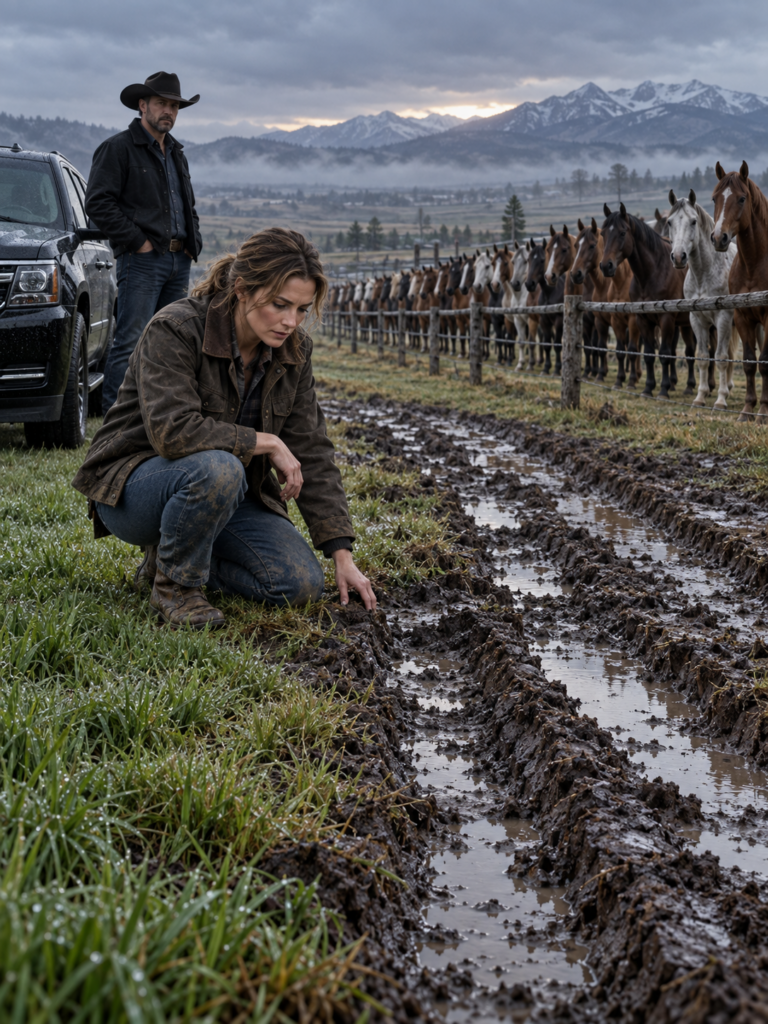
Maren’s hand stopped an inch above the gray tracking module.
“Don’t touch it,” Tessa said.
Maren drew back immediately.
They photographed the bag where it lay, documented the time, then locked it in Tessa’s veterinary evidence case.
For the first time since dawn, Maren possessed something Sterling Blackwood had not prepared an explanation for.
That did not mean she was safe.
Three mornings later, Vivian Pembroke filed for a temporary custody order on Calder, Flint, and Hollis.
The argument was clinical and devastatingly simple: the stallions were central to a disputed breeding incident, so they should be moved to a neutral facility to preserve possible evidence.
A judge signed before lunch.
At two o’clock a state-approved trailer backed toward Maren’s chute.
No one shouted.
No one threatened her.
That made it worse.
Calder walked up the ramp first because Calder always trusted Maren’s handling.
Flint resisted twice, then loaded.
Hollis threw his head near the top.
Maren stepped beside him and steadied the lead.
For several seconds she hated herself for helping.
Then she understood that frightening him would not save him.
So she kept one palm against his neck until he settled, and she let him walk forward calmly.
The divider closed.
Sterling stood near his SUV.
“All of this could end tonight,” he said.
Vivian offered Maren another transfer agreement.
The price was lower now.
Maren noticed.
Sterling did not deny it.
“Contested horses lose value,” he said. “Especially when the controversy follows the owner.”
Maren looked at the trailer holding the three animals he had been trying to buy for four years.
“You didn’t come here because forty-one mares went missing.”
His expression did not change.
“No?”
“You came because you knew where they would be.”
Vivian’s eyes lifted from the tablet.
Sterling only said, “Be careful what you accuse people of when you’re already in trouble.”
The trailer pulled away.
That night Maren’s daughter asked where the horses had gone.
“Visiting,” Maren said.
Later, alone in the dark kitchen, she hated that word too.
At eleven she opened the fireproof box under the stairs.
Nine years of records covered the table.
Registration certificates.
Transfer histories.
Laboratory reports.
Old pedigree documents.
The dispersal catalog where she had bought Hollis.
She stopped looking for proof that her horses were valuable.
Sterling already knew that.
Instead she asked a different question.
Why would a man with land, money, breeding facilities, lawyers, and hundreds of horses spend four years trying to acquire these three?
Near three in the morning, memory answered before paper did.
Sterling’s first visit.
He had stood beside Calder’s stall.
Before asking about fertility.
Before asking about performance.
Before offering money.
He had asked whether Maren still possessed the original Red Canyon foundation genetic records—the archived typing predating the modern registry database.
She had answered yes.
He had nodded and moved on.
At the time, the question had seemed technical.
Now it felt surgical.
Maren pulled the oldest manila envelope from the pile.
Its adhesive had gone brittle with age.
Inside were archived genetic reports linking Calder and Flint to the foundation stock from which the Red Canyon branch had descended.
A wealthy breeder shopping for stallions would ask what they could produce.
A man asking first about original genetic proof might be shopping for something else entirely.
Control.
Tessa called just after sunrise.
The tracking module had been accepted by a technician in Billings.
If its internal history had survived, they would know whether the mare had traveled on foot or by trailer.
Grant Sutter called an hour later with something less dramatic but equally useful.
He had requested transport records.
Blackwood Crown’s attorney had begun objecting.
“People don’t usually fight boring paperwork this hard,” Grant said.
Maren looked at the old genetic packet spread across her kitchen table.
“Grant, can you check whether the registry has announced anything involving foundation bloodlines?”
A pause.
“That’s specific.”
“So was Sterling’s first question four years ago.”
Maren ended the call and opened the packet fully.
Near the back was an archived reference sheet she had barely looked at in years.
She drew it toward her, turned on the kitchen light, and began comparing the Red Canyon entries line by line.
The first sheet contained nothing dramatic enough to frighten a wealthy man.
That was what made Maren keep reading.
Old genetic notations.
Registration numbers.
Foundation pairings.
Transfer dates.
Nothing that would mean much to anyone without the newer registry files beside it.
By breakfast, Maren had filled six pages of a notebook with names and questions.
Tessa arrived before noon carrying coffee and the expression of someone who had been awake nearly as long.
“You find something?”
“I found what he cared about before he pretended to care about buying the horses.”
Maren pushed the archived file toward her.
Tessa read Sterling’s old handwritten inquiry note that Maren had saved with the records.
Original foundation typing confirmed?
“Yes,” Tessa said slowly. “That’s not a casual question.”
“No.”
“You think this has something to do with Blackwood’s breeding claims?”
“I think I don’t know enough yet to accuse him of anything.”
That restraint became important.
Everything about Sterling’s pressure invited Maren to react emotionally.
To publicly accuse him before she could prove motive.
To sound desperate.
Instead she did what people had underestimated her for doing all her life.
She kept records.
Six days after Tessa delivered the tracking module, the technician sent the recovered data.
Ninety-one location entries.
Plain coordinates, timestamps, speeds.
Tessa printed them and drove directly to Juniper Hollow.
Maren sat at the kitchen table while Tessa pointed to the first relevant line.
11:47 p.m.
Willow Creek June—the mare carrying the tracker—was at a Blackwood Crown holding facility.
2:26 a.m.
The tracker began moving.
Maren followed the numbers.
The speed stabilized just under fifty miles per hour.
Not for seconds.
For thirty-eight minutes.
Straight along a county road.
Tessa leaned back.
“She was in a trailer.”
At 3:11 the tracker stopped.
Maren checked the coordinates against the map.
Her breath caught.
Two hundred yards south of Juniper Hollow’s eastern corner.
Exactly where she had documented five sets of heavy tire ruts.
At 3:24 the tracker moved again.
Slowly this time.
Walking speed.
At 3:31 it stopped twenty-one feet outside Maren’s fence.
Neither woman spoke.
They did not need to.
One mare had been hauled from a Blackwood Crown facility, unloaded beside Maren’s ranch, and walked into position.
The other forty stood beside her with clean legs and fresh halter marks.
The mares had not escaped toward the stallions.
They had been delivered.
Relief should have followed.
Instead, Maren felt something colder.
“Why risk forty-one expensive mares?”
Tessa understood immediately.
“If this was only about getting your horses, three or four would have made the same accusation.”
“Exactly.”
Forty-one was not random.
It was scale.
It was money.
It was a number designed to justify damages large enough to crush Juniper Hollow.
Tessa pulled Blackwood Crown’s public breeding catalog onto her tablet.
They compared the names of the mares one by one.
Willow Creek June.
Crown Lark.
Meridian Belle.
North Wind Alice.
Every mare belonged to the same premium group.
Crown Meridian.
Blackwood Crown’s flagship foundation program.
Not one animal had been pulled from the less valuable commercial bands.
“This wasn’t whoever happened to be in the nearest pasture,” Maren said.
“No.”
“They chose a list.”
Forty-one Crown Meridian mares allegedly exposed to three unauthorized stallions could create a breeding-loss claim worth millions.
It could trigger canceled contracts.
Insurance disputes.
Civil damages.
And if a small ranch could not pay?
Assets could settle a claim.
Three rare stallions were assets.
The mares were not the target.
They were the invoice.
Two days later Grant Sutter drove out with a folder beneath his arm.
He looked uncomfortable, which Maren had learned meant he had found something useful.
“The registry issued a notice six weeks ago,” he said.
He placed the letter on her table.
A broad genetic verification initiative.
Newer testing standards.
Foundation programs reviewed first.
Crown Meridian appeared in the first audit group.
The window opened in less than three months.
Maren read the notice twice.
Tessa was already thinking ahead.
“If Blackwood Crown has been advertising Meridian as direct Red Canyon descent—”
“They have,” Maren said.
“Then the registry needs a verified reference.”
All three of them looked toward the fireproof box.
The Red Canyon line had become so scarce that modern databases contained only fragments from some of the older branches.
But Maren held paper records, archived typing, transfers, and living animals whose ancestry could still be independently tested.
Sterling’s first question returned with horrifying clarity.
Did she still have the original genetic documentation?
He had not wanted to know whether her stallions were profitable.
He had wanted to know whether they were provable.
Maren authorized fresh genetic samples from Calder, Flint, and Hollis at the neutral holding facility, under third-party supervision.
Sterling’s attorney objected.
That told Maren almost as much as the result eventually did.
The samples went to an independent laboratory with no connection to Blackwood Crown.
Eleven days later, Tessa drove to Juniper Hollow without calling first.
Maren saw her truck and walked outside.
Tessa did not get out immediately.
She sat behind the wheel reading the same page again.
Finally she stepped down.
“They confirmed it.”
Maren said nothing.
“Calder, Flint, and Hollis are the only living verified male descent they can document from the original Red Canyon foundation stock.”
Maren looked toward the empty barn.
For years people had called her horses rare.
She had never understood how literal that word had become.
Tessa continued.
“There’s more. They ran preliminary comparisons against available Crown Meridian reference material.”
Maren felt her stomach tighten.
“And?”
“Some pedigree claims don’t align cleanly.”
“Meaning?”
“Meaning the lab will not call anything fraudulent from preliminary data. But they’re recommending a full review.”
The motive snapped into place.
Blackwood Crown had built premium prices, contracts, reputation, and breeding value around the claim that Crown Meridian continued the historic Red Canyon foundation line.
The registry was about to test that claim using modern methods.
And somewhere in a patched Montana barn sat three living animals whose archived documentation could become the comparison standard.
Sterling had tried to buy them.
When buying failed, he had built an incident capable of forcing their transfer.
Own the reference.
Control the comparison.
Or at minimum bury the only clean evidence beneath years of litigation.
Maren’s anger arrived then.
Not loud.
Not wild.
Dense.
For years Sterling had treated her poverty as leverage.
Her patched roof.
Her old truck.
Her daughter.
Her inability to spend what he could spend.
He had mistaken limited money for limited intelligence.
Tessa watched her carefully.
“What are you going to do?”
“Nothing.”
Tessa blinked.
“For now.”
That became the hardest choice Maren made.
For three weeks, she allowed Sterling to believe pressure was working.
Vivian sent another settlement package.
Maren responded slowly.
Vivian’s assistant heard hesitation in her voice because Maren put it there.
Rumors continued.
Maren corrected none of them.
Meanwhile Grant subpoenaed transport records.
Tessa certified veterinary findings on all forty-one mares.
The tracking export was independently validated.
An examiner compared Maren’s tire-rut photographs against stock-trailer configurations.
A fuel station fourteen miles east produced overnight security footage showing multiple livestock trailers traveling together during the critical window.
Maren spent evenings building a hearing binder.
Tabs.
Chronology.
Maps.
Veterinary reports.
GPS records.
Registry notice.
Genetic report.
She prepared it herself because paperwork had been the skill no one ever bothered respecting when it belonged to a woman with mud on her boots.
The county hearing fell on a cold Monday.
Every chair was taken.
Sterling arrived in a charcoal suit beside Vivian Pembroke.
He looked exactly as he always did: controlled enough to make everyone else feel emotional by comparison.
He spoke first.
He discussed breeding integrity.
Financial exposure.
Professional standards.
Then he described Juniper Hollow as a well-meaning family operation without the infrastructure necessary to steward unusually valuable animals.
He never called Maren incompetent.
He let the room arrive there on its own.
Several people nodded.
Maren waited.
When her turn came, she carried one binder to the front table.
No speech.
No anger.
Just evidence in order.
The tracking record came first.
11:47 p.m.—Blackwood Crown facility.
2:26 a.m.—movement.
Thirty-eight minutes at nearly fifty miles per hour.
3:11 a.m.—stop beside Juniper Hollow.
3:24 a.m.—walking pace.
3:31 a.m.—stationary outside Maren’s fence.
She read the speed aloud.
Someone near the back gave a short involuntary laugh.
No horse had galloped fifty miles an hour down a county road for thirty-eight minutes.
The second exhibit showed the five tire patterns.
The third showed fuel-station footage of trailers moving together before dawn.
Vivian stood.
“Those vehicles have not been established as company assets.”
Maren looked toward Grant.
He slid another document to the hearing officer.
Transport contractor records.
The contractor’s largest recurring client was Blackwood Crown.
Sterling changed tactics immediately.
“If company contractors moved animals without authorization, then obviously we support determining who was responsible.”
Maren heard it.
Everyone did.
He had moved from denying transport to isolating blame.
Individuals.
Drivers.
Unauthorized decisions.
Vivian whispered something.
Sterling ignored her.
Then the rear door opened.
A man in a work coat stepped inside carrying a paper folder worn soft at the edges.
Maren recognized him from the fuel-station footage.
Grant rose.
“Mr. Roark?”
The man nodded.
“Evan Roark. Third trailer.”
Sterling stopped moving.
Evan walked toward the front table with the original dispatch packet in his hand.
Evan Roark placed the dispatch packet in front of Grant Sutter.
“I kept paper copies,” he said. “Started doing that years ago after a company disputed my hours.”
Grant examined the pages before passing them to the hearing officer.
Five transport units.
Forty-one head.
Departure window: 1:45 a.m.
Reason: emergency livestock relocation.
No destination address.
Only verbal coordinates to be issued at staging.
At the bottom of the authorization page was a signature.
Sterling Blackwood.
The hearing room went silent.
Sterling’s attorney asked to inspect the document.
Vivian took it from the clerk, read the signature line, then the dispatch codes.
For the first time since Maren had known her, Vivian stopped looking prepared.
Sterling did not.
Not completely.
He leaned back.
“Mr. Roark was terminated from contractor rotation.”
Evan gave a tired smile.
“After that night.”
“For cause.”
“Two weeks after that night.”
Sterling turned toward the hearing officer.
“This man has a grievance.”
Maren waited.
Sterling continued, and with every sentence he revealed something more important than anger.
Fear.
Evan testified that the five drivers had been told to load designated Crown Meridian mares.
Not whichever animals were easiest.
A printed list.
Forty-one names.
They were instructed to remove visible identification halter pieces after unloading.
One module had apparently remained hidden in the webbing.
The convoy left the Blackwood facility under a signed emergency order.
There had been no emergency.
No wildfire.
No flood.
No veterinary evacuation.
No county warning.
At staging, drivers received coordinates leading to the road south of Juniper Hollow.
Evan had asked whose property they were approaching.
No one answered.
“I figured somebody important had already made the decision,” he said.
His gaze moved briefly toward Maren.
“I should’ve asked harder.”
That mattered to her.
Not because an apology could undo what happened.
Because responsibility spoken plainly had become rare in the room.
Sterling attacked Evan’s credibility for nearly ten minutes.
He questioned invoices.
Past disciplinary complaints.
Memory.
Payment disputes.
Maren let him finish.
A man losing control should not be interrupted while proving it.
Then she opened the final tab of her binder.
“Four years ago,” she said, “Mr. Blackwood visited my ranch for the first time.”
Sterling turned toward her.
“He asked whether I possessed original foundation genetic documentation for the Red Canyon line.”
Vivian’s head moved slightly.
Maren continued.
“He asked that before he asked about fertility, offspring, breeding performance, or price.”
Sterling said, “A buyer conducts due diligence.”
“Yes.”
Maren lifted the certified laboratory report.
“So did I.”
Copies went forward.
The laboratory’s language was restrained.
Calder, Flint, and Hollis represented the only currently verified living male descent the laboratory could establish through unbroken archived evidence from the original Red Canyon foundation stock submitted for review.
No accusation.
No drama.
Only proof.
Beside it sat the registry notice announcing enhanced verification of foundation pedigree claims.
Crown Meridian appeared in the first audit group.
Then came the preliminary comparison.
Several pedigree assertions within Crown Meridian could not yet be reconciled with the verified Red Canyon reference profile.
Further investigation required.
Nobody in the room needed Maren to explain the rest.
But she did anyway, because clarity mattered.
“Blackwood Crown has marketed Crown Meridian for years as a direct continuation of Red Canyon foundation stock.”
Sterling’s jaw tightened.
“The registry planned to review that claim.”
Maren rested one hand on the binder.
“My horses could provide a verified reference Mr. Blackwood did not control.”
Vivian stood again.
“This is speculation regarding motive.”
“Yes,” Maren said.
Vivian seemed surprised by the agreement.
“Motive is for investigators to determine. The transport records are not speculation. The GPS record is not speculation. The halter injuries are not speculation. The five trailer patterns are not speculation. The signed dispatch order is not speculation.”
She looked at Sterling.
“And my stallions never left their stalls.”
That was all.
Maren sat down.
She did not call Sterling a fraud.
She did not accuse Crown Meridian of being worthless.
She did not claim the preliminary genetics proved more than they proved.
That discipline gave Sterling nowhere useful to attack her.
Facts occupied the space anger would have wasted.
The hearing officer called a recess.
People did not talk loudly this time.
The same ranchers who had laughed when Sterling described Juniper Hollow as a backyard operation now avoided one another’s eyes.
Grant remained near the front reviewing documents.
Tessa came to stand beside Maren.
“You all right?”
“No.”
Tessa nodded.
“Good answer.”
Maren almost smiled.
Across the room Sterling conferred with Vivian.
His associates had stopped taking notes.
When the hearing resumed, the officer announced several immediate actions.
The temporary custody rationale involving Calder, Flint, and Hollis no longer stood on the original facts presented.
Their hold would be reviewed for dissolution.
Transport materials would be forwarded to the appropriate investigative authorities.
The registry would receive the certified genetic evidence.
Any transfer of the three stallions would remain prohibited while their evidentiary status was clarified—meaning Sterling could not obtain them through a civil settlement while the audit proceeded.
Nothing ended that afternoon.
That was important.
Large institutions did not collapse because one woman opened a binder.
Sterling was not handcuffed in the hearing room.
Blackwood Crown did not vanish.
The truth did something slower.
It changed direction.
What had begun as an examination of Maren Holt’s ranch became an examination of Blackwood Crown’s transport orders, insurance exposure, pedigree representations, breeding contracts, and internal decisions.
Within weeks, the registry suspended verification on portions of Crown Meridian pending full review.
Insurers requested records.
Transport contractors produced invoices.
Other employees answered questions.
The forty-one mares were transferred into third-party management while ownership, breeding status, and program records were sorted out.
The temporary order on Maren’s stallions was dissolved.
After the hearing, as people gathered coats and moved toward the door, Sterling approached her.
Vivian remained several steps behind.
For once he did not look at Maren’s clothes, her boots, or the binder in her hands as though all of it belonged to a category beneath him.
“What do you want?” he asked.
The question carried the assumptions of his entire life.
A settlement.
A number.
A rebuilt barn.
A larger ranch.
Money for silence.
Money for cooperation.
Money to transform insult into agreement.
Vivian lifted her tablet.
Maren thought about the first time Sterling had stood in her barn and told her that horses like hers needed a name big enough to stand behind them.
She thought about Calder loading calmly into a trailer because she had taught him to trust people.
Flint resisting twice.
Hollis throwing his head.
Her daughter asking where they had gone.
The lie: visiting.
Maren looked directly at Sterling.
“I want my horses home.”
Vivian’s fingers stopped.
Sterling waited.
Perhaps he expected a second demand.
There was none.
No price for humiliation.
No offer for the genetic archive.
No request to become part of his operation.
Nothing he could negotiate downward.
Grant called Sterling’s name from the front.
Sterling looked at Maren for another moment, then turned away.
Calder, Flint, and Hollis came home Thursday morning.
Maren followed the approved transport trailer the entire distance from the holding facility.
She kept exactly far enough back to see its tires.
Calder came down first.
He reached the bottom of the ramp, lifted his head, and stared at the barn as though offended anyone had rearranged his schedule.
Flint unloaded next and went directly toward the water tank.
Hollis came out last.
For one second he stood completely still.
Then he launched into the corral at a hard trot, completed one full lap with his tail raised, and stopped at the rail.
Maren laughed.
The sound broke something open.
She sat on the mounting block and cried.
Not beautifully.
Not quietly.
For ninety seconds she let herself feel the months of pressure she had refused to show Sterling Blackwood.
Then Calder walked over and breathed against her shoulder.
Maren wiped her face on her sleeve.
“Fine,” she told him. “You win.”
She stood and got the feed cart.
The larger investigation widened over the following months.
Pedigree claims became contract questions.
Contract questions became insurance questions.
Insurance questions returned investigators to the staged movement of forty-one mares through rain at three in the morning.
Evan Roark provided his records.
Other drivers confirmed portions of his account.
The registry’s full audit proceeded separately from any legal investigation and with much less drama.
That process proved more damaging to Blackwood Crown than public accusation could have been.
Some claims were verified.
Others required correction.
Some animals previously marketed under specific foundation descriptions could no longer be sold using those descriptions without qualification.
Customers asked questions.
Contracts were reviewed.
Quiet business relationships became quieter exits.
Sterling was not destroyed in one cinematic fall.
He lost certainty.
Influence.
The assumption that his version would automatically become the official one.
Maren found that more satisfying than spectacle.
At Juniper Hollow, another change occurred.
Operators who once passed her driveway without slowing began stopping.
Some apologized.
A few attempted the kind of apology that blamed rumor itself, as though rumors were weather systems rather than sentences repeated by people.
Maren learned not to rescue them from their discomfort.
One breeder stood beside her corral and said, “I should’ve known you wouldn’t haul forty-one mares in the dark.”
Maren replied, “You could have waited until you knew anything.”
He looked down.
“Yes.”
That was enough.
Then came offers.
Large ones.
Exclusive access to Calder.
Multi-year rights involving Flint.
A national program offered a number for Hollis that made Maren sit very still at the kitchen table.
Another offered to fund a new barn in exchange for priority breeding access to the entire line.
Before the Blackwood incident, those figures might have represented freedom.
Now she saw the trap inside a different kind of admiration.
Scarcity made people hungry.
The Red Canyon line had survived precisely because someone, somewhere, had failed to maximize it.
Maren refused every exclusive offer.
Instead she contacted four independent breeders whose judgment she trusted.
With the registry’s guidance, they created a preservation plan.
Limited annual breedings.
Genetic screening.
Health requirements.
Public documentation.
No hidden ownership chains.
No single program controlling access.
Every resulting foal traceable.
Every breeding decision recorded.
The line would grow slowly enough to remain healthy and broadly enough that no one wealthy operation could ever again own the reference simply by buying three horses.
Maren kept authority over her stallions.
But she did not keep the truth locked beneath her stairs.
That distinction mattered.
Years earlier she had believed protection meant holding everything tightly because no one else could be trusted.
Sterling taught her something by trying to exploit exactly that isolation.
Evidence was safer when duplicated.
Bloodlines were safer when responsibly distributed.
Truth was stronger when more than one person could verify it.
Juniper Hollow changed, though not in the ways people predicted.
Maren hired a roofing crew.
The barn roof finally stopped being a problem she solved by climbing a ladder alone on Sunday afternoons.
She replaced several dangerous corral posts.
She upgraded record storage and backed up every genetic document in multiple secure locations.
She did not buy a mansion.
She did not replace the old pickup.
The truck still cleared its throat on cold mornings, and Maren had become irrationally loyal to the noise.
Tessa told her the transmission would eventually force an intervention.
Maren told Tessa to mind her own patients.
Grant stopped by one afternoon with final county paperwork relating to the original custody order.
He stood beside the fence watching Hollis test a gate latch with his lips.
“He really does that?”
“Twice watching you open something,” Maren said. “Then he considers himself management.”
Grant handed over the documents.
“I owe you an apology.”
Maren looked at him.
“I followed procedure.”
“You did.”
“I also spent too long treating the size of Blackwood’s operation like evidence of reliability.”
“That’s different.”
“Not different enough.”
Maren accepted the paperwork.
The apology did not erase the morning he had allowed a legal process to remove her horses.
But he had not asked her to erase it.
That was why she could accept what he said.
“Thank you.”
He nodded once and left.
No grand reconciliation.
No sudden transformation.
Only one person taking responsibility for his part without asking the injured person to make him feel better about it.
Maren found she respected that.
Her daughter adapted fastest of anyone.
Children, Maren discovered, cared less about prestige than adults.
She wanted to know why people suddenly visited the ranch.
“Because Calder is famous now?” she asked.
“Calder thinks he was famous before.”
The girl considered him through the fence.
“He does look like that.”
The first Red Canyon preservation contract was signed at Maren’s kitchen table.
Not in a corporate breeding center.
Not beneath chandeliers.
Not with Sterling Blackwood’s name anywhere on the page.
The mare’s owner was a woman from Wyoming who brought three generations of health records, asked more questions about temperament than marketability, and did not once ask whether the resulting foal could be advertised as exclusive.
Maren signed.
Then she opened the fireproof box.
For years the old archived Red Canyon packet had represented vulnerability.
Proof someone might steal.
Evidence someone powerful wanted controlled.
She lifted it out now and placed a certified copy beside the new contract.
The same papers.
Different meaning.
Months after the morning the mares appeared, Maren stepped onto her porch at almost the same hour.
Coffee in hand.
Gray light over the eastern fence.
She stopped on the same porch step.
Nothing stood there.
No forty-one mares.
No black SUV.
No line of people arriving with explanations prepared before she had asked a question.
The grass ran unbroken toward the road.
Calder stood in the corral with sunrise behind him.
Flint was already waiting beside the feed gate.
Hollis had discovered that a new latch required additional research.
Maren leaned against the porch post.
She remembered Sterling telling her she could not afford to protect what she owned.
In one sense, he had been right.
She could never have outspent him.
She could never have matched his lawyers invoice for invoice or his facilities acre for acre.
But he had misunderstood what protection required.
He believed protection meant control.
Ownership.
Silencing alternatives.
Buying the evidence before someone else could use it.
Maren had learned the opposite.
Protection meant records.
Witnesses.
Independent testing.
Shared verification.
The willingness to refuse a profitable shortcut.
And sometimes it meant leaving a gate closed when forty-one frightened horses appeared outside it, even when every compassionate instinct told you to open it.
She carried her coffee toward the barn.
The patched rails still ran in mismatched grains.
Mud still gathered near the water tank.
Her daughter’s jacket hung from the tack-room hook where it did not belong.
Nothing about Juniper Hollow looked like the headquarters of anything powerful.
That no longer bothered Maren.
At the barn door, Calder stretched his head over the stall front.
She rested her palm against his forehead.
Four years earlier Sterling had stood almost exactly there and told her that horses like these needed a name big enough to stand behind them.
Maren finally understood why that sentence had always bothered her.
It placed value in the wrong direction.
The Red Canyon bloodline had survived before Sterling Blackwood.
It had survived before Blackwood Crown’s catalogs, buildings, premium contracts, and polished language.
It had survived because generations of ordinary people had kept records, made careful breeding decisions, resisted easy money, and passed responsibility forward.
A famous name had never held the bloodline up.
For years, the bloodline had been holding famous names up.
Maren scratched Calder beneath the forelock.
Outside, morning light reached the eastern fence where the forty-one mares had once stood.
The ground there looked ordinary again.
But Maren would never again mistake ordinary for insignificant.
The mud had told the truth when powerful people had not.
A hidden tracker had remembered what witnesses were expected to forget.
Old papers in a small ranch kitchen had proved stronger than a reputation built across three counties.
And the woman everyone assumed could be cornered because she had less money had discovered the one advantage Sterling Blackwood never understood.
He needed her to believe his power defined reality.
She only needed reality to remain provable.
Maren opened Calder’s stall.
“Come on,” she said.
He walked beside her into the morning, calm and unhurried.
This time, nothing was being taken from Juniper Hollow.
And nothing there was for sale simply because somebody powerful had decided it should be.


