
Part 1
The strangest thing about that rainy Thursday evening was how close I came to driving past her.
I was thirty-two, divorced for three years, exhausted from a project that seemed determined to ruin everyone’s week, and thinking about nothing more meaningful than reheating whatever was left in my refrigerator and falling asleep in front of the television.
By seven-thirty, our downtown Columbus office had emptied to the point that footsteps echoed.
I packed my laptop, ignored three emails that could wait until morning, and headed toward the parking garage.
Then I saw Rachel through the glass doors.
She was sitting on the curb beneath the shallow overhang outside the building, one hand around her ankle and the other gripping her purse against her side. Rain blew underneath the awning in thin sheets. Her dark hair had come loose around her face, and even through the glass I could see that she was trying very hard to look less miserable than she was.
For half a second, I kept walking.
Not because I didn’t care.
Because that was what I did.
I kept moving.
Three years earlier, my marriage had ended badly enough that I had turned emotional distance into something resembling a philosophy. I went to work. I did my job. I paid my bills. I answered invitations with maybe and usually turned maybe into no.
Life was easier when you didn’t need much from anyone.
Rachel made that philosophy inconvenient.
She had joined accounting eight months earlier, two floors below me. We weren’t friends exactly, although she had somehow learned how I took my coffee and that I hated meetings scheduled before nine.
She remembered everyone’s birthdays.
She brought muffins to the office and pretended there was no particular reason.
Once, after a client had spent twenty minutes blaming me for a scheduling problem that wasn’t mine, I’d walked into the break room and found a fresh cup of coffee beside the machine.
Rachel had been washing a mug.
“Is this yours?” I’d asked.
“No.”
“It has my name on it.”
“Then I guess we’ve solved the mystery.”
She hadn’t looked at me.
I had smiled despite myself.
That was Rachel.
She noticed things and then protected people from having to thank her for noticing.
Now she was sitting alone in the rain.
I turned around.
When I pushed through the doors, she looked up.
“Nathan?”
“What happened?”
“Nothing.”
I looked at her ankle.
It was already swollen beneath the hem of her jeans.
“That’s an impressive amount of nothing.”
She made a face.
“I slipped on the wet stairs earlier.”
“Earlier?”
“Like an hour ago.”
“And you’ve been sitting here?”
“I thought it would stop hurting.”
“Has that strategy worked?”
“Not especially.”
I crouched a few feet away, careful not to touch her without asking.
“Can you stand?”
“Technically?”
“Rachel.”
She sighed.
“No.”
“Did you call somebody?”
“My dad was supposed to come.”
“Supposed to?”
“He said he’d leave when I called. Then he stopped answering.”
Something changed in her expression.
Not irritation.
Worry.
“How old is your dad?” I asked.
“Sixty-seven.”
“And he’s driving in this?”
“That was the plan.”
“Have you tried him again?”
She held up her phone. “Six times.”
I took mine out.
“I can call an ambulance.”
Her eyes widened.
“Absolutely not.”
“You can’t stand.”
“I twisted my ankle. I did not suffer a battlefield amputation.”
Despite myself, I laughed.
She looked pleased with the result.
“Urgent care, then.”
“I’ll go tomorrow if it still hurts.”
“Rachel.”
“Nathan.”
We stared at each other.
Then she smiled faintly.
That was the problem with her. She could make stubbornness look reasonable.
“How far away do you live?”
“About forty minutes.”
“I’ll drive you.”
The smile disappeared.
“No.”
“That wasn’t a difficult decision.”
“It should be. You look exhausted.”
“Thank you.”
“You know what I mean.”
“I do.”
“I don’t want to inconvenience you.”
I glanced at the rain.
“Leaving you alone on a curb unable to walk would inconvenience me more.”
She studied my face as if checking for sarcasm.
There wasn’t any.
Finally, some of the resistance left her shoulders.
“You’re sure?”
“Yes.”
“I can call a rideshare.”
“And explain to the driver that they need to carry you to the car?”
“I could crawl.”
“That’s a strong alternative.”
“You’d be surprised by my upper-body strength.”
“Come on.”
I offered my hand.
She hesitated before taking it.
That small pause stayed with me longer than it should have.
Her hand was cool from the rain. I helped her up slowly, and the instant she tried putting weight on her right foot, she sucked in a breath.
“Okay,” I said. “No heroics.”
“I wasn’t being heroic.”
“You were considering crawling.”
“Practicality and heroism are different things.”
She put one arm carefully around my shoulders.
I steadied her at the waist.
It was the closest we’d ever been.
I became abruptly aware of ridiculous things: the scent of rain on her coat, how determined she was not to lean too much of her weight on me, the tiny crease between her eyebrows whenever pain caught her by surprise.
I concentrated on getting her safely to the car.
Nothing more.
I placed her purse in the back seat, moved the passenger seat farther back so she could stretch out her leg, and waited until she was settled before closing the door.
When I got behind the wheel, she was staring at me.
“What?”
“Nothing.”
“That’s twice tonight you’ve said nothing when there was clearly something.”
She looked out the window.
“I’m not used to people being this helpful.”
“Your standards are disturbingly low.”
A soft laugh escaped her.
Then she said, “I mean it.”
The windshield wipers swept across the glass.
“What are you used to?”
She was quiet for so long that I almost thought she wouldn’t answer.
“People usually want something.”
The sentence landed more heavily than she seemed to intend.
I understood it better than I wanted to.
“Sometimes they don’t,” I said.
She turned her head slightly.
“Do you believe that?”
I kept my eyes on the road.
“I’m trying to.”
We drove in silence for a while after that.
Not an uncomfortable silence.
Just two people letting a conversation settle instead of rushing to fill the space.
The city moved around us in blurred reflections—red brake lights, yellow streetlamps, storefronts shining against wet pavement.
After fifteen minutes Rachel apologized again.
I told her if she did it one more time I was charging her mileage.
“That’s more like it,” she said.
“What is?”
“I was starting to suspect you were secretly nice.”
“Don’t spread that around.”
“I work in accounting. We document everything.”
Another few miles passed.
Then she told me about her father.
Thomas had raised her mostly on his own after her mother died when Rachel was sixteen. He had taught high school history for more than thirty years before retiring recently.
“He doesn’t understand retirement,” Rachel said.
“What does that mean?”
“It means he’s treating it like a problem he can out-stubborn.”
“Is that working?”
“No. But don’t tell him.”
“Your secret’s safe.”
“He spent his entire adult life with bells telling him where to be. Classes. Students. Papers to grade. Basketball games. Faculty meetings. Now he wakes up and doesn’t know what he’s supposed to matter to.”
The last sentence was quieter.
I glanced at her.
“You worry about him.”
“Constantly.”
“Does he know?”
“He thinks I worry because I’m his daughter.”
“You’re saying that’s not why?”
“I’m saying he thinks that means he can dismiss it.”
I smiled.
“He sounds stubborn.”
“You have no idea.”
“Anything else I should know before I meet him?”
Her eyebrows lifted.
“Meet him?”
“I assume I’m helping you to the door.”
“Oh.”
Something flickered across her face.
It was gone too quickly for me to name.
Then she said, “He’s protective.”
“That sounds ominous.”
“Only if he decides he doesn’t like you.”
“What are my odds?”
She looked out at the rain.
“Better than you think.”
I didn’t understand why her voice had changed.
I also didn’t ask.
Her neighborhood was quiet, lined with mature trees and older houses set back from the road. When she pointed out her home, I pulled beside the curb.
It was a two-story house with flower boxes under the windows and a wide front porch. A small American flag shifted weakly in the damp air.
The rain had softened to mist.
I got out, came around to Rachel’s side, and opened the door.
“I can manage from here,” she said.
She put one foot down.
Then she looked at me.
“I cannot manage from here.”
“I admire the speed of that reassessment.”
“Don’t enjoy this.”
“I’m enjoying it a little.”
She gave me a look, but there was laughter underneath it.
Once again, she put her arm around my shoulders.
Once again, I steadied her.
This time the contact felt different.
Not because it was more intimate.
Because we’d spent forty minutes talking.
I knew something about her now that I hadn’t known an hour earlier. I knew she worried about her father. I knew she hated asking for help. I knew that beneath the woman who remembered birthdays and brought muffins to the office was someone who had learned to distrust kindness that came too easily.
And I suddenly wondered what had taught her that.
We made it halfway up the walk when the front door opened.
A tall older man in glasses and a gray sweater appeared.
His face tightened immediately.
“Rachel?”
“Dad, I’m fine.”
“You’re being carried.”
“I am being assisted.”
He came down the steps before she could finish.
“What happened?”
“I slipped at work.”
“You said you were waiting inside.”
“I was.”
I looked at her.
She looked away.
Thomas noticed.
“So you sat outside in the rain?”
“Temporarily.”
“Rachel.”
“I’m fine.”
Father and daughter stared at each other with identical expressions.
That answered several questions about where her stubbornness came from.
Together, Thomas and I got her inside.
The living room was warm and lived-in: books stacked on end tables, framed photographs on the walls, a knitted blanket over the couch, a lamp glowing beside an old wooden bookshelf.
Rachel lowered herself onto the couch.
Thomas found a pillow and lifted her ankle onto it with the efficient irritation of a parent who had performed similar acts of care many times before.
Then he straightened.
And looked at me.
Really looked.
His expression changed.
The concern didn’t disappear, but something else moved across his face.
Recognition.
For several seconds he simply stared.
I wondered whether we’d met before.
Maybe through work.
Maybe somewhere in Columbus.
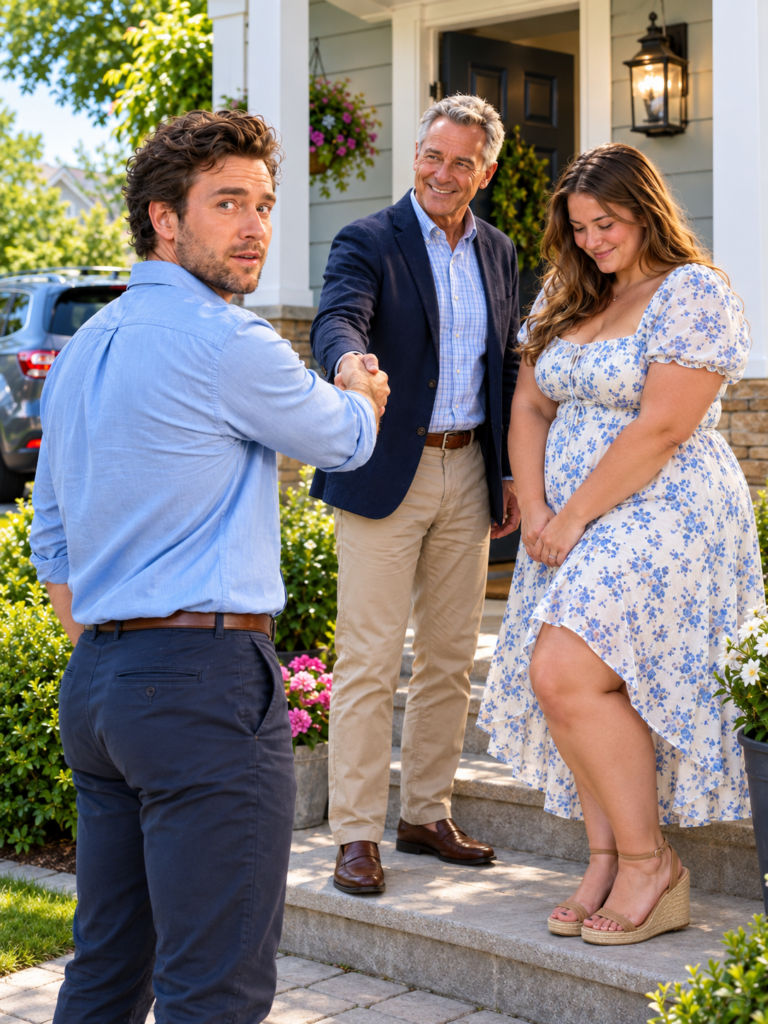
Then Thomas walked toward me and extended his hand.
“So,” he said, “you’re Nathan.”
I stopped breathing for a second.
His grip was firm.
“Finally.”
Behind him, Rachel went still.
I looked at her.
She appeared almost as startled as I felt.
“I’m sorry,” I said. “Have we met?”
“No.”
Thomas kept holding my gaze.
“But I’ve heard about you.”
My eyes moved toward Rachel.
“Dad.”
“What?”
“Don’t make it sound like that.”
“Like what?”
“You know exactly like what.”
Thomas glanced between us.
“I didn’t say anything.”
“You didn’t need to.”
For the first time that evening, Rachel actually looked embarrassed.
I should have found it funny.
Instead, something warm and unexpected moved through me at the knowledge that she’d talked about me at home.
Then Thomas said, “Your name came up for another reason.”
The warmth vanished.
He turned toward the bookshelf.
On the second shelf stood an old photograph in a silver frame.
Thomas picked it up and handed it to me.
A younger version of him stood beside a teenage boy on a basketball court.
The boy was thinner than I remembered.
His hair was longer.
His smile was the same.
The room seemed to tilt.
I knew that smile.
I had spent years trying not to remember it.
“Caleb,” I said.
Thomas nodded.
My older brother had been dead for eight years.
And somehow, I was standing in a stranger’s living room holding a photograph of him.
Part 2
For a moment, nobody spoke.
There are names that stop being ordinary words after someone dies.
You can hear them spoken by other people and still feel as though a door has opened somewhere you spent years trying to keep shut.
Caleb.
Five years older than me.
The first person I called when my car broke down at nineteen.
The person who taught me how to throw a baseball badly and change a tire correctly.
The person who could insult me for ten straight minutes and somehow leave me feeling better than when he’d started.
The person who died after a long illness when I was twenty-four.
I had spent years reducing him to facts because facts were safer than memories.
Thomas pointed toward a chair.
“You should sit.”
“I’m fine.”
Rachel looked at me.
“That’s what I said about my ankle.”
Under any other circumstances I might have laughed.
Instead, I sat.
Thomas settled across from me.
Rachel remained on the couch, her injured foot elevated, watching both of us carefully.
“You taught him?” I asked.
“Senior year.”
I looked again at the photograph.
“I never knew.”
“He might not have thought to mention me.”
“No. Caleb mentioned everyone.”
That made Thomas smile.
“He did like to talk.”
“He could tell a five-minute story for half an hour.”
“He certainly could.”
For the first time, I heard someone outside my family describe my brother as though his existence did not need explaining.
It hurt.
It also felt strangely good.
Thomas leaned back.
“Caleb had a difficult year.”
I frowned.
“What kind of difficult?”
“He started missing assignments. Stopped participating. Some weeks he looked like he’d decided failing first was easier than finding out whether he could succeed.”
That didn’t match the brother I remembered.
Or maybe it did, and I’d simply been too young to notice.
Thomas continued.
“He’d stay after school occasionally. At first I thought he was avoiding going home.”
“Was he?”
“Sometimes.”
I lowered my eyes.
Our father had been going through layoffs around then. Money had been tight. My parents had argued more than they thought we knew.
I had been thirteen.
Caleb had protected me from most of it.
Of course he had.
“What did you talk about?”
“History. Basketball. College. Your parents.”
Thomas paused.
“And you.”
I looked up.
“Me?”
“He talked about you constantly.”
The words struck harder than I expected.
Rachel shifted on the couch but didn’t interrupt.
Thomas rubbed one hand across his knee.
“One afternoon he told me he didn’t particularly care what happened to him as long as his younger brother didn’t make the same mistakes.”
I laughed once, but there was no humor in it.
“That sounds like him.”
“I told him that was a poor excuse for giving up.”
“That also sounds like something he’d remember.”
“He got angry with me.”
“Definitely sounds like him.”
Thomas smiled.
“So I asked him what kind of man he wanted his brother to become.”
I couldn’t speak.
Thomas’s voice softened.
“Caleb said he wanted you to become someone kind enough that people felt safer when you walked into a room.”
My fingers tightened around the photograph.
A memory surfaced without permission.
Caleb and me sitting on the hood of his car late one summer night.
I couldn’t have been older than sixteen.
I’d been angry about something—a teacher, a girl, our father, maybe all three.
Caleb had listened until I ran out of words.
Then he’d said, You’re going to be better than me, Nate.
I’d punched his shoulder and told him to stop being dramatic.
He’d laughed.
I hadn’t remembered that night in years.
Thomas was still speaking.
“He wanted to be someone you could look up to.”
I stared at the floor.
“He told me that once.”
Thomas nodded.
“I thought he might have.”
Rachel reached toward the coffee table, picked up a box of tissues and placed it nearer to me.
She didn’t hand me one.
Didn’t comment.
Just moved the box within reach.
It was exactly the kind of kindness I could tolerate.
The kind that left you somewhere to put your pride.
I finally looked at her.
“How did you know?”
“Know what?”
“Who I was.”
She glanced at Thomas.
“He figured it out.”
Thomas nodded.
“A few weeks ago.”
I waited.
“Rachel mentioned someone at work named Nathan.”
Rachel closed her eyes briefly.
“Dad.”
“You did.”
“Not like you’re making it sound.”
I might have enjoyed her embarrassment if my mind hadn’t still been trying to catch up.
Thomas continued.
“She mentioned your surname. It was familiar. I asked a few questions.”
“Interrogated me,” Rachel corrected.
“I asked questions.”
“You wanted his age, hometown, parents’ names—”
“And eventually I realized Nathan was Caleb’s brother.”
I looked at Rachel.
“You knew?”
“Not at first.”
“But eventually.”
“A few weeks ago.”
The answer bothered me more than I expected.
“So you knew my brother had been your father’s student.”
“Yes.”
“And you didn’t tell me.”
Her face changed.
“I didn’t know how.”
“You could have started with that.”
“I thought about it.”
“Then why didn’t you?”
Thomas started to speak.
Rachel lifted a hand.
“No, Dad. He’s asking me.”
She shifted on the couch and winced when her ankle moved.
“I didn’t know what Caleb meant to you.”
“He was my brother.”
“That doesn’t tell me what talking about him would do to you.”
I had no answer.
She continued quietly.
“I’ve heard you talk about your parents maybe twice. You never mentioned a brother. Dad told me Caleb had died, and I realized there might be a reason you didn’t talk about him.”
“So you decided not to say anything.”
“I decided it wasn’t my story to force you into.”
That stopped me.
There was no defense in her voice.
No attempt to make me feel guilty for being upset.
Just an explanation.
A boundary.
One she had respected without receiving credit for it.
The irritation drained out of me.
“I’m sorry.”
“You don’t need to apologize.”
“Apparently we both say that a lot.”
A faint smile touched her mouth.
Thomas stood.
“I think this conversation requires coffee.”
Rachel looked at him.
“I thought your doctor told you to cut back.”
“I’ve already raised a daughter. I no longer recognize authority.”
He disappeared into the kitchen.
Rachel watched him go.
“That’s the man who didn’t answer his phone.”
Thomas called from the other room.
“It was charging upstairs.”
“You own three chargers!”
“I know where one is.”
For the first time since I’d seen the photograph, I laughed.
Rachel smiled.
Not the polite smile she used at work.
Something gentler.
“I’m sorry,” she said.
“For what?”
“That you found out like this.”
I looked at Caleb’s photograph again.
“I’m not sure I am.”
Her expression softened.
Thomas returned with three mugs.
Rachel accepted hers.
“You remembered,” she said.
“Cinnamon.”
“He’s trainable.”
“I can still hear you.”
“I know.”
Thomas gave me coffee and sat again.
Then he started telling stories.
At first, I listened cautiously.
He told me about Caleb defending a student who was being mocked in class. About him staying after school to help another student who couldn’t understand an assignment, even though his own work was overdue.
He told me Caleb once argued with him for fifteen minutes over a grade and returned the following morning with an apology written on notebook paper because he had been too embarrassed to say it aloud.
“That sounds exactly right,” I said.
“He was proud.”
“Extremely.”
“He was also generous.”
I looked down at my coffee.
“Yeah.”
That one word almost broke me.
For eight years, I had remembered the hospital.
The weight Caleb lost.
The medication bottles.
The day my mother called.
The funeral.
I had let the ending consume everything that came before it.
Thomas gave pieces of my brother back to me one at a time.
Not the sick man.
The boy.
The student.
The person.
Rachel barely spoke.
She listened.
Every so often, I became aware of her watching me, but whenever I looked at her, she gave me enough space to look away again.
That mattered.
More than I understood at the time.
Eventually Thomas rose and went to a desk near the kitchen.
He opened a drawer.
When he returned, he carried an envelope yellowed slightly at the edges.
“I kept this,” he said.
My throat tightened before he even handed it to me.
Caleb’s handwriting covered the front.
MR. BENNETT.
I knew every uneven angle of those letters.
“I don’t know whether I should—”
“You should.”
Inside was a single sheet of lined paper.
Caleb had thanked Thomas for staying after school with him.
For pushing him when he had decided not to care.
For believing he could still become something worthwhile.
The note wasn’t eloquent.
Caleb had never been eloquent.
That made it worse.
Halfway through, the words blurred.
I stopped reading.
No one pretended not to notice.
Thomas looked at his hands.
Rachel looked toward the window.
They gave me the dignity of not being watched while I cried.
Eventually, I folded the note carefully.
“Why did you keep it?”
Thomas considered the question.
“Because teachers have bad days.”
I waited.
“Days when you wonder whether anything you’re saying reaches anyone. That letter reminded me that sometimes it does.”
His expression changed.
“When I retired, I found it again.”
He looked toward the bookshelves.
“For the first time, it made me sad.”
“Why?”
“Because I started wondering whether any of it had mattered after all.”
Rachel’s face tightened.
“Dad.”
“I’m not asking for reassurance.”
“I know.”
Thomas looked at me.
“I spent more than thirty years teaching young people that what they choose matters. That character matters. That the things we do become part of other people’s lives.”
He nodded toward the note.
“Then I retired, and the classrooms kept going without me.”
There was no self-pity in his voice.
That somehow made the loneliness clearer.
“I tried finding Caleb,” he said. “Eventually I learned he’d died.”
“I’m sorry.”
“So was I.”
His gaze remained steady.
“Then Rachel came home talking about a man named Nathan.”
Rachel muttered, “I did not come home talking about him.”
Thomas ignored her.
“I recognized the surname. Once I understood who you were, I wondered about something Caleb said.”
“What?”
“One afternoon he asked me whether one good person could really change another person’s life.”
I held still.
“I told him yes. But usually not through one grand act. Mostly through small choices made when nobody is keeping score.”
Thomas glanced toward Rachel’s swollen ankle.
“When Rachel finally got me on the phone tonight and told me a coworker was driving her home because she couldn’t walk, she said your name.”
I looked at Rachel.
“You called him?”
“From the car. While you were concentrating on traffic.”
“I didn’t hear you.”
“I texted first.”
Thomas continued.
“And when I saw you bring her up that walkway, I thought about Caleb.”
Something uncomfortable rose in me.
“Mr. Bennett—”
“Thomas.”
“Thomas, I didn’t do anything special.”
“No?”
“No. She needed a ride.”
“Exactly.”
I shook my head.
“I don’t think Caleb would look at my life and be particularly impressed.”
Thomas’s expression sharpened.
“Did I say anything about being impressed?”
I fell silent.
“Your brother didn’t ask me whether you’d become rich.”
He leaned forward.
“He didn’t ask whether you’d have the perfect marriage, the perfect job, or whether you’d make every decision correctly.”
The mention of marriage hit close enough that I looked away.
Thomas noticed.
He didn’t press.
“He wanted to know whether you’d be a decent man.”
I tried to dismiss the emotion with a laugh.
“I’ve managed one ride home.”
“No,” Thomas said. “You’ve managed one choice that you thought nobody was watching.”
That stayed with me.
Rachel’s gaze met mine.
For the first time, I wondered what she had actually said about me during those evenings at home.
Not whether she’d found me attractive.
Not whether she liked me.
What had she noticed?
What had made my name worth remembering?
Thomas settled back.
“Caleb was right about you.”
I couldn’t answer.
Rachel could have filled the silence.
She didn’t.
And sitting there in that warm kitchen with rain ticking softly against the windows, I became aware that something between us had shifted.
Not romance.
Not yet.
It was more dangerous than that.
She had seen a part of me I kept hidden.
And instead of trying to fix it, explain it, or turn it into something comfortable, she had simply stayed.
When I finally stood to leave, it was after ten.
Rachel tried getting up.
I pointed at her ankle.
“Don’t.”
“I was going to walk you out.”
“You are currently banned from walking.”
“By whom?”
“Me.”
“That’s not legally binding.”
Thomas said, “I’ll allow it.”
She looked betrayed.
“Whose side are you on?”
“The side with functional ankles.”
I smiled.
At the front door Thomas shook my hand again.
This time he didn’t say anything surprising.
He didn’t need to.
I looked toward Rachel.
She was sitting sideways on the couch.
“Get that checked tomorrow.”
“Yes, Nathan.”
“I mean it.”
“So do I.”
“And no crawling.”
“No promises.”
Her smile followed me all the way to my car.
I drove home beneath a clear sky.
The rain had stopped.
For years, I had thought grief was something you survived by refusing to touch it.
That night I discovered memory could hurt without destroying you.
And somehow Rachel had become part of that discovery.
That should have frightened me.
Instead, for the first time in years, I found myself looking forward to seeing someone the next morning.
Part 3
Rachel didn’t come to work the next day.
At 9:17, I checked the accounting floor.
At 9:46, I invented a reason to ask someone about an invoice.
At 10:03, I admitted to myself that I was wondering whether she had gone to urgent care.
I took out my phone.
Then I stopped.
We had never texted outside work.
Technically, I had her number because of an office contact list.
Using it suddenly felt too personal.
At 10:11, my phone buzzed.
Rachel: Before you send a search party, I am alive.
I stared at the message.
Then smiled.
Me: I wasn’t worried.
Three dots appeared.
Rachel: You came downstairs twice.
I looked toward the accounting department through the glass wall as though she might somehow be watching from home.
Me: Work reasons.
Rachel: Of course.
Me: Did you see a doctor?
Rachel: Mild sprain. Brace. Rest. Ice. No dramatic amputation required.
Me: Devastating news.
Rachel: Dad says hello.
A second message came before I could respond.
Rachel: He also says thank you.
I looked at that one longer.
Me: Tell him coffee was enough.
Her reply came a minute later.
Rachel: I think you know the ride wasn’t what he’s thanking you for.
I put the phone facedown on my desk.
For the rest of the morning, Caleb sat somewhere at the edge of every thought.
That evening I called my mother.
I hadn’t spoken to her in almost two months.
She answered on the fourth ring.
“Nathan?”
There was a small note of alarm in her voice.
That alone told me how badly I had let things drift.
“Hi, Mom.”
“Is everything okay?”
“Yeah.”
I swallowed.
“I wanted to ask you something about Caleb.”
Silence.
Then she exhaled.
“Okay.”
We talked for forty-three minutes.
The next week, Rachel returned to work wearing a brace.
I met her at the elevator.
She looked at me.
“You are not carrying me.”
“I wasn’t offering.”
“You had the expression.”
“What expression?”
“The one men get when they’re about to ignore a woman’s perfectly clear statement.”
“That seems unfairly broad.”
“Is it inaccurate?”
I considered it.
“No.”
The elevator opened.
She stepped inside carefully.
I entered beside her.
“You need anything?” I asked.
“I’m fine.”
“That’s historically unreliable.”
She smiled.
“Coffee.”
“What?”
“You asked if I needed anything.”
“Yes.”
“Coffee.”
She named an unnecessarily complicated order.
I stared at her.
“You’ve been drinking plain coffee in the break room for eight months.”
“Because no one ever volunteered.”
“I didn’t volunteer.”
“You asked.”
She walked out when the doors opened.
I bought her coffee anyway.
That became the first routine.
Not every morning.
That would have felt like too much.
But often enough that eventually she stopped specifying the order.
On days I arrived first, a cup occasionally appeared on her desk.
On days she arrived first, mine appeared beside my keyboard.
Neither of us discussed it.
The next routine involved lunch.
We had always occasionally eaten with the same group of coworkers, but now we started finding ourselves lingering after everyone else left.
Sometimes we talked about work.
Sometimes Thomas.
Sometimes Caleb.
Rachel never asked questions about my brother unless I brought him up first.
I noticed that.
I also noticed that when I did bring him up, she remembered details.
“The blue Camaro brother?”
“It was not his Camaro. He borrowed it.”
“And damaged it.”
“Allegedly.”
“You told me there was a dent.”
“There was already a dent.”
“You said he backed into a mailbox.”
“Those facts do not necessarily establish causation.”
She laughed.
I liked making her laugh.
The realization came quietly.
So did most things between us.
A month after the accident, Thomas invited me over for dinner.
Rachel delivered the invitation while standing beside my desk.
“My father has decided you’re coming Sunday.”
“Decided?”
“He doesn’t understand invitations either.”
“Is this connected to the fact that I fixed his email last weekend?”
“Probably. You’re useful now.”
“Good to know my position.”
She hesitated.
“You don’t have to.”
There it was again.
The small retreat she always offered when something became too personal.
An exit.
I realized she’d been giving me exits for months.
She never cornered me.
Never made me responsible for her feelings.
Never turned kindness into debt.
That was probably why I kept choosing not to leave.
“I’ll come,” I said.
Her smile was immediate.
“Good.”
Sunday became occasional dinners.
Occasional dinners became evenings when Thomas called me directly because he wanted help moving a bookshelf or arguing about Ohio State football or fixing something that had been broken for years but had apparently become urgent because I now existed.
Rachel accused him of adopting me.
Thomas denied it while asking whether I could come over Saturday.
I helped him start volunteering at a community education center almost by accident.
We were sitting on the porch one afternoon when he mentioned that a former colleague taught there.
“They run history classes for retired adults,” he said.
“So?”
“So nothing.”
“You’ve brought it up three times.”
“Have I?”
“Yes.”
He frowned at his coffee.
“I don’t know that I want to teach again.”
“Then don’t.”
He looked at me.
That answer clearly irritated him.
“You’re supposed to encourage me.”
“I thought you didn’t want to.”
“I don’t.”
“Then we’re done.”
He was quiet.
“What if I’m not any good anymore?”
That was the real question.
I recognized it because fear often disguised itself as disinterest.
“I think you know that isn’t why people remember you.”
His gaze shifted toward me.
I didn’t mention Caleb.
I didn’t need to.
Two weeks later Thomas called.
“I’ve agreed to teach one class.”
“That’s great.”
“It’s not teaching.”
“What is it?”
“Facilitating.”
“Of course.”
“There’s a difference.”
“Naturally.”
Rachel called me that evening.
“What did you say to him?”
“Nothing.”
“He’s teaching again.”
“Facilitating.”
She laughed.
Then there was a quiet moment on the line.
“Thank you.”
“He did it himself.”
“I know.”
That was another thing I admired about Rachel.
She understood the difference between helping someone and claiming their progress.
By then, my mother and I were speaking every week.
I called my father, too.
The first conversation was awkward enough that both of us nearly gave up after four minutes.
The second lasted ten.
The third lasted nearly an hour.
We spoke about Caleb.
Not just his illness.
Caleb as a person.
For years, grief had frozen my family around the moment we lost him. Talking about him slowly returned time to motion.
Rachel never took credit.
But I knew where the first crack in that wall had appeared.
One evening in early November, we worked late again.
Not as late as the rainy Thursday.
But late enough that the building had quieted.
I found Rachel in the break room putting leftovers into the microwave.
“You’re still here?”
She looked over her shoulder.
“So are you.”
“I have an excuse.”
“I’m fascinated already.”
“Construction emergency.”
“That sounds serious.”
“Someone ordered the wrong bathroom fixtures.”
She stared.
“I withdraw my sarcasm.”
“Thank you.”
She took out a second container.
“Want some?”
“What is it?”
“Lasagna.”
“Homemade?”
“Yes.”
I accepted immediately.
We sat at the small break-room table.
Outside, the city was dark.
Inside, the fluorescent lights buzzed softly overhead.
Nothing about the setting was romantic.
Maybe that was why I felt safe.
Halfway through dinner Rachel said, “Can I ask you something?”
“Probably.”
“Why did your marriage end?”
My fork stopped.
She immediately said, “You don’t have to answer.”
There was the exit.
For once, I didn’t take it.
“No single reason.”
She waited.
“I was bad at needing people.”
Her expression remained neutral.
“So was she. Or maybe we both became bad at it together.”
“What does that mean?”
“It means we could argue for three hours about dishes because neither of us knew how to say we were lonely.”
Rachel looked down at her food.
“That sounds exhausting.”
“It was.”
“Were you in love?”
“At the beginning.”
“And at the end?”
I thought about it.
“I think we were mostly afraid of failing.”
She nodded.
No judgment.
No empty reassurance.
“What about you?” I asked.
“What about me?”
“You said people usually want something.”
Her fingers went still around her fork.
I nearly withdrew the question.
Then she said, “I dated someone for four years.”
I waited.
“He was very good at generosity when generosity gave him leverage.”
Something cold moved through me.
“What kind of leverage?”
“Nothing dramatic.”
Her expression warned me not to turn her history into a rescue mission.
So I listened.
“He paid for things, then reminded me. Helped me, then expected agreement. Did favors and kept an invisible list.”
She looked at me.
“When I finally ended it, he told me I’d never find anyone willing to do as much for me as he had.”
I understood the sentence she’d spoken during our drive.
People don’t usually offer help without expecting something in return.
“That’s why you wouldn’t let me drive you home.”
“Partly.”
“And why you kept apologizing.”
“Probably.”
I leaned back.
“Rachel?”
“Yeah?”
“There’s no invoice coming.”
A smile appeared.
Small at first.
Then real.
“Good.”
She looked at my empty container.
“Because you owe me for the lasagna.”
I laughed loudly enough that someone down the hallway probably heard.
The moment passed.
But something had changed.
Trust had become personal.
After that night, I became more aware of her.
Not simply of how she looked, though I noticed that too.
I noticed how she listened without interrupting.
How she always tapped a pen twice before signing something.
How she kept emergency chocolate in the bottom drawer of her desk and pretended it was for accounting morale.
How she became quieter when worried instead of louder.
And I noticed when she wasn’t there.
That was the dangerous part.
One Friday she took a vacation day and didn’t mention it.
At ten in the morning I walked past accounting and felt an unreasonable disappointment at seeing her chair empty.
At noon I ate lunch alone.
At two, she texted a photo of Thomas standing in front of a classroom whiteboard with his arms crossed.
Rachel: First day back.
Below it:
Rachel: He says this is not technically teaching.
I stared at the photograph.
Thomas looked alive in a way I hadn’t seen before.
Me: Tell him his lie is becoming difficult to maintain.
Rachel: Already did.
I saved the photograph.
That realization unsettled me.
So did the next one.
I missed her.
Not dramatically.
Not painfully.
I simply wanted her there.
And wanting someone’s presence was the first step toward having something to lose.
For a man who had spent three years arranging his life around not losing anything, that felt like standing near an edge.
So I did what frightened people often do.
I became careful.
Not cold.
Just careful enough that Rachel noticed.
She stopped lingering at lunch.
I stopped finding reasons to visit accounting.
Our coffee routine became inconsistent.
Neither of us said anything.
It lasted eleven days.
Then Thomas called me.
“I’m having people over for Thanksgiving.”
“Okay.”
“You’re coming.”
I smiled despite myself.
“Rachel put you up to this?”
“No.”
“Did she invite me?”
“No.”
That bothered me.
Thomas heard the silence.
“Should she have?”
“No.”
“Then what’s the problem?”
“There isn’t one.”
“You’re a terrible liar.”
“I have plans.”
“You just invented those.”
“Thomas.”
“Nathan.”
I rubbed my forehead.
He waited.
Finally I said, “I don’t know what I’m doing.”
There was a pause.
“With Rachel?”
I closed my eyes.
“You’re her father. I’m not discussing this with you.”
“I’m retired. I require entertainment.”
“Goodbye, Thomas.”
“Thanksgiving. Four o’clock.”
I hung up.
Then went.
Of course I went.
Rachel opened the door.
For a second, neither of us moved.
She wore a simple sweater and jeans. There was flour on one sleeve.
“You came.”
The surprise in her voice made me feel worse than accusation would have.
“Your father threatened me.”
“That sounds right.”
“Are you okay with me being here?”
She studied me.
“Why wouldn’t I be?”
“I’ve been—”
“Distant?”
Apparently we were discussing it.
“Yeah.”
Her expression softened, but she didn’t rescue me from the conversation.
“Was that intentional?”
“Yes.”
“Okay.”
I hadn’t expected that.
“Okay?”
“If you needed space, you needed space.”
No punishment.
No demand.
That made the guilt worse.
“I didn’t need space from you.”
She waited.
“I got scared.”
Her face changed.
Not triumph.
Not satisfaction.
Just attention.
“Of what?”
I looked through the doorway behind her.
Thomas was in the kitchen arguing with a timer.
The house smelled like turkey and cinnamon.
Family photographs lined the hallway.
A picture of Caleb still sat on the shelf.
“Of liking this too much.”
Rachel’s eyes met mine.
“This?”
I almost laughed.
“You know what I mean.”
“I’d rather hear you say it.”
That was fair.
“I like being here.”
I took a breath.
“I like talking to you. I like your coffee showing up on my desk. I like your father’s ridiculous phone calls.”
From the kitchen Thomas yelled, “I can hear you.”
Rachel closed her eyes.
I laughed.
Thomas called, “Continue.”
Rachel shouted, “Dad!”
He retreated.
I looked back at her.
“I spent three years making my life manageable.”
“And I’m unmanageable?”
“No.”
I shook my head.
“You’re starting to matter.”
The humor left her face.
I forced myself to continue.
“And I remembered what happens when people matter.”
Her gaze dropped briefly.
“People can leave.”
“Yeah.”
“People can die.”
“Yeah.”
“People can disappoint you.”
“Definitely.”
She leaned against the doorframe.
“And what happens if they don’t?”
I had no prepared answer.
That was the problem.
She had found the flaw in the entire system I’d built.
“I don’t know.”
“Maybe you don’t have to.”
We stood there in the doorway, close enough that I could have touched her.
Neither of us moved.
There was no kiss.
No dramatic confession.
There was only Rachel making space for my uncertainty without pretending it meant nothing.
Then she said, “For the record, you were starting to matter before the ankle.”
I looked at her.
“How long before?”
“I’m not telling you.”
“Rachel.”
“Come inside. The potatoes are becoming political.”
I followed her.
And that was enough.
Dinner was chaotic.
Rachel had cooked too much food.
Thomas complained that I was helping too much while handing me things to carry.
At some point Rachel stood beside me at the sink drying dishes.
Our arms brushed.
Neither of us moved away quickly.
It was such a small thing.
Once, I would have thought small things didn’t count.
I knew better now.
Later, while Rachel was packing leftovers, Thomas pulled me aside.
He glanced toward the living room before speaking.
“When I first saw you standing on my porch, do you know what I thought?”
“That your daughter had terrible judgment in coworkers?”
“That came later.”
I smiled.
Thomas’s expression softened.
“I thought about Caleb.”
The humor left me.
“He’d spent so much time wondering what kind of man his little brother would become.”
Thomas looked toward the silver-framed photograph.
“Then there you were.”
“I was just helping Rachel.”
“You’re still doing that.”
“I think she’s helped me more.”
“That’s generally how it works.”
He placed one hand on my shoulder.
“Your brother once asked whether one good person could change another person’s life.”
I remembered the story.
Thomas continued.
“You may never know how many lives you’ve touched simply because you chose not to walk away.”
My throat tightened.
I looked through the doorway.
Rachel was laughing to herself while trying to force leftovers into a container that was obviously too small.
Something became clear.
For years, I had imagined important choices would feel important while you made them.
They rarely did.
Sometimes they looked like stopping beside a curb.
Sometimes they looked like accepting coffee.
Sometimes they were answering your mother’s phone call instead of letting it go to voicemail.
Sometimes they were letting a retired teacher become useful again.
Sometimes they were telling a woman you were frightened instead of disappearing until she stopped expecting you.
I walked back into the kitchen.
Rachel was still fighting the container.
“Need help?”
“No.”
The lid flew from her hand and landed on the floor.
I looked down.
Then at her.
She pointed a warning finger.
“Not one word.”
I bent to pick up the lid.
“What exactly did you think I was going to say?”
“I know your face.”
“You’ve become very confident about that.”
“Eight months of professional observation.”
“Professional?”
“Strictly.”
I handed her the lid.
Our fingers touched.
This time neither of us immediately looked away.
“Rachel.”
“Yeah?”
“I don’t want to go back to being careful.”
Her expression changed.
I didn’t need to explain what I meant.
“I don’t need you to promise anything,” she said.
“I know.”
“And I’m not asking you to become somebody different.”
“I know.”
“But if you disappear for eleven days again, I’m changing your coffee order to decaf.”
I smiled.
“That’s cruel.”
“I have boundaries.”
“I’ve noticed.”
For a second, we were both smiling.
Then the smile faded from her face.
I raised my hand slowly.
Gave her every opportunity to move.
She didn’t.
My fingers brushed a loose strand of hair away from her cheek.
It was the first time I had touched her without necessity.
No injured ankle.
No crowded elevator.
No accidental contact.
A choice.
Her eyes closed for half a second.
When they opened, she said quietly, “You look terrified.”
“I am.”
“Good.”
I frowned.
“Good?”
“Means you’re not pretending this doesn’t matter.”
I laughed softly.
Then kissed her.
There was nothing dramatic about it.
No grand declaration.
Just warmth, hesitation, and the strange relief of discovering that wanting something did not automatically mean losing yourself to it.
When we separated, Rachel looked toward the doorway.
“If my father is standing there, I’m moving to another state.”
Thomas shouted from the living room, “I’m watching television.”
She covered her face.
I laughed until my ribs hurt.
Months later, I would think back to that first rainy drive and understand that nothing between us had started with attraction.
Not really.
It had started with attention.
Rachel noticing the exhaustion I tried to hide.
Me noticing her alone on a curb.
Thomas noticing a struggling student years before either of us understood how important that choice would become.
Caleb noticing that his little brother was watching him.
Kindness had passed between us like something carried hand to hand.
Thomas continued teaching at the community center.
He stopped calling it facilitating after his third class.
My mother visited Columbus in the spring.
My father came too.
For the first time since Caleb died, the three of us sat at one table and told stories about him without letting the story end at the hospital.
Rachel sat beside me.
She didn’t hold my hand the entire time.
She didn’t need to.
When the memories became difficult, her knee touched mine beneath the table.
That was enough.
Our relationship grew the same way.
Slowly.
Coffee.
Lunch.
Dinner with Thomas.
Long drives when neither of us needed to talk.
Arguments that ended with actual conversations instead of doors closing.
The first time Rachel asked for help without apologizing, I noticed.
The first time I admitted I was having a bad day before she figured it out herself, she noticed too.
Neither of us became perfect.
I still withdrew sometimes.
Rachel still tried to manage everything alone when she was afraid.
But we learned each other’s tells.
More importantly, we learned not to use them as weapons.
One evening nearly a year after the rainstorm, Rachel and I sat on Thomas’s front porch.
He was inside grading papers for a class he claimed did not assign grades.
The sun was going down beyond the houses.
Rachel had her feet on the porch railing.
The ankle she’d injured was long healed.
“Do you ever think about it?” she asked.
“What?”
“That night.”
“Sometimes.”
“Do you know what I remember?”
“What?”
“You almost walked past me.”
I looked at her.
“How do you know that?”
“I saw you through the doors.”
“You did?”
“You took about three steps toward the garage.”
“That’s embarrassing.”
“It should be.”
“I came back.”
“You did.”
She rested her head against my shoulder.
For a moment we watched the street.
“I almost didn’t ask you to stay for coffee,” she said.
“Thomas asked me.”
“I told him to.”
I turned toward her.
“You did?”
She smiled.
“You looked like you were going to run.”
“I was considering it.”
“I know.”
“How?”
“I know your face.”
“Apparently.”
She became quiet.
Then she said, “I think that’s the part nobody tells you.”
“What part?”
“Second chances don’t always look like second chances.”
I waited.
“Sometimes they look like an inconvenience.”
I laughed.
“You were definitely inconvenient.”
“Careful.”
“Forty minutes out of my way.”
“You volunteered.”
“Rain.”
“Nathan.”
“Significant ankle-related transportation responsibilities.”
She elbowed me gently.
I caught her hand.
She let me keep it.
Inside the house, Thomas dropped something and muttered loudly enough for us to hear.
Rachel smiled.
I looked down at our joined hands.
For most of my adult life, I had believed meaning would arrive with certainty.
That if I ever found the right job, the right relationship, the right answer to grief, I would recognize it immediately.
Instead, the moments that changed me had been ordinary.
My brother staying after school.
A teacher listening.
A handwritten note kept in a drawer for fifteen years.
A woman sitting alone outside an office building.
A car ride through Columbus in the rain.
A father opening a door.
A cup of coffee accepted instead of refused.
A phone call made after years of avoiding one.
A Thanksgiving invitation I almost declined.
None of those moments announced themselves.
They simply asked for a choice.
Stay or leave.
Speak or remain silent.
Reach out or protect yourself.
I had spent years thinking strength meant needing less.
Caleb had apparently understood something before I did.
The people who change us rarely do it by rescuing us.
They change us by showing up consistently enough that eventually we decide to show up too.
Rachel squeezed my hand.
“What are you thinking about?”
I looked at her.
“My brother.”
Her expression softened.
“What about him?”
“That he would’ve liked you.”
She smiled.
“Thomas says the same thing.”
“Thomas says too many things.”
From inside the house came his voice.
“I can still hear you.”
Rachel laughed.
I leaned back in the chair.
For once, the sound of family around me didn’t make me think first about what could be lost.
It made me grateful for what was here.
Thomas came to the doorway.
“You two staying for dinner?”
Rachel looked at me.
It was a small question.
Ordinary.
The kind I once would have treated casually because I hadn’t understood how much a life was made from ordinary answers.
I looked at Thomas.
Then at Rachel.
“Yeah,” I said. “We’re staying.”
And as Rachel stood and pulled me toward the door, I thought about the question Caleb had asked all those years ago.
Could one good person really change another person’s life?
Thomas had answered yes.
But standing there, surrounded by people connected through choices none of us could have predicted, I understood that the answer was larger than that.
One person helps another.
That person carries something forward.
A teacher believes in a struggling boy.
The boy spends years trying to become someone his younger brother can admire.
The brother grows up bruised and cautious and almost drives past a coworker sitting alone in the rain.
But he doesn’t.
He stops.
And sometimes that is enough to begin.
Not a miracle.
Not destiny.
Just a person choosing not to walk away.


