
She Found Ten Men at Her Father’s Grave—Then the Mafia Boss Claimed the Plus-Size Mechanic as His Own
Part 1
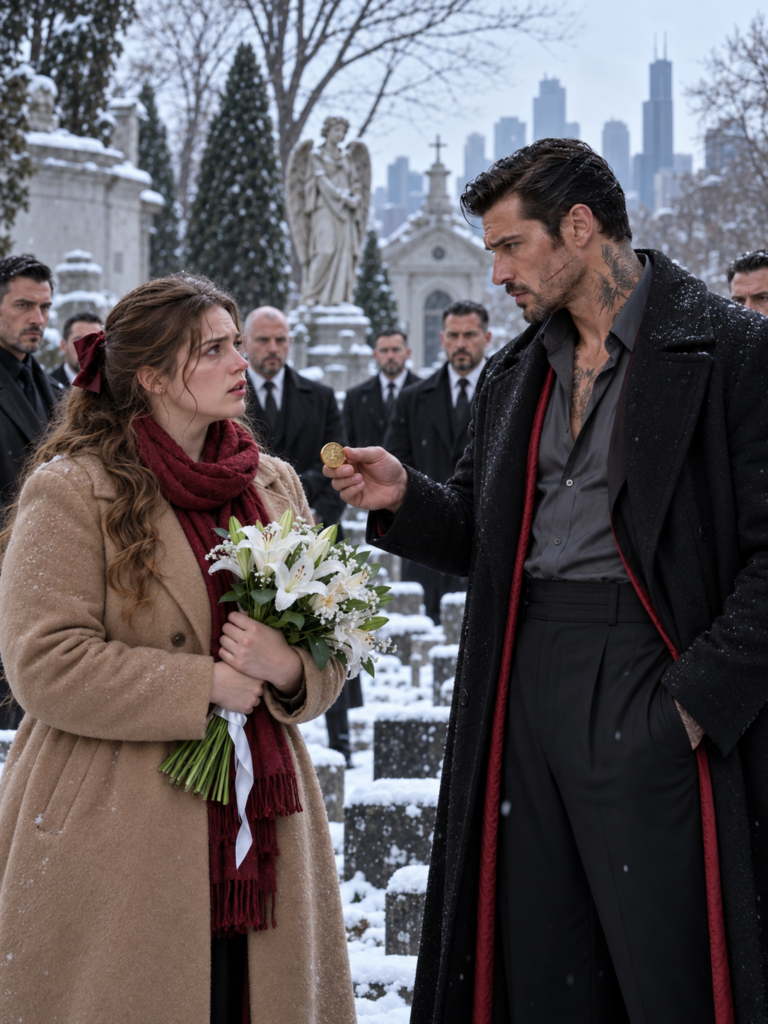
Ten men in black suits stood around Norah Reed’s father’s grave.
Not grieving.
Guarding it.
Rain swept across St. Jude’s Cemetery in cold silver sheets, turning the narrow paths to mud and plastering Norah’s dark hair against her cheeks. She stopped at the cemetery gate with a cheap bundle of lilies pressed against her chest.
For one irrational second, she wondered whether she had walked into the wrong funeral.
Then she saw the headstone.
Thomas Reed.
Beloved Father.
The fresh earth beneath it was still dark from the burial three days earlier.
Norah’s grip tightened around the flowers.
Her father had been a mechanic.
He wore twenty-dollar work boots until the soles came apart. He bought coffee from the gas station because he considered six dollars for a latte an insult to working people. He had died owing money on his garage and leaving less than fifty dollars in his checking account.
Men like these did not come to mourn men like Thomas Reed.
Every one of them was broad-shouldered, silent, and dressed in tailored black wool.
And at the center stood a man who made the others look like shadows.
He was tall, perhaps in his late forties, with silver beginning to touch his dark hair at the temples. A charcoal overcoat sharpened the width of his shoulders. A faint scar crossed one side of his jaw.
He held a gold coin between two gloved fingers.
Norah started walking.
She knew they saw her.
She was difficult not to see.
At five-foot-seven, Norah had always been a large woman—full hips, thick thighs, a soft stomach she had spent half her life trying to hide beneath oversized jackets. As a teenager, she had learned to enter rooms sideways, to fold her arms across herself in photographs, to laugh first when someone made a joke about her size so nobody would realize it hurt.
Her father had hated that.
“You take up exactly as much space as God intended,” Thomas used to tell her.
It had embarrassed her when she was sixteen.
At twenty-six, standing in a freezing cemetery three days after putting him in the ground, she would have given anything to hear him say it again.
She reached the ring of men.
Nobody moved.
“Excuse me.”
Her voice came out rough.
Still no one moved.
Norah looked directly at the man with the scar.
“You have the wrong grave.”
His expression did not change.
Norah’s grief turned instantly to anger.
She was exhausted. Broke. Three months behind on the garage mortgage. Her only decent black dress no longer fit comfortably, so she had attended her father’s funeral in dark jeans while two distant relatives whispered about how much weight she had gained since high school.
She had no patience left for mysterious rich men.
“That is my father,” she said. “So either explain why ten strangers are standing on top of him or move.”
Something flickered in the scarred man’s eyes.
Interest.
He lifted one hand.
The circle opened.
Norah walked through it.
Rain ran over the simple granite marker.
The expensive man looked at her for another long moment.
“Norah Reed.”
It was not a question.
Every instinct in her body sharpened.
“How do you know my name?”
“My name is Dominic Valenti.”
“That doesn’t answer me.”
One of the men behind him shifted slightly.
Dominic didn’t.
Instead, the smallest trace of approval touched his face.
“Your father spoke of you.”
Norah nearly laughed.
“My father spoke about carburetors and baseball. He did not speak about men who arrive at cemeteries with bodyguards.”
“He spoke about you more than either.”
That stopped her.
Dominic looked at the headstone.
“Thomas was a good man.”
“You didn’t know him.”
“I knew him for nineteen years.”
The world seemed to move beneath Norah’s boots.
“No.”
Dominic reached out.
The gold coin rested on his palm.
Old. Heavy. Worn smooth around the edges.
Norah stared at it without taking it.
“I don’t want your money.”
“It isn’t money.”
“Then what is it?”
“A marker.”
“For what?”
Dominic’s gaze settled on her face.
“A debt.”
Cold worked down Norah’s spine.
“My father didn’t borrow from people like you.”
A muscle moved in Dominic’s jaw.
“He did much more than borrow.”
Norah stepped toward him.
She had spent her whole life knowing how people reacted when a large woman moved aggressively into their space. Some became mocking. Others became patronizing.
Dominic did neither.
He simply watched her.
“My father is dead,” she said. “So if you came here to scare him, you’re late.”
“I did not come to scare Thomas.”
“Then why?”
“To honor him.”
Dominic placed the coin carefully on top of the headstone.
Then his eyes returned to hers.
“He paid a very high price to ensure you would never have to meet me.”
Norah forgot the rain.
“What does that mean?”
“It means the debt is closed.”
He moved past her.
Norah turned.
“That’s it?”
Dominic paused.
The ten men waited.
Black SUVs idled beyond the cemetery gates.
Norah hated how small the entire world suddenly felt around this stranger.
“You show up at my father’s grave,” she called, “tell me he spent nineteen years knowing you, leave some ridiculous coin, and walk away?”
Dominic looked over his shoulder.
For the first time, she saw something beneath the terrifying control.
Regret.
“He wanted you outside my world, Norah.”
“And what world is that?”
His voice dropped.
“One you should pray never notices you.”
Then he left.
That evening, Norah sat in her father’s cracked leather chair with the gold coin on the coffee table.
Bills surrounded it.
Past-due electric notice.
Medical statements.
Property taxes.
The mortgage on Reed Auto Repair.
She stared at the coin until her phone rang.
First National Bank.
Norah almost ignored it.
Instead, she answered.
Twenty minutes later she was standing in the middle of the living room, unable to breathe.
The garage mortgage was gone.
Two hundred thousand dollars.
Paid in full.
That afternoon.
Through a private holding company whose representative had apparently frightened the bank manager so badly that he had apologized three separate times.
Norah looked at the gold coin.
“The debt is closed.”
“No,” she whispered.
She stormed into her father’s bedroom.
Thomas Reed had not spent nineteen years secretly knowing a man like Dominic Valenti while living like a broke mechanic without leaving evidence somewhere.
It took Norah forty minutes to find the false compartment beneath an old steel toolbox.
Inside were three things.
Cash.
A handgun.
A small black leather ledger.
Norah touched only the ledger.
Her father’s handwriting filled the pages.
Dates.
Initials.
Payments.
Short coded phrases.
Fix the Rivera problem.
Transport.
Southside leak.
D.V.
Dominic Valenti.
Norah’s hands began shaking.
Then she reached the final page.
It had been written the day before Thomas died.
They know about the ledger.
Dominic promised to keep Norah out.
If you find this, sweetheart, I am sorry.
Run.
Norah stared at the word.
Run.
Her father had taught her many things.
How to replace brake pads.
How to negotiate with parts suppliers.
How to tell when a customer was lying.
How to throw a punch with enough weight behind it that the other person reconsidered whatever stupid idea had brought them close.
He had never taught her to run.
Norah went to the window.
A black SUV sat across the street.
A man was inside.
Watching the apartment.
Fear moved through her.
Then anger followed.
Anger was more useful.
At six the next morning, Norah left through the rear alley.
By ten, she stood outside Verona, one of the most expensive restaurants in downtown Chicago.
Two men guarded the entrance.
“We’re closed,” one said.
“Great. I’m not hungry.”
His gaze traveled over her worn canvas jacket, grease-marked jeans, work boots, and broad body.
A tiny sneer appeared.
Norah knew that look.
She had known variations of it her entire life.
Too big for elegance.
Too poor for the room.
Too ordinary to matter.
“I’m here for Dominic Valenti.”
The man laughed once.
“Sure you are.”
Norah pulled the black ledger from her bag.
“Tell him Thomas Reed’s daughter is here.”
The laugh disappeared.
“And tell him I have this.”
Three minutes later, Norah was walking through a restaurant whose chandeliers probably cost more than her apartment.
Dominic sat alone in a private dining room.
White shirt.
Sleeves rolled back.
Reading glasses resting low on his nose.
Espresso beside one hand.
Norah stopped.
The terrifying man from the cemetery looked unexpectedly human.
Then he looked up.
His face hardened instantly.
“You’re supposed to be packing.”
Norah dropped the ledger onto his table.
“I don’t take orders from you.”
Dominic removed his glasses.
“The mortgage was paid so you could sell the garage and leave Chicago.”
“You paid my father’s mortgage.”
“Yes.”
“You watched my apartment.”
“Guarded.”
“I found a gun in his toolbox.”
Dominic’s silence answered enough.
Norah planted both hands on the table.
“What did my father do for you?”
Dominic studied her.
“He solved problems.”
“He fixed cars.”
“He did that too.”
“What kind of problems?”
“The kind decent people should never be asked to solve.”
The anger left Norah abruptly.
“What did you make him do?”
Something dangerous entered Dominic’s eyes.
“Choose your next words carefully.”
“Why? You’ll have one of your men drag the fat mechanic out of your fancy restaurant?”
The sentence came out before she could stop it.
Dominic became perfectly still.
Norah immediately regretted revealing that weakness.
Then Dominic said quietly, “Never use another person’s cruelty as your own description of yourself.”
Norah blinked.
“What?”
“I heard the word you chose.”
His gaze moved over her, but not in the way men often looked at her.
There was no mockery.
No appraisal disguised as politeness.
Only attention.
“You are angry,” he continued. “Be angry. You have every right. But do not stand in front of me and repeat insults other people taught you.”
Her throat tightened unexpectedly.
“My body has nothing to do with this.”
“Exactly.”
For several seconds neither spoke.
Then Dominic leaned back.
“Your mother became ill when you were six.”
Norah froze.
“Cancer.”
“You needed treatments insurance wouldn’t fully cover. Your father was desperate.”
“You paid for them.”
“He drove one car for me.”
Norah stared.
“One?”
“That was the agreement.”
“What happened?”
“Your father noticed something my own people missed. He prevented a mistake that would have cost me millions and several lives.”
Dominic looked toward the rain-darkened windows.
“I asked him to solve another problem. Then another.”
“You used him.”
“Yes.”
The immediate admission disarmed her more than denial would have.
“You’re not going to pretend you helped him?”
“No.”
“Why?”
“Because that would insult both of us.”
Norah swallowed.
Dominic touched the ledger.
“Thomas stayed because the money helped you. Then because leaving became dangerous. Eventually because he believed he could reduce the damage done by men like me.”
“My father hated criminals.”
“So do I, most days.”
She stared at him.
“That’s supposed to be funny?”
“No.”
“What happened before he died?”
Dominic’s expression changed.
“A rival named Victor Sullivan lost something extremely valuable. Thomas discovered information connected to it.”
“The ledger.”
“Partly.”
“Did Sullivan kill my father?”
“No.”
Norah searched his face.
“You’re sure?”
“Your father’s heart failed.”
Dominic’s voice softened.
“But fear helped kill him.”
Norah’s eyes burned.
She hated that she was going to cry here.
In front of this man.
In this perfect room where she already felt too large, too messy, too working-class.
She turned away.
Dominic did not approach her.
That somehow made it worse.
“My father was scared?”
“Yes.”
“And you knew?”
“Too late.”
Norah wiped her cheek angrily.
“You promised him I’d be safe.”
“I did.”
“You’re doing a terrible job.”
A violent explosion tore through the front of the restaurant.
Glass erupted.
The floor shook.
Dominic moved before Norah understood what was happening.
His body hit hers.
He wrapped both arms around her and drove them behind the heavy dining table as the ceiling screamed above them.
Norah crashed against the floor.
Dominic covered her.
Not delicately.
Completely.
His chest pressed across her shoulders. One arm protected her head.
For years Norah had carried an irrational fear that in an emergency someone would decide she was too heavy to help.
Dominic did not hesitate for one fraction of a second.
“Stay down.”
His voice was different now.
Cold.
Commanding.
Gunfire cracked somewhere beyond the smoke.
Dominic rose.
Blood already darkened one shoulder.
“You’re hurt.”
“Later.”
He pulled her up.
Norah stumbled.
His hand closed around her waist.
Strong.
Certain.
Not embarrassed by the softness beneath his palm.
Not trying to avoid touching too much of her.
Just holding her because keeping her alive mattered more than anything else.
They escaped through the rear kitchen into an alley where a hidden sedan waited.
Norah drove.
Dominic bled in the passenger seat.
By the time they reached a secure clinic hidden above an abandoned storefront outside the city, he had gone pale.
Norah found medical supplies.
“You need a hospital.”
“And explain what?”
“That someone tried to kill you.”
“That narrows the list very little.”
She glared.
“You make jokes when you’re bleeding?”
“Apparently.”
Norah cleaned and bandaged the wound as carefully as she could.
Dominic sat shirtless on the edge of a steel table.
Scars crossed his chest and ribs.
Old damage.
A life written in healed violence.
Norah forced herself not to stare.
Then she caught Dominic watching her.
“What?”
“Your hands.”
She looked down.
“They stopped shaking.”
“You were terrified in the restaurant.”
“I’m still terrified.”
“But your hands are steady.”
“I’m a mechanic.”
“That explains courage?”
“No. It explains hands.”
For the first time, Dominic smiled.
It transformed his entire face.
Norah’s pulse stumbled.
She immediately concentrated on the bandage.
When she finished, Dominic said, “Thank you.”
“You saved me first.”
“I promised Thomas.”
There it was.
The reminder.
Duty.
Debt.
Not her.
Never her.
Norah stepped away.
“Tell me about Sullivan.”
Dominic did.
A stolen shipment.
Men turning against their own organization.
Her father discovering where the missing property had been hidden.
A coded location somewhere inside his records.
Sullivan believed Norah had inherited the answer.
“He wants me because he thinks I know.”
“Yes.”
“I don’t.”
Dominic’s eyes lowered to the ledger.
“You might.”
For nearly an hour, Norah studied her father’s notes.
The solution came when she noticed the number patterns.
Not financial codes.
Mechanical sequences.
Her father had hidden a map inside the language he had taught her as a child.
When Norah finally identified the abandoned municipal impound lot indicated by the pattern, Dominic stared at her.
Not at her body.
At her.
At her mind.
“Thomas raised a brilliant daughter.”
Norah’s chest tightened.
“Don’t.”
“Don’t what?”
“Say things like that because you feel guilty.”
Dominic stood.
Even wounded, he filled the room.
“I do not compliment people to make them comfortable.”
“Then why?”
“Because it is true.”
A phone vibrated.
Dominic answered.
Sullivan’s voice came through.
Cruel.
Amused.
Demanding the ledger.
Demanding Norah.
Dominic’s face turned to stone.
“She is not available to you.”
Norah looked at him.
Sullivan laughed.
“You’re protecting the mechanic’s fat little girl now?”
Silence.
Deadly silence.
Dominic leaned toward the phone.
“When this is finished,” he said quietly, “you will regret every word in that sentence.”
Norah’s breath stopped.
Sullivan laughed again.
“You always did have expensive tastes, Dominic. Didn’t know they’d changed that much.”
Dominic ended the call.
Norah looked away.
She hated herself for caring.
“You don’t have to defend me from playground insults.”
“They were not playground insults.”
“They’re words.”
“They were intended to reduce you.”
“I’m used to it.”
Dominic stepped closer.
“That sentence,” he said, “makes me angrier than anything Sullivan said.”
She lifted her chin.
“Why?”
“Because you should never have had to become used to it.”
Something inside her cracked.
Not dramatically.
Quietly.
A hairline fracture through armor she had spent years building.
Dominic reached for her face, then stopped before touching her.
Permission.
Norah realized that was what he was waiting for.
She gave the smallest nod.
His thumb brushed rain-dried mascara beneath her eye.
So gentle it hurt.
Then he withdrew.
“You’re leaving Chicago tonight.”
The softness vanished.
Norah stared.
“No.”
“I have a car ready.”
“No.”
“Norah.”
“You just spent ten minutes telling me my father encoded that location in a language only I understand.”
“I can handle what comes next.”
“And if there are more codes?”
“I will handle them.”
“You mean your men will.”
“Yes.”
“And I disappear.”
“Yes.”
“Because of your promise.”
Dominic’s jaw tightened.
“Because I need you alive.”
“I can help.”
“I know.”
“Then let me.”
“No.”
Norah laughed without humor.
“There it is.”
“What?”
“The part where I become cargo.”
“You are not cargo.”
“You’re deciding where I go, what I know, what risks I’m allowed to take.”
“To protect you.”
“My father did that for twenty years. Look where it got us.”
Dominic flinched.
She almost apologized.
Almost.
Then he stepped toward her.
“This world destroys good people.”
“Maybe.”
“I will not watch it destroy you.”
“Then stop treating me like something breakable.”
His eyes darkened.
“You think I believe you are breakable?”
“You keep trying to send me away.”
“Because I watched a restaurant explode around you.”
“And I watched you bleed all over my passenger seat.”
“Exactly.”
She stared.
Dominic’s control slipped.
Only slightly.
But enough.
“I cannot think clearly when you are in danger.”
The room went silent.
Norah’s heart struck hard against her ribs.
They had known each other barely two days.
But fear compressed time.
Grief stripped away manners.
Danger revealed truths people usually took months to hide.
“What are you saying?” she whispered.
Dominic looked almost angry with himself.
“I’m saying you complicate things.”
“That might be the least romantic sentence ever spoken.”
“I was not attempting romance.”
“Good.”
“Good.”
Neither moved.
Then headlights swept across the boarded windows downstairs.
Dominic looked toward the door.
His expression changed instantly.
Men’s voices echoed from the stairwell.
Too many.
Dominic reached for his jacket.
“How did they find us?” Norah whispered.
He looked at the security monitor.
One of his own vehicles was entering the lot.
His face went cold.
“They didn’t.”
“What?”
“My people brought them.”
The first gunshot sounded downstairs.
Dominic turned to Norah.
“Someone inside my organization sold you to Sullivan.”
Part 2
They escaped through a service corridor moments before armed men reached the clinic.
Dominic’s remaining loyalists met them three blocks away.
By sunrise, Norah was inside Valenti House.
Calling it a house felt absurd.
The estate occupied several wooded acres north of Chicago, hidden behind iron gates and security walls. The mansion itself was old limestone and dark glass, severe enough to be intimidating but beautiful enough to make Norah self-conscious the moment she entered.
A woman in a black suit approached.
“Mr. Valenti, your room is prepared.”
“Not mine. Hers.”
The woman glanced at Norah.
Only once.
But Norah saw it.
Everyone looked.
Her canvas jacket was torn. Her jeans were stained with soot. She had spent the night running from criminals beside a man who looked like he owned half the state.
Now she was standing beneath a chandelier the size of her old bedroom.
Dominic noticed her discomfort.
“You need clothes.”
Norah looked at him sharply.
“What’s wrong with these?”
“They have blood on them.”
“Oh.”
“You thought I meant something else.”
“No.”
“You’re lying.”
“Welcome to human communication.”
A corner of his mouth moved.
“I’ll have Mara find whatever you need.”
Norah stiffened.
“Meaning?”
“Meaning clothes.”
“In my size?”
Dominic’s eyes narrowed.
“I know what size you are.”
Her eyebrows shot upward.
“You absolutely do not.”
“You told the clinic guard you needed a replacement jacket because yours was a women’s eighteen.”
Norah remembered.
“You listen to everything?”
“Yes.”
“That’s unsettling.”
“It keeps people alive.”
Within two hours, several garment bags arrived.
Norah expected shapeless black dresses.
Instead she found dark jeans, fitted sweaters, boots, coats, and an emerald wrap dress that made her stop.
She held it against herself.
The tag displayed her actual size.
Not a size deliberately too small.
Not a supposedly “aspirational” dress.
Her size.
Mara appeared at the doorway.
“Mr. Valenti selected that one.”
Norah nearly dropped it.
“He what?”
“He rejected three others.”
“Why?”
Mara hesitated.
“He said the colors were boring.”
Norah stared at the emerald fabric.
Her father used to say the same thing.
Stop hiding in black, Nora-bean. You’re not attending your own funeral.
She put on the dress.
It fit.
Not “fit once she lost ten pounds.”
Fit now.
The fabric followed her waist, skimmed her stomach, and moved over her hips without apologizing for them.
Norah looked at herself in the mirror.
For once, she did not immediately turn sideways.
A knock sounded.
“Come in.”
Dominic entered and stopped.
Completely.
Norah’s confidence vanished.
“What?”
“Nothing.”
“You’re staring.”
“Yes.”
“That generally means something.”
Dominic’s gaze met hers in the mirror.
“You look beautiful.”
No hesitation.
No qualifier.
Norah laughed nervously.
“That’s unnecessary.”
“Why?”
“You bought me clothes. You don’t have to sell them too.”
Dominic walked closer.
“I told you before. I don’t offer compliments out of politeness.”
Norah folded her arms over herself automatically.
His eyes dropped to the gesture.
“Why do you do that?”
“Do what?”
“Hide.”
“I’m standing directly in front of you.”
“You know what I mean.”
She looked away.
Dominic stopped several feet behind her.
“No one in this house gets to make you feel unwelcome.”
“You can’t control what people think.”
“No.”
His voice lowered.
“But I can control who stays in my house.”
She looked back at him.
“You’d fire someone for thinking I’m fat?”
“I’d fire someone for disrespecting the woman under my protection.”
The woman under my protection.
Norah ignored the strange warmth those words created.
“That’s extreme.”
“I am an extreme man.”
“At least you know.”
For the next week, Norah lived under Dominic’s protection.
And hated how quickly she began feeling safe.
She ate breakfast with him each morning because he refused to discuss the ledger before coffee.
She learned he took espresso without sugar.
He learned she hated grapefruit.
She discovered he owned dozens of expensive suits but wore the same battered watch every day because it had belonged to his brother.
He discovered she slept poorly during storms.
The first night thunder woke her, Norah wandered downstairs and found Dominic already in the kitchen.
“You too?” she asked.
“Different reasons.”
He made tea.
They sat across from each other in silence.
Finally, Norah said, “People assume women like me are confident.”
Dominic looked over the rim of his cup.
“Women like you?”
“Big women.”
“Why would size determine confidence?”
“Because if you’re visibly different, people expect you to either be ashamed or aggressively proud. There’s no middle.”
Dominic listened.
Norah stared at the steam rising from her tea.
“When I was seventeen, I went to prom with a boy named Adam.”
Dominic’s expression immediately darkened.
“You already dislike Adam.”
“I dislike where this story is going.”
“He asked me because his friends dared him.”
Dominic put down his cup.
“He pretended to like me for three weeks.”
Norah smiled without humor.
“He was actually pretty convincing. Flowers. Texts. Everything.”
“What happened?”
“At prom, his friends took pictures when he kissed me.”
Dominic’s hand tightened around the cup.
“Then they posted them.”
Norah swallowed.
“With captions.”
She did not repeat them.
She did not need to.
Dominic’s face had become very still.
“I transferred schools.”
“Your father knew?”
“Eventually.”
“What did he do?”
“He found Adam.”
Dominic almost smiled.
“What happened?”
“Dad made him spend two Saturdays working in the garage.”
Dominic blinked.
“That was the punishment?”
“Dad said violence would teach him fear. Work might teach him character.”
“Did it?”
“No. But Adam learned how to change oil.”
Dominic laughed.
A real laugh.
Deep, brief, unexpected.
Norah stared.
“You should do that more.”
His laughter disappeared.
“What?”
“That.”
“No.”
She smiled.
“Why not?”
“People become careless around men who smile.”
“Maybe that’s why your face looks permanently irritated.”
He leaned back.
Then his expression changed.
“Norah.”
“Yes?”
“If someone kissed you now, would you wonder whether it was a joke?”
She stopped breathing.
The room suddenly felt smaller.
“Maybe.”
Dominic’s eyes moved to her mouth.
“What would convince you otherwise?”
Her pulse raced.
“Why?”
“I asked first.”
She forced herself to hold his gaze.
“Consistency.”
He nodded once.
“Then I suppose kissing you tonight would be inefficient.”
Norah almost dropped her tea.
“Dominic.”
“Yes?”
“You are impossible.”
“So I’m told.”
But he did not kiss her.
And somehow, his restraint stayed with her more powerfully than a kiss would have.
Two days later, Dominic took her to a charity gala hosted by one of Chicago’s oldest business families.
Norah initially refused.
“I’m not walking into a ballroom full of billionaires while your rival wants me dead.”
“You are safer beside me than hidden upstairs.”
“That sounds arrogant.”
“It is also true.”
Then he added, “Someone inside my organization betrayed us. I want that person to believe I’m no longer hiding you.”
Norah understood.
A public message.
Dominic Valenti was not ashamed.
He was not afraid.
And anyone trying to reach Norah would have to go through him.
“Fine,” she said. “But I choose the dress.”
Dominic looked surprised.
“Obviously.”
Norah chose emerald again.
Not because it made her look thinner.
Because it made her impossible to ignore.
When she came down the staircase, Dominic waited below in a black tuxedo.
His gaze rose.
Stopped.
And stayed.
Norah smiled.
“Still inefficient?”
His eyes darkened.
“Dangerously less so.”
At the gala, conversations quieted.
Norah felt them looking.
Some recognized Dominic.
Most did not recognize her.
Then came the whispers.
Who is she?
His date?
Her?
Norah’s shoulders began curling inward.
Dominic’s hand settled at her lower back.
Warm.
Steady.
“You’re doing it again.”
“What?”
“Making yourself smaller.”
“I’m literally incapable of becoming smaller in the next thirty seconds.”
His expression sharpened.
“That is not what I meant.”
“I know.”
Dominic leaned close.
“Then stand beside me.”
She looked up.
“Not behind me. Beside me.”
Norah straightened.
They entered the ballroom together.
Halfway through the night, a familiar voice said, “Nora?”
Her stomach dropped.
Adam Mercer.
Prom-night Adam.
Older now.
Still handsome.
Still possessing the polished smile of a man who believed charm erased history.
His eyes widened.
“Wow.”
Norah knew that wow.
She had heard versions of it at reunions.
You cleaned up well.
You’re surprisingly pretty.
You look good for—
Adam looked at Dominic.
Then back at her.
“I almost didn’t recognize you.”
Norah smiled.
“I recognized you immediately.”
Adam laughed.
“That sounds ominous.”
“It wasn’t meant to be friendly.”
Dominic remained silent.
Adam finally noticed.
“Adam Mercer.”
He extended his hand.
Dominic looked at it.
Did not take it.
“Dominic Valenti.”
Color disappeared from Adam’s face.
The name meant something.
Enough.
Adam swallowed.
“Mr. Valenti.”
Dominic’s voice was calm.
“You know Norah.”
“High school.”
Adam smiled awkwardly.
“We actually went to prom together.”
“So I heard.”
Adam looked at Norah.
She saw panic growing.
“Oh.”
Dominic did nothing.
Said nothing.
That was somehow far more frightening.
Adam rushed forward.
“We were kids.”
“Yes,” Norah said.
“And I’ve regretted it.”
“Have you?”
“Of course.”
“Why?”
Adam blinked.
“What?”
“Why do you regret it?”
People nearby were listening now.
Norah could feel them.
Once, that would have terrified her.
Now Dominic’s hand remained lightly at her back.
Not steering.
Supporting.
Adam lowered his voice.
“Can we not do this here?”
Norah smiled.
“You were comfortable humiliating me publicly.”
His face reddened.
“Nora—”
“Norah.”
“Norah. I’m sorry.”
She studied him.
For seventeen-year-old Norah, this apology would have been everything.
For twenty-six-year-old Norah, it felt strangely small.
“I believe you.”
Adam exhaled.
“But forgiveness doesn’t mean access.”
His relief vanished.
“You don’t get to become familiar with me because I’m standing beside someone important.”
“I wasn’t—”
“You were.”
Dominic’s thumb brushed once against the back of her dress.
Norah continued.
“You could have apologized any year before tonight. You didn’t.”
Adam looked around, humiliated now.
Norah felt no joy in it.
Only release.
“I hope you grew up,” she said. “I did.”
Then she walked away.
On the terrace outside, Norah exhaled shakily.
Dominic joined her.
“You didn’t say anything.”
“You didn’t need me to.”
“I thought you might threaten him.”
“I considered it.”
She laughed.
“What stopped you?”
“You.”
Norah turned.
Dominic leaned against the stone railing.
“You deserved to own that moment.”
Something expanded inside her chest.
“That may be the nicest thing anyone has ever done for me.”
“I did nothing.”
“Exactly.”
Their eyes met.
The city glittered below.
Norah’s breath slowed.
Dominic moved closer.
This time he raised one hand and touched the curve of her waist.
Not tentative.
Not apologetic.
Norah looked down at his hand.
Then up.
“You’re staring again.”
“I know.”
“Why?”
His voice became rougher.
“Because I have spent nine days pretending my reasons for noticing you are strategic.”
Her heart hammered.
“And?”
“I am very tired of pretending.”
Norah swallowed.
“You said consistency.”
“I remember.”
“And you think nine days counts?”
“No.”
Dominic stepped closer.
“But surviving two attacks together has distorted my sense of time.”
She laughed.
His forehead nearly touched hers.
“Tell me to stop.”
Norah didn’t.
Dominic kissed her.
Slowly.
He did not seize her or pull her into him like she belonged to him.
He waited.
Norah kissed him back.
Only then did his arm slide fully around her waist.
He pulled her against his body.
All of her.
Without hesitation.
Without careful distance.
Without making her feel as if her softness were something he had to navigate.
Norah’s hands gripped his tuxedo.
When they separated, Dominic rested his forehead against hers.
“I have wanted to do that since you threatened me in my restaurant.”
“I didn’t threaten you.”
“You slammed a criminal ledger onto my invoices.”
“You deserved it.”
“I did.”
They smiled.
Then Dominic’s phone rang.
The moment shattered.
He answered.
Listened.
His expression went blank.
“What?”
Norah felt dread immediately.
Dominic looked at her.
“The person who betrayed us has been identified.”
“Who?”
“My cousin.”
Lucian Valenti had grown up beside Dominic.
His second-in-command.
The man who had attended every family funeral, every meeting, every crisis.
And he had been selling information to Sullivan for almost a year.
Why?
Because Dominic had refused to expand into narcotics.
Lucian wanted a more profitable empire.
Sullivan had promised him one.
They returned to Valenti House immediately.
But Lucian had anticipated discovery.
The estate lost power twelve minutes after they arrived.
Security doors locked.
Gunfire sounded outside.
Norah stood in the dark hallway.
Dominic reached for her.
“Stay behind me.”
“No.”
“Norah.”
“You said beside you.”
Even in the darkness, she felt his gaze.
Then his hand found hers.
“Beside me.”
They reached the security room.
Mara was bleeding from one temple but conscious.
“Lucian took control of the east gate,” she said. “He brought Sullivan’s men inside.”
Dominic swore.
Then a voice echoed through the estate’s intercom.
Lucian.
“Cousin.”
Dominic looked toward the speaker.
“You always were dramatic,” he said.
Lucian laughed.
“I learned from you.”
“What do you want?”
“The ledger.”
Norah tightened her grip on it.
“And the woman,” Lucian added.
Dominic’s face changed.
“No.”
“One mechanic, Dominic.”
Lucian sounded genuinely amused.
“You’re going to sacrifice an empire for her?”
Norah looked at Dominic.
Silence filled the security room.
Then he answered.
“Yes.”
One word.
No hesitation.
Norah stopped breathing.
Lucian laughed.
But Dominic wasn’t finished.
“You misunderstand the situation.”
His voice became almost gentle.
“The empire is replaceable.”
His eyes found Norah’s.
“She isn’t.”
Part 3
Norah had spent most of her life assuming love would require negotiation.
Lose weight.
Be easier.
Be grateful.
Accept the joke.
Take whatever affection arrived and never ask whether she deserved better.
Then Dominic Valenti looked at his burning empire and called it replaceable.
Because she wasn’t.
It terrified her more than gunfire.
“Dominic,” she whispered.
He turned.
“We’re getting you out.”
“No.”
“Not again.”
“Listen to me.”
His expression hardened.
“Norah—”
“The garage.”
“What?”
“My father’s garage.”
She opened the ledger.
“Lucian thinks this book contains everything.”
“It contains enough.”
“No. Dad would never put the real leverage in one place.”
Dominic stared.
Norah flipped backward through the pages.
Mechanical codes.
Dates.
Parts.
Tiny notes nobody else would understand.
“He taught me redundancy,” she said. “Every important system needs a backup.”
Understanding entered Dominic’s eyes.
“You think Thomas had another record.”
“I know where.”
The garage.
Reed Auto Repair sat dark on Fourth Street when Norah and Dominic arrived through the rear alley hours later.
A few loyal men secured the perimeter while Sullivan and Lucian still believed Norah was trapped at the estate.
Norah unlocked the side door.
The smell hit her.
Oil.
Rubber.
Metal.
Home.
For one painful second, she expected her father to emerge from beneath a truck and complain about the cold.
Dominic stood quietly behind her.
“You all right?”
“No.”
She walked farther inside.
“But keep going anyway, right?”
“That sounds like something Thomas would say.”
“It was.”
Norah found the old diagnostic cabinet near Bay Three.
She removed a panel.
Behind it sat a weatherproof envelope.
Dominic exhaled.
Inside were copies of financial records, names, photos, and communications connecting Lucian to Sullivan.
Enough to destroy them politically within their own organizations.
But there was something else.
A letter.
For Norah.
Her hands trembled as she opened it.
Nora-bean,
If you are reading this, then all the things I tried to keep separate have finally collided.
I’m sorry.
I spent too many years believing protection meant deciding what you could handle.
That was wrong.
You were stronger than I gave you credit for.
You always were.
Do not inherit my fear.
And don’t spend your life believing you have to earn the right to be loved.
Anyone who makes you shrink to fit beside them is standing in the wrong place.
Norah stopped.
Tears blurred the page.
Dominic turned away, giving her privacy.
“Keep reading,” she whispered.
He looked back.
She continued.
Dominic owes me a debt, but debts are dangerous things.
If he protects you because of me, walk away when you are safe.
If he protects you because of you, make him prove the difference.
Norah laughed through tears.
Dominic closed his eyes.
“That sounds like him.”
“He knew.”
“Thomas knew everything.”
Norah folded the letter carefully.
“How do you prove the difference?”
Dominic looked at her.
“I don’t know.”
“For once, the great Dominic Valenti doesn’t have an answer?”
“No.”
“Good.”
She wiped her cheeks.
“Then listen.”
He stepped closer.
Norah placed one hand against his chest.
“I will not be your debt.”
“You aren’t.”
“I won’t be your responsibility.”
“You aren’t.”
“I won’t spend the rest of my life wondering whether you loved me because my father died for your secrets.”
Dominic covered her hand with his.
“Then don’t.”
“Easy for you.”
“No.”
His voice roughened.
“Nothing about you has been easy for me.”
Norah almost smiled.
Dominic continued.
“I protected you because I owed Thomas.”
Her heart tightened.
“That is how it started.”
He moved closer.
“I stayed awake outside your bedroom because you cried in your sleep.”
Norah stared.
“I bought an emerald dress because you disappeared inside black clothes.”
Her throat closed.
“I stopped myself from kissing you because you told me consistency mattered more than desire.”
His hand rose to her cheek.
“I would burn every ledger, every business, every favor, every alliance I have if keeping them required losing you.”
“Dominic.”
“I do not love you because Thomas asked me to protect you.”
His thumb brushed her cheek.
“I love you because you walked into my restaurant carrying a bag you could barely keep zipped and demanded I reverse a two-hundred-thousand-dollar payment.”
Despite herself, Norah laughed.
“I love you because you were terrified and came anyway.”
He smiled faintly.
“Because you looked at codes that fooled experienced men and saw your father.”
Another step.
“Because when people tried to teach you to hate your body, some stubborn part of you survived them.”
Norah’s eyes filled again.
“Because you make me laugh.”
“Rarely.”
“More than anyone else.”
He touched his forehead to hers.
“And because when you stand beside me, I remember there are things in this world worth protecting that have nothing to do with power.”
Norah closed her eyes.
“Say it again.”
“I love you.”
She kissed him.
There was nothing hesitant about it now.
Norah wrapped both arms around his neck.
Dominic caught her around the waist and pulled her close.
She felt the full strength of him.
And for once, she did not wonder whether she was too heavy.
Too soft.
Too much.
She simply allowed herself to be held.
When they separated, Dominic whispered, “Thomas said I had to prove it.”
“He did.”
“How am I doing?”
“Ask me in twenty years.”
“I can work with that.”
A vehicle screamed into the lot outside.
Dominic turned.
Too late.
Lucian entered through the open bay door with three armed men.
Behind him came Sullivan.
Norah’s body went cold.
Lucian smiled.
“Touching.”
Dominic moved instinctively in front of her.
Norah stepped sideways.
Beside him.
Lucian laughed.
“She really trained you quickly.”
Dominic’s voice dropped.
“You have no idea what she has done.”
Sullivan looked at Norah.
“The documents.”
Norah held the envelope.
“You mean these?”
“Give them to me.”
“No.”
Lucian sighed.
“You’ve caused quite enough trouble.”
Norah felt Dominic shift.
She touched his arm.
Not yet.
Lucian continued.
“You know what I never understood, cousin? Of all the women in Chicago…”
His gaze traveled over Norah deliberately.
“…this one?”
Dominic smiled.
It was not pleasant.
Norah squeezed his wrist.
“My turn.”
She stepped forward.
Lucian’s eyebrows lifted.
Norah had spent years dealing with men who assumed a plus-size woman was insecure enough to manipulate.
Mechanics who spoke over her.
Customers who asked for a male technician.
Dates who called her beautiful privately and avoided holding her hand publicly.
She knew their rhythm.
Lucian had the same rhythm.
Make her defensive.
Make her prove herself.
Make her emotional.
Then control the conversation.
Norah smiled.
“You think you understand Dominic’s weakness.”
Lucian chuckled.
“You?”
“No.”
She lifted the envelope.
“Control.”
His smile faded.
“He built his entire life around controlling outcomes. You knew exactly how he would respond to danger.”
Sullivan shifted.
Norah continued.
“You knew he’d protect the ledger. Protect the organization. Protect his reputation.”
Lucian’s eyes narrowed.
“So?”
“So you never planned for him to choose something else.”
Dominic understood first.
A faint smile touched his mouth.
Lucian looked between them.
“What did you do?”
Norah opened the envelope.
Empty copies.
Lucian’s face changed.
The real evidence had already been sent through multiple channels to every senior figure whose loyalty Lucian depended on.
His secret agreements.
His thefts.
His alliance with Sullivan.
His plan to replace Dominic.
Norah did not explain how.
She did not need to.
Her phone began vibrating.
Then Lucian’s.
Then Sullivan’s.
Again.
And again.
Dominic watched them realize what was happening.
Power did not always fall with gunfire.
Sometimes it collapsed because everyone stopped believing in it at once.
Lucian looked at his phone.
“No.”
Another message.
His face drained.
Sullivan cursed.
Norah looked at Dominic.
“Your empire isn’t burning.”
He raised an eyebrow.
“Apparently not.”
“I thought you said it was replaceable.”
“It is.”
“Good answer.”
Lucian raised his weapon.
Dominic moved.
Everything happened at once.
A shot.
Breaking glass.
Sullivan diving behind a workbench.
Dominic knocking Norah down behind the steel chassis of an unfinished restoration car.
But Norah saw something Dominic didn’t.
The hydraulic lift control.
Her father had replaced it with an old manual system years ago.
She reached.
Pressed.
The half-raised vehicle beside Lucian descended abruptly.
Not onto him.
In front of him.
A two-ton steel barrier slammed between Lucian and Dominic.
The distraction lasted seconds.
It was enough.
Dominic’s men entered from the rear.
Sullivan’s remaining allies surrendered.
Lucian was dragged from behind the car.
His expression was pure hatred.
At Norah.
“You ruined everything.”
She stood.
Grease streaked the emerald coat she had thrown over her clothes.
Her hair was disheveled.
Her cheek was bleeding from broken glass.
Norah had never felt more beautiful.
“No,” she said.
“You did.”
Lucian laughed bitterly.
“You think you belong in his world now?”
The old wound stirred.
Norah looked at Dominic.
He said nothing.
He didn’t need to.
Norah faced Lucian again.
“I belong wherever I choose to stand.”
Dominic’s expression softened.
Lucian was taken away.
Sullivan’s organization fractured before sunrise.
Dominic did not execute either man.
He didn’t need to.
Their own allies abandoned them once Thomas Reed’s evidence revealed how thoroughly both men had betrayed everyone around them.
For Dominic, losing power would have been painful.
For Lucian and Sullivan, it was annihilation.
Two weeks later, Reed Auto Repair reopened.
Norah insisted.
Dominic objected to the security arrangement.
Norah objected to his objections.
Eventually they compromised on three guards disguised badly as mechanics.
“You know,” Norah told Dominic one afternoon, “none of them can actually fix a car.”
“They can learn.”
“The tall one tried to put windshield fluid into the coolant reservoir.”
Dominic winced.
“I’ll have him reassigned.”
“Please.”
He leaned against her workbench wearing a three-thousand-dollar coat in a building that smelled like gasoline.
Norah wiped grease across her forehead.
Dominic watched.
“What?”
“Nothing.”
“You’re staring.”
“Yes.”
“Again.”
“Yes.”
She smiled.
This time she did not fold her arms.
She did not suck in her stomach.
She did not turn her body to find a supposedly better angle.
Dominic walked toward her.
“You have dinner with me tonight.”
“Is that a question?”
“It was supposed to be.”
“Try again.”
His eyes narrowed with amusement.
“Norah Reed, would you have dinner with me tonight?”
“Where?”
“My house.”
“You mean the mansion.”
“My house.”
“Are you cooking?”
Silence.
She laughed.
“That bad?”
“I employ people for that.”
“Coward.”
Dominic caught her waist.
Norah squealed when he pulled her against him.
“You’re getting oil on your coat.”
“I own other coats.”
“Of course you do.”
He kissed her.
Slow.
Familiar.
Real.
A customer entering the garage immediately backed out.
Norah laughed against Dominic’s mouth.
“You scared him.”
“He interrupted.”
“You cannot intimidate customers.”
“I didn’t say anything.”
“You looked at him.”
“I look at everyone.”
“Exactly.”
Three months later, Dominic brought Norah back to St. Jude’s Cemetery.
Spring had arrived.
The dead oak near Thomas Reed’s grave had begun producing small green leaves.
Norah placed fresh lilies beneath the headstone.
Dominic stood several steps away.
Giving her space.
Eventually she said, “Dad would hate your shoes.”
Dominic looked down at his polished leather.
“Why?”
“Too expensive for mud.”
“That sounds accurate.”
Norah smiled.
Then she touched the headstone.
“I’m okay, Dad.”
Her voice broke slightly.
“I’m still angry.”
Wind moved through the grass.
“I think I’ll always be a little angry.”
Dominic remained silent.
“But I understand.”
She swallowed.
“And I’m not running.”
When she stood, Dominic approached.
Norah looked at the gold coin still resting in a small weatherproof case they had placed near the grave.
“The debt is paid,” she said.
Dominic shook his head.
“No debts between us.”
Norah smiled.
“Good.”
He reached into his coat.
Her smile disappeared.
“Dominic.”
He lowered himself onto one knee.
Norah stared.
“No.”
His expression changed.
“No?”
“I mean—wait.”
She covered her mouth.
“You cannot just—”
“I am literally already doing it.”
“Get up.”
“I’d prefer to finish.”
“You’re insane.”
“Yes.”
“Dominic.”
“Norah.”
She began laughing and crying simultaneously.
He opened the small box.
The ring was elegant.
Not enormous.
Not theatrical.
Exactly the kind she would have chosen.
That almost destroyed her.
Dominic looked up.
The feared man who could silence rooms with a glance suddenly looked uncertain.
It was the most vulnerable she had ever seen him.
“I have made arrangements my entire life,” he said. “Deals. Alliances. Promises designed to solve problems.”
Norah’s eyes filled.
“I refuse to make one with you.”
She laughed through her tears.
“That sounds like you’re breaking up with me.”
“I am doing badly.”
“Very.”
He exhaled.
“What I mean is that I do not want a strategic marriage.”
Norah became still.
“I do not want you because of your father. Or because you saved my organization. Or because marrying you protects something.”
His voice softened.
“I want mornings when you steal half my coffee.”
“You drink espresso.”
“You still steal it.”
“It tastes better when it’s yours.”
“I know.”
He smiled.
“I want arguments about garage security. Thunderstorms in the kitchen. Your clothes mixed with mine. Your tools everywhere.”
“My tools are organized.”
“They are absolutely not.”
“Continue before I reject you.”
“Yes.”
Dominic’s eyes became serious again.
“I want you exactly as you are today.”
Norah’s throat tightened.
“Not after you change. Not after the world becomes kinder. Not after you decide you have finally earned enough confidence to believe me.”
A tear slid down her cheek.
“I want the woman who walked through ten armed men because they were standing between her and her father.”
Another tear.
“The woman who refused my money.”
Another.
“The woman who solved a mystery that men with entire intelligence networks could not solve.”
He took her hand.
“The woman who takes up exactly as much space as she chooses.”
Norah laughed softly.
“My dad told you that.”
“No.”
Dominic shook his head.
“He didn’t have to.”
He held up the ring.
“Marry me, Norah.”
She looked at Thomas Reed’s name carved into the stone.
Then at Dominic.
Her answer felt strangely peaceful.
“Yes.”
He stood.
Norah wrapped her arms around him before he could even put the ring on.
Dominic laughed as she nearly knocked him backward into the wet grass.
“Careful.”
“You’re supposed to be a terrifying mafia boss.”
“I am.”
“Then catch me.”
He did.
Both arms around her.
Strong and certain.
Norah kissed him beneath the budding oak tree beside her father’s grave.
Months later, their wedding took place at Valenti House.
Norah wore ivory.
Not because it was slimming.
It wasn’t.
The dress fitted closely through her waist before opening into a full skirt that celebrated every curve she had once been taught to hide.
When Mara zipped it, Norah stared into the mirror for a long time.
She saw her round face.
Her soft arms.
Her wide hips.
The stomach no diet had ever permanently erased.
And for once, she felt no urge to edit herself.
“You’re smiling,” Mara said.
“I know.”
“Dominic is going to lose his mind.”
“That would be inconvenient.”
“He deserves it.”
Norah laughed.
Outside, almost three hundred guests waited.
Some were politicians.
Some business leaders.
Some people whose professions Norah preferred not to examine closely.
And near the front sat her old high-school history teacher, three mechanics from her father’s garage, her neighbor Mrs. Alvarez, and even the bank manager who had once called about foreclosure.
Norah had invited every part of her life.
She refused to divide herself anymore.
When the doors opened, everyone stood.
Dominic waited at the end of the aisle.
Black tuxedo.
Silver at his temples.
Scar along his jaw.
Completely motionless.
Until he saw her.
Then his composure vanished.
Not dramatically.
Just enough.
His lips parted.
His eyes softened.
And Norah saw tears he would later deny existed.
She walked toward him alone.
No one gave her away.
She belonged to herself first.
When she reached Dominic, he whispered, “You’re beautiful.”
Norah smiled.
“I know.”
His eyebrows lifted.
Then his smile came.
“That may be my favorite thing you’ve ever said.”
During the vows, Dominic took both her hands.
“I spent most of my life thinking strength meant never needing anyone,” he said.
The crowd became silent.
“You taught me that choosing someone is not weakness.”
His thumb moved over her knuckles.
“I cannot promise you a quiet life.”
A few people laughed.
Norah did too.
“I cannot promise I will stop worrying.”
“You won’t.”
“I definitely won’t.”
More laughter.
“But I promise I will never ask you to shrink so I can feel larger.”
Norah’s eyes burned.
“I promise I will stand beside you when you ask, behind you when you need room, and in front of you only when the danger belongs to me.”
She squeezed his hands.
“And when I forget?”
“I’ll remind you.”
“How?”
“Probably loudly.”
He smiled.
“Good.”
When it was Norah’s turn, she looked at the man who had first appeared beside her father’s grave as the embodiment of everything Thomas wanted to keep away from her.
Then she remembered the restaurant.
The safe house.
The emerald dress.
The gala.
The garage.
The cemetery.
“I spent years believing love was something people like me had to be grateful to receive.”
Dominic’s expression tightened.
Norah shook her head.
“I don’t believe that anymore.”
Her voice strengthened.
“I don’t marry you because you protected me.”
She smiled.
“I marry you because eventually you learned when not to.”
Dominic laughed softly.
“I marry you because you see strength in me when I forget it exists. Because you listen when I say no. Because you argue terribly but apologize surprisingly well.”
“I dispute the first part.”
“You’re interrupting my vows.”
“Sorry.”
The guests laughed again.
Norah looked into his eyes.
“And I marry you because beside you, I do not feel rescued.”
She paused.
“I feel chosen.”
Dominic’s control broke.
He kissed her before the officiant finished.
Someone protested.
Someone else applauded.
Norah laughed against his mouth.
And as Dominic’s arms closed around her in front of everyone—family, allies, enemies, strangers, every person who might once have judged whether a woman with her body belonged beside a man with his power—Norah understood something her father had tried to teach her long before she was ready to hear it.
Love was never supposed to make her smaller.
Not quieter.
Not thinner.
Not easier.
Not grateful for scraps.
Real love expanded the space around her until she could finally stand inside her own life without apology.
Dominic had once promised Thomas Reed he would keep his daughter away from the darkness.
He had failed.
Norah had walked into it herself.
She had entered grieving, frightened, ashamed of how much space she occupied.
She emerged knowing exactly who she was.
A mechanic.
A daughter.
A survivor.
A plus-size woman who had spent too many years mistaking other people’s limitations for flaws in herself.
And now the wife of the most feared man in the city.
But when Dominic looked at her, none of those titles came first.
He simply saw Norah.
That night, long after the guests had gone, they stood alone on the terrace overlooking the sleeping grounds.
Norah had kicked off her shoes.
Dominic had abandoned his jacket.
She rested against him.
“Mrs. Valenti,” he murmured.
Norah wrinkled her nose.
“Sounds dangerous.”
“It is.”
“Mr. Reed-Valenti?”
“No.”
She laughed.
“Worth trying.”
Dominic kissed her temple.
After a while, Norah said, “Do you ever think about the cemetery?”
“Every day.”
“Ten men.”
“Nine.”
Norah looked up.
“There were ten.”
“Nine men and me.”
“You’re impossible.”
“I have documentation proving otherwise.”
She smiled.
Then grew quiet.
“My father thought you were going to be my protector.”
Dominic looked toward the dark trees.
“He was wrong.”
Norah frowned.
Dominic turned toward her.
“You became mine.”
Her expression softened.
“Careful. That almost sounded romantic.”
“I have improved.”
“Barely.”
He bent and kissed her.
Norah smiled against him.
Far beyond the estate gates, Chicago continued moving.
Danger still existed.
So did grief.
Neither of them believed love magically erased either one.
But the ledger was closed.
The old debt was finished.
And for the first time in her life, Norah Reed did not wonder whether she deserved the space she occupied.
She simply occupied it.
Dominic’s arms tightened around her.
Not because she needed saving.
Because he loved holding her.
And this time, Norah let herself believe him.


