
Part 1
I was on one knee behind a wall of fake peonies when I heard the bride tell her sister nobody wanted her.
The position wasn’t romantic.
I had a screwdriver between my teeth, a dimmer switch open in front of me, and one dress shoe planted in dust behind eight feet of plywood and plastic flowers. Frank had asked me to check the lights because they’d flickered during the toast, and when somebody hires you to wire a barn, you don’t stop being an electrician just because they hand you a plate of cake and make you wear a tie.
“Nobody wants you, Christine,” Tiffany Ratliff said on the other side of the wall. “Not at thirty-five. Not in that dress. Not when this whole town knows why he left.”
My hand stopped on the screw.
“You promised me,” Christine said. “You said you wouldn’t do this today.”
“Do what? Tell you the truth before you embarrass yourself?”
There are moments when a man understands he has accidentally stepped into a room he has no business entering. Even if the room happens to be hidden behind plywood flowers.
I should have made some noise.
Coughed. Dropped the screwdriver. Announced myself.
Instead I stayed still.
Through a narrow gap between two plastic blooms, I could see the side door and the two women standing beside it. Tiffany was twenty-nine, dressed in enough white satin to make the barn look smaller. She kept smiling whenever she turned toward the tables, as though cruelty didn’t count if the guests couldn’t see your face.
Christine stood with her back close to the door.
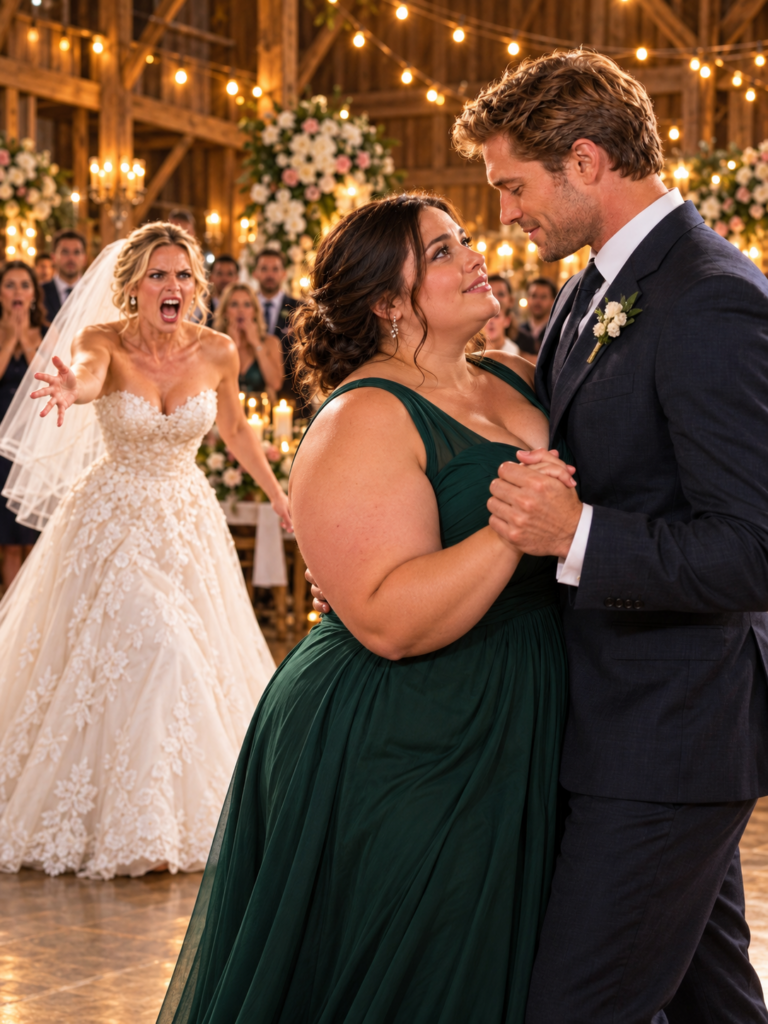
She wore dark green. No bridesmaid pink. No bouquet. No place beside her sister at the head table.
Her right hand was wrapped around her left wrist.
I had noticed that habit during the week. She did it whenever something went wrong—when the caterer called about missing trays, when rain threatened the ceremony, when Tiffany announced two hours before rehearsal that the centerpieces looked “cheap.”
Christine never raised her voice.
She only caught hold of her wrist and solved the problem.
“I saw you at dinner,” Tiffany said. “Looking over at the electrician.”
My stomach dropped.
“A man like him isn’t going to come across a room for you.”
Christine went very still.
So did I.
I’d spent four days trying not to make it obvious that I had noticed her.
Frank had hired me to install a new panel and hang nine hundred feet of string lights in the tobacco barn he’d converted into a wedding venue. I arrived Tuesday morning with two ladders, three toolboxes, and the intention of finishing by Friday without becoming involved in anybody’s family business.
Christine was already there.
Clipboard tucked against her ribs. Mason jars stacked at her feet. Pencil behind one ear.
By noon I knew she ran the kitchen at the county middle school. By two I knew she could move folding tables by herself faster than three groomsmen could do it together. By three, half a ham sandwich appeared on the rung of my ladder wrapped in a paper napkin.
“You forgot lunch,” she said.
I looked down.
She didn’t.
“I didn’t forget.”
“You’ve been up there since eleven.”
“That doesn’t prove anything.”
“I feed four hundred children a day, Andy. I can identify hungry men at distance.”
Then she walked away before I could think of anything worth saying.
I ate the sandwich.
The next day, I found reasons to test the outlet beside the gift table.
Four reasons, as it turned out.
There was never anything wrong with that outlet.
Her clipboard just happened to live there.
She caught me on the fourth test.
“You expecting it to develop a personality?”
“Electrical faults can be shy.”
“Is that in the code book?”
“Appendix C.”
She looked at me for two seconds, decided I might be joking, and smiled.
That smile stayed with me through the rest of the wiring.
Friday evening, she found me coiling extension cords and held out an invitation with Andy Turner written across the front in blue ink.
“You hung all those lights,” she said. “You ought to see them turned on.”
So Saturday night I came back wearing the one suit I owned.
It had attended more funerals than weddings.
Now, behind the flower wall, I watched Christine look across the dance floor toward the table where I had been sitting with Frank and his wife.
My chair was empty.
Because I was ten feet away, kneeling beside a dimmer switch.
But she didn’t know that.
Something passed over her face.
Not humiliation exactly. More like acceptance.
“Fine,” she said.
Tiffany’s smile sharpened.
“Go home before people start feeling sorry for you.”
Christine nodded once.
Then Tiffany patted her arm and walked back toward the head table.
I remained behind the flowers.
Christine went to the gift table and began gathering her purse and clipboard.
I could finish the dimmer.
That was the sensible thing.
The familiar thing.
I was good at fixing what had wires.
People were harder.
I could also step around the flower wall and tell Tiffany Ratliff exactly what kind of woman humiliates her own sister at her wedding.
I wanted to.
My hands were hot with it.
But that would tell Christine I’d heard everything.
It would make me another person standing over her while she had to explain herself.
So I tightened the final screw.
I don’t leave cover plates hanging.
Then I turned the dimmer one notch higher.
The lights above the dance floor warmed.
If I was going to do something stupid, I wanted her to see my face.
I took the long way.
Through the service hall behind the kitchen, around the opposite side of the barn, and out beside my empty chair.
Christine was forty feet away.
Her purse hung from one shoulder. Clipboard under her arm.
The dance floor between us was clear.
Tiffany had said a man like me wouldn’t cross a room for her.
Forty feet was nothing.
I’d pulled wire farther than that through an attic in July.
Still, I have never walked a longer distance in dress shoes.
Frank noticed first. His fork stopped halfway to his mouth.
The best man looked over.
Then Christine saw me.
Her expression changed so fast it nearly stopped me.
Surprise.
Wariness.
Hope trying not to look like hope.
She straightened her shoulders.
I kept walking.
“Christine.”
“Andy.”
“I thought you left.”
“I was fixing the dimmer.”
Her eyes lifted briefly toward the lights.
“Is it fixed?”
“It is.”
I held out my hand.
“Would you dance with me?”
She looked at it.
Then at the purse on her shoulder.
“I was leaving.”
“I can see that.”
“You don’t dance.”
“I never claimed to.”
The speakers changed songs behind me.
Slow.
Convenient enough that I almost believed in providence.
“I should warn you,” I said. “I dance like a man carrying a ladder through a doorway.”
“Can you hear the beat?”
“Perfectly.”
“And?”
“I just can’t persuade my feet to respect it.”
The corner of her mouth moved.
Then her expression became careful again.
She studied me the way somebody studies an estimate before signing.
Finally she set her purse and clipboard down.
“Then I’ll drive.”
Her hand settled into mine.
Cold fingers. Work-roughened palm.
There was a pale burn across the back of her wrist, the kind you get from an oven rack when you’re reaching too quickly for something hot.
I noticed because I had been noticing too much about her all week.
We stepped onto the floor.
She adjusted my hand at her waist.
“Here.”
“Yes, ma’am.”
“Not so stiff.”
“That may be structural.”
That earned a quiet laugh.
Then she glanced past my shoulder.
“They’re staring.”
“I noticed.”
“You enjoy being looked at?”
“No. I hide behind flower walls for a living.”
The words left my mouth before my brain caught them.
Christine’s hand went rigid on my shoulder.
Her feet kept moving.
“The electrical panel,” she said slowly, “is behind the flower wall.”
“It is.”
“How long were you back there?”
I could have lied.
For half a second, I wanted to.
“Long enough.”
She pulled away just enough to look at me.
“This is pity.”
“No.”
“You heard her.”
“Yes.”
“And you thought, poor Christine, somebody ought to dance with her.”
“No.”
“She said nobody wants me.”
“I heard that.”
Her chin came up.
“And?”
“She’s wrong.”
“You can’t know that.”
“I can’t.”
I swallowed.
“I do.”
It landed between us.
Plain. Unplanned.
Christine stared at me.
Then the corner of her mouth lifted.
“That,” she said, “is a dangerous sentence to say to a woman at a wedding.”
It took me a second.
My ears went hot.
“I’d like to clarify that I was talking about the wanting.”
“I know what you meant.”
She didn’t step away.
Instead her hand softened against my shoulder.
A small change.
But not politeness anymore.
A decision.
“Now,” she said, “I have to decide whether I believe you.”
“Take your time.”
“How long do I have?”
“The whole song. I’m not capable of anything advanced.”
She laughed.
A quick, startled sound.
I would have rewired the entire barn for free to hear it again.
We turned past the head table.
Tiffany was standing now.
Christine saw her.
I felt the awareness pass through the hand holding mine.
For one moment I thought she might pull away.
Instead she looked directly at me.
And stepped closer.
The song ended.
Frank and his wife started clapping.
A few tables followed.
Christine looked honestly bewildered.
I forgot to release her hand.
She forgot too.
Then Tiffany arrived.
“That was sweet, Andy.”
She said it loudly enough for neighboring tables.
“Frank never mentioned the electrician did charity work.”
Christine’s fingers tightened.
I put my free hand in my pocket because anger tends to live in my hands.
Tiffany smiled at her sister.
“Did she tell you about Vince?”
“No.”
“Vince Griffin. She was supposed to marry him. Nineteen days before the wedding, he walked away. Two hundred invitations already mailed.”
So that was him.
That was the man the town knew about.
The man I had wondered about behind the flowers.
“I only want you to understand what you’re picking up,” Tiffany said.
I looked at Christine.
Then back at Tiffany.
“I asked your sister to dance. I didn’t ask for her paperwork.”
Tiffany blinked.
“What I understand,” I continued, “is that she said yes. That was all the information I needed.”
A man spoke behind me.
“Christine.”
Tall.
Expensive suit. Good teeth.
He offered me his hand with the confidence of somebody accustomed to closing deals.
“Vince Griffin.”
“Andy Turner.”
“You did the lights.”
“I did.”
“Good work.”
“Thank you.”
His attention shifted to Christine.
Then back to me.
“Are you here with her?”
The easy answer was no.
The truthful answer, technically, was also no.
I looked at Christine.
“As of about four minutes ago,” I said, “yes.”
She inhaled.
Then let go of my hand only long enough to step even with my shoulder.
Not behind me.
Beside me.
“He asked me to dance,” she told Vince. “I told him yes.”
Short sentence.
Sounded like a gate closing.
Vince smiled without warmth.
“I hope you enjoy the evening.”
“We plan to,” Christine said.
He walked off.
Tiffany hurried after him.
Christine stared after them for a moment.
Then she breathed out.
“I’m sorry.”
“For what?”
“That.”
“Your family comes with a deductible.”
She turned to me.
I shrugged.
“I carry good coverage. I work around church committees.”
Another almost-smile.
Then she looked down at where our hands had separated.
“You told him you were here with me.”
“I did.”
“Why?”
There were too many people around us.
Too many ears.
I nodded toward the open barn door.
“Want some air?”
She hesitated.
“My truck has a tailgate and no relatives.”
That did it.
She nodded.
Outside, the gravel lot was cool and dark, the crickets louder than the band.
I dropped the tailgate.
We sat one polite foot apart.
When she folded her arms against the chill, I took off my jacket and offered it.
She looked at the jacket.
Then at me.
“If I put that on, are you going to feel pleased with yourself for the next week?”
“Probably.”
“Then you can freeze.”
I folded it between us.
For a minute neither of us spoke.
Then Christine said, “You ought to hear it from me.”
“You don’t owe me that.”
“I know.”
Her fingers traced the edge of the tailgate.
“That’s why I think I can tell you.”
And under the wedding lights I had hung myself, while music leaked through the barn walls, Christine began telling me why the whole town thought they knew her.
Part 2
“Two years ago in June, I was supposed to marry Vince at the church on Main.”
Christine looked toward the barn instead of at me.
“Nineteen days before the wedding, he came into the school kitchen during lunch service and told me he couldn’t do it.”
I said nothing.
“He said I was hard to love. That I was married to my job. Strung too tight. That I didn’t know how to make life easy for a man.”
My jaw—
No.
That wasn’t what happened.
What happened was simpler.
My hand closed around the edge of the tailgate until the metal pressed into my palm.
Christine continued.
“Then he repeated his version all over town. Apparently leaving me was an act of personal courage.”
She looked down at her dress.
“I bought this for my rehearsal dinner.”
The green dress.
“The one you’re wearing?”
“It hung in my closet for two years with the tag still attached. I cut it off this morning in the school parking lot with kitchen shears.”
I thought of the tiny piece of plastic still caught beneath the seam under her arm.
Tiffany had noticed it.
I remembered her smile.
Christine gave me a sideways look.
“What’s that face?”
“I’m doing a load calculation.”
“On what?”
“How much electrical demand would be involved in shutting off Vince Griffin’s heat every January.”
She laughed.
“I wouldn’t actually do it,” I said.
“Good.”
“I’d think about it.”
“How often?”
“Every January.”
Her laughter faded, but some of the tension stayed gone.
Then she said quietly, “You hear something enough times and eventually you wonder whether everybody else knows something you don’t.”
“He was wrong.”
“You’ve known me four days.”
“I know you fed a stranger standing on a ladder.”
“That’s not evidence.”
“I know you organized a two-hundred-person wedding for a sister who didn’t put you in the wedding party.”
Christine flinched.
I regretted the wording.
But she said, “Keep going.”
“I know you solved everybody else’s problems all week without turning any of them into proof you were important. I know Tiffany spent five minutes trying to humiliate you and you never said one cruel thing back.”
I looked toward the barn.
“I wouldn’t have managed that.”
Her shoulders loosened.
“That was nearly smooth.”
“Accident.”
“I suspected.”
“I once told a building inspector I loved him when I meant thank you.”
She stared at me.
“Did he pass the inspection?”
“Yes.”
“Then perhaps it worked.”
She smiled down at her hands.
I wanted to touch her.
Not because she was wounded.
Not to prove Tiffany wrong.
Because I wanted to.
And I wanted her to know the difference.
“Would it be all right if I held your hand?”
Her head lifted.
“Or,” I added, “is that ahead of schedule?”
She studied me for several seconds.
“I’m not going to be your good deed, Andy.”
“You’d be terrible at it.”
Her eyebrow rose.
“You’d have my entire life reorganized by Thursday.”
“Wednesday.”
“See?”
That smile returned.
Then she placed her hand in mine.
Her fingers were warmer now.
My thumb touched the pale oven scar once.
She let it.
“In there,” she said, looking toward the barn, “I felt like something people felt sorry for.”
I waited.
“Out here I feel…”
Her throat moved.
“Picked.”
Every useful sentence I had ever learned disappeared.
“You are,” I said.
Her eyes shone.
She smiled anyway.
“Then pick me again.”
“What?”
“There’s another slow song in ten minutes. I know because I made the playlist.”
She slid off the tailgate, picked up my jacket, and put it on.
I tried not to look pleased.
Failed.
At the barn door she stopped.
“And Andy?”
“Yes?”
“If anybody asks whether you’re with me again, don’t say ‘as of four minutes ago.’”
“What should I say?”
Her thumb crossed my palm.
“Say yes.”
She looked at me.
“I’m going to.”
We walked back inside together.
The second dance got fewer stares.
Not none.
Christine put her hand on my shoulder.
“You’re not holding me like a ladder anymore.”
“I’m improving.”
“I can tell. You’ve upgraded to large appliance.”
I laughed.
She moved nearer.
“I’ve never had anybody pick me in front of two hundred people before.”
“That makes it sound heroic.”
“It felt heroic from where I was standing.”
“I was terrified.”
“You hid it.”
“I was counting.”
She frowned.
Then listened.
“One, two, three, four…”
I stopped.
Her ears went pink.
“You were counting out loud.”
“I hoped that part stayed internal.”
“What comes after four?”
“Something close to prayer.”
She laughed again.
I wanted to kiss her.
Instead I said, “I’ll tell you something plain.”
She waited.
“You’re the only person in this barn I’ve wanted to talk to all week.”
Her expression softened.
Then she looked overhead.
“These are barn lights, Andy.”
“I’m aware.”
“You hung them yourself. Everybody looks sincere under these.”
“That’s disappointing.”
“Say it somewhere ugly and I might believe you.”
“Fine.”
“Fine?”
“Let me take you somewhere ugly.”
Her eyebrows lifted.
“When this is over, I’ll buy you something out of a fryer.”
“I can’t leave before the cake.”
“When’s cake?”
“Nine.”
“Of course you know.”
“It’s on the clipboard.”
“Then five after nine.”
She went cautious again.
“Tell me it isn’t pity.”
“It isn’t.”
“Tell me I’m not the sad sister tonight and those lights are helping.”
I looked at her.
“There was never anything wrong with the outlet beside the gift table.”
She stopped moving.
“I know.”
“What?”
“I tested it Thursday after you went home.”
I nearly walked us into another couple.
Christine laughed.
“I noticed you too.”
“You did?”
“You coil every extension cord the same direction. You apologize to ladders when you bump them into things. You learned all six bridesmaids’ names even though not one of them learned yours.”
I had no response.
So I held her slightly closer.
When the song ended, neither of us moved.
Frank appeared beside us.
“The photographer wants family, then everybody who worked on the barn.”
He looked between us.
“That’s both of you.”
During the photographs Vince drifted beside Christine twice.
Both times she moved until she was beside me.
By the third picture, her arm was looped through mine.
Frank leaned forward from behind us.
“You two are subtle as a tractor on the highway.”
Then Vince appeared at my other shoulder.
He kept looking at the camera.
“Has she told you why I really left?”
“No.”
“You ought to ask before you get attached.”
I understood the bait.
The old version of me would have turned immediately.
Demanded an explanation.
Made Vince the keeper of information about Christine.
Instead I smiled for the photograph.
Still, his question followed me.
The cake was cut at nine.
Christine handed her clipboard to Frank’s wife a little after.
We left soon after that.
She’d had two glasses of champagne. I’d had none, thanks to the dimmer, so her car stayed at Frank’s.
Eleven miles up the highway sat an all-night truck stop.
Ugly enough.
Under buzzing fluorescent tubes, Christine ordered a breakfast platter at ten o’clock at night.
“I’ve cooked for four hundred children every weekday for eleven years,” she said. “Nobody has cooked for me since Tuesday.”
I ordered onion rings and coffee.
She leaned across the table.
“All right.”
“What?”
“This qualifies as ugly. Say it again.”
Above us, a light hummed.
“One ballast is dying.”
“Andy.”
“The coffee smells burnt.”
“Andy.”
“That man behind you is losing an argument with a claw machine.”
She narrowed her eyes.
I gave in.
“You’re still the only person I’ve wanted to talk to all week.”
The teasing disappeared from her face.
“Thank you.”
Our food arrived.
For a while we ate.
Then Christine rotated her coffee cup by the handle.
“I forgot what this was like.”
“What?”
“Sitting across from somebody who isn’t keeping score.”
I reached across the table.
Not far enough to take.
Only far enough to offer.
Her fingers met mine beside the napkin holder.
“I haven’t dated in a long time,” she said. “I haven’t trusted my own judgment in a long time either.”
Her phone buzzed.
She looked at it.
The color drained from her face.
I looked at my onion rings.
After several seconds she turned the screen toward me.
Don’t be stupid. Vince wants to talk. You owe him one conversation before you embarrass this family again at my wedding.
Tiffany.
Christine took the phone back.
But she didn’t release my hand.
“I’m not talking to him tonight.”
“Then don’t.”
“I want to finish my eggs with you.”
So she did.
The phone buzzed three more times.
On the fourth, Christine shut it off and dropped it into her purse.
“That’s the first time I’ve turned my phone off since the school hired me.”
Outside, the air had sharpened.
At my truck, I stopped with my hand on the passenger door.
“My judgment’s been loud tonight too.”
“What’s yours saying?”
“That I should ask if I can kiss you.”
Her face stilled.
“And?”
“That I should probably do it out here instead of beside the pie case.”
For once she didn’t joke.
“Yes.”
I touched her cheek slowly.
Plenty of time to change her mind.
She didn’t.
Instead she caught my tie and rose onto her toes.
Christine kissed me first.
Soft.
Brief.
Certain enough to make every thought in my head scatter.
When I kissed her back, she made a tiny sound I would remember years later.
Then we separated.
Her fingers remained around my tie another second.
I opened the door for her.
On the drive home, her hand rested on the seat between us.
“Is that a habit?” she asked.
“What?”
“Crossing rooms. Saying what you mean. Making it look like it costs nothing.”
I laughed once.
“Christine, I’ve spent most of my life making sure nobody could tell when anything mattered.”
“Why?”
My first instinct was a joke.
She had been brave with me all night.
So I gave her the truth.
“My father was a lineman. Every storm, he was gone. My mother kept track of every supper he missed, every night he came home late. When they fought, she read out her list. Then he read out his.”
The road rolled beneath the headlights.
“I learned young that wanting something out loud is like handing somebody a pencil so they can start keeping score.”
Christine was quiet.
“So I became useful,” I said. “I’m the man people call. I show up, fix the problem, leave. Nobody can say I failed them, but nobody gets close enough to make a list.”
Her hand covered mine.
“For what it’s worth,” she said, “you haven’t seemed careful tonight.”
“I haven’t been.”
“Scared?”
“Yes.”
“So am I.”
My phone rang through the truck speakers.
Frank.
I answered.
He skipped hello.
“Where’d you two go? Is Christine with you?”
“I’m here,” she said.
“Then both of you should know Vince is telling people Andy cornered him during the pictures. Tiffany’s got half the bridesmaids saying Christine is having one of her episodes. It’s ugly.”
I looked toward Christine.
She didn’t crumble.
She sat straighter.
“Frank,” she said, “thank you for worrying about me. Please don’t argue with them.”
“But—”
“I mean it. I’m done having my life decided by whoever talks loudest in a barn. I’ll deal with it tomorrow.”
She looked at me.
“Tonight I’m busy.”
Then she ended the call.
A mile passed.
Her hands were trembling.
I turned mine palm-up.
She took it.
“You sounded sure.”
“I was shaking the whole time.”
“Counts anyway.”
She breathed out.
“Two sentences from those people and I’m fifteen again.”
“What were you like at fifteen?”
“Second trombone. Too many library books. I folded down every page with a good love scene.”
I smiled.
“Why?”
“Because I was quietly certain I was owed one.”
“I’d have liked her.”
Christine turned toward me.
“She’d have folded down a page about you.”
Her house stood six miles outside town beneath two maple trees.
The porch light flickered.
I noticed.
She noticed me noticing.
“Don’t.”
“It’s a loose connection.”
“I know.”
“It’s going to keep me awake.”
“This is me,” she said.
She didn’t open the door yet.
“I’m not inviting you inside.”
“I didn’t ask.”
“I know. I need to say it anyway so I can hear myself being sensible.”
“I like sensible.”
And I meant it.
If I went inside that night, I would become one more thing that happened to her at her sister’s wedding.
I wanted to be something she chose on an ordinary day.
I walked her to the porch.
On the bottom step, she turned.
“Ask me properly.”
“What?”
“You know.”
I did.
“Christine, will you have supper with me tomorrow? Not because of Vince. Not because of Tiffany. Not because of anything said tonight.”
I drew a breath.
“Because I like you, and I want to know which pages you folded down, and tonight ended before I was finished talking to you.”
“Yes.”
The answer came immediately.
“Tomorrow.”
She caught my tie.
Kissed me good night.
Then she stole my jacket.
“Collateral,” she said.
I watched the kitchen light come on before I started the truck.
My phone buzzed.
Unknown number.
Stay away from Christine Ratliff. You have no idea what she did to the last man who loved her.
Then another.
Ask her why Vince really left.
I sat with the engine running.
For a few minutes, those messages tried to become louder than everything that had happened between us.
That was how doubt worked.
It offered to protect you if you let it make decisions first.
The old me would have driven away and built an entire case before sunrise.
Instead I texted Christine.
Still awake?
Her reply came almost immediately.
Yes. Turned my phone back on to set the alarm. Have you already forgotten how normal people behave?
I smiled.
Then typed:
Completely. I got a strange message. I’m not discussing it over text. But I want you to hear it from me before somebody bends it.
My phone rang.
Christine.
“Tell me exactly what it says.”
So I did.
Word for word.
When I finished, the silence wasn’t guilty.
It was tired.
“That’s probably Vince.”
“You sure?”
“He keeps another phone for work.”
“My number is painted on both sides of my truck.”
“So technically it could be anybody.”
“Comforting.”
She didn’t laugh.
“Andy, Vince didn’t leave because I was difficult.”
I waited.
“He left because I wouldn’t sign.”
And suddenly the story everybody in town knew began to come apart.
Part 3
“My grandmother left me the house,” Christine said. “And eleven acres behind it.”
I looked through the windshield at that small white house beneath the maples.
“It isn’t a fortune. But development has been moving down this road for years, and Vince knew what the property might become worth.”
“He sells real estate.”
“Yes.”
She breathed in.
“About four months before the wedding, he became very interested in our future. He wanted the land transferred into his company. Said we were building something together.”
“And you said no.”
“I said I wanted my own lawyer to read the documents first.”
That was all.
The thing the town thought Christine had done.
The terrible flaw that supposedly made a man abandon her nineteen days before a wedding.
She had asked for a lawyer.
“He called me paranoid,” she said. “Then controlling. Then he told me I didn’t understand how to trust a man. When I still refused, he left.”
Her voice shook.
“Afterward he told people I came apart. Tiffany believed him. She introduced us. Her husband works for him. Believing his story was easier than admitting she might have helped put me in a bad situation.”
“Why didn’t you tell people?”
Christine was silent long enough that I thought the call had dropped.
Then:
“Because I was ashamed.”
“Of saying no?”
“Of nearly saying yes.”
That answer reached somewhere deep.
Somewhere I recognized.
“I’m still in your driveway,” I said.
Silence.
“You are?”
“I was waiting for your kitchen light.”
Another silence.
Softer this time.
“Can I come back onto the porch? I won’t come inside.”
“Yes.”
She stepped outside barefoot, still in the green dress, my jacket folded over one arm.
The porch light flickered above us.
“You can go,” she said. “That’s a lot of history for one dance and some eggs.”
I climbed the steps.
“I’m not leaving because a small man punished you for asking for legal advice.”
Her eyes filled.
“There’s something else.”
“What?”
“I’m not always brave.”
“I didn’t ask you to be.”
“Some days I can still hear all of them.”
“I don’t need brave.”
“What do you need?”
“Honest.”
I moved one step nearer.
“And I need you to tell me when to come closer and when to back away.”
Christine looked at me.
Then held out her hand.
“Closer.”
I went.
She rested her forehead against my chest.
My arms went around her.
No audience.
No music.
No applause.
Just a flickering porch light, distant barking, and the weight of a woman trusting me enough not to pretend she was fine.
It was better than the dance floor.
The next afternoon I drove her back to Frank’s for her car.
That evening we had barbecue at a place with picnic tables.
I wore a clean work shirt with TURNER ELECTRIC stitched over the pocket because my only suit smelled like fryer grease and my jacket was still being held hostage.
Christine looked me over.
“Good.”
“What?”
“Now I know what you look like on a Tuesday.”
She told me about her grandmother, who had run a church kitchen for thirty years.
I told her about the first thing I ever wired.
“I was nine,” I said. “I wanted privacy, so I ran a doorbell from the hallway to my bedroom.”
“That’s actually clever.”
“It rang in the kitchen instead.”
She stopped chewing.
“For two years, every time my mother ran the mixer, I thought somebody was standing outside my bedroom.”
Christine laughed so hard she had to put her sandwich down.
After supper, we walked the path behind the ball fields.
Her phone rang.
She checked the screen.
“Vince.”
Then she sent it to voicemail.
Tiffany sent a message next.
Christine read the first line and deleted it.
We walked another twenty yards before she stopped.
“I don’t want to spend my whole life on trial.”
I turned toward her.
“I’m tired of standing in front of people proving I’m worth the trouble.”
I took both her hands.
“Then quit arguing the case in front of me.”
Her eyes lifted.
“I’m not the jury.”
“What are you?”
“The man who already made up his mind.”
A strand of hair had blown across her cheek.
I tucked it back.
Christine leaned into my hand.
She didn’t answer.
I didn’t make her.
I had told her on the dance floor to take her time.
I meant longer than one song.
Vince didn’t stop immediately.
He called Frank.
He sent messages.
On Friday, Christine wrote one reply with Tiffany copied.
Short.
Calm.
Final.
She showed me before sending it.
Saturday morning I was at her house fixing the porch light.
I had the fixture open and a screwdriver in my hand when a car turned into the drive.
Vince.
He stepped out carrying a folder.
“Christine.”
I came down one ladder rung.
Then another.
Stopped.
This was her porch.
Her land.
Her fight.
If I stepped between them, Vince would make the story about two men deciding what happened to Christine Ratliff.
So I stayed on the ladder.
Hardest electrical work I’d ever done.
Vince walked toward the steps.
“Give me five minutes. There’s a buyer now, a serious one. I can make this right for you.”
Christine came outside.
“The answer is no.”
“Christine—”
“It was no two years ago. It’s no today.”
Her voice never rose.
“I asked for a lawyer. You called that a flaw in me. Then you told this town I’d come apart, and I let you because I was ashamed.”
Vince opened his mouth.
She kept going.
“I’m finished being ashamed.”
He stopped.
“You have my message. Any more calls, any more texts from another number, any more visits, and I document all of it and give it to my attorney.”
The folder lowered.
“My land isn’t up for discussion. My money isn’t up for discussion.”
She paused.
“And who I dance with isn’t up for discussion.”
I almost smiled.
“You can go.”
Vince stood there another second.
Then returned to his car.
We watched him back past the maples.
Christine stayed at the top of the steps until the dust disappeared.
Then her right hand caught her left wrist.
Exactly as it had at the wedding.
She looked down.
Saw herself doing it.
Slowly released herself.
I went back up the ladder.
The loose connection took another ten minutes.
I tightened the cover.
Flipped the switch.
Steady light.
Christine stared up at it.
Then at me.
“I need to say something.”
“All right.”
“And I need you not to be funny until I finish.”
“That may exceed my certification, but I’ll try.”
She gave me a look.
I shut up.
“I’m not choosing you because you crossed a dance floor.”
I listened.
“It was a good night. But I’m not building a life on one good night. I’m not choosing you because I was lonely. I’m not choosing you because I want to prove Tiffany wrong.”
Her hands were trembling again.
She let them.
“I’m choosing you because you sat in my driveway with that message in your hand and called me instead of guessing.”
Something inside my chest went painfully still.
“Nobody ever just asked me.”
She stepped closer.
“So I’m telling you on a plain Saturday morning, with no wedding and no audience.”
Her voice softened.
“I want you.”
I forgot the ladder beneath my hand.
“I’m with you.”
I had been carrying one sentence around for eleven days.
Waiting for a better version.
There wasn’t one.
“I love you.”
Christine’s eyes widened.
“I’ve been trying to find a clever way to say that.”
She came close enough to take hold of my shirt.
“I didn’t ask for clever.”
Then she kissed me.
Tiffany didn’t apologize immediately.
Pride takes its time paying debts.
But the messages stopped.
The whispering stopped.
Christine changed too, though I never told people I changed her.
She became bigger in her own life.
I was simply beside her while she did it.
There is a difference, and both of us cared about it.
By spring, we had routines.
Sunday mornings meant coffee, then the secondhand bookstore two towns over.
Christine still folded corners on pages with good love scenes.
The first time I caught her doing it, I objected on behalf of the books.
“They survive.”
“You’re vandalizing literature.”
“I’m indexing.”
“You work in a school.”
“Exactly. I’m a professional.”
I met the five women on her kitchen staff.
They questioned me over a steam table like a parole board.
Mrs. Patterson, the oldest, pointed a serving spoon at me.
“You planning to stay?”
“Yes, ma’am.”
“Or are you seasonal?”
“Year-round.”
“Good. We’ve had seasonal.”
She looked at Christine.
“He’ll do.”
Eight months after Tiffany’s wedding, I asked Christine to marry me.
On her porch.
Beneath the light that no longer flickered.
I went down on one knee.
Christine covered her mouth.
“This is the second time I’ve been on one knee because of you,” I said.
“You were fixing a dimmer the first time.”
“Still counts.”
“Andy.”
“Christine Ratliff, will you—”
“Yes.”
“I hadn’t finished.”
“Yes.”
“You told me to ask properly once.”
She laughed through tears.
So she made me finish.
Fourteen months after the night behind the flower wall, we had our wedding reception in Frank’s barn.
I hung the lights again myself.
Nine hundred feet.
After supper Christine disappeared.
When she returned, she had changed out of her white wedding dress.
Into green.
The dress she had bought for a rehearsal dinner that never happened.
“This dress was purchased for a night that didn’t show up,” she told me. “I decided it was owed one.”
She lifted her arm to fix her hair.
There, beneath the seam, I saw it.
The tiny piece of plastic tag fastener.
Still there.
I had noticed it the first night.
I had never told her.
I didn’t tell her then either.
On the way toward the dance floor, we passed the side door.
Christine slowed.
The same place.
The same wall.
The place where Tiffany had told her nobody wanted her.
Her hand found mine.
“You all right?” I asked.
She looked around the barn.
At Frank.
At the women from the school kitchen.
At friends who had come because they loved her.
At me.
“I’m fine.”
She smiled.
“She was wrong. I’m just taking a second to enjoy that.”
Across the room, Tiffany watched us.
Then she walked over.
Christine’s fingers tightened once around mine.
Tiffany didn’t make a speech.
She didn’t give the apology Christine deserved.
She only reached up, straightened the strap of the green dress the way sisters sometimes do, and said quietly, “It looks good on you.”
Christine looked at her.
Tiffany swallowed.
“It always did.”
Then she walked away.
Not enough.
Maybe a beginning.
Christine let it be enough for one night.
She turned to me.
“Dance with me, husband.”
“I should warn you.”
“I already know.”
“I still dance like a man carrying a ladder through a doorway.”
Her hand slipped into mine.
“Then I’ll drive.”
She did.
Halfway through the song, she leaned closer.
“When you crossed that floor the first time, I thought it was pity.”
“It wasn’t.”
“Then I decided you’d lost your mind.”
“That theory remains viable.”
She smiled against my shoulder.
“Now I think you were already on your way to me.”
I stopped counting.
Christine looked up.
“And the dance floor,” she said, “was only the last forty feet.”
There was no useful answer to that.
So I kissed my wife beneath nine hundred feet of wire I had hung with my own hands.
After the song, while everyone found their tables, I slipped behind the flower wall.
Same plywood.
Same plastic peonies.
Same electrical panel.
I turned the dimmer all the way up.
Because this time, I wanted everyone in that barn to be able to see her face.


