
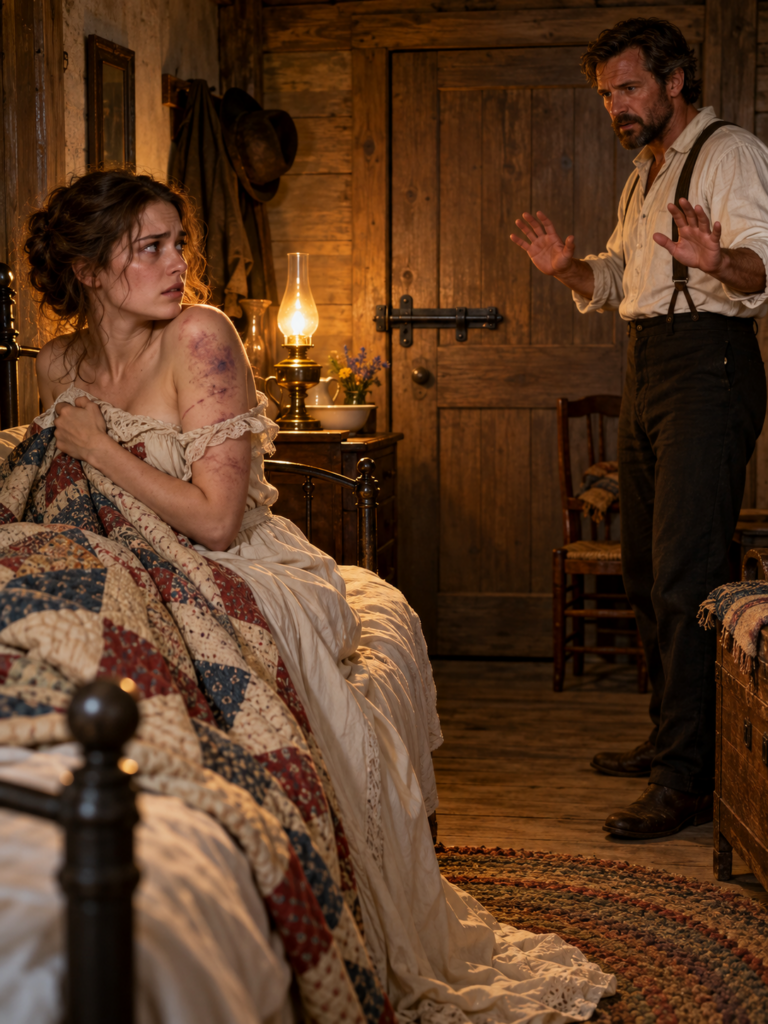
The iron bolt settled into its bracket with a hard metallic click.
Eleanor kept one hand on it.
Outside, Samuel heard the sound from halfway across the yard.
He stopped beneath the Kansas stars.
Relief moved through him so sharply it almost hurt.
She had locked him out.
Good.
For once, a closed door meant she had chosen something and a man had accepted it.
Samuel slept badly in the barn.
At dawn he washed at the pump, fed the horses, and stood before his own front door wondering how a husband properly requested admission to his own house.
Then he knocked.
Eleanor opened it cautiously.
Samuel lifted the coffee tin.
“Morning.”
“Morning.”
“I was hoping my wife might allow me to make coffee badly in her kitchen.”
The smallest movement touched her mouth.
Not quite a smile.
“Come in.”
That morning became the first rule of their marriage.
Samuel announced himself.
Behind you.
Coming through.
Opening the door.
If he needed to pass close, he warned her.
If he handed her something sharp, he held it by the safe end.
When the wagon step proved difficult on a trip into Abilene, he offered his hand instead of taking her elbow.
Eleanor stared at it.
“You don’t have to ask every time.”
“I know.”
“Then why do you?”
Samuel considered.
“Because I’d rather ask one time too many than teach you that you were right to fear me.”
Her eyes filled so quickly he looked away to give her dignity.
Weeks passed.
Eleanor planted beans beside the cabin.
She reorganized Samuel’s confused account books and discovered he had paid the same feed invoice twice.
Samuel protested.
Eleanor produced both receipts.
He surrendered.
She mended curtains because she wanted them mended, not because anyone told her a wife should.
Samuel repaired the garden fence because jackrabbits had developed stronger opinions about beans than either of them.
One afternoon he struck his thumb with a hammer and swore with such inventive force that Eleanor laughed from the porch.
The sound stopped him.
She stopped too.
Fear flashed across her face, as if laughter itself might require an apology.
Samuel looked at his thumb.
Then at her.
“That was an excellent word.”
Eleanor blinked.
Samuel added, “I intend to use it again.”
Her second laugh came easier.
By September they could sit on the porch without filling every silence.
One evening their shoulders nearly touched.
Samuel remained still.
Eleanor’s hand rested beside his on the bench.
Slowly, deliberately, she moved her smallest finger until it touched his.
Samuel did not turn his palm over.
He did not seize the invitation and enlarge it.
He let the contact remain exactly what she had made it.
Eleanor looked at him.
“You noticed.”
“Yes.”
“You could acknowledge it.”
“I feared frightening it away.”
That time her smile lasted.
Autumn deepened.
The bruises faded.
The scars did not.
Samuel never asked her to cover them.
Then in December, Eleanor entered the kitchen carrying the key to her battered trunk.
“I want to show you something.”
Samuel followed her into the bedroom.
The trunk remained where it had stood since she arrived.
Eleanor opened it herself.
Clothes.
Letters.
Her mother’s Bible.
A small purse.
Then papers.
She handed Samuel one document.
He read it once.
Then again.
Two hundred dollars had passed from Caleb Voss to Cyrus Hart.
In exchange, Cyrus had agreed to deliver Eleanor for marriage.
Samuel’s jaw clenched.
“He sold you.”
“He called it compensation.”
“Why keep this?”
Eleanor touched the paper.
“Because someday someone may claim I belonged to him.”
Samuel looked up.
“No man owns you.”
“I know that here.”
Her voice dropped.
“I don’t know whether everyone else will.”
Samuel folded the agreement carefully.
“What do you want done with it?”
Eleanor expected him to say he would handle everything.
Instead he waited.
Her choice.
Again.
“I want a copy made.”
“All right.”
“And I want the sheriff to see it.”
Samuel nodded.
“If Cyrus ever comes here, I want someone besides us to know why.”
Samuel picked up his coat.
“I can ride into town tomorrow.”
Eleanor shook her head.
“We can.”
Samuel looked at her.
She lifted her chin.
“I spent too many years having men conduct business about my life while I remained in another room.”
Samuel put the coat back down.
“Then we go together.”
Eleanor locked the trunk again, but this time the key remained in her hand instead of disappearing beneath her dress.
The next morning she climbed into the wagon beside Samuel carrying the document that proved what Cyrus had tried to make of her—and, for the first time, intending to place it in the hands of the law herself.
Eleanor kept the document in her own coat pocket all the way to Abilene.
Samuel drove.
He did not ask to hold it.
That mattered more than he realized.
The prairie lay hard and pale beneath a winter sky, grass flattened by wind, wagon ruts frozen at the edges. Eleanor watched the eastern road whenever another traveler approached, but she did not ask Samuel to turn back.
Sheriff Dalton occupied two rooms behind a plain wooden office near the center of town.
He knew Samuel.
Most people did.
Mercer was the quiet widower with good horses, stubborn cattle, and a habit of paying what he owed even when it took longer than he liked.
Dalton looked surprised when Eleanor entered beside him.
“Mrs. Mercer.”
“Sheriff.”
Samuel remained near the door.
Eleanor took out the document.
“I want you to read this.”
Dalton did.
His expression changed slowly.
When he finished, he looked toward Samuel.
Samuel said, “Ask her.”
Dalton returned his attention to Eleanor.
She told him about Cyrus.
Not everything.
Enough.
The guardianship.
The violence.
The attempted escape.
Caleb Voss.
The two hundred dollars.
Dalton did not promise miracles.
Missouri lay beyond his immediate authority.
No frontier sheriff could simply ride across jurisdictions and erase what had happened.
But he made a copy.
He recorded Cyrus Hart’s name.
He recorded Voss’s.
And he told Eleanor that if either man appeared in his county and threatened her, the matter would no longer exist only as her word against theirs.
On the wagon ride home, Eleanor held the folded original in her lap.
“I expected to feel different.”
Samuel glanced toward her.
“How?”
“Safer.”
“You don’t?”
She considered.
“A little.”
Samuel nodded.
“I imagine paper takes time to feel like a wall.”
That made her look at him.
“You understand that?”
“No.”
He guided the horses around a washout.
“But I understand fences. First day you build one, cattle test it.”
Eleanor smiled.
“So I am cattle now?”
“No.”
“Your comparison needs work.”
“It usually does.”
Winter settled around them.
Their marriage did not become romantic simply because Samuel behaved decently.
Trust remained work.
Samuel occasionally forgot to announce himself.
Eleanor occasionally woke with her heart hammering because the wind moved something against the wall.
Once, in January, Samuel dropped a cast-iron pan.
The crash brought Eleanor to the floor with both arms over her head before thought could intervene.
Samuel froze.
For one terrible second shame filled her face.
Then Samuel sat on the floor several feet away.
He did not say, You are safe.
He had learned that telling frightened people what they ought to feel rarely helped.
Instead he said, “That pan has attempted murder twice this month.”
Eleanor stared at him.
Samuel looked toward the skillet lying upside down.
“I may have to shoot it.”
A laugh escaped her through tears.
He remained where he was until she stood first.
Their life grew through moments like that.
Eleanor learned the ranch books properly.
Samuel discovered she could calculate feed costs in her head faster than he could with pencil and paper.
She learned to harness the gentler wagon team.
He taught her which horses would test an inexperienced rider and which merely looked unfriendly.
He never placed her on a horse without asking.
She never pretended she knew what she did not.
By early spring, Eleanor had taken over most household accounts because she was better at them.
Not because she was his wife.
Because she was better.
One evening Samuel found her at the table surrounded by bills.
“You look murderous.”
“The hardware merchant charged us twice for nails.”
Samuel leaned over the paper.
“Maybe we bought twice the nails.”
“We did not.”
“You know this how?”
“You lose half of them.”
“That proves nothing.”
“It proves we should buy fewer.”
He laughed.
Eleanor stared at him.
Then laughed too.
The sound belonged in the cabin now.
So did her things.
At first everything she owned had remained packed except what she needed immediately.
By March, her mother’s Bible sat on a shelf.
By April, two dresses hung openly from pegs.
The trunk remained locked, but less often.
Then one warm evening Eleanor sat beside Samuel on the porch and kissed him.
He stopped moving entirely.
She drew back.
Samuel’s face had gone blank with astonishment.
Eleanor’s nerves rose.
“I thought—”
“May I kiss you back?”
The absurdity of the question made her smile.
“Yes.”
Samuel touched her face lightly.
The kiss was gentle.
No urgency.
No demand.
When it ended, Eleanor remained where she was.
Samuel rested his forehead briefly against hers.
“That all right?”
“Yes.”
He smiled.
The expression changed him.
For the first time Eleanor saw not the older widower, not the rancher, not the man carefully controlling every movement so he would not frighten her.
Just Samuel.
A lonely man trying to build something worth staying for.
May came.
Nearly a year had passed since Eleanor arrived in Kansas.
The garden was green.
Beans climbed the supports.
Samuel repaired fencing at the edge of the yard while Eleanor carried a basket between garden rows.
A rider appeared on the eastern road.
Eleanor saw him first.
The basket fell.
Samuel heard it.
He turned.
Every trace of color had left her face.
The rider came closer.
Broad shoulders.
Gray hair.
Familiar posture.
Eleanor whispered, “No.”
Samuel crossed the yard.
“Who?”
She could barely speak.
“Cyrus.”
Samuel looked toward the approaching horse.
Every protective instinct in him sharpened.
“Go inside.”
Eleanor turned on him.
“No.”
He stopped.
Her breathing was fast.
Her hands shook.
But she remained standing.
“I hid from him for years.”
“Eleanor—”
“I am not hiding in my own house.”
Samuel looked at her.
Then nodded.
“Where do you want me?”
She swallowed.
“Beside me.”
He took his place there.
Not in front.
Beside.
Cyrus Hart pulled up twenty feet away.
He looked older than Eleanor remembered and no kinder.
His eyes moved over the cabin, the barn, the cattle beyond the fence.
Then settled on her.
“There you are.”
The old words struck some ancient place inside her.
As if she were property misplaced and finally recovered.
Samuel’s hand opened between them.
Eleanor looked at it.
Then took it.
Cyrus dismounted.
“You caused enough trouble.”
Samuel’s voice remained calm.
“State your business.”
“My business is with her.”
“Then speak from where you are.”
Cyrus laughed.
“You Mercer?”
“Yes.”
“You have no notion what you married.”
Samuel said nothing.
Cyrus stared at Eleanor.
“Get your things.”
Fear traveled through her body exactly as it once had.
The difference was that fear no longer controlled her mouth.
“No.”
Cyrus frowned.
“You embarrassed me.”
“You hurt me.”
His face hardened.
“You were disobedient.”
Samuel’s hand tightened once.
Eleanor squeezed it.
He understood.
He stayed where he was.
Cyrus took one step forward.
“I fed you seven years.”
Eleanor’s eyes burned.
“And made me pay for every meal.”
“You ungrateful little—”
“That is far enough,” Samuel said.
His voice did not rise.
It did not need to.
Cyrus looked at him.
“You think you can keep her?”
Samuel’s answer came immediately.
“She’s not mine to keep.”
Cyrus blinked.
Samuel looked at Eleanor.
“She stays because she chooses to stay.”
The words struck her harder than Cyrus’s anger.
Cyrus reached inside his coat.
Samuel moved half a step.
Eleanor felt his body change beside her.
But Cyrus withdrew folded papers.
“She was promised to another man.”
Eleanor’s fear sharpened into anger.
“I am legally married.”
“You had no right.”
“I was twenty-one.”
“Voss paid for you.”
Samuel reached into his own pocket.
Months earlier, after Eleanor asked him to help protect the proof, he had carried a copy whenever they traveled.
He unfolded it.
“That payment may be the worst argument you could make.”
Cyrus’s face shifted.
Samuel continued.
“Sheriff Dalton has seen this.”
Eleanor watched her uncle calculate.
For the first time in her memory, uncertainty entered his eyes.
“You took that to the law?”
Eleanor answered.
“I did.”
Not Samuel.
I did.
Cyrus looked toward her.
The words seemed to enrage him more than the marriage.
“You had no authority.”
“It was my life.”
Hoofbeats sounded from the road.
Everyone turned.
Two riders approached.
Sheriff Dalton.
Deputy Reeves.
Samuel glanced at Eleanor.
“I didn’t send for them.”
She believed him.
Dalton reined in near the fence.
“Cyrus Hart?”
Cyrus stepped backward.
“What is this?”
Dalton dismounted.
“We’ve had word from Missouri.”
The deputy remained mounted.
Dalton looked toward Eleanor briefly before returning to Cyrus.
“Fraud complaints. Financial matters connected to a man named Caleb Voss.”
The name froze Eleanor.
“What happened to Voss?”
Dalton hesitated.
“He was arrested this spring.”
“For what?”
The sheriff’s expression told her before the words did.
“His second wife’s death.”
The yard became utterly still.
Eleanor felt Samuel’s hand beneath hers.
Warm.
Steady.
Not closing.
Dalton continued.
“A former household worker gave evidence. Authorities began reviewing Voss’s dealings. Your uncle’s payment arrangement surfaced.”
Eleanor looked at Cyrus.
The old document in her trunk changed meaning.
It had always been proof that Cyrus treated her as property.
Now it was also proof he had tried to send her into a house where another woman may have died violently.
Cyrus swore.
Dalton stepped toward him.
“You need to come with us.”
Cyrus backed away.
“Eleanor.”
Her body reacted before her mind did.
She flinched.
Then stopped.
Samuel shifted.
Eleanor released his hand.
He looked at her.
She walked forward alone.
Cyrus stared at her as if expecting the girl he had controlled.
Eleanor stopped several feet away.
Behind her stood Samuel.
The cabin.
The beans climbing their supports.
The front door with its iron bolt.
The battered trunk that no longer contained everything necessary for escape.
Cyrus’s voice turned desperate.
“You owe me.”
For years Eleanor had imagined speeches.
Accusations.
Questions.
Now all of them seemed too large for the man standing before her.
“No,” she said.
Cyrus stared.
“I survived you.”
Her voice steadied.
“That’s all.”
She turned away.
Dalton took Cyrus by the arm.
The man shouted her name.
Eleanor kept walking.
She made it halfway to the cabin before her knees began to shake.
Samuel did not rush toward her.
He waited.
Eleanor stopped.
Turned.
Their eyes met across the yard.
Samuel’s face asked the question before his voice did.
“May I come closer?”
Eleanor looked at the man who had once slept in his own barn because she needed a locked door.
Then she crossed the remaining distance herself and wrapped both arms around him.
Eleanor reached Samuel before he moved.
Her arms closed around his middle.
Only then did he hold her.
Gently.
His hands settled across her back without trapping her.
For several minutes she shook against him while Sheriff Dalton led Cyrus toward the road.
Samuel did not tell her to stop crying.
He did not tell her the danger was over.
He did not tell her what she ought to feel now that the man who had hurt her was finally being taken away.
He simply remained.
The riders disappeared toward Abilene.
Wind moved through the grass.
Eleanor’s trembling gradually eased.
Samuel lowered his chin.
“Do you want to go inside?”
She nodded.
They crossed the yard together.
At the doorway Eleanor stopped.
The iron lock remained exactly where it had been on their wedding night.
Her fingers touched it.
Samuel waited behind her.
“The first night I came here,” she said, “I thought this was the safest thing in the house.”
Samuel looked at the bolt.
“And now?”
Eleanor turned.
“You were.”
His expression tightened with emotion.
Eleanor shook her head before he could misunderstand.
“Not because you could protect me from Cyrus.”
Samuel remained silent.
“Because you kept showing me I did not need protection from you.”
He looked away.
That affected him more than any declaration of love might have.
Eleanor stepped inside.
Samuel followed.
The arrest did not erase the past.
It created work of another kind.
Sheriff Dalton returned two days later with questions.
Missouri officials wanted copies of Eleanor’s documents.
They wanted a statement about Cyrus.
Later, they wanted her testimony regarding the agreement with Voss.
Samuel offered to accompany her to every meeting.
Eleanor accepted some offers and refused others.
The first time she traveled with Dalton to give a formal statement, Samuel waited outside the room.
Not because she excluded him.
Because she wanted to tell the story without watching his reaction.
When she emerged, pale and exhausted, Samuel stood from the bench.
“How did it go?”
“I hated every minute.”
“Do you want to go home?”
“Yes.”
He did not ask what she had said until she volunteered it that evening.
That was another lesson.
Love did not entitle him to every memory.
Marriage did not make every locked room his.
Some doors opened because Eleanor chose to open them.
Some remained closed.
Both could exist inside a good marriage.
News eventually reached them that Cyrus faced financial charges in Missouri connected to fraudulent dealings, while investigators continued examining the arrangement with Voss.
Voss’s case developed separately.
Eleanor learned enough to confirm what she had feared: his second wife’s death had not been the simple household accident first described.
She stopped asking for details.
Knowing everything would not make her safer.
Knowing she had escaped was enough.
Summer returned.
Nearly a full year had passed since Samuel first saw bruises beneath Eleanor’s sleeve.
The marks had faded.
One scar near her wrist remained visible whenever she rolled her sleeves for work.
She no longer hid it.
Samuel noticed that before Eleanor did.
One afternoon they worked together in the garden.
Samuel hated weeding.
Eleanor claimed this revealed a defect in his character.
“I manage six hundred acres.”
“You avoid twenty feet of beans.”
“Cattle are more cooperative.”
“Cattle do not grow beside the kitchen.”
“They should consider it.”
Eleanor laughed.
The sound remained one of Samuel’s favorite things.
He never said so often enough to make her self-conscious.
Their affection deepened slowly.
Eleanor began entering his space without warning.
Not because he demanded it.
Because she no longer feared doing so.
She leaned against him while reading.
She reached across him at the table.
She sometimes fell asleep with her head on his shoulder.
Samuel remained careful.
At first Eleanor found that care comforting.
Eventually, a new problem emerged.
One evening she found him preparing to sleep on the narrow bench in the front room.
They had spent more evenings together in the bedroom recently, but Samuel still withdrew whenever he sensed hesitation.
“What are you doing?”
“Sleeping.”
“That is evident.”
Samuel unfolded a blanket.
Eleanor stood in the doorway.
“Why here?”
He looked at her.
“You seemed troubled tonight.”
“I am.”
“I thought you wanted space.”
“I wanted you to ask.”
Samuel stopped.
Eleanor folded her arms.
“You are allowed to speak to me, Samuel.”
“I know.”
“Do you?”
He sat on the bench.
She remained standing.
“I have spent so long learning not to presume,” he said, “that sometimes I fear any wanting from me will feel like pressure.”
Eleanor’s expression softened.
“That is not what frightens me.”
“What does?”
“When you decide for me.”
Samuel frowned.
“I thought giving you distance was the safest thing.”
“It was when I asked for it.”
The distinction settled between them.
Eleanor walked closer.
“On our wedding night, you stepped away because I needed you to.”
“Yes.”
“That does not mean you must spend our entire marriage stepping away before I have chosen anything.”
Samuel looked down.
“I don’t know where the line is.”
“Neither do I.”
He looked up.
Eleanor sat beside him.
“So we speak.”
Samuel’s mouth curved faintly.
“That sounds almost too simple.”
“It will be terribly inconvenient.”
“Good.”
“Why good?”
“Anything worth doing around this ranch is inconvenient.”
She laughed.
Then grew serious.
“I want you beside me tonight.”
Samuel’s eyes searched hers.
Eleanor held his gaze.
“I am saying it because I want it.”
He nodded.
“All right.”
They walked to the bedroom together.
The door remained open.
Months earlier that would have been impossible for Eleanor.
Now she barely noticed until morning.
That was how healing usually arrived.
Not as a grand transformation.
As the disappearance of small calculations that once consumed entire days.
Where is the nearest door?
How angry is his voice?
What is in his hand?
Who knows where I am?
Can I run before he reaches me?
Those questions did not vanish entirely.
Some slept lightly.
A stranger raising his voice in town might wake one.
A slammed door could wake another.
But Samuel never treated their return as betrayal.
He did not say, I thought you were over this.
He understood that scars were not promises never to hurt again.
They were evidence of survival.
Eleanor’s life expanded beyond recovery.
That mattered most.
She became responsible for ranch accounts because numbers made sense to her and Samuel’s system did not.
His method consisted largely of folded receipts placed wherever his hand happened to be.
She created proper books.
She tracked feed, repairs, livestock sales, household expenses, and debt payments.
Within two years, Samuel knew more precisely what the ranch earned than he had at any previous point in his life.
“You married me for my personality,” Eleanor told him while balancing quarterly figures.
“I married you because you asked whether my door locked.”
“That was romantic.”
“It was memorable.”
She looked over the ledger.
“Your fencing expenses are ridiculous.”
“There. Romance.”
Samuel taught her to ride confidently.
He began with an older bay mare named Molly, who possessed patience and little ambition.
Eleanor resented the implication.
“Molly is almost asleep.”
“That is the quality I selected.”
“I can handle a livelier horse.”
“You can.”
“Then why this one?”
“Because learning is easier when the horse is not also learning.”
Eleanor considered.
“Reasonable.”
“I have rare moments.”
She progressed quickly.
Not because the story required a miraculous transformation.
Because she practiced.
She learned to saddle her own horse.
She learned when not to ride.
She learned that spring mud could exhaust a horse faster than distance.
She learned to listen when experienced hands warned her about weather.
Samuel, in return, learned to take her judgment seriously where she knew more.
The ranch became theirs in practice long before the law or local habit would have used equal language.
Eleanor knew every account.
Samuel knew every pasture.
She understood contracts.
He understood livestock.
Decisions affecting both came to the kitchen table.
They argued there.
Sometimes loudly.
Never frighteningly.
The first time Eleanor raised her own voice at Samuel, she stopped mid-sentence.
His expression changed.
She froze.
Then Samuel said, “You were saying?”
Her eyes filled.
He did not mention it.
She finished the argument.
Samuel was wrong.
He admitted it after supper.
Two years after Cyrus’s arrest, Eleanor began volunteering help through the church for women traveling through Abilene alone.
She did not create a grand institution.
The town was too small and resources too thin.
Instead she kept practical things.
A list of respectable boarding rooms.
Names of families willing to hire women fairly.
The sheriff’s office hours.
A spare mattress.
Food.
Sometimes nothing more than conversation.
Samuel never made her work into his cause.
He repaired the spare bed when it broke.
He hauled water.
He stayed out of conversations that were not his.
One rainy evening a woman arrived with a young child and would not enter because Samuel stood in the doorway.
Eleanor saw the fear immediately.
“Samuel.”
He understood.
“I’ll be in the barn.”
The woman stayed three nights.
Afterward Eleanor found Samuel repairing tack.
“You did not ask what happened.”
“No.”
“Why?”
“If she wants me to know, she will tell me.”
Eleanor sat on the workbench.
Samuel glanced at her.
“What?”
“Nothing.”
“You have that look.”
“What look?”
“The one that means I am about to be examined like an account book.”
Eleanor smiled.
“I was remembering our wedding night.”
Samuel’s hands slowed.
“Bad memory?”
“No.”
She looked toward the cabin.
“I remember thinking you were leaving because you regretted marrying me.”
Samuel turned fully.
“I was terrified of frightening you.”
“I know that now.”
He set the leather strap down.
“Eleanor.”
“Yes?”
“I have never regretted you.”
Her throat tightened.
“Not even the feed ledgers?”
“Those most of all.”
She threw a rag at him.
He caught it.
Life accumulated.
So did ordinary trouble.
A harsh winter killed several calves.
A summer drought forced Samuel to sell cattle earlier than planned.
One horse broke a leg and had to be put down.
Margaret’s old blue cup remained in the cupboard.
For years Samuel had kept it untouched.
One autumn Eleanor found him holding it.
She knew enough of his first wife to understand.
“Do you want me to put it away?”
“No.”
He traced the rim.
“I think I kept it because putting it away felt like agreeing she was gone.”
Eleanor waited.
Samuel looked around the kitchen.
“You never asked me to remove it.”
“She was your wife.”
“Some women would resent it.”
“Some might.”
“You don’t?”
Eleanor thought carefully.
“I would resent being compared to a dead woman.”
“I have never done that.”
“I know.”
She touched the cup.
“But I do not resent proof that you loved before me.”
Samuel closed his eyes briefly.
That winter, the blue cup began being used again.
Not by Eleanor.
Samuel drank coffee from it some mornings.
The object stopped being a shrine to a life that had ended and became part of the life still happening.
Years passed.
The ranch debt shrank.
The cabin grew by two rooms.
Not because wealth suddenly arrived.
Because Samuel and Eleanor saved.
Planned.
Worked.
Their family changed too.
The source of that change was never treated as proof that their marriage succeeded.
Their marriage had already succeeded through trust long before children came.
But when their daughter was born, Samuel asked Eleanor what name she wanted.
“Margaret,” she said.
He stared at her.
“You don’t have to.”
“I know.”
“Why?”
“Because love existed before me.”
Her eyes filled.
“And because it did not prevent love after.”
Samuel wept quietly after that.
Their son came two years later.
They named him Thomas.
By then the original battered trunk had moved into the attic.
Eleanor made that decision herself.
Samuel carried it up.
Halfway up the narrow stairs he said, “This thing weighs more than when you arrived.”
“It contains books now.”
“Books are hostile objects.”
“You married a woman who reads.”
“I was deceived.”
At the attic entrance, Eleanor stopped him.
For a moment she rested her hand on the trunk.
Once it had remained packed because departure had to remain possible.
Clothes.
Documents.
Money.
Everything necessary to run.
Now most of those things lived elsewhere in the house.
She no longer needed her whole existence contained inside one box.
“Put it in the corner,” she said.
Samuel did.
Six years after their wedding, Eleanor sat on the porch watching Margaret chase fireflies near the fence while little Thomas dragged a wooden horse through the dirt.
Samuel lowered himself beside her.
His knees complained.
Eleanor smiled.
“You’re getting old.”
“I was old when you married me.”
“You were thirty-eight.”
“Ancient.”
“You behaved ancient.”
Samuel looked offended.
The summer evening stretched warm across the prairie.
Behind them stood the expanded cabin.
The original front door remained.
Samuel had offered twice to replace it.
Eleanor refused both times.
He followed her gaze.
“You still like that door.”
“Yes.”
“It leaks cold air.”
“So do you.”
“Doors should not insult their owners.”
“It isn’t your door alone.”
Samuel smiled.
“No.”
The iron bolt remained visible inside.
Eleanor remembered the first night.
Her bruised arm.
Samuel’s shocked face.
His hands raised.
His deliberate step backward.
The barn.
The sound of the bolt sliding closed.
For years she had thought their marriage began in the church.
Later she understood it differently.
It began when she established a boundary and Samuel honored it even though respecting that boundary excluded him.
Their daughter ran toward them.
“Papa!”
Samuel caught Margaret as she climbed onto his knee.
Thomas followed with the wooden horse.
Eleanor watched them.
The sight brought joy.
It also brought something quieter.
Proof that the story had continued beyond survival.
Not because children healed her.
They did not.
Eleanor had already reclaimed her life before becoming their mother.
But they grew inside a house where doors could close without anger and open without fear.
That mattered.
Samuel looked at Eleanor.
“You’re thinking.”
“A dangerous habit.”
“Usually expensive.”
She rested her head against his shoulder.
They watched the children disappear through the open doorway.
Warm lamplight spilled across the porch.
Eleanor remembered when she could not sit with her back to that door.
Now she barely noticed.
Samuel reached toward her hand.
Stopped just before touching it.
Six years.
Still the habit remained.
Eleanor looked down.
Then smiled and placed her hand in his.
“You know something?”
“What?”
“That advertisement was terrible.”
Samuel groaned.
“It was honest.”
“It sounded like you wanted another ranch hand.”
“I did need help.”
“You wrote, ‘Respectable woman willing to build a life on the frontier.’”
“Accurate.”
“You failed to disclose your biscuits.”
“My biscuits are sound.”
“They can be used for masonry.”
“Children eat them.”
“Children eat dirt.”
Samuel laughed.
Eleanor squeezed his hand.
Sometimes, on their anniversary, he asked the same question.
Tonight he asked again.
“If you could go back, would you answer it?”
Eleanor did not respond immediately.
She thought of the stage.
The battered trunk.
The documents hidden beneath clothing.
Cyrus.
Voss.
The bruises.
The girl who had studied Samuel’s hands before she studied his face.
That girl had not traveled west for love.
She had traveled because a stranger had a lock on his door and a sheriff nearby.
Eleanor did not romanticize that desperation.
She wished she had possessed better choices.
She wished she had never needed Samuel’s advertisement.
But wishing the road had been kinder did not require denying where it eventually led.
She thought of the wedding night.
Samuel seeing the bruises.
Samuel moving backward.
Samuel offering the quilt.
Samuel leaving.
Samuel knocking on his own door the next morning.
She thought of the years afterward.
His mistakes.
Her anger.
Their conversations.
The accounts.
The horses.
The garden.
His first wife’s blue cup.
Her mother’s Bible.
The women who occasionally slept in their spare room.
Their children.
The door that remained because she wanted it to remain.
“Yes,” Eleanor said.
Samuel smiled.
“Even with the biscuits?”
“Despite the biscuits.”
He kissed her forehead.
Eleanor did not flinch.
She had not for years.
Samuel looked toward the doorway.
“People still say I rescued you.”
“I know.”
“Bothers me.”
“Me too.”
“What should we tell them?”
Eleanor watched Margaret reappear briefly inside, chasing a firefly that had followed her through the door.
“Tell them the truth.”
Samuel waited.
“You gave me somewhere safe enough to rescue myself.”
He considered.
“That gives me very little credit.”
“You made coffee.”
“Badly.”
“Terribly.”
Samuel nodded.
“A vital contribution.”
Eleanor laughed.
Then her expression softened.
“You did something harder.”
“What?”
“You refused to become another person I had to survive.”
Samuel’s smile disappeared.
He looked at their joined hands.
“I nearly failed sometimes.”
“So did I.”
“I frightened you once.”
“Yes.”
“I remember.”
“So do I.”
Eleanor turned toward him.
“A good marriage is not one where nothing goes wrong.”
Samuel looked back.
“What is it?”
“One where being wrong does not give someone permission to become cruel.”
He nodded slowly.
The prairie darkened.
Crickets began calling from the grass.
The children’s voices drifted from inside.
Eleanor stood.
Samuel started to rise.
She held out her hand.
He took it.
They walked toward the front door together.
At the threshold, Eleanor paused.
The bolt caught the lamplight.
Once, that piece of iron had represented everything she wanted from the world.
A barrier.
A way to say no.
A means of keeping danger outside.
Now the door stood open.
Not because Eleanor believed the world harmless.
Cyrus had taught her otherwise.
Voss had proved worse might exist.
The years had never transformed her into someone naïve enough to believe safety came from pretending danger disappeared.
The door stood open because she possessed something she had lacked at twenty-one.
Choice.
She could close it.
Open it.
Lock it.
Leave through it.
Return through it.
Invite someone across the threshold.
Refuse them.
The meaning belonged to her.
Samuel waited without rushing her.
Eleanor looked at him.
“You coming inside?”
“I was waiting.”
“For what?”
“You.”
She smiled.
“Still learning?”
“Slowly.”
“So am I.”
Eleanor crossed the threshold first.
Samuel followed.
Behind them, the Kansas night remained wide and dark.
Ahead waited dishes, children who should already have been asleep, unfinished accounts, an early ride Samuel needed to make, and ordinary work enough for a lifetime.
Eleanor reached back.
Her hand rested briefly on the old door.
Then she left it open to the summer air.
Not because she had forgotten the frightened bride who once bolted it against her own husband.
Because she remembered her exactly.
And she knew that frightened woman had made the first free decision of her new life when she slid that bolt into place.
Samuel had honored it.
Everything after had been built from there.

