
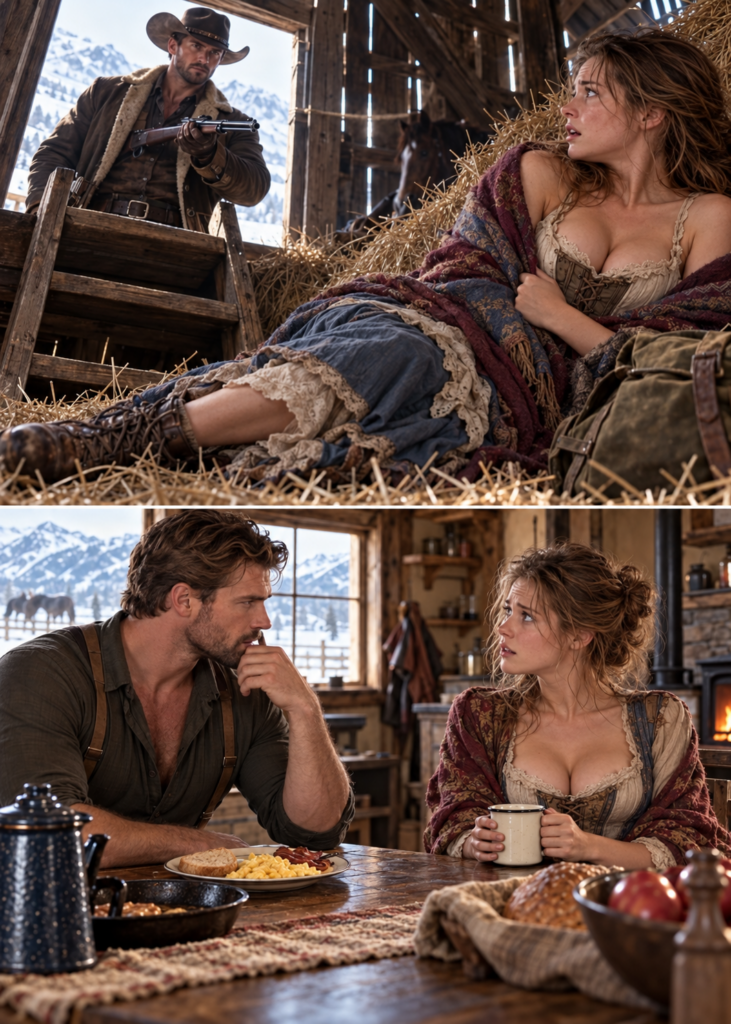
“Why?” Ransom said.
“Because something is wrong.”
They were in his office.
His foreman, Wade Mercer, looked up from the desk.
“What’s wrong?”
Tessa placed four sheets of paper in front of them.
“You’re buying feed for fourteen hundred head in the north range.”
“Yes.”
“You’re feeding approximately eleven hundred eighty.”
Wade frowned.
“No.”
“Yes.”
“How would you know?”
“I counted the transfer records.”
“Those aren’t current.”
“I know. So I compared them with veterinary records, the branding tally, sale receipts and winter allocation.”
Wade’s face changed.
Ransom leaned over the papers.
Tessa pointed at a row of numbers.
“You’ve either got two hundred cattle hiding extremely well, or somebody is billing this ranch for feed that never arrives.”
Nobody spoke for several seconds.
Wade took the papers.
He checked the figures once.
Then again.
“Son of a—”
He caught himself.
Tessa pretended not to notice.
Ransom looked at her.
“How long did this take?”
“Three evenings.”
“You were supposed to be off after dinner.”
“I was curious.”
Ransom almost laughed.
Within a week, they discovered nearly nine thousand dollars in inflated deliveries stretching back almost two years.
The supplier was dismissed.
A purchasing system was changed.
And Tessa’s thirty-day job quietly stopped having an expiration date.
But money was easier to fix than people.
By December, Livingston was talking.
A poor young woman had appeared from nowhere.
She lived at Calder Ridge.
Ransom Calder listened to her.
She rode beside him into town.
And the most dangerous detail of all was that he did not seem embarrassed by any of it.
Beatrice Holloway certainly noticed.
Her father owned one of the biggest cattle operations in Park County and had spent years imagining a future in which Holloway land, Calder land, and perhaps Beatrice herself all became part of the same arrangement.
She had been raised to believe certain doors opened naturally for people like her.
Tessa Reed represented something Beatrice found intolerable.
A door had opened for the wrong woman.
Their first real collision happened at the Winter Stockmen’s Dinner.
Tessa had not wanted to attend.
“You need me there?” she asked Ransom.
“You understand the spring numbers better than anyone except me.”
“Wade understands them.”
“Wade thinks percentages are a personal attack.”
From the doorway, Wade shouted, “I heard that.”
“You were supposed to.”
Tessa laughed before she could stop herself.
So she went.
She wore a dark green dress bought with her own wages, simple and fitted, with her hair pinned back.
When she came downstairs, Ransom looked up.
For perhaps three seconds, the man who always had an answer had none.
Tessa touched her sleeve.
“Is something wrong?”
“No.”
“Then why are you staring?”
Ransom cleared his throat.
“Trying to remember where I put my gloves.”
“They’re in your hand.”
He looked down.
They were.
Tessa smiled all the way to the wagon.
The smile did not last.
At dinner, nearly forty ranchers, merchants and spouses crowded into the upper dining room of the Hawthorne Hotel.
Tessa sat at Ransom’s table because she was there to discuss contracts.
Beatrice Holloway arrived late.
She wore blue silk, pearls and the confidence of a woman who had never entered a room wondering whether she would be welcome.
Halfway through dinner, conversation briefly faded.
Beatrice looked directly at Tessa.
“Forgive me,” she said sweetly. “I thought this dinner was for ranch owners and their families.”
The nearest conversations stopped.
Tessa laid down her fork.
Beatrice continued.
“Perhaps the hotel has changed its policy regarding staff.”
Somebody laughed.
Only one person.
But cruelty does not need a crowd. It only needs permission.
Tessa felt every old humiliation rise inside her.
The hotel owner who had made her use the back entrance.
The woman who had inspected a silver spoon after Tessa touched it.
The grocer who had withheld her wages because a poor woman could not afford to fight him.
She lifted her chin.
Before she could speak, a chair scraped across the floor.
Ransom stood at the other end of the table.
He walked around it slowly.
He stopped beside Tessa and pulled out the empty chair at her right.
Then he sat.
Beatrice’s smile faltered.
Ransom unfolded his napkin.
“Tessa works at Calder Ridge,” he said.
“I believe that was my point.”
“No. Your point was that work makes her less worthy of sitting beside you.”
The room became painfully silent.
Beatrice’s cheeks reddened.
“I meant no offense.”
“You meant exactly enough offense to deny it afterward.”
Her father shifted in his chair.
“Calder—”
Ransom did not raise his voice.
“If this chair is too good for the woman who saved my ranch thousands of dollars, then it’s too good for me.”
Nobody laughed this time.
Tessa stared at her plate because if she looked at Ransom, she was afraid something in her carefully built defenses would break open.
Beatrice gave a brittle smile.
“How noble.”
Ransom finally looked at her.
“No, ma’am. Basic decency just looks noble in a room where there isn’t enough of it.”
Tessa would remember that sentence for the rest of her life.
The gossip became worse after the dinner.
It also became less effective.
People could call Tessa a charity case, but merchants had begun asking her opinion on supply pricing.
They could call her a servant, but three ranchers had privately requested copies of the inventory system she designed.
They could say she wanted Ransom’s money, but anyone watching her knew she fought him over every unnecessary dollar he tried to spend on her.
When he ordered new boots after seeing water leak through hers, she placed the cost against her wages.
He discovered the deduction in the ledger.
“What is this?”
“My boots.”
“I bought those.”
“Yes.”
“So remove it.”
“No.”
“Tessa.”
“Ransom.”
Wade escaped the office before the argument began.
Ransom tapped the ledger.
“Employees are not charged for necessary equipment.”
“I’m not wearing ranch equipment.”
“You need boots to work.”
“I had boots.”
“You had leather held together by string and religious optimism.”
“They worked.”
“They leaked.”
“Only in water.”
“That is when boots are most useful.”
The argument ended in a compromise neither admitted was ridiculous.
Tessa paid half.
Ransom never collected it.
Winter deepened.
So did the thing between them that neither named.
It lived in ordinary moments.
Ransom leaving coffee beside her ledger at midnight.
Tessa knowing from the sound of his boots whether a day had gone badly.
Her hand resting on his shoulder when he returned from checking cattle half-frozen.
His habit of asking for her judgment in rooms where men twice her age initially looked offended and eventually began taking notes.
Then January brought the storm.
The forecast had promised snow.
What came over the Absaroka foothills was something worse.
Wind erased the fences before noon.
By dusk, a section of cattle had broken through the north boundary, and three ranch hands were missing.
Ransom saddled his horse.
Tessa met him in the barn.
“You’re not going.”
He tightened the cinch.
“Apparently I am.”
“You can’t see twenty feet.”
“I know where they’ll shelter.”
“So does Wade.”
“Wade’s already out.”
“I’m coming.”
“No.”
Tessa stared at him.
“Was that supposed to work?”
“It was worth trying.”
She saddled a mare.
For two hours, the world existed only in fragments of white.
They found Wade and one hand near a ravine.
The third, nineteen-year-old Ben Carver, had been thrown when his horse panicked. His ankle was badly injured.
Then Ransom’s horse slipped.
Tessa heard the animal scream.
She turned.
Ransom hit the frozen ground hard enough to knock the air from his lungs.
His leg twisted beneath him.
She was off her horse before he could rise.
“Don’t move.”
“Tessa—”
“Don’t.”
His knee was injured, perhaps worse.
Meanwhile the frightened cattle were moving through the storm toward the ridge.
Tessa looked at the slope.
Then at an old feed wagon half buried in snow near a fence line.
A bell hung from its side.
An idea came to her.
“Wade, get Ransom and Ben toward the line shack.”
“What are you doing?”
“Moving cattle.”
“With what?”
She pointed at the wagon.
Ransom caught her wrist.
“No.”
She looked down at his hand.
“What?”
“I know that face.”
“What face?”
“The face you make right before doing something you’ve calculated just enough to convince yourself isn’t insane.”
Despite the storm, Tessa smiled.
“You know me well.”
“Tessa.”
“I’m not going near them. I’m turning them.”
She took a sack of grain, mounted, and rode toward the abandoned wagon.
The bell was still functional.
She rang it.
Once.
Twice.
Again.
The sound traveled strangely in the storm.
Several cattle lifted their heads.
Ranches often used bells, wagons and feeding calls during winter. The animals recognized patterns even when humans could barely see.
Tessa rang again, scattered feed along the safer southern line, then slowly rode away from the ravine.
The first cows followed.
Then more.
The herd turned.
Not dramatically.
Not all at once.
But enough.
When Tessa finally reached the line shack, ice coated her hair.
Ransom was sitting against the wall, furious.
“You took too long.”
“Nice to see you too.”
He grabbed her coat and pulled her close enough to examine her face.
“Are you hurt?”
“No.”
“Are you sure?”
“Yes.”
He closed his eyes.
For one strange second, his forehead rested against hers.
The room disappeared.
The wind disappeared.
Then Wade cleared his throat with exaggerated force.
“I am looking very carefully at the stove.”
Ransom released her.
Tessa stepped back.
Nobody mentioned it.
Three weeks later, Ransom was walking with a cane.
And Beatrice Holloway’s father began squeezing him where pain lasted longer than a bad knee.
Two buyers suddenly reconsidered spring contracts.
A line of credit required unexpected review.
A transport company raised its rate.
None of the moves was illegal.
All were connected.
Tessa saw the pattern before Ransom admitted there was one.
“This is because of me.”
They stood in the office after midnight.
Ransom’s expression hardened.
“No.”
“Yes.”
“This is because Douglas Holloway dislikes being told no.”
“He was told no because of me.”
“He was told no because I said no.”
Tessa folded her arms.
“If I leave—”
“No.”
“You don’t even know what I was going to say.”
“Yes, I do.”
She turned toward the window.
“If I leave, he loses the excuse.”
“He’ll find another.”
“Maybe.”
“Tessa.”
She hated the gentleness in his voice because it made leaving harder.
“You asked me what I would do with a chance,” she said. “I said I’d make myself impossible to fire.”
“You succeeded.”
“That doesn’t mean I get to destroy what you built.”
“You are not destroying it.”
“I’m costing you contracts.”
“Contracts can be replaced.”
“Your men depend on this ranch.”
“So do you.”
She went still.
Ransom stepped closer.
“You keep talking about yourself like you’re passing through.”
“Maybe I am.”
“Is that what you want?”
Her heart beat painfully.
It would have been easy to tell him.
No.
I want this kitchen.
I want the office.
I want Wade swearing at columns of numbers.
I want the men complaining about my coffee.
I want the east bedroom window.
I want you.
Instead she said, “What I want isn’t always what makes sense.”
Ransom’s face closed.
“That may be the saddest thing you’ve ever said.”
Tessa left Calder Ridge four days later.
She did it before dawn because courage sometimes looks embarrassingly similar to cowardice.
She left a letter.
Ransom,
You gave me more than employment. You gave me proof that I was still capable of building something.
I will not repay that by making you choose between me and the ranch.
Please do not come after me.
Tessa
He came after her.
Of course he did.
He found her at the station in Livingston with her canvas bag at her feet.
Ransom’s horse was lathered.
His bad leg almost buckled when he dismounted.
Tessa’s anger arrived before her heartbreak.
“You rode here on that knee?”
“You left before breakfast.”
“That is not an answer.”
“Neither was your letter.”
“The train comes in ten minutes.”
“I know.”
“Then go home.”
“No.”
People on the platform pretended not to watch.
Ransom stopped three feet from her.
“I can’t force you to stay.”
“No.”
“I won’t beg you.”
“I wouldn’t want you to.”
“But you don’t get to call leaving a favor to me.”
Her eyes burned.
“Ransom—”
“You made my decision without asking me.”
“Because you would have chosen me.”
“Yes.”
“That’s exactly the problem.”
“No, Tessa. That’s exactly the choice.”
The distant whistle of the train sounded through the valley.
Her composure cracked.
“I was hungry when you found me. I had thirty-seven dollars. I slept with my bag under my arm because everything I owned fit inside it. People like me don’t get to become the reason a man loses everything.”
Ransom looked at her for a long time.
Then he said quietly, “You still don’t understand what I built it for.”
The train appeared beyond the bend.
Tessa grabbed her bag.
“I have to go.”
Ransom did not stop her.
That hurt more than if he had.
She climbed aboard.
Through the window, she watched him standing alone on the platform, one hand on his cane, growing smaller until the train turned and the mountains swallowed him.
For the first time since arriving at Calder Ridge, Tessa cried.
Six weeks later, Tessa was working at a boarding house in Helena.
She had a clean room.
She had wages.
She had respectable work.
She hated almost every minute of it.
Not because the people were cruel.
They weren’t.
That made it worse.
Nothing was wrong enough to justify how empty she felt.
One Tuesday, a letter arrived from Wade Mercer.
It contained exactly four sentences.
Ranch still standing.
Holloway thinks Ransom is weak.
Ransom is eating like a widower who never had the sense to get married.
Figure out what you think a ranch is for.
Tessa read the final sentence five times.
Then she laughed.
Then she cried.
Then she went downstairs and asked for the week’s newspaper.
The annual spring cattle auction was three days away.
Every major buyer in the region would be there.
So would Douglas Holloway.
Tessa knew something else.
Before leaving Calder Ridge, she had built six months of projections based on cattle weight, feed costs, transport capacity and contracted prices.
Those numbers proved Ransom did not need Holloway’s buyers.
He needed different buyers.
And Tessa knew where to find them.
Three days later, the auction hall outside Livingston was packed when Douglas Holloway offered Ransom his final bargain.
Tessa heard it from twenty feet away.
“You’ve had a difficult winter,” Holloway said. “Nobody would blame you for being practical.”
Ransom stood with his cane.
“What does practical cost these days, Douglas?”
Holloway smiled.
“Less than pride.”
“Then I’m probably over budget.”
Several men laughed nervously.
Holloway leaned closer.
“Take my transportation agreement. Bundle your summer contracts with ours. We stabilize your position. All this nonsense disappears.”
“And what do you receive?”
“Partnership.”
“Control.”
“Don’t be childish.”
That was when Tessa spoke.
“He doesn’t need your transportation agreement.”
Ransom froze.
Douglas Holloway turned.
The room seemed to inhale.
Tessa walked through the crowd wearing the same green dress she had worn to the winter dinner.
But she was not the woman who had sat silently while people decided whether she belonged.
Not anymore.
Wade saw her first and grinned.
“Well, hell.”
Ransom did not smile.
He simply stared.
Tessa stopped beside him.
Holloway recovered.
“Miss Reed. I understood you had moved on.”
“I did.”
“How fortunate.”
“For you, apparently.”
His face cooled.
Tessa opened her portfolio.
“Calder Ridge shipped fourteen percent heavier steers than the county average last fall. Mortality is down. Feed cost per pound of gain is down almost nine percent since November. Mr. Calder can accept a lower per-head bid and still clear a better margin than last year.”
Holloway looked amused.
“You expect us to negotiate based on the bookkeeping of a housemaid?”
A familiar silence fell.
Months earlier, those words would have cut Tessa open.
Now she smiled.
“No. I expect them to negotiate based on arithmetic.”
A man near the auction rail stepped forward.
Nathan Pritchard, a buyer from Wyoming.
“I saw those figures in January.”
Holloway glanced at him.
Nathan continued.
“Calder sent me projections. I assumed his accountant prepared them.”
Ransom finally spoke.
“She did.”
Nathan looked at Tessa.
“You’re Reed?”
“Yes.”
“You calculated the winter weight retention model?”
“Yes.”
“Delivery capacity for July?”
“Twenty-two cars if you split shipment over four days. Twenty-six if the eastern pens are cleared first.”
He stared.
“That was from memory.”
“Yes.”
Nathan laughed.
Then he extended his hand to Ransom.
“I’ll take twelve hundred head if your quality matches last year.”
The room changed instantly.
Another buyer stepped closer.
Then another.
Douglas Holloway’s leverage disappeared in less than three minutes.
Not because Ransom fought harder.
Not because somebody humiliated Holloway.
Because Tessa had done what she had always done.
She had looked at the numbers and found the door nobody else noticed.
When the crowd finally scattered, Ransom and Tessa remained facing one another.
“You came back,” he said.
“I came to fix something.”
“The contracts?”
“No.”
She swallowed.
“Me.”
Ransom’s expression softened.
“I made your choice for you.”
“Yes.”
“I thought leaving was noble.”
“It wasn’t.”
“No.”
“It was arrogant.”
“A little.”
She almost smiled.
“I’m sorry.”
“I know.”
Tessa looked down.
“I don’t know what happens now.”
“I do.”
Her eyes lifted.
Ransom stepped closer.
“The first morning I found you, I asked what you’d do if somebody gave you a chance.”
“I remember.”
“You said you’d become impossible to fire.”
“I did pretty well.”
“You became impossible to replace.”
Her breath caught.
Around them, men shouted bids and gates slammed and cattle bawled in the pens.
But Tessa heard only him.
Ransom continued.
“I have another question.”
Her heart began pounding.
“Is this another thirty-day arrangement?”
“No.”
“Does it involve livestock?”
“Not directly.”
“Then ask.”
He hesitated.
Ransom Calder, who negotiated thousand-head cattle contracts without blinking, suddenly looked almost uncertain.
That made Tessa love him more than confidence ever could.
He said, “What would you build if you finally believed you were allowed to stay?”
She stared at him.
Not Will you marry me?
Not Will you work for me?
Not Will you let me save you?
What would you build?
The same gift he had given her in the kitchen.
Not rescue.
Possibility.
Tessa looked around the auction barn, at ranchers and laborers and farmers’ wives and hired girls carrying ledgers for men who might never ask what they could become.
Then she looked back at Ransom.
“A business office.”
He blinked.
“What?”
“At Calder Ridge.”
A smile began at the corner of his mouth.
“Go on.”
“A real one. Purchasing, contracts, inventory. And I want to train people.”
“What people?”
“Anybody worth training.”
“Specific.”
“Women who can do more than the work people let them do. Farm girls. Widows. Girls from boarding houses. Anybody who knows numbers and has never been given a desk.”
Ransom nodded slowly.
“What else?”
“A separate house near the east pasture.”
His eyebrows rose.
“For employees?”
“Eventually.”
“Eventually?”
She stepped closer.
“First, I thought maybe we could live there while the main house is renovated.”
Now he understood.
His voice dropped.
“We?”
Tessa smiled through tears.
“If you’re asking what I’d build if I knew I could stay, Ransom, I’d build a life.”
He touched her cheek.
“With me?”
“With you.”
He kissed her in the middle of the livestock auction.
Wade later claimed half the county stopped breathing.
Tessa maintained that was an exaggeration.
The following October, they were married beneath the cottonwoods at Calder Ridge.
It was not an extravagant wedding.
Tessa refused one.
There were long tables, beef roasted outdoors, pies from three neighboring kitchens and more ranch hands than wealthy guests.
Wade cried and denied it.
Nathan Pritchard brought a ledger as a wedding gift.
Beatrice Holloway did not attend.
Tessa did not care.
Two years later, the east pasture office employed six people.
Four were women who had never previously held bookkeeping positions.
One had been widowed at twenty-nine.
One had worked twelve years in a laundry.
One was the daughter of a ranch hand who could calculate freight margins faster than any buyer Tessa had met.
And once each winter, Tessa personally reviewed applications from people needing work.
Ransom found her doing it late one evening after snow had begun falling.
He leaned against the office door.
“You’re supposed to be home.”
“So are you.”
“I came looking for my wife.”
“She’s busy.”
“With?”
Tessa held up an application.
“Twenty-three-year-old woman from Butte. Lost her position when the store closed. Says she knows inventory.”
Ransom walked closer.
“You going to hire her?”
“I’m going to interview her.”
He smiled.
“What are you going to ask?”
Tessa looked through the window.
Across the yard stood the old stallion barn.
The loft window glowed silver beneath the moon.
Years earlier, she had slept behind that window wrapped in a horse blanket, frightened that sunrise would expose her and send her back into the cold.
She had believed the greatest thing a rich man could give a poor woman was shelter.
She had been wrong.
Shelter kept her alive for a night.
Food kept her alive for a day.
Money could have carried her for a month.
But one question had returned something poverty had almost taken permanently.
The right to imagine a future.
Tessa looked at her husband.
“I think I’ll ask her what she would do with a real chance.”
Ransom nodded.
“Good question.”
Tessa smiled.
“It changed my life.”
Outside, snow covered the roofs of Calder Ridge, softening fences and wagon tracks beneath clean white silence.
Inside, the lamps burned late.
And the barn where a penniless woman had once hidden from the cold still stood exactly where it had always stood.
The only difference was that nobody at Calder Ridge called it the place where Ransom Calder rescued Tessa Reed.
That had never been the real story.
He had opened a door.
She had walked through it herself.
And then she had held it open for everyone who came after her.
THE END

