
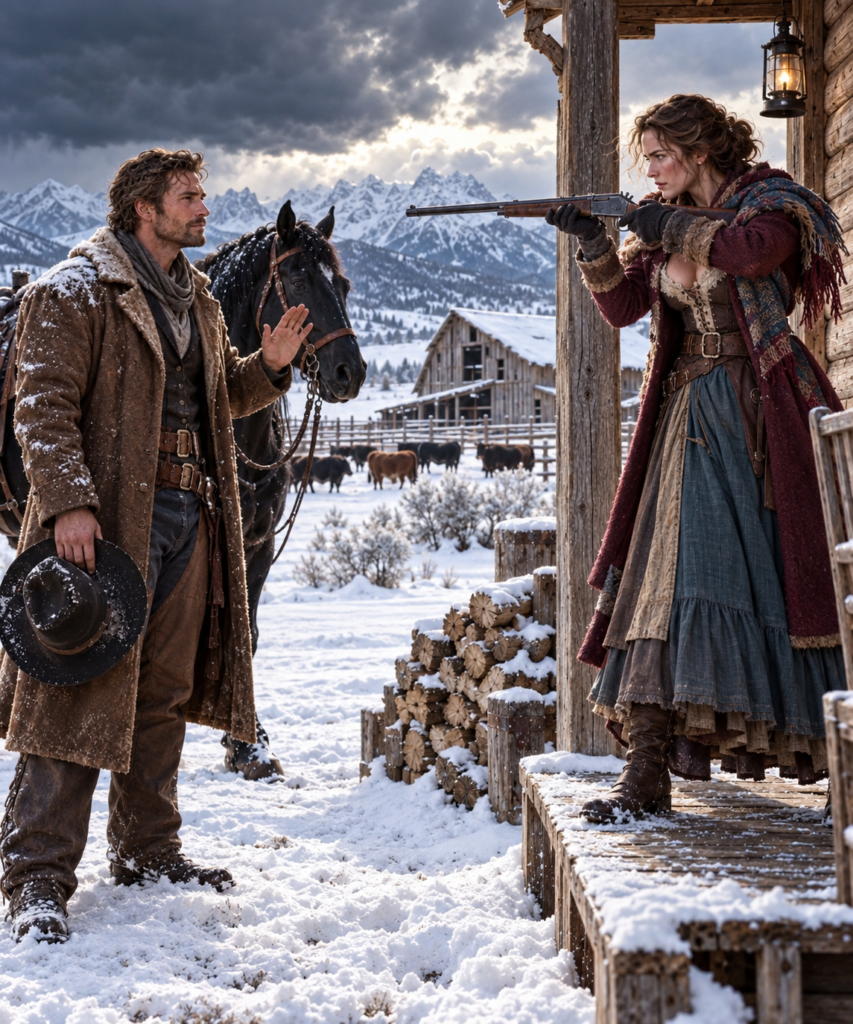
For twenty minutes, Clara stood on the porch pretending she was furious.
Then the wind became strong enough to whip her skirt against her legs, and she finally went inside.
She watched him through the window.
There was no performance in him.
No pausing to see whether she was impressed.
No flexing, grinning, or unnecessary noise.
He simply worked.
Steady.
Patient.
One log after another.
By the time he finished, Clara had enough firewood stacked beneath the eaves to last several weeks.
When he came inside for coffee, the room instantly seemed smaller.
Elijah had to duck beneath the beam near the door.
Clara had seen tall men before.
She had never seen one built like him.
His shoulders strained against his shirt when he removed his coat. His hands looked capable of snapping the handle off her coffee cup, yet when she passed it to him, his fingers barely touched hers.
“You always invite armed strangers in for coffee?” he asked.
“No.”
“Then I’m honored.”
“I invited you because you chopped half a tree into my yard.”
“That sounds less flattering.”
“It was intended to.”
A small smile appeared.
Clara found herself staring.
She immediately turned toward the stove.
“You said you live north.”
“About fifteen miles.”
“Family?”
The smile vanished.
“I had a wife.”
Clara slowly faced him.
“I’m sorry.”
“It’s been four years.”
“What happened?”
“Wagon accident in Laramie.”
He stared into the coffee.
“She was buying fabric for curtains. I was supposed to go with her. Decided I had fences that couldn’t wait.”
Clara knew that tone.
It was the voice people used when they had replayed one decision a thousand times.
“You couldn’t have known.”
“No.”
“But you still blame yourself.”
His eyes lifted.
“You always this direct?”
“Only with strangers.”
“That seems backward.”
“It’s easier. If I dislike you, I never have to see you again.”
“And if you don’t dislike me?”
Clara’s fingers tightened around her cup.
“Then I suppose that becomes inconvenient.”
For a moment, neither spoke.
Outside, snow began tapping softly against the window.
Elijah eventually stood.
“I should ride.”
“You should.”
He put on his coat.
At the doorway he paused.
“I’ll be back.”
“For the cattle?”
“For that.”
A beat passed.
“And more.”
Clara frowned.
“What does that mean?”
But Elijah Stone was already stepping into the snow.
The storm lasted three days.
By the second night, Clara’s well pump froze.
By the third morning, half the north fence disappeared beneath drifting snow and one heifer stopped eating.
Clara worked until her fingertips split.
Fire.
Water.
Feed.
Break ice.
Check cattle.
Repeat.
Sleep came in pieces.
Her shoulders ached so badly she struggled to raise her arms, but she refused to stop because stopping gave her time to think.
Thinking led to Thomas.
Thomas led to the empty side of the bed.
And lately, somehow, that empty space had started leading to Elijah Stone.
Which made her angry enough to keep working.
Late on the third afternoon, Clara was carrying water from the creek when she heard hoofbeats.
She reached the porch just as a black gelding emerged from the whiteout.
Elijah swung down before the horse fully stopped.
He was covered in snow.
“You’re insane,” Clara shouted.
He looked at the empty bucket in her hand.
“You’re one to talk.”
“The road is buried.”
“I didn’t use the road.”
“You could’ve died.”
“So could you.”
He walked past her.
Clara followed him inside.
“Elijah Stone, you do not get to ride onto my property and—”
He picked up the bucket.
“Where’s the pump?”
“Frozen.”
“I assumed.”
He headed back outside.
Clara grabbed his sleeve.
“Why are you here?”
He stopped.
She expected another clever answer.
Instead, he looked directly at her.
“Because I said I’d come back.”
Something inside her went painfully quiet.
People had promised Clara things before.
Thomas had promised they would grow old on that ranch.
Her brother had promised he would visit after the funeral.
Neighbors promised they would check in once winter came.
Promises were just words people used when leaving.
Elijah Stone had ridden through a blizzard because he had said he would return.
That frightened her more than his size ever could.
For the next day and a half, they worked side by side.
Elijah thawed the pump.
He repaired the barn brace.
He checked the heifer and discovered she was carrying earlier than Clara had expected.
Then, near midnight, Clara woke to the sound of cattle bawling.
She pulled on her boots and ran outside.
Elijah was already in the barn.
The pregnant heifer lay on her side, breathing hard.
“What’s wrong?”
“Calf’s turned.”
Clara knelt.
“Can you fix it?”
“I think so.”
“You think?”
Elijah rolled up his sleeves.
“This is the part where confidence would be dishonest.”
Another contraction hit the animal.
Clara’s panic rose.
Thomas had always handled difficult births.
She had assisted.
She had watched.
But she had never done this without him.
Elijah crouched beside the heifer.
“I need you near her head.”
Clara hesitated.
“I don’t know if I can.”
“You can.”
“What if we hurt her?”
“We go carefully.”
“And if—”
“Clara.”
His voice changed.
Still gentle, but firm enough to pull her eyes toward his.
“Relax.”
The word sounded almost ridiculous coming from a man kneeling beside a distressed cow in a freezing barn.
“I’ll go in slow.”
Clara stared at him.
Then, despite everything, she laughed.
It burst out of her before she could stop it.
Elijah blinked.
“What?”
“You cannot possibly know what that sounded like.”
For three seconds his face remained completely serious.
Then understanding arrived.
His ears actually turned red.
Clara laughed harder.
The heifer bawled.
Elijah sighed.
“I walked into that one.”
“You certainly did.”
“Can we save the teasing until the calf is breathing?”
Clara wiped tears from her eyes.
“Yes.”
His embarrassment disappeared instantly.
“Good. Keep her calm.”
The work took nearly forty minutes.
Elijah moved slowly, exactly as he had promised, repositioning the calf while Clara whispered to the frightened animal and held her steady.
Finally he nodded.
“Now.”
The next contraction came.
Clara pulled where Elijah instructed.
A slick, shivering calf slid onto the straw.
For one awful second, it did not move.
“Elijah.”
He cleared its nose.
Nothing.
“Elijah.”
“Give me a second.”
He rubbed the calf hard with a cloth.
Clara stopped breathing.
Then the tiny animal coughed.
A weak sound escaped it.
The mother turned immediately.
Clara sat back on her heels.
Her hands were shaking.
Elijah looked at her.
“There.”
Clara began crying.
She hated it.
She wiped her cheeks angrily.
“I’m tired.”
“I know.”
“That’s all this is.”
“I know.”
“I’m not crying over a cow.”
“Of course not.”
“And don’t look at me like that.”
“Like what?”
“Like you understand.”
His expression softened.
“That one I can’t promise.”
Clara stood too quickly and stumbled.
Elijah caught her around the waist.
She froze.
His hands were enormous.
His chest was inches from her face.
The entire barn seemed to disappear.
Neither moved.
“Elijah.”
“Yes?”
“You can let go.”
His hands loosened immediately.
But Clara did not step away.
She looked up at him.
“How long were you married?”
“Seven years.”
“Did you love her?”
“With everything I had then.”
“Then?”
His brow furrowed.
“You think there’s only one version of a person’s heart?”
“I don’t know.”
“I used to.”
Clara swallowed.
“What changed?”
“You.”
She stepped back.
“Don’t.”
“Don’t what?”
“Say things because we’re tired and it’s dark and something survived tonight.”
“I’ve wanted to say it since before tonight.”
“You barely know me.”
“I know you mend fencing with wire because you won’t waste a good nail. I know you drink coffee too strong and forget meals when you’re worried. I know you talk to your cattle when you think no one’s listening.”
Clara’s face heated.
“You heard that?”
“I know you still set two plates sometimes before remembering there’s only one person at your table.”
Her smile vanished.
Elijah continued quietly.
“And I know whenever someone tries to help, you act angry because anger is easier than admitting you’re afraid they might leave.”
Clara turned away.
“That’s enough.”
“I’m sorry.”
“No, you aren’t.”
“No.”
That made her face him.
“I’m not Thomas.”
“I know.”
“I don’t want his place.”
“There is no place.”
“There is.”
Elijah touched his own chest.
“There always is.”
Clara looked at the calf struggling to stand.
“What do you want from me?”
“Nothing you don’t want to give.”
“And if I give nothing?”
“I’ll still honor the cattle contract.”
“That isn’t what I meant.”
“I know.”
The new calf finally stood.
Its mother began cleaning it.
Elijah watched for a moment, then quietly reached for his coat.
“Get some sleep, Clara.”
“Where are you going?”
“Barn loft.”
“There’s a bed in the cabin.”
He stared at her.
She almost laughed again.
“The spare room, Elijah.”
His shoulders relaxed.
“That clarification was useful.”
This time she did smile.
For the first time since Thomas died, Clara went to bed smiling because a man was under her roof.
That should have terrified her.
Instead, she slept for nine straight hours.
By February, Elijah’s visits became so regular that the black gelding started walking directly toward Clara’s barn without being guided.
Elijah never moved in.
Clara never asked him to.
That mattered.
He came when he said he would.
He left when she wanted space.
He repaired the south fence only after she agreed.
When they argued over where to move the feed bins, he argued with her rather than simply lifting them and deciding for her.
When Clara disagreed, he listened.
She discovered this was more seductive than flattery.
Then Warren Pike arrived.
Warren owned three ranches east of town and had spent most of the winter trying to buy Clara’s land.
He arrived in a polished carriage with a fur-lined coat and an envelope tucked beneath his arm.
Elijah was fixing a gate.
Warren looked him over.
“Didn’t know you’d hired help.”
“I didn’t,” Clara said.
Elijah continued hammering.
Warren smiled.
“Then I suppose congratulations are in order.”
“No.”
Clara held out her hand.
“What do you want?”
Warren gave her the envelope.
“County note.”
Her stomach dropped.
Inside was a copy of a lien Thomas had signed eleven months before his death.
Eight hundred dollars.
The ranch had been collateral.
Payment was ninety days overdue.
Clara read it twice.
“This is wrong.”
“It isn’t.”
“Thomas never borrowed eight hundred dollars.”
Warren’s expression became almost sympathetic.
“Apparently he did.”
“From you?”
“From an investment company in Cheyenne.”
“Which you purchased.”
“Last month.”
Elijah stopped hammering.
Warren noticed.
“I’m speaking with Mrs. Matthews.”
Elijah set the hammer down.
“And she’s answering.”
Clara stepped between them.
“I can handle this.”
Elijah’s eyes met hers.
Then he picked up the hammer again.
That small act—obeying her when every instinct in his body appeared to be telling him otherwise—gave Clara enough strength to face Warren.
“When is payment due?”
“Technically, it already is.”
“Then why are you here?”
“To offer an alternative.”
“Which is?”
“Sell me the east pasture and the river access.”
Clara almost laughed.
That land was the most valuable part of the ranch.
Without river access, everything else would eventually become worthless.
“For eight hundred dollars?”
“I’ll forgive the entire lien.”
“You bought Thomas’s debt so you could take my water.”
Warren shrugged.
“I bought an opportunity.”
Clara folded the paper.
“I’ll pay you.”
“Eight hundred?”
“Yes.”
“With what?”
“That isn’t your concern.”
His eyes drifted toward Elijah.
“Perhaps not.”
Clara slapped him.
The sound cracked across the yard.
Elijah stopped hammering again.
Warren touched his cheek.
His pleasant expression vanished.
“You should reconsider.”
“You should leave.”
He climbed into the carriage.
Before departing, he looked directly at Elijah.
“Careful, Stone. Widow’s land has a way of costing a man more than expected.”
Elijah said nothing until the carriage disappeared.
Then he put the hammer down.
“I have the money.”
“No.”
“Clara.”
“No.”
“It wouldn’t hurt me.”
“It would hurt me.”
“How?”
“Because then Warren Pike would be right.”
Elijah frowned.
“About what?”
“That I need a man to save this ranch.”
“He’d be wrong.”
“Would he?”
“Yes.”
“You pay my debt, Elijah, and every person in town will say I kept Thomas’s ranch by finding another husband before the ground settled over the first.”
“I don’t care what they say.”
“I do.”
He looked frustrated.
“Why?”
“Because I have spent almost a year proving that Thomas did not build this place alone.”
The words came louder than she intended.
Clara breathed hard.
“I built it too. I kept the books. I chose half those breeding cows. I hauled lumber. I planted that garden. I slept beside sick calves and rode for the doctor when Thomas broke his wrist. Then he died, and suddenly everyone started calling it his ranch.”
Elijah said nothing.
Clara pointed toward the house.
“I love him. I will probably love part of him until I die. But this place is not his grave. It is my life.”
Elijah slowly nodded.
“All right.”
She blinked.
“All right?”
“You said no.”
“You’re not going to argue?”
“I might disagree.”
“But?”
“But it’s your decision.”
She stared at him.
That night, Clara opened every drawer Thomas had owned.
She searched his desk.
His ledger.
Old receipts.
Toolboxes.
Nothing explained the debt.
Then, inside the pocket of his winter coat, she found a folded letter.
Clara recognized Thomas’s handwriting before opening it.
Clara,
If anything happens before I fix this, I need you to know the Pike loan isn’t what it looks like. Caleb Mercer was going to lose his place after Ellen got sick. I borrowed against ours because Warren wouldn’t lend directly to Caleb without taking his whole ranch. Caleb has been paying me back when he can. I didn’t tell you because you would have said we should help him outright, and we couldn’t afford that either.
You’ll be angry.
You should be.
I should have told you.
Thomas.
Clara sat on the floor for a long time.
Then she began laughing through tears.
Even dead, Thomas had managed to make her furious.
The next morning she rode into town.
Caleb Mercer was seventy-two years old.
When Clara placed the letter on his kitchen table, he covered his face.
“I thought Thomas had settled it.”
“He hadn’t.”
“I have six hundred and twenty dollars left.”
Clara stared.
“You have it?”
“In the bank.”
“Why didn’t you tell me?”
Caleb’s eyes filled.
“Because I was ashamed.”
Clara almost shouted.
Instead, she thought about the past winter.
About pride.
About refusing help.
About Elijah saying standing beside someone was not the same as leaning on them.
“You’re going to withdraw it,” Clara said.
Caleb nodded.
“I’ll find the rest.”
“No.”
“But—”
“You owe six hundred twenty. Thomas and I carry the other hundred eighty.”
“Clara.”
“We helped you together. I’m not undoing that because he died.”
By sunset, Clara had sold an old wagon, two spare saddles, and a collection of silver serving pieces her mother had sent west with her.
She had eight hundred and twelve dollars.
The following morning, she placed eight hundred dollars on Warren Pike’s desk.
He stared at the money.
“Where did you get this?”
Clara smiled.
“You seem confused about who owns the ranch again.”
Warren reluctantly signed the release.
When Clara walked outside, Elijah was across the street.
Waiting.
He had not contributed one dollar.
He had not interfered.
But he was there.
Clara crossed the street.
“Did you know?”
“That you’d manage?”
“Yes.”
“No.”
She frowned.
Elijah smiled.
“I believed you would. Different thing.”
She kissed him.
Right there in the middle of Main Street.
For a second, the giant cowboy who could throw a feed sack over one shoulder without effort looked completely stunned.
Then his hands settled lightly at her waist.
Clara pulled away.
“That doesn’t mean you own anything.”
“I wouldn’t dare.”
“It doesn’t mean we’re getting married.”
“Understood.”
“It doesn’t mean—”
“Clara.”
“What?”
“You’re ruining my first kiss in four years.”
She stared.
Then laughed so loudly three people turned around.
Elijah kissed her again.
Spring arrived late.
Snow remained along the tree line into April, but the valley finally began turning green.
Elijah’s cattle remained on Clara’s land according to their agreement.
His own ranch, Clara learned, was larger than she expected but lonelier than any place she had ever seen.
He had a sturdy house.
Good barns.
Fine horses.
No curtains.
No photographs except one of his late wife, Rebecca, beside the bedroom door.
The first time Clara saw it, she stopped.
“She was beautiful.”
Elijah stood behind her.
“Yes.”
Clara looked at him.
“You don’t have to put it away.”
“I wasn’t planning to.”
“Good.”
His brow rose.
“Good?”
Clara nodded.
“If loving me required pretending you never loved her, I wouldn’t trust your love very much.”
Something in Elijah’s face broke open.
He turned away briefly.
Clara touched his arm.
“Hey.”
“I’m all right.”
“No, you’re not.”
He laughed softly.
“You’ve gotten very comfortable telling me that.”
“I learned from an irritating man.”
Elijah pulled her toward him.
“Sounds handsome.”
“Massive ego.”
“Terrible flaw.”
“Can barely fit through doors.”
“Tragic.”
She pressed her cheek against his chest.
His heartbeat was slow beneath her ear.
For months, Clara had believed loving Elijah would somehow betray Thomas.
Now she understood grief differently.
Love did not replace.
It expanded.
Thomas belonged to the woman Clara had been.
Elijah was not asking to erase her.
He was learning the woman she had become.
Two weeks later, disaster struck.
A group of cattle broke through weakened fencing near the river after a thunderstorm.
Clara and Elijah were moving them back when they heard shouting.
A wagon had overturned downstream.
Caleb Mercer’s granddaughter, nine-year-old Emma, had been traveling home with her father.
Her father crawled free.
Emma did not.
The wagon lay half submerged near the riverbank.
Spring runoff had transformed the normally shallow river into a violent brown current.
“Elijah!”
He was already moving.
Clara grabbed his arm.
“You can’t go in there.”
“Girl’s trapped.”
“The current will take you.”
He looked at her.
There was no fear in his face.
That frightened Clara more.
“Elijah, don’t.”
“I have to.”
“No, you do not get to decide dying is noble because someone needs help.”
His expression changed.
The words were not really about Emma.
They were about Thomas.
Rebecca.
Every person who had left without permission.
Elijah took Clara’s face between his hands.
“I’m not planning on dying.”
“Neither were they.”
He pressed his forehead against hers.
“I need rope.”
They looped a heavy ranch rope around Elijah’s torso.
Clara and three other men held the opposite end.
The water reached Elijah’s knees.
Then his thighs.
The current pushed hard.
He stopped.
Clara’s heart pounded.
“Elijah!”
He looked back.
She could barely breathe.
“I can’t lose another person.”
His face softened.
“You hear me?”
“Yes.”
“I mean it.”
“I know.”
He turned toward the wreck.
Then he looked back one last time.
“Relax.”
Clara almost became furious.
Then she saw the tiny smile.
“I’ll go in slow.”
The same ridiculous words from the barn.
The words that had made her laugh in the middle of terror.
Clara understood what he was doing.
He was reminding her who he was.
Careful.
Steady.
Not invincible.
Not reckless.
Just present.
“Come back slow too,” she shouted.
“That’s the plan.”
Elijah entered the river.
The water climbed to his waist.
Then his chest.
He reached the wagon.
Emma was trapped between the bench and a broken wheel brace.
Elijah fought the debris while the current hammered against him.
Clara wrapped the rope around both hands until it burned her palms.
“Hold!”
One of the men shouted.
The wagon shifted.
Clara screamed Elijah’s name.
For one terrible instant his head disappeared beneath the water.
Then he surfaced.
Emma was in his arms.
“Pull!”
Five people leaned backward.
Inch by inch, they dragged Elijah toward shore.
When he finally collapsed onto the mud, Emma coughing against his chest, Clara fell to her knees beside him.
She hit him.
Hard.
Right in the shoulder.
Elijah coughed water.
“Ow.”
“You disappeared.”
“For about two seconds.”
“Two seconds too long.”
Emma’s father took the child.
Clara grabbed Elijah’s wet shirt.
“You listen to me.”
“Yes, ma’am.”
“Do not yes-ma’am me.”
“Yes—”
“Elijah.”
His smile vanished when he saw her crying.
“I love you.”
Everything around them seemed to stop.
Clara had never said it.
Not once.
Not even privately.
Elijah stared at her.
“What?”
“You heard me.”
“I did. I just thought almost drowning might’ve damaged something.”
She hit him again.
He laughed.
Then Clara threw her arms around his neck.
“I love you,” she whispered. “And I hate how much that scares me.”
His arms closed around her.
“That makes two of us.”
“I can’t promise I’ll stop being afraid.”
“I’m not asking you to.”
“I can’t promise I’ll need you.”
“I hope you don’t.”
Clara pulled back.
“What?”
Elijah brushed wet hair from her face.
“I don’t want to be needed, Clara.”
“Then what do you want?”
“To be chosen.”
Those words changed everything.
Not because they were romantic.
Because they were exactly right.
Thomas had once been Clara’s choice.
Then death had turned him into an absence she felt obligated to protect.
The ranch had become an obligation.
Strength had become an obligation.
Loneliness had become something she wore like proof that she had survived.
Elijah was offering her something different.
A choice.
Not surrender.
Not dependence.
Not rescue.
Choice.
Three months later, Elijah rode to Clara’s ranch carrying no flowers.
Clara noticed immediately.
“No flowers?”
“You don’t like cut flowers.”
“I like flowers.”
“You said cutting them just to watch them die indoors was stupid.”
“It is.”
“I listened.”
He removed a small wooden box from his saddlebag.
Clara’s heart stopped.
“Elijah.”
“Before you panic, nothing happens unless you say yes.”
“That sentence is not helping.”
He opened the box.
Inside was a simple gold ring.
No enormous jewel.
No unnecessary decoration.
Just a warm band with a tiny engraved mountain along the inside.
Clara stared at it.
“I’m not moving.”
Elijah blinked.
“I haven’t asked anything yet.”
“If this is marriage, I’m not selling my ranch and moving into your house.”
“Fine.”
“And I’m not changing the cattle brand.”
“Fine.”
“And the east pasture remains mine.”
“Clara.”
“What?”
“Would you like me to ask before you negotiate?”
She closed her mouth.
Elijah lowered himself onto one knee.
The sight was almost comical.
Even kneeling, he seemed enormous.
Clara covered her mouth.
“Elijah.”
“I loved Rebecca.”
Clara’s eyes filled.
He continued.
“I need you to know I’m not asking you because grief disappeared. It didn’t. And I know you loved Thomas.”
“I did.”
“I would never ask you not to.”
Tears slid down her cheeks.
Elijah held up the ring.
“But I also know I want mornings when you complain my coffee is weak. I want winters where you insist you can chop wood until your hands bleed and I argue with you about it. I want to help when you let me and get out of the way when you don’t.”
Clara laughed through her tears.
“I want your bad temper.”
“My temper is perfectly reasonable.”
“Noted.”
“Elijah.”
“I want every stubborn year you’re willing to share.”
Clara looked at the man kneeling before her.
She thought of the first afternoon.
The rifle.
The snow.
His open hands.
She thought of cattle steaming in the winter air.
Firewood stacked without being requested.
A frozen pump.
A newborn calf.
Eight hundred dollars he had offered but respected her enough not to force upon her.
A flooded river.
A little girl breathing because he had gone in slowly and come back.
Then she thought of Thomas.
For a moment grief rose, familiar and deep.
But it no longer felt like a locked door.
It felt like a room inside her.
One she could visit without living there forever.
Clara looked toward the hill where Thomas was buried beneath a cottonwood tree.
She whispered, “I think he’d understand.”
Elijah did not pretend not to know who she meant.
“I hope so.”
She faced him.
“There are conditions.”
A smile appeared.
“Of course there are.”
“My ranch stays my ranch.”
“Yes.”
“Your ranch stays yours.”
“Yes.”
“We decide later which house we live in.”
“Yes.”
“No selling cattle without discussing it.”
“Yes.”
“No moving my kitchen table.”
He hesitated.
“What?”
“It leans.”
“So do you after whiskey.”
Elijah laughed.
“All right.”
“And if I say I can do something myself—”
“I believe you.”
Clara stopped.
He had remembered.
Not I leave you alone.
Not I do it anyway.
I believe you.
Her voice cracked.
“And if I ask for help?”
“I come.”
“What if there’s a blizzard?”
“I come.”
“What if it’s fifteen miles?”
“I come.”
“What if I point a rifle at you?”
Elijah considered.
“I come slightly slower.”
Clara laughed.
Then she held out her hand.
“Yes.”
He froze.
Her smile faded.
“Elijah?”
“Just making sure I heard you.”
“You did.”
“Yes?”
“Yes.”
He stood so quickly Clara squealed.
Then he lifted her clear off the ground.
“Elijah Stone, put me down!”
“You agreed to marry me.”
“I did not agree to being carried like a sack of flour.”
“You weigh considerably less than flour.”
“That isn’t the point.”
He lowered her carefully.
Clara stared at him.
“You’re impossible.”
“And you said yes.”
“I may reconsider.”
“No, you won’t.”
“That sounded confident.”
“I know you.”
“You think so?”
Elijah slid the ring onto her finger.
“I know enough.”
They married in September beneath the cottonwood near Clara’s house.
There were no white satin gowns brought from New York.
No orchestra.
No church full of strangers.
Caleb Mercer brought pies.
Emma scattered wildflowers she had picked that morning.
Clara wore Thomas’s mother’s pearl earrings.
Elijah wore the same boots he had worn the day he first came to buy cattle.
Before the ceremony, Clara walked alone to Thomas’s grave.
She stood there for several minutes.
“I was angry with you,” she said quietly.
Wind moved through the grass.
“I’m still angry about that loan.”
Her mouth trembled.
“You would’ve told me eventually. At least that’s what I’m choosing to believe.”
She looked toward the house.
Elijah stood in the distance, deliberately giving her privacy.
“He’s different from you.”
Clara smiled.
“Very different.”
A tear escaped.
“I used to think moving forward meant leaving you behind.”
She touched the weathered wooden marker.
“I know better now.”
When Clara returned, Elijah did not ask what she had said.
He simply offered his hand.
She took it.
They exchanged vows as sunset turned the valley gold.
When the preacher asked whether Elijah Stone would honor Clara in sickness, hardship, prosperity, and all the uncertain years ahead, Elijah looked directly at her.
“I will.”
When he asked Clara the same, she swallowed hard.
For a woman who had spent a year insisting she needed no one, the words should have felt frightening.
They did not.
“I will.”
That winter, their first married calf arrived during another snowstorm.
Naturally, it came backward.
Clara stood in the barn with her hands on her hips.
“You have got to be kidding me.”
Elijah rolled up his sleeves.
“Apparently your cattle enjoy drama.”
“My cattle?”
“You refused to change the brand.”
“You bought half of them.”
“Contractual technicality.”
The cow groaned.
Elijah knelt.
Clara looked at him.
“Can you turn it?”
“Yes.”
“You sure?”
“I’ve had practice.”
He reached forward.
Then stopped.
Clara saw the smile before he spoke.
“Don’t you dare.”
He grinned.
“Relax.”
“Elijah.”
“I’ll go in slow.”
Clara threw a handful of straw at him.
He laughed so hard he almost fell backward.
And something remarkable happened.
The phrase that once might have sounded scandalous became theirs.
A joke born in fear.
A promise born in patience.
Go slow.
Wait.
Listen.
Never force what fear is not ready to give.
That was how Elijah loved Clara.
Not by smashing through the walls around her.
Not by rescuing her from a life she was perfectly capable of living.
He waited outside the door until she opened it.
He stood beside her until she stopped believing companionship was weakness.
He let grief have its place.
He never demanded that love move faster than trust.
Years later, people in town would tell a prettier version of their story.
They would say the giant rancher rode through a blizzard and saved the beautiful widow.
Clara always corrected them.
“He didn’t save me.”
Someone would inevitably ask, “Then what did he do?”
By then, Clara usually had silver in her hair.
Sometimes Elijah would be sitting across the room pretending not to listen.
She would look at him.
At the man whose shoulders had stooped a little with age.
At hands still large enough to make a coffee cup look ridiculous.
At the face she had once seen beneath a snow-covered hat while holding a rifle between them.
Then Clara would smile.
“He stayed.”
And Elijah would look back at her with the same careful eyes he had carried into her winter all those years before.
That had been the thing Clara Matthews swore no man would ever receive from her again.
Not her ranch.
Not her independence.
Not even her heart.
Trust.
And once she finally gave it, Elijah Stone spent the rest of his life proving she had not made a mistake.
THE END

