
Part 1
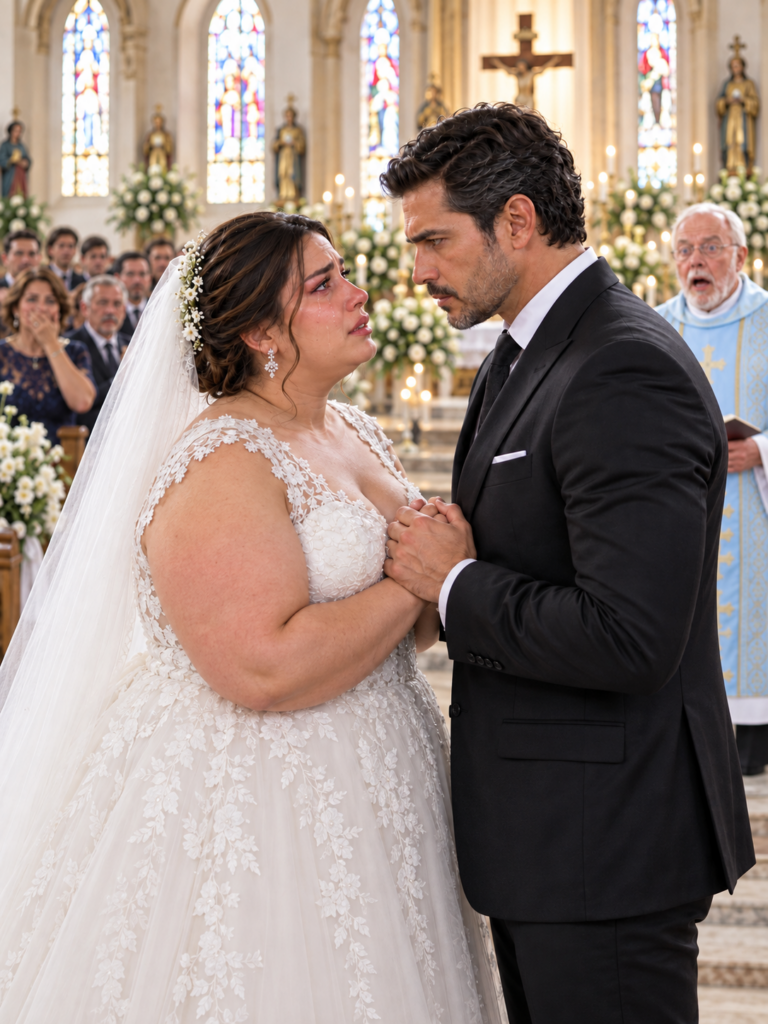
Forty-seven minutes after her wedding was supposed to begin, Valentina Nava understood that no one inside the church was waiting for the groom anymore.
They were waiting for her to break.
The scent of tuberoses had become almost unbearable inside the little church of San Ignacio del Monte, sweet and heavy beneath the heat of two hundred bodies packed into wooden pews. Colored light from the stained-glass windows spilled across Valentina’s white dress, touching the lace at her shoulders in red, blue, and gold.
She had sewn the dress herself.
Night after night, after long days coordinating restoration work in Querétaro, she had sat at the small table in her rented apartment and guided the fabric beneath her needle. The lace across the bodice had been made by her grandmother Refugio, whose fingers had grown crooked with age and whose eyesight had nearly disappeared before she died in March.
Her grandmother had finished it anyway.
“I only have to see you walk in wearing it,” she had told Valentina.
She had not lived long enough to do that.
Now Valentina stood at the altar clutching a bouquet of white roses cut that morning from her mother’s garden.
The roses were already wilting.
“So he isn’t coming,” someone whispered loudly from the third pew.
Ofelia Prado, the groom’s aunt.
Then, with no attempt to hide the satisfaction in her voice, she added, “Poor girl. All that effort.”
A few people laughed.
Valentina tightened her hand around the stems until a thorn pierced her glove.
Behind her, phones were appearing discreetly in people’s hands.
Her mother, Doña Lucía, sat in the first pew holding a handkerchief to her mouth. Her carefully applied makeup had begun to run.
Valentina refused to look at her.
If she saw her mother crying, she knew she would lose the thin thread holding her upright.
Father Anselmo, the priest who had baptized her twenty-nine years earlier, cleared his throat.
“Valentina, perhaps we should—”
“Five more minutes, Father.”
Then Fernanda came hurrying up the aisle.
Her face said everything before she reached the altar.
She was carrying Valentina’s phone.
“Valentina.”
Her voice trembled.
“He sent you a message.”
Three words.
Forgive me. I can’t.
Valentina read them once.
Then twice.
Then again, as though the letters might rearrange themselves into an explanation.
Four years with Emiliano Prado.
Fourteen months planning their wedding.
And he had ended it with three words typed by his thumb.
“Is there going to be a wedding or not?” a man called from the back. “We came all the way from Tequisquiapan.”
This time the laughter was not even disguised.
Valentina felt the ancient stone beneath her shoes become strangely unsteady.
There was only one thing left to do.
She would have to walk back through the church alone, past two hundred witnesses, while everyone watched the abandoned bride leave.
Then movement came from the last pew on the right.
Rodrigo Ibarra stood.
Her employer.
The owner of the restoration firm where she had worked for three years.
Rodrigo was a serious man in his early forties who rarely raised his voice and never wasted words. When Valentina had handed him the wedding invitation, he had accepted it with a slight nod and said, almost apologetically, that he usually preferred not to mix work with private life.
Yet he had come.
Now he walked down the aisle.
As he passed the pews, the whispers faded.
Rodrigo climbed the three steps to the altar and stopped beside Valentina.
He did not touch her.
He looked instead at the people holding their phones.
“Valentina Nava has done nothing here that should embarrass her.”
The church became still.
“This ceremony is over. But none of you has the right to turn this woman’s pain into entertainment.”
Several phones lowered.
Rodrigo’s voice remained calm.
“Put them away. Anyone who cannot manage that can leave.”
Then he turned to Valentina and offered his arm without taking hers.
“May I walk you to the door?”
The choice was hers.
That mattered.
Valentina placed her hand on his arm.
She descended those three steps with him and walked the entire length of the church without lowering her head.
Outside, Doña Amparo Prado was waiting.
Emiliano’s mother wore dark glasses and carried her handbag neatly against one forearm. Her expression showed neither surprise nor grief.
“Don’t go looking for him,” she said.
Valentina stared at her.
Doña Amparo lowered her voice.
“And do yourself a favor, dear. Don’t ask too many questions.”
Then she left.
Rodrigo waited until the woman was gone before helping Valentina into his truck.
Before he shut the door, however, he said something that seemed almost cruelly ordinary after what had just happened.
“On Monday, when you’re able, come to my office. I need to speak to you about something related to work.”
The reception hall had already been paid for.
So had the food, the flowers, and the marimba band.
Two hundred chairs waited beneath yellow lights spelling the names VALENTINA & EMILIANO.
Valentina wanted everything thrown away.
Her mother stopped her.
“You paid for that food from your salary,” Doña Lucía said. “If you throw it away, the people laughing at you win twice.”
Rodrigo solved the rest with the same practical efficiency he brought to construction sites.
He asked the hall manager to remove the illuminated names.
He had the tables rearranged.
Then he stood at the entrance and politely thanked most of the guests for attending the church ceremony while informing them that the meal would now be limited to close friends and family.
One hundred forty people left.
Sixty remained.
Real relatives. Neighbors from Zaragoza Street. Women from Valentina’s office. Father Anselmo. The two ladies who had helped Doña Lucía cut roses that morning.
They ate mole and tortillas.
The marimba played.
At five in the afternoon, Aunt Chelo announced that she had come prepared to eat and no useless man was going to ruin her appetite.
For the first time all day, Valentina laughed.
Later, she noticed Rodrigo had disappeared.
She found him in the parking lot with his jacket folded across the hood of his truck, carrying boxes of unused drinks back to the hall’s delivery van.
“You didn’t have to do all this, Engineer.”
“Someone had to move the boxes.”
He wiped his hands on a cloth.
“And we’re not at the office now. You can call me Rodrigo.”
That night he drove Valentina and her mother home.
He did not come inside.
He waited on the curb until the kitchen light came on, then drove away.
Valentina hung her wedding dress inside the wardrobe of her old bedroom and stared for a long time at her grandmother’s lace.
Monday morning, she reported for work at seven thirty.
She would not give San Ignacio another story about her hiding at home.
Rodrigo called her into his office.
On his desk lay an ivory-colored folder.
He closed the door.
“Before we begin, this has nothing to do with Saturday.”
Valentina sat.
“All right.”
“Last Thursday, our accounting review flagged irregularities on the Santa Rita restoration.”
Her attention sharpened.
“What kind?”
“Material invoices that don’t appear to match what was built. Limestone, in particular.”
“And why are you telling me?”
His expression changed.
“Because you coordinated that project. And eleven delivery receipts carry your signature.”
Valentina went very still.
“Thursday?”
Rodrigo nodded.
“You knew Thursday.”
“Yes.”
“I was getting married Saturday.”
“I didn’t have anything conclusive. I thought—”
“You thought you’d wait.”
“Yes.”
“So you decided what information I could handle.”
The rebuke landed cleanly.
Rodrigo did not defend himself.
“I did.”
“For three years, have I ever behaved like someone who needed you to decide things for me?”
“No.”
“Then don’t do it again.”
He met her gaze.
“I won’t.”
No excuse.
No speech about good intentions.
Just acceptance.
Something inside Valentina shifted, although she did not yet know what to call it.
She pulled the folder closer.
“Show me the receipts.”
There were eleven.
Pink quarry stone. Lime. Timber beams.
Each document carried an official receiving stamp.
Below it appeared her full name in a long, elegant signature.
Valentina turned over the first page.
Then the second.
By the sixth, the blood had drained from her face.
By the eleventh, her hands were cold.
Rodrigo watched her.
Finally Valentina placed both palms on the desk.
“I did not sign any of these.”
Within a week, humiliation became danger.
The auditors confirmed that significant materials were missing from Santa Rita’s accounts.
The diocese, which had financed the restoration through donations, demanded a written explanation.
Rodrigo’s partner, Engineer Bringas, argued that Valentina had to be removed from the project while the matter was investigated.
“She’ll come off Santa Rita,” Rodrigo agreed. “She will not be dismissed from this firm. And the record will show that we are not accusing her.”
“There are eleven signatures.”
“There are eleven signatures she says are not hers.”
Bringas looked at him.
Rodrigo did not move.
“Until someone proves otherwise, I’m going to believe the employee who has worked here three years without giving me a reason not to.”
Valentina survived the meeting without crying.
She reached the restroom afterward, locked herself inside a stall, and allowed herself exactly three minutes.
Then she washed her face and returned to work.
In San Ignacio del Monte, however, there were only four thousand people and one main square.
News did not travel.
It flew.
Soon two stories had become one.
Valentina Nava had been abandoned at the altar.
Money was missing from the church project Valentina Nava had coordinated.
People connected them with one poisonous sentence.
There must have been a reason he left her.
Doña Lucía stopped going to Tuesday market.
She claimed her knees hurt.
Valentina knew better.
One evening, while peeling potatoes in the kitchen, her mother finally said, “I can survive what happened at the altar. What I cannot bear is hearing people say my daughter stole from a church.”
Valentina put down the knife.
“I didn’t sign those receipts.”
“I know.”
“Then let me prove it.”
That Saturday, she went to the Prado house.
Doña Amparo made her wait twenty minutes before appearing.
Valentina remained standing.
“Tell me where Emiliano is.”
“My son is away handling business.”
“Your son left me standing in a church in front of two hundred people.”
Doña Amparo calmly smoothed her skirt.
“My late husband left the Prado name in disgrace. It took me twenty-two years to rebuild it. Prado Materials feeds forty families. I will not allow paperwork from one unfortunate project to destroy what I preserved.”
“I never mentioned Prado Materials.”
“Not yet.”
Doña Amparo smiled faintly.
Then she offered Valentina a solution.
Admit administrative negligence.
Say she had signed the receipts without checking them because she had been overworked and distracted by wedding preparations.
People would forgive a careless young woman.
They would not forgive a thief.
Valentina understood.
“You want me to confess to something I didn’t do.”
“I’m offering you an easy way out.”
At the door, Doña Amparo added, “And stop claiming the signatures aren’t yours. Your full name is written there in your own hand. Even Father Anselmo would recognize it.”
Valentina drove away with the sentence following her.
Your full name.
She could not explain why it bothered her.
Not yet.
Part 2
Without anyone deciding it, Tuesday mornings became theirs.
Valentina arrived at the office at seven thirty.
Rodrigo arrived around seven forty with two coffees from the bakery on the corner—black for himself, milk with very little sugar for her.
The first time he set hers on her desk, she looked at it suspiciously.
“How did you know?”
“I’ve watched you order coffee during meetings for three years.”
“You notice too much.”
“Occupational hazard.”
Those quiet minutes before the rest of the office arrived became the easiest part of Valentina’s week.
Sometimes they talked about work.
Sometimes about rain.
Sometimes about Don Nicolás, the construction foreman who considered schedules an insult invented by people who had never laid stone.
Sometimes they said nothing.
The silence never demanded anything from her.
One afternoon Rodrigo noticed several pencil drawings beneath her notebook.
Interior designs.
Tiled courtyards. Kitchens. Lighting plans. A small chapel.
He lifted one carefully.
“You did these?”
Valentina reached for it.
“They’re nothing. I draw during lunch.”
“This isn’t nothing.”
“I’m the project coordinator.”
“You’re a project coordinator who can draw like this and still deliver every report on time. That’s actually worse.”
She laughed despite herself.
He returned the page.
“When this mess is finished, I want to talk to you about doing design work.”
“You’re serious?”
“Unfortunately.”
That Saturday he invited her to Bernal.
The invitation was so awkward that Valentina laughed before accepting.
“My grandfather is eighty-two,” Rodrigo explained. “For three weeks he’s complained that I haven’t visited in three weeks. If I arrive alone, he’ll lecture me for two hours. If I bring someone, he’ll behave.”
“So I’m protection.”
“Completely selfish protection.”
Don Artemio Ibarra welcomed her into his restored adobe house beneath the great rock as though she had belonged there for years.
They ate dried meat, cactus, beans, and handmade tortillas.
Then the old man asked what was troubling her.
Valentina told him everything.
The altar.
The three-word message.
The eleven signatures.
Don Artemio listened.
Finally he said, “The young man who didn’t arrive at that church spared himself one difficult moment and bought himself a lifetime of shame.”
Valentina lowered her eyes.
Then the old man pointed a tortilla at her.
“And don’t rush to repair your heart.”
She smiled faintly.
“Why?”
“Because love doesn’t arrive finished. You build it. Brick by brick. Put the bricks down too quickly and the wall falls.”
Later, while Don Artemio slept in the sun, Valentina and Rodrigo walked among the hawthorn trees.
She asked about his wife.
He was quiet before answering.
“Julieta. We were married two years.”
Valentina had known he was a widower. She had never heard him speak of her.
“She became ill. Five months later, she was gone.”
“I’m sorry.”
“She used to sing deliberately off-key because she knew it annoyed me.”
A brief smile crossed his face.
“When she died, I closed everything. Not just because grief hurt. Because work was easier.”
“For how long?”
“Six years.”
He looked at her.
“Until recently.”
Neither of them said anything after that.
On the drive home, Rodrigo finally spoke.
“I want to tell you something once. Then I won’t mention it again unless you do.”
Valentina turned toward him.
“I stood up in that church because what was happening to you was wrong. I wasn’t trying to replace anyone.”
His hands remained steady on the wheel.
“I don’t want you choosing me because Emiliano wasn’t there and I was.”
She could hear the tires moving over the mountain road.
“If your heart ever reaches me on its own, I’ll be grateful. If it doesn’t, I’ll still be the same man you see at work.”
Her throat tightened.
“Thank you.”
That was all she could say.
When they reached San Ignacio after ten, there was a white envelope on her doorstep.
Inside was an agreement from the Prado family’s attorneys.
Valentina was required to admit she had negligently signed the Santa Rita receipts, resign from Ibarra Restoration, and agree never to connect the Prado name to the missing materials.
At the bottom, someone had handwritten a deadline.
Sunday. Before the town festival.
Valentina stared at the document for three nights.
One sentence.
One signature.
The gossip might stop.
Her mother might return to the market.
Then she put the unsigned agreement back into its envelope and returned it.
The Sunday festival of San Ignacio filled the square with fireworks, colored paper, food stalls, brass music, and nearly everyone in town.
Doña Amparo Prado appeared onstage after Mass.
She announced a generous donation from Prado Materials toward Santa Rita.
Then she added, with carefully practiced sorrow, that sacred projects should never suffer because “careless hands failed to protect what others sacrificed to give.”
She never said Valentina’s name.
She did not need to.
Half the square turned toward her.
Beside Valentina, Doña Lucía began shaking.
“Let’s go.”
Valentina linked arms with her.
“No.”
“Everyone is looking.”
“I know.”
“What are we going to do?”
“Finish our horchata.”
They did.
That evening, the town band began an old waltz.
Rodrigo appeared beside Valentina in a white shirt.
He held out his hand.
She looked around.
“Everyone will watch us.”
“That’s the point.”
She placed her hand in his.
They danced in the square.
Rodrigo did not pull her against him. He left a respectful space between them, and somehow that small distance moved her more than possession would have.
Halfway through the waltz, she leaned closer.
“Do you know the worst part?”
“What?”
“In fourteen months of planning that wedding, no one ever asked me whether I was all right. Not even Emiliano.”
She looked at him.
“You were the only man who remembered how much sugar I take in my coffee.”
Rodrigo said nothing.
His fingers tightened once around hers.
When the music ended, Valentina glanced toward the church arcade.
Emiliano stood there.
Thinner.
Unshaven.
Watching.
She took one step in his direction.
He turned and disappeared into the crowd.
She did not follow him.
For the first time, another possibility occurred to her.
Perhaps Emiliano had not simply run because he was a coward.
Perhaps someone had needed him gone.
The diocese gave Ibarra Restoration fifteen days.
At the end of that period, the company had to identify who was responsible for the eleven disputed receipts or risk losing its church contracts.
The obvious name was Valentina’s.
Rodrigo refused to submit it.
“I can’t certify that an employee committed fraud when she challenged the signatures from the first moment and no independent review has been completed.”
“Thirty-two families depend on this office,” Valentina reminded him.
“I know.”
He folded the letter.
“That doesn’t mean I manufacture a scapegoat.”
Four days later Valentina resigned.
Rodrigo found her in the parking lot.
“I don’t accept this.”
“I already signed it.”
“This is exactly what they want.”
“I know.”
She leaned against her car.
“But if I stay, you’ll eventually have to choose between giving them my name or losing the diocesan work. You won’t give them my name. So thirty-two employees may pay for a fight that belongs to me.”
“It doesn’t belong only to you anymore.”
“This decision does.”
Her voice faltered once.
“And when I clear my name, I can’t have people saying my employer covered for me because we’re close. I need to prove this from outside your company.”
Rodrigo stared at the keys in his palm for several seconds.
“Fine.”
Then he looked at her.
“But say it correctly. You resigned. I did not fire you.”
Valentina swallowed.
“And if you ever want your chair back, it’s still there.”
The first unemployed mornings were brutal.
She cleaned the house.
Swept an already clean sidewalk.
Rearranged cupboards.
In town, people decided she had been fired anyway.
Only Fernanda refused to disappear.
Every Saturday she arrived with bread and stayed three hours.
Doña Lucía seemed to age an entire season in a few weeks.
Then, one Saturday morning, Rodrigo arrived carrying something large beneath a blanket.
He set it on the kitchen table.
When he removed the covering, Doña Lucía pressed both hands over her mouth.
Grandmother Refugio’s old treadle sewing machine.
Black enamel.
Gold lettering.
Restored.
“You took it?” Valentina whispered.
“A month ago. You told me no one in town could repair it.”
He demonstrated the mechanism.
“The shuttle was jammed. A screw was missing. They don’t manufacture it anymore, so a man in San Francisquito made one by hand.”
Rodrigo worked the treadle.
The needle began moving.
Doña Lucía cried openly.
Valentina turned away before Rodrigo could see her doing the same.
He came to sit beside her on the front step.
“I didn’t bring lawyers.”
Valentina laughed softly through her tears.
“No.”
“And I didn’t bring money because you’d probably throw it at me.”
“Correct.”
“So I brought something useful.”
Their hands rested close together on the stone step.
Neither moved away.
Two nights later, Emiliano knocked on her door.
Valentina allowed him as far as the kitchen.
He sat in the same chair where he had eaten soup during happier years.
When he saw Refugio’s sewing machine, his face crumpled.
“You finally repaired it.”
“Rodrigo did.”
Emiliano closed his eyes.
Valentina sat opposite him.
“Why are you here?”
He clasped his hands to hide their trembling.
“On the Thursday before our wedding, my mother showed me a request from the auditors. Prado Materials had supplied Santa Rita. The invoices were under our company.”
Valentina said nothing.
“She told me the store had cash problems. There had been gaps for years. She covered them by invoicing materials that weren’t always delivered.”
Valentina felt something inside her become cold.
“Continue.”
“She told me that when the investigation became public, if we were married, it would connect everything. You, the project coordinator. Me, the son of the supplier.”
His eyes filled.
“Then she said if I didn’t marry you, the problem would remain on your side.”
Valentina stared at him.
“You knew.”
“I panicked.”
“You knew before I walked into that church.”
He nodded.
“My mother gave me a choice.”
“No.”
Valentina’s voice remained quiet.
“She gave you an opportunity to make a choice. And you made one.”
Emiliano began crying.
“I loved you.”
“I believe you.”
That surprised him.
Valentina continued.
“But love isn’t just the feeling you have when life is easy. Love is standing beside someone when standing there costs you something.”
She thought of the last pew.
“A man who had been my employer for three years stood up for me in that church.”
Her eyes met Emiliano’s.
“You didn’t.”
“Can you forgive me?”
She considered the question seriously.
“Yes.”
Hope flashed across his face.
Then she stopped it.
“I forgive what you did at the altar because carrying it will cost me more than it costs you.”
She leaned forward.
“But forgiveness doesn’t mean I want you back. And it doesn’t mean I will help you remain silent.”
Emiliano’s shoulders collapsed.
“She’s my mother.”
“I’m not asking you to accuse her of something you didn’t see. I’m asking you to tell the truth about what you did see.”
He stood.
At the door, he stopped.
“There’s something I don’t understand.”
Valentina waited.
“My mother keeps saying those signatures are yours. I’ve watched you sign things a thousand times.”
He turned around.
“You sign with two quick strokes.”
Valentina stopped breathing.
“Those receipts have your whole name written out. Long. Almost decorative.”
After he left, she went to her bedroom and pulled out her voter identification card.
Her current signature was exactly as Emiliano had described it.
Short.
V. Nava.
Three quick movements.
She had changed it four years earlier because her old signature no longer fit inside official boxes.
Before that, she had signed differently.
Loops.
A long underline.
Sometimes the additional name she had loved because it belonged to her grandmother.
Valentina Refugio Nava.
The signature on the eleven receipts was the one she had stopped using four years ago.
And Valentina knew where someone might have obtained it.
Three months before the wedding, Doña Amparo had offered to organize some of the marriage paperwork.
Valentina had taken a blue plastic folder to the Prado house.
Birth certificate.
Old identification.
Previous documents.
Documents carrying the long signature.
Doña Amparo had never returned the folder.
At five the next morning Valentina sat at the kitchen table making a list.
The old signature could explain the forgery.
But not the missing materials.
She still needed proof that what appeared on the receipts had never reached Santa Rita.
At six thirty she called Rodrigo.
“I need the original purchase orders and site records.”
“I’ll bring them.”
“No lawyers.”
“Agreed.”
“And when we go up there, you let me do the talking.”
A beat of silence.
“Agreed.”
Part 3
Santa Rita stood four hours away in the mountains.
The final road cut through pine forest and mud left by recent rain.
When Valentina and Rodrigo arrived, Don Nicolás, the senior foreman, was eating lunch on a stone outside the church.
“I thought they didn’t allow you on this project anymore,” he told her.
“They don’t. I’m here on my own behalf.”
She explained everything.
The old craftsman listened.
Then he went inside and returned carrying a thick notebook bound with an elastic strap.
“I write down everything that enters my sites,” he said. “How much. Who delivers it. What time. I’ve done it since 1979.”
They sat in the courtyard.
Valentina found the eleven dates.
No trucks.
No deliveries matching the disputed receipts.
On seven of those dates, another note appeared in Don Nicolás’s large handwriting.
Valentina Nava inspected arch.
She had physically been on-site, yet there was no record of the materials whose receipt she supposedly signed.
Then Don Nicolás took her to the southern wall.
“Those receipts say pink quarry stone?”
“Yes.”
He placed one rough hand against the church.
“This is white limestone from Escolásticas. Local stone. We always use it here.”
He looked around.
“No pink stone ever came to this church. Not one piece.”
Valentina reached down and picked up a fragment of white limestone.
She held it in her palm.
Eleven false receipts could be complicated.
A wall was not.
When she walked back into the courtyard at dusk, Rodrigo was waiting on the low wall where he had promised to remain.
She held up the notebook and the stone.
“Nothing came.”
Her voice broke.
“It’s written down. It’s in the wall. It’s in the stone.”
Tears spilled down her face.
“Rodrigo, I’m not crazy.”
His answer came immediately.
“I never thought you were.”
Valentina laughed and cried at the same time.
Then she looked at him.
“Do you remember what you said on the mountain road?”
“Yes.”
“That you didn’t want me choosing you because of the altar.”
Rodrigo stood.
“Yes.”
“That you’d wait and see whether my heart found you on its own.”
He said nothing.
Valentina stepped closer.
“It did.”
For once, Rodrigo Ibarra seemed to have no prepared response.
He lifted one hand and touched her cheek with such caution that she had every opportunity to step away.
She did not.
Their first kiss happened in the courtyard of Santa Rita beneath a darkening mountain sky.
It was not desperate.
It was not an escape.
It was the kiss of two adults who understood that love was not an ambulance sent to rescue one person from another.
It was a choice.
And Valentina was finally making her own.
The next morning Fernanda called.
Doña Amparo had arranged a ceremonial reopening of Santa Rita for Friday, weeks before the construction was actually finished.
The bishop would attend.
So would the mayor.
So would the press from Querétaro.
A bronze plaque would be unveiled.
Only one family name appeared on it.
Prado.
Doña Amparo had learned that Rodrigo’s truck had been seen near Santa Rita.
She understood that Valentina was searching.
So she attacked first.
A formal complaint reached the diocese alleging that Rodrigo was protecting Valentina because of a personal relationship.
Two future Ibarra Restoration projects were suspended.
Engineer Bringas confronted Rodrigo.
“Give them her name. Friday is the deadline. One signature and this stops.”
Rodrigo refused.
“Thirty-two jobs are at risk.”
“Then we figure out how to cover payroll with private work.”
“You’d risk the company?”
Rodrigo looked at him.
“If I falsely accuse her now and she’s cleared tomorrow, I’m the one who destroyed this company.”
Meanwhile, a letter from the Prado family’s attorneys arrived at Doña Lucía’s home warning Valentina against repeating unsupported accusations.
“Can they hurt us?” her mother asked.
“They can frighten us.”
That evening Valentina returned to the Prado house.
She did not demand a confession.
She asked only for the blue folder containing her documents.
A maid opened the gate a few inches.
From somewhere inside the house came Doña Amparo’s voice.
“The folder was misplaced during an office move. I’m terribly sorry.”
The gate closed.
That night Rodrigo arrived carrying two coffees.
They sat on the front step.
“It’s going to be a difficult few months,” he said. “But no one at the firm is losing a job.”
Valentina looked at him.
“You can give them my name if you need to.”
Rodrigo turned slowly.
“I can’t.”
“I would understand.”
“I wouldn’t.”
He looked toward the dark street.
“I spent six years hiding inside work because it was easier than feeling anything. If the first thing I do after finally waking up is sign a lie to protect the office, then what exactly did I save?”
Valentina placed her hand over his.
Neither spoke.
The following morning Don Artemio was taken to a hospital in Querétaro after a spike in blood pressure.
By the time Valentina reached him, the eighty-two-year-old was sitting up in bed complaining about the hospital gown and demanding his pants.
She told him everything.
The old signature.
The missing blue folder.
Don Nicolás’s notebook.
The white limestone.
The rushed ceremony.
“What are you going to do tomorrow?” he asked.
“I thought I would write the bishop and request a meeting.”
“No.”
Valentina blinked.
Don Artemio took her hand.
“Listen to an old stubborn man. All my life I’ve watched people like us go somewhere asking. Asking for work. Asking for time. Asking people, please, to believe us.”
His fingers tightened around hers.
“Don’t go ask them to believe you.”
He smiled.
“Go prove it.”
That night Valentina laid everything across the kitchen table.
A piece of white stone.
A certified copy of the foreman’s records.
Her old identification carrying the long signature.
The eleven delivery receipts.
A page listing all eleven dates.
Doña Lucía stood in the doorway.
“You’re going?”
“Yes.”
“The bishop will be there. The whole town.”
“That’s why I’m going.”
She closed the bag.
“I’m not going to ask anyone for anything, Mama.”
She touched the white stone.
“I’m going to show them a wall.”
Friday morning was brilliantly clear.
Plastic chairs filled Santa Rita’s courtyard.
A temporary platform had been draped in white cloth.
The bell tower still wore scaffolding, revealing the absurdity of calling the event a completion ceremony.
The bishop arrived.
The mayor arrived.
Families from the surrounding farms arrived in their best clothes.
A newspaper truck from Querétaro parked outside.
At eleven thirty, Doña Amparo Prado stepped onto the platform in a dark blue suit and accepted the bronze plaque with both hands.
Applause rose.
Then Valentina walked down the center aisle.
Her bag hung from one shoulder.
People began turning.
Conversations faded.
Rodrigo followed three steps behind her and stopped.
This was not his fight to lead.
Not today.
Valentina stopped below the platform.
“Your Excellency, may I have five minutes?”
The bishop looked at her.
She continued before fear could become negotiation.
“I won’t raise my voice.”
Then she reached into her bag and lifted the piece of limestone.
“This came from the south wall of this church.”
Every face turned toward the building.
“White limestone from Escolásticas. Local stone. Anyone here can recognize it.”
She raised the fragment higher.
“The documents in the diocesan file show that someone charged substantial amounts for pink quarry stone delivered to this project.”
She turned toward the crowd.
“So I have only one request.”
The courtyard remained silent.
“Find one piece of pink stone in this church.”
No one moved.
They didn’t need to.
Santa Rita stood behind her.
White beneath the mountain sky.
Valentina produced the notebook records.
“Don Nicolás has documented every delivery entering his worksites for forty-seven years. On the eleven dates corresponding to these receipts, no material truck arrived.”
Don Nicolás stood.
“And on seven of those days,” Valentina continued, “his records say I was personally here inspecting the work.”
She looked at him.
“Don Nicolás, is that correct?”
He removed his hat.
“Yes, Miss Nava. And I’ll say it anywhere I’m asked.”
Valentina took out two more pages.
“Now the signatures.”
The old humiliation tried to rise in her throat.
She refused it.
“The eleven receipts are signed Valentina Nava Refugio in a long signature.”
She held up her identification.
“I stopped signing that way four years ago. When I renewed my identification, I shortened my signature because the old one didn’t fit the required field.”
She displayed the documents side by side.
“Since then, I have signed with two short strokes. Anyone can compare them.”
Now Valentina turned toward Doña Amparo.
“This proves someone used an old version of my signature. It does not, by itself, prove who.”
Doña Amparo’s expression did not change.
Valentina continued.
“The old signature still existed on some of my previous documents. Three months before my wedding, I delivered the newest copies I possessed to you, Doña Amparo, in a blue plastic folder because you offered to help organize the paperwork for my marriage to your son.”
The crowd stirred.
“You never returned that folder.”
Doña Amparo spoke at last.
“That proves nothing. Documents get lost.”
Valentina nodded.
“You’re right.”
The admission caused a ripple of surprise.
“That alone proves nothing.”
Then a voice came from the back of the courtyard.
“I saw it.”
Valentina turned.
Emiliano walked between the chairs carrying a travel bag.
He should have been on his way to Mérida.
Instead, he climbed toward the platform and faced his mother.
“I saw the blue folder three weeks ago on the desk in the study at our house.”
Doña Amparo’s face changed.
Barely.
But it changed.
“Emiliano.”
He swallowed.
“There’s more.”
The courtyard seemed to contract around him.
“Materials for this church were invoiced through Prado Materials. For years I signed documents without reading them because I trusted my mother to handle the business.”
His voice shook.
“That’s my responsibility too. I’ll say that to the auditors or anyone else who asks.”
“Emiliano.”
“Keeps stopping here, Mama.”
He looked at her.
“It’s over.”
There was no shouting.
No dramatic collapse.
Only the long murmur of a community realizing that the story it had enjoyed repeating might have been cruelly wrong.
A diocesan secretary approached Doña Amparo and asked for the bronze plaque.
She handed it back with the same two hands that had accepted it.
When she passed Valentina, she stopped.
“I only wanted the family name to survive.”
Valentina held the stone at her side.
“You were the one who spent it.”
Her voice contained no triumph.
“I only brought a stone.”
The bishop requested the microphone.
He canceled the ceremony.
The plaque would remain in diocesan custody.
An independent audit would begin immediately, and all relevant records would be secured that morning.
Then he looked toward the gathered town.
“Until that investigation is complete, no one in this diocese will again publicly identify Miss Nava as responsible for these irregularities. Justice requires facts before accusation.”
Valentina managed to thank him.
Only after people began leaving did her hands start shaking.
Rodrigo approached.
He did not embrace her in front of everyone.
He stood beside her facing the white wall.
“You did it.”
Valentina exhaled.
“You brought me the contracts.”
“I brought you paper.”
He nodded toward the church.
“You showed them the wall.”
She laughed through exhausted tears.
“And now, Engineer Ibarra?”
“Now I drive you home.”
“How romantic.”
“You eat with your mother.”
“Even better.”
“Then you sleep for twelve hours.”
Valentina smiled.
Rodrigo placed his hands in his pockets.
“After things settle down, there’s something I want to ask you.”
She studied him.
“But not today,” he added. “Today belongs to you.”
The independent review ended in March.
Investigators recovered the missing blue folder from the Prado home office.
Inside were Valentina’s old documents.
Handwriting specialists concluded that all eleven delivery signatures had been forged from the older version of her name.
Records traced the fraudulent receipts back through the administration of Prado Materials.
Valentina was formally cleared.
Doña Amparo answered to the authorities and sold the business to repay what had been taken.
But money was not the only price.
For a woman who had spent twenty-two years rebuilding a respected family name, there was a consequence she felt more deeply.
People in San Ignacio stopped standing when she entered a room.
Emiliano gave investigators everything he knew.
Then he left for Mérida alone.
The diocese asked Valentina to return and coordinate the completion of Santa Rita.
She accepted.
The little church was finished in August.
White stone.
Clear accounts.
Every delivery recorded.
Every signature verified.
In October, Rodrigo took Valentina back to the church of San Ignacio on a quiet Sunday evening.
Six o’clock light passed through the stained-glass windows.
Valentina paused when she saw the altar.
The last time she had stood there, two hundred people had watched her wait for a man who had already chosen not to come.
Rodrigo led her only as far as the bottom of the three steps.
Then he stopped.
“The first time we were here together,” he said, “another man made a decision for you.”
Valentina looked at him.
“So today I don’t want to decide anything.”
He reached into his pocket.
The ring he produced was simple.
No spectacle.
No audience.
“Valentina Nava, would you like to build a life with me?”
She said yes before he finished the question.
They married the following February in the same church.
Forty guests attended.
Valentina did not reuse her first wedding dress.
She made another one herself from simple linen on her grandmother Refugio’s restored treadle machine.
But she removed a section of lace from the old gown and sewed it along the new collar.
Not because she wanted to preserve the failed wedding.
Because the lace had never belonged to Emiliano.
It belonged to her grandmother.
Her history was hers to decide what to keep.
She carried white roses from Doña Lucía’s garden.
Don Artemio, now eighty-three and walking with a new cane, arrived leaning on his grandson’s arm.
At the meal, he stood and struck his glass with a spoon.
“I told them,” he announced.
Rodrigo covered his eyes.
Valentina laughed.
Don Artemio refused to be interrupted.
“I said love doesn’t arrive finished. It gets built one brick at a time.”
He raised his glass.
“And this wall, ladies and gentlemen, is properly built.”
Doña Lucía cried through the entire ceremony.
Then she laughed through the entire reception.
Two years later, a framed drawing hung near the entrance of Ibarra & Nava Restoration.
Beside it sat a piece of white limestone from Santa Rita.
There was also a photograph of a little dark-eyed girl named Esperanza.
At the house on Zaragoza Street, Refugio’s sewing machine still worked.
The old rosebush still flowered every spring.
And sometimes, when Valentina told the story, people expected her to say that the worst day of her life became the best because Rodrigo rescued her.
She never said that.
Rodrigo had helped her.
He had believed her.
He had stood when others watched.
He had brought coffee, records, a repaired sewing machine, patience, and eventually love.
But when the moment came to recover her name, Valentina had walked into Santa Rita carrying the evidence herself.
That mattered.
She remembered the first church most clearly.
The phones.
The laughter.
The wilted roses.
The three steps beneath the altar.
And the man who had offered his arm without assuming she would take it.
There was no shame in accepting a good hand when one was offered.
But some steps still had to be taken on your own.
Head upright.
Back straight.
Even when the whole world was watching.

