
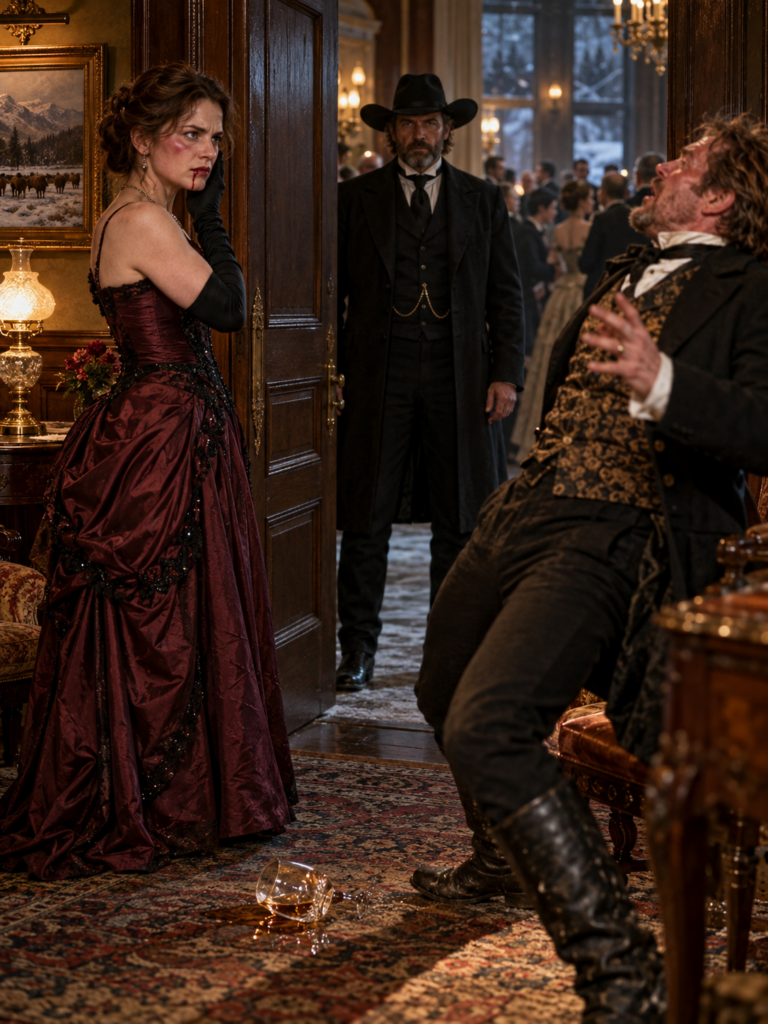
Henry turned with her into the narrow servants’ corridor just as Beatrice’s knees threatened to give beneath her.
His arm tightened under her hand, but he did not lift or hurry her.
“Slowly.”
“I can walk.”
“I know.”
That answer steadied her more than being carried would have.
They left the hotel through a side entrance where no curious guests could see her face. Outside, the winter air bit through Beatrice’s silk wrap. Henry’s carriage waited beneath two lanterns, the horses blowing pale breath into the dark.
He handed her inside.
Only after the door shut did Beatrice realize she was shaking.
Henry sat opposite her.
She turned toward the window.
“I did not provoke him.”
Henry’s head came up sharply.
Beatrice hated how quickly the explanation had escaped her. All her life, women had been expected to account for male anger as though somewhere beneath every insult or bruise lay a feminine mistake.
“He was drunk,” she continued. “He was angry about years ago. I tried to leave.”
“Beatrice.”
His voice was rougher than she had ever heard it.
“You will not defend yourself to me.”
She looked at him.
“You told him no. That should have ended the matter.”
The carriage rocked over frozen ruts.
“He will talk.”
“Perhaps.”
“And if you threaten him into silence, people will talk more.”
Henry’s mouth tightened.
“What do you want done?”
It was not the question she expected.
Beatrice pressed the back of her fingers beneath her cheekbone and winced.
“I want him kept away from me. I want no duel. No shooting. No grand performance in the street. And I do not want you deciding the rest without me.”
Henry studied her.
Then he nodded.
“All right.”
A simple agreement.
No argument.
At the ranch house, Henry dismissed the servants with a story about Beatrice becoming ill from the cold. He brought a basin, clean linen, and a wrapped piece of ice from the kitchen himself.
When he knelt beside her chair, Beatrice almost laughed from exhaustion.
“You employ people for this.”
“Tonight I do not want people.”
He dampened the cloth.
When his hand approached her face, she flinched.
Henry stopped instantly.
The shame of the reaction stung worse than the cut.
“I am sorry,” she whispered.
“You have nothing to apologize for.”
“Try again.”
He did.
This time she remained still while he cleaned the blood from her lip and settled the cold bundle against her swelling cheek.
For several minutes neither spoke.
Then Beatrice asked, “Why did you come tonight?”
Henry’s eyes stayed on the ice.
“I finished with the ranch accounts early.”
“That has never driven you to a ballroom.”
“No.”
“Then why?”
His silence lasted long enough that she thought he would retreat into it.
Instead he said, “Because I realized you were going alone again.”
Beatrice’s breath caught.
Henry looked directly at her.
“I believed distance was part of our bargain. You had married a stranger for security. I thought leaving you free of my company was the nearest thing I could give you to freedom.”
“And now?”
“Now I think I mistook absence for respect.”
The room became very still.
Beatrice lowered the ice.
“Then do not replace absence with control.”
Henry’s expression changed.
She continued.
“You may stand beside me. You may help me. You may be angry. But you will not make my decisions because another man struck me.”
Henry absorbed every word.
Then he inclined his head.
“Agreed.”
Beatrice set the melting ice on the saucer.
On the table beside Henry lay a stack of ranch ledgers he had apparently brought from his study before coming upstairs.
She looked at them.
At him.
Then she drew the top book toward herself.
“If we are renegotiating this marriage,” she said, opening the ledger despite the ache in her face, “we may as well begin with the part you never thought to ask whether I understood.”
Henry stared as Beatrice turned the book around, placed her finger beside a column of cattle-sale figures, and silently showed him the first discrepancy.
Henry leaned over the ledger where Beatrice’s finger rested.
The entry concerned thirty-eight steers sold in autumn.
The payment recorded beside them was too small.
Henry frowned.
“That price is wrong.”
“Yes.”
He pulled the book closer.
Beatrice stopped him with her palm.
“Do not look only at the sale price. Look three pages back.”
Henry did.
A feed purchase had been entered for cattle supposedly held through early winter.
“But those steers were already sold,” Beatrice said.
His eyes narrowed.
“The books claim I paid to feed animals I no longer owned.”
“Exactly.”
Henry sat back slowly.
For the first time since she had known him, Beatrice saw him look genuinely surprised by her.
“How did you see that?”
“My father lost nearly everything we had because he preferred trusting charming men to reading dull columns.”
She turned another page.
“I learned dull columns.”
Henry looked toward her bruised face, then back at the figures.
“You have done this before.”
“I kept my father’s household accounts from seventeen onward. By nineteen I was finding debts before he remembered creating them. By twenty I knew which creditors could be delayed, which could not, and which men were lying simply by the way they avoided writing numbers in ink.”
There was no pride in the confession.
Only experience.
Henry’s expression hardened, though not at her.
“And I married you because I thought you knew how to host dinners.”
Beatrice gave him a level look.
“You married me because my name was respectable and my family was desperate enough to accept your terms.”
The truth landed between them.
Henry did not deny it.
“No,” he said. “I did.”
Beatrice waited.
“I was wrong to think that was all you brought.”
Something inside her loosened.
Not forgiveness.
Not yet.
But room for it.
Henry pulled a chair beside hers.
“Show me everything.”
They remained awake until the lamps burned low.
The problem was larger than one false entry but smaller than the catastrophic betrayal Henry first feared. His range manager had been inflating feed purchases and shaving money from several cattle sales, little thefts designed to resemble normal winter loss.
By midnight, Beatrice had identified three patterns.
Henry had found two more.
They argued over whether a missing shipment represented theft or clerical carelessness.
Beatrice won.
It was carelessness.
“You assume guilt too quickly,” she told him.
“I own cattle. Suspicion is cheaper than replacement stock.”
“That philosophy is precisely why your bookkeeper hates you.”
“My bookkeeper is paid to hate me accurately.”
Despite herself, Beatrice laughed.
Pain immediately pulled at her cheek.
Henry’s amusement vanished.
He reached toward her, then remembered.
“May I?”
She nodded.
He replaced the warm ice bundle with another.
That became the rhythm of the next two weeks.
Her bruise deepened before it faded.
Purple became green, then yellow.
The cut in her mouth healed more quickly.
Henry moved a working table into Beatrice’s sitting room because she refused to spend her recovery being treated like an invalid. He brought ranch books, correspondence, contracts with drovers, hay tallies, horse purchases, and winter supply lists.
He did not give her meaningless papers.
He gave her problems.
And Beatrice gave him answers.
Not always the answers he wanted.
“You are overpaying for freight.”
“The road south is poor.”
“Then why are you paying the same man to haul north?”
Henry paused.
Beatrice lifted one eyebrow.
He muttered something impolite and reached for another ledger.
Their marriage changed in increments too small for either of them to name.
Henry learned that Beatrice took coffee only when she was tired enough to become unreasonable.
Beatrice learned that Henry rubbed the side of his thumb when mentally calculating.
She discovered he quietly sent extra flour to two ranch families after a poor harvest without recording it as charity.
He discovered that she remembered every hired hand’s wife and every child she had ever met at a ranch gathering.
She stopped asking permission before moving his papers.
He stopped assuming the chair beside him would remain empty.
The range manager responsible for the missing money was dismissed after Henry confronted him with Beatrice’s reconstructed accounts. No gun was drawn. No spectacle was made.
The stolen amount was taken from wages and property still owed to the man, as far as could be settled without turning the matter into a public feud.
More importantly to Beatrice, Henry called the bookkeeper in afterward and said, in her presence, “Mrs. Summerton will review the ranch accounts with me from now on.”
Not my wife will help.
Not she has taken an interest.
With me.
That evening Beatrice stood at the window watching snowmelt drip from the eaves.
Henry approached carrying a folded newspaper.
“Thomas Reed left town.”
She turned.
“When?”
“The morning after the ball.”
Henry set the paper down.
“I did not force him onto a train.”
“I was going to ask.”
“I told his father what happened. I told him that if Thomas approached you again, we would make the matter public.”
Beatrice searched his face.
“And?”
“His father sent him east.”
A smaller question had been answered.
Thomas was gone.
But the ball had left another problem behind.
People had noticed his sudden departure.
People had noticed Beatrice and Henry vanish early the same night.
People had noticed the Summertons cease attending church suppers, dinners, card evenings, or business gatherings.
No one knew the truth.
So they invented versions.
By the thirteenth day, notes arrived asking after Beatrice’s “illness” with such elaborate politeness that their curiosity practically bled through the paper.
On the fourteenth morning Beatrice sat before her mirror.
The bruise had faded enough to cover lightly.
Henry stood in the doorway.
“There is a dance at the hotel tonight,” he said.
“I know.”
“We do not have to attend.”
Beatrice looked at her reflection.
Two weeks earlier that face had belonged, at least partly, to a woman who believed her place in town depended upon successfully performing a marriage that did not truly exist.
Now she knew Henry’s silences.
She knew the tension in his shoulders before bad weather.
She knew how impatiently he read foolish letters.
She knew he had listened when she demanded a say in what followed Thomas’s assault.
And Henry knew she could read a fraudulent account faster than most men he employed.
“If we stay away,” she said, “they will decide what happened for us.”
Henry came farther into the room.
“Let them.”
“I won’t.”
He stopped.
Beatrice rose.
“I spent too much of my life allowing other people to decide whether my family was respectable, whether our poverty was shameful, whether marrying you made me fortunate or mercenary.”
She faced him fully.
“I will not hide because Thomas Reed behaved disgracefully.”
Henry’s eyes warmed with something like pride.
“All right.”
He reached into his coat.
The narrow box he produced was covered in dark leather.
Beatrice frowned.
“Henry.”
“Open it.”
Inside lay a necklace of deep blue sapphires set in gold.
Not the heavy family jewels she wore when duty demanded them.
These were simpler.
Chosen.
“For tonight?” she asked.
“For whenever you please.”
She touched one stone.
“They are extravagant.”
“So are most of my cattle losses. At least these are attractive.”
Her laugh came without pain this time.
Henry moved behind her.
“May I?”
Beatrice gathered her hair aside.
“Yes.”
He fastened the necklace.
In the mirror their eyes met.
“I cannot promise no one will whisper,” he said.
“I expect them to.”
“I cannot promise I will enjoy hearing it.”
“I certainly do not expect that.”
His hands settled briefly on her shoulders.
“But I can promise,” Henry said, “that you choose when we leave. You choose whom you speak to. And if you want me near you, I stay near you.”
Beatrice placed one hand over his.
“That is what I want.”
That evening their carriage stopped before the same hotel.
Music poured through the open doors.
Guests crowded the entrance beneath gas lamps and hanging lanterns.
Henry stepped down first.
He turned and offered his hand.
Beatrice looked past him toward the staircase, where half the town’s most curious faces were already turning in their direction.
Then she placed her gloved hand in her husband’s and stepped into the light.
Beatrice’s shoe touched the hotel step, and the conversations nearest the entrance faltered.
Not stopped.
People in cattle towns were too practiced at pretending not to stare.
But voices dipped.
Heads turned.
A rancher from the southern range forgot whatever story he had been telling. His wife elbowed him without taking her own eyes from Beatrice. Two young women near the cloakroom whispered behind their fans.
Henry’s fingers closed around Beatrice’s hand only firmly enough to let her know he was there.
He did not pull her forward.
She moved first.
Together they climbed the stairs.
The ballroom looked exactly as it had two weeks earlier.
Same chandeliers.
Same polished floor.
Same musicians crowded on the little raised platform.
Same velvet curtains beside the corridor where Thomas Reed had followed her.
For half a second the sight of that doorway sent the memory through her body faster than thought.
His hand on her arm.
The smell of brandy.
The blow.
Beatrice stopped.
Henry stopped with her.
He said nothing.
That, too, mattered.
He did not ask whether she was frightened.
He did not tell her she was safe.
He did not make the moment larger by announcing that he understood it.
He simply waited.
Beatrice took one breath.
Then another.
“I want to go in.”
Henry inclined his head.
They entered.
The room seemed to divide around them.
The first person brave enough to approach was Mrs. Carmichael, whose husband owned the hotel and most of the commercial property along the main street.
“My dear Mrs. Summerton.”
Her concern was exquisitely performed.
“We have all been terribly worried. Such a sudden illness.”
Beatrice smiled.
“The winter air disagreed with me.”
Mrs. Carmichael’s gaze flicked toward Henry.
“I see you have quite recovered.”
“Entirely.”
“How fortunate.”
A pause followed.
Then came the blade wrapped in silk.
“And poor Thomas Reed gone east the very next morning. Such strange timing.”
Henry’s shoulders hardened beside Beatrice.
She touched his sleeve once.
Not yet.
Mrs. Carmichael waited.
So did everyone within hearing distance.
Beatrice had spent years among people who considered curiosity a social art. She knew how to answer a rude question without acknowledging it had been rude.
“Thomas always did possess a remarkable talent for leaving when remaining would require character.”
A man behind Mrs. Carmichael coughed into his drink.
Someone else turned away too quickly.
Mrs. Carmichael’s smile flickered.
“I had heard there were debts.”
“So had I.”
Beatrice’s tone remained mild.
“I hope distance improves his arithmetic.”
This time the laughter could not be entirely concealed.
Henry looked down at her.
The corner of his mouth moved.
Mrs. Carmichael recovered herself.
“Well. We are simply delighted to see you restored.”
“How kind.”
Beatrice inclined her head.
Then she walked away before permission could be granted.
Henry followed.
“You enjoyed that,” he murmured.
“I survived that.”
“You also enjoyed it.”
“Perhaps slightly.”
They crossed the ballroom.
People spoke to them.
Not all were cruel.
Several older ranch wives seemed genuinely pleased to see Beatrice. One woman squeezed her hand and asked no questions. A cattle buyer Henry respected discussed spring contracts with Beatrice as naturally as if she had always been included. The minister’s wife complimented the sapphires and changed the subject before gossip could enter.
Beatrice noticed all of it.
For years she had thought society divided neatly into judges and victims.
Tonight she saw something more complicated.
Some people hunted weakness.
Some merely followed whatever story seemed easiest.
Some had enough decency to leave a wound alone.
And some could be taught to see a woman differently if she insisted upon being seen.
Near the musicians, the hotel owner approached Henry about a delayed cattle payment.
Normally Beatrice would have stepped away.
Henry said, “Ask my wife.”
The man blinked.
Beatrice nearly did too.
Henry continued.
“She found the discrepancy.”
The owner turned toward her with obvious uncertainty.
Beatrice explained the accounting error in three sentences.
The man listened.
Then he asked a sensible question.
She answered it.
By the end of the exchange, he was speaking to her rather than through Henry.
That simple shift affected her more deeply than the whispers.
When the musicians began a waltz, Henry looked at her.
“Would you like to dance?”
Beatrice studied him.
“You hate dancing.”
“I dislike being bad at things publicly.”
“You are bad at it?”
“No.”
“Then that is vanity.”
“Probably.”
She placed her hand in his.
“I accept.”
They moved onto the floor.
Henry was, infuriatingly, an excellent dancer.
“You deceived me.”
“I withheld information.”
“That distinction is why you require supervision with contracts.”
His hand rested at her back.
Beatrice could feel people watching.
For the first few turns, her spine remained too straight.
Then Henry said quietly, “You may stop whenever you wish.”
“I know.”
Another turn.
The musicians lifted into the next passage.
Beatrice looked around the room.
Two weeks ago she had fled this same crowd desperate for quiet, convinced she had been left alone inside a marriage designed only to look respectable from the outside.
Tonight she was not alone.
But neither was she hidden behind Henry.
That difference was everything.
She relaxed.
Henry felt it.
His expression softened.
“I owe you an apology.”
“For stepping on my dress?”
“I have not.”
“You nearly did.”
“Then I owe you two.”
Beatrice smiled despite herself.
Henry’s humor faded.
“I married you because the arrangement benefited me.”
“I remember.”
“I thought providing money, a house, and freedom from interference made the arrangement fair.”
“It made it tolerable.”
He accepted the correction.
“I never considered that freedom from interference might become another form of neglect.”
Beatrice watched his face.
This was not the Henry who had pinned Thomas against the mantel.
Nor the distant husband who had once measured kindness by how rarely he entered her rooms.
This was a man choosing uncomfortable honesty in the middle of a ballroom.
“I was not entirely innocent either,” she said.
Henry’s brow lifted.
“I decided what you were very early.”
“What was I?”
“A cold rancher who wanted a well-bred wife because successful men eventually purchase furniture suitable to their position.”
“That is devastatingly specific.”
“It was a carefully developed theory.”
“And incorrect?”
Beatrice considered.
“Partly.”
The dance carried them past the corridor leading to the side parlor.
This time she saw it without stopping.
“I thought if I expected nothing from you,” she continued, “you could never disappoint me.”
Henry’s hand tightened slightly at her back.
“And now?”
“Now you disappoint me regularly.”
He looked alarmed.
Beatrice smiled.
“It is much better.”
Understanding reached him.
“You expect something.”
“Yes.”
“What?”
“The truth.”
His expression sobered.
“Always?”
“When it matters.”
“It will often be inconvenient.”
“So am I.”
“That,” Henry said, “I have discovered.”
The music ended.
He bowed.
Beatrice curtsied.
When they straightened, neither immediately stepped away.
Then Henry offered his arm.
“Stay?”
She looked around the crowded room.
“No.”
His eyebrows rose.
“I have done what I came to do.”
“What was that?”
“Walk through the door.”
Henry’s gaze held hers.
“Then we leave.”
No argument.
No concern about appearances.
No demand that she remain until society was satisfied.
They collected their coats and departed before supper.
Outside, the night had cleared.
The last snow along the street shone pale beneath the moon.
Inside the carriage Henry sat beside her rather than opposite.
Beatrice noticed.
She said nothing.
After several blocks, his hand turned palm upward on the seat between them.
An invitation.
She placed her hand in it.
Their fingers closed.
The ranch house stood dark against the open country when they finally reached it.
A lantern burned above the door.
The house had once seemed enormous to Beatrice, built by a man who had acquired rooms faster than reasons to enter them.
Her suite lay at one end.
Henry’s study at the other.
Their first year of marriage had been measured in hallways.
Tonight Henry removed his coat in the entry hall.
Beatrice handed hers to the sleepy servant who had waited up.
Then they reached the point where they usually separated.
Left for her rooms.
Right for his study.
Henry released her hand.
Not reluctantly.
Deliberately.
The choice remained hers.
“Good night, Beatrice.”
He turned right.
She watched him walk away.
For several seconds she stood beneath the lamp.
Then she turned right too.
Henry heard her footsteps and stopped.
Beatrice passed him.
“You are coming to my study?”
“Yes.”
“Why?”
“Because the freight figures are still wrong.”
“They can survive until morning.”
“I have spent two weeks waiting to leave my rooms. I refuse to spend the first night of freedom going directly back to them.”
Henry looked at her for a moment.
Then he opened the study door.
Beatrice walked inside.
His study had always been the most honest room in the house.
Maps.
Account books.
A worn saddle blanket folded near the hearth for his old cattle dog.
Stacks of correspondence.
Dusty shelves.
No flowers arranged for display.
No decorative objects selected by someone in the East.
No pretense.
Henry lit the lamp.
Beatrice crossed to the desk.
There was still only one chair behind it.
She looked at him.
Henry followed her gaze.
“I see the problem.”
“Do you?”
“Yes.”
He left the room.
Beatrice heard his boots crossing the hall.
A minute later he returned carrying a heavy wooden chair from the library.
He set it beside his own.
Not opposite.
Beside.
Beatrice ran her fingertips across the worn back.
“That will do.”
“I am relieved.”
Henry poured two small measures of whiskey.
He handed one to her.
She tasted it and grimaced.
“That is terrible.”
“It is expensive.”
“That does not improve it.”
“You have attacked my bookkeeping, my freight contracts, my dancing, and now my whiskey.”
“You wanted a wife who would improve the place.”
“I did not realize improvement would be so comprehensive.”
She set the glass aside.
Henry did the same.
Silence settled.
Not the old silence.
That silence had been distance.
This one contained choice.
Beatrice touched the sapphire at her throat.
“Why these?”
Henry looked at the necklace.
“The family emeralds belong to the house.”
“I know.”
“I wanted to give you something that did not.”
Her fingers stilled.
“I did not purchase them because you are Mrs. Summerton.”
His voice dropped.
“I chose them because they reminded me of the blue dress you wore the first time you contradicted me in front of another person.”
Beatrice searched her memory.
“The banker’s dinner.”
“You told him his proposed interest rate was robbery performed with clean cuffs.”
“It was.”
“He lowered it the next morning.”
Henry moved closer.
“I should have understood you then.”
“Understood what?”
“That you were never decoration.”
The words struck somewhere beneath the last defenses she had preserved.
Beatrice looked down.
“I was frightened that night.”
“At the ball?”
“When Thomas struck me.”
Henry’s face changed.
She continued before he could answer.
“Not only because he hurt me. For a moment I thought everyone had been right about my marriage.”
His brow furrowed.
“That I had sold myself for safety.”
“Beatrice—”
“I know what I agreed to. I am not ashamed of it. My family needed help. You offered terms I could live with. I accepted them.”
She met his eyes.
“But when Thomas called me bought, some part of me hated how closely it touched what I already feared.”
Henry stood utterly still.
“I never bought you.”
“No.”
“But I treated the bargain as though fulfilling its terms excused me from learning the woman who made it.”
Beatrice swallowed.
“That is closer.”
Henry looked toward the two chairs.
“I do not know how to undo the first year.”
“You cannot.”
He nodded.
“I can change the second.”
“That depends.”
“On?”
“Whether you mean what you said.”
“Which part?”
“That I choose.”
Henry’s answer came immediately.
“You do.”
“Even if I chose to leave?”
Pain passed across his face.
But he did not evade the question.
“Yes.”
Beatrice watched him.
“If you wanted your own house, I would provide whatever portion we could arrange fairly without attaching conditions. If you wanted to return east, I would arrange the journey. If you wanted to stay married in name and live separately, I would not drag you back.”
He paused.
“I would hate every mile between us.”
Her chest tightened.
“But I would not call hatred of your choice love.”
For perhaps the first time in her life, Beatrice understood the difference between being protected and being possessed.
Thomas had believed wanting her gave him a claim.
Henry, for all his mistakes, was learning that loving her required the opposite.
“So,” Henry said quietly, “if you ask whether the door is open, it is.”
Beatrice glanced toward the study door.
Then at the second chair.
Then down at the sapphire resting against her chest.
“I do not want to leave.”
Henry inhaled slowly.
“But I do want changes.”
“Name them.”
“I want the ranch books available to me without asking.”
“Done.”
“I want a say before money is spent on household matters that affect me.”
“Agreed.”
“I want to travel into town when I wish, with reasonable arrangements for safety but without obtaining permission.”
Henry almost smiled.
“You have never needed my permission.”
“No. But we have never said it aloud.”
“Then now we have.”
“And when you decide something because you think it protects me, you tell me.”
His smile disappeared.
“That one will be harder.”
“I know.”
“I will do it.”
Beatrice stepped closer.
“I do not want a different house.”
Henry said nothing.
“I want this one to become less divided.”
Something raw appeared in his face.
“How?”
Beatrice looked around his study.
“Start with two desks.”
He laughed.
A real laugh this time.
Low and surprised.
“I have a larger table in storage.”
“Good.”
“Anything else?”
“Two cups that do not taste of your dreadful whiskey.”
“That is unreasonable.”
“And I intend to use the sitting room when I please without discovering that you have filled it with three years of livestock accounts.”
“I thought you enjoyed them.”
“I enjoy solving them. I object to tripping over them.”
“Fair.”
She was close enough now to rest her hands lightly against his coat.
Henry looked down at them.
Then at her.
“Beatrice.”
“Yes?”
“I wanted you before that night.”
Her pulse quickened.
He continued carefully.
“I did not understand that wanting company, wanting to hear you at dinner, wanting to know whether you would laugh at something I read—those things were not inconveniences to suppress.”
“Why did you?”
“Because our marriage began as a bargain. I thought asking for more would make the bargain dishonest.”
Beatrice considered that.
“And I thought offering more would make me foolish.”
Henry’s gaze dropped briefly to the place where Thomas’s blow had left no visible mark.
“We were both remarkably efficient at being miserable.”
“Yes.”
“Should we stop?”
Beatrice smiled.
“I believe we already have.”
Henry raised one hand.
He paused before touching her.
Even now.
Especially now.
Beatrice closed the remaining distance herself.
She placed his hand against her uninjured cheek.
Henry’s eyes shut briefly.
When he opened them, there was no triumph there.
Only tenderness and something more uncertain than she had ever associated with him.
Hope.
“May I kiss you?”
Beatrice answered by drawing him down.
The kiss was not payment for rescue.
It was not gratitude for violence done in her defense.
It was not the fulfillment of a contract signed by two practical strangers.
It was a choice made after the door had been opened.
After staying had become voluntary.
After both of them had finally learned enough about the other to understand what they were choosing.
When they separated, Henry rested his forehead lightly against hers.
Beatrice laughed softly.
“What?”
“You are very different from the husband I believed I had.”
“So are you.”
“I was always this troublesome.”
“I had poor information.”
“That is what happens when a man fails to review all available evidence.”
Henry glanced toward the ledgers.
“I married an accountant.”
“You married a woman who can count.”
“That may be worse.”
The following weeks changed the ranch house in visible ways.
A second desk appeared in Henry’s study.
Then a second lamp.
Beatrice’s correspondence began sharing shelves with cattle contracts and supply lists.
She did not abandon her own sitting room, nor did Henry consume it with his work again.
Some evenings they worked apart.
Some together.
Some they did not work at all.
Henry began taking breakfast with her.
Not because marriage required it.
Because he wanted to know what she was thinking before the day scattered them into separate duties.
Beatrice began accompanying him when ranch decisions affected families whose names she had seen in the ledgers.
She never pretended to know cattle as well as men who had spent decades among them.
Henry never pretended numbers were less important because she understood them better.
They taught one another.
When spring came, Beatrice rode with Henry to inspect the southern pastures.
At a creek crossing, their horses paused to drink.
Henry pointed toward the hills.
“I once thought the ranch was the only thing I had built correctly.”
Beatrice looked back toward the distant house.
“And now?”
“I think I built a good place.”
He turned toward her.
“But not a home.”
The wind moved through the new grass.
Beatrice remembered the hotel parlor.
The locked feeling of that room.
The taste of blood.
The doorway opening.
For months afterward she occasionally dreamed of Thomas’s hand rising.
But the memory changed.
It no longer ended with the blow.
It ended with Henry stopping when she told him to stop.
With a question before a touch.
With an unlocked choice.
With a second chair carried into a room that had been built for one man.
Beatrice gathered her reins.
“The house is better now.”
Henry’s mouth curved.
“Because of the second desk?”
“Obviously.”
They rode home side by side.
That evening two lamps burned in the study windows.
Two cups sat near the account books.
The sapphires lay in their case upstairs because Beatrice had spent the afternoon riding and had no intention of wearing jewels to examine feed invoices.
Henry was bent over a column when she entered.
“I found another mistake,” he said.
“Yours?”
He looked offended.
“Certainly not.”
Beatrice pulled out the chair beside him.
Outside, the ranch settled into darkness—the cattle quiet beyond the barns, the wind moving softly through the cottonwoods, the wide country holding more room than either of them had once known what to do with.
Inside, she opened the ledger.
Henry slid the lamp between them.
And the marriage that had begun as a bargain continued as something neither wealth, rescue, fear, nor duty could have purchased:
a life they were now choosing together.

