
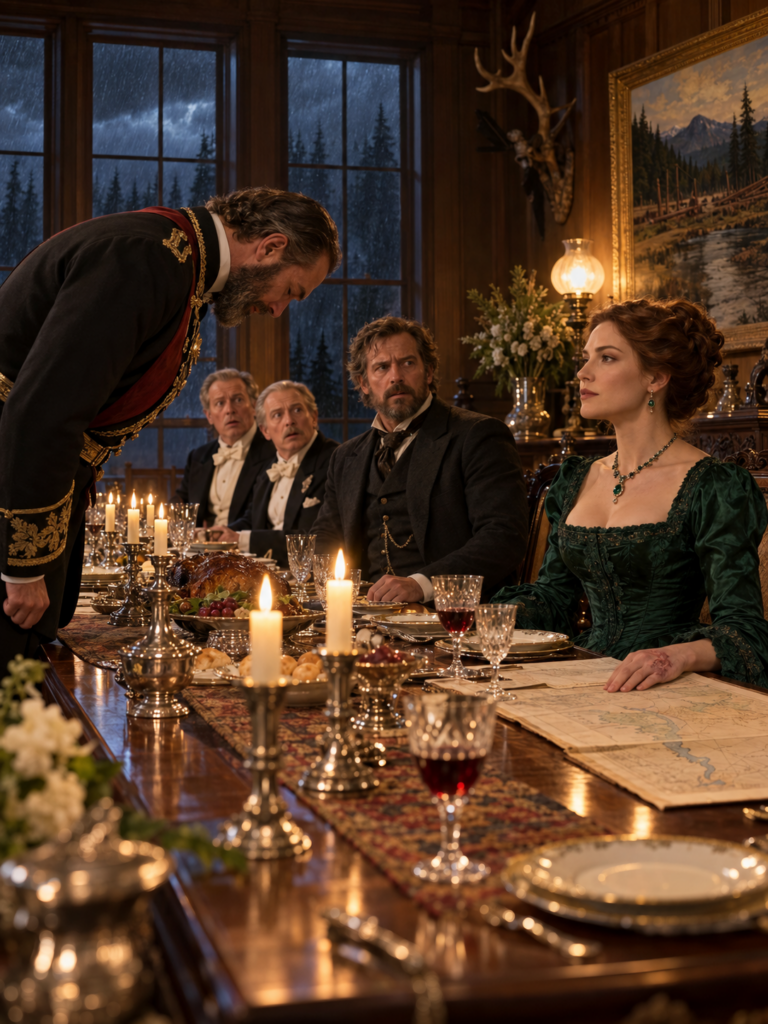
Nora placed her bare, scarred hand on the map and drew one finger along the river.
“My father is dead.”
Leonid’s expression changed.
“I am sorry.”
“He died in the Cascades three winters ago.”
Gareth stared.
Three winters.
Before the village.
Before the stale loaf.
Before him.
Leonid remained standing.
“We heard he disappeared from Europe after the accusations.”
“He was meant to disappear.”
Harrington recovered enough to sneer.
“What accusations?”
Nora looked at him once.
“Those manufactured by men who benefited from his silence.”
Beatrice shifted uncomfortably.
Gareth felt anger rise—not at the dead men Nora described, but at the realization that he had known nothing of this because he had never thought to ask.
He had provided a house.
Clothing.
Servants.
Food.
He had congratulated himself on generosity while showing almost no curiosity about the person receiving it.
Leonid returned to the table.
“Your river proposal.”
Nora nodded.
“The autumn rains raise the Cowlitz enough for shallow scows. Not ocean vessels. Timber carriers. Float the milled wood downriver, transfer near the Columbia, then load your chartered ships below.”
Harrington laughed too quickly.
“With what scows? Langdale owns forests, not a river fleet.”
“We build them.”
Gareth finally found his voice.
“In six weeks?”
“Five if the mills work two shifts.”
“You calculated this?”
Nora looked at him.
“I calculated three versions.”
Silence.
Leonid sat.
“Show me.”
Nora removed the second glove.
Then she drew Gareth’s papers toward herself.
What followed was not performance.
That made it worse for Gareth.
She knew his mill capacity.
His payroll.
The distance between camps.
The price of iron fittings.
The number of men who could be reassigned after seasonal work ended.
She even knew which bridge below the logging road could not bear loaded wagons.
Harrington’s face grew paler with every answer.
Then he tried another attack.
“Even if Langdale can build the scows, he lacks financing.”
Nora turned toward him.
“You require this contract more than my husband does.”
Harrington went still.
She continued.
“Two of your coastal vessels were lost last winter. Your creditors extended terms because you promised new northern freight.”
His hand flattened against the table.
“That is private.”
“So are many things people discuss when they believe a quiet woman cannot understand them.”
Gareth felt the remark strike exactly where it belonged.
Harrington pointed toward him.
“Are you going to permit this?”
Gareth looked at Nora.
Six months of silence.
Six months of lowered eyes.
Six months during which he had assumed absence where there had actually been observation.
He had invited her to be mocked.
Now she was preserving the livelihoods of men who would never know she had done it.
“Permit what?” Gareth asked.
“This humiliation.”
Nora’s expression changed slightly.
Gareth recognized the irony before Harrington did.
He almost laughed.
Leonid did.
A deep bark that startled the servants.
Then he produced the contract case he had brought with him.
“The river plan interests me.”
He pushed the papers toward Nora.
“Review the delivery clauses.”
Harrington half rose.
Leonid did not look at him.
“Sit.”
He did.
Nora read.
She found one weather penalty and crossed her nail beneath it.
“This must change. We guarantee proper preparation and departure. We do not guarantee the river against Providence.”
Leonid considered.
Then nodded.
“Agreed.”
The amended contract went to Gareth.
He held the pen but looked at Nora.
“Is it sound?”
Her eyes met his.
“Yes.”
He signed.
Leonid signed beneath him.
The timber sale was secured.
The room should have felt victorious.
Instead Gareth felt exposed.
Later, after the Harringtons left and Leonid departed with the contract, Gareth remained beside the dying fire.
Nora stood at the far end of the table removing her gloves.
“Who are you?” he asked.
She looked tired.
Not mysterious.
Tired.
“Nora.”
“That is not an answer.”
“It is the only one you ever required.”
He took a step toward her.
She lifted one hand.
He stopped.
The boundary was small.
Absolute.
“You do not get to discover I am useful,” she said, “and decide that gives you a different wife.”
Gareth’s face burned.
“Nora—”
“You invited me here tonight so they could laugh at me.”
He could not deny it.
“Yes.”
“You married me partly to insult people you despised.”
His silence answered.
Her chin lifted.
“If we continue this marriage, Gareth, it will not be because I saved your timber contract.”
He stood several feet away, unable to hide behind anger.
“What would it be because of?”
Nora gathered the map from the table.
“Because you learn the difference between providing for a woman and knowing her.”
She turned toward the door.
Gareth did not stop her.
But before she reached it, he asked the question he should have asked six months earlier.
“What do you want?”
Nora’s hand rested on the brass handle.
She looked back.
“To stop surviving in rooms where I have to pretend to be less than I am.”
Then she opened the door and walked out, leaving Gareth alone beside the signed contract that had saved his estate and the marriage he had finally understood could still be lost.
Gareth remained beside the signed contract until the fire collapsed into red coals.
He did not follow Nora.
Six months earlier he would have.
He would have demanded explanations because he owned the house, carried the title to the property, paid every household account, and had mistaken those facts for the right to command whatever answer he wanted.
Tonight she had raised one hand.
He had stopped.
It was not much.
It was the first honest thing he had given her.
By dawn Gareth had spread every map of his northern holdings across the study.
Nora entered shortly after sunrise carrying one of his ledgers.
She wore plain dark wool rather than the emerald dinner gown. Her hair was pinned simply. Without silk gloves, the white scars across her hands remained visible.
She placed the ledger on the desk.
“We need iron.”
No greeting.
No apology.
Gareth looked up.
“For the scows.”
“For twenty if Leonid expects the first contracted shipment before the heavy winter weather.”
He gestured toward the chair opposite him.
Nora remained standing.
Gareth remembered her words.
He moved around the desk instead and took the other chair, leaving the larger working space to her.
She noticed.
Said nothing.
Then opened the ledger.
“Your local smith can handle brackets and smaller fittings. He cannot make enough chain. We should order from the foundry at the river works.”
“Higgins supplies my mill.”
“Higgins mixes poor iron.”
Gareth frowned.
“You know Higgins?”
“I know his chain failed on two commercial rafts last spring.”
“How?”
“I read the county notices.”
“When?”
“At night.”
“In my library.”
“Yes.”
Gareth rubbed a hand over his face.
For months he had thought Nora retreated there because books were quieter than people.
He had never considered that she was studying his business.
“Anything else I should know about my own operations?”
“A great deal.”
Despite himself, he laughed.
Nora’s mouth almost moved.
Almost.
They worked until noon.
She knew diplomacy better.
He knew timber.
She understood credit, transport, and how political men disguised self-interest as inevitability.
Gareth understood how many men could safely fall a stand of old growth in wet ground, how long green oak required at the mill, which foremen cheated measurements, and which crews would work through rain if paid fairly and fed properly.
For the first time, neither had to pretend the other was useless.
By evening the work plan was ready.
“We leave tomorrow,” Nora said.
“For the mountains?”
“The river route cannot be managed from Portland.”
Gareth leaned back.
“You want to go?”
She closed the ledger.
“I proposed the plan.”
“That was not my question.”
Nora studied him.
“Yes. I want to go.”
“Then we go.”
The journey east took several days.
Gareth rode most of the daylight beside the carriage.
When cold rain swept down from the Cascades, he finally climbed inside.
Nora sat opposite him wrapped in a fashionable traveling cloak entirely inadequate for mountain weather.
She was shivering.
Gareth removed his heavy lined coat.
“May I?”
The question surprised her.
She nodded.
He laid the coat over her shoulders without touching her more than necessary.
Warmth gathered around her.
“You remembered,” she said.
“What?”
“The difference between helping and deciding.”
Gareth looked toward the rain-streaked window.
“I am trying.”
“That is not the same as succeeding.”
“No.”
She tucked the coat closer.
“But it is better than not trying.”
The carriage rolled in silence.
After a while Gareth noticed Nora’s hands beneath the coat.
Uncovered.
Scarred.
He wanted to ask.
This time he did not command.
“What happened to them?”
Nora looked down.
“A hatchet slipped while I was cutting frozen pine.”
Another scar crossed her wrist.
“And that?”
“Kitchen grease. I washed dishes in a tavern.”
Gareth remembered Leonid bowing.
The diplomat’s daughter washing plates for coins.
Not because she lacked education.
Because knowledge had not prevented hunger.
Gareth understood why she had hidden.
“What happened to your father?”
She looked out into the rain.
For several miles he thought she would not answer.
Then she did.
“He advised governments until the wrong men decided his loyalty was inconvenient. Documents appeared. Charges followed. He knew they were preparing an arrest.”
“So he ran.”
“With me.”
“How old were you?”
“Old enough to understand we could not go back.”
Gareth waited.
No demands.
Nora continued.
“They expected him to seek protection in a capital. Instead he disappeared into the American West where nobody cared what languages he spoke if he could split wood.”
Her voice softened.
“He grew sick the second winter.”
Gareth said nothing.
“He taught me until he could no longer sit upright. Languages. Maps. Trade. Negotiation. He believed information was the only wealth men could not confiscate at a border.”
“And when he died?”
“I buried him where nobody watching the settlements would connect his death to me.”
Gareth’s hands clenched.
Not with possessiveness.
With anger at an image of Nora digging into cold earth alone.
“I stayed poor because poor women are ignored,” she said. “Being ignored kept me alive.”
“Until I arrived.”
“Yes.”
“And proposed marriage after knowing you less than a week.”
Nora looked at him.
“You were very strange.”
That surprised a laugh from him.
“You accepted.”
“You had food.”
The laughter vanished.
“And I gave you a reason to disappear behind a new name.”
“Yes.”
Gareth nodded slowly.
“Then I turned your hiding place into another cage.”
Nora’s gaze sharpened.
“You did not imprison me.”
“No.”
“That matters.”
“But I never made the house yours.”
“That also matters.”
He absorbed the correction.
When they reached Langdale’s northern property, work began immediately.
Riders went east with offers of wages.
Men came.
Not as desperate masses grateful for rescue, but workers evaluating whether Gareth’s pay justified abandoning temporary jobs elsewhere.
Nora insisted rates be posted clearly.
Gareth backed her.
Some foremen disliked receiving instructions from her.
One laughed openly when she rejected a shipment of chain.
“That iron held last season.”
“It also snapped twice,” Nora replied.
He glanced toward Gareth.
Gareth crossed his arms.
“Why are you looking at me? She asked you a question.”
The laughter stopped.
Nora examined every major purchase.
Gareth worked beside the logging crews and mill hands.
Not as theater.
He had always preferred labor to offices.
This time, however, he began carrying questions back to Nora instead of decisions.
How many men could they afford on the river crews?
How much reserve should remain for food and medical supplies?
Could they increase wages for the men taking the first dangerous downstream run?
They argued.
Frequently.
Nora wanted larger reserves.
Gareth wanted faster production.
He won some discussions.
She won others.
Both changed their minds when evidence required it.
That was new for Gareth.
For Nora too.
Late one night he found her asleep over shipping calculations in the temporary river office.
He stopped beside the table.
In the old version of himself, he might simply have lifted her and carried her home.
Instead he touched the tabletop hard enough to wake her without startling her.
“Nora.”
Her eyes opened.
“The load figures.”
“Finished.”
“I need to check—”
“You need sleep.”
She straightened.
“Is that an order?”
“No.”
Gareth pulled out the second chair.
“It is a request from a man who has watched you work eighteen hours.”
Nora stared at him.
Then rubbed both hands over her face.
“I hate when you improve your arguments.”
“I learned from a difficult woman.”
“That sounds dangerous.”
“It is.”
This time she smiled.
Fully.
The sight affected Gareth more than the ambassador’s bow had.
He looked away first.
The launch morning came beneath cold mist.
Twenty ugly timber scows sat along the river.
Nora stood above the bank with a watch and water marks taken from posts hammered into the mud.
Gareth waited beside the first line.
“Current is near its height!” she called. “Launch now!”
Blocks were knocked free.
The first scow slid into the river.
Then another.
Then another.
The seventh entered crooked.
Its stern swung sharply.
A mooring line snapped.
Men shouted.
Gareth lunged for the secondary chain before the loose scow could turn broadside.
The load jerked him forward.
His boots carved through mud.
“Secondary rope!” Nora shouted.
Gareth held while three men scrambled.
Then Nora was beside them.
Not because she needed rescuing.
Because she saw the solution.
She looped the heavy rope around a stone anchor and shouted for the crew to haul.
The rope tightened.
“Gareth!”
He looked at her.
“Release it!”
He let go.
The chain tore from his hands.
The scow swung once.
Then held.
Gareth fell backward into the mud.
For several seconds he only breathed.
Nora dropped beside him.
Blood showed through his torn glove.
“You idiot.”
“I agree.”
“You tried to hold a loaded scow.”
“I noticed.”
“You could have gone into the river.”
“Yes.”
She was shaking.
Gareth stopped smiling.
He understood the fear.
“I am here.”
Nora looked furious at the sentence.
Then relieved.
Then furious about being relieved.
Gareth slowly offered his injured hand.
She took it.
Together they stood.
The final scow entered the current before noon.
The timber went downriver.
Three days later a rider returned with confirmation.
The transfer had succeeded.
Leonid’s ships were taking the first load.
That night Nora cleaned Gareth’s torn palm beside the study fire.
He watched her tie the bandage.
“The estate is safe,” she said.
“For now.”
“The workers will have wages through winter.”
“Yes.”
“That matters more.”
Gareth looked at her bent head.
“Nora.”
She finished the knot.
“What?”
“When this contract is settled, you may choose what happens next.”
Her hands stilled.
“To the business?”
“To us.”
She looked up.
Gareth forced himself to continue.
“You married for safety. I married partly from spite. Neither is enough reason to demand the rest of a life.”
Nora said nothing.
“If you want money settled independently in your name, I will arrange it. If you want a house elsewhere, you may have one. If you want to stay here and work with me, I want that more than I can explain.”
His voice roughened.
“But I will not make necessity choose for you again.”
Nora stared at him for a long moment.
Then she placed the finished bandage gently across his palm.
“When the Russian payment clears,” she said, “we will settle your workers, your debts, and the winter stores.”
“And after that?”
“After that, Gareth, I will give you my answer.”
For once he did not press.
He only closed his injured hand carefully around the linen she had tied and waited for a choice he finally understood had to belong entirely to her.
The Russian payment arrived eleven days later.
Nora knew before Gareth did.
She was in the mill office when the rider brought the bank draft from Portland, still sealed in an oilskin packet against the rain.
She checked the amount twice.
Then carried it herself to Gareth.
He was outside the main saw shed with two foremen discussing winter cutting limits.
Nora waited until the conversation ended.
She did not interrupt.
That mattered because people had begun watching them.
Workers who once looked to Gareth for every answer now looked naturally toward whichever of the two held the better knowledge for the question being asked.
Timber?
Gareth.
River schedules?
Nora.
Wages?
Both.
Purchasing?
Usually Nora.
Logging safety?
Gareth and the foremen.
No decree had created the arrangement.
Work had.
Nora held up the oilskin.
“It cleared.”
Gareth exhaled.
The relief moved through his whole body.
“Leonid?”
“Paid in full.”
The workers nearest them heard.
A cheer began at one end of the yard and traveled through the mill.
Gareth looked toward the men.
For months he had feared telling them the truth about the estate because he believed authority required certainty.
Nora had taught him otherwise.
He climbed onto a timber block.
“The first Russian payment is in!”
Another cheer.
He raised one hand.
“Payroll gets settled first. Winter stores second. Mill repairs third.”
A man near the saw shed shouted, “And you, Mr. Langdale?”
Gareth grinned.
“I apparently require permission from my accountant.”
Laughter rolled across the yard.
Nora folded her arms.
“You cannot afford me.”
That produced more laughter.
Gareth climbed down.
He did not call her wife in front of them as though the relationship explained her authority.
He said simply, “Mrs. Langdale has the figures.”
And turned the meeting over to her.
Nora spent the afternoon settling obligations.
Every worker received promised wages.
Additional danger pay went to the first river crews.
Suppliers were paid.
Food contracts were secured.
A reserve remained large enough that one bad month would no longer destroy the operation.
Harrington’s shipping interests received nothing.
His threatened lawsuit never materialized.
Leonid’s contract had named Langdale’s independent transport directly, leaving Harrington no claim beyond wounded pride.
When the books finally balanced, Nora closed the ledger.
There was still money left.
Enough to begin paying down Gareth’s inherited debt.
Enough for repairs.
Enough for security.
For the first time since her father’s death, Nora could look at a column of figures and know that survival did not depend on tomorrow remaining merciful.
The realization frightened her.
She had learned hunger.
Cold.
Disguise.
Silence.
She had not learned abundance.
That evening she walked alone beyond the ranch buildings.
The first snow dusted the upper Cascades.
Below, the yard lamps shone warm through mist.
She heard Gareth before she saw him.
He deliberately stepped on loose gravel.
A warning.
Not an ambush.
He stopped several paces away.
“You said you would answer.”
“Yes.”
He waited.
Nora looked toward the mountains.
“When my father and I ran, he believed he would clear his name.”
Gareth listened.
“He kept copies of correspondence proving the charges against him had been arranged. He carried them through Europe, across the Atlantic, and into these mountains.”
“You still have them?”
“Yes.”
“Where?”
“In a locked trunk you have never opened.”
Gareth remembered the small trunk she had brought into their marriage.
“I thought it held clothing.”
“That was convenient.”
“Are you still in danger?”
“Perhaps not the way I once believed.”
She took a slow breath.
“My father died convinced men were searching for him. For years I behaved as though they were always one town behind me.”
“Were they?”
“I do not know.”
It was the first complete admission of uncertainty Gareth had ever heard from her.
Nora turned.
“I knew how to hide so well that eventually I stopped asking whether I still needed to.”
Gareth’s expression softened.
She continued before tenderness could make the words harder.
“When you found me, marriage seemed safer than movement. Your name was protection. Your house was protection.”
“And now?”
“Now I have money.”
He nodded.
“Work.”
“Yes.”
“A reputation that is entirely your own.”
Nora almost smiled.
“Leonid helped with that.”
“He worships you.”
“He respected my father.”
“He looks frightened of you.”
“That is not the same thing.”
Gareth laughed softly.
Then grew serious.
“So now you can leave.”
“Yes.”
The word hurt.
He did not hide that it hurt.
He also did not argue with it.
Nora watched him absorb the answer without reaching for her.
That mattered more than any speech.
“I could buy a house in Portland,” she said.
“Yes.”
“Travel east.”
“Yes.”
“Write to European contacts under my own name.”
“Yes.”
“You would help me obtain the documents?”
“If you asked.”
“And if I never came back?”
Gareth looked toward the mountains.
When he answered, his voice was low.
“I would hate it.”
Nora waited.
“But I would know you left because you could.”
Something in her chest loosened.
He had finally understood.
Freedom did not threaten love.
Without freedom, love could not be trusted.
Nora stepped closer.
“I do not want a house in Portland.”
Gareth looked at her.
“I do not want London society either, should we ever return east.”
“Good.”
“I have conditions.”
His mouth moved.
“Of course you do.”
“The business accounts are shared.”
“Yes.”
“I retain money independently.”
“Yes.”
“No correspondence of mine is opened.”
“Agreed.”
“My work is not treated as charming assistance from your wife.”
Gareth’s expression hardened.
“Anyone who says that may discuss it with you.”
“With me.”
“Yes.”
“Not after you threaten to throw him through a window.”
Gareth looked disappointed.
“That happened once.”
“Once was sufficient.”
He nodded.
“What else?”
Nora looked toward the ranch house.
“I want a study.”
“You already use mine.”
“I want my own.”
“Done.”
“A lock.”
“Done.”
“And a second key.”
Gareth paused.
“For me?”
“For the desk drawer containing business records we both need.”
He understood the distinction.
“Done.”
Nora let the silence remain.
Then Gareth asked the question.
“And the marriage?”
She looked up.
“I am staying.”
He closed his eyes for half a second.
Relief.
Raw and unmistakable.
Nora raised one finger.
“I did not say why.”
His eyes opened.
“No.”
“I am staying because I choose the work.”
He nodded.
“The land.”
Another nod.
“The life we are building.”
“Yes.”
“And because the man standing in front of me is no longer the man who invited his own wife to dinner so strangers could laugh at her.”
Gareth did not defend himself.
“I am ashamed of him.”
“You should be.”
“I am.”
Nora stepped within reach.
“But shame is useful only if it changes behavior.”
His voice dropped.
“I intend it to.”
She studied him.
Then held out her hand.
Not for protection.
Not because she needed help crossing mud.
Simply because she wanted contact.
Gareth took it carefully.
His thumb passed over the scar on her knuckle.
“You once told me I would never cut firewood again.”
“I remember.”
“That was foolish.”
“Yes.”
“If I want to cut wood, I will.”
“Yes.”
“If I want to wash a plate, I will.”
He smiled.
“Yes.”
“And if I do not?”
“I will wash it.”
Nora laughed.
The sound carried into the dark yard.
Gareth stared.
“What?”
“You look alarmed.”
“I have heard you laugh twice.”
“I may charge for the third.”
“Put it in the accounts.”
She shook her head.
Then she kissed him.
Not because he had rescued her.
Not because he owned the ranch.
Not because his name protected her.
Because when she had finally obtained the means to leave, he had opened the door instead of standing in it.
Gareth’s hands came to her waist and stopped.
Nora felt the hesitation.
Permission.
She stepped closer.
Only then did he hold her.
Winter settled over Langdale gradually.
The Russian contract expanded rather than collapsed.
The first timber shipment arrived as promised.
Leonid requested another.
Then another.
Nora refused exclusive terms.
When Gareth asked why, she showed him the clause.
“We do not exchange Harrington’s dependence for Leonid’s.”
Gareth read it twice.
“Keep three buyers.”
“At least.”
“Even if one pays better?”
“Especially then.”
He grinned.
“Yes, ma’am.”
The mill survived winter.
So did the surrounding farms.
Not because Nora had single-handedly saved everyone.
The workers cut the trees.
Sawyers milled them.
Carpenters built the scows.
River crews navigated them.
Women in nearby settlements took paid work sewing heavy canvas covers, preparing food, keeping supply accounts, and housing seasonal laborers.
Gareth’s role was real.
Nora’s was real.
So was everyone else’s.
By spring the estate no longer resembled the desperate operation Leonid had first been invited to finance.
Nor did the marriage resemble the one Gareth had arranged out of bitterness.
He began learning Russian.
Badly.
Nora discovered this one morning when she entered the breakfast room and found him muttering at a language book.
“What are you saying?”
Gareth looked offended.
“I intended to say the weather is improving.”
“You announced that the cabbage has betrayed your grandfather.”
He stared at the page.
“That explains the footman.”
Nora laughed so hard she had to sit down.
Gareth closed the book.
“You could teach me.”
“I could.”
“Will you?”
“Perhaps.”
“What does that depend on?”
“Your humility.”
“We may need another instructor.”
That afternoon she taught him anyway.
Months later they returned briefly to Portland for a commercial dinner.
This time Gareth asked whether Nora wished to attend.
“Yes.”
“Certain?”
“Yes.”
She chose her own gown.
Dark blue.
No severe hairstyle.
No gloves.
The scars remained visible.
When they entered, several people stared.
Beatrice Harrington was present.
Her brother was not.
She approached Gareth first.
“Mr. Langdale.”
Then Nora.
“Mrs. Langdale.”
Nora inclined her head.
Beatrice looked toward the scarred hand resting lightly on Nora’s fan.
“I owe you an apology.”
Nora waited.
“I treated you cruelly because I believed you powerless.”
“That is not an apology yet.”
Beatrice flushed.
“No.”
She tried again.
“I was cruel to you. I enjoyed believing myself above you. I was wrong.”
Nora studied her.
“Thank you for saying so.”
Beatrice seemed uncertain whether forgiveness had been granted.
It had not.
Neither had it been refused forever.
Nora no longer believed every account had to be closed the moment a debtor noticed it existed.
Across the room, a newly appointed trade representative from Europe recognized her father’s name.
He approached cautiously.
“Mrs. Langdale, may I ask whether you are related to Anton Varenko?”
Nora felt the old instinct.
Disappear.
Lower your eyes.
Become small.
Then Gareth moved beside her.
Not in front.
Beside.
Nora looked at the diplomat.
“I am his daughter.”
The words did not bring soldiers.
No one dragged her away.
The room remained standing.
Something inside her did too.
In the months that followed, Nora opened her father’s locked trunk.
Gareth was not present.
She had not invited him.
He respected that.
Inside were letters, maps, notebooks, and records of negotiations that had cost Anton his career and sent father and daughter into hiding.
Nora spent two days reading.
On the third, she carried one bundle into her private study.
Gareth was reviewing timber orders at the shared business desk outside.
“I am going to send copies east.”
He looked up.
“To clear his name?”
“To establish the truth.”
“Do you want help?”
“Yes.”
That was all.
He helped.
Not by taking charge.
By writing letters where his contacts mattered, paying couriers when Nora requested them, and refusing to answer questions that belonged to her.
Eventually replies came.
Some confirmed what Anton had claimed.
Others complicated it.
Her father had been brilliant.
He had also taken risks.
He had made enemies.
The complete history proved less perfect than the story grief had preserved.
Nora accepted that too.
Love did not require turning the dead into saints.
Years later, Anton Varenko’s papers would be cited by men studying negotiations he had once shaped.
That pleased Nora.
What pleased her more was the locked study at Langdale, where his maps rested beside her own river plans.
The room had two doors.
One opened toward the business office.
The other opened directly outside toward the mountain path.
Nora had designed it that way.
Gareth once asked why.
“So I never forget that I can leave.”
He was quiet.
Then he nodded.
“And you stay.”
“Yes.”
“Good design.”
Their marriage never became gentle in the dull sense.
They argued over freight rates.
Tree cutting.
Expansion.
Workers’ housing.
Whether Gareth truly needed another horse.
He claimed he did.
Nora proved mathematically that he did not.
He bought the horse anyway with his own money.
She charged him stable costs.
But neither returned to the first mistake.
Gareth never again mistook shelter for intimacy.
Nora never again mistook invisibility for safety when other choices existed.
He learned that strength could make room.
She learned that being seen did not always end in danger.
The business grew.
So did the settlements around it.
Their shared table accumulated maps, contracts, muddy gloves, language books, timber samples, and two cups of coffee placed close enough to suggest that work and affection had stopped needing separate rooms.
One autumn evening, years after the dinner that changed everything, Ambassador Leonid returned west.
He was older.
Grayer.
Still formidable.
Gareth invited him to supper.
Nora approved the guest list.
The table was smaller than the famous Portland dinner.
No Harringtons.
No audience waiting for humiliation.
Just Leonid, two river captains, a mill foreman and his wife, Gareth, and Nora.
During the meal Leonid turned to Gareth.
In Russian, he asked whether Gareth had finally learned the language.
Gareth sat straighter.
He answered.
Leonid froze.
Nora closed her eyes.
The mill foreman looked concerned.
“What did he say?”
Nora pressed two fingers against her mouth.
Leonid began laughing.
Gareth scowled.
“I said the timber market is strong.”
Nora recovered enough to translate.
“You said my uncle is a courageous potato.”
Gareth stared into his plate.
“I remain a man of practical talents.”
“Yes,” Nora said.
Leonid raised his glass.
“To practical talents.”
They drank.
Later, after the guests left, Nora found Gareth on the porch looking toward the black outline of the timbered hills.
She stood beside him.
He took her hand.
Not because she needed leading.
Because years earlier, she had offered it.
The gesture had stayed.
Below them, the river carried another shipment west.
Above them, the mountains that had once hidden Nora now formed the boundary of a home she had freely chosen.
Gareth looked toward the lighted windows of her private study.
“Do you ever think about leaving?”
“Yes.”
He glanced at her.
She smiled.
“I told you I wanted the door.”
“You did.”
“I did not say I wanted to use it.”
His thumb moved over the old scar on her knuckle.
Inside the house, her father’s maps rested beside Langdale ledgers and shipping schedules marked in Nora’s hand.
Once, she had survived by ensuring nobody saw what she knew.
Once, Gareth had believed providing a roof entitled him to understand nothing beneath it.
Neither person remained.
He had changed because losing her had become possible.
She had stayed because leaving had become possible.
And that was the difference upon which everything they built afterward depended.

