
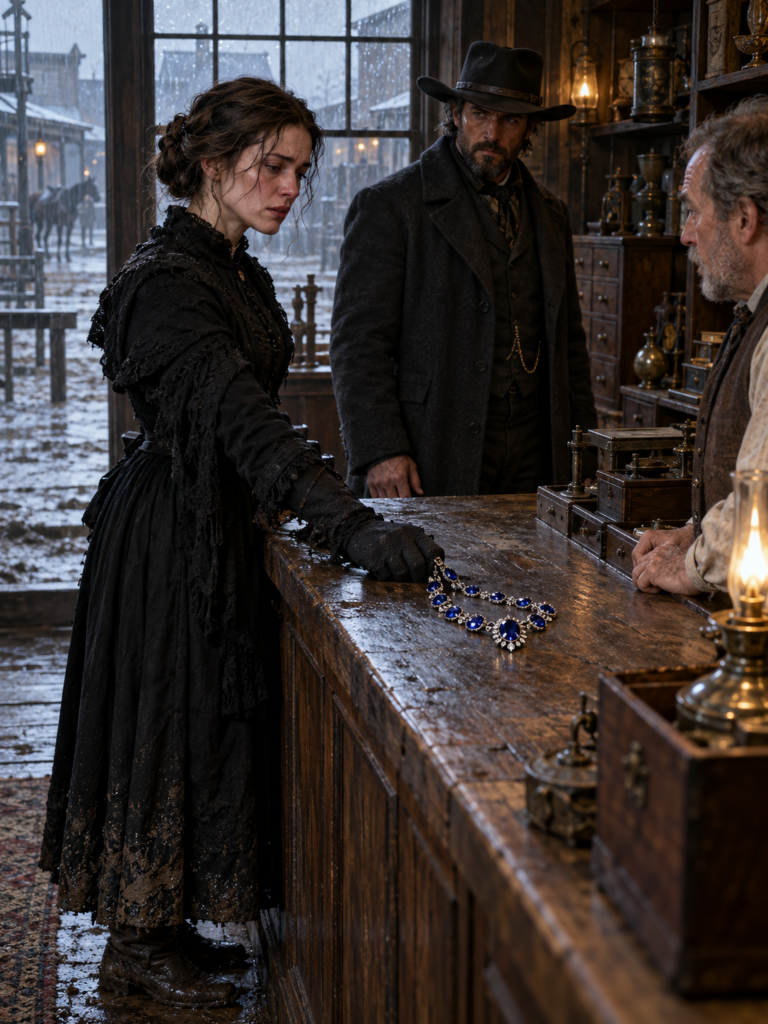
Beatrice had agreed to become his wife, and Roman spent the next morning proving that her agreement did not mean surrender.
His attorney brought the settlement papers before noon.
Beatrice read every line.
Roman waited.
At the clause granting him control over household expenditures, she stopped.
“This changes.”
The attorney glanced at Roman.
Roman said, “Change it.”
Beatrice looked up.
“You did not even ask why.”
“If you are responsible for managing the household, you require authority to do it.”
“And my personal allowance?”
“Yours.”
“No accounting to you?”
“None.”
She studied him.
“If I leave?”
Roman’s chest tightened.
The attorney shifted uncomfortably.
Roman answered anyway.
“The settlement remains sufficient for you to live independently.”
Beatrice lowered the document.
“So I could marry you, allow you to clear Thomas’s creditors, and leave?”
“Yes.”
“Why would you permit that?”
Because otherwise your choice would not be real.
Roman kept the thought to himself.
“Because I am offering marriage, not purchasing a prisoner.”
Something in her expression softened.
Only slightly.
She signed.
They married quietly two days later.
Fourteen minutes in a small church.
No crowd.
No celebration.
Beatrice wore the same repaired mourning dress she had nearly worn to the pawn counter.
Roman wore black.
When the minister finished, Roman did not kiss her.
He offered his arm.
She took it.
At the townhouse, heat poured from every grate.
Beatrice stood before the bedroom fire that afternoon as if she did not trust warmth to remain once she turned her back.
Roman found her there.
A dressmaker waited downstairs.
“I don’t need gowns.”
“You do.”
Her shoulders stiffened.
He corrected himself.
“The position does.”
She glanced at him.
“Position?”
“You agreed to host dinners and manage household appearances. Consider the clothing equipment.”
Beatrice’s mouth almost curved.
“A uniform?”
“If that makes you less likely to argue with me.”
“It does not.”
“But?”
“But it makes the expense comprehensible.”
He nodded toward the fire.
“Choose what you need. Nothing you do not.”
Roman turned to leave.
“Roman.”
He stopped.
Beatrice’s voice had changed.
“Thank you.”
He waited.
She touched the sleeve of her old dress.
“For the fire.”
Roman looked at the flames instead of her face.
“You will never be cold in any house of mine.”
Three weeks later, she discovered how seriously he meant his promises.
By then Beatrice had reorganized staff schedules, reduced waste in the kitchen accounts, corrected stable purchases, and learned the political and cattle-business alliances Roman maintained between Denver and his ranch.
They lived exactly as agreed.
Separate rooms.
Formal dinners.
Polite conversation.
No assumptions.
And yet Roman remembered how she took coffee.
Beatrice noticed he removed his boots outside the library whenever mud from the stockyards clung to them because she disliked dirty carpets.
He noticed she ate too little when anxious.
She noticed he hated society dinners but always spoke to nervous junior ranchers before powerful bankers.
Their marriage remained practical.
Their awareness of each other became anything but.
One night after midnight, Beatrice sat in Roman’s study auditing household books.
She reached for an unmarked black ledger.
Her own name appeared on the first page.
She froze.
Thomas’s creditors were listed one by one.
Paid.
Settled.
Investigated.
Predatory interest challenged.
Threats documented.
Finch’s pawnshop lease purchased by one of Roman’s companies after Finch tried to cheat her.
Then she turned a page.
A date appeared.
Ten years earlier.
Her wedding day.
Beneath it, in Roman’s handwriting, were four words.
I let her go.
Beatrice stopped breathing.
Behind her, the study door opened.
Roman stepped inside in shirtsleeves.
His eyes went instantly to the ledger beneath her hand.
Neither spoke.
Beatrice slowly stood.
“Tell me the truth.”
Roman remained by the door.
“You were auditing the wrong book.”
“Tell me why my wedding day is in your private ledger.”
His jaw tightened.
Beatrice came around the desk.
“Why did you follow every debt Thomas left? Why did you protect me from men I never told you had threatened me?”
Roman looked toward the rain-dark window.
“Because they were dangerous.”
“That is not an answer.”
“It is enough.”
“No.”
She set her palm on the ledger.
“You demanded honesty from every account in this house. I am demanding it from you.”
Roman’s composure finally cracked.
He turned toward her.
“Because I loved you before Thomas ever asked you to dance.”
Beatrice did not move.
Roman’s voice lowered.
“And because I never stopped.”
“And because I never stopped.”
The words seemed to remain between them after Roman finished speaking.
Beatrice stared at him across the lamplight.
Ten years.
She remembered Roman in her father’s parlor—quiet, uncomfortable among louder men, always appearing near the edge of rooms rather than their center.
Thomas had made everyone laugh.
Roman had listened.
At nineteen, she had mistaken one quality for emptiness and the other for depth.
“You watched me marry him.”
“Yes.”
“You never said anything.”
“You had chosen.”
“I was nineteen.”
“And still entitled to choose badly without another man deciding your choice did not count.”
Beatrice flinched.
That answer hurt because it contained no attempt to excuse him.
Roman continued.
“I thought Thomas made you happy.”
“He did. At first.”
Roman looked away.
Beatrice heard rain beating against the windows.
“Why the marriage bargain?”
He did not answer immediately.
“Because I knew if I paid the debts outright, you would spend the rest of your life believing you owed me.”
“And instead you invented work.”
“I needed help.”
“Did you?”
“Yes.”
She raised an eyebrow.
Roman almost smiled.
“Not six-thousand-dollars’ worth.”
“Ah.”
“I wanted you safe.”
“That is different from wanting me.”
His expression changed.
“I wanted both.”
The honesty left neither of them anywhere to hide.
Beatrice moved closer.
Roman stepped back.
She stopped.
“You are retreating.”
“I am giving you room.”
“Because you think I am grieving Thomas?”
Roman’s jaw hardened.
“You wore mourning into my house.”
“Society required it.”
“You kept his name.”
“The law required very little of my heart.”
Roman looked at her.
Beatrice drew a long breath.
“Thomas had mistresses.”
Roman went still.
“Several.”
She continued before he could interrupt.
“He gambled almost from the beginning. By our third year, creditors knew our front door better than my friends did. By the last three years, Thomas and I barely shared more than a surname.”
Roman’s face lost color.
“I did not know.”
“I worked very hard to ensure nobody knew.”
“Why?”
“Pride.”
She laughed once without humor.
“And fear. If people knew what the marriage was, then I had to admit I had chosen it.”
Roman’s hands tightened.
“Did he hurt you?”
“Not with his hands.”
The answer was enough.
Beatrice touched the edge of the desk.
“When they came to tell me his carriage had gone over a bridge, I did not weep.”
Roman waited.
“I felt relief.”
She closed her eyes.
“Then the creditors arrived the next morning, and relief became terror.”
Roman crossed half the distance between them, then stopped.
Beatrice noticed.
Always stopping.
Always waiting.
“I am not mourning Thomas,” she said. “I am mourning the years I spent reducing myself to survive him.”
Roman’s eyes closed briefly.
When he opened them, Beatrice stepped closer.
This time he remained where he was.
“You gave me safety,” she said.
“I gave you a bargain.”
“You gave me choices inside it.”
“Not enough.”
Beatrice looked around the study.
“Separate rooms.”
“You asked.”
“Control of money.”
“You required it.”
“The ability to leave.”
His voice roughened.
“You still have it.”
She touched the front of his shirt.
“And that is precisely why I do not want to.”
Roman stared down at her hand.
“Beatrice.”
“No.”
Her fingers closed lightly in the cloth.
“You have spent ten years deciding for me what would make me happy.”
“That is not what I—”
“You decided Thomas did. You decided silence was noble. You decided I needed a practical marriage instead of truth.”
Roman exhaled.
She was right.
Beatrice looked into his eyes.
“So I am deciding something now.”
He did not move.
She rose onto her toes and kissed him.
Roman’s first reaction was stillness.
Absolute stillness.
Then one hand settled carefully at her waist.
Not pulling.
Waiting.
Beatrice kissed him again.
Only then did Roman answer.
Nothing about it resembled the ownership their written marriage could have given him under law and custom.
It was voluntary.
Late.
Almost painfully so.
When they separated, Roman rested his forehead against hers.
“I do not know how to do this without frightening you.”
“Start by asking.”
“May I kiss you again?”
“Yes.”
So he did.
After that, Grosvenor House—as Denver society jokingly called Roman’s enormous stone townhouse because of his English mother’s influence on its architecture—began to change.
Not publicly.
Privately.
Beatrice moved her place at dinner from the distant opposite end of the table to the chair beside Roman.
He stopped sending notes through servants when a spoken question would do.
She began joining him in the ranch office when business brought him home late.
He asked before changing any arrangement they had made.
She stopped treating every kindness as a debt to repay.
Weeks passed.
The sapphire necklace returned to her dressing table.
Roman had never purchased it.
He had simply kept Finch from stealing it and carried it safely out of the shop.
One evening he placed the case before her.
“Yours.”
Beatrice touched the sapphires.
“Wear them tonight,” he said.
“Why?”
“Because you choose to.”
She smiled.
That evening, the Pendletons hosted a gathering bringing together stockmen, bankers, a state senator, railroad representatives, and Denver families accustomed to deciding who belonged among them.
Beatrice entered in deep green silk.
No one mistook her for a desperate widow.
She ran the evening with an ease Thomas had once mocked as unnecessary.
Roman watched from near the fireplace as she redirected a tedious railway argument, rescued a young ranch wife from a condescending banker, and prevented two cattlemen from reopening a dispute over fencing during supper.
Then a man Beatrice had not invited stepped into her path.
Calvin Kavanaugh.
Thomas had known him.
Too well.
Kavanaugh moved easily between respectable drawing rooms and gambling houses where respectable men preferred not to be seen.
“Mrs. Cole,” he said.
Beatrice’s spine stiffened.
“Mrs. Pendleton.”
His smile widened.
“My mistake.”
“What are you doing here?”
“Collecting.”
Her pulse changed.
“My late husband’s debts were settled.”
“Money debts.”
Kavanaugh reached inside his coat.
He withdrew a folded note.
He did not give it to her.
“Thomas became desperate near the end.”
Beatrice’s mouth went dry.
“He needed collateral for one final loan. So he produced a promissory note guaranteed by Roman’s uncle.”
“That is impossible.”
“Entirely.”
Kavanaugh smiled.
“The signature is forged.”
Beatrice heard the room around her but could no longer follow it.
Thomas had forged the name of the man whose estate Roman had inherited.
If exposed, the scandal would drag Beatrice back through every accusation she had escaped.
It could also damage Roman’s business dealings at a moment when eastern investors already questioned western cattle credit.
“What do you want?”
“Ten thousand dollars.”
She stared at him.
“Tomorrow evening.”
“That is absurd.”
“So is scandal.”
His gaze moved toward Roman.
“Do not tell your husband.”
Beatrice almost laughed.
Months earlier, the warning would have worked.
The woman living in that frozen room would have hidden the threat, sold the sapphires, borrowed money, and broken beneath the burden before admitting she needed help.
Kavanaugh leaned closer.
“If Pendleton threatens me, copies go to the papers.”
Beatrice looked across the room.
Roman caught her gaze.
He knew immediately something was wrong.
Kavanaugh followed her eyes.
“Think carefully.”
Beatrice set down her glass.
Then she walked directly across the room to Roman.
He broke off a conversation before she reached him.
“What happened?”
“My study,” she said.
He followed without question.
The door closed behind them.
Beatrice turned.
“Kavanaugh has a forged note Thomas made using your uncle’s name.”
Roman’s face became still.
“How much?”
“He wants ten thousand dollars.”
“What did he threaten?”
“Publication.”
Roman’s eyes darkened.
“He told me not to tell you.”
Beatrice folded her arms.
“That was his mistake.”
Something changed in Roman’s expression.
Not relief.
Respect.
“You came straight to me.”
“I told you I would no longer live by hiding damage until it buried me.”
Roman stepped closer.
“What do you want to do?”
Beatrice studied him.
He had not said what will I do.
He had asked her.
She answered slowly.
“We find out whether copies exist.”
Roman nodded.
“And we do not pay him.”
“Agreed.”
“And you do not break his neck.”
Roman looked disappointed.
“Beatrice.”
“No.”
“He threatened you.”
“He threatened us.”
Roman went quiet.
Us.
Beatrice held his gaze.
“We handle him together.”
For the first time since the pawnshop, Roman smiled without restraint.
Then he offered her his arm.
“Together.”
She took it.
They crossed the hall toward the library where Roman’s attorney and security man were already being summoned.
Behind them the party continued.
Ahead waited Thomas’s final shadow.
Beatrice tightened her hand on Roman’s sleeve.
And when the library door opened, she entered first.
Beatrice entered first.
Calvin Kavanaugh was brought in several minutes later under considerably less dramatic circumstances than Roman would have preferred.
Roman’s head of security, Graves, simply blocked the man’s path to the front door and informed him that the Duke—an old nickname Denver society had given Roman because of his family’s English connections and his severe manners—requested his presence in the library.
Kavanaugh entered smiling.
Then he saw Beatrice standing beside Roman’s attorney.
The smile faded.
“You told him.”
Beatrice remained by the desk.
“Yes.”
“I warned you not to.”
“You mistook fear for obedience.”
Kavanaugh’s gaze snapped toward Roman.
Roman stood near the fireplace with both hands clasped behind his back.
It took effort.
He wanted to put those hands around Kavanaugh’s throat.
Beatrice knew it.
He knew she knew it.
That was precisely why he kept them where they were.
Kavanaugh took out the folded note.
Roman’s attorney extended a hand.
“I will examine it.”
“No.”
Kavanaugh held it away.
“Money first.”
Beatrice spoke.
“No money.”
“You do not appear to understand your position.”
“I understand it better than you do.”
She walked toward him.
“Thomas forged that note.”
“Correct.”
“So your demand depends upon public belief that Roman concealed the forgery after marrying me.”
Kavanaugh smiled again.
“Very good.”
Beatrice continued.
“But you already attempted to collect on a document you knew was false.”
The smile faltered.
Roman’s attorney said calmly, “And you communicated a demand for money in exchange for suppressing evidence of that false instrument.”
Kavanaugh looked toward the door.
Graves remained there.
Not threatening him.
Simply preventing an easy escape from the conversation.
Roman finally spoke.
“Copies?”
Kavanaugh hesitated.
Roman’s voice stayed low.
“Do they exist?”
“One.”
“Where?”
Kavanaugh’s eyes narrowed.
“You cannot prove—”
Beatrice interrupted.
“You approached me inside a house filled with witnesses after entering without invitation. You named a price. You gave a deadline. You threatened publication if I told my husband.”
Kavanaugh’s confidence began to thin.
Beatrice stepped closer.
“You expected the same frightened widow Thomas left behind.”
She shook her head.
“That woman does not live here.”
Roman felt something almost fierce rise in his chest.
Not possession.
Pride.
Beatrice was not standing behind him.
She was not waiting for him to save her.
She was dismantling the threat herself.
Roman’s attorney reached again for the note.
This time Kavanaugh surrendered it.
The signature was poor.
Roman’s uncle’s real signature existed on dozens of estate documents.
Any competent examination would reveal the difference.
The attorney looked up.
“This would not survive scrutiny.”
“It does not have to,” Kavanaugh snapped. “Scandal only has to survive breakfast.”
Beatrice almost smiled.
“That was Thomas’s philosophy too.”
She turned to Roman.
“What happens if this becomes public?”
Roman answered honestly.
“Some newspapers will feast for several days. Investors may ask questions. Political allies will pretend outrage until something more entertaining happens.”
“And us?”
Roman looked directly at her.
“Nothing.”
Kavanaugh stared.
Roman continued.
“My wife did not forge anything.”
“No,” Kavanaugh said, “but she married the man who inherited the victim’s estate.”
Roman’s mouth hardened.
Beatrice touched his wrist.
A reminder.
No violence.
Roman exhaled once.
Then he looked at Kavanaugh.
“You overestimated the value of shame.”
Kavanaugh’s face changed.
Roman continued.
“I spent most of my life thinking reputation was power. Perhaps it is. But it is not worth paying a blackmailer.”
Beatrice took the forged note from the attorney.
For several seconds she looked at Thomas’s handwriting.
Her dead husband had reached into another life again.
Another lie.
Another debt.
Another secret Beatrice was supposed to carry.
Roman said nothing.
The decision was hers.
She folded the paper.
“Keep it.”
Kavanaugh blinked.
“What?”
Beatrice handed it back to the attorney.
“As evidence.”
Roman looked at her.
She understood the question.
Why not burn it?
Because destruction had been Thomas’s way.
Hide the bill.
Burn the letter.
Lie about the gambling.
Pretend there was no mistress.
Pretend the account would somehow settle itself.
Beatrice was finished with disappearing evidence.
“Document everything,” she said.
The attorney nodded.
Kavanaugh’s face paled.
Roman looked almost amused.
“You may go.”
Kavanaugh stared at him.
“That is all?”
“No.”
Roman stepped forward.
“If you publish the note, we will publish the full demand you made for money. If you attempt to collect on it, my attorney will challenge the instrument. If you threaten my wife again, every legitimate lender, stockman, hotelkeeper, and property owner with whom I conduct business will know exactly how you operate.”
Kavanaugh swallowed.
Roman stopped several feet away.
“You may discover that a man does not need violence to become unwelcome.”
Kavanaugh looked at Graves.
The security man opened the door.
Kavanaugh left.
No one followed him.
Silence settled over the library.
Beatrice stared at the closed door.
“It feels strange.”
“What does?”
“Not being afraid afterward.”
Roman turned toward her.
She looked at the forged note now sealed inside an evidence envelope.
“For years, every time Thomas made a mess, I thought the safest thing was to hide it before anyone saw.”
Roman came closer.
“You came to me tonight.”
“Yes.”
“You did not try to sell your necklace.”
She laughed softly.
“No.”
“Or secretly borrow ten thousand dollars.”
“I considered neither.”
“A remarkable improvement.”
Beatrice looked up at him.
“Do not sound so pleased with yourself.”
“I am pleased with you.”
The simple distinction silenced her.
Roman lifted one hand.
Stopped.
“May I?”
Beatrice nodded.
He touched her cheek.
Weeks earlier, in the pawnshop, Beatrice had been one unpaid bill away from losing her room.
Roman had intervened.
At the time she believed rescue meant dependence.
Tonight he had stood beside her while she chose how the threat would be answered.
That difference mattered more than the warmth of his hand.
“It is over,” she said.
“Thomas?”
“The part of him I kept carrying.”
Roman’s eyes searched hers.
Beatrice lowered her voice.
“I spent so long being ashamed that I chose him.”
“You were young.”
“I was still responsible for the choice.”
Roman nodded.
He did not tell her she had been foolish.
Did not erase her agency to spare her pain.
Beatrice continued.
“But being responsible for choosing badly did not make me responsible for everything he did afterward.”
“No.”
“I know that now.”
Roman leaned his forehead lightly against hers.
For several breaths they remained that way.
Then Beatrice pulled back.
“There is another matter.”
Roman looked wary.
“That tone has cost me money every time I have heard it.”
“Good.”
She crossed to the desk.
From a drawer she removed the original marriage settlement.
Roman’s suspicion deepened.
“What are you doing?”
“Renegotiating.”
“Already?”
“You should have married a less competent woman.”
“I tried avoiding marriage entirely. That was worse.”
Beatrice unfolded the pages.
“When we made this agreement, I was nearly homeless.”
Roman’s humor vanished.
“Yes.”
“That means some of my choices were free legally but not free practically.”
Roman stood very still.
Beatrice had thought about this for days.
“I do not regret marrying you.”
He exhaled.
“But I want to know what this marriage becomes now that I have money of my own, work of my own, and the ability to leave without freezing.”
Roman’s eyes darkened.
“Tell me.”
“I want a formal share of the household management compensation we agreed upon.”
“Done.”
“I want my personal funds transferred to an account requiring no approval from you.”
“Already arranged.”
She blinked.
“Roman.”
“You insisted on autonomy.”
“I enjoy occasionally asking for something before you provide it.”
“I will make an effort to be less efficient.”
“Thank you.”
He almost smiled.
Beatrice continued.
“I want responsibility for the Denver house and the entertaining budget because I am good at it, not because I am your wife.”
“Agreed.”
“And when we are at the ranch, I want something useful beyond arranging flowers for visitors.”
Roman’s eyebrows rose.
“What?”
“The accounts.”
“You want the ranch books?”
“I have seen your household purchasing records.”
“That bad?”
“Criminal.”
He looked offended.
“The cattle are healthy.”
“The numbers are not.”
Roman surrendered.
“Fine.”
“And one more condition.”
He waited.
“If this is to remain a marriage, it cannot remain a contract we hide behind whenever we are frightened.”
Roman looked down at the old settlement papers.
Then back at her.
“What replaces it?”
“Truth.”
He considered the word.
“That seems more difficult.”
“It will be.”
“And separate rooms?”
Beatrice’s expression changed.
“That clause may be reviewed.”
Roman laughed.
It was the first time she had ever heard the sound arrive without restraint.
Months passed.
Their life divided naturally between Denver and Pendleton Ranch.
The ranch lay far enough outside the city that society noise faded into wind, cattle, and cottonwoods along the creek.
There Beatrice learned another version of Roman.
The man Denver knew could freeze a banker with one look.
The man his ranch hands knew stopped to inspect a lame horse himself.
He remembered which cowhand’s mother was sick.
He knew every unreliable bridge on the northern grazing route.
He repaired tack badly.
Beatrice discovered this last fact within a week.
“You own three thousand head of cattle and cannot stitch leather straight.”
“I employ people.”
“Apparently for good reason.”
He discovered that Beatrice understood numbers faster than his bookkeeper and horses better than anyone had expected.
Thomas had once treated her competence as unfeminine.
Roman treated it as useful.
That difference quietly healed something no speech could have reached.
By spring, Beatrice was no longer managing Roman’s life to repay him.
She was building her own beside it.
She reorganized purchasing between the Denver house and ranch stores.
She created written wage schedules for household staff rather than leaving raises dependent on memory.
At the ranch, she separated horse-breeding expenses from general cattle costs so Roman could finally see which part of the operation actually earned what.
He objected for three days.
Then admitted she was right.
“You enjoyed that,” he said.
“Immensely.”
Their marriage changed through work as much as affection.
A second chair appeared beside Roman’s desk.
Not across from it.
Beside it.
At dinner, they discussed leases, guests, pasture rotation, politics, and which mare Beatrice wanted bred in spring.
Some nights they disagreed so sharply that servants avoided the hallway.
Other nights they sat without speaking.
The silence no longer meant distance.
One evening Roman found the sapphire necklace on Beatrice’s dressing table.
The same necklace that had nearly disappeared across Finch’s pawn counter.
She was fastening an ordinary silver chain instead.
“You are not wearing them?”
“Not tonight.”
“Why?”
“They used to mean my family’s security. Then they became rent.”
Roman picked up the case but did not touch the necklace.
“And now?”
Beatrice looked at him in the mirror.
“Now they are only sapphires.”
Roman smiled.
“That may be the healthiest thing anyone has ever said about jewelry.”
A year after the day he found her at Finch’s counter, they returned to Denver in November rain.
The old pawnshop was gone.
Finch had lost the lease after repeated complaints over predatory practices.
A respectable watchmaker now occupied the storefront.
Beatrice stopped beneath the awning.
Roman stood beside her.
“You planned this route.”
“No.”
“You are a terrible liar.”
“So I have been told.”
Rain struck the street.
Beatrice looked through the glass at polished watches where desperate people had once surrendered heirlooms.
“Do you still have Thomas’s debt ledger?”
“Yes.”
“Why?”
“Records.”
She nodded.
“Good.”
Roman watched her.
A year earlier he would have asked whether the memories hurt.
He had learned better.
Beatrice did not require him to interpret every silence.
After a moment she said, “I am glad you came into that shop.”
“So am I.”
“I am also glad you would have let me walk out.”
Roman understood.
The rescue mattered.
The freedom mattered more.
Beatrice slipped her hand into his.
“Do you remember what you said when I asked why you stopped Finch?”
“That he was robbing you.”
“After that.”
Roman thought.
“It was my concern?”
She smiled.
“Yes.”
“I was arrogant.”
“Very.”
“I apologize.”
“Accepted.”
They continued walking.
At the corner, Roman’s carriage waited.
Beatrice stopped before entering.
“There is something I have never asked.”
Roman held the door but did not hurry her.
“What?”
“If I had refused your proposal, what would you have done?”
Roman answered immediately.
“Paid your rent for a month.”
“And after?”
“Offered you work managing one of the houses.”
“You had that plan?”
“By the time we reached your room.”
She stared.
“You truly would not have forced the marriage.”
“No.”
“Even knowing you loved me?”
Roman’s expression softened.
“Especially then.”
Beatrice looked away because tears had risen unexpectedly.
Roman waited.
Ten years earlier, he had loved her and said nothing because she had chosen another man.
A year earlier, he had loved her and nearly hidden the truth again because debt narrowed her choices.
Now they stood together with no creditor behind her, no bargain between them, and no practical reason she could not leave.
Beatrice turned back.
“That is why I stayed.”
Roman’s throat moved.
She climbed into the carriage.
He joined her.
The sapphire necklace rested that night not around her throat but in a small wooden box in their bedroom.
Beside it lay their original marriage settlement.
Beatrice had kept that too.
Not because the contract still ruled them.
Because it proved how far they had come.
The first agreement had promised separate rooms, independent money, defined duties, and the right to leave.
Those things had protected her when trust did not yet exist.
Now trust had grown around them rather than replacing them.
Her money remained hers.
Her work remained respected.
Her authority in the household and ranch books was real.
Roman still asked before making choices that affected her.
And when they fought, neither used rescue, debt, title, money, or love as a weapon.
Years later, when someone asked Beatrice when she believed her marriage became real, she never named the wedding.
Not the first kiss.
Not the night Roman confessed he had loved her for ten years.
She named the evening Calvin Kavanaugh threatened them.
“The moment I walked across the room and told my husband the truth.”
Because that was when she stopped living as a woman trying to prevent disaster alone.
Roman answered the same question differently.
“For me?”
He would look toward Beatrice.
“The pawnshop.”
She always rolled her eyes.
“We were not married.”
“I know.”
“I did not even like you very much.”
“I know.”
“I thought you were controlling.”
“I was.”
She would smile despite herself.
“And yet you count that as the beginning?”
Roman always gave the same answer.
“No.”
He would take her hand.
“I count it as the moment I finally learned loving someone does not mean deciding what saves them.”
Then Beatrice would squeeze his fingers.
Because that was the truth beneath every other truth.
Roman had found her in a pawnshop believing money could solve the danger.
Beatrice had married him believing work could repay safety.
Both had been wrong.
Money cleared debts.
Contracts created boundaries.
Work rebuilt confidence.
But none of those things created love.
Love began only when rescue stopped being the story.
When Beatrice could walk away.
When Roman knew it.
And when, with the door open before her, she chose to stay.

