
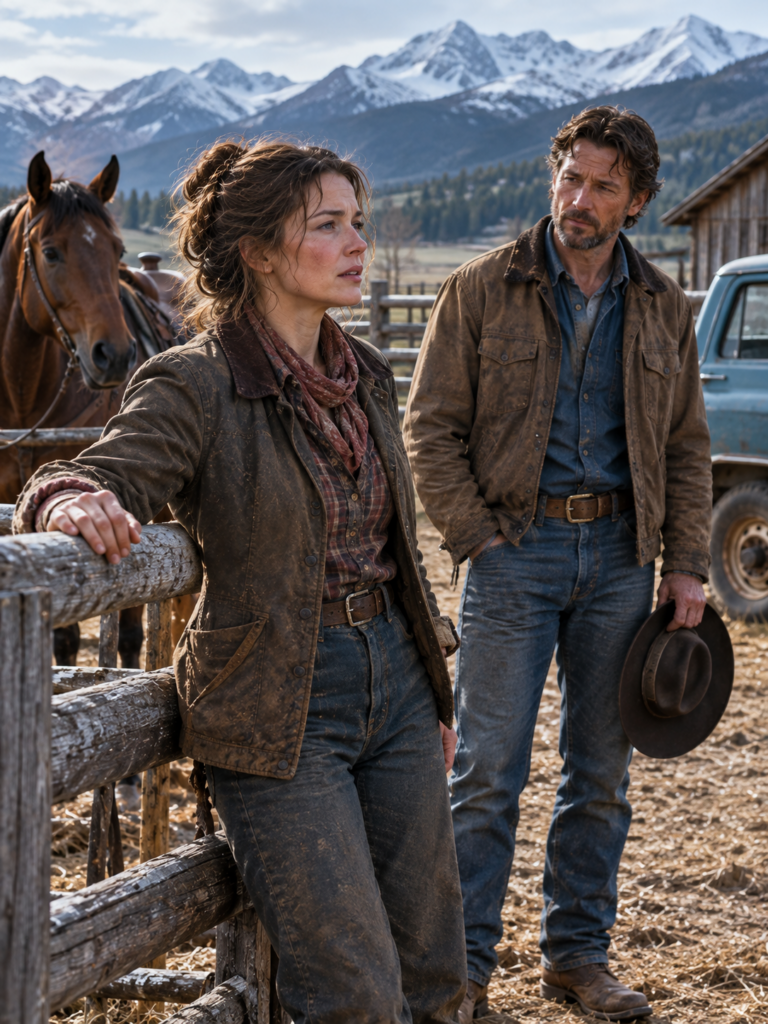
The pen had barely left the page when Maggie understood that the signature solved almost nothing.
It gave her a possible husband.
It also gave a stranger legal standing inside the most important fight of her life.
Nine days later, wearing a good wool coat over ranch clothes, Maggie stood beside Wade in the parlor of Justice Arlene Voss. Hollis Pike, who had worked for the Ellisons since Eisenhower, witnessed the ceremony. Ruthie Amos from the feed store cried with such conviction one might have thought Maggie had survived a great romance instead of negotiating one.
Wade brought exactly four things to Willow Creek afterward: a suitcase, a trunk, a saddle, and a coffee tin.
He moved into the east room.
Then he behaved in the most inconvenient way possible.
He kept every promise.
He knocked before entering Maggie’s kitchen.
He washed his own plate.
He never wandered upstairs.
He never opened a cabinet, changed a ranch procedure, repaired a hinge, or moved equipment without asking.
After two weeks Maggie finally snapped, “Wade, you live here.”
He was examining a crooked barn gate.
“This kitchen is yours.”
“The ranch needs that hinge fixed.”
“I know.”
“So fix it.”
He hesitated.
Maggie stared.
“Why do you keep asking?”
For the first time, the man who could stand quietly beside an uncatchable mare looked uncomfortable.
“Because it isn’t mine.”
The answer cooled her irritation.
Wade touched the hinge with two fingers.
“And if I start acting like it is,” he said, “someday I might forget.”
Maggie granted permission.
He rehung the gate before supper.
The next morning they moved cattle together.
Maggie rode ahead on Ledger while Wade worked the rear. At the summer pasture he dismounted and held a wire gate while she passed through, not because she needed him to, but because he happened to be there and she happened to be carrying the movement of ninety cattle in her head.
He shut it behind her and rode on.
The gesture should have meant nothing.
Instead, Maggie thought about it for the rest of the day.
Then the trustee’s letter arrived.
The scheduled inspection had been moved forward.
June twelfth.
Four weeks.
Someone operating neighboring property had submitted a written inquiry about Willow Creek’s compliance.
Maggie read the letter twice.
Wade read it once.
He did not curse.
He turned the envelope over and began writing.
At sunrise the next morning he rode every section of Willow Creek—owned ground, leased pasture, water sources, hay field, horse pasture, north fence, calving barn.
He returned after dark carrying eleven pages of notes and a hand-drawn map.
He spread them across the kitchen table.
“This is what I found.”
Maggie waited for the familiar sentence.
Here is what you need to do.
Wade did not say it.
He looked at her.
“What do we do about it?”
Something shifted.
Not ownership.
Not obedience.
Space.
Maggie pulled out the chair beside him.
They worked until midnight.
The Sentinel mares came first.
Older mares needed better feed. Younger easy keepers needed separation. Breeding records had grown difficult to follow during the years after Daniel’s death, so Maggie rebuilt twelve years of information into a ledger an inspector could understand quickly.
Wade repaired.
Maggie organized.
He worked Juniper twenty minutes every evening and never pushed for more.
By the second week the mare met him at the gate.
By the third she followed him.
Then came the old round pen, leaning badly enough that Maggie had considered it lost since 1979.
“I can save it,” Wade said.
“You can’t.”
“Give me two days.”
“Three,” Maggie said. “Because when you’re wrong, I want enough evidence to enjoy it.”
He smiled.
They jacked the structure upright, reset nine posts, repaired the damaged rails, and by the third evening Maggie stood inside a working pen her family had abandoned six years earlier.
She had to walk behind the barn alone afterward.
Not because Wade had saved it.
Because together they had.
That difference had begun to frighten her.
Then they reached the north windmill.
It had been dry for two years.
Four days, two parts trips, one improvised leather cup, and a miserable afternoon of hard wind later, the wheel finally turned.
Brown water coughed from the pipe.
Then rust-colored water.
Then cold, clear water poured into the empty stock tank.
Maggie put her hand into it.
Forty feet above her, Wade clung to the tower with a pipe wrench in one hand.
She looked up.
And for the first time, July frightened her for a reason that had nothing to do with losing the ranch.
Because their agreement ended when the ranch was safe.
And Wade Turner always kept agreements.
Because their agreement ended when the ranch was safe, Maggie began noticing every sign that Wade understood Willow Creek as temporary.
His saddle stayed ready.
His possessions still fit inside a trunk.
He never called anything his.
Not the room.
Not the barn.
Not the ranch.
Not even the blue coffee cup Maggie had begun setting out because it was the one his hand reached for every morning.
Yet his work was everywhere.
The repaired round pen stood straight.
Water ran again in the north pasture.
The mares improved.
When Hollis’s nephew asked Wade how to rotate the eastern grazing section, Wade pointed across the field toward Maggie.
“Ask her. It’s her lease.”
The boy blinked.
Wade went back to tightening wire.
Maggie heard the exchange from twenty feet away and said nothing.
She had spent four years meeting men who assumed a widow’s uncertainty was simply a vacancy waiting for male authority.
Wade kept giving authority back to her even when she was tired enough to hand it away.
That unsettled her almost as much as wanting him to stay.
On May twenty-eighth the mail brought a business envelope addressed to Wade.
He read it in the yard with his back toward the porch.
Then he folded it once and slipped it inside his canvas coat.
“We need those calves gathered before dark,” he said.
Nothing more.
Eight days later a hard Montana rain blew sideways across Willow Creek.
Wade’s coat was soaked.
Maggie took it from its peg to hang beside the stove.
The envelope fell onto the mudroom floor.
Cottonwood Land and Cattle.
East of Big Timber.
She should have put it back.
Instead, she read it.
Eleven thousand acres.
Foreman.
A salary high enough to make her fingers tighten.
A three-bedroom foreman’s house.
A truck.
Benefits.
A start date of August first.
They were willing to wait for Wade because a man who had worked beside him years earlier had told them he was worth waiting for.
Maggie replaced the letter exactly where she had found it.
Then she cooked supper with unsteady hands.
At the table she finally asked, “Did anything come in the mail lately that I need to know about?”
Wade met her eyes.
For a moment she watched a man who had sworn not to lie decide what truth required.
“Nothing about the ranch.”
That was all.
And later Maggie understood how painfully precise the answer had been.
The offer was about Wade.
It apparently had never occurred to him that Wade’s future might matter to her.
A week later Dale Kessler made his next move.
Hollis came racing up the lane shortly after six in the morning to report a backhoe and two survey men on the northern boundary.
Maggie drove there with Wade.
Kessler leaned against his green Ford holding a rolled survey as though he were offering neighborly assistance.
He claimed the old fence stood forty feet inside his property.
Maggie climbed out.
Wade stepped down on the passenger side.
Then he stayed beside the truck.
Kessler smiled.
“Just thought you’d appreciate knowing before we moved anything.”
“Dale,” Maggie said, “that fence has occupied the same line since 1954.”
“Surveys improve.”
“So does memory.”
His smile thinned.
Maggie pointed at the rolled document.
“The trustee’s map carries that line. Yours does too, if you unfold the bottom half.”
Kessler glanced toward Wade, perhaps expecting interruption.
Wade offered none.
Maggie continued.
“You’ve grazed cattle in this county forty years. Do you truly want Helena receiving photographs of your excavator disturbing leased ground six days before a compliance inspection?”
The pleasantness vanished from Kessler’s eyes.
The backhoe left twenty minutes later.
On the drive home Maggie said, “You didn’t say anything.”
“You didn’t need me to.”
“Most men would have.”
“Most men would’ve been wrong.”
The inspection began at nine on June twelfth.
Owen Farrow from the Helena trustees spent six hours walking Willow Creek.
He inspected water, fences, mares, ledgers, hay ground, the restored round pen, and the northern boundary.
Near the repaired windmill, he turned toward Wade.
“Mr. Turner, for the file, how would you describe your role here?”
Maggie stopped breathing.
This was the question.
The entire marriage had been created for a sentence like this.
All Wade had to say was that he ran the ranch.
The trustee could write it down.
Nobody present would contradict him.
Maggie realized, with shame, that she would even forgive him.
Wade removed his hat.
“Maggie runs Willow Creek,” he said. “She ran it before I came here, and she’ll run it after me.”
Farrow’s pencil paused.
“I’m here because she asked me to stand beside her.”
The windmill clicked overhead.
Maggie looked away before Wade could see her face.
Farrow wrote for several seconds.
Then he asked to see the hay field.
At supper he finally delivered his assessment.
The ranch operation itself was sound.
The family partnership requirement, in his view, was satisfied.
Two married adults lived there.
Both were responsible for the operation.
But Sentinel had separate maintenance conditions.
Six of them.
A second windmill.
A spring box.
Four-wire fencing along the northern boundary.
A calving shelter.
Records transferred into Sentinel’s preferred form.
Final signatures.
All by July first.
Nineteen days.
“And something else,” Farrow said.
Maggie’s relief vanished.
“Your neighbor has formally asked for the Sentinel grazing contract if Willow Creek fails renewal.”
Kessler had attached numbers.
He had also asked the trustees to determine whether Wade and Maggie’s shared residence was genuine.
Wade leaned back.
Maggie folded the list once.
“Nineteen days?”
Farrow nodded.
“Nineteen.”
They began before daylight the next morning.
The eastern windmill took five days.
The spring box, expected to require two, consumed four after they discovered collapsed tile beneath it.
Hollis and his nephew helped Wade string four wires along the northern boundary.
Maggie ran the stretcher.
At night she reformatted records.
Ruthie bullied suppliers.
The veterinarian provided updated horse reports.
Every task had a deadline.
Every meal became shorter.
Every private thought waited.
One afternoon Maggie carried cold chicken and bread to the spring where Wade had been working since dawn.
They ate beneath cottonwoods.
He watched her tear bread.
“You favor your right hand.”
Maggie looked up.
“What?”
“You’ve held a fencing hammer left-handed three days.”
She had jammed her right thumb in the stretcher and deliberately mentioned it to nobody.
“It’s fine.”
“I know.”
Wade leaned against the tree.
“I only wanted you to know somebody noticed.”
Maggie looked down at the bread in her hand.
Four years of keeping Willow Creek alive had taught her how easily competence could make a person invisible.
She had forgotten what it felt like to be seen without being judged incapable.
By June twenty-fifth, only six days remained.
That evening they sat exhausted on the porch steps.
Maggie finally asked the question she had avoided.
“Why didn’t you ever settle anywhere?”
Wade rotated his coffee cup.
“Nineteen years. Somebody must’ve asked you to stay.”
“They did.”
“Then why leave?”
He stared across the pasture.
“Because sooner or later every place reminded me it belonged to somebody else.”
Maggie followed his gaze toward Willow Creek—the rebuilt pen, the moving windmill, the barn, the green fields.
“And this place?”
Wade set his cup beside him.
“This one’s getting dangerous.”
“Why?”
He was silent long enough that Maggie heard the evening birds along the river.
Then he said, “Because I could get used to coming home.”
The words struck between them.
Maggie turned.
Wade raised one hand.
“Don’t.”
She stopped.
“Not tonight,” he said. “Not six days before that paper gets signed. Anything either of us says now, we’ll spend the rest of our lives wondering whether the deadline said it for us.”
Maggie wanted to argue.
Instead she remembered the yellow pad.
No promises we don’t mean.
“You’re right.”
“Don’t sound so disappointed.”
“Six days.”
“Six days.”
“And after?”
Wade looked out across the pasture.
“Afterward, there won’t be a contract forcing either one of us to say a word.”
The next morning a Buick from Big Timber came up the lane.
The man who stepped out carried a registered envelope from Dale Kessler’s attorney.
Nine carefully prepared pages challenged the legitimacy of Maggie and Wade’s arrangement.
The letter listed the marriage-license date.
Wade’s recent arrival.
His lack of previous family connection.
The fact that he originally came seeking wages.
And, in paragraph nine, the Cottonwood job offer beginning August first.
Maggie pushed the page toward Wade.
“He knows.”
Wade went still.
“I know about the letter too,” Maggie said.
His eyes lifted.
“It fell out of your coat three weeks ago. I read it. I put it back. I hated myself for reading it and hated myself for saying nothing.”
Wade sat.
“I was going to tell you when this was finished.”
“I know.”
“Maggie—”
“You thought the moment the trustee ruled, you were supposed to leave.”
He said nothing.
Her throat tightened.
“You planned your departure like an equipment receipt.”
“That’s how it’s always worked.”
“Well, it works badly.”
Maggie stood.
Then she did what she trusted herself to do when emotion threatened judgment.
She went to work.
By ten that morning she had spoken with Owen Farrow.
“Does a marriage entered for a practical reason count as a marriage under the agreement or not?”
Farrow answered carefully.
“The trustees have never judged why members of the Ellison family became family. We judge conduct. Who lives there? Who manages? Who carries responsibility?”
Then his tone softened.
“Answer paragraph nine plainly.”
So Maggie did.
They documented everything.
Wade’s nineteen-year employment history.
References.
His address change.
Work orders.
Repair invoices.
Sentinel records.
Hollis wrote a statement.
Ruthie wrote two pages and was persuaded not to write four.
The veterinarian described the improved horse condition.
Maggie answered paragraph nine herself:
Wade Turner had received an offer.
He had not accepted it.
He had spent the intervening weeks rebuilding Willow Creek.
If the trustees wished to know where Wade Turner presently lived, they were welcome to come see what his hands had built.
They mailed the response Friday, June twenty-eighth.
Monday, July first, at three in the afternoon, the kitchen telephone rang.
The kitchen telephone rang, and Maggie stared at it long enough for Wade to look up from the Sentinel ledger.
Neither moved on the first ring.
On the second, Maggie crossed the room.
“Willow Creek.”
Owen Farrow’s voice answered from Helena.
He did not make her wait through ceremony.
The Ellison trustees had accepted his field verification.
The resident-family partnership requirement was satisfied.
Sentinel’s six conditions had been completed.
The grazing and breeding arrangement would renew.
Kessler’s objection had been reviewed and rejected.
Willow Creek was secure.
For a moment Maggie heard only the faint hum of the line.
“Mrs. Ellison?”
“I’m here.”
“You’ve got your ranch.”
She thanked him.
Then she replaced the receiver.
Wade was standing now.
Maggie looked at him.
“It’s done.”
He released a breath.
Not a cheer.
Not a victory cry.
Only the exhausted breath of a man who had carried half a burden for eleven weeks and finally set it down.
Maggie laughed.
Wade did too.
Hollis, hearing the news later that afternoon, insisted the entire matter had been obvious from the start, which everyone ignored.
Ruthie drove out with pie.
The Sentinel representative confirmed the renewal.
By evening the kitchen table that had held contracts, accusations, maps, receipts, breeding records, and cold coffee finally held nothing more complicated than supper.
The deadline was over.
That was when Maggie discovered the deadline had been protecting her too.
For two months she had possessed an explanation for Wade’s presence.
He was there because the agreement required him.
He slept in the east room because they had negotiated it.
He repaired fences because she paid him.
He noticed her bruised thumb because he was observant.
He sat beside her on the porch because the evening happened to be pleasant.
Every dangerous feeling could be filed beneath necessity.
Now necessity was gone.
Wade remained.
On July second he repaired a section of irrigation gate no inspector had mentioned.
On July third he helped Maggie rework the autumn grazing plan.
On July fourth they ate sandwiches beside the river while Hollis complained that fireworks frightened cattle and people who enjoyed them probably deserved the consequences.
On July fifth Wade began setting posts for a new loading chute.
He did not ask permission first.
Maggie saw him through the kitchen window with a post-hole digger.
For several seconds she simply stood there.
The man who had once asked before changing a hinge was building something meant to serve Willow Creek for twenty years.
He stopped once, as though remembering.
His head turned toward the house.
Maggie raised her coffee cup.
Wade studied her.
Then he went back to digging.
She smiled.
The next morning Maggie drove to Big Timber alone.
She sat forty minutes in a lawyer’s office.
When she returned, three documents lay inside a brown envelope.
A mutual release ending every private obligation in the agreement she and Wade had created in April.
An accounting showing his full wages through July and the complete share she had promised him.
And a letter of recommendation.
The last document she had written herself at four in the morning.
It was the most difficult page.
Not because she struggled to find praise.
Because she had too much of it.
That evening she waited until after supper.
Wade knew something was coming.
He sat more carefully than usual.
Maggie put the brown envelope on the table.
“The trustee ruling is signed. Sentinel renewed. Kessler’s objection is closed. Nothing either one of us does now changes any of that.”
Wade looked at the envelope.
“This is a release.”
His eyes rose to hers.
“It terminates our April agreement effective today.”
He said nothing.
“There’s also your final accounting. Full wages through the end of July and your share, exactly as written.”
“Maggie.”
“And a recommendation.”
His jaw tightened.
She continued before courage failed.
“You have a foreman’s position at Cottonwood starting August first.”
“I haven’t accepted it.”
“I know.”
“Then why are we discussing it like I have?”
“Because you didn’t accept it for the wrong reason.”
Wade leaned back.
“Meaning?”
“You signed something in April. And you would rather cut off your hand than leave before you’d done what you promised.”
“That seems dramatic.”
“You climbed two windmills.”
“Fair.”
Maggie slid the release toward him.
“You spent nineteen years working land that always belonged to somebody else. Cottonwood is offering you a house. A salary. Responsibility that’s yours. Three bedrooms with your name attached to them. Nobody’s son coming home from college can suddenly turn it back into somebody else’s place.”
Wade’s expression changed.
Maggie forced herself to continue.
“I asked you for a husband on paper. You gave me exactly that and more than I had any right to expect. Willow Creek is safe now. So I will not use the fact that we happen to be legally married to keep you here.”
“You think that’s what you’re doing?”
“I think I don’t know.”
“Maggie—”
“No.”
Her voice shook.
She steadied it.
“This part is mine.”
Wade became still.
Maggie understood suddenly why Juniper had watched him from the corner of that corral.
There were moments when the right to choose mattered more than the thing being chosen.
“You taught me something the first day you came here,” Maggie said. “Maybe you didn’t mean to. Choice only counts if leaving is real.”
Wade’s eyes lowered.
She touched the envelope.
“So I’m making it real.”
“You want me to go.”
The sentence nearly broke her.
“I want you free to.”
“That isn’t the same thing.”
“No.”
“What do you want?”
Maggie had imagined this question.
In every imagined version she answered clearly.
Standing in her kitchen, she could not.
The clock ticked above the stove.
Finally she said, “I don’t want my answer deciding yours.”
Wade rubbed one thumb over the edge of the envelope.
“That sounds like something I’d say.”
“I’ve spent eleven weeks around you. It was bound to happen.”
A faint smile passed between them.
Then vanished.
Wade stood.
“Do you want me to sign it?”
Maggie’s throat tightened.
“Yes.”
He looked at her for several seconds.
Then he signed.
The April agreement ended.
Maggie had thought the act would feel honorable.
It felt like being cut open cleanly.
Wade picked up the recommendation.
He read it.
Once.
Then again.
His eyes remained on the page.
“This is a dangerous letter.”
“Why?”
“Somebody might believe it.”
“They’d be right.”
He folded it carefully.
That night Maggie heard him moving in the east bedroom.
Drawers opened.
The trunk lid closed.
Boots crossed the floor.
She remained in her room.
The agreement was over.
He was free.
She would not turn freedom into another kind of pressure by making him comfort her through it.
Before daylight, an engine started in the yard.
Maggie rose and went to the window.
Wade’s truck was loaded.
Suitcase.
Trunk.
Saddle.
Coffee tin.
Everything he had brought to Willow Creek.
Everything he owned.
The truck backed toward the road.
Maggie gripped the window frame.
She did not run after him.
She had promised herself she would let him choose.
The pickup reached the level of the house.
Stopped.
The engine shut off.
Maggie stared.
Wade climbed out.
He walked around the hood.
Then he sat on the porch steps with his hat in his hands.
Maggie put on her wool jacket and went outside with her bootlaces still loose.
“You’re packed.”
“Yep.”
“Your whole life is in that truck.”
“Pretty much.”
He turned his hat once.
“That’s the problem.”
Maggie sat two feet away, the distance they had kept through dozens of evenings.
Wade looked toward the mares emerging through the early mist.
“I didn’t sleep.”
“Neither did I.”
“I read that release eleven times.”
“It’s a good document.”
“It is.”
He rubbed the brim of his hat.
“That bothered me.”
Maggie’s heart began beating harder.
“What’s wrong with it?”
“Nothing.”
“Then I’m confused.”
“So was I.”
He turned toward her.
“Every line of the paper we signed in April had a reason. The family clause. July first. The trustees. Sentinel. Your land.”
He paused.
“All of that is finished.”
“Yes.”
“You finished it.”
“We finished it.”
“Some of it.”
That almost-smile appeared.
“Which leaves the problem.”
“What problem?”
Wade stood.
He stepped into the gravel and removed his hat.
“The agreement you gave me ends something I don’t want ended.”
Maggie stopped breathing.
“I want it changed.”
“How?”
“No deadline.”
He looked directly at her.
“No trustee. No grazing contract. No sentence either one of us can point to later and say the paper was doing the talking.”
Maggie’s eyes burned.
Wade glanced once at the loaded truck.
“I packed that because you were right.”
“About what?”
“You had to know I could leave.”
His voice stayed quiet.
“I needed to know it too.”
The truck waited behind him with his entire portable life inside it.
Nineteen years of moving from ranch to ranch.
Nineteen years of leaving before someone else could remind him that home belonged to another family.
“I’m not trapped here, Maggie.”
“No.”
“Neither are you.”
“No.”
He drew one slow breath.
“We’re already legally married, so this is probably backwards.”
Despite herself, she laughed through the tears gathering in her eyes.
Wade continued.
“But I’m asking anyway.”
He held his hat against his leg.
“Maggie Ellison, will you marry me again?”
Her vision blurred.
“This time because you want me?”
“Yes.”
The answer came so quickly he blinked.
Maggie laughed, cried, and said it again.
“Yes.”
She crossed the gravel before he could move.
For eleven weeks Wade had been the one who waited for permission.
This time Maggie closed the distance.
She put both arms around him.
Wade held her carefully at first, almost cautiously, until she tightened her grip.
Then his arms closed around her.
Nothing about it felt like the marriage ceremony in April.
Nothing required it.
No trustee watched.
No neighbor threatened a boundary.
No contract depended on it.
No deadline remained.
The truck was packed.
The road was open.
And Wade stayed.
They held a second ceremony later that summer.
Not because Montana required one.
Because they did.
Ruthie brought jars of wildflowers and lined them along the porch rail.
Hollis gave Maggie away and performed the duty with so little dignity that Justice Arlene Voss threatened to remove him.
Owen Farrow drove from Helena on his own time.
Half the feed store appeared.
Every one of them claimed afterward that the romance had been obvious since March, when Wade still lived in Wyoming.
Maggie wore her mother’s dress.
Wade wore a new shirt and the same boots he had worn through spring mud, fence work, windmill repairs, and nineteen days of Sentinel requirements.
When Arlene asked whether they wished to say anything, Wade reached into his pocket.
He unfolded a yellow piece of paper.
Maggie recognized his square handwriting before he spoke.
No promises we don’t mean.
The words that had once protected two strangers from pretending had become the only vow worth repeating.
Wade refused the Cottonwood position with a short letter thanking them and saying he had found his place.
Not employment.
Place.
The distinction mattered.
Willow Creek did not suddenly become Wade’s because he married Maggie.
That would have violated the thing both of them had spent months learning.
Instead, partnership arrived in smaller evidence.
One autumn morning Wade moved equipment without asking whether he could use it.
Another day Maggie entered his east room to leave clean sheets and stopped in the doorway.
“Do I need permission?”
Wade considered the question solemnly.
“Probably.”
She threw the sheets at him.
By winter his trunk no longer remained packed.
His saddle had a permanent rack.
The coffee tin migrated into Maggie’s pantry.
The blue cup remained beside hers.
When they planned pasture rotation, they planned together.
When the ranch account needed a major expenditure, neither decided alone.
Maggie continued handling the breeding records because she was better at them.
Wade handled machinery repairs because he was better at those.
They disagreed about hay timing, a new horse purchase, fence posts, and whether Hollis should still be allowed near a ladder.
They never solved disagreement by deciding which spouse outranked the other.
The ranch itself changed slowly.
The round pen stayed in use.
Both windmills turned.
The spring box remained clear.
The loading chute Wade began in July stood for years.
And Juniper became one of the easiest mares on the property to handle.
Not because Wade broke her.
Because he never tried to.
Sometimes Maggie watched him at the gate while Juniper approached under her own power.
That first spring returned to her then.
A stranger with an empty hand.
A frightened mare being given room.
A widow standing behind the fence, not yet understanding that she was watching the shape her own future would take.
Dale Kessler never acquired Willow Creek.
He remained their neighbor, which meant life required the less dramatic discipline of dealing with him rather than defeating him forever. Boundary questions were documented. Business remained business. Maggie made certain every map, letter, and lease stayed exactly where she could find it.
Willow Creek remained an Ellison ranch.
But the meaning of family had changed.
For years after Daniel’s death, Maggie believed keeping the land was the same as keeping a life intact.
Daniel had been a good man.
She never rewrote that truth simply because Wade came later.
Grief was not a room another man needed to empty before moving in.
Wade never asked her to.
He did something harder.
He helped her discover that loving what had been did not forbid building what came next.
And Maggie gave Wade something no employer ever had.
Not merely land to work.
Not merely a bed beneath a roof.
A place where staying was not employment and leaving was not assumed.
Years later, Wade still occasionally asked before changing something substantial on the ranch.
Maggie still occasionally answered, “You live here.”
He would say, “I know.”
And both understood that those words meant something entirely different now.
One late summer evening, after the cattle had settled and the mountains had turned blue beyond the pasture, Maggie found Wade standing at the same corral where Juniper had first approached him.
The mare was older.
So were they.
The gate stood open.
Wade rested one hand on its top rail.
Maggie joined him.
“You remember what you told me here?”
“That you didn’t need another hired man?”
“After that.”
He thought.
“That Juniper wasn’t mean.”
“The other part.”
Wade glanced at her.
Maggie smiled.
“You said nobody had given her the choice to refuse.”
Understanding moved across his face.
“That was a long time ago.”
“No.”
Maggie looked toward the ranch.
The barn.
The windmill.
The house.
The porch where a fully loaded truck had once stopped before reaching the road.
“Not really.”
She slipped her hand into his.
“You gave me the same thing.”
Wade’s fingers closed around hers.
“So did you.”
The gate remained open beside them.
Neither needed to shut it.
They were home because either one could have walked through.
And neither did.


