
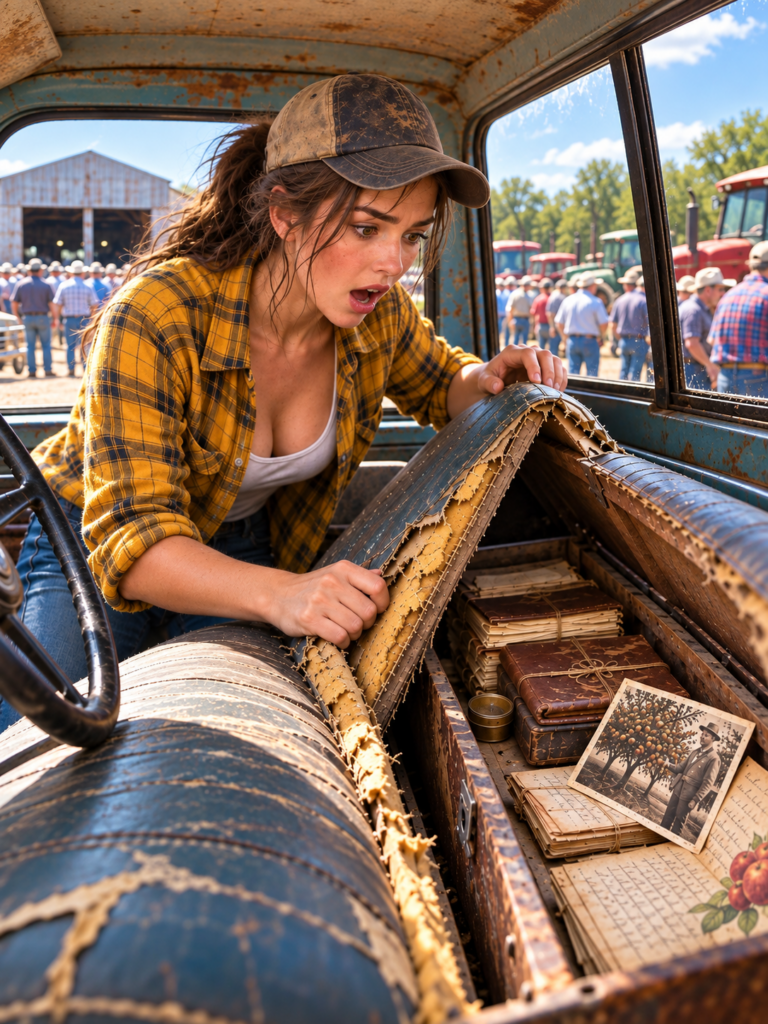
she bought a rusted farm truck for $920—then found the forgotten notebooks that could save a dying orchard and a family legacy
Part 1
The auctioneer’s gavel came down at nine hundred and twenty dollars, and Romy Dolan immediately wondered whether she had just made the most expensive mistake of her life.
The truck waiting in the gravel lot was a 1988 Ford F-250 with a cracked windshield, faded blue paint, rust eating through both rear wheel wells, and a bench seat that smelled as if thirty years of wet dogs, hay, diesel fuel, and old work clothes had been sealed inside it.
But the engine ran.
Mostly.
At twenty-five years old, Romy had learned that “mostly” was sometimes enough.
She stood beside the truck in a flannel shirt stained with coffee, tapping two fingers against her thumb the way she always did when she was calculating something she could not afford.
Nine hundred twenty dollars for the truck.
Four hundred eighty dollars remaining in checking.
Rent due in twelve days.
Six acres of neglected ground outside Ghent, New York, waiting for her to turn them into something resembling a farm.
She climbed into the cab.
“Please don’t die.”
The Ford coughed twice when she turned the key.
Then the diesel settled into a rough, determined rattle.
Romy laughed.
“All right. Same agreement for both of us.”
She had spent the previous five years in Albany working for a food distributor, a job respectable enough that her mother could describe it without sounding worried.
The pay had been good.
The office had been clean.
The work had made Romy miserable.
Most days consisted of watching buyers squeeze another few cents from small growers while executives talked about efficiency.
The final argument had come over a family orchard whose contract the company wanted to cancel after thirty years because a larger supplier could deliver cheaper apples.
Romy had objected.
Her supervisor had told her not to become sentimental.
She had resigned two weeks later.
Principle, she discovered, did not pay rent.
But she had used nearly every dollar of her savings for the down payment on six overgrown acres outside Ghent.
There was no proper farmhouse yet, just an old caretaker cottage needing more work than she could afford.
The land held weeds, scrub maple, two collapsing sheds, and precisely zero productive fruit trees.
Still, when Romy stood there in the mornings, she could breathe.
She planned to start small.
Vegetables first.
Maybe berries.
Eventually apples.
The problem was transportation.
Lime came in bags too heavy for her little sedan.
Fence posts did not fit inside it.
Neither did manure, lumber, irrigation pipe, or the hundred other things rural land required.
So she bought the Ford.
That evening she parked beneath a maple whose leaves had begun turning orange around the edges.
The truck ticked as it cooled.
Romy sat behind the wheel with both hands resting on it.
For the first time in months, she felt she had done something useful.
Then she remembered the spare keys the auction clerk had mentioned.
She searched the glove box.
Nothing.
Door pocket.
Nothing.
Finally she reached behind the bench seat.
Her fingers touched something soft.
Not keys.
She pulled harder.
A cracked leather folio slid free.
It had been wedged between the seatback and the metal frame so long that dust had formed around its outline.
A shoelace held it shut.
Romy turned on the cab light.
Inside were three notebooks.
The paper had yellowed to the color of weak tea.
Every page was filled with tight handwriting.
Dates.
Tree numbers.
Rows.
Grafting notes.
Bloom observations.
Rootstock percentages.
Disease records.
Weather.
Harvest weights.
Romy understood only pieces of it.
Then she found a section about cider.
Specific gravity.
Fermentation temperatures.
Blending ratios.
Near the bottom of one page, someone had written:
Patience is the whole of it. More than yeast. More than apples.
Between the final pages was a photograph.
A man stood beneath a huge apple tree.
He appeared to be in his fifties, wearing work pants and a white undershirt beneath suspenders.
The tree behind him sagged with dark red fruit.
Romy looked at the photograph.
“Who are you?”
Nobody answered.
By the following afternoon, half of Columbia County seemed ready to.
Small towns treated mystery as community property.
The auction clerk remembered the truck.
A waitress at a diner remembered the orchard.
An elderly customer two stools down remembered the man in the photograph.
“Ellis Faulk.”
Romy turned.
The old man stirred cream into his coffee.
“You know him?”
“Everybody who cared about apples did.”
He explained.
Ellis Faulk had run an orchard outside Ghent for roughly forty years.
Not big.
Not fancy.
But respected.
He had grown old varieties commercial orchards had abandoned.
One apple in particular had become locally famous.
People called it the Faulk Apple because Ellis had never bothered finding a more elegant name.
It was too tart for supermarkets.
Too irregular.
Too difficult to ship long distances.
But cider makers loved it.
So had Ellis.
“What happened?”
The old man shrugged.
“Age.”
Ellis’s knees failed first.
Then his hands.
His wife had already died.
Eventually he sold the orchard and moved into town.
The buyer lasted less than two years.
Equipment went to auction.
Land changed hands again.
“And the orchard?”
“Still there.”
“Who owns it?”
“Grandson.”
The waitress glanced over.
“Reed.”
The old customer’s expression shifted.
“Hard-headed boy.”
“Is it still producing?”
“Some.”
“Then why does everyone sound like it’s dead?”
The old man looked at her.
“Because sometimes dying takes years.”
That sentence stayed with Romy.
For three nights, she read Ellis Faulk’s notebooks at the kitchen table in her rented room.
She understood more every time.
This was not a diary.
It was a working life.
Forty years of mistakes had been written beside forty years of corrections.
A failed graft.
A successful one.
A dry spring.
Fire blight.
Early bloom.
Late frost.
Poor fruit set.
Excellent cider.
Sometimes Ellis had written only one sentence.
Sometimes half a page.
Romy began imagining the trees behind those numbers.
By the third night, she knew mailing the notebooks back would be the reasonable thing.
She also knew she would not do it.
The following morning she placed the folio on the passenger seat of the Ford and drove toward the Faulk orchard.
The road narrowed.
Pavement became gravel.
Gravel became dirt.
Then the orchard appeared.
Fifteen acres.
Maybe more.
At first glance it looked abandoned.
Tall grass.
Suckers around trunks.
Broken limbs.
Deadwood.
An equipment barn sagging slightly along one roofline.
But there were apples.
Not many.
Enough.
Romy parked.
A man stepped from the barn carrying a pruning saw.
He was about twenty-eight, broad-shouldered, dark-haired, and looked like someone who had already decided strangers usually meant trouble.
“You lost?”
“Probably.”
He did not smile.
“Can I help you?”
“Reed Faulk?”
“Yes.”
Romy lifted the folio.
“I found something that belongs to your family.”
His face changed.
Only slightly.
But enough.
She handed him the first notebook.
Reed opened it.
The guarded expression vanished for half a second.
Recognition.
Then pain.
Then suspicion returned twice as strong.
“Where did you get this?”
“Behind the seat of a truck.”
“What truck?”
“An old Ford I bought at auction.”
He stared at her.
She added, “Nine hundred twenty dollars, if that helps establish how glamorous this operation is.”
Nothing.
Reed turned another page.
“My grandfather wrote this.”
“I figured.”
He closed the book.
“So you drove here to give it back.”
“Yes.”
Romy hesitated.
“And maybe ask you something.”
There it was.
His shoulders tightened.
“I knew there was a second part.”
She frowned.
“What’s that supposed to mean?”
“People don’t usually drive out here because they want to return something without wanting something else.”
“That may say more about people you know than me.”
His eyes narrowed.
Romy pointed toward the orchard.
“I bought six acres a mile or two from here.”
“I know the place.”
“Then you know there’s nothing useful growing on it.”
“Pretty much.”
“I want to plant apples.”
Reed laughed once.
Not kindly.
“You picked a good place to ask for advice.”
Romy looked around at the neglected trees.
“Yes.”
That stopped him.
“I’ve been reading the notebooks,” she said. “I think there’s enough in there to help this place.”
“You think?”
“No. I know enough to know I don’t know enough.”
Reed glanced down.
Romy continued.
“I’m not asking for your orchard.”
“Good.”
“I don’t want your land.”
“Better.”
“I want to learn.”
His expression remained guarded.
“And what do I get?”
“The notebooks.”
“They’re already mine.”
“Then you get somebody stupid enough to help you use them.”
For several seconds neither spoke.
Wind moved through unpruned branches.
An apple dropped somewhere behind them.
Reed finally said, “I can’t pay you.”
“I didn’t ask.”
“You have farming experience?”
“Almost none.”
“That inspires confidence.”
“I can read, work, and admit when I screw up.”
“Two out of three would put you ahead of most people.”
Romy looked at him.
Almost a smile.
Almost.
Reed stepped toward the barn.
“Come on.”
That was how it began.
Not with romance.
Not with money.
Not even with trust.
With a dying orchard, three forgotten notebooks, and two people stubborn enough to believe that neglect was not the same thing as death.
Part 2
The first thing Romy learned about orchards was how long they remembered neglect.
You could mow tall grass in a day.
You could clear suckers in a week.
You could prune dead limbs before lunch.
But a tree recorded every bad season inside itself.
Disease.
Crowding.
Broken branches.
Weak growth.
Improper cuts.
Stress.
Reed taught her to look beyond leaves.
“See that?”
He pointed toward darkened bark on a branch union.
Romy squinted.
“Looks normal.”
“That’s why you’re dangerous.”
“Thank you.”
“Canker.”
He cut below it.
“What happens if you leave it?”
“It spreads.”
“To?”
“Everything you care about.”
Romy wrote that down.
Reed noticed.
“You writing down my insults too?”
“Those need their own notebook.”
They worked carefully through Ellis’s records.
Row numbers no longer matched obvious rows because sections had been cut down.
A stone wall mentioned repeatedly had collapsed beneath vines.
Some tree labels were gone.
But in the back of the second notebook, they found a hand-drawn map.
One mark appeared repeatedly.
MOTHER.
They followed compass notes from the old wall toward the southeast corner.
Wild raspberry covered part of the ground.
A black locust leaned over the area.
Then Reed stopped.
There it was.
One enormous tree.
Gnarled.
Silvered with lichen.
Half-choked by surrounding growth.
Still alive.
Dark red apples hung from several limbs.
Reed picked one.
Split it with his thumbnail.
Handed half to Romy.
She bit.
The first sensation was acid.
Her eyes watered.
Then came sweetness.
Not sugar.
Something darker.
Honey.
Mineral.
Spice.
She stared at the apple.
“What is that?”
“The Faulk.”
“This?”
“This.”
Reed looked toward the tree.
“Only one left.”
Romy thought she had misunderstood.
“One mature one?”
“One anywhere.”
He explained.
Every other grafted Faulk tree had been removed, lost, sold, or died during the years of decline.
Apple seeds did not reproduce a variety accurately.
A seed planted from a Faulk Apple might grow into something entirely different.
The variety survived because growers had once grafted living wood from one tree onto another root system.
Now this old tree contained the last known source.
“If it dies?”
Reed looked at her.
“That’s it.”
From that day forward, their work changed.
They were no longer merely restoring an orchard.
They were preserving something that could disappear.
Late winter brought their first grafting season.
Romy approached it with the enthusiasm of someone who had not yet learned how many ways precision could punish impatience.
She cut scion wood too thick.
Her cuts were uneven.
Cambium layers failed to align.
Thirty grafts.
Only two weakly leafed out.
Both died.
Romy stood over the failed row in June.
“I killed thirty trees.”
“They weren’t trees yet.”
“That is not comforting.”
Reed examined one failed union.
“You were rushing.”
“I know.”
“No, you know now.”
He pointed to the narrow layer beneath the bark.
“Cambium has to meet.”
“I lined them up.”
“You lined up the outside.”
“What’s the difference?”
“The difference is twenty-eight dead grafts.”
She glared at him.
He handed her the knife.
“Again.”
Their second attempt was slower.
Thinner scions.
Cleaner cuts.
Careful contact along one side.
Tight grafting tape.
Wax to prevent drying.
Eighteen grafts.
Twelve took.
Romy wrote 12/18 on her kitchen wall.
Underneath she added:
Slow is faster than doing it twice.
Reed saw it one morning when he brought coffee.
“That yours?”
“The first sentence.”
“The second sounds like my grandfather.”
“Then he owes me royalties.”
Summer brought another lesson.
Fire blight.
Romy first noticed curled leaves on a young shoot.
Reed’s face changed immediately.
“No.”
They followed the blackening down the branch.
Another tree showed symptoms.
Then another.
Warm rain had created ideal conditions.
Reed had been working evenings repairing tractors for a farm outside town because the orchard barely paid its taxes.
He had missed the earliest signs.
They cut hard.
Well below infected wood.
Disinfected tools.
Removed entire trees where necessary.
The sick wood was burned.
By August they had lost a row.
That night Romy found Reed sitting on the tailgate of her truck.
“You should go home,” he said.
“So should you.”
“I am home.”
That silenced her.
The farmhouse behind them was dark.
Reed had inherited it after Ellis sold the original operation and subsequent ownership eventually collapsed back into family hands through a complicated sale Reed rarely discussed.
Home, Romy realized, did not necessarily mean safety.
For Reed it meant obligation.
He had watched his grandfather build the orchard.
Then watched age dismantle it.
Then watched other people neglect it.
Now every dying tree felt personal.
Romy sat beside him.
“You think you’re failing him.”
Reed looked over.
“I didn’t say that.”
“You didn’t have to.”
“You’ve been here four months.”
“And?”
“And you don’t know me.”
Romy stared out at the rows.
“No. But I know guilt.”
Reed’s voice softened.
“From what?”
“My father wanted me to keep the Albany job.”
“You quit anyway.”
“Three weeks before he died.”
Reed looked at her.
She rarely talked about it.
Her father had not been cruel.
That almost made it worse.
He had been afraid for her.
“You finally have health insurance,” he had said.
“You finally have stability.”
Romy had heard accusation where there had mostly been fear.
Their last real conversation had become an argument.
He died from a heart attack three weeks later.
Nothing had been resolved.
“I spent a year wondering whether the last thing he thought about me was that I was irresponsible.”
Reed said quietly, “Was he right?”
“About the irresponsible part?”
“Yes.”
“Absolutely.”
Reed laughed.
Romy looked at him.
“But that doesn’t mean he wanted me miserable.”
They sat without speaking.
Then Reed said, “My grandfather never asked me to save this place.”
“No?”
“No. That’s the worst part.”
He looked toward the trees.
“I asked myself.”
Autumn brought fruit.
Not enough.
But enough to try cider.
They followed Ellis’s blending ratios as closely as they could.
Four hundred pounds of apples.
Pressed.
Collected.
Transferred into a food-grade barrel.
They congratulated themselves too early.
By November, Romy smelled the mistake before Reed said anything.
Sharp.
Acidic.
Wrong.
She leaned over the barrel.
“No.”
Reed tasted a drop.
His expression collapsed.
“Vinegar.”
They had allowed wild yeast and bacteria too much opportunity.
The barn was too warm.
The seal had not been tight enough.
They had read Ellis’s warning and underestimated it.
Keep it cold till it’s working proper, and keep air off it after.
Romy stared at the barrel.
“We knew.”
“We read.”
“That’s the same thing.”
“No,” Reed said. “Apparently it isn’t.”
He sat on an overturned crate.
For once there was no sarcasm.
No irritation.
Only exhaustion.
“My grandfather used to say an orchard doesn’t owe you anything for trying.”
Romy looked at him.
“He sounds cheerful.”
“It only pays out for getting it right.”
The ruined cider smelled like accusation.
They poured it away.
The first winter could have ended the experiment.
Instead, Romy drove Reed into town.
Ellis Faulk lived in a ground-floor apartment near the center of Ghent.
He was in his eighties now.
Thin.
Unsteady.
His hands trembled.
But when Reed placed the notebooks on his table, Ellis became completely still.
“Well,” he whispered.
He touched the leather folio.
“Where in hell were these?”
“Behind a truck seat.”
Ellis looked at Romy.
“You steal the truck?”
“Paid nine hundred twenty dollars.”
“Then somebody robbed you.”
For the first time, Reed laughed in front of his grandfather.
They stayed three hours.
Ellis answered questions.
Corrected notes.
Explained what he had assumed anyone reading them would already know.
Cultured yeast.
Temperature.
Specific gravity.
Air exclusion.
Patience.
He could no longer graft.
Could not climb ladders.
Could not run an orchard.
But his mind still held decades the notebooks did not.
When they prepared to leave, Ellis held Romy’s wrist.
“You like apples?”
“Yes.”
“No. Do you like the work?”
Romy thought about failed grafts.
Blight.
Mud.
Cold mornings.
Vinegar.
Reed swearing at broken equipment.
Her own six acres still mostly empty because every spare hour had gone here.
“Yes.”
Ellis nodded.
“Then you might last.”
On the drive back, Reed was quiet.
“What?” Romy asked.
“He likes you.”
“He barely knows me.”
“He doesn’t like anybody.”
“That explains you.”
Reed looked out the window.
Then, despite himself, smiled.
Somewhere during that winter, their partnership stopped feeling temporary.
Neither mentioned it.
There were chores instead.
Coffee left for the other.
Tools already sharpened.
Gloves drying beside the stove.
Reed steadying Romy’s hand during a graft.
Romy bringing him food when he worked through lunch.
There was also Pippen.
Pippen was an emu.
Nobody could adequately explain why the previous owner had bought him.
Reed had inherited the bird along with the property and lacked either the cruelty or motivation to sell him.
Pippen considered personal boundaries an insult.
He stole apples.
He chased wheelbarrows.
Once he grabbed Reed’s pruning saw and ran through three orchard rows while Romy followed laughing so hard she nearly fell.
“STOP ENCOURAGING HIM!”
“I’m not!”
“You’re laughing!”
“That’s not encouragement!”
“It is to him!”
Pippen looked over his shoulder, saw Reed gaining, and accelerated.
For several minutes, the dying orchard did not feel dying.
It felt alive.
Part 3
Their first real sale happened almost by accident.
A tiny experimental cider batch survived where the larger barrel had failed.
A neighbor smelled apples pressing, wandered into the barn, tasted a glass, and bought four bottles.
Forty dollars.
Romy held the bills.
Reed stared.
“He overpaid.”
“He paid what he thought it was worth.”
“He felt sorry for us.”
“Excellent. We’ll build the entire business around pity.”
Still, that evening Romy wrote another sentence on her kitchen wall:
People will pay for it if it’s real.
The next year tested whether she was right.
Twelve grafted Faulk trees entered their third leaf.
Old orchard rows were pruned aggressively.
Disease was monitored.
Sprays went on schedule.
They collected roughly eleven hundred pounds of fruit between the mother tree, surviving seedlings, and recovered older trees.
This time they treated fermentation like surgery.
Clean equipment.
Controlled temperature.
Cultured yeast.
Sealed vessels.
Specific gravity readings.
No shortcuts.
Weeks later, Reed pulled the first sample.
He smelled it.
Tasted.
His face changed.
“What?”
He poured Romy a little.
“Tell me.”
She tasted.
Dry.
Sharp.
Structured.
Long finish.
It was not sweet supermarket cider.
It tasted like an orchard.
Romy looked at him.
“Your grandfather?”
Reed nodded.
“Close.”
His voice broke slightly on the word.
They bottled 210 bottles.
That number seemed enormous until they began trying to sell them.
Romy’s old job had taught her one useful skill.
She knew buyers.
Not personally.
But she knew how they thought.
She made lists.
Farm-to-table restaurants.
Independent bottle shops.
Regional specialty stores.
Most ignored her.
A few declined politely.
One chef in Hudson named Saurin agreed to taste.
He poured the cider into a glass in his restaurant kitchen.
Swirled it.
Smelled it.
Tasted.
Then looked at Romy.
“What apple?”
“Faulk.”
“Never heard of it.”
“Almost nobody has.”
“Good.”
He bought a case.
A specialty buyer named Priya Alcott was more difficult.
Her bottle shop sat forty minutes south.
She tasted without speaking.
Reed shifted beside Romy.
Priya took another sip.
“How many cases can you commit for spring?”
Romy blinked.
“Depends.”
“On what?”
“Whether you’re asking because you’re curious or because you’re buying.”
Priya smiled.
“I’m buying.”
Eighteen dollars wholesale per bottle.
Romy nearly asked her to repeat it.
They sold everything they could spare.
It was not enough to live on.
Not close.
But when Reed entered the figure into the orchard ledger that evening, he said one word.
“Maybe.”
Romy looked up.
“What?”
“Maybe this place isn’t finished.”
She pretended not to notice how much it meant.
Their success remained fragile.
Reed still worked side jobs.
Romy planted part of her own six acres with rootstock and nursery trees.
Money disappeared into barrels, pruning equipment, rootstock, bottles, labels, disease management, fuel, insurance, repairs.
Every dollar had somewhere to go before it arrived.
Then spring came.
Rain.
Warmth.
Bloom.
And fire blight.
Reed found it in May.
Not on a young row.
On the mother tree.
He stood beneath it before dawn.
Romy knew something was wrong the moment she saw him.
“What?”
Reed pointed.
Black shoots curled at the crown.
She climbed closer.
More.
The infection had struck multiple points.
“No.”
Reed said nothing.
They began cutting.
Healthy margin below visible infection.
Tool sanitation.
Burn pile.
More cuts.
The old tree’s crown changed shape before noon.
For two seasons they had taken scion wood from it.
Thirty-one young trees were alive.
More grafts existed.
But none were mature enough to replace the mother source with complete confidence.
Every surviving Faulk Apple still traced back to this tree.
They worked until dark.
Four days later, the telephone rang.
The caller represented a regional cider company distributing across three states.
They had heard about the Faulk cider.
They had tasted a bottle.
They wanted a meeting.
Romy expected a wholesale conversation.
It was not.
The company wanted exclusivity.
Full rights to commercially propagate and market the Faulk Apple.
Romy and Reed would provide remaining genetic stock.
The company would establish contracted acreage elsewhere.
National distribution.
Professional marketing.
Reliable production.
And a payment.
Ninety-five thousand dollars.
Romy read the figure twice.
The orchard owed back taxes.
Equipment needed replacement.
The barn roof needed work.
Reed had debts.
Romy’s own farm barely survived.
Ninety-five thousand dollars could change everything.
There was one condition that mattered more than the rest.
A non-compete.
Romy and Reed would no longer commercially grow or sell the Faulk Apple independently.
The company would control it.
Romy sat with the contract for two days.
She did not accept.
She did not reject.
That uncertainty terrified Reed.
Fear, with Reed, rarely looked like fear.
It looked like anger.
He found Romy in the barn holding the offer letter.
Outside, blackened limbs from the mother tree still smoldered in the burn pile.
“You going to sign it?”
“I’m reading it.”
“You’ve been reading it for two days.”
“Yes.”
“How many times do you need?”
“As many as it takes.”
Reed laughed bitterly.
“Of course.”
Romy looked up.
“What does that mean?”
“Oldest story in the valley.”
“Which is?”
“Somebody comes in from outside. Finds something worth money. Walks away with it.”
Romy stared.
“Be careful.”
“You found those notebooks in a truck.”
“I returned them.”
“And now there’s ninety-five thousand dollars on the table.”
“Yes.”
“You didn’t grow up here.”
“No.”
“You didn’t watch this orchard disappear.”
“No.”
“You didn’t watch my grandfather get too old to climb his own ladders.”
“No.”
“So maybe this is numbers to you.”
Her face went still.
“That’s enough.”
“Is it?”
“You want to know what I think? Ask.”
“I’m asking.”
“No. You’re accusing.”
Reed’s voice rose.
“Then tell me you want to reject it.”
Romy opened her mouth.
Nothing came.
Not because she wanted to sell.
Because she had not finished deciding what responsibility required.
Ninety-five thousand dollars could protect the orchard physically.
A large company could preserve the variety.
Professional acreage could reduce risk.
Was refusing because of sentiment truly better?
Her hesitation lasted only seconds.
Reed saw betrayal.
His face closed.
Romy saw it happen.
And something in her closed too.
“You know what?” she said. “Go to hell.”
He walked away.
They did not speak for six days.
Six terrible days.
The mother tree continued deteriorating.
Romy worked at her own property.
Reed worked the orchard.
Neither called.
Neither apologized.
On the seventh morning, Romy woke before four.
She lay staring at the ceiling.
Then she understood.
The contract was not the immediate problem.
The mother tree was.
Everything else was pride.
She dressed.
Loaded her grafting equipment into the truck.
Packed a cooler with ice.
Drove to the orchard before sunrise.
The mother tree stood black against the gray sky.
Romy cut every usable length of healthy dormant-quality scion wood she could safely take from unaffected portions.
Piece after piece.
She labeled everything.
Wrapped it.
Kept it cool.
Then began grafting.
Rootstock waited in the nursery row.
Clean cut.
Match cambium.
Bind.
Seal.
Again.
Again.
Again.
By noon, her hands hurt.
By afternoon, she had stopped feeling two fingertips.
At dusk, forty-four new grafts stood in the row.
Reed found her kneeling in wet grass.
Tape stuck to her sleeve.
Wax covered one glove.
He looked at the grafts.
Then at the cooler.
Then toward the mother tree.
“You did all these?”
“Yes.”
“Today?”
“Yes.”
“Why?”
Romy sat back.
“Because while we were busy being idiots, the tree kept dying.”
Reed crouched across from her.
“You could’ve signed.”
“I could have.”
“They’d preserve it.”
“Probably.”
“On better land.”
“Probably.”
“With more money.”
“Yes.”
Reed looked toward the new grafts.
“Instead you did this.”
Romy’s exhaustion turned to anger again.
“I never wanted to sell your grandfather.”
Reed flinched.
“That isn’t what I—”
“It’s exactly what you accused me of.”
“I was scared.”
“So was I.”
Silence.
Romy looked at the rows.
“I was trying to decide whether protecting the variety mattered more than controlling it. That deserved thought.”
Reed nodded slowly.
“I know.”
“No, you know now.”
He almost smiled at the echo of his own words.
Romy continued.
“I wasn’t going to decide what this is worth without you.”
Reed sat in the wet grass.
For once, he stopped defending himself.
“My grandfather gave everything to this place.”
“I know.”
“I watched him lose the ability to keep it.”
Romy waited.
“If that company owns the apple, they’ll change the name eventually. Maybe not immediately. They’ll plant thousands somewhere else. Put some mountain or valley name on the bottle.”
“Maybe.”
“And we’ll have saved the genetics.”
He looked at her.
“But lost the story.”
That was the answer Romy had been trying to articulate.
She looked down the row.
Thirty-one earlier trees.
Forty-four new grafts.
Potential.
Not security yet.
But potential.
“Give me two years.”
Reed frowned.
“What?”
“Two years.”
“For what?”
“To make this work without them.”
“That’s insane.”
“We grafted seventy-five trees.”
“Some will fail.”
“Then we graft more.”
“We owe taxes.”
“We sell cider.”
“We don’t make enough.”
“Then we sell more cider.”
“You make everything sound simple.”
“No. I make it sound possible.”
Reed looked at her for a long moment.
“What if we go under?”
Romy held out her raw hands.
“Then at least we’ll know what killed us.”
Reed laughed quietly.
A tired laugh.
A surrender.
The following week they rejected the ninety-five-thousand-dollar offer.
Four drafts.
One short letter.
Polite.
Firm.
No bitterness.
No exclusivity.
The company wished them luck.
They would need it.
Part 4
Luck helped less than work.
The mother tree survived.
Barely.
Its crown looked uneven after the infected wood was removed, but by July green growth appeared beneath the cuts.
Romy found Reed staring upward.
“New shoots.”
“I see them.”
“She’s stubborn.”
“She’s a Faulk.”
Romy raised an eyebrow.
“That explains the disease.”
He looked at her.
Then took her hand.
No speech.
No apology repeated for the twentieth time.
Just his hand around hers on the porch step that evening.
They sat there while summer insects moved through the dark.
Romy leaned toward him.
Reed hesitated.
Then kissed her.
At that exact moment, Pippen made an enormous shrieking noise somewhere beside the barn.
Romy pulled away laughing.
Reed shouted into the darkness.
“I swear to God, bird!”
Pippen appeared from behind a barrel looking completely satisfied with himself.
Nothing changed overnight.
Everything changed gradually.
The following season, the first generation of grafted trees began bearing lightly.
Six hundred gallons of cider replaced the tiny early batches.
Priya made her order permanent.
Saurin put the cider on tap.
Another shop joined.
Then a restaurant.
Then another.
Romy handled sales and accounts.
Reed handled most orchard operations.
Both grafted.
Both pruned.
Both cleaned equipment.
Both hauled crates.
No task respected job titles during harvest.
Romy’s six acres became a nursery and satellite planting.
The land she had bought without knowing exactly what she would do with it now held young Faulk trees.
Reed stood among them one evening.
“You realize this means it isn’t just my orchard anymore.”
Romy looked up.
“Technically these acres are mine.”
“You know what I mean.”
She did.
The Faulk Apple no longer depended on one farm.
That was the point.
Preservation became safer when shared.
They visited Ellis regularly.
He had grown weaker.
But he still demanded samples.
“Too sweet,” he said of one batch.
Reed frowned.
“It finished dry.”
“Then your blend’s wrong.”
Another time:
“Too much acid.”
Romy protested.
“That’s the Faulk.”
“That’s bad blending hiding behind the Faulk.”
He was almost always right.
The notebooks lived on Romy’s kitchen table for a while.
Then Reed moved them to the farmhouse.
Romy quietly moved in not long after.
Neither held a formal discussion.
Her coffee appeared beside his.
Her boots appeared by the door.
Her clothes occupied half a drawer.
Then two.
One morning Reed asked, “Do you still rent that room?”
Romy stopped.
“I think so.”
“You should probably check.”
She canceled the lease that afternoon.
Their fourth year changed the scale completely.
More than two hundred grafted Faulk descendants grew across restored acreage.
The old orchard no longer looked abandoned.
Rows opened under controlled pruning.
Grass was managed.
Deadwood disappeared.
New support posts stood where young trees needed them.
Thousands of pounds of apples came into the barn during harvest.
The press ran long days.
They bottled nearly four thousand bottles in their biggest season yet.
Income remained modest after expenses, but the orchard finally paid its obligations.
They hired their first regular employee.
Elias Brandt.
Quiet.
Steady.
Raised on dairy work.
He arrived early without being asked and quickly learned that Pippen stole anything left at bird height.
One morning Romy found Elias chasing the emu through the yard.
“What did he take?”
“My glove.”
“Only one?”
“He ate the other.”
“You’re officially hired.”
By then people who had once described the Faulk orchard as dead began describing its comeback as inevitable.
Romy hated that.
Nothing about it had been inevitable.
Not the notebooks.
Not the mother tree surviving blight.
Not thirty-one grafts living.
Not the buyers saying yes.
Not the rejected corporate offer.
Every surviving piece rested on dozens of moments when failure had been easier.
One night she and Reed stood in the packing shed completing accounts.
“Remember when people told you to sell?”
Romy asked.
“Which time?”
“Before me.”
“Constantly.”
“You ever almost do it?”
Reed closed the ledger.
“Yes.”
“When?”
“The morning you showed up.”
Romy stared.
“You’re kidding.”
“No.”
“What stopped you?”
“You.”
Her expression softened.
Then he added, “Mostly because I was too irritated to make major financial decisions.”
She threw a pencil at him.
They married the following spring.
The ceremony took place between orchard rows.
Romy wore a simple dress.
Reed wore a suit that looked physically painful to him.
Ellis sat in the front row.
Netty—one of the diner women who had first told Romy the Faulk history—cried before anyone else.
Priya brought cider from the first commercial batch she had purchased.
Saurin sent food.
Pippen was specifically excluded.
Pippen attended anyway.
Halfway through the ceremony, the emu appeared between two rows.
Reed saw him first.
“No.”
Everyone turned.
Pippen increased speed.
“No!”
The bird passed behind the officiant, knocked into a folding chair, and made directly for the reception tables.
Romy began laughing before disaster occurred.
Pippen seized part of a sheet cake.
Three people chased him.
Nobody caught him.
Reed watched his wedding dessert disappear into the orchard.
“Four years,” he said. “Four years I’ve fed that criminal.”
Romy kissed his cheek.
“He wanted to be included.”
“I’m putting him in the will.”
“As what?”
“A debt.”
That autumn delivered the first genuinely heavy harvest from the saved lines.
Fruit filled bins.
Pressing days began before dawn.
The smell of crushed apples saturated the barn.
At the end of the season, Romy opened one bottle from the new batch.
Deep gold.
Clear.
Dry.
Reed lifted his glass beneath the barn light.
“My grandfather used to say an orchard doesn’t owe you anything for trying.”
Romy smiled.
“I’ve heard.”
“It only pays out for getting it right.”
This time the sentence did not sound cruel.
It sounded earned.
Then winter brought a problem no notebook could solve.
Ellis fell.
Nothing dramatic.
He slipped in his apartment.
His hip fractured.
At ninety, recovery became uncertain.
Reed visited every day.
Romy went when she could.
One evening she found Reed sitting in the truck outside the hospital.
He did not turn when she opened the door.
“He asked about the mother tree.”
“What did you tell him?”
“That she’s fine.”
“She is.”
“I know.”
Reed rubbed both hands over his face.
“He asked whether we pruned the northwest side.”
“Did you?”
“Yes.”
“He remembers everything.”
“He remembers the orchard.”
Romy waited.
Reed’s voice dropped.
“I spent years angry at him.”
“For what?”
“Selling.”
There it was.
A wound older than Romy had understood.
Reed had been young when Ellis gave up the farm.
He had interpreted surrender where there had actually been age.
“He didn’t sell because he stopped loving it,” Romy said.
“I know that now.”
“You didn’t then.”
“No.”
Reed looked at the hospital windows.
“I thought he abandoned everything.”
Romy touched his arm.
“He probably thought he was keeping it from becoming your burden.”
“That worked well.”
She smiled faintly.
Reed did not.
“I wasted years.”
“No.”
“I could’ve learned more.”
“Yes.”
The answer surprised him.
Romy continued.
“You could have. You didn’t. That’s true.”
He looked away.
“But you’re learning now.”
“What if now isn’t enough?”
“Then use what time is left instead of spending it punishing yourself for what’s gone.”
Reed closed his eyes.
The next afternoon he brought Ellis one of the old notebooks.
They spent two hours talking through orchard rows that no longer existed.
Romy sat quietly nearby.
Sometimes restoration had nothing to do with land.
Part 5
Ellis returned to the orchard the following October.
He was ninety.
Thinner than before.
Slow.
A cane in one hand.
Reed drove him carefully down the dirt lane.
Romy had placed a folding chair beneath the mother tree.
Not because they expected ceremony.
Because Ellis could no longer stand long.
When the truck stopped, he looked through the windshield.
For several seconds he said nothing.
The orchard he saw was not the orchard Romy had first entered years earlier.
Deadwood no longer dominated the canopy.
Young trees filled restored rows.
The back acreage, once nearly lost beneath brush, now held descendants of the old Faulk Apple.
Workers moved bins toward the press shed.
Elias coiled hose beside the barn.
Pippen wandered suspiciously near anything unattended.
Reed helped his grandfather from the truck.
Ellis waved him away.
“I can walk.”
“You can fall too.”
“I’ve demonstrated that.”
Slowly they reached the mother tree.
Ellis stopped beneath it.
His hand touched the trunk.
The old tree remained scarred from the blight.
One side of the crown was lower.
Several old cuts had healed imperfectly.
But fruit hung everywhere.
Ellis looked upward.
“How many now?”
Reed knew exactly what he meant.
“Two hundred seventeen producing or established.”
Ellis nodded.
“And Romy’s place?”
“Another sixty-four coming.”
“Loss rate?”
“Last grafting season?”
“Yes.”
“Twelve percent.”
Ellis frowned.
“Too high.”
Romy laughed.
“Ninety years old and still impossible.”
He looked at her.
“Twelve percent doesn’t become good because I’m old.”
“No, sir.”
They settled him into the folding chair.
Romy brought a bottle from that season’s cider.
She poured three glasses.
Ellis held his toward the sunlight.
Checked color.
Clarity.
Then smelled it.
Reed watched so closely that Romy almost felt sorry for him.
Ellis tasted.
He swallowed.
Nothing.
Reed finally said, “Well?”
Ellis took another sip.
“Tastes like it did.”
Reed looked away.
His eyes had gone bright.
Romy pretended not to notice.
Ellis leaned back.
“That’s difficult.”
“What?”
“Making something taste like itself.”
Romy understood.
Anyone could turn heritage into branding.
Old photograph on a label.
Romantic story.
Premium price.
That was easy.
The hard part was preserving the actual thing.
Tree.
Fruit.
Method.
Flavor.
Meaning.
They had done that.
Not perfectly.
But enough.
Pippen approached Ellis’s chair.
Reed pointed at him.
“Don’t.”
The emu stopped.
Tilted his head.
Then moved behind Ellis.
Ellis looked over.
“That the same idiot bird?”
“Yes.”
“You said four years ago you were going to sell him.”
“I lied.”
Ellis smiled.
A dry, delighted sound escaped him.
For several minutes nobody spoke.
The orchard smelled of crushed fruit, damp leaves, and pomace drying near the press shed.
Workers deliberately gave the family distance.
Romy looked toward the farmhouse.
Through the kitchen window she could see the shelf where Ellis’s notebooks now sat.
No longer behind a truck seat.
No longer forgotten.
Accessible.
Used.
Pages softened further by hands.
Margins filled with newer notes beside old ones.
Reed’s handwriting.
Romy’s.
Even Elias’s.
They had resisted turning the notebooks into sacred objects.
Ellis would have hated that.
Knowledge should be dirty.
Handled.
Corrected.
Tested.
One year later Ellis died quietly in his sleep.
The funeral took place in a small church outside town.
Afterward, people gathered at the orchard.
Some knew Ellis from decades earlier.
Others knew only the cider.
An elderly man approached Reed.
“Your grandfather grafted twelve trees for me in 1979.”
Reed nodded.
“Any still alive?”
“Three.”
“What variety?”
The man named them.
Reed immediately asked for locations.
Romy watched and smiled.
Even at a funeral, orchard work continued.
Ellis left no fortune.
No secret bank account.
No hidden acreage.
He left Reed a box of hand tools.
A pocketknife.
Two pruning books.
And a letter.
Reed opened it alone first.
Later he handed it to Romy.
Most of the letter was practical.
Instructions regarding tools.
A complaint about Reed’s habit of sharpening blades at the wrong angle.
A reminder to replace a failing hinge on the south barn door.
Then, near the end:
I sold because I was afraid the place would die under me and I did not want you to spend your youth keeping an old man’s mistakes alive.
If you have chosen the orchard anyway, then make it yours.
Do not preserve it because it was mine.
Preserve only what deserves another season.
Reed read those lines many times.
The following morning he took down an old rotten pear tree he had kept solely because Ellis had planted it.
Romy found him cutting the stump.
“You sure?”
“Yes.”
“Your grandfather planted that.”
“I know.”
“Then why now?”
Reed looked toward the Faulk rows.
“Because not everything old is valuable.”
That distinction became important.
Within another three years, Faulk Heritage Cider had accounts across three counties.
They never became a giant company.
Romy did not want one.
They produced carefully.
Expanded slowly.
Licensed no exclusive rights.
When another orchard asked to propagate the Faulk Apple, Romy and Reed agreed under one condition.
The variety name stayed.
Faulk.
No ownership trap.
No attempt to prevent others from growing it.
Reed initially resisted.
“What if they compete with us?”
“They will.”
“That doesn’t bother you?”
“It terrifies me.”
“Then why?”
Romy looked at the mother tree.
“Because one tree almost carried the whole thing once.”
She shook her head.
“I’m never letting that happen again.”
They shared scion wood with two responsible growers.
Then a third.
Within a decade, the Faulk Apple existed in multiple orchards.
For Reed, that was the final emotional test.
His grandfather’s variety was no longer his to control.
But it could no longer disappear with one fire, disease outbreak, storm, death, or bad decision.
He finally understood the difference between possession and preservation.
Romy’s six acres expanded in purpose too.
She established a nursery specializing in heritage varieties.
Some came from forgotten farmsteads.
Others from old local collections.
People called when they discovered unusual apple trees on abandoned properties.
Romy never promised treasure.
Most trees were ordinary seedlings.
A few were special.
Every evaluation began the same way.
Taste.
History.
Disease.
Propagation.
Evidence.
No legends without proof.
One autumn afternoon, a young woman drove onto Romy’s property in an old pickup.
The truck coughed before shutting down.
Romy smiled at the sound.
The woman climbed out holding a cardboard box.
“My grandfather died.”
“I’m sorry.”
“He had an orchard.”
Romy waited.
“Not really anymore. Six trees.”
“What do you have?”
The woman opened the box.
Inside were notebooks.
Romy stared.
Not Ellis’s.
Different hand.
Different family.
Same kind of care.
“My mother wanted to throw these out.”
The young woman looked embarrassed.
“I thought maybe they mattered.”
Romy touched the top notebook.
“They might.”
“Can you tell me?”
“Yes.”
Romy glanced toward the Faulk orchard.
Reed was there with Elias, inspecting harvest bins.
Children ran between the lower rows—Romy and Reed had two by then, both old enough to understand that ladders were not toys and young enough to ignore that knowledge whenever adults looked away.
Pippen was gone.
He had lived to an absurd age and died having stolen food, tools, gloves, ribbons, one wedding decoration, and at least three things nobody ever recovered.
They had buried him near the barn.
Reed had pretended the entire time that the grave was unnecessary.
Then he built the marker himself.
Romy looked back at the young woman.
“Come inside.”
They spread the notebooks across the kitchen table.
For two hours Romy asked questions.
Where had the trees grown?
Which remained?
Any photographs?
Any fruit?
Any labels?
Any old family names for varieties?
The woman gradually stopped looking embarrassed.
Interest replaced it.
By late afternoon, Romy recognized something familiar.
Not certainty.
Possibility.
When the woman left, Reed entered the kitchen.
“What was that?”
“Maybe nothing.”
“Dangerous words.”
“Her grandfather kept orchard notes.”
Reed looked at the papers.
“Another Faulk situation?”
“Probably not.”
“Good.”
Romy smiled.
“Disappointed?”
“Terrified.”
He poured coffee.
On the shelf behind him sat Ellis’s original three notebooks.
The cracked leather folio rested beside them.
Romy sometimes thought about the truck.
The old Ford survived six years after the auction.
Then the transmission finally surrendered.
Reed suggested selling it for parts.
Romy refused.
For another year it sat beside the equipment barn.
Eventually practicality won.
A local mechanic bought it.
Before it left, Romy sat in the cab one final time.
The cracked windshield had worsened.
The bench seat had split.
It still smelled faintly of oil.
She reached behind the seat.
Empty.
Of course.
But for a moment she remembered being twenty-five, broke, uncertain, and convinced that the biggest thing she had purchased that day was transportation.
She had been wrong.
Nine hundred twenty dollars had bought a truck.
Chance had delivered the rest.
Knowledge.
Work.
Failure.
A dying orchard.
An impossible man.
A family she had not expected.
A life built from something other people had nearly discarded.
Years later, when people visited the orchard, they often asked to see the famous notebooks.
Romy showed them.
But she always corrected one misconception.
“The notebooks didn’t save the orchard.”
Visitors usually looked confused.
“Then what did?”
Romy would point outside.
At the rows.
At workers pruning.
At barrels being cleaned.
At young trees growing.
At Reed arguing with somebody over thinning cuts.
“People used what was in them.”
That was the part stories often skipped.
A hidden object was exciting.
Transformation was slow.
The notebooks had contained knowledge.
But knowledge without labor would still have remained dead paper.
The mother tree eventually declined beyond recovery.
It happened gradually.
No disease.
No catastrophe.
Age.
One spring it leafed weakly.
The next, weaker.
Reed and Romy took final scion wood.
By then hundreds of descendants existed elsewhere.
There was no emergency.
No desperate race.
When the original tree finally failed to wake one spring, Reed stood beneath the bare branches.
Romy joined him.
Neither spoke for a while.
“This used to scare me,” Reed said.
“What?”
“This tree dying.”
Romy looked across the orchard.
Young Faulk trees stood in row after row.
“It did die.”
“I know.”
He smiled sadly.
“And nothing ended.”
They did not cut it immediately.
They left the old tree standing through summer.
In autumn, after harvest, Reed removed it.
He saved several sound sections of wood.
One became a bench beneath the farmhouse porch.
Another became a frame for Ellis’s photograph.
A small piece was carved into handles for two grafting knives.
Romy kept one.
Reed kept the other.
The following spring, they grafted another hundred trees.
No ceremony.
No speeches.
Just work.
Many years after the auction, Romy found herself sitting beneath the porch with one of the original notebooks in her lap.
Her hair had begun turning gray at the temples.
Reed was repairing a sprayer.
Their children were grown.
The orchard spread farther than Ellis had ever seen.
She opened to the cider page.
Patience is the whole of it. More than yeast. More than apples.
Romy smiled.
When she was twenty-five, she had thought patience meant waiting.
She understood now.
Patience meant continuing.
Through mistakes.
Through seasons.
Through losses.
Through years when results came slowly.
Through arguments.
Through grief.
Through the temptation to sell something valuable simply because someone finally put a large number beside it.
She looked toward the rows.
The original Faulk tree was gone.
Ellis was gone.
Pippen was gone.
Her father was gone.
Nothing stayed.
That had once frightened her.
Now she saw the other side.
Things did not have to stay unchanged to survive.
They only had to be carried forward.
Knowledge into practice.
Wood into graft.
Fruit into cider.
Memory into responsibility.
Love into work.
Reed came onto the porch wiping his hands.
“What are you reading?”
“Your grandfather insulting us from beyond the grave.”
“Which page?”
“Patience.”
“Ah.”
He sat beside her.
In the barn, someone started the press.
The machinery settled into a familiar rhythm.
Outside, wind moved gently through hundreds of trees descended from one that almost disappeared.
Romy closed the notebook.
Years earlier, she had found those pages hidden behind the seat of a truck most people considered nearly worthless.
The truck had rusted away.
The notebooks had not made her rich overnight.
The orchard had nearly failed more than once.
The ninety-five-thousand-dollar offer had once looked like salvation.
It turned out salvation had looked very different.
It looked like grafting tape around young wood.
Blackened branches burning behind a barn.
Hands raw from winter work.
A frail old man tasting cider beneath a scarred tree.
A grandson finally understanding that inheritance was not ownership.
And a woman who had once walked away from a safe city life discovering that belonging could grow from the things nobody else wanted badly enough to save.
Reed rested his hand over hers.
From somewhere near the nursery rows came the sound of workers laughing.
Romy looked toward the orchard.
The Faulk Apple had once survived inside one old tree.
Now it grew across farms, counties, and generations.
Nobody owned its future anymore.
That was precisely why it had one.
And on the kitchen shelf behind them, the three notebooks remained where anyone who needed them could find them.


