
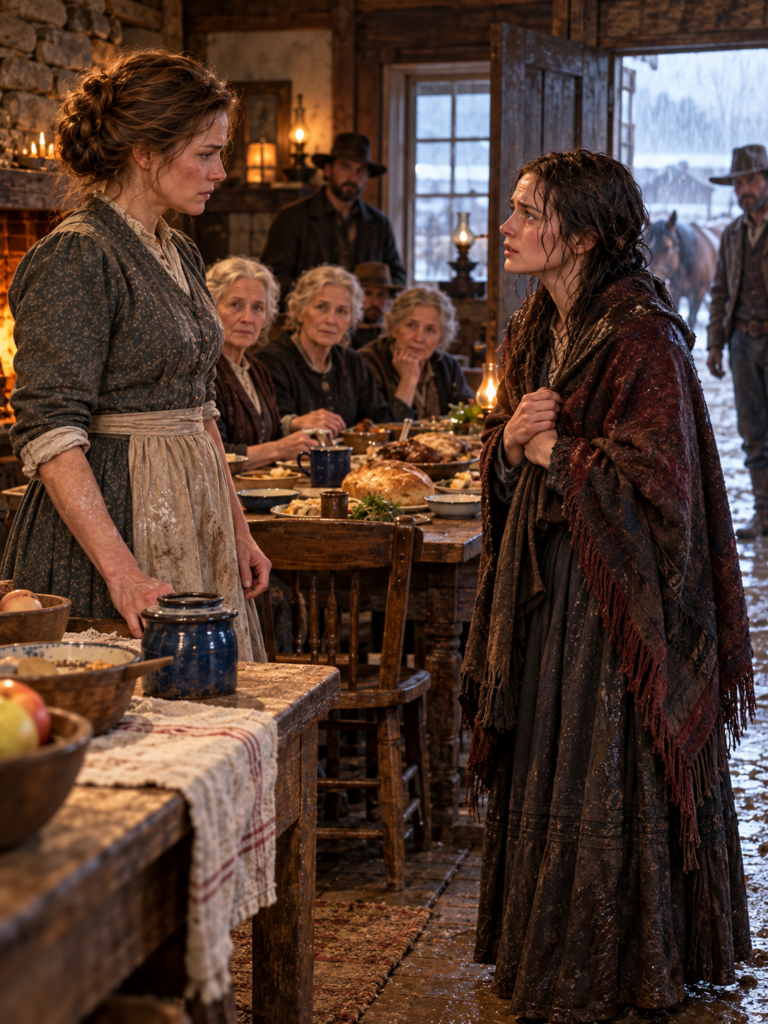
Maud carried the first bucket of clay toward the oven, set it down, and dropped to her knees before the cracked firebox.
“If we do this,” she said, “we do it as mine as much as yours.”
Honoria looked over the rim of the old account book.
“Meaning?”
“No one eats free because he thinks three gentlewomen are a curiosity. No one pays extra to stare. And nobody comes here expecting you to bow because your nephew owns half the cattle between here and the railroad.”
Dorcas smiled faintly.
“That seems reasonable.”
“And,” Maud added, “the first money goes to food and repairs. I won’t have you working to save my lease while pretending otherwise.”
That erased Honoria’s smile.
She closed the book.
“Mrs. Lowry, I spent thirty years keeping another household solvent while men who could not add two columns signed their names below mine. Do not protect me from the satisfaction of knowing where a dollar goes.”
Maud met her eyes.
Then she nodded.
“Show me.”
It was their first agreement.
By Sunday the oven held heat.
Six men arrived.
The following week eleven came, several bringing wives.
By the fourth Sunday Maud had men sitting on buckets near the wall and women balancing bowls on their knees. Dorcas cooked. Honoria counted coins into a blue stoneware jar. Winifred welcomed each arrival as though Cold Harbor had been expecting that exact person all morning.
Maud worked everywhere.
She kneaded bread, hauled water, patched the roof, split kindling, and carried steaming bowls to ranch hands who ordinarily ate cold biscuits in bunkhouses.
No one called the sisters leftovers again.
Not after Mr. Tebbet, the storekeeper who had first used the insult outside church, came one Sunday and quietly placed his coin beside Abel’s.
When the meal was over he found Maud at the door.
“I spoke meanly.”
“You did.”
He rubbed his hat brim between his fingers.
“I’m ashamed of it.”
The following morning a slab of bacon hung from Maud’s empty smoke hook.
No bill came with it.
Then hard frost settled over the range.
Four nights later, a report like a rifle shot cracked through Cold Harbor’s kitchen.
Smoke burst from the chimney breast.
Maud was on her feet instantly.
She smothered the fire, pushed the sisters into the back room with blankets, and spent the remainder of the night in a freezing kitchen with soot streaking her face.
At sunrise Sneath appeared at the gate.
He carried a folded paper.
“Mr. Brewell has learned his aunts are operating an eating house.”
“They’re helping me keep a table.”
“He finds the spectacle embarrassing.”
Maud stared at him.
“Their allowance ends today.”
Behind her, Honoria went still.
Sneath continued.
“Rooms have been prepared for the ladies above the Brewell laundry. The wagon will collect them Monday.”
Dorcas stepped into the doorway wrapped in a quilt.
“And if we decline?”
Sneath glanced at the broken chimney.
“Then Mr. Brewell sees no reason to finance this arrangement.”
He turned to Maud.
“Your lease payment comes due after the thaw, doesn’t it?”
That was the blade hidden beneath the words.
When he left, Dorcas spoke first.
“We go Monday.”
“No.”
“We will not cost you Cold Harbor.”
Maud pulled her husband’s brown coat from its peg.
“You aren’t costing me anything you chose.”
She thrust her arms into the sleeves.
“Where are you going?” Winifred asked.
“To buy flour.”
“With what money?”
Maud looked once at the sleeves her husband had worn smooth at the cuffs.
Then she opened the door.
“With this coat if I have to.”
She walked the frozen road to Tebbet’s store and laid the coat across his counter.
“I need meat and flour on credit until spring.”
Tebbet looked down.
Then he pushed the coat back.
“Put it on.”
“I have nothing else worth enough.”
“Your name is.”
He pulled his slate toward him.
“And send Abel to me. That chimney isn’t waiting until spring.”
Maud stood there with one hand on the coat.
For the first time since the funeral, accepting help felt harder than offering it.
Then she put the coat back on, turned toward the door, and started for home knowing she had just chosen debt, risk, and three unwanted women over the only safe way to keep her land.
Maud reached Cold Harbor before noon and found Abel Stroud already crossing her yard with four ranch hands behind him.
Tebbet had sent word faster than she could walk.
The men brought brick, lime, rope, and two ladders. None asked what she could pay.
Abel only pointed at the broken chimney.
“Show us where she split.”
Maud did.
For two days they worked in biting cold. The men removed damaged brick while Maud kept the mortar warm beside the stove so it would not freeze before setting. Dorcas fed them. Honoria recorded every sack of lime and pound of meat as a debt to be repaid. Winifred carried coffee until her fingers shook.
On the evening the chimney drew clean again, Maud found all three sisters staring at the fire.
“No wagon came,” Winifred said.
It was Monday.
Maud had forgotten.
Honoria had not.
“I suppose Sneath decided four laborers with brick hammers made poor company for collecting old ladies.”
Dorcas shook her head.
“No. He expected us to surrender ourselves.”
Maud put another log on the fire.
“Then he misunderstood the house.”
The Sunday dinners resumed.
What had begun as six laborers became something stranger and larger.
The curate came.
Then a neighboring stockman’s wife.
Then families from farther ranches who had heard that Dorcas could turn the cheapest beef cut into something worth riding ten miles to taste.
Maud disliked the richer guests at first.
Not because they were rich, she told herself, but because she feared they had come to inspect hardship like a traveling curiosity.
So she watched.
A woman in a fine wool coat once tried to press a silver dollar into Winifred’s hand.
Winifred gave it back.
“Dinner costs the same for everyone.”
“But surely—”
“One coin,” Honoria called from the table.
The woman looked offended.
Then embarrassed.
The following week she returned in an older coat and brought two sacks of potatoes, asking whether Maud might trade for them.
That Maud accepted.
The rule mattered.
Nobody bought importance at Cold Harbor.
Nobody bought gratitude either.
By deep winter the blue jar on the dresser held enough to keep flour in the bin, lamp oil on the shelf, and a little money against the lease.
Then the snow came.
Not a violent storm. Simply hours of heavy, patient flakes that filled the road cutting below Brewell Ranch until carriages could not pass.
That same evening Silas Brewell’s young wife, Cordelia, was holding her first large winter supper at the ranch house.
Forty guests were expected.
Almost none reached it.
The first carriage stalled in the drift. Others stopped behind it. Men climbed down. Horses labored. Women in dinner shoes discovered that wealth did not shorten a snow-filled mile.
Then someone saw a candle.
Cold Harbor.
Maud always left one burning in the front window when Abel’s crew might be walking home late.
She saw the first lanterns moving toward her across the whitened lane.
Then more.
“Dorcas.”
Dorcas came to the window.
“Oh.”
“That many?”
“Oh, yes.”
Honoria was already opening the pantry.
“We have bread for tomorrow’s dinner.”
“Not anymore,” Dorcas said.
Maud pulled on her husband’s coat and took a lantern outside.
She guided the first group through the yard, returned for another, then another. At the bend she found an elderly cattle buyer who had slipped into the ditch and could not rise.
Maud put his arm over her shoulders.
“You’ll ruin your dress,” he gasped.
“I own another.”
It was a lie.
He laughed despite himself, and she half dragged him to the farmhouse.
By then Cold Harbor held nearly forty stranded guests.
Dorcas surveyed them.
“Big pot.”
Every usable scrap went into it.
Beans.
Onions.
Bacon.
Flour.
The last preserved herbs.
Honoria warmed spiced cider and refused money.
Winifred sang when conversation faltered.
Nobody mentioned that most of the stranded guests had been expected at Brewell Ranch.
But everybody thought about it.
High on the hill, lights burned in every window of the big house while its dining room remained nearly empty.
By midnight the travelers were sleeping wherever room allowed—chairs, benches, quilts on the floor—while Maud sat nearest the door.
The elderly cattle buyer remained awake beside her.
“You know who’ll hear of tonight.”
Maud looked toward the hill.
“I imagine he’ll hear several versions.”
“He won’t like any of them.”
“That sounds like his burden.”
The man chuckled.
“You always speak to powerful men like that?”
“No.”
She pulled the brown coat tighter.
“I spent years being frightened of losing things.”
Her eyes moved across the room.
Dorcas asleep by the hearth.
Honoria curled under a shawl with the account book still beneath one hand.
Winifred resting beside two ranch wives she had met that night.
Maud touched the worn cuff.
“Then I learned some things can only be kept by risking them.”
Within two weeks nearly everyone in the county had heard how Brewell’s invited guests ate at the widow Lowry’s table while his own house stood prepared for them.
Invitations from the ranch began to be declined.
Silas responded by saying nothing.
Cordelia Brewell began asking questions.
That fact reached Cold Harbor through the storekeeper.
“What sort?” Honoria asked.
“Mostly about you three.”
Dorcas’s mouth tightened.
“And?”
Tebbet shifted uneasily.
“Seems she did not know why you left.”
Honoria stared at him.
“Everyone knew.”
“Everyone except her, maybe.”
Maud remembered what Sneath had said. Rooms were needed. Family embarrassment. The young wife’s taste.
It had been easy to make Cordelia the villain in the empty place Silas left.
Maud disliked easy explanations.
“Did she ask you directly?”
Tebbet nodded.
“She asked whether the sisters chose to leave.”
Winifred stopped kneading dough.
“What did you say?”
“The truth.”
Which meant the question could no longer be put back in its box.
The weather softened.
Snow withdrew from the low fields.
By March the lane became mud.
On a Sunday crowded enough that Abel had carried another bench inside, Maud stood near the dresser with the blue jar tucked beneath one arm.
The door opened.
Cold rain blew in.
A young woman stood alone on the threshold.
No driver.
No servant.
Her gray cloak was muddy to the hem, and her boots showed she had walked from the hill.
Cordelia Brewell.
Conversation died.
She looked first at Maud.
Then at Dorcas, Honoria, and Winifred seated together near the head of the table.
Her face lost what little color the cold had left in it.
“I’ve come to ask something.”
Nobody helped her.
Nobody humiliated her either.
Maud waited.
Cordelia swallowed.
“May I have a seat at your Easter table?”
Her voice nearly failed on the last words.
“I will pay the same coin as anyone.”
The blue jar felt heavy in Maud’s hand.
Winifred stood before Maud could answer.
She walked the length of the room, took Cordelia’s chilled hands between hers, and said, “First you are coming near the fire.”
Cordelia let herself be led inside.
Dorcas placed soup before her.
The young woman ate several spoonfuls before speaking.
“I never asked Silas to send you away.”
Honoria’s expression did not change.
Cordelia looked from sister to sister.
“I admired those rooms once. That was all. Days later they were empty. I asked where you had gone, and nobody answered plainly. I thought there was some family grief they believed improper to discuss.”
“We know,” Dorcas said.
Cordelia blinked.
“You know?”
“We know whose decision it was.”
Rain tapped the windows.
Maud heard a horse stop outside.
Then another sound.
Boots crossing the yard.
Cordelia turned toward the door.
Her expression told Maud who had followed her before the knock came.
Silas Brewell stood outside Cold Harbor, bareheaded in the rain, his hat held against his chest.
Maud opened the door only wide enough to face him.
He looked past her and saw his wife by the fire.
Then his three aunts at the crowded table.
Then every ranch hand, shopkeeper, churchman, stockman, and farm wife who had watched what happened through winter.
His face reddened.
“I would like to come in.”
Maud did not move.
“Why?”
His gaze returned to hers.
For once no steward spoke in his place.
“I have come to learn what I owe.”
Maud opened the door wider, but she did not step aside until Silas wiped the mud from his boots.
It was a small thing.
The room noticed.
So did he.
Only then did she let him enter.
Silas Brewell had crossed Cold Harbor’s threshold once before, months earlier, to hand Maud a sealed note and leave three elderly women in her yard.
That day he had worn gloves.
Now he held his hat in both bare hands.
Nobody offered him a chair.
Cordelia remained beside the fire.
His aunts sat together at the table.
Maud placed the blue jar on the dresser.
“You said you came to learn what you owe.”
“I did.”
“The allowance first.”
He nodded.
“Every week from the day Sneath stopped it.”
“From the day you stopped it.”
Silas flinched.
“Yes.”
“Mr. Tebbet extended food on credit. Abel and four men rebuilt the chimney during the freeze. There was brick, lime, flour, bacon, lamp oil.”
“I’ll pay all of it.”
“That is the money.”
Silas looked at her.
“And the rest?”
Maud had rehearsed no speech.
She had imagined this man ruined in pride, shamed before neighbors, forced to discover what he had thrown away.
Standing before him now, she found that humiliation interested her very little.
The winter had already taught her the difference between justice and revenge.
“The rest belongs to them.”
Silas turned toward his aunts.
Maud continued.
“They decide where they live.”
His jaw tightened almost invisibly.
“No wagon comes unless they ask for it. No steward announces where they will sleep. No allowance disappears because you dislike how they use their days.”
He looked down.
“And if they remain here?”
“Then you pay what you promised for as long as the arrangement remains acceptable to them and me.”
Honoria lifted one finger.
“Subject to accounting.”
A few people smiled.
Silas did not.
He looked toward the three women.
“Aunt Dorcas.”
Dorcas waited.
“Aunt Honoria. Aunt Winifred.”
His voice roughened.
“I thought I was solving a household difficulty.”
“You were,” Honoria said.
The words landed harder because she said them quietly.
Silas breathed in.
“I told myself you would be comfortable. I told myself the money made the decision decent.”
Dorcas folded her hands.
“You did not come inside to see whether we were comfortable.”
“No.”
“You did not ask whether we wished to go.”
“No.”
“You allowed your wife to be blamed.”
His eyes moved toward Cordelia.
That accusation seemed to hurt most.
“No,” Cordelia said softly. “He did more than allow it.”
Silas closed his eyes briefly.
She rose.
“When people stopped coming to the house, I thought they disliked me. When I asked about your aunts, you said there had been an arrangement.”
“There had.”
“Made by you.”
“Yes.”
“You let me spend a winter wondering why a county of strangers had decided I was cruel.”
Silas looked at her.
“I was ashamed.”
“That explains your silence. It does not excuse it.”
“No.”
Nobody in the kitchen moved.
Maud remembered the first night the sisters had slept three across her bed while she cried into her husband’s coat.
Back then she had imagined wealthy people possessed a kind of certainty denied to everyone else.
Now Silas Brewell stood in her kitchen looking less certain than Abel did when choosing a nail.
Cordelia’s next question was simple.
“Why did you send them away?”
Silas rubbed one thumb over his hat brim.
“Because I had inherited a ranch I was frightened I could not manage.”
Honoria’s eyebrows rose.
“You had me keeping the accounts.”
“I know.”
“You had Dorcas overseeing half the household stores without anyone admitting it.”
“I know.”
“And Winifred knew every family that traded with the ranch.”
Winifred tilted her head.
Silas gave a joyless laugh.
“I know that now.”
“That was not my question,” Cordelia said.
He looked at her.
“I wanted the house to feel like mine.”
The admission was so ordinary that the room seemed to become quieter around it.
Silas continued.
“My father’s sisters had lived there longer than I had. Every room carried a habit older than anything I could change. I married you and wanted to prove I was master of the place. Then you admired those rooms.”
Cordelia stared.
“So you cleared them.”
“Yes.”
“For me.”
“For myself.”
Dorcas’s face softened, though not with forgiveness.
With recognition.
Silas swallowed.
“I decided three old women could be moved because I had the power to move them.”
There it was.
No villain’s secret.
No conspiracy.
Only power exercised against people assumed too dependent to refuse.
Maud found that more believable—and uglier—than any excuse.
Silas faced his aunts.
“I was wrong.”
Honoria looked unconvinced.
He went on.
“I thought age had made you burdens. What I had actually done was stop seeing the work you performed because it had always been there.”
Dorcas glanced toward the crowded kitchen.
Silas followed her eyes.
The repaired window.
The sound chimney.
The bread stacked under clean cloth.
The long table full of people.
He looked back at the sisters.
“I did not know what I was sending away.”
Honoria’s mouth tightened.
“That sentence is not as kind as you think.”
Silas nodded immediately.
“No. It isn’t.”
For the first time she seemed surprised.
He tried again.
“I did know whom I was sending away. I simply decided my convenience mattered more.”
Dorcas let out a slow breath.
“That is nearer the truth.”
Silas’s eyes shone.
“Come home.”
Nobody spoke.
He seemed to realize his mistake before anyone corrected it.
“No,” he said quickly. “Forgive me. That is wrong too.”
His shoulders lowered.
“If you want rooms at Brewell, they are yours. If you want Cold Harbor, I will not interfere. If you want some arrangement I have not thought of, tell me.”
Honoria looked at her sisters.
Winifred reached for Dorcas’s hand.
They had spent a lifetime together. Their decision passed among them almost without words.
Then Honoria spoke.
“We are home.”
Silas shut his eyes.
A breath escaped him.
It might have been grief.
It might have been relief.
Probably both.
“But,” Winifred added brightly, “we shall be pleased to see you Easter Sunday.”
A few people laughed.
Honoria pointed toward the blue jar.
“You will pay your coin.”
Silas opened his eyes.
“Yes, ma’am.”
“And your wife?”
Cordelia looked startled.
Dorcas answered.
“Her seat was already requested properly.”
That broke the tension.
Not completely.
Enough.
Silas reached into his pocket and placed a coin on the table.
Honoria looked at it.
“That is for today.”
He almost smiled.
“I haven’t eaten.”
“Neither has your money.”
This time the whole room laughed, including Cordelia.
Silas did not take the coin back.
The following week he returned with the unpaid allowance.
Not a dramatic purse dropped in apology.
Honoria would not permit drama where arithmetic was required.
They sat at Maud’s kitchen table with the account book between them.
She counted every dollar.
Tebbet’s store credit was repaid.
Abel and the men received wages for the chimney work.
The cost of materials was settled.
Silas offered Maud extra money.
She refused.
“You owed what you owed.”
“I caused damage beyond that.”
“Yes.”
“Then how do I repay it?”
“You don’t buy forgiveness.”
He leaned back.
“What do I do?”
Maud looked toward the sisters.
“Behave differently when it costs you something.”
Silas absorbed that.
Then nodded.
Within the month Sneath no longer managed Brewell’s household affairs.
Maud asked no questions about the dismissal.
Honoria did.
She learned Sneath had carried out Silas’s orders faithfully but had also sharpened them when cruelty made his work easier. Silas dismissed him because accountability could not stop at blaming a servant.
Even that did not make everything right.
It merely made one wrong stop continuing.
Spring came slowly.
The road dried.
Grass showed green beneath the old brown stalks.
And Cold Harbor changed again.
Not because Brewell Ranch poured money into it.
Maud would not accept that.
The Sunday meals paid for themselves. The growing traffic gave her other ideas.
Travelers began asking whether she could sell bread during the week.
She could.
Dorcas taught her how to stretch meat without cheapening a meal.
Honoria showed her exactly what each loaf cost in flour, fuel, salt, and time.
Winifred discovered that people lingered longer—and purchased more—when nobody hurried them from the table.
Maud turned the unused back room into a small dining room after the broken window was properly glazed.
She repaired two additional benches with Abel.
When Silas offered lumber, she agreed only after settling a price against what Brewell Ranch already purchased from Cold Harbor.
He accepted the terms.
That mattered more to her than the lumber.
Cordelia began walking down from the hill once or twice a week.
At first she came to see the aunts.
Then she began staying.
She learned bread from Dorcas badly.
She learned accounts from Honoria better.
Winifred taught her songs that had once been sung at the ranch before Cordelia arrived.
Maud watched something unexpected occur.
Cold Harbor did not take Cordelia from Brewell.
It gave her a place from which she could return there stronger.
One afternoon Cordelia stood drying plates beside Maud.
“I nearly hated you.”
Maud looked over.
“Before we met?”
Cordelia nodded.
“I heard people praising this place and condemning the house on the hill. I thought you had all decided who I was.”
“Some did.”
“Did you?”
“For a while.”
Cordelia waited.
Maud set a bowl on the shelf.
“Then I decided I preferred evidence.”
A corner of Cordelia’s mouth lifted.
“Honoria says that too.”
“She says it louder.”
On Easter morning the sky cleared hard and blue.
Primroses had begun appearing along the sheltered bank beside the lane.
Smoke rose straight from Cold Harbor’s rebuilt chimney.
Every chair filled before noon.
Abel came with his wife.
Tebbet wore a polished Sunday coat.
The curate squeezed between two stockmen.
The old cattle buyer Maud had hauled from the ditch returned and claimed the chair beside Winifred before anyone else could take it.
Dorcas roasted lamb with rosemary and garlic.
Cordelia arrived in a plain blue dress instead of the elaborate clothes people expected from Brewell Ranch.
She placed her coin in the jar.
Then she rolled her sleeves above her wrists and carried plates.
Nobody mistook the gesture for service owed.
She had chosen the work.
Silas came last.
He stopped inside the door.
For one instant Maud remembered him in the rain months earlier, turning his carriage in her yard while three old women stood in the mud.
Now he waited until Honoria pointed toward the end of the bench.
“There.”
He sat.
His coin lay in front of him.
Dorcas served every other guest first.
When she reached Silas, only one portion of lamb remained on the carving board.
It was the best slice.
She set it on his plate.
Silas looked up.
Dorcas rested her hand briefly on his shoulder.
Nothing was erased.
That was why the touch mattered.
“Eat before it cools,” she said.
His face tightened.
“Yes, Aunt Dorcas.”
After dinner Winifred began singing.
Conversation softened around her voice.
Maud went to the mantel.
Behind the blue jar sat the old sealed note Silas had delivered on the first wet afternoon.
The seal had long since broken.
The folds were worn.
Four dollars a week until spring.
Those few words had once meant survival to Maud.
Then obligation.
Then anger.
Then, unexpectedly, opportunity.
She carried the paper to the stove.
Honoria noticed.
So did Dorcas.
Maud hesitated.
Her husband’s brown coat hung on the peg beside the door.
For months she had worn it whenever she needed courage.
She had once thought keeping it exactly where he left it was proof that she still belonged to the life they had shared.
Now she understood that memory did not require a room to remain unchanged.
Neither did love.
Neither did grief.
She opened the stove door and laid Silas’s note onto the coals.
The paper darkened.
Curled.
Flamed.
The last corner vanished upward through the chimney the sisters had helped clear, the men had rebuilt, and the whole community had kept warm beneath.
Maud closed the stove.
When she turned, Dorcas nodded once.
Honoria lifted the account book.
“Before you become sentimental, we have Easter receipts.”
Maud laughed.
“Of course we do.”
Winifred continued singing.
Cordelia stood beside the table distributing the last bread.
Silas rose without being asked and carried empty bowls toward the wash basin.
Abel shifted so he could pass.
No one praised him for it.
That mattered too.
Outside, Cold Harbor still looked like a modest frontier homestead.
The roof showed patches.
The yard became mud after rain.
The land would never make Maud rich.
But the lease was paid.
The oven worked.
The chimney drew.
The pantry held enough.
And people now traveled miles for a place at her table.
Dorcas controlled the kitchen because she loved the work and could leave it whenever she pleased.
Honoria kept the books because no one had ever respected that talent enough before.
Winifred filled the room with music because at Cold Harbor nobody told an aging woman that usefulness required silence.
Cordelia belonged there without taking anyone else’s place.
Silas was welcome only under the same rule as every other guest: enter with respect, pay what is fair, and remember that hospitality is not ownership.
And Maud—
Maud no longer slept beside the fire.
She moved back into her own bed after the sisters insisted upon taking the back room once it was repaired.
Her husband’s coat remained on its peg.
Some cold mornings she still wore it.
Others she did not.
The difference no longer frightened her.
Months earlier Silas Brewell had believed he was sending three unwanted old women away.
Maud had believed she was accepting them because four dollars a week might save her failing home.
Both had been wrong about the same thing.
Dorcas, Honoria, and Winifred had never been burdens waiting for someone stronger to decide where they belonged.
They had arrived carrying knowledge, labor, memory, stubbornness, humor, and the ability to turn one poor kitchen into a place the county wanted to enter.
Cold Harbor saved none of them by itself.
They rebuilt it together.
And long after the Easter plates had been washed and stacked, evening sun crossed the mended window and reached the white cloth on Maud’s crowded table.
Three faded silk sleeves rested beside work-worn hands.
A rancher’s young wife laughed with laborers.
A wealthy man carried bowls without expecting anyone to notice.
Smoke rose clean from the chimney.
And Maud Lowry stood beneath the roof she had once expected to lose, listening to the warmest room in the county fill with voices belonging to people who were there for one reason no steward, ranch owner, grief, poverty, or old family rule could dictate for them.
They had chosen their own seats.


