
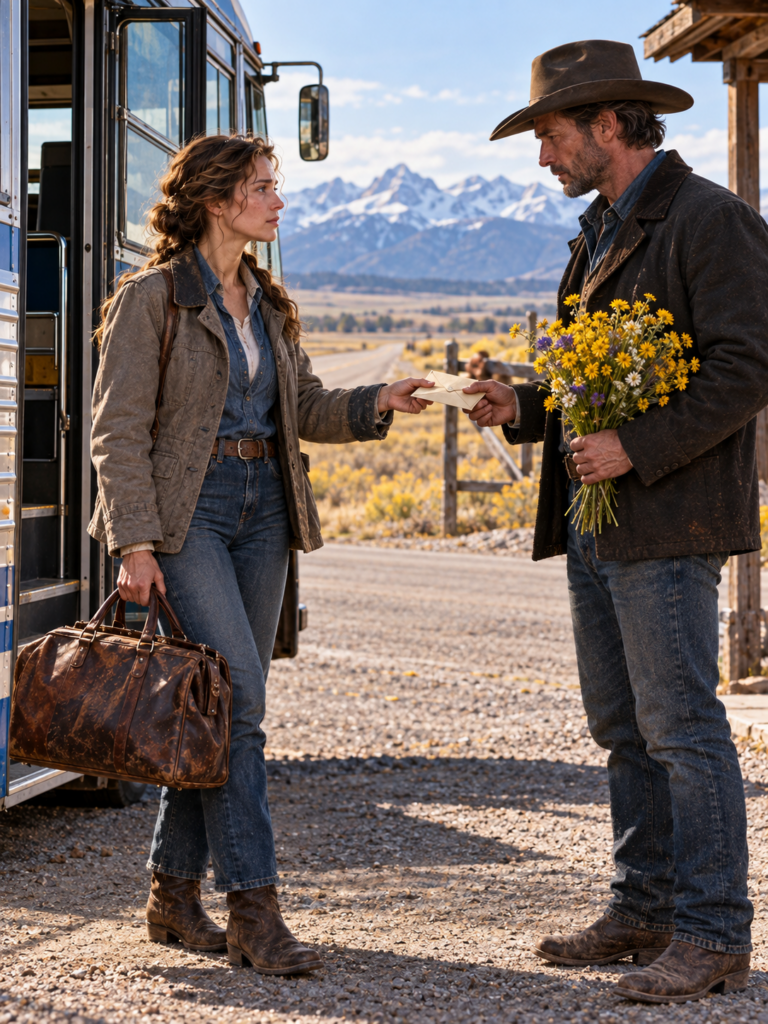
Sarah walked straight toward the frightened horse, and when the mare slammed one hoof against the stall wall again, she stopped six feet short instead of reaching for the halter.
An older man with a silver mustache watched from the rail.
“Hank Miller,” he said. “I run what Daniel forgets to run.”
Daniel, behind her, said, “He means he complains about it.”
“I heard that.”
Sarah ignored both men.
She turned slightly sideways, loosened the lead rope, and waited.
The mare’s ears flicked.
Sarah took one step.
Stopped.
Another.
Five minutes later, the mare followed her quietly around the pen.
Hank stared at Daniel.
“Where’d you find her?”
“Bus station.”
Hank nodded thoughtfully.
“Might check there more often.”
Sarah laughed and pretended she had not.
By noon she had found two duplicate feed payments in the ranch office.
By three she had discovered that Daniel was paying unnecessary delivery charges because nobody had time to consolidate orders.
By supper, his ledgers covered half the porch table.
Daniel set two steaks down and looked at the columns Sarah had marked.
“You’ve been here nine hours.”
“Long enough.”
“For what?”
“To tell you money is leaking out everywhere.”
His expression sharpened.
“Someone stealing?”
“No.”
She turned the ledger around.
“Nothing dramatic. Fuel bought in town instead of through the cooperative. Small feed orders instead of one large delivery. Late fees on notes when the cash was already sitting in the account.”
Daniel lowered himself into the chair opposite her.
Sarah tapped the page.
“My father used to say ranches rarely die from one enormous mistake. They die from a thousand little ones nobody has time to notice.”
Daniel studied her.
“You sound like him.”
“Is that good?”
“I wouldn’t know. Never met him.”
The smile that crossed her face disappeared almost immediately.
“He died this winter.”
Daniel said nothing foolish.
No empty reassurance.
He simply filled her coffee cup.
That silence earned more of Sarah’s trust than sympathy would have.
She worked through another page.
“I can save you four, maybe five hundred a month.”
Daniel’s eyes stayed on her pencil.
“But?”
“But whatever you owe by the end of summer, housekeeping won’t fix it.”
He was quiet.
“How much?”
Sarah asked.
Daniel looked toward the dark barn.
“That isn’t your problem.”
“No.”
She laid down the pencil.
“And I leave Thursday.”
She said it firmly enough that he knew she was reminding herself.
Thursday arrived.
Sarah was still there.
On Friday morning Daniel found her pitching hay from the loft.
“You missed another bus.”
“I know.”
“Should I report the transportation system?”
“I changed the ticket.”
Again.
He tried not to look pleased.
Failed.
“One week,” Sarah said.
“Certainly not more?”
“Certainly not.”
But that evening, after the livestock were settled, Sarah stood in the ranch office studying invoices stacked beside an old family agreement.
A number on one payment notice stopped her.
Then another.
She carried both pages into the kitchen.
Daniel was washing his hands.
“This is bigger than sloppy bookkeeping.”
He went still.
Sarah placed the papers between them.
“What happens August thirty-first?”
His expression gave her the answer before his voice did.
Daniel dried his hands slowly.
“My cousin owns twenty percent of the ranch company.”
“And?”
“If we default, an old family agreement gives him the right to demand enough land be sold to satisfy the debt.”
Sarah looked through the window toward miles of grass glowing under the late sun.
“Which land?”
“The southern pasture.”
“What’s there?”
“Summer grazing.”
She waited.
Daniel added, “And the creek crossing.”
Sarah understood instantly.
Without that pasture, cattle capacity collapsed.
Without the crossing, moving stock became harder.
Richard was not trying to buy an inconvenient corner.
He was trying to remove the hinge from the ranch.
Sarah picked up the payment notice.
“How short are you?”
Daniel hesitated.
She pushed the paper toward him.
“If I’m staying another week, I don’t need control. But I need the truth about any numbers you expect me to touch.”
It was her first condition.
Daniel met her eyes.
Then he opened the locked desk drawer.
He carried every loan document, payment schedule, and the 1958 agreement to the kitchen table.
Sarah pulled out a chair.
Daniel placed the final folder in front of her.
And when she saw the amount due before September, she stopped breathing for one stunned second.
There was no way ordinary ranch income could cover it.
Not even close.
She raised her eyes.
Daniel stood across the table, waiting for judgment.
Sarah instead reached for a clean sheet of paper.
“All right,” she said. “Show me everything Willow Creek can still earn before August ends.”
Daniel pulled out the chair opposite Sarah and began listing everything Willow Creek could still earn before August ended.
Cattle.
Four young horses.
Some unused machinery.
The guesthouse standing empty east of the main house.
Sarah stopped writing.
“Guesthouse?”
“Six bedrooms.”
“Empty?”
“Mostly since my grandfather died.”
She stared at him.
“You’re twelve miles from town, less than an hour from Yellowstone traffic, and you have six empty bedrooms?”
Daniel frowned.
“People pay money to come to a ranch?”
“People who don’t own one do.”
“That seems suspicious.”
Within three days, Sarah had proved him wrong.
They opened windows that had not moved in years, carried mattresses into sunlight, found bright quilts in cedar chests, scrubbed floors, repaired plumbing, and rebuilt a porch rail Hank claimed he alone was qualified to touch.
Daniel did not treat Sarah like temporary help.
When she proposed something sensible, he listened.
When he disagreed, he explained why.
And when she told him the guesthouse accounts would remain separate so they could see whether the idea truly paid, he handed her a new ledger without argument.
They named it Willow Creek Ranch Rooms.
A woman from Chicago saw Sarah’s small travel advertisement and telephoned for three nights.
Daniel stared at the reservation note.
“Forty-five dollars a night?”
“Yes.”
“For a room I’ve been heating for free?”
“That is generally how lodging works.”
The first guests, Frank and Doris Bellamy, arrived in a Buick with a Yellowstone map spread across the dashboard.
They photographed the barn.
The windmill.
A chicken.
Daniel watched from the porch in disbelief.
“They’re paying for this.”
Sarah nudged him.
“They’re happy.”
That mattered more than he expected.
Soon a family from Omaha arrived.
Then a widower from Denver.
Sarah began Saturday horse clinics for local children. Five dollars a child.
Daniel resisted until a ten-year-old boy spent half an hour brushing an old gelding named Buck and announced Willow Creek was the greatest place on earth.
That evening Sarah found Daniel repairing Buck’s stall door.
“It wasn’t broken.”
“It was loose.”
“It was not.”
He pointed the hammer at her.
“You ask too many questions.”
“You’re a terrible liar.”
He almost smiled.
Weeks slipped by.
Sarah kept postponing Montana.
She told Daniel about the Bennett horse place outside Fort Collins—how her father Robert had died that winter, how her brothers had sold after the estate was settled, how she had fed horses already belonging to strangers on her final morning there.
Her brother had told her it was only a place.
Daniel had not insulted her by agreeing.
“No,” he had said. “It wasn’t.”
That simple answer reached farther into her than comfort would have.
For Daniel, Willow Creek was no less personal.
His grandfather had bought the first thousand acres after the Second World War. His father had expanded it. Daniel knew fence posts by the men who had sunk them and shallow places in the creek by which month cattle could cross.
Richard Whitmore knew it by price per acre.
He arrived one Sunday in a new Cadillac.
He stepped onto the porch with polished shoes and a folder.
His gaze paused on Sarah.
“So the news from the bus station was true.”
Daniel leaned against a porch post.
“What news?”
“That Margaret didn’t come.”
“Old news.”
Richard indicated Sarah.
“And this?”
Sarah stepped down.
“Sarah Bennett.”
He shook her hand.
“How long are you staying?”
Sarah answered before Daniel could.
“We’ll see.”
Richard’s smile thinned.
He had brought a developer’s offer for three thousand acres of southern pasture.
Enough money to relieve most of the pressure.
Enough land to cripple the ranch.
“You’re borrowing against sentiment,” Richard told Daniel.
“No. I’m refusing to sell because the ranch still works.”
“With what money?”
“We’ll find it.”
Richard glanced at Sarah.
“Is she the new business plan?”
Sarah smiled pleasantly.
“No. I’m helping him uncover the old one from beneath about fifteen years of badly managed paperwork.”
Hank coughed into his fist to hide a laugh.
Richard’s mouth tightened.
“You have until the end of August, Danny.”
He drove away, leaving dust floating above the road.
Sarah watched it settle.
“Do you really think we can save it?”
Daniel turned toward her.
“You said we.”
She realized she had.
Neither corrected it.
That night Daniel did something he had not done even with his sister.
He placed every financial document in front of Sarah.
She read the 1958 clause twice.
A twenty-percent partner could force enough land sold to cover secured debt—but only if the company actually defaulted.
Richard’s leverage depended on failure.
They did not need to make Willow Creek rich.
They needed to keep it current.
The difference gave Sarah a target.
The guesthouse filled more often.
The horse clinics grew.
They sold idle equipment.
She renegotiated feed purchases.
Daniel contacted buyers he had avoided because asking for business felt too much like asking for help.
Then, near the end of June, Richard sent formal notice of a September first partnership meeting.
Sarah sat on the porch holding the registered letter.
“My ticket is July tenth,” she said when Daniel joined her.
“I know.”
“I’m changing it.”
His gaze moved from the letter to her.
“Until when?”
“September.”
The next night Silver Creek held its summer festival.
Hank announced Sarah was attending because Daniel had bought a new shirt.
Daniel nearly dropped his coffee.
Later, beneath lights strung across Main Street, Daniel finally offered his hand.
“I’m not very good at this.”
“Dancing?”
“Asking.”
Sarah put her hand in his.
“Good thing I understood.”
During the slow song he held her carefully, as if he was determined never to presume what she had not offered.
Sarah rested her head against his shoulder.
When the song ended, neither immediately let go.
Richard found them near the truck.
He reminded Daniel—loudly enough for two county men to hear—that sentiment did not pay bank notes.
After he left, Sarah looked at Daniel.
“Say it.”
“What?”
“Whatever you keep deciding not to say.”
Daniel opened his mouth.
Closed it.
Then, driving home through nine miles of darkness, he finally spoke.
“When this is over in September, one way or another, there’s something I want to tell you.”
Sarah looked at his hands gripping the wheel.
“Why wait?”
“Because I don’t want to ask anything of you while there’s still a chance I lose this place.”
She understood what he meant.
He would not mix love with debt.
Would not make her feel responsible for saving him.
“All right,” she said.
Ten days later, Margaret Collins called Willow Creek.
Sarah answered.
When Margaret gave her name, neither woman spoke for several seconds.
“I’ve been trying to make this call since April,” Margaret finally said. “I owe him an apology.”
“He understood.”
“That almost makes it worse.”
Sarah smiled faintly.
“No. That’s just Daniel.”
Daniel spoke privately with Margaret for ten minutes.
When he came outside afterward, Sarah had two glasses of iced tea waiting.
“She staying in St. Louis?” Sarah asked.
“Yes.”
“Are you angry?”
Daniel considered it.
“No.”
“Disappointed?”
“Not anymore.”
He turned the glass slowly between his palms.
“She asked if the woman who delivered the letter was still here.”
Sarah became very still.
“What did you say?”
“Yes.”
“That’s all?”
“That’s all.”
His eyes met hers.
“I think things worked out better than anything I planned.”
Sarah’s pulse jumped.
Then Hank appeared from behind the barn shouting that forty head had discovered the north gate hinge was failing.
The moment vanished into work.
By evening all three of them were filthy and laughing.
After supper Daniel called from downstairs that he needed registration papers from his bedroom dresser.
Second drawer.
Brown envelope.
Sarah went upstairs.
She opened the third drawer by mistake.
She closed it immediately—but the old wood caught halfway, tipping a small wooden box.
The lid opened.
A faded blue handkerchief slid partly out.
Sarah reached to put it back.
Then she saw the initials embroidered in one corner.
S. B.
Her hand stopped.
Heavy footsteps sounded on the stairs behind her.
Daniel appeared in the doorway.
His gaze dropped to the handkerchief.
Every trace of ease left his face.
Sarah slowly turned toward him.
“Where did you get this?”
Daniel stood utterly still.
Then he crossed the room, sat on the edge of the bed, and looked at the piece of blue cloth Sarah had not seen in twelve years.
“It was 1972,” he said.
Sarah’s breath caught.
Daniel raised his eyes.
“I think you were there.”
“I think you were there.”
Sarah lowered herself into the chair across from him without taking her eyes off the faded blue handkerchief.
Daniel spoke carefully.
“Twelve years ago this fall, I was bringing two horses north from an auction in Colorado. My truck quit eight miles outside a little town near Fort Collins.”
Sarah’s fingers tightened around the cloth.
“It was almost dark,” he continued. “Cold enough that I couldn’t sleep in the truck with any sense.”
He had walked to the nearest light.
A white house with green-trimmed windows.
A family let him use the telephone, fed him supper, and refused to let him spend the night outside.
“Their daughter came out later with a flashlight while I was trying to repair the fuel pump.”
Daniel smiled at the memory.
“I had grease up both arms and across half my face. She shined that light directly at me and started laughing.”
Sarah covered her mouth.
Daniel looked at her.
“Not mean laughter.”
“I know.”
His smile vanished.
She looked down at the initials.
“What color was the house?”
“White.”
“The windows?”
“Green.”
Daniel stopped breathing.
Sarah whispered, “Old apple tree beside the drive?”
“Never produced anything worth eating.”
A tear slipped down her cheek.
“My mother embroidered these.”
Daniel stared at her.
“Your mother?”
“She made six. Those are my initials.”
The truth traveled across his face slowly.
“Robert Bennett.”
Sarah nodded.
Daniel stood.
“The Bennett place.”
“Yes.”
“You were the girl with the flashlight.”
“And you were the stubborn cowboy who thought a pocketknife qualified you to rebuild a fuel pump.”
“I fixed it.”
“Three hours later.”
“Still counts.”
They laughed.
Then neither did.
Daniel crossed the room.
“I kept that because I never forgot the night.”
Sarah searched his face.
“You came back?”
Daniel hesitated.
“Two years later.”
Her eyes widened.
“You did?”
“I drove down without knowing what I meant to say. Your father remembered me.”
Sarah’s lips parted.
“He told me you’d gone to Montana to help your aunt after surgery. He didn’t know when you’d be back.”
“I didn’t know either.”
“So I left.”
Twelve years compressed into the space between them.
Sarah remembered the young man covered in grease, too proud to admit he was stranded and too polite to refuse the second plate her father pushed toward him.
She remembered laughing beneath the flashlight.
Remembered giving him the handkerchief.
Remembered almost nothing happening.
That was what made it astonishing.
Nothing had happened.
And yet both had carried the memory.
Daniel took the handkerchief from her, smoothed it once, then placed it back into her palm instead of returning it to the box.
“I thought something about you felt familiar at the bus station. I blamed the day. Margaret. The disappointment.”
Sarah looked at him.
“Maybe some people have to meet twice.”
Daniel’s voice was barely above a whisper.
“Maybe the first time is so you recognize home when you find it again.”
Neither moved for one breath.
Then Daniel came closer.
Slowly enough to let Sarah decide.
She did not step away.
Their first kiss was quiet.
No spectators.
No declarations.
Just an open bedroom window, the smell of cut hay from the field, and two adults understanding that chance had not obligated either of them to anything.
It had merely given them another choice.
When they returned downstairs, Hank was pouring coffee.
He looked at them for perhaps two seconds.
“Horse papers are in the office. Second file.”
Then he walked out.
Sarah stared after him.
Daniel narrowed his eyes.
“He knew.”
“He absolutely knew.”
Later they learned Hank had known exactly where those papers were all along.
The handkerchief answered one question.
It did nothing about the debt.
By early August, Willow Creek was healthier than it had been in years.
Still not healthy enough.
Guesthouse income and riding clinics had brought in thousands. Cost cuts had stopped the quiet bleeding. Daniel had buyers interested in horses.
But the August obligation remained larger than cash available.
Richard returned with another contract.
This one was harder to refuse.
The developer’s payment would clear the debt, equipment loan, and overdue interest while leaving money in the bank for winter.
All Daniel had to surrender was three thousand acres.
Sarah watched him read the figure.
She did not tell him what to do.
“This is your ranch.”
Daniel looked up.
“It’s starting to feel like ours.”
Sarah’s expression changed.
“Not legally.”
“Not yet.”
She held his gaze, then walked to the sink window where the southern pasture rolled toward the creek.
“If you want my opinion, ask.”
“I’m asking.”
Sarah considered the question as she had considered every ranch decision with her father.
“What problem does the money solve?”
“The debt.”
“For how long?”
Daniel said nothing.
Sarah turned.
“My father sold forty acres once. Never regretted it. Land isn’t sacred merely because your name is on it.”
Daniel waited.
“But if selling this pasture keeps Willow Creek alive permanently, then consider it. If it only gives you four years until the rest becomes unworkable, then the money isn’t rescue.”
“What is it?”
“Surrender paid in advance.”
The next morning Richard received his unsigned contract back.
“You’re making a mistake.”
“Maybe.”
“You could lose everything.”
“Maybe.”
Richard looked toward Sarah in the doorway.
“This because of her?”
Daniel glanced at Sarah.
“No.”
Then he added, “She reminded me why I was fighting.”
Richard drove away.
Daniel watched the Cadillac disappear.
“What now?” he asked.
Sarah folded her arms.
“Now we find out what the ranch is actually worth when people are willing to show up for it.”
The county horse-and-cattle auction fell on August twenty-fifth.
Willow Creek would sell everything it could spare in one day.
Sarah and Hank selected thirty-seven cattle already intended for market, then eleven more that could be sold without damaging the breeding plan.
Daniel had spent weeks preparing four young horses.
Sarah mailed more than a hundred notices.
She telephoned former guests.
Daniel drove hundreds of miles visiting cattlemen and horse buyers he had not spoken to in years.
He hated asking.
Sarah knew that.
So she never called it begging.
“You’re selling something good,” she told him. “Let them decide whether they want it.”
Not everyone welcomed him.
One rancher reminded Daniel that his father had once taken nine weeks to send registration papers on a purchased horse.
Daniel could have defended a dead man.
Instead he apologized.
That changed something in him.
On the Friday before the auction they loaded trailers in darkness.
Daniel did not sleep.
At four in the morning Sarah found him at the kitchen table with cold coffee.
“Last Saturday in August,” he said. “Everyone’s cutting hay.”
“And half the county has animals of their own to move.”
He rubbed his face.
Sarah sat opposite him.
She did not promise success.
“Then today we find out the truth.”
At sunrise they opened the gate.
The yard was empty.
So was the road.
At seven-forty, the first livestock trailer appeared.
A man from Meeteetse.
Then another truck.
By eight there were nine vehicles.
By eight-thirty Hank stopped directing traffic onto the road shoulder and began waving people into the hay meadow.
They came from Cody, Powell, Thermopolis.
Two buyers drove up from Colorado.
Former guests returned.
Frank and Doris Bellamy appeared wearing Willow Creek caps Sarah had ordered half as a joke.
Doris hugged her hard enough to knock hers sideways.
By ten o’clock the yard was full.
Daniel stood beside the rail with the sale list in his hand.
“When did this happen?”
Sarah stood next to him.
“While you were busy worrying.”
The auction ran six hours.
The four young horses sold well.
The brown gelding brought more than Daniel had dared put into his projections.
Cattle prices were merely fair.
Fair was enough.
Before the last trailer left, Sarah signed three winter-training agreements.
That evening Daniel sat in the office with deposit slips, the bank ledger, and a pencil.
Hank stood behind him twisting his hat.
Sarah waited in the doorway.
Daniel added the figures.
Again.
Again.
Then he put down the pencil.
“We did it.”
Sarah covered her mouth.
Hank’s mustache moved.
“You sure?”
Sarah asked.
Daniel held the page toward her.
“Check it.”
She did.
Of course she did.
Then she laughed.
Daniel crossed the office and lifted her clear off the floor.
Hank removed his hat, nodded once, and disappeared toward the barn under the transparent excuse that some horse urgently needed inspection.
On August thirtieth, the bank confirmed the ranch company was current.
September first, Richard arrived with an attorney.
Sarah placed eleven months of reconstructed books and the bank letter on the dining-room table.
The attorney read the documents.
Then the 1958 agreement.
He turned toward Richard.
“The clause requires default.”
Richard’s jaw hardened.
“There is no default.”
Twenty minutes later, the meeting ended.
No forced sale.
No southern pasture transfer.
The creek crossing remained part of Willow Creek.
The cattle would still graze there next summer.
Daniel stood on the porch watching Richard’s Cadillac disappear.
This time there was no triumph in him.
Only relief.
Sarah came beside him.
“It’s yours.”
Daniel looked at her.
“Ours?”
She smiled.
“Don’t get ahead of yourself.”
Two mornings later Daniel came downstairs before sunrise.
Sarah’s suitcase stood beside the front door.
Fear hit him faster than Richard’s threats ever had.
Sarah entered from the kitchen carrying her jacket.
“What’s this?”
“I have to go to Colorado.”
His face changed.
“My brother finished settling Dad’s estate. There are papers I still have to sign and things stored in the barn loft.”
Daniel nodded once.
“When are you coming back?”
Sarah did not answer.
“Sara.”
“I don’t know.”
He stared at her.
“You don’t know?”
She set the jacket over a chair.
“I came here because I had nowhere else that felt like mine. That isn’t true anymore.”
“I know.”
“Willow Creek was your whole life before I stepped off that bus. I’ve seen what holding onto this place costs you.”
Her voice trembled, but she continued.
“I won’t become one more thing you think you have to hold because you’re afraid of losing it.”
Daniel did not answer immediately.
Instead he went upstairs.
A drawer opened.
When he returned, the blue handkerchief was in his hand.
He placed it in hers.
“Twelve years ago you gave me this and disappeared.”
“I didn’t disappear.”
“That’s what it looked like from where I stood.”
His eyes were wet.
He made no effort to hide it.
“I spent twelve years wondering where that girl went. Whether she had a good life. Whether she was happy.”
Sarah stood still.
“Then in April I went to a bus station to meet somebody else, and you stepped off.”
A tear ran down Sarah’s face.
Daniel breathed once.
“I told you in June I had something to say when this was over.”
He looked around the quiet house.
“It’s over.”
He took another breath.
“I’m not spending twelve more years wondering.”
Sarah’s fingers closed around the handkerchief.
“I love you.”
The house seemed to listen.
Daniel continued before she could answer.
“Not because you saved the ranch. Anyone good with numbers could have helped straighten books.”
Sarah gave him a watery smile.
“That is a terrible romantic argument.”
“I’m not finished.”
“Then keep going.”
He stepped closer.
“I love you because this place feels different with you in it. Like a home instead of a job I inherited and was too stubborn to lose.”
Sarah’s smile broke fully through the tears.
Daniel took both her hands.
Then he said the last thing she expected.
“Go to Colorado.”
She stared.
“What?”
“Go.”
His grip remained gentle.
“Sign your papers. Get your things. Say goodbye to your father’s place properly. You never got to do that.”
He glanced at her suitcase.
“You don’t owe Willow Creek your grief just because you helped save it.”
Sarah could barely speak.
“And after that?”
Daniel looked at her with all the hope he had spent years training himself not to show.
“Come home.”
Her breath stopped.
“To Willow Creek?”
“If you choose it.”
Not stay because he needed her.
Not stay because she had nowhere else.
Not stay because she had rescued him.
If you choose it.
Sarah wrapped her arms around his neck.
“Yes.”
Daniel held her.
“Yes what?”
She laughed into his shoulder.
“Yes, I’m going to Colorado.”
He groaned.
“And then I’m coming home.”
Three weeks later Daniel heard a vehicle turn through the gate.
He did not run out.
He later claimed that with impressive seriousness.
Hank always called him a liar.
Sarah climbed from her brother’s pickup with two trunks, a saddle, boxes of books, her father’s account ledgers, and the battered suitcase that had once carried everything she believed she owned.
Daniel walked toward her.
Sarah held out the blue handkerchief.
“I think this belongs in the house.”
He closed her fingers around it.
“I think it belongs to you.”
She tucked it into her jacket pocket.
“Then I’ll decide where it goes.”
Daniel smiled.
“That sounds familiar.”
They did not marry immediately.
That mattered to Sarah.
Willow Creek had survived one desperate summer. They needed to discover what they were when survival was not forcing every decision.
So they worked.
Sarah formally took over ranch accounts and the guesthouse operation for wages and a defined share of new lodging and horse-training income.
Daniel insisted on putting the agreement in writing.
“Romantic,” she said.
“Clear.”
“I like clear.”
The eastern guesthouse stayed open.
Sarah’s horse clinics expanded.
Daniel developed winter training work from contacts made during the August sale.
Hank postponed retirement because, according to Hank, no reasonable man retired precisely when everyone around him had finally learned to do things properly.
They argued.
About feed.
About paint.
About Daniel’s habit of trying to repair machinery before admitting replacement might be cheaper.
About Sarah accepting too many guest reservations at once.
The arguments ended with decisions, not winners.
That was new for both of them.
Winter closed the ranch in white.
Spring returned late.
By the final week of May, the cottonwoods along Willow Creek were green again.
There were sixty-one calves in the west pasture.
Four foals followed their mothers near the barn.
The guesthouse was booked through much of the summer.
On a bright Saturday morning, chairs stood beneath the largest cottonwood near the house.
Sarah wore a simple ivory dress.
Daniel wore the same dark jacket he had worn to Silver Creek the morning he expected Margaret Collins.
Hank stood beside him in a new hat.
Daniel’s sister came from Montana with her family.
Sarah’s brothers drove from Colorado and spent more time examining horses than behaving properly at a wedding reception.
Tommy Hill, now taller and desperately serious, carried the rings.
Doris Bellamy started crying before Sarah crossed the porch.
Frank claimed he had dust in his eye.
Even Margaret Collins sent a card.
Sarah read it privately before the ceremony.
Then she handed it to Daniel.
He read the single line, smiled, and placed it on the table beside the yellow wildflowers Sarah had chosen for her bouquet.
The same kind Daniel had once bought for another woman.
The flowers were not a joke now.
They were not leftovers.
They were chosen.
So were they.
When Sarah reached him beneath the cottonwood, Daniel did not take her hand until she offered it.
The small habit had begun on the dance floor in Silver Creek.
It had become part of how he loved her.
Their vows were simple.
No promises of rescue.
No claim that fate had made choice unnecessary.
Daniel promised truth even when silence felt safer.
Sarah promised she would never confuse staying with surrender.
They promised to build what came next together.
Afterward, guests crossed the yard toward tables beside the guesthouse.
Hank disappeared because a gate allegedly required attention.
Sarah and Daniel remained beneath the tree for a moment.
From there they could see the red barn, the west pasture, and beyond it the land Richard had once tried to separate from Willow Creek.
Sarah slipped one hand into Daniel’s.
“You know something?”
“What?”
“The first time we met, you spent three hours trying to fix a truck with a pocketknife.”
“I had other tools.”
“Not enough good ones.”
“It ran.”
“Eventually.”
“The second time we met, you brought me another woman’s letter.”
Sarah smiled.
“You gave me her flowers.”
“They needed somewhere to go.”
She looked toward the house that had once held one man eating alone at a table for eight.
The guesthouse windows stood open.
Someone laughed near the barn.
Children ran past the porch.
Two horses shifted lazily beneath the cottonwoods.
Sarah reached into the small pocket sewn inside her dress and withdrew the blue handkerchief.
The initials were still visible.
S. B.
She placed it in Daniel’s palm.
He looked at her.
“For twelve years you kept it because you didn’t know where I was.”
“Yes.”
She folded his fingers over it.
“Keep it now because you do.”
Daniel’s expression softened.
Then he put the handkerchief into the inside pocket of his dark jacket, over his heart.
Sarah took his hand again.
Together they walked toward the house.
Not because Daniel had once needed a bride.
Not because Sarah had once needed somewhere to go.
Not because a ranch required saving.
Willow Creek had survived because many people had worked for it.
Their marriage survived for a different reason.
Two people who had each lost a place they believed defined them had learned that home was neither land alone nor another person held too tightly.
It was a life both were free to leave—and kept choosing to return to.
And every spring afterward, yellow wildflowers appeared beside the old bus-station road outside Silver Creek.
Whenever Sarah saw them, she remembered the morning Daniel Whitmore stood waiting for one future and watched another step down from the bus.


