Part 1
My daughter-in-law, Brooke, said it while she was standing in the kitchen I had cleaned that morning.
That detail stayed with me.
Not because the kitchen mattered, but because I remember looking at the polished granite counter between us and seeing the faint circular mark left by her coffee mug. I had wiped that same counter after breakfast. I had emptied their dishwasher. I had folded the towels Brooke had forgotten in the dryer.
Then, three hours later, she was telling me I no longer belonged there.
My husband, Alan, had been dead for nineteen days.
Nineteen.
I had not yet stopped reaching for the other side of the bed during the night.
I still expected to hear his cough from the hallway. I still caught myself buying the strawberry jam he liked even though I didn’t eat it.
Alan had been sick for almost three years. Cancer first, then complications from treatment, then an infection that his weakened body simply could not fight.
By the final six months, our lives had shrunk to medicine bottles, hospital parking garages, appointment cards, soup, blankets, and the sound of the oxygen machine beside his recliner.
Our son, Mark, offered to let me stay with him and Brooke after the funeral.
At least, I thought Mark had offered.
Later I realized Brooke had probably agreed because she assumed it would be temporary and financially useful.
They lived outside Fort Lauderdale in a large house with white tile floors and more bedrooms than two people needed.
I had a small room upstairs.
For nineteen days, I tried to take up as little space as possible.
That afternoon, Alan’s attorney, Mr. Kaplan, had called us together for the final property distributions.
Alan had arranged most of his affairs before he died.
That was like him.
He labeled extension cords.
He kept batteries in separate containers according to size.
The man once made a spreadsheet for Thanksgiving dinner.
Death had frightened him, but disorder offended him.
Mr. Kaplan gave Mark one envelope and me another.
Mark opened his first.
Inside was the deed to Alan’s condominium in Miami Beach.
It was on the twenty-fourth floor of a glass tower overlooking Biscayne Bay.
Alan had bought it twelve years earlier as an investment, back when prices were lower. Brooke had loved that condominium from the first time she saw it.
She used to joke that Alan should “put it in writing” that she got it when he was gone.
I never found that joke funny.
Apparently Alan remembered it.
Mark read the deed twice.
Brooke actually clapped.
“Oh my God.”
She turned to me, smiling.
“Marilyn, do you know what that unit is worth?”
“I have an idea.”
“No, I mean now. With that view?”
She grabbed Mark’s arm.
“We could move in before Christmas.”
Mark smiled for the first time since his father’s funeral.
Then Mr. Kaplan told me to open mine.
Inside was a deed and a small brass key taped to a card.
The property address was familiar.
Pine Hollow Road.
Near Boone, North Carolina.
Alan’s mountain place.
Or, as everyone in the family called it, Alan’s cabin.
He had bought it decades earlier, before we married.
I had been there only a handful of times.
In my memory it was a two-bedroom wooden cabin with an iron stove, uneven floors, unreliable plumbing, and a porch that tilted slightly toward the trees.
Brooke stared at my document.
Then she laughed.
Not a polite laugh.
A sharp one.
“The cabin?”
Mr. Kaplan looked up.
Brooke covered her mouth as though she were trying to behave.
“I’m sorry. I just…”
She looked at Mark.
Then at me.
“Well, Marilyn, I guess your husband knew everybody pretty well.”
I said nothing.
She leaned against the counter.
“A Miami penthouse for Mark. A cabin in the woods for you.”
Still I said nothing.
That seemed to irritate her more than an argument would have.
She tilted her head.
“It does fit you, though.”
“Brooke,” Mark murmured.
She ignored him.
“Quiet. Isolated. Old-fashioned.”
Then she smiled.
“Honestly, it’s exactly the kind of dump an old woman belongs in.”
The kitchen went silent.
Mr. Kaplan had already left, thank God.
Otherwise I might have died from embarrassment before I died from grief.
I looked at Mark.
My only child.
The boy whose fever I had sat beside all night when he was eight.
The teenager whose wrecked car Alan and I quietly paid off.
The twenty-seven-year-old whose rent we covered after he lost his first job.
The newlywed whose credit cards I helped erase because Brooke said they needed “a clean beginning.”
Mark wasn’t looking at me.
He was studying the grout between the floor tiles.
“Mark?” I said.
He finally raised his eyes.
“Brooke didn’t mean it like that.”
I remember thinking there must be a thousand sentences a son could choose at a moment like that.
That was the one mine picked.
Brooke straightened.
“Actually, since we’re discussing this, it solves another issue.”
“What issue?”
“Your room.”
I stared at her.
She walked toward the refrigerator and took out a bottle of sparkling water.
“I ordered a Pilates reformer.”
I thought I had misunderstood.
“You ordered what?”
“For the upstairs room.”
“My room?”
“Technically, our guest room.”
She twisted off the cap.
“And now you own a house.”
Mark rubbed a hand over his face.
“Maybe we don’t need to do this tonight.”
Brooke looked at him.
“We’ve been talking about this for months.”
Months.
I had been there nineteen days.
Then I understood.
They had been discussing that room before Alan died.
Perhaps before I even knew I would need somewhere to stay.
Brooke faced me again.
“The equipment arrives Friday. So if you can pack tonight, that would make things easier.”
I looked at Mark.
He looked miserable.
But misery is not the same as courage.
He said, “Mom, maybe the mountain place is better for you anyway.”
There it was.
Permission disguised as concern.
I don’t remember walking upstairs.
I only remember opening the closet and staring at my clothes.
Most of my life fit into that one closet now.
Alan and I had sold our family home during his illness because the stairs were too difficult for him.
We had moved into a small rental near the hospital.
After he died, I donated his medical equipment, gave away boxes of his clothing, stored some furniture, and brought two suitcases to Mark’s house.
I packed those same suitcases again.
Brooke never came upstairs.
Mark appeared in the doorway once.
“Mom.”
I folded a sweater.
“Your father left me a property. Apparently I should go see it.”
“You don’t have to drive tonight.”
“I’d rather.”
He shifted his weight.
“Brooke’s under stress.”
I stopped folding.
“Your father died nineteen days ago.”
“I know.”
“I’m under stress too.”
His face changed.
For half a second, I saw the little boy he had once been.
Then it was gone.
“I’ll call you tomorrow.”
I zipped the suitcase.
“You don’t need to.”
I carried them downstairs one at a time.
Brooke was already on her laptop measuring exercise equipment online.
I placed the spare house key beside her water bottle.
She looked up.
“You’re leaving now?”
“Yes.”
“It’s nearly seven.”
“So?”
“Well.”
She gave a tiny shrug.
“I assumed you’d go in the morning.”
I looked at her long enough to make her uncomfortable.
“You wanted the room tonight.”
I drove away before either of them could answer.
For the first hour, I cried.
Not dramatically.
No sobbing.
The tears simply kept coming while the highway disappeared beneath my headlights.
I cried for Alan.
I cried because my husband was dead.
I cried because my son had watched his wife humiliate me and decided keeping his marriage comfortable mattered more than defending his mother.
And somewhere near the South Carolina line, I cried because a humiliating truth had finally caught up with me.
I had helped create some of this.
Not Brooke.
Her cruelty belonged to her.
But Mark’s dependence?
That had roots.
Whenever he struggled, I solved.
Whenever he fell behind, I paid.
Whenever he made a foolish choice, I softened the landing.
Alan warned me sometimes.
“Marilyn, let him be uncomfortable.”
“He’s our son.”
“Yes. Not our patient.”
I hated when Alan said things like that because they sounded cold.
Now, driving alone through the dark, I wondered whether they had actually been kind.
It was after eleven when I reached the mountain road.
The temperature dropped as I climbed.
Fog moved among the trees.
My GPS lost signal twice.
Finally, a rusted mailbox appeared beside a stone pillar.
The number matched the deed.
I turned.
The gravel driveway curved through dense woods.
I remembered that road being rutted mud.
This road was smooth.
Fresh gravel.
Drainage channels.
Reflectors.
I slowed.
Then the trees opened.
My foot hit the brake.
For several seconds I simply sat there.
The old cabin was gone.
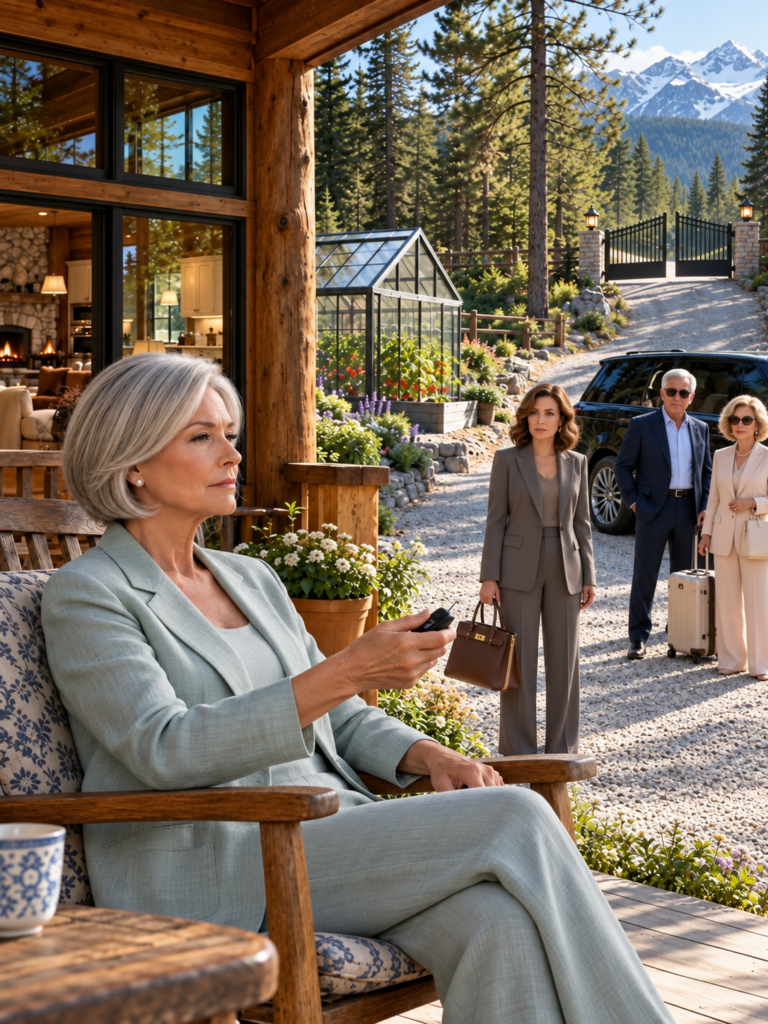
In its place stood a beautiful timber house glowing beneath warm porch lights.
The original shape was still there, but expanded.
A stone chimney climbed along one side.
Wide windows reflected the forest.
A covered porch wrapped around the front.
There was a detached garage where weeds used to grow.
The roof was dark metal.
Solar panels angled along the southern side.
I whispered Alan’s name.
Then I laughed because I knew exactly what he had done.
All those weekends.
For two years Alan had occasionally disappeared to “deal with maintenance” at the mountain property.
I had been annoyed with him.
Once, during chemotherapy, I actually scolded him.
“You can barely climb stairs. Why are you worrying about that miserable cabin?”
He had smiled.
“Because some things are worth getting ready.”
I thought he meant selling it.
My hands shook as I took the brass key from my purse.
The front door opened without sticking.
That alone was a miracle.
Motion lights came on inside.
Hardwood floors.
A stone fireplace.
Deep green armchairs.
Bookshelves.
A kitchen with a farmhouse sink and copper fixtures.
Nothing flashy.
Everything beautiful.
Everything looked like me.
Not Brooke’s idea of me.
Alan’s.
There was the blue pottery I had admired in Asheville.
The old oak table we had almost bought twenty years earlier.
The reading lamp from our first house.
A quilt made by Alan’s grandmother folded across the back of the sofa.
Then I saw the photograph on the mantel.
Our wedding picture.
I sat down on the floor.
For maybe fifteen minutes, I couldn’t move.
Eventually I found the bedroom.
On the bed sat a leather binder.
MARILYN was written on the cover in Alan’s block handwriting.
Inside were warranties, contracts, tax records, well reports, solar information, insurance documents, and a list of local phone numbers.
Typical Alan.
On the first page, he had written a note.
Marilyn,
Before you panic, everything is paid for.
Before you worry, I have planned for maintenance.
Before you decide this is too much for you, keep reading.
I pressed my fingers to his handwriting.
Below that:
You always cared whether a thing would last. Mark and Brooke care whether people notice it.
I knew exactly which kind of home you needed.
I laughed and cried at the same time.
My phone buzzed.
For one foolish second, I hoped it was Mark asking whether I had arrived safely.
It was Brooke.
Her message read:
Need your help with the condo association payment. $4,100 due tomorrow. Mark said Alan used to cover it from the family account. Please transfer it tonight.
I read it three times.
No Are you safe?
No I’m sorry.
No We shouldn’t have sent you into the mountains at night.
Four thousand one hundred dollars.
I opened my banking app.
Years earlier, Mark and I had created a joint emergency savings account after his employer went bankrupt.
I had continued contributing occasionally.
There was a little more than $32,000 in it.
Most of it had come from me.
I had never thought about that before.
Now I did.
I transferred $16,000 into my personal savings.
Then I sent Mark one message.
I removed my half of the emergency fund. The remainder is yours. From now on, please handle your household expenses independently.
My phone rang before a full minute passed.
“Mom, what did you do?”
“Hello, Mark.”
“We need that money.”
“You have sixteen thousand dollars.”
“The condo association alone—”
“Then perhaps you should review what the condo costs.”
“Dad always handled those payments.”
“Your father is dead.”
Silence.
I hated how harsh it sounded.
I hated more that it was true.
“Mom.”
“The condo belongs to you now. Its bills belong to you too.”
Brooke’s voice came through behind him.
“Give me the phone.”
Then she was there.
“What are you trying to prove?”
“Nothing.”
“You know we were counting on that money.”
“No, Brooke. I didn’t know that.”
“We’re family.”
I looked around at the house she had called a dump without ever seeing it.
“You ordered exercise equipment for my bedroom before my husband was buried a month.”
She inhaled sharply.
“That has nothing to do with this.”
“It has everything to do with this.”
“So you’re punishing Mark?”
“No.”
That answer came easier than I expected.
“I’m stopping.”
“Stopping what?”
“Paying.”
Her voice hardened.
“If you do this, don’t expect us to come running every time you get lonely up there.”
I looked through the window.
Moonlight lay across the trees.
For nineteen days, I had worried I was imposing on them.
Now, standing in the home my husband had prepared for me, something inside me became very quiet.
“Brooke,” I said, “you threw me out tonight.”
“You know what I mean.”
“I do.”
I ended the call.
I turned off my phone.
Then, for the first time since Alan died, I slept through the night.
The next morning, I woke to birds against the window and sunlight across the quilt.
For several seconds, I forgot everything.
Then grief returned.
But it arrived differently there.
Less like drowning.
More like weight.
Something I could carry.
I made coffee and continued reading Alan’s binder.
The house had no mortgage.
The taxes were prepaid through a trust account for several years.
The solar installation was owned outright.
The well had been drilled sixteen months earlier.
A local company checked the property monthly.
Alan had thought of everything.
At ten thirty, I heard tires outside.
Mark’s SUV came up the driveway.
He got out before the engine fully stopped.
I stepped onto the porch.
His eyes moved past me toward the house.
“What is this?”
“Good morning.”
“This is Dad’s cabin?”
“Yes.”
He stared.
“He renovated it?”
“Apparently.”
Mark’s face tightened.
“Can I come in?”
That question surprised me.
But I nodded.
The moment he stepped inside, his anger disappeared.
He looked around the great room.
The kitchen.
The fireplace.
The windows.
“This is worth a fortune.”
There it was.
Not beautiful.
Not Dad did this for you.
Worth.
He turned.
“Mom, you could sell this.”
“No.”
“You haven’t even heard me.”
“I heard you before you arrived.”
He rubbed his forehead.
“The Miami place is complicated.”
“Then sell it.”
“Brooke doesn’t want to.”
“That sounds like something the two of you should discuss.”
“Do you know what Dad left you here?”
“A home.”
“No. Financially.”
I set down my coffee.
“I don’t know yet.”
“You should have it appraised.”
“Eventually.”
“Mom, listen. You could sell this, buy a little townhouse near us, and we’d have enough left to handle the condo.”
I stared at him.
“A little townhouse.”
“You don’t need all this space.”
Neither did he.
But I didn’t say it.
Instead I asked, “Did Brooke tell you to come here?”
His silence answered.
I stepped toward the door and opened it.
“I’m going to save both of us an ugly conversation.”
“Mom.”
“You have a home.”
He frowned.
“So do I.”
He stared at me as if the thought had never occurred to him.
Then he left.
I watched his SUV disappear down the drive.
That afternoon, I found a second envelope in Alan’s binder.
The flap was sealed.
Across the front he had written:
MARILYN — NOT YET.
Underneath, in smaller handwriting:
You’ll know when.
I put it back.
For the first time in forty-one years of marriage, I wished Alan were sitting beside me so I could tell him how infuriating he was.
Part 2
For the next two weeks, I learned the house.
Not the property.
The house.
That distinction became important.
I discovered Alan had turned the small back room into a greenhouse with south-facing windows.
There was an automatic irrigation timer beneath the sink.
The garage held gardening tools, a compact tractor, stacked firewood, and three shelves labeled in Alan’s handwriting.
ELECTRICAL.
PLUMBING.
MARILYN WILL NEVER PUT THINGS BACK HERE.
I laughed so loudly I frightened myself.
A woman named Donna Mercer stopped by on my third morning carrying blueberry muffins.
She was sixty-eight, widowed, and lived two miles away.
“Alan said you’d eventually show up,” she told me.
“You knew him?”
“Oh, honey.”
She smiled.
“Half the mountain knew him.”
That was how I learned Alan had spent two years becoming part of a community I had never known existed.
He drank coffee at the volunteer fire station.
He hired local carpenters.
He helped Donna repair her chicken coop despite being in treatment.
“He didn’t tell people much about being sick,” she said.
“That sounds like him.”
“He talked about you constantly.”
That did not sound like the final months I remembered.
At home Alan had been tired.
Quiet.
Sometimes irritable.
I had mistaken exhaustion for distance.
Donna took a muffin from the basket.
“He said this place was his apology.”
“My apology?”
“No. His.”
“For what?”
She studied me.
“He didn’t say.”
That stayed in my mind.
Sixteen days after I moved in, I found out.
Brooke arrived shortly after lunch.
Not alone.
Mark was driving.
Brooke sat beside him.
In the back were Brooke’s parents, Steven and Gail.
And strapped to the roof rack were two expensive suitcases.
I stepped outside.
Brooke climbed from the passenger side wearing sunglasses.
“We’re staying through Sunday.”
I actually looked behind me, wondering if another woman named Marilyn owned the house.
“No, you’re not.”
Brooke lowered her sunglasses.
“Excuse me?”
“We’re not having guests.”
“Guests?”
She laughed.
“We’re family.”
Steven got out slowly.
He was a retired dentist in his seventies, a gentle man I had always liked.
Gail remained beside the car looking uncomfortable.
Steven cleared his throat.
“Marilyn, I thought Brooke said you invited us.”
I looked at him.
“I didn’t.”
He turned toward his daughter.
Brooke’s jaw tightened.
“It was implied.”
“How?” I asked.
She removed the sunglasses completely.
“Can we not do this in the driveway?”
“Yes, we can.”
Mark came around the SUV.
“Mom, we just need a weekend to sort some things out.”
“What things?”
“The estate.”
“The estate was handled.”
Brooke laughed.
“Clearly not.”
She pointed toward my house.
“There are major assets here nobody disclosed.”
Nobody.
As if I were a corporation withholding quarterly earnings.
“Brooke, this property was deeded to me.”
“We know that. We’re trying to determine whether Dad intended the improvements to come out of the shared estate.”
“Dad?”
I looked at Mark.
“Your wife called Alan ‘Dad’ approximately three times in fifteen years.”
“Mom.”
“No.”
For the first time, I understood the usefulness of that word.
No explanation.
No negotiation.
No.
Brooke put both hands on her hips.
“We have serious financial obligations because of what Alan left Mark.”
“Then why are you here?”
“Because he treated the beneficiaries unfairly.”
“Interesting.”
“What is that supposed to mean?”
“It means you didn’t consider the Miami condominium unfair when you thought it was the more valuable inheritance.”
Steven looked from Brooke to Mark.
“What financial obligations?”
Nobody answered.
Gail finally got out of the vehicle.
“Brooke?”
Brooke’s face changed.
That was the first clue.
Whatever they had come to ask from me, her parents did not know everything.
Mark sat on the porch step.
He looked exhausted.
“The building assessment was approved.”
Brooke spun toward him.
“We don’t have to discuss numbers out here.”
“Assessment?” Steven asked.
Mark nodded.
“How much?”
He stared at his hands.
“Three hundred and twelve thousand dollars.”
Gail whispered, “Good Lord.”
I felt the railing beneath my palm.
“Three hundred and twelve thousand?”
“For structural work, reserves, waterproofing, elevators, some code upgrades.”
“And you didn’t know?”
Mark looked away.
Brooke answered.
“It wasn’t final.”
That wasn’t my question.
“Did you know it was possible?”
No answer.
“Mark?”
His face told me.
I felt something cold move through my chest.
“When?”
He swallowed.
“Dad mentioned it.”
“When?”
“Before Thanksgiving.”
Alan had died in September.
“So you knew nearly a year ago?”
“It wasn’t certain.”
“What did your father tell you?”
Mark stood.
“He said the association had been underfunded for years. He said special assessments were likely.”
“And you chose the condo anyway.”
Brooke cut in.
“We chose a property with long-term value.”
Steven stared at her.
“You told us the place was practically debt-free.”
“It is.”
“No,” I said quietly. “The mortgage may be gone. That doesn’t mean living there is free.”
Brooke’s expression hardened.
“This isn’t helping.”
“I wasn’t trying to help.”
She looked genuinely shocked.
That was when Gail spoke.
“Brooke, what exactly did you bring us up here to do?”
Brooke hesitated.
Steven answered for her.
“She told us Marilyn was considering selling the property and sharing the proceeds.”
I stared at her.
“I never said that.”
Brooke’s mouth tightened.
“You said you hadn’t decided what to do.”
“That isn’t the same thing.”
Steven’s face slowly changed.
I had seen that expression before.
It was the look of a person noticing the first crack in a wall and realizing the damage might extend much farther.
“Brooke,” he said, “is that why you asked about the home equity line?”
Mark turned.
“What home equity line?”
Nobody moved.
Brooke looked at her father.
“Dad.”
Steven’s voice became wary.
“The loan. Three years ago.”
Mark stared at his wife.
“What loan?”
“Not now.”
“What loan, Brooke?”
Gail closed her eyes.
I realized she already knew where this was going.
Steven spoke carefully.
“Brooke borrowed against our house.”
“How much?” Mark asked.
Brooke stepped between them.
“My finances with my parents are none of your mother’s business.”
“They’re my business.”
Mark’s voice was different.
Stronger.
“How much?”
Steven answered.
“One hundred and five thousand.”
Mark actually laughed.
It was not a happy sound.
“For what?”
Brooke folded her arms.
“I invested it.”
“In what?”
“Different things.”
“What things?”
“Mark, stop.”
“Did I know about this?”
“You knew we were investing.”
“I knew about our brokerage account.”
“That was part of it.”
“How much is left?”
She said nothing.
Steven looked stricken.
“Brooke told us you were aware.”
Mark’s face went pale.
“How much is left?”
Brooke’s voice dropped.
“About twenty-eight.”
“Twenty-eight thousand?”
She nodded.
A silence settled over the porch.
A bird called somewhere beyond the trees.
Mark sat down again.
Then Gail began to cry.
Not loudly.
She looked embarrassed by it.
“We’ve been making the interest payments,” she said.
Brooke snapped, “Mom.”
Gail ignored her.
“And the car.”
Mark looked up.
“What about the car?”
Brooke shut her eyes.
Steven stared into the woods.
“The Range Rover.”
Mark’s mouth opened.
“Her Range Rover?”
“She fell behind.”
“How long?”
“Seven months.”
I stepped backward.
Not because I was shocked by the debt.
Because suddenly the whole structure became visible.
My money.
Alan’s money.
Steven and Gail’s home.
Credit cards.
Cars.
The condo.
The way Brooke always spoke about “our lifestyle” as though lifestyle were a utility bill someone else was obligated to keep connected.
But Mark had participated too.
He had enjoyed the benefits.
He had accepted rescue after rescue.
He had learned not to ask where the floor was because someone always built one under him.
Brooke turned on me.
“This is exactly what happens when people start judging things they don’t understand.”
“I haven’t said anything.”
“You didn’t have to. You brought everyone out here and turned them against me.”
I almost smiled.
“Brooke, you brought everyone out here.”
Her face reddened.
“You know what I mean.”
Actually, I did.
For years, whenever consequences appeared, somebody had caused them.
A boss.
A bank.
An unfair bill.
Her parents.
Mark.
Me.
Never Brooke.
Never the choice that came before the bill.
Never the purchase before the debt.
Never the insult before the loneliness.
She pointed toward the house.
“If you hadn’t pulled that money from the account, none of this would be happening.”
That sentence did something to me.
It did not make me angry.
It made me certain.
I walked inside.
“Where are you going?” Mark asked.
I stopped at the doorway.
“I’ll be right back.”
The leather binder was in my desk.
I opened it to the sealed envelope.
MARILYN — NOT YET.
You’ll know when.
I smiled despite myself.
“Oh, Alan.”
I took it outside.
All four of them watched me.
I broke the seal.
Inside were several folded documents and a letter.
The first line read:
My darling Marilyn,
If you’re opening this while someone is demanding that you turn your security into their rescue, then unfortunately I know our family too well.
I covered my mouth.
Mark whispered, “Dad wrote that?”
I nodded.
The letter continued.
The cabin was only one portion of the property.
Alan had spent four years acquiring adjacent parcels through a family trust.
The house itself sat on fourteen acres.
Behind it, connected through three recorded parcels, were another 171 acres of forest, meadow, and creek land.
There was a pond I had not yet seen.
An old apple orchard.
A conservation easement.
And a timber-management agreement with a regional forestry cooperative.
I flipped through maps.
Mark came closer.
“So this is all yours?”
“Apparently.”
Brooke stepped forward.
“How much is it worth?”
Mark shot her a look.
She ignored him.
I kept reading.
The land could not be subdivided for major residential development without violating the conservation agreement.
Brooke immediately said, “That’s terrible.”
Steven looked at her.
“No, Brooke. That’s the point of a conservation agreement.”
She frowned.
“But it limits the value.”
“Not everything is about resale value,” he said.
I almost laughed.
Then I found the financial section.
Under the agreement, selective timber harvesting, habitat management, stream restoration, and conservation payments produced annual income.
Not millions.
Not a miraculous fortune.
Just steady money.
The projected net annual amount was between sixty-two and seventy-four thousand dollars, depending on approved forestry work and program funding.
Enough to maintain the property.
Enough to pay taxes, insurance, repairs, and much of my living expenses.
Alan had built a self-supporting home.
Mark read the estimate twice.
Brooke whispered, “You’ve got to be kidding.”
But the money wasn’t what broke me.
It was the next page.
Alan’s handwriting.
Marilyn,
You are going to look at the acreage and worry that I have given you another job.
I haven’t.
Donna knows the cooperative. Ben Talley manages the forestry work. Their numbers are in the binder.
You have spent forty years making yourself useful to everyone you love.
For once, I am asking you not to be useful.
Live here.
Plant something.
Burn dinner.
Read books in the afternoon.
Sit by the water.
Miss me.
Laugh anyway.
Your job is to remain alive long enough to discover you were always more than what you did for us.
I had to stop reading.
The porch blurred.
Mark turned away.
Even Steven lowered his head.
There was another paragraph.
I forced myself to continue.
About Mark:
You will want to save him.
That instinct has been one of your most beautiful qualities and one of your most dangerous.
We made adulthood too comfortable for him.
I participated too.
Don’t carry all the blame.
But if we keep paying for every mistake, then we are teaching our son that consequences are emergencies other people should solve.
Let him carry something.
He may surprise himself.
I wiped my eyes.
Mark’s voice came quietly.
“Dad thought I was a failure.”
“No.”
I looked at him.
“He thought we didn’t let you find out whether you could fail and recover.”
“Same difference.”
“No.”
This time my voice was firmer.
“A failure is an identity. A bad decision is something you survive.”
Mark sank onto the porch step.
I sat beside him.
For a moment, he was ten again.
Then thirty.
Then forty-two.
All at once.
“I chose the condo,” he said.
“Yes.”
“He warned me.”
“Yes.”
“I thought he was trying to talk me out of it because he wanted to keep it.”
That surprised me.
“Why?”
Mark gave a bitter laugh.
“Because I thought everybody wanted what I wanted.”
Brooke was standing near the SUV.
Her arms were crossed.
She looked more frightened than angry now.
“Fine,” she said. “Everybody gets to have a moral awakening. Wonderful. We still have three hundred twelve thousand dollars due.”
Steven turned toward her.
“You mean you and Mark do.”
She stared at him.
“Dad.”
“I love you.”
His voice trembled.
“But your mother and I are not borrowing against our home again.”
Brooke looked at me.
Then at Mark.
Something inside her hardened.
“So that’s it? Everyone abandons us?”
Mark stood.
“No.”
She looked relieved.
Then he finished.
“We sell the condo.”
Her face changed.
“No.”
“Yes.”
“That property is our future.”
“The assessment is our present.”
“We’ll find another solution.”
“Whose?”
She said nothing.
He nodded slowly.
“That’s what I thought.”
Brooke grabbed one suitcase from the roof rack.
“I’m leaving.”
“You came in our car.”
“I’ll get a hotel.”
She pulled out her phone.
Mark watched her.
For years, I had seen him surrender to that performance.
The anger.
The dramatic exit.
The punishment waiting if he did not chase her.
This time he didn’t move.
Brooke noticed.
Her face registered disbelief.
“You’re seriously staying here?”
“No.”
He looked at me.
“Mom doesn’t want guests.”
The corner of my mouth lifted.
Mark looked back at Brooke.
“I’m driving us home.”
The four of them left twenty minutes later.
No one stayed the weekend.
After their SUV disappeared, I closed the front gate.
Then I stood there with my hand on the latch.
The silence around me felt different from the silence in Mark’s kitchen.
That silence had been humiliation.
This one felt like ownership.
Over the following months, I learned the rest of the property.
Donna introduced me to Ben Talley, the forestry manager, who had known Alan for years.
He walked me through the conservation plan and never once talked to me as though being sixty-nine made me stupid.
I found the orchard.
I found the creek.
I found the pond.
On its eastern bank stood a bench beneath a maple tree.
A little brass plate was screwed into the wood.
Marilyn,
Sit down.
For once, nobody needs anything.
I sat for nearly an hour.
And cried until I had nothing left.
Then I went home and burned a grilled-cheese sandwich.
Alan would have been delighted.
Mark texted occasionally.
At first the messages were practical.
We listed the condo.
Brooke is furious.
Inspection Tuesday.
Assessment paperwork is worse than we thought.
I resisted every instinct to call.
To research.
To offer.
Then one evening:
Mom, I’m sorry.
I stared at the words for a long time.
Finally I wrote:
I love you.
But love and rescue are not the same thing.
His answer came five minutes later.
I think I’m finally learning that.
Part 3
Mark came back in March.
Alone.
I saw his sedan pull up instead of the SUV he used to drive.
He got out wearing jeans, work boots, and an old canvas jacket that had belonged to Alan.
He carried no folder.
No bank documents.
No envelope.
That mattered more than he knew.
When he reached the porch, he stopped.
“May I come in?”
I remembered Brooke arriving with luggage and declaring my house family property.
Those four words loosened something in my chest.
“Yes.”
We sat at the oak kitchen table.
I made coffee.
Mark wrapped both hands around the mug.
“The condo sold.”
I waited.
“For less than we expected.”
“I’m sorry.”
“We paid the assessment, taxes, association balance, and closing costs.”
He gave a tired smile.
“We walked away with enough for a deposit on a normal apartment.”
“Normal can be nice.”
“I’m discovering that.”
He looked thinner.
Not unhealthy.
Just less polished.
“What happened to the SUV?”
“Sold mine.”
“And Brooke’s?”
He stared into the coffee.
“I don’t know.”
I sat back.
He raised his eyes.
“We’re separated.”
I had suspected it.
Still, hearing it hurt.
Not because I thought their marriage had been healthy.
Because nobody gets married expecting to end at separate addresses.
“How long?”
“Six weeks.”
“I’m sorry.”
He nodded.
“We’re in counseling separately.”
He took a breath.
“I don’t know whether we’ll stay married.”
I didn’t offer an opinion.
That was new for me too.
Mark studied the table.
“I owe you an apology.”
“You already apologized.”
“No.”
He shook his head.
“I sent you words.”
He looked up.
“I need to tell you what I did.”
I waited.
“When Brooke insulted you that night, I wasn’t confused. I wasn’t shocked. I knew exactly what she was doing.”
My stomach tightened.
“I stayed quiet because I knew that if I defended you, she’d turn on me.”
He swallowed.
“So I let her humiliate you instead.”
The honesty hurt more than an excuse would have.
He rubbed both hands over his face.
“I told myself I was keeping the peace.”
“That phrase has covered a lot of cowardice in families.”
He nodded.
“I know.”
“And I helped create some of yours.”
His head came up.
“No, Mom.”
“Yes.”
I smiled sadly.
“We’re done pretending only one person at a time can be responsible for something.”
He looked at me.
“I rescued you too much.”
“That doesn’t excuse me.”
“No.”
I reached across the table.
“But it explains part of how we got here.”
He turned his hand beneath mine.
For the first time since Alan died, touching my son did not feel like holding him up.
It felt like meeting him.
Mark reached into the inside pocket of his jacket.
My heart sank.
Then he produced a letter.
Not a bill.
The envelope was old.
“Dad gave me this last Thanksgiving.”
I recognized Alan’s handwriting.
“Did you read it?”
“About fifty times.”
He unfolded it.
“There’s something you should know.”
The letter explained that Alan had offered Mark the mountain property three different times.
Once six years earlier.
Again when Alan’s illness returned.
And a final time during the private conversation they had the previous Thanksgiving.
Each time, Mark had refused.
I stared at him.
“You never told me.”
“I was embarrassed.”
“What did you say?”
He grimaced.
“The first time? I asked what I was supposed to do with a bunch of trees.”
Despite myself, I laughed.
“The second time?”
“I said maintaining the place would be a nightmare.”
“And the third?”
He looked miserable.
“I told Dad I wanted the Miami condo.”
I laughed harder.
Mark groaned.
“You don’t need to enjoy this so much.”
“I raised you. I’ve earned a little.”
His smile faded.
“Dad warned me about the assessment.”
“I know.”
“No. I mean specifically.”
He unfolded the final page.
Alan had written:
Mark,
I am giving you the Miami property because you have asked for it repeatedly, and because you are old enough to choose what kind of responsibility you want.
Do not confuse a valuable asset with a free life.
Your mother is not a backup financial plan.
If maintaining the image you want requires selling her security, then you cannot afford the image.
Mark stopped reading.
His voice cracked.
He continued.
You are not helpless.
Your mother sometimes treats you as if you are because protecting you makes her feel useful, and you sometimes allow it because being rescued feels easier than disappointing her.
Both of you need to stop.
Love her as your mother.
Not as your emergency fund.
Then the last lines.
If there comes a day when Marilyn has peace and you resent her for it, ask yourself a difficult question:
Do you want your mother happy?
Or do you simply miss having her useful?
The kitchen became completely still.
Mark folded the letter.
“I hated him when I first read that.”
“Your father had a gift.”
“For making people mad?”
“For being right in an inconvenient way.”
Mark laughed.
Then he cried.
Quietly.
I let him.
I did not rush around the table.
I did not tell him everything was fine.
Everything wasn’t.
Instead, when he finally looked up, I handed him a napkin.
He smiled through tears.
“Look at you. Making me wipe my own face.”
“Progress.”
We walked to the pond that afternoon.
The woods had begun turning green.
At the bench, Mark read the plaque.
He sat down.
“Dad built all this while he was dying.”
“Yes.”
“Why didn’t he tell us?”
“I think he knew we’d interfere.”
Mark looked at me.
“You would have told him not to spend the money.”
“I absolutely would have.”
“And I would have asked what the property was worth.”
“Probably.”
We sat quietly.
Then Mark said, “I gave away the money.”
“What money?”
“The remainder from our old emergency account.”
My stomach tightened.
“You didn’t have to give it back to me.”
“I didn’t.”
He handed me a folded receipt.
Fifteen thousand dollars had been donated to the cancer-support organization that helped Alan during treatment.
“For Dad?”
Mark nodded.
“For people sitting in those waiting rooms wondering how they’re going to pay for gas and parking and food while somebody they love is dying.”
My eyes filled.
“That was a good thing.”
“I almost used it for the assessment.”
“Also understandable.”
He smiled.
“But I wanted to do one thing Dad couldn’t accuse me of doing for appearances.”
Spring turned to summer.
Mark visited every few weeks.
He found a job with a logistics company after leaving the consulting position he hated.
The salary was lower.
He seemed happier.
He learned how to repair the greenhouse door.
He helped Ben clear a trail.
He complained about mosquitoes.
He stopped asking what the property was worth.
Then, near Thanksgiving, I got a phone call from Brooke.
I almost didn’t answer.
“Hello?”
“Marilyn?”
“Yes.”
Her voice was quieter than I remembered.
“I’d like to ask you something.”
“All right.”
“Mark and I are still living separately.”
“I know.”
“We’ve been doing counseling.”
“I know that too.”
She paused.
“I want to apologize to you.”
“You already apologized once.”
“No.”
There was pain in her voice.
“I said I was sorry for how things turned out. That’s not the same thing as being sorry for what I did.”
I sat down.
“What are you asking?”
“One hour.”
“At the house?”
“Yes.”
“Will Mark be with you?”
“No.”
That surprised me.
“Why?”
“Because if I need him beside me to apologize to you, then I’m still making him responsible for what I did.”
I closed my eyes.
“All right.”
She came the following Saturday.
No luxury SUV.
She drove a five-year-old Honda sedan.
She parked near the garage and walked up carrying a cardboard box.
At the porch, she stopped.
“May I come in?”
Apparently humility had a favorite sentence.
“Yes.”
She placed the box on the kitchen table.
Inside were things from my room at Mark’s house.
A framed photograph of Alan fishing with Mark when he was seven.
My mother’s handwritten recipe book.
A small jewelry case.
Two scarves.
Alan’s fountain pen.
I picked it up.
“I thought I lost this.”
Brooke looked at the floor.
“You didn’t.”
I stared at her.
“I packed your room before the night you left.”
The words seemed to change the temperature.
“What?”
“The exercise equipment wasn’t arriving Friday.”
She swallowed.
“It had already arrived. It was in storage.”
I put the pen down.
“You planned to throw me out.”
“Yes.”
“How long?”
“Before Alan died.”
I gripped the back of a chair.
She rushed to continue.
“I knew you’d probably stay with us afterward. I didn’t want it.”
“You could have said that.”
“I should have.”
“Instead you waited until my husband died.”
Her eyes filled with tears.
“Yes.”
I wanted to hurt her then.
Not physically.
I wanted to find the sentence that would make her feel as small as she had made me feel in that kitchen.
The old version of me would have swallowed the anger.
This version did something different.
I told the truth.
“That was cruel.”
“I know.”
“Not thoughtless.”
“I know.”
“Not stress.”
“I know.”
“Cruel.”
She nodded.
“Yes.”
I sat.
“So tell me why.”
Brooke remained standing.
“At first I thought I hated how dependent Mark was on you.”
I almost laughed.
“You benefited from that dependence.”
“I know.”
She wiped her cheek.
“That’s what I had to admit.”
She finally sat across from me.
“Whenever Mark and I fought, he called you. If we had money problems, you fixed them. If he was scared, he talked to you instead of me.”
“That wasn’t healthy.”
“No.”
Her eyes met mine.
“But instead of asking him to change, I turned you into competition.”
I said nothing.
“My parents always fought about money when I was growing up. Everything felt scarce. Attention. Approval. Security.”
She shook her head.
“Somewhere along the way I started believing that if somebody else had something, it meant there was less left for me.”
“So you wanted me gone.”
“Yes.”
The directness stopped me.
“I thought if Mark couldn’t run to you, he’d finally choose me.”
“That’s not choosing.”
“I know now.”
She looked toward the window.
“When Alan died and Mark inherited the condo, I thought we’d won something.”
“Won against whom?”
She gave a broken little laugh.
“Exactly.”
We sat there for a while.
Then she said, “The worst part is that you never competed with me.”
“No.”
“I built a fight you weren’t having.”
“Yes.”
She looked down.
“I don’t expect forgiveness.”
“Good.”
Her eyes rose.
“I mean that.”
I touched Alan’s fountain pen.
“I don’t trust you.”
“I understand.”
“I don’t know whether I ever will.”
“I understand.”
“And if you and Mark reconcile, that doesn’t automatically restore your relationship with me.”
“I know.”
Something softened in her face.
Not relief.
Acceptance.
That mattered.
I studied her.
“But I believe you’re telling me the truth today.”
She cried then.
I didn’t rush across the table.
I did not rescue her from that moment either.
Before she left, she asked if she could hug me.
“No,” I said.
She nodded.
“Okay.”
At the door, I added, “Maybe someday.”
Her face trembled.
“I’d like that.”
That Christmas, Mark came for three days.
Brooke did not come.
That was her choice and mine.
Maybe next year would be different.
Maybe not.
I no longer needed every damaged relationship to be repaired immediately in order to believe the future could still be good.
Christmas Eve, Mark and I sat beside the fireplace talking about Alan.
Not Alan the patient.
That surprised me.
For almost three years, illness had swallowed the man.
When I thought of him, I remembered medication alarms.
Hospital bracelets.
Weight loss.
Oxygen.
That night, Mark remembered Alan trying to dance at his wedding and stepping on three women.
I remembered the Hawaiian shirts he wore specifically because I hated them.
Mark remembered how his father checked the weather six times before driving anywhere.
I remembered the candy bars Alan hid behind frozen broccoli because he knew I would never look there voluntarily.
We laughed until my stomach hurt.
At some point I realized I had gone an entire hour without thinking about how he died.
I had been thinking about how he lived.
That was another gift.
Weeks later, Donna came over carrying a small metal box.
“Ben found this while cleaning the old workshop.”
My name was taped across the top.
Inside was one final envelope.
I knew Alan’s handwriting before I touched it.
Marilyn,
If you’ve found this, I have officially run out of places to hide letters.
Typical.
I kept reading.
There were no deeds.
No accounts.
No warnings.
Just my husband.
He told me he was sorry for the years his work had taken priority.
He thanked me for caring for him when illness made him difficult.
He told me he knew I would remember the last painful years too clearly unless I deliberately made new memories.
Then came the line I needed most.
Do not turn grief into another job you have to perform correctly.
Some days, miss me.
Some days, forget me for three hours because you’re laughing.
Both are love.
I folded the letter.
That evening, I carried it to the pond.
The sun was setting behind the ridge.
I sat on Alan’s bench.
The water barely moved.
No phone rang.
No child needed money.
No daughter-in-law was measuring my bedroom for something else.
No doctor was waiting for me to make a decision.
There was only wind in the trees and the ache of missing a man who had loved me imperfectly, stubbornly, and well.
Mark still had problems.
So did Brooke.
So did I.
That was another thing I had learned.
Peace was not the reward you received when everyone you loved finally stopped making mistakes.
Peace was what happened when you stopped believing every mistake was yours to fix.
I touched the brass plaque on the bench.
For most of my life, I had believed love meant making myself indispensable.
A good wife served.
A good mother sacrificed.
A good grandmother, neighbor, friend, and caregiver noticed needs before anyone had to ask.
There was goodness in some of that.
But somewhere along the way, I had confused being needed with being loved.
Alan had seen it.
Maybe because he had benefited from it too.
In the end, he gave me more than property.
He gave me a locked door with my key.
A home nobody could order me out of.
Money I did not have to surrender.
Land I was not required to sell.
A son I could love without carrying.
And a life that did not need to justify the space it occupied.
The first stars appeared above the trees.
I looked toward them.
“Good night, Alan.”
Nothing answered.
No wind suddenly moved.
No bird called.
No miraculous sign appeared across the pond.
And for once, I didn’t need one.
I had spent forty-one years being loved by that difficult, meticulous man.
I had the letters.
I had the memories.
I had the house.
Most importantly, I had finally understood what he had been trying to give me before he died.
Permission.
Permission to open my own front door without apologizing.
Permission to sit down when there was work left unfinished.
Permission to let grown people solve grown problems.
Permission to love my son without paying for his choices.
Permission to miss my husband without following him into the grave.
Permission to be more than useful.
The temperature dropped, so I stood and tucked Alan’s letter into my coat.
Then I walked home through the trees.
My porch light was already glowing.
For years, I had thought a home was the place where the people you loved needed you.
I was wrong.
Sometimes a home is simply the place where no one can make you earn the right to stay.
I unlocked the door.
Walked inside.
And closed it gently behind me.