
Part 1
The first thing I noticed when I walked into the house was the cold.
Not the ordinary draft that slipped beneath the mudroom door every January. This was a hard, open-air cold, the kind that made the heat inside the house seem useless.
I stood there with my briefcase still in my hand.
“Claire?”
No answer.
I heard a sound from somewhere beyond the kitchen.
A child crying.
Not loudly.
That was what frightened me.
Our daughter, Lucy, had never been quiet when she was upset. She had inherited my tendency to announce every injury as if medical helicopters were already on the way. A scraped knee became a tragedy. A tangled brush became an injustice.
But this sound was small.
Broken.
Almost exhausted.
I dropped my keys on the counter and ran toward the back of the house.
The sliding door was open.
Snow blew across the threshold.
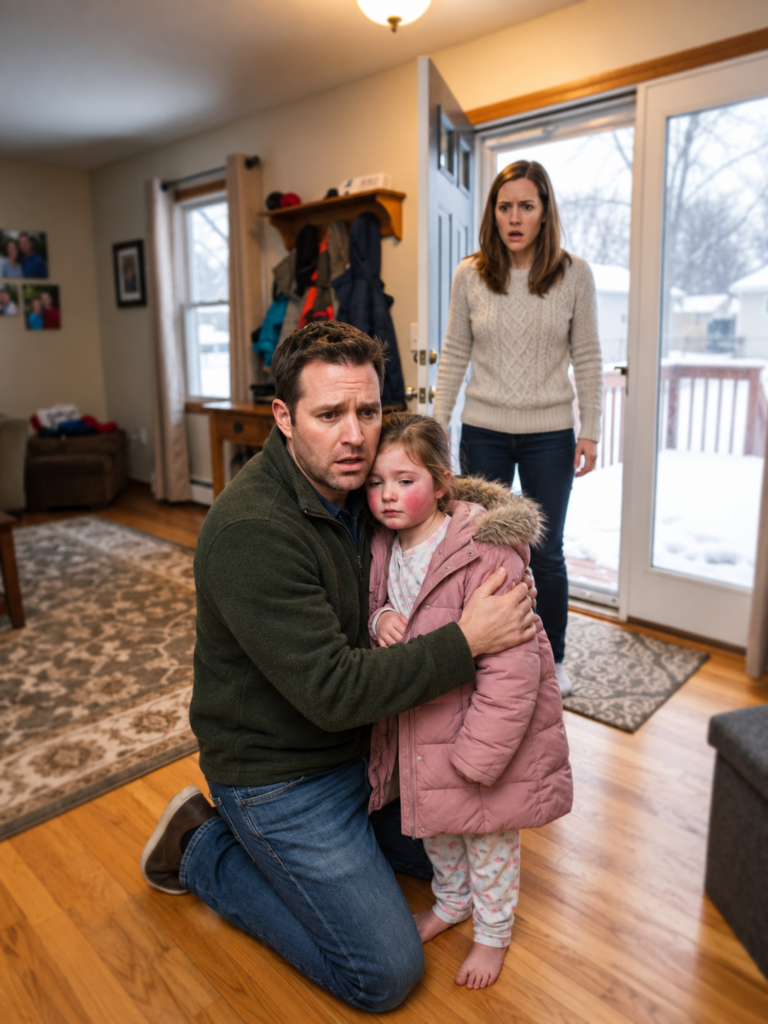
And on the patio, beneath the yellow porch light, I saw my wife gripping our daughter by the ankles.
Lucy’s coat had ridden up around her shoulders. Her shirt was half untucked. Her bare hands were against the icy concrete as she tried to push herself upright.
There was a plastic bowl near the steps, cracked down one side, with macaroni scattered across the snow.
For perhaps two seconds, my mind refused to understand what I was seeing.
“Claire!”
My wife looked over.
She wasn’t startled.
That was what I remembered later.
She didn’t react like someone who had been caught doing something terrible.
She looked irritated that I had interrupted her.
“She threw her dinner.”
Lucy sobbed.
I crossed the patio and took hold of her.
“Let go.”
Claire’s grip tightened.
“Daniel, stay out of it.”
“Let go of her.”
“She needs consequences.”
Lucy made a choking sound.
I pulled her free.
The instant I lifted her, she curled against me.
She was burning with fever and freezing at the same time.
Her cheek felt hot against my neck.
Her fingers were so cold they seemed stiff.
I wrapped my wool coat around her and carried her toward the house.
Behind me, Claire said, “You’re doing exactly what she wants.”
I turned.
“What?”
“She acts helpless and you rescue her. Every time.”
Lucy’s face disappeared beneath my collar.
I felt her breathing against my chest.
Fast.
Shallow.
She whimpered when I adjusted my grip.
“What hurts, sweetheart?”
Her eyes lifted toward mine.
“My side.”
“Where?”
She touched the right side of her chest.
Then she immediately pulled her hand away.
I looked at Claire.
“What happened?”
“She fell.”
A moment earlier, she had been talking about consequences.
Now Lucy had fallen.
I carried her into the kitchen.
“Did she fall today?”
Claire followed me inside and shut the sliding door with more force than necessary.
“She slipped.”
“Where?”
“I don’t know. Outside.”
“You don’t know?”
“Oh, stop interrogating me.”
Lucy clung tighter.
That movement hurt her.
She winced again.
I sat her carefully in one of the kitchen chairs and crouched beside her.
“How long have you been outside?”
She glanced toward her mother.
I noticed it immediately.
“Lucy.”
Claire crossed her arms.
“She can answer.”
Our daughter’s mouth opened, but no sound came.
I had seen that look before.
Suddenly, dozens of moments from the previous year rearranged themselves in my memory.
Lucy saying she bumped into the dresser.
Claire saying Lucy bruised easily.
Lucy refusing to change clothes in front of me after swimming.
A teacher mentioning that she had become “withdrawn.”
Lucy asking if she could come to my office one Saturday rather than stay home with Claire.
I had noticed each thing separately.
I had never placed them beside one another.
Until that night.
I stood.
“She needs a doctor.”
“Oh, please.”
Claire laughed once.
It was a humorless sound.
“She has the flu.”
“She can barely breathe without hurting.”
“She’s being dramatic.”
I stared at her.
She stared back.
Ten years earlier, I had loved the certainty in Claire’s face.
That confidence had attracted me when we were both twenty-nine and working too many hours and pretending we knew where our lives were going.
Claire could walk into a room and make a decision before anyone else had understood the problem.
After Lucy was born, that same certainty hardened.
A child who cried too much was manipulative.
A teacher who disagreed with her was incompetent.
A pediatrician who suggested patience was indulgent.
And a husband who questioned her discipline was undermining her.
For years, I had made compromises because I thought that was what marriage required.
Lately, I had begun to understand that some compromises were simply another name for surrender.
My briefcase was still by the mudroom.
Inside it were divorce papers.
That morning, I had sat in the office of a family-law attorney named Rebecca Hale and signed my name on the preliminary petition.
I had not told Claire.
I planned to tell her after Lucy went to bed.
I had rehearsed it all afternoon.
No shouting.
No accusations.
No using Lucy as a weapon.
I was going to tell Claire we could no longer live together without damaging everyone in the house.
I had even believed we might discuss temporary arrangements like reasonable adults.
Standing in that kitchen, I realized how naive that plan had been.
I walked to the mudroom and returned with the papers.
Claire looked at the envelope.
Her face changed.
“What is that?”
I set it on the table.
“I was going to talk to you tonight.”
She opened the envelope.
Lucy watched us from inside my coat.
Claire read the first page.
Then the second.
Her mouth tightened.
“You filed for divorce?”
“I signed today.”
Her eyes lifted slowly.
“You planned this.”
“Yes.”
“Behind my back.”
“I met with an attorney.”
“You coward.”
“This isn’t the conversation we’re having right now. Lucy needs medical attention.”
Claire slapped the papers off the table.
Pages slid across the floor.
Lucy jumped at the sound.
I saw it.
So did Claire.
Neither of us mentioned it.
“You are not taking my child anywhere.”
I took out my phone.
Claire moved toward me.
“You hear me?”
“Yes.”
“I said no.”
“She is injured.”
“She fell.”
“Then a doctor can determine whether she’s okay.”
“This is because of those papers.”
“No.”
“You want custody.”
“I want her seen by a doctor.”
“You’re building a case.”
Something in her voice made me stop.
Not because the accusation was true.
Because she sounded as if she had already been thinking in those terms.
Evidence.
Cases.
Sides.
I dialed 911.
Claire’s expression went blank.
Then furious.
“What are you doing?”
“Calling an ambulance.”
“You are unbelievable.”
The dispatcher answered.
I gave our address.
I explained that my eight-year-old daughter had been outside in freezing temperatures, that she had a fever, that she was experiencing pain when breathing, and that I had found my wife holding her upside down as punishment.
Claire stepped close enough that the dispatcher could probably hear her.
“He’s lying.”
I moved away.
“He just served me divorce papers,” she said loudly. “This is about custody.”
The dispatcher asked whether everyone was currently safe.
I looked at Lucy.
She was watching Claire.
“Yes,” I said. “My daughter is with me.”
Lucy reached out.
I went to her.
She caught two fingers of my left hand.
“Daddy?”
“I’m right here.”
Her voice dropped until I almost missed the words.
“Don’t make me stay with Mommy.”
Every argument I had prepared for that evening became irrelevant.
I sat beside her.
“You’re coming with me.”
Claire heard.
Her face hardened.
“She has been coached.”
“She just said it.”
“She says whatever gets her attention.”
Lucy began crying again.
I turned to Claire.
“Stop.”
“You stop. You are poisoning her against me.”
“I have said almost nothing.”
“You don’t have to. Look at you.”
The sirens arrived before I could answer.
Two paramedics came through the front door.
One was a woman in her forties named Marisol. She knelt beside Lucy, introduced herself, and spoke in a voice so calm that Lucy stopped crying long enough to listen.
“Can you tell me where you hurt?”
Lucy pointed.
Marisol pressed gently around her rib cage.
Lucy cried out.
The second paramedic looked at me.
“How long has she been having pain?”
“I don’t know. I came home maybe fifteen minutes ago.”
“She’s been sick?”
“Fever since yesterday.”
Claire stood by the refrigerator.
“Her temperature was barely over a hundred.”
Marisol glanced at her, then back at Lucy.
“How long was she outside?”
Claire replied first.
“Two minutes.”
I said, “I don’t know.”
The second paramedic looked between us.
Claire said, “She threw dinner and ran outside.”
I looked at her.
That was new.
“You said she fell.”
“She did.”
“You also said you were punishing her.”
“I was bringing her back inside.”
Lucy shook her head.
Very slightly.
Marisol saw it.
She did not challenge Claire.
She simply asked Lucy, “Sweetheart, can you take a slow breath for me?”
Lucy tried.
She cried.
Marisol looked at her partner.
“We’re transporting.”
The police arrived while the paramedics were moving Lucy to the stretcher.
Claire immediately approached the first officer.
“My husband is filing for divorce, and he is turning our daughter against me.”
The officer, whose badge read MORALES, held up one hand.
“We’ll talk to everybody separately.”
“She has the flu. She had a tantrum. That is what happened.”
“Ma’am, I said we’ll talk separately.”
I went with Lucy.
As the paramedics rolled her through the doorway, she reached for me.
“Dad?”
“I’m coming.”
I rode in the ambulance.
For the first time since walking through the door, I had nothing practical to do.
No call to make.
No argument to answer.
I sat beside Lucy and watched Marisol secure a warm blanket around her.
Lucy’s eyelids drooped.
I thought about the divorce papers scattered across our kitchen floor.
Three hours earlier, they had represented the biggest decision I had made in my adult life.
Now they felt strangely small.
At St. Catherine’s Hospital, the emergency department was bright, overheated, and nearly silent.
Doctors examined Lucy.
They ordered X-rays, then additional imaging.
I stood behind a curtain while a nurse helped her into a hospital gown.
Lucy would not let me leave the room.
“Dad stays,” she kept saying.
So I stayed.
When the doctor returned, he pulled a stool toward me.
His name was Dr. Levine.
He had the careful expression of someone about to deliver information he wished were different.
“Mr. Mercer, Lucy has three fractured ribs.”
For a moment, I thought I had misheard him.
“Three?”
“Yes.”
“How?”
“We can’t determine the exact mechanism simply from imaging. There can be different causes. But these are significant injuries.”
“She slipped?”
His pause answered before his words did.
“I would be cautious about drawing conclusions until the appropriate team has evaluated everything.”
“How old are the fractures?”
“One appears more recent. The others may not have occurred at exactly the same time.”
I sat down.
The room seemed to tilt.
“One appears more recent?”
“That’s something our pediatric specialists will review.”
I looked through the opening in the curtain.
Lucy was asleep.
Her hair was spread across the pillow.
Eight years old.
Three fractured ribs.
I remembered a Sunday six weeks earlier when she refused to go sledding with us because she said her chest hurt.
Claire told me Lucy had fallen against the bathtub.
I had believed her.
Or perhaps I had chosen the explanation that required the least courage from me.
The distinction hurt more than I expected.
Officer Morales came to the hospital a little after nine.
He spoke with hospital staff before approaching me.
“Mr. Mercer?”
I stood.
“Your wife is still at the residence.”
“Is she under arrest?”
“I can’t discuss every aspect of the investigation yet.”
I nodded.
He looked toward Lucy.
“How is she?”
“Three broken ribs.”
His jaw tightened.
“I’m sorry.”
He asked me again what I had seen.
This time, I understood why repetition mattered.
So I gave him only facts.
I had entered the house.
The back door was open.
I had seen Claire outside holding Lucy by the ankles.
Food was spilled on the patio.
Lucy was crying.
Claire described what she was doing as discipline.
Lucy complained of pain.
Claire later said Lucy had fallen.
I did not call Claire abusive.
I did not tell him what I now suspected.
I did not fill the silences with theories.
Officer Morales wrote everything down.
When he finished, he closed the notebook.
“There’s something else.”
My stomach tightened.
“What?”
“One of your neighbors contacted dispatch after seeing the emergency vehicles.”
“Who?”
“A man named Harold Bennett. Lives behind you?”
I knew Harold.
Barely.
Retired electrician. Widower. Kept his lawn perfect even in drought years.
We exchanged greetings over the fence.
Nothing more.
Officer Morales continued.
“Mr. Bennett has an exterior security camera.”
I stared at him.
“It faces our yard?”
“Partially. Mostly his side gate and rear property line. But a section of your patio is visible.”
My hands went cold.
“Did it record tonight?”
“Yes.”
“What does it show?”
He hesitated.
“That’s what we’re reviewing.”
“Does it show what happened to Lucy?”
“It begins well before you arrived home.”
I looked toward my sleeping daughter.
The room suddenly felt very quiet.
Claire had told the police Lucy ran outside.
She had told me Lucy slipped.
She had told the paramedics she was outside two minutes.
Now there was a camera.
Not a perfect camera.
Not a witness with opinions about our marriage.
A fixed lens that had been pointed in the same direction before anyone knew there would be something worth recording.
“Can I see it?”
“Not right now.”
“Why?”
“Because we’re preserving the original and establishing the timeline.”
I must have looked frustrated because his tone softened.
“Mr. Mercer, this is important. Don’t contact Mr. Bennett about the footage. Don’t ask him to send you anything. Let us preserve what he has.”
“All right.”
“And don’t assume the recording will answer every question.”
I nodded.
But inside, one question was already screaming louder than the rest.
How long had Lucy been outside before I came home?
Officer Morales moved toward the door.
Then he stopped.
“There’s one more thing.”
I waited.
“The video appears to show someone coming into your backyard before the incident.”
My first thought was that he meant me.
But I had entered through the garage.
“Who?”
“We’re working on identification.”
“Was Lucy with them?”
He did not answer directly.
“We’ll know more once we’ve reviewed the full recording.”
He left.
I sat beside Lucy again.
Around midnight, she woke.
Her eyes moved around the room until they found me.
“Daddy?”
“I’m here.”
“Am I in trouble?”
The question hit me harder than the doctor’s diagnosis.
“No.”
“I broke the bowl.”
“I don’t care about the bowl.”
“Mommy said you would.”
“I don’t.”
Her lower lip trembled.
“She said I ruin everything.”
I swallowed.
“No, sweetheart.”
“I tried to clean it up.”
“You don’t have to explain.”
“Yes, I do.”
Her voice sharpened with panic.
“Mommy says if I tell stories people take children away.”
I leaned closer.
“Lucy, listen to me. You tell people exactly what you remember. You do not have to protect me. You do not have to protect Mommy. You just tell the truth.”
She stared at me.
“What if Mommy gets mad?”
“That is not your responsibility.”
She was quiet for several seconds.
Then she whispered, “Aunt Jenna came over.”
Claire’s sister.
I straightened.
“When?”
“Before you got home.”
“Tonight?”
Lucy nodded.
“What happened?”
She glanced toward the door.
“Aunt Jenna told Mommy she had to stop.”
My pulse quickened.
“Stop what?”
Lucy closed her eyes.
“I’m tired.”
I wanted to keep asking.
I wanted every answer immediately.
But Officer Morales’s voice returned to me.
Facts.
Not assumptions.
I pulled the blanket up around her shoulders.
“Sleep.”
She caught my hand before I could move away.
“Dad?”
“Yes?”
“Don’t make me go back there.”
I held her hand.
“I won’t.”
That was the first promise I made without knowing exactly how I would keep it.
By morning, keeping it had become the only thing that mattered.
Part 2
Rebecca Hale met me in the hospital cafeteria shortly after seven.
I had called her at five-thirty.
She arrived wearing jeans, boots, and a navy sweater beneath a winter coat, looking less like the polished divorce attorney I had met the previous afternoon and more like someone who had been dragged out of bed by a family emergency.
Which, I realized, was exactly what had happened.
“You signed divorce papers yesterday,” she said, setting down two coffees. “And by midnight we have police, fractured ribs, and an open child-safety investigation.”
“Yes.”
She studied me.
“Tell me only what you personally know.”
I almost laughed.
“That’s what everyone keeps saying.”
“There’s a reason.”
So I told the story again.
When I mentioned Jenna, Rebecca stopped me.
“Claire’s sister?”
“Yes.”
“Did you contact her?”
“No.”
“Good.”
“Why good?”
“Because right now, people need to give independent accounts.”
She opened her legal pad.
“Has Lucy made allegations about previous incidents?”
“Not clearly.”
“Do not question her repeatedly.”
“I need to know what happened.”
“I understand. But you’re her father and there’s now a custody dispute. Let trained interviewers do the detailed questioning where possible.”
I rubbed both hands over my face.
“I should have seen this.”
Rebecca waited.
I looked at her.
“There were bruises. Excuses. She was quiet. I knew Claire was getting harsher.”
“Did you know your daughter had fractured ribs?”
“No.”
“Did you witness physical abuse before last night?”
I thought carefully.
“I witnessed discipline I disagreed with. Yelling. Sending her to her room for hours. Throwing away toys. Making her redo chores repeatedly.”
“Physical?”
“Once Claire grabbed her arm hard enough to leave red marks.”
“When?”
“Maybe five months ago.”
“What did you do?”
“I told her never to do it again.”
“And?”
“She accused me of undermining her.”
Rebecca wrote something.
I hated that she was writing it because seeing the words on paper transformed memory into evidence.
Evidence could be judged.
So could I.
“I should have left sooner.”
“Maybe,” she said.
The answer surprised me.
Most people would have rushed to comfort me.
Rebecca didn’t.
“Regret can make people rewrite history,” she continued. “Don’t do that either. If you failed to act on something you should have taken more seriously, own it. That’s different from pretending you knew facts you didn’t know.”
I looked through the cafeteria window.
Snow was falling again.
“What happens now?”
“I’m filing for emergency temporary custody this morning.”
“Can Claire stop it?”
“She can contest it.”
“Will Lucy have to go home?”
“Given the injuries and active investigation, I would be surprised if anyone simply sent her back without safeguards. But family court works from evidence, not your certainty.”
Evidence.
That word again.
By ten, a hospital social worker had interviewed me.
By noon, a child-protection investigator named Andrea Wells arrived.
Lucy spoke with trained staff without me in the room.
Those forty minutes were some of the longest of my life.
When Andrea emerged, she did not tell me what Lucy had said.
“She was able to speak with us,” was all she offered.
“Did she tell you what happened?”
“She provided information.”
“Is she safe with me?”
“We’re evaluating the full situation.”
I wanted to shout that I was not the one who left her outside.
Instead, I said, “All right.”
At one-thirty, my phone began vibrating.
Claire.
I let it ring.
Again.
Again.
Then text messages.
YOU HAVE DESTROYED THIS FAMILY.
Tell the police the truth.
Lucy is confused.
You know I would never hurt her.
Jenna is lying too.
That last message made me freeze.
Jenna is lying too.
I had not told Claire that Lucy mentioned her sister.
I showed the message to Rebecca.
“Do not respond.”
“Claire knows Jenna talked.”
“Or she assumes she will.”
“What does Jenna know?”
“That is exactly why you should not call her.”
The restraint nearly drove me mad.
At three, Officer Morales returned.
This time, another detective was with him.
Detective Price introduced herself and asked whether we could speak privately.
We went to a consultation room.
She placed a folder on the table.
“Mr. Mercer, we have reviewed the video provided by Mr. Bennett.”
I sat rigidly.
“Okay.”
“It covers approximately fifty minutes before your arrival.”
“How long was Lucy outside?”
“Not all of that time.”
Relief came too quickly.
Then vanished when I saw Detective Price’s expression.
“The footage begins at 4:41 p.m. Your sister-in-law, Jenna Cole, appears to enter your yard from the side gate at approximately 5:03.”
“How do you know it’s Jenna?”
“She gave us a statement and identified herself.”
“She talked to you?”
“Yes.”
“What did she say?”
Price ignored the question for now.
“At 5:11, Ms. Cole leaves through the same gate. Your wife follows her outside briefly. They appear to be arguing.”
“Can you hear them?”
“Some audio is captured, but wind and distance make parts difficult to distinguish.”
“What happens next?”
“At approximately 5:17, your daughter is visible on the patio.”
I felt my stomach twist.
“She’s outside?”
“Yes.”
“Alone?”
“For portions of the recording.”
“For how long?”
Price opened the folder.
“Approximately nineteen minutes before your vehicle arrives.”
I closed my eyes.
Nineteen minutes.
Claire had said two.
“What was she wearing?”
“Indoor clothing. No coat visible.”
I put my hands flat on the table because they had started shaking.
“Was Claire with her?”
“On and off.”
“What does that mean?”
“Your wife appears outside several times.”
“And the ribs?”
“This is where we need to be precise.”
I looked at her.
“The footage does not clearly capture how Lucy sustained every injury. Part of the patio is obscured by your storage shed.”
I felt strangely disappointed.
Then ashamed of the disappointment.
I wanted certainty so badly that I had begun treating the camera like a machine designed to punish Claire.
Detective Price seemed to read my face.
“But the recording is significant.”
“How?”
“At approximately 5:29, your daughter is visible attempting to enter the house.”
I waited.
“Your wife blocks the doorway.”
My mouth went dry.
“Blocks it?”
“Yes.”
“Then what?”
“Lucy moves toward the yard. Your wife follows. There is physical contact, partly outside the camera’s clearest field of view.”
“What kind?”
“We are still analyzing it, and I do not want to overstate what the image shows.”
“Does she fall?”
“There is a point at which Lucy goes out of view near the patio steps. Several seconds later she comes back into view on the ground.”
I swallowed.
“So Claire could still say she slipped.”
“She can describe events as she recalls them.”
That careful police language made me want to throw the table through the wall.
Price continued.
“However, the video also shows your wife placing the cracked food container outside before Lucy appears.”
I stared at her.
“What?”
“She told officers Lucy threw her dinner and ran outside.”
“Yes.”
“The bowl is already on the patio.”
Before Lucy.
I felt something inside me settle.
Not relief.
Something colder.
Claire had not simply changed details under stress.
She had built a story.
“Why would she do that?”
“That is not something I can answer.”
“What did Jenna tell you?”
Price studied me before replying.
“She said she came to the house because Lucy called her.”
“Lucy called Jenna?”
“From a tablet.”
I pictured the old tablet Lucy used for games.
“Why?”
“According to Ms. Cole, your daughter asked her to come over because she was scared.”
I stopped breathing for a second.
“Scared of Claire?”
“According to the statement, yes.”
“Did Jenna see Claire hurt her?”
“She witnessed part of an argument. She told your wife she was taking Lucy to her home. Your wife refused.”
“Why did Jenna leave?”
Price’s expression changed.
“She says Claire told her that if she attempted to remove Lucy, she would call police and accuse her of kidnapping.”
I leaned back.
“That sounds like Claire.”
“I understand this is upsetting.”
“Did Jenna just leave her there?”
“Ms. Cole says she intended to call you from her car. She did call.”
My phone had been on silent during a late meeting.
I remembered three missed calls from Jenna around five.
I had assumed they concerned a birthday dinner planned for the weekend.
I had not called back.
Price continued.
“She also contacted another family member.”
“Who?”
“Your mother-in-law.”
That surprised me.
“Margaret?”
“Yes.”
“What did Margaret say?”
“She has not yet provided a full statement.”
Rebecca later told me an emergency hearing had been scheduled for the following morning.
I spent the night on a vinyl chair beside Lucy’s hospital bed.
At two in the morning, I woke and found her staring at the ceiling.
“You okay?”
She nodded.
Then shook her head.
“Does Aunt Jenna hate me?”
“No.”
“Mommy said she left because I was bad.”
The pieces kept arriving.
Each one small enough to dismiss in isolation.
Together, they formed something I could no longer deny.
“Aunt Jenna came because you asked her to?”
Lucy nodded.
“On your tablet?”
Another nod.
“Why didn’t you call me?”
Her answer broke me.
“You’re at work.”
As if work were sacred.
As if I had somehow taught my child that spreadsheets and meetings were too important to interrupt when she was frightened.
I moved closer.
“You can always call me.”
“Mommy gets mad when I bother you.”
“She doesn’t get to decide that anymore.”
Lucy looked at me.
“Are you mad at Mommy?”
I chose my words carefully.
“I am angry about what happened. But none of this is your job to fix.”
“Are you getting divorced?”
“Yes.”
She was quiet.
Then: “Because of me?”
“No.”
The answer came so quickly she believed it.
“Your mom and I have had problems for a long time.”
“Will I have two houses?”
“I don’t know yet.”
“Do I have to sleep at hers?”
My chest tightened.
“I’m working with people whose job is to make sure you’re safe.”
She did not look reassured.
Neither was I.
The emergency hearing took place by video because Lucy had not yet been discharged.
Claire appeared from her attorney’s office.
She wore a pale blouse I had bought her for our anniversary two years earlier.
For one strange second, she looked like my wife again.
Not the woman on the patio.
The woman I had eaten breakfast beside for a decade.
That almost made it worse.
Her lawyer argued that the event had been misinterpreted during the emotional collapse of our marriage.
He described me as “a father understandably alarmed by an injured child, but also a husband who had secretly retained counsel before the incident.”
Secretly retained counsel.
As if consulting a divorce attorney explained three broken ribs.
Rebecca did not react.
She presented the hospital findings, the active investigation, the footage timeline, and Lucy’s expressed fear of returning home.
The judge granted me temporary physical custody upon Lucy’s release.
Claire was permitted only supervised contact pending further review.
I should have felt victorious.
Instead, I felt sick.
Because Claire began crying.
Real crying.
Not theatrical.
Her shoulders shook.
She pressed a tissue beneath her eyes.
“I love my daughter,” she told the judge. “I have never intentionally injured her.”
For a moment, I wanted to believe her.
That was the humiliating truth.
Even after everything, some part of me searched for an explanation that would allow the woman I married and the woman on the patio to remain separate people.
The judge ended the hearing.
Rebecca closed her laptop.
“You all right?”
“No.”
“That’s normal.”
“I almost felt sorry for her.”
“You can feel sorry for someone and still protect yourself from them.”
Lucy came home with me two days later, but not to our house.
The police investigation was still active, and Rebecca strongly advised that we stay elsewhere.
So we moved into my mother’s small ranch house fifteen minutes away.
My mother, Evelyn, had converted her sewing room into a bedroom before we arrived.
She hung yellow curtains and found a lamp shaped like a rabbit at a thrift store.
Lucy pretended not to care.
That night I found her sleeping with the lamp on.
My mother stood beside me in the hallway.
“How much did you know?”
There was no accusation in her voice.
That made the question harder.
“Not enough.”
“That isn’t what I asked.”
I looked at her.
“I knew Claire was too harsh.”
Mom nodded.
“I told myself it was parenting style.”
“She frightened Lucy.”
“I know.”
“You know now.”
I looked down the hall.
“I think I knew more than I admitted.”
My mother exhaled slowly.
“That matters, Daniel.”
“I know.”
“But what you do with that matters more.”
Three days later, Jenna called Rebecca.
She had retained her own attorney before agreeing to speak with me.
We met in Rebecca’s conference room.
Jenna looked nothing like Claire.
Where Claire was polished and composed, Jenna always seemed rumpled, even when dressed well.
That afternoon she wore an oversized green sweater and no makeup.
Her eyes were swollen.
The moment I entered, she stood.
“I’m sorry.”
I held up a hand.
“Tell me what happened.”
She sat.
Rebecca reminded us not to pressure one another into matching accounts.
Then Jenna began.
“Lucy messaged me around four-thirty.”
“What did she say?”
“Just: Can you come?”
Jenna swallowed.
“I called Claire. No answer. So I went over.”
She described arriving through the side gate because the front door was locked and she could see Claire in the kitchen.
“Lucy had spilled macaroni.”
“Did she throw it?”
“No. Claire knocked it off the counter.”
My skin prickled.
“Why?”
“They were arguing because Lucy wouldn’t eat.”
“She was sick.”
“I know.”
Jenna stared at the table.
“Claire said she was pretending.”
“What happened?”
“I told Claire to leave her alone.”
“And Claire?”
“She told me to mind my own business.”
Jenna rubbed her palms together.
“I told her I was taking Lucy with me.”
“You left without her.”
The sentence came out sharper than I intended.
Jenna flinched.
“Yes.”
“Why?”
“Because Claire said if I touched Lucy she would call the police and say I was kidnapping her.”
“So you left an eight-year-old with her?”
“I called you.”
“I didn’t answer.”
“I know.”
“You could have called 911.”
“I know.”
Her eyes filled.
“I know, Daniel.”
Anger rose in me because hers was easier to carry than mine.
“You knew your sister.”
“I knew she had a temper.”
“You saw Lucy scared.”
“Yes.”
“And you walked away.”
Rebecca said my name quietly.
I stood and walked toward the window.
Jenna began crying behind me.
“I drove two blocks,” she said. “Then I called Mom. I told her she had to go over there because Claire might listen to her.”
“Did Margaret go?”
“No.”
I turned.
“Why not?”
Jenna wiped her face.
“Because Mom said I was exaggerating.”
Of course.
Claire’s certainty had not appeared from nowhere.
Their mother had spent decades treating appearances as morality.
Good families did not scream.
Good mothers did not lose control.
Good daughters did not accuse their sisters.
Problems became acceptable if no outsider saw them.
“What happened after you left?” I asked.
“I don’t know. That is the truth.”
Rebecca leaned forward.
“Did you witness Claire strike Lucy?”
Jenna hesitated.
“No.”
I watched her.
She looked at me.
“I saw her grab Lucy by the arm. Hard.”
“Anything else?”
“No.”
The answer disappointed me.
Again, I hated myself for it.
I had begun wanting witnesses to give me certainty rather than truth.
The camera footage came to matter even more.
Then, a week later, Detective Price called.
“We found additional footage.”
My heart jumped.
“From Harold?”
“No.”
“Who?”
“Your own house.”
I almost laughed.
“We don’t have cameras.”
“You have a video doorbell.”
“At the front door.”
“Yes.”
“That doesn’t cover the backyard.”
“No. But it records audio when motion activates near the entry.”
I was silent.
Price continued.
“At 5:09, your sister-in-law exits the front door briefly before going around the side of the house. The microphone captures part of an argument through the open doorway.”
“What does it say?”
“We’re enhancing the audio, but several phrases are audible.”
“What phrases?”
She paused.
“One appears to be your sister-in-law saying, ‘You can’t keep doing this to her.’”
My hand tightened around the phone.
“And Claire?”
“There is a response.”
“What?”
“‘She knows what happens when she lies.’”
I sat down.
Same word.
Lie.
Claire had used it when I found Lucy outside.
Maybe now she’ll learn to stop lying.
I had thought she meant the spilled dinner.
But what if she meant something else?
“What was Lucy lying about?”
“We don’t know yet.”
The answer came two days later.
Not from police.
From Lucy.
We were at my mother’s kitchen table working on a school packet when she suddenly stopped writing.
“Dad?”
“Yeah?”
“If someone tells a teacher something, is that lying?”
“Depends whether it’s true.”
“What if your mom says it isn’t true?”
I set down my coffee.
“What did you tell your teacher?”
Lucy stared at the worksheet.
“I told Mrs. Patterson Mommy hurts me when she gets mad.”
The room went completely still.
“When?”
“Last week.”
Before the patio.
“What did Mrs. Patterson say?”
“She asked questions.”
“And then?”
“Mommy came to school.”
My stomach dropped.
No one had told me.
I contacted the school.
Mrs. Patterson confirmed that Lucy had made a concerning statement the previous week and that the counselor had begun the school’s mandated reporting procedure.
Claire had been contacted because the counselor originally believed the statement involved “harsh discipline,” though a formal report had also been initiated.
There had been no completed external investigation before the backyard incident.
Rebecca requested records.
The records changed everything.
In the counselor’s handwritten notes, Lucy had said:
Mom squeezes me until I say I’m sorry.
She makes me stand outside when I’m bad.
Sometimes my chest hurts.
The school had called Claire.
Not me.
Claire had picked Lucy up early that afternoon.
That was the “lie.”
Lucy had told someone.
Claire knew.
And the next time Lucy was accused of misbehaving, punishment became a lesson about what happened when she talked.
I read the counselor’s notes three times.
Then I went into Rebecca’s bathroom and vomited.
Part 3
The investigation lasted six weeks.
Those weeks changed my understanding of justice.
Before then, I had imagined truth as something dramatic.
A confession.
A camera angle.
A witness bursting into a courtroom at the perfect moment.
Instead, truth arrived in fragments.
A teacher’s notes.
A timestamp.
A bowl already sitting outside before Lucy appeared.
A missed phone call from Jenna.
A video-doorbell microphone catching eight useful seconds.
Medical imaging showing injuries from more than one incident.
A neighbor’s camera showing nineteen minutes in the cold.
A child explaining things differently depending on which memory she could tolerate that day.
No single piece told the entire story.
Together, they told enough.
Claire’s supervised visits began in February.
The first took place at a family-services center.
Lucy refused to enter the room.
The supervisor encouraged her gently.
Claire waited inside.
I could see her through a narrow window.
She had brought Lucy’s favorite stuffed fox.
For weeks, Claire had insisted through attorneys that I was poisoning Lucy against her.
But when Lucy finally entered and saw her mother, she did not run into Claire’s arms.
She stopped.
Her whole body stiffened.
Claire stood.
“Baby.”
Lucy moved backward.
The supervisor intervened.
The visit lasted eleven minutes.
Afterward, Lucy threw up in the parking lot.
The next visit was canceled on a therapist’s recommendation.
Claire sent me an email that night.
You are enjoying this.
I did not answer.
Another arrived.
You wanted to win, and now you’re winning.
I stared at those words for a long time.
Winning.
I looked into the living room where Lucy was building a blanket fort with my mother.
She still slept with lights on.
She cried when food spilled.
If I raised my voice at the television, she flinched.
She had started therapy twice a week.
She had three healing ribs and an eight-year-old’s understanding of betrayal.
If this was victory, I wanted no part of it.
Rebecca filed the email.
“Useful,” she said.
“I hate that everything has become useful.”
“That’s litigation.”
“No. It feels like we’re collecting pieces of a dead marriage and assigning exhibit numbers.”
She looked at me for a moment.
“That’s not all you’re doing.”
“What else?”
“You’re creating a record that prevents people from rewriting what happened later.”
That sentence stayed with me.
Because rewriting was already happening.
Margaret began calling relatives.
According to her, Claire had made “one parenting mistake during a stressful divorce.”
My brother received a message asking him to “encourage Daniel to think about the damage he is doing.”
A cousin I had not spoken to in three years sent me an article about parental alienation.
Even some friends became cautious.
“Claire always seemed like such a good mom.”
“She volunteered at school.”
“She organized every birthday.”
“Could things have gotten out of hand just once?”
The old me might have argued.
The new me stopped trying to convince anyone.
I had learned that people often defend the version of reality that protects their own comfort.
If Claire could do what the evidence suggested, then the pleasant dinners they remembered had to coexist with something ugly.
Some people preferred the dinners.
Harold Bennett did not.
I finally met him properly after investigators released him from any restriction on speaking with us.
He came to my mother’s house carrying a foil-covered casserole.
“I don’t cook,” he announced. “My sister made this.”
Lucy hid behind my mother.
Harold noticed and immediately lowered his voice.
“Hi there, young lady.”
She peeked out.
“You have the camera?”
I froze.
Harold’s face softened.
“Yes.”
“Did you see me?”
He looked toward me.
I started to intervene.
Lucy stepped forward.
“Did you?”
Harold considered his answer.
“I saw part of that evening.”
“Why didn’t you come over?”
The question hit everyone in the room.
Harold looked down.
“Because I didn’t understand what I was seeing soon enough.”
He did not excuse himself.
That mattered.
“My camera sends alerts,” he explained. “I ignore most of them. Cats. Delivery trucks. Branches moving. I didn’t watch the recording until I saw the ambulance.”
Lucy nodded as if this made sense.
Harold continued.
“I wish I had looked sooner.”
“So does Daddy.”
My throat tightened.
Harold looked at me.
Then back at Lucy.
“Sometimes adults miss things they wish they hadn’t.”
Lucy thought about that.
“Did you give it to the police?”
“Yes.”
“Good.”
Then she returned to her fort.
Harold stood quietly for a moment.
“She’s tougher than she should have to be,” he said.
I nodded.
“That’s what worries me.”
“Don’t confuse tough with unhurt.”
I remembered that line for months.
The prosecutor eventually informed us that criminal charges would be filed.
I will not pretend I felt satisfied.
When Detective Price told me, I sat in my parked car outside Lucy’s therapist’s office and cried.
Not because I wanted Claire protected from consequences.
Because consequences made everything final.
Claire was no longer simply my estranged wife.
She was the subject of a criminal case involving our child.
There would be no returning to the fantasy that we had merely become incompatible.
No version of the story ended with us calmly dividing furniture and attending school concerts from opposite ends of the auditorium.
The family-court hearing took place before the criminal matter was resolved.
By then, Lucy’s ribs had healed.
The rest had not.
Claire entered the courtroom with her lawyer and Margaret.
Margaret did not look at me.
Jenna sat behind Rebecca.
That alone would once have seemed impossible.
Two sisters who had spent thirty-five years defending one another now sat on opposite sides of a courtroom because one of them had finally decided that loyalty could not require silence.
Claire testified first.
She admitted putting Lucy outside.
She admitted grabbing her.
She admitted losing her temper.
But she denied intentionally injuring her.
“She was defiant,” Claire said. “I handled it badly.”
Rebecca asked, “For nineteen minutes?”
Claire’s lawyer objected.
The judge allowed the question.
Claire looked toward me.
“I didn’t know it had been that long.”
“Did you tell paramedics it was approximately two minutes?”
“I was upset.”
“Did you tell police Lucy ran outside after throwing food?”
“Yes.”
“Did she?”
Claire hesitated.
“She had been behaving badly around dinner.”
“That was not my question.”
“No.”
“Did Lucy throw the bowl outside?”
“No.”
“Who placed it outside?”
Another pause.
“I did.”
Rebecca walked toward the exhibit monitor.
A still image from Harold’s camera appeared.
Time stamp: 5:16:08.
The cracked bowl sat in the snow.
Lucy was nowhere in the frame.
Rebecca asked, “Why did you tell investigators that Lucy threw it outside?”
Claire’s face changed.
For the first time, she looked less angry than tired.
“I don’t remember exactly what I said.”
Rebecca returned to the table.
“Did you know that Lucy had spoken to her school counselor about your discipline?”
Claire’s attorney stood.
“Objection.”
The judge allowed limited questioning.
Claire’s hands tightened.
“Yes.”
“How did that make you feel?”
“I was hurt.”
“Angry?”
“I was concerned that she was exaggerating private family matters.”
“Did you call her a liar?”
Claire glanced toward Margaret.
Then back at Rebecca.
“I may have.”
“Did you tell her she needed to learn what happened when she lied?”
“I don’t remember.”
Rebecca played the doorbell audio.
The sound was rough and distant.
Jenna’s voice came first.
“You can’t keep doing this to her.”
Then Claire.
“She knows what happens when she lies.”
Silence filled the courtroom.
Claire stared straight ahead.
Rebecca did not ask a dramatic question.
She simply sat down.
Jenna testified later.
She admitted everything, including the part that made her look bad.
She admitted leaving.
She admitted being afraid of Claire’s threat.
She admitted calling me instead of police.
And she admitted that she had seen signs months earlier but allowed her sister to explain them away.
Claire watched her with an expression I could not read.
When Jenna stepped down, Claire whispered something to her attorney.
Then Margaret was called.
That was the moment the case changed for me emotionally.
Until then, I had understood Margaret as background pressure.
An enabler.
A woman who valued family reputation too much.
But under questioning, she revealed something none of us expected.
Rebecca asked whether Jenna had called her the evening of the incident.
“Yes.”
“What did she say?”
“That Claire was upset.”
“Anything else?”
Margaret looked at her daughter.
Claire’s face had gone pale.
Margaret swallowed.
“She said Lucy was frightened.”
“What did you do?”
“I told Jenna not to interfere.”
“Why?”
“Because sisters fight.”
“Did Jenna mention previous concerns?”
“Yes.”
“What concerns?”
Margaret’s voice became quieter.
“She said Claire was becoming too rough with Lucy.”
Rebecca glanced down at her notes.
“When was the first time Ms. Cole expressed that concern to you?”
Margaret hesitated.
“Not that day.”
“When?”
“Several months before.”
A murmur moved through the courtroom.
The judge silenced it.
Rebecca waited.
Margaret closed her eyes briefly.
“Last summer.”
I stared at Jenna.
She looked stunned.
Rebecca asked, “And what did you say?”
“I told her Claire was under stress.”
“Did you ever speak to Claire?”
“Yes.”
My stomach dropped.
“When?”
“August.”
“What did she say?”
Margaret began crying.
“She said Lucy was difficult.”
The courtroom blurred around me.
“How did the conversation end?”
“I told Claire she had to control her temper.”
“And did you take any other action?”
“No.”
Rebecca paused.
“Why not?”
Margaret looked toward Lucy’s empty seat.
We had fought to keep her from being required to sit through adult testimony.
“Because I was ashamed.”
Her answer was barely audible.
“Ashamed of what?”
“That people would think I raised a bad mother.”
It was one of the saddest answers I had ever heard.
Not because it excused anything.
Because it explained so much.
Margaret had protected the image of her daughter at the expense of her granddaughter.
I thought about every family gathering where she had corrected table manners, ironed napkins, and whispered about what neighbors might think.
Appearance had become a kind of religion.
And Lucy had paid the price.
Rebecca asked one final question.
“Mrs. Cole, when your granddaughter needed an adult to believe her, did you?”
Margaret shook her head.
“No.”
After that, Claire asked for a recess.
When court resumed, her attorney requested time to discuss a revised temporary custody arrangement.
Rebecca leaned toward me.
“She may stop contesting primary custody.”
“What does that mean?”
“It means listen before reacting.”
The negotiations took hours.
Claire did not surrender parental rights.
This was not a movie.
Courts do not erase family relationships because everyone reaches the end of a dramatic scene.
But she agreed that I would retain sole physical custody while the criminal case and therapeutic evaluations proceeded.
Any contact would remain supervised and subject to Lucy’s treatment team.
Decision-making authority for medical care and schooling went to me temporarily.
The house would remain unoccupied pending the property division because neither side could agree on possession.
When we left the courthouse, reporters were not waiting.
There was no crowd.
No applause.
No public humiliation.
Only dirty snow along the curb and two families who had once shared Thanksgiving dinner walking toward different parking lots.
Jenna stood beside me.
“Did we win?”
I almost smiled because she sounded as tired as I felt.
“No.”
She nodded.
“I didn’t think so.”
We stood there in the cold.
Then she said, “I should have called the police that night.”
“Yes.”
“I know.”
“I should have left months earlier.”
She looked at me.
“Yes.”
I appreciated her honesty.
“Guess we both get to live with that.”
“Maybe living with it is what keeps us from doing it again.”
Months passed.
The divorce moved forward.
Claire entered a plea in the criminal matter after prosecutors and her attorney reached an agreement that included court supervision, mandatory treatment, parenting restrictions, and consequences tied to the documented injuries and endangerment.
I did not attend every proceeding.
At some point, I understood that I could spend the rest of my life watching Claire be punished, or I could spend it helping Lucy recover.
Those were not the same thing.
Claire began therapy.
So did Jenna.
So did Margaret.
I continued mine after Lucy’s therapist suggested that parents who ignored their own guilt sometimes turned it into overprotection.
She was right.
For several months, I hovered.
I checked Lucy while she slept.
I panicked if she was five minutes late coming out of school.
I asked too many times whether she was okay.
Finally, one morning she put down her cereal spoon.
“Dad.”
“What?”
“You keep asking.”
“Asking what?”
“If I’m okay.”
I stopped.
“Am I annoying you?”
“Yes.”
I laughed for the first time in what felt like weeks.
“Fair.”
She took another bite.
Then said, “If I’m not okay, I’ll tell you.”
I wanted to tell her that was all I had ever wanted.
Instead, I said, “Deal.”
By autumn, the divorce was final.
I was awarded primary custody.
Claire’s contact remained structured and dependent on professional recommendations.
She did not disappear from Lucy’s life.
I had once imagined justice might require that.
I changed my mind.
Justice was not pretending Claire had never been Lucy’s mother.
It was refusing to let that title outweigh Lucy’s safety.
Some visits went badly.
Some went better.
Claire eventually stopped demanding that Lucy forgive her.
That was the first sign, according to Lucy’s therapist, that she might finally understand what accountability meant.
One November afternoon, almost a year after the night on the patio, I returned to the old house.
It had finally sold.
The closing was the next morning.
I needed to remove the last few things from the garage.
Lucy came with me.
I asked twice whether she was sure.
She rolled her eyes.
“I said yes.”
The backyard looked smaller than I remembered.
The cracked bowl was gone.
The snow was gone.
Harold’s camera still pointed over his side gate.
Lucy stood near the sliding door.
I watched her carefully but said nothing.
After a moment, she stepped outside.
My whole body tensed.
She walked to the edge of the patio.
The same place where I had found her.
For a few seconds, she stared at the ground.
Then she turned.
“Dad?”
“Yeah?”
“Can we get hot chocolate?”
I almost laughed.
“Sure.”
“With marshmallows?”
“Obviously.”
She walked back inside.
That was it.
No speech.
No dramatic declaration that she had conquered the past.
She simply decided she was finished standing there.
I locked the sliding door.
In the kitchen, I noticed faint scratches on the floor where the divorce papers had landed that night.
For months, I had thought those papers represented the moment our family broke.
They didn’t.
Our family had been breaking quietly for a long time.
What happened that night was that I finally stopped calling the cracks normal.
Lucy waited near the front door with her coat zipped to her chin.
“Ready?”
“Almost.”
I took one last look through the house.
I remembered birthday cakes.
Christmas mornings.
Arguments.
Apologies.
Excuses.
The good memories were still real.
That had been difficult to accept.
For a while, I thought admitting there had once been love somehow weakened the truth about what came later.
It didn’t.
People can build something beautiful and still become dangerous to one another inside it.
A family can contain love and fear at the same time.
The responsibility is not to deny whichever half makes the story more complicated.
It is to protect the person who has the least power.
Outside, Harold was bringing his trash cans in.
He raised one gloved hand.
“You moving out for good?”
“Tomorrow.”
He nodded toward Lucy.
“How’s she doing?”
Lucy answered for herself.
“I’m getting hot chocolate.”
Harold smiled.
“Sounds serious.”
“With marshmallows.”
“Very serious.”
We walked toward the car.
Before getting in, Lucy looked back at the house.
“Dad?”
“Yeah?”
“Do you still have that coat?”
I knew immediately which one she meant.
The wool coat I had wrapped around her.
“I do.”
“You should throw it away.”
I looked at her.
“Why?”
She shrugged.
“It’s ugly.”
I laughed.
A real laugh this time.
“All right.”
“And it smells weird.”
“Now you’re being rude.”
She grinned and climbed into the passenger seat.
I stood beside the car for another second.
For almost a year, that coat had hung in the back of my closet because I could not bring myself to touch it.
I had treated it like evidence even after the police had returned it.
Like preserving the fabric somehow proved I had reached her in time.
But Lucy did not need the coat.
Neither did I.
The proof was not in some damp piece of wool.
It was in school records that no one could erase.
Hospital scans.
Witness statements.
A camera recording.
Court orders.
Therapy notes.
And, more importantly, in the fact that Lucy had learned something she should never have had to learn so young:
Adults could be wrong.
Mothers could be wrong.
Fathers could fail to notice things.
Grandmothers could choose appearances over courage.
Aunts could become frightened and leave when they should stay.
But adults could also admit those failures.
They could tell the truth afterward.
They could stop defending the indefensible.
They could choose differently the next time.
I got into the car.
Lucy was already arguing for the coffee shop that used whipped cream as well as marshmallows.
“That is excessive,” I told her.
“It is not.”
“It’s basically dessert.”
“That’s the point.”
I started the engine.
As we pulled away, she never looked back.
I did.
Only once.
The porch light was on though no one lived there anymore.
Harold’s camera sat beneath the eave of the house behind ours, small and ordinary.
For months, I had thought of that camera as the thing that saved us.
But cameras do not save people.
They record.
Sometimes that is enough to keep a lie from becoming the official version of what happened.
The rest still requires someone to look.
Someone to listen.
Someone to admit what they missed.
And someone, eventually, to choose the child over the comfort of pretending everything is fine.
At the coffee shop, Lucy ordered the largest hot chocolate they sold.
The cashier covered it with whipped cream and marshmallows until the lid barely fit.
Lucy carried it carefully to a table by the window.
Outside, the first snow of the season had begun falling.
She noticed me watching it.
“I’m not scared of snow,” she said.
“I didn’t say you were.”
“I know.”
She took a sip and left a stripe of whipped cream across her upper lip.
Then she smiled.
I smiled back.
There are moments a parent wants to preserve forever.
Birthdays.
First steps.
School plays.
For me, it was that one.
My daughter beside a warm window.
Snow falling outside.
A ridiculous amount of marshmallows floating in her cup.
No one demanding an apology.
No one telling her fear was dishonesty.
No one deciding that love gave them permission to hurt her.
Just a child safe enough to complain that her drink was still too hot.
I looked at the snow.
Then at Lucy.
Almost a year earlier, she had asked me whether she had to go back outside.
At the time, all I could promise was no.
Now I understood what I had really been promising.
Not that she would never feel cold again.
Not that nobody would ever disappoint her.
Not even that I would always know the right thing to do.
I was promising something simpler.
When she told the truth, I would listen.
When she needed help, I would not call her difficult.
And when protecting her required me to face something ugly about someone I loved—or about myself—I would face it.
Lucy pushed a marshmallow across the top of her drink with her straw.
“You’re staring again.”
“Sorry.”
“You’re weird.”
“I’ve been told.”
She smiled.
Outside the window, snow gathered along the sidewalk.
Inside, she wrapped both hands around the warm cup.
And this time, no one was going to make her stand in the cold to prove a point.


