
“That folder,” Sophia said, keeping her finger against the screen. “Teresa was holding one just like it tonight.”
Luca leaned closer.
In the old photograph, Teresa stood beside her brother with a dark leather folder tucked beneath her arm.
“What was in the one she brought tonight?” he asked.
“I never saw inside. She kept it against her chest.”
Matteo examined the photograph.
“Carlo Santoro handled the Duca accounts until 2008. Then three million dollars disappeared.”
“And Carlo vanished,” Sophia said.
Luca nodded.
“My father believed he’d stolen the money.”
“Did anyone prove it?”
His silence answered.
Sophia lowered the phone.
“So your father condemned a man without knowing the full truth.”
Luca’s face hardened.
“Careful.”
She met his eyes.
“You asked me to tell you what I noticed.”
He held her gaze.
Then nodded.
“You’re right.”
It surprised her.
Not because he agreed, but because he had stopped himself from turning discomfort into authority.
A taxi pulled toward the curb.
Sophia raised her hand.
Luca glanced at her stained blouse.
“I can arrange a car.”
“I already arranged one.”
“Someone may have seen you interfere with Vale.”
“They definitely saw.”
“That could become dangerous.”
She studied him.
“Then tell me what you know.”
He hesitated.
“Vale wants my family’s riverfront property. Teresa seems to be looking for evidence connected to his family’s old construction dealings.”
“And you think the two things are related?”
“I don’t know yet.”
“Then don’t pretend your uncertainty gives you the right to make my decisions.”
Luca looked at her for a long moment.
Finally, he stepped back.
“Fair enough.”
She opened the taxi door.
“Goodnight, Mr. Duca.”
“Luca.”
“Goodnight, Luca.”
His expression softened.
“Thank you for helping Teresa.”
“I didn’t do it for you.”
“I know.”
She climbed inside.
As the taxi pulled away, Luca remained beneath the restaurant awning, watching the taillights disappear.
***
The next morning, someone knocked on Sophia’s apartment door.
She checked the peephole.
Teresa Marino stood outside holding the same old leather folder.
Sophia opened the door cautiously.
“How did you find me?”
“I asked someone at Bellarosa.”
“That’s not particularly reassuring.”
Teresa looked exhausted.
“May I come in?”
Sophia stepped aside.
Minutes later, the two women sat at her small kitchen table.
Teresa placed the folder between them.
“I came to Bellarosa because my brother hid something there.”
“Carlo?”
Teresa looked startled.
“You know his name?”
“Luca found an old photograph.”
The elderly woman’s face drained.
“Then the past is finally catching up with us.”
She opened the folder.
Inside were yellowed invoices, property documents, and copies of old bank transfers.
“My brother didn’t run away,” Teresa whispered.
Sophia went still.
“What happened?”
“He was killed.”
The kitchen suddenly felt colder.
“Who killed him?”
“I don’t know who carried it out. But someone inside the Duca organization arranged it.”
Sophia stared at the documents.
“Why?”
“Carlo discovered money moving through construction companies connected to Antonio’s business. He believed somebody was stealing and covering it with false records.”
“Did Antonio know?”
“Not at first.”
Teresa touched a faded invoice.
“Someone made it look as though Carlo was responsible.”
“And your brother found proof?”
“He said he had.”
Sophia remembered Richard Vale.
“Was Vale’s family involved?”
Teresa nodded slowly.
“His father’s company appears in these transfers.”
“Does Richard know?”
“I don’t know how much. But he became frightened the moment he heard me ask for a Duca.”
Sophia leaned back.
“Why did you wait eighteen years?”
Teresa looked down at her hands.
“Because I was afraid.”
The answer needed no embellishment.
Fear had kept her silent while her brother’s name became synonymous with betrayal.
“Carlo said the proof would be hidden where Antonio first gave him a job,” Teresa continued.
“Bellarosa.”
“Yes. Somewhere beneath the original restaurant.”
Sophia thought about the renovation work Vale had proposed along the riverfront.
“If his company buys Luca’s property, what happens to Bellarosa?”
“The entire block could be demolished.”
Sophia stared at the folder.
Vale wasn’t merely chasing a profitable development.
He might be trying to eliminate whatever Carlo had left behind.
“We need to tell Luca.”
Teresa hesitated.
“Can we trust him?”
Sophia considered the question.
“I don’t know.”
Then she remembered the millionaire’s raised hand, Luca’s refusal to complete the agreement, and the moment he admitted she was right.
“But yesterday, he gave up sixty million dollars rather than work with a man who mistreated someone he thought was powerless.”
Teresa watched her.
“Does that make him good?”
“No.”
Sophia touched the folder.
“It makes him worth telling.”
A hard knock struck the apartment door.
Both women froze.
“Sophia Bellini?” a man’s voice called. “Building management.”
Sophia frowned.
Her landlord never sent anyone without calling first.
The doorknob moved.
Locked.
Teresa shook her head urgently.
Sophia reached for her phone.
Her pulse raced as she found Luca’s contact and typed.
Teresa Marino is at my apartment. Someone is outside my door pretending to be management.
The reply came almost immediately.
Don’t open it. I’m nearby.
Another knock struck the door.
Then the sound of footsteps moving away.
Sophia stared at the screen.
The old leather folder remained open on the table.
She looked toward Teresa.
“Whatever your brother hid,” she whispered, “someone is still afraid we’ll find it.”
A moment later, another knock sounded.
This time a familiar voice called her name.
“Sophia. It’s Luca.”
She approached the door, checked the peephole, and began turning the lock.
The lock clicked beneath Sophia’s hand.
She opened the door just far enough to see Luca Duca standing in the hallway.
His charcoal jacket was unbuttoned, his expression sharp with concern.
Matteo Russo stood behind him, watching the stairwell.
“Are you hurt?” Luca asked.
“No.”
“Teresa?”
“She’s inside.”
He glanced past Sophia.
“May we come in?”
The question surprised her.
Yesterday, Luca had entered a restaurant and silenced a millionaire with a few quiet words.
Now he stood outside a waitress’s apartment waiting for permission.
Sophia opened the door wider.
“Come in.”
Matteo remained near the entrance while Luca followed her into the small kitchen.
Teresa stood when she saw him.
“Luca Duca.”
“Teresa Santoro.”
Her expression tightened.
“So you know.”
“I know Carlo was your brother.”
She gestured toward the folder.
“Then perhaps you’re ready to learn what happened to him.”
Luca took a seat across from her.
Sophia stayed beside the table.
Nobody asked her to leave.
Teresa told the story slowly.
Eighteen years earlier, Carlo Santoro had been Antonio Duca’s trusted accountant.
He had helped manage the financial arrangements connected to the family’s construction interests.
Then he discovered transactions that made no commercial sense.
Money moved between companies without completed projects.
Invoices repeated across unrelated contracts.
Payments supposedly made for materials appeared in accounts connected to the Vale family.
Carlo began investigating.
Before he could present his findings, evidence appeared suggesting he had stolen from Antonio.
Within days, Carlo disappeared.
The Duca organization concluded he had taken the missing money and fled.
Teresa never believed it.
“He called me the night before he vanished,” she whispered.
Luca looked at her.
“What did he say?”
“That somebody had turned Antonio against him. That he had copied the records. And that the originals were hidden.”
“Where?”
“He told me to remember the place Antonio first trusted him.”
Sophia answered.
“Bellarosa.”
Teresa nodded.
“Antonio hired him after meeting him in the original wine cellar.”
Luca looked toward the folder.
“Why didn’t you come forward?”
Teresa’s eyes filled.
“Your father’s people believed Carlo was a thief. I was afraid they would decide I was helping him.”
Luca lowered his gaze.
For the first time, Sophia saw something other than calm authority in his face.
Shame.
“My father told me Carlo betrayed him,” he said.
“He was wrong.”
“Possibly.”
Teresa’s expression hardened.
“My brother is dead, Luca. I won’t spend another eighteen years listening to powerful men use uncertainty as an excuse to do nothing.”
Silence settled over the kitchen.
Then Luca nodded.
“You’re right. We need the original evidence.”
Teresa looked toward Sophia.
“And I think someone is trying to destroy it.”
***
The trip to Bellarosa took twenty minutes.
Teresa remained in a secure location with her consent while Luca, Matteo, and Sophia went to the restaurant before its opening hours.
Sophia had insisted on accompanying them.
Luca had objected.
She reminded him that she knew the building better than anyone in the car.
“I’ve worked there six years,” she told him. “You’ve been there for expensive meetings. Those aren’t the same thing.”
“I don’t like taking you into danger.”
“Neither do I.”
“Then why insist?”
“Because I know where the original cellar is, and Teresa trusted me with the information.”
He looked at her.
“You could let Matteo handle it.”
“I could.”
She paused.
“But I choose not to.”
Luca considered that.
Then he nodded.
“Stay with us. If anything feels wrong, we leave.”
“Agreed.”
For the first time, their cooperation felt like a negotiation rather than an order.
***
The restaurant manager looked horrified when Sophia walked through the service entrance.
“You quit.”
“Good morning to you too.”
“You can’t just come back here.”
Luca appeared behind her.
The manager stopped speaking.
Sophia sighed.
“Please don’t look at him before answering me.”
The man’s face reddened.
“Sorry.”
“We need access to the original cellar,” she said.
“The cellar is private.”
“So was the dining room where Richard Vale threatened an elderly woman.”
The manager looked trapped.
Matteo stepped forward.
“We have permission from the building’s ownership representatives. We’re here to inspect the older storage area.”
The manager reluctantly led them downstairs.
The elegant marble and polished brass of Bellarosa gave way to narrow stone steps.
The air grew cooler.
Metal racks lined the cellar walls.
Boxes of wine stood in neat rows.
Sophia glanced around.
“I haven’t been down here since the renovation inspection.”
Luca looked at her.
“You remember the layout?”
“Of course.”
She pointed toward the far wall.
“The original cellar was smaller. They extended the storage room but left most of the north wall intact.”
Matteo examined the brickwork.
“There’s a section behind these racks.”
They moved the wine racks aside.
The wall concealed a narrow steel door.
Its lock was broken.
Luca went still.
“Someone came before us.”
Matteo opened it carefully.
Beyond was a cramped storage room.
Dust covered the floor.
Old shelves stood along one wall.
An overturned chair lay near a rusted metal box.
Matteo lifted the lid.
Burned paper filled the bottom.
Luca stared.
“Too late.”
Sophia stepped closer.
“Maybe.”
He looked at her.
“What?”
“Something doesn’t make sense.”
Matteo examined the ashes.
“Someone tried to destroy documents.”
“Yes,” she said. “But why leave the box here?”
Luca frowned.
“What do you mean?”
“If you found the evidence you wanted to destroy, wouldn’t you take it away or make sure nobody knew where it had been?”
Matteo considered that.
“Unless you wanted us to believe the search was over.”
Sophia nodded.
“Exactly.”
She slowly examined the room.
The shelves were old.
The floorboards uneven.
The brickwork had clearly been disturbed.
But one detail bothered her.
A framed wine inventory hung crookedly on the wall.
Sophia stared.
“I remember that.”
Luca turned.
“The frame?”
“It’s been crooked for years.”
“And?”
“I straightened it once. The next day it was crooked again.”
She approached it.
There was no dramatic mechanism.
No hidden electronic lock.
Only an old frame covering a narrow recess.
Sophia lifted it carefully from its hook.
Behind it was a small compartment.
Inside lay a ledger wrapped in aged plastic.
For several seconds, nobody moved.
Then Matteo said quietly, “Well, I’ll be damned.”
Sophia glanced toward Luca.
“Please don’t look so surprised.”
His mouth curved.
“I’m trying not to.”
Matteo carefully removed the ledger.
The plastic crackled as he opened it.
Inside were handwritten entries, property contracts, transaction dates, and references to construction companies connected to the Vale family.
Luca turned several pages.
Then stopped.
His father’s handwriting appeared near the bottom of one page.
He read it once.
Then again.
Sophia watched the color leave his face.
“What does it say?”
He swallowed.
“Carlo didn’t steal from him.”
Matteo leaned closer.
Luca read the handwritten note aloud.
“Carlo is innocent. Vale has the original transfer records.”
Below it was another line.
“If Carlo is dead, I believed the wrong man.”
The cellar seemed to grow colder.
Sophia looked at Luca.
“Your father knew.”
“Eventually.”
“But Carlo was already gone.”
Luca nodded.
For nine years after Antonio’s death, Luca had believed the version of history his father had publicly maintained.
Carlo Santoro had betrayed the Duca family.
He had stolen money.
He had run away.
Now his father’s own handwriting contradicted that story.
A voice sounded from the stairs.
“Touching family reunion.”
Richard Vale stood above them.
Two men waited behind him.
Sophia felt her stomach tighten.
Luca turned.
“Richard.”
Vale descended one step.
“I wondered how long it would take you to find this place.”
His gaze moved toward Sophia.
“And there she is. The waitress who started all of this.”
Sophia stood beside the open compartment.
“Funny. I thought it started when someone stole money and a man disappeared.”
Vale’s smile vanished.
“You have no idea what you’re talking about.”
“Then explain it.”
He looked toward Luca.
“Are you seriously allowing her to question me?”
Luca folded his arms.
“She’s asking a reasonable question.”
Vale stared at him.
“You’re throwing away our entire arrangement because of an old book?”
“Not because of a book,” Luca replied.
“Because of what it proves.”
Vale looked at the ledger.
Sophia noticed something.
His eyes weren’t fixed on the written entries.
They were fixed on the cover.
He looked uncertain.
She turned toward Luca.
“He hasn’t seen it before.”
Vale’s expression hardened.
“What?”
“That’s why you had someone burn the papers in the box,” she said. “You found the obvious hiding place, but you never found the real ledger.”
Silence.
Luca watched Vale carefully.
“You didn’t know where Carlo put the originals.”
Vale said nothing.
Sophia continued.
“That’s why you needed the whole block demolished. You couldn’t risk someone finding what you missed.”
Richard’s jaw tightened.
“You should have stayed out of this.”
She glanced at the ledger.
“And you should have left an elderly woman alone.”
Vale took another step.
Matteo moved toward the foot of the stairs.
Two more members of his security team appeared above Vale’s companions.
Nobody drew a weapon.
Nobody needed to.
Richard looked around and understood that intimidation was no longer enough.
Luca held out his hand.
Matteo gave him the ledger.
“These records are going to be examined,” Luca told Vale.
Vale laughed bitterly.
“You think you’re better than your father?”
Luca looked at him.
“No.”
The answer surprised everyone.
“I think I have the chance to correct something he left unresolved.”
Vale’s eyes narrowed.
“You’ll regret making me an enemy.”
Luca remained still.
“You were already my enemy when you threatened Teresa.”
For several seconds, the two men faced each other.
Then Vale turned.
His men followed him upstairs.
The cellar door closed.
Only then did Sophia release a long breath.
Luca noticed.
“You were afraid.”
“Of course I was.”
“You didn’t show it.”
She looked at him.
“That’s not the same as not feeling it.”
Something shifted in his expression.
He nodded.
“You’re right.”
Sophia glanced toward the empty staircase.
“Again.”
A small smile appeared.
“I’m beginning to notice a pattern.”
***
That afternoon, they brought the ledger to Luca’s office.
Teresa sat with it open before her.
Her hands trembled as she read Antonio Duca’s handwriting.
For eighteen years, she had carried the humiliation of hearing her brother called a thief.
Now the man who had condemned Carlo had left behind written evidence that he knew Carlo was innocent.
Teresa touched her brother’s name.
“He believed him.”
Luca stood across the desk.
“Eventually.”
She looked up.
“Eventually is a terrible word when the person you’re talking about is dead.”
He lowered his gaze.
“I know.”
“No,” Teresa said. “You inherited the story. I lived with it.”
Luca accepted the distinction.
“What would you like us to do?”
Her expression changed.
She had expected promises of revenge.
Perhaps even threats.
Instead, he was asking her.
“Find out what happened to Carlo.”
He nodded.
“We’ll make the records available for an investigation.”
“And clear his name.”
“Yes.”
“Not quietly.”
Luca looked at the ledger.
“Not quietly.”
Teresa closed her eyes.
For the first time in eighteen years, she allowed herself to believe her brother might be remembered as something other than a traitor.
***
Later, Sophia stood outside Luca’s office looking at the Chicago skyline.
The afternoon sun filtered through the clouds.
Her phone showed two missed calls from her mother.
She returned one.
Her mother sounded tired but cheerful.
Sophia reassured her that everything was fine.
She didn’t mention the threatening visitor at her apartment or the millionaire who had appeared in a hidden cellar.
When she ended the call, Luca stood a few feet away.
“Your mother?”
Sophia nodded.
“She wanted to know whether I’d found another job.”
“And have you?”
“Not yet.”
He considered that.
“Come work for me.”
Sophia laughed.
“No.”
He blinked.
“You haven’t heard the offer.”
“I heard who made it.”
“That’s not usually a problem.”
“Perhaps people are afraid to tell you when it is.”
His mouth curved.
“Apparently, I’ve met the exception.”
She folded her arms.
“What position?”
“Hospitality operations across three properties.”
Her expression changed.
“That’s an actual job.”
“What did you expect?”
“A mysterious assignment involving envelopes and men named Tony.”
“That department is fully staffed.”
She laughed despite herself.
Luca continued.
“I need someone who notices problems before they become expensive. Someone who understands how customers and employees behave when nobody is supervising them.”
Sophia considered it.
“That’s management.”
“Yes.”
“I’ve never managed three properties.”
“You’ve spent six years watching managers make mistakes. You know exactly which mistakes you don’t want to repeat.”
She looked toward the city.
“Why me?”
Luca’s answer was quiet.
“Because you were afraid of Richard Vale, and you stood up to him anyway.”
Sophia met his eyes.
“That doesn’t automatically qualify me.”
“No. Your experience does.”
He paused.
“Your courage is simply the reason I noticed.”
For a moment, she couldn’t find a sarcastic answer.
Then she asked, “And what’s the salary?”
Luca smiled.
“Now we’re negotiating.”
“Of course we are.”
They discussed the position for twenty minutes.
Sophia asked about staff protection, complaint procedures, scheduling authority, and whether she would have the power to remove abusive customers.
Luca answered every question.
When she finished, he said, “Dinner.”
She stared.
“What?”
“Would you have dinner with me?”
“As part of the interview?”
“No.”
For the first time, Luca looked slightly uncertain.
Sophia found that more compelling than all his confidence.
“Are you asking me on a date?”
“Yes.”
“That’s surprisingly straightforward.”
“I’m learning.”
She smiled.
“One dinner.”
“Tonight?”
“Impatient?”
“Efficient.”
She laughed.
“Fine. But I decide about the job separately.”
“Fair.”
“And I choose the restaurant.”
His smile widened.
“Naturally.”
For the first time since the confrontation at Bellarosa, Sophia felt the possibility of something good emerging from the chaos.
Not because Luca had offered her a job.
Not because he was wealthy.
But because he had listened when she challenged him.
And because she had begun to suspect there was more to him than the dangerous reputation that followed his name.
Still, she understood one thing clearly.
A decent dinner would not make him trustworthy.
That would take time.
At seven that evening, Sophia arrived at a small Italian restaurant in a quiet Chicago neighborhood.
Luca was already waiting.
Not in a private dining room.
Not surrounded by men in dark suits.
Just sitting near a window with a menu in front of him.
Sophia stopped beside the table.
“You’re early.”
He rose.
“I was trying something new.”
“Being on time?”
“Waiting for someone.”
She smiled.
The owner approached and apologized that their table hadn’t been prepared yet.
Luca nodded.
“No problem. We’ll wait.”
Sophia watched him.
“You could probably buy this place.”
“I could.”
“But you’re standing here like everyone else.”
He glanced at her.
“You would be annoyed if I behaved otherwise.”
“Very.”
“Then perhaps I’m learning.”
They waited.
And talked.
For the first time, Sophia discovered that Luca Duca had once studied architecture.
He had loved drawing buildings before his father’s obligations drew him into the family business.
She learned that he disliked olives, preferred old jazz recordings, and remembered the names of people who had worked for his family decades earlier.
He learned that Sophia had taken restaurant shifts through difficult financial years, that her mother’s health weighed heavily on her, and that she had once hoped to run a restaurant herself.
“Why didn’t you?” he asked.
“Money. Timing. Responsibility.”
“Those are practical obstacles.”
“They’re still obstacles.”
He nodded.
She studied him.
“Do you think you can solve everything with money?”
“No.”
“Good.”
“Though I’m told I try.”
She laughed.
As the evening progressed, Luca became less guarded.
He spoke about Antonio.
About the weight of inheriting an organization filled with old loyalties and older grudges.
About discovering that his father had allowed an innocent man’s reputation to remain destroyed.
“Carlo trusted him,” Luca said quietly.
Sophia nodded.
“And Antonio failed him.”
“Yes.”
She looked at Luca carefully.
“What are you going to do with that knowledge?”
“Something my father should have done.”
“Which is?”
“Let the truth stand, even when it damages our name.”
She considered that.
“That may cost you.”
“I know.”
“And you won’t change your mind?”
“I intend not to.”
Sophia appreciated the precision.
He wasn’t making a grand promise that nothing could ever challenge.
He was stating a decision he would have to keep making.
That felt more believable.
***
In the weeks that followed, the evidence from Carlo’s ledger began changing long-established assumptions.
The records showed that construction funds had been diverted through companies associated with the Vale family.
Carlo’s original bookkeeping distinguished legitimate transfers from manipulated entries.
Several documents demonstrated that he had flagged the discrepancies before being accused of theft.
Antonio’s handwritten acknowledgment became especially important.
He had discovered the accusation against Carlo was false.
But by then, Carlo had vanished.
Luca turned the original ledger over to his legal counsel for preservation and examination.
Investigators began reconstructing the old financial transactions and the circumstances surrounding Carlo’s disappearance.
Some witnesses were unavailable.
Some records had been destroyed.
Eighteen years was a long time.
The evidence did not immediately identify who had killed Carlo.
But it established something Teresa had spent nearly two decades trying to prove.
Her brother had not stolen the money.
He had uncovered evidence of theft.
The distinction changed everything.
Luca also learned that Vale Development’s recent attempts to acquire the entire Bellarosa block were tied to pressure on neighboring properties.
The original cellar would have been lost if the planned demolition had gone ahead.
Richard’s attempt to secure the Duca riverfront property was therefore more than an investment opportunity.
It would have placed the final section of the block under his control.
After Luca withdrew from the sixty-million-dollar agreement, the development stalled.
The discovery of Carlo’s records brought additional scrutiny.
Business partners began reconsidering their involvement.
Auditors requested documents.
Investors demanded explanations.
Richard Vale, who had once expected every room to adjust itself around his importance, found that his influence could not prevent every question from being asked.
His business empire began to contract under the weight of abandoned partnerships and financial examination.
Sophia followed the developments from a different perspective.
She wasn’t interested in seeing Richard humiliated.
She wanted Teresa’s brother remembered truthfully.
And she wanted Bellarosa to become a place where no employee would ever again be expected to tolerate humiliation simply because a customer was wealthy.
***
Three weeks after that first night, Sophia accepted the hospitality operations position.
She did not accept it because she was dating Luca.
In fact, she insisted that their professional and personal arrangements remain separate.
She requested a written employment agreement.
Clear responsibilities.
Defined compensation.
Authority over employee protection policies.
And the right to challenge operational decisions without being punished for disagreeing.
Luca accepted the conditions after several revisions.
Their first professional disagreement arrived almost immediately.
Sophia introduced a staff conduct policy across the properties she supervised.
Employees would be able to report abusive customers without risking their jobs merely because the customer was influential.
Managers would be responsible for documenting incidents.
Staff could request assistance when threatened.
And no employee would be required to apologize for preventing harassment or mistreatment.
Luca reviewed the draft.
“It’s long.”
Sophia looked up.
“It’s comprehensive.”
“Page four repeats page two.”
“Page four addresses retaliation.”
“Then simplify it.”
She leaned back.
“Are you rejecting the policy or criticizing the writing?”
“The writing.”
“Good. Because the policy stays.”
He glanced at her.
She glanced back.
For a moment, the silence resembled their first confrontation.
Then Luca picked up his pen.
“Page four stays.”
Sophia blinked.
“Really?”
“You made your case.”
She smiled.
“That was suspiciously easy.”
“Don’t become accustomed to it.”
She laughed.
The final policy was signed.
Within weeks, employees at all three properties had clearer procedures for dealing with abusive customers.
Sophia wasn’t merely sitting in a more expensive office.
She was using her authority to change something that had once cost her a job.
And Luca was learning that leadership sometimes meant allowing another person to know better.
***
The investigation into Carlo’s disappearance continued.
It established more about the financial scheme and strengthened the evidence clearing his name.
But the precise circumstances of his death remained unresolved.
Luca did not promise Teresa an answer he didn’t possess.
Instead, he kept her informed.
He made the records available.
He acknowledged Antonio’s mistake.
And he ensured that the people within the Duca organization who had spent years repeating the accusation against Carlo understood that it was false.
Teresa did not forgive the past.
Nobody asked her to.
Her brother was still gone.
Eighteen years of grief could not be corrected with a written statement.
But the lie was no longer accepted as fact.
And for Teresa, that mattered.
One afternoon, she visited Sophia at work.
She stood near the newly prepared Bellarosa dining room while employees arranged tables for a reopening celebration.
“I never thought I’d see this place again without being afraid,” Teresa said.
Sophia touched her arm.
“You shouldn’t have had to feel afraid here.”
Teresa smiled sadly.
“My brother used to say that important people aren’t always the people sitting at the best tables.”
Sophia thought about the night she had stood between Teresa and Richard.
“Sounds like he understood people.”
“He did.”
Teresa reached into her handbag.
“I brought something.”
It was the old photograph from 2004.
Antonio Duca and Carlo Santoro stood outside Bellarosa.
Younger.
Confident.
Still living inside a friendship that betrayal would eventually destroy.
“I want Luca to have this,” Teresa said.
Sophia looked at the photograph.
“Are you sure?”
“Yes.”
She paused.
“But I want him to remember both men. Not only his father.”
Sophia nodded.
“I’ll make sure he understands.”
***
That evening, Luca found an invitation on his desk.
Bellarosa Reopening Gala.
Teresa Marino was listed as guest of honor.
The event would acknowledge Carlo’s innocence and the restoration of his name within the community that had known him.
Luca read the invitation twice.
Then looked at Sophia.
“You arranged this?”
“The team did.”
“Teresa agreed?”
“She helped plan it.”
His expression softened.
“She deserves the recognition.”
“Yes.”
He placed the invitation on the desk.
“Will you be there?”
Sophia pretended to consider.
“I might have plans.”
“With someone?”
“Possibly.”
Something shifted in his expression.
Sophia narrowed her eyes.
“Are you jealous?”
“No.”
“That sounded unconvincing.”
“I asked a question.”
“You looked personally offended by the possibility that I might bring another man.”
Luca leaned back.
“I look like this most of the time.”
Sophia laughed.
He tried not to smile.
Failed.
Then he stood.
“Sophia.”
She looked at him.
“Come to the gala with me.”
She folded her arms.
“As your employee?”
“No.”
“As a favor?”
“No.”
“Then ask properly.”
He held her gaze.
For years, Luca had lived in a world where requests were often indistinguishable from commands.
People anticipated his wishes.
They agreed before he finished speaking.
They rarely required him to expose the uncertainty of wanting something he could not simply obtain.
But Sophia did.
And he had come to understand that her answer mattered precisely because she was free to say no.
“Would you come to the gala with me?” he asked.
Sophia smiled.
“Yes.”
He exhaled.
She noticed.
“You were nervous.”
“Don’t tell Matteo.”
“Absolutely telling Matteo.”
***
On the evening of the gala, Bellarosa glowed beneath warm chandeliers.
The marble floors had been polished.
Cream flowers decorated the tables.
The wine cellar, once a place of hidden accusations and burned documents, had been carefully restored.
Sophia arrived wearing a pale blue dress.
Her hair fell softly around her shoulders.
She looked comfortable.
Confident.
Entirely herself.
Luca was speaking with Matteo near the entrance when he saw her.
He stopped midsentence.
Matteo followed his gaze.
“Oh, this is embarrassing.”
Luca didn’t respond.
“Boss?”
“What?”
“You stopped talking.”
“I was thinking.”
“Apparently very intensely.”
Sophia approached.
“Good evening.”
Luca smiled.
“Good evening.”
She looked at Matteo.
“Is he all right?”
“No.”
Luca glared at him.
Matteo walked away laughing.
Sophia turned back.
“Your security chief is enjoying himself.”
“He has an unfortunate sense of humor.”
“I like him.”
“Don’t encourage him.”
Luca offered his arm.
Sophia examined it.
“Very traditional.”
“I can withdraw the offer.”
She slipped her hand through.
“Don’t.”
Together, they entered the dining room.
Near the private dining area, Sophia stopped.
She recognized the exact section of marble where the champagne glass had shattered.
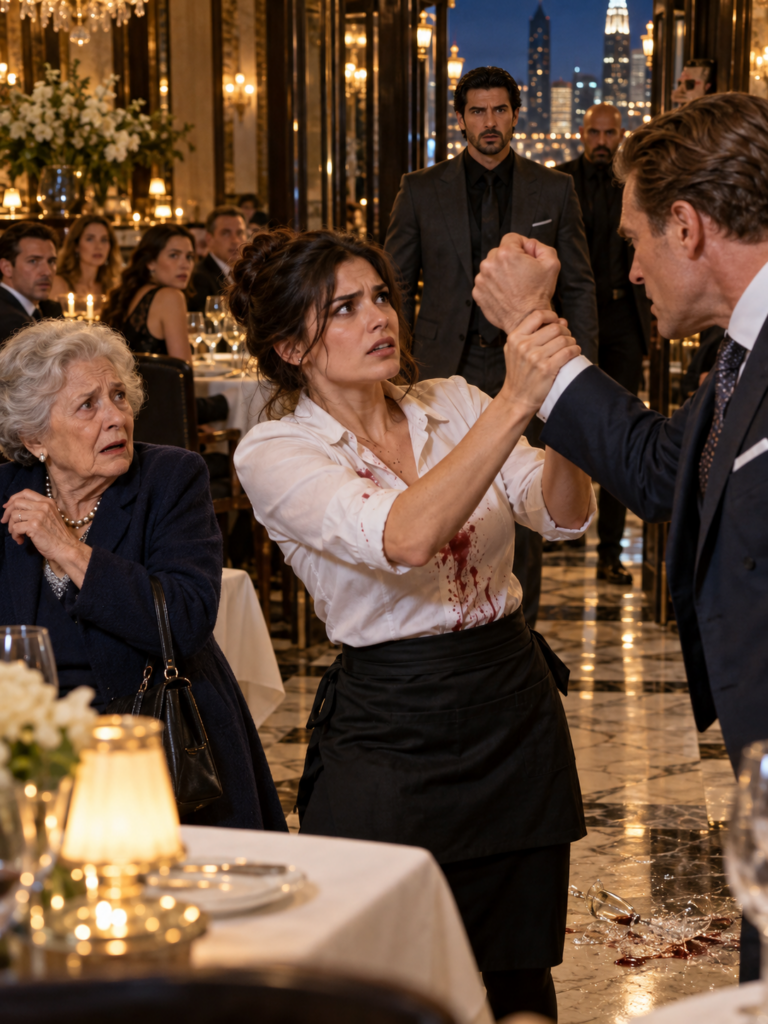
The place where Richard Vale had raised his hand against Teresa.
Where Sophia had risked her job.
Where Luca had watched her refuse to move.
He noticed her expression.
“Regrets?”
She looked across the room.
Teresa stood near the center, surrounded by friends and former colleagues.
She was smiling.
“No.”
“You lost your job that night.”
“I found another.”
“Someone threatened you at home.”
“And we found the evidence.”
“You helped destroy a sixty-million-dollar agreement.”
Sophia smiled.
“That part was impressive.”
Luca laughed softly.
Then she grew serious.
“Teresa shouldn’t have been standing there alone.”
He looked at her.
“You really believe that?”
“Of course.”
Luca studied her face.
“No,” he said quietly. “You don’t just believe it. You live it.”
The compliment caught her off guard.
Not because it was extravagant.
Because he understood exactly what her decision had cost.
She had been frightened.
She had needed the paycheck.
She had known Richard could retaliate.
And she had helped Teresa anyway.
Music began drifting through the room.
Couples moved toward the center.
Luca held out his hand.
Sophia looked at it.
“You dance?”
“No.”
She raised an eyebrow.
“Then why are you asking?”
“Practice.”
“At dancing?”
“At asking.”
Her expression softened.
She placed her hand in his.
“Good answer.”
***
Luca was a terrible dancer.
Sophia discovered this within thirty seconds.
“You stepped on my foot.”
“Once.”
“Twice.”
“The second time is debatable.”
She laughed.
He tried to correct his steps.
It only made things worse.
Finally, Sophia rested one hand on his shoulder.
“Follow me.”
Luca raised an eyebrow.
“That’s new.”
“Get used to it.”
And for once, the most powerful man in the room let someone else lead.
They moved slowly beneath the chandeliers.
Sophia could feel the careful restraint in his hand at her waist.
He wasn’t trying to control the dance.
He was learning her rhythm.
After a moment, Luca looked down at her.
“Sophia.”
“Yes?”
“I’ve wanted to kiss you for three weeks.”
She smiled.
“Only three?”
He almost laughed.
Then his expression grew serious.
He didn’t lean closer.
Didn’t assume.
Didn’t turn his confession into a demand.
He simply waited.
Sophia recognized the difference.
On the night they met, Richard Vale had believed money entitled him to obedience.
Luca had walked away from him because of that arrogance.
Now Luca was proving he had understood the lesson personally.
Wanting something didn’t make it his.
Sophia rose onto her toes.
And kissed him.
It was gentle.
Brief.
Deliberate.
When she pulled away, Luca looked genuinely surprised.
She smiled.
“You didn’t see that coming?”
“No.”
“Good.”
He glanced at her lips.
“May I kiss you again?”
Her smile widened.
“See? Practice.”
This time, she met him halfway.
***
Later, Teresa approached them near the windows.
She held out the old photograph.
“This belongs to you, Luca.”
He accepted it carefully.
Antonio Duca and Carlo Santoro stood together outside Bellarosa in 2004.
Luca turned the photograph over.
Something was written on the back in his father’s handwriting.
He read it silently.
Sophia leaned closer.
“What does it say?”
Luca turned the photograph so she could see.
It was a reminder that a person’s true character was revealed by how they behaved when they believed nobody important was watching.
Sophia smiled.
“Your father stole my philosophy.”
“He wrote it twenty years ago.”
“Details.”
Luca laughed softly.
Teresa touched the edge of the photograph.
“My brother believed something similar.”
Then she looked at Luca.
“Your father wasn’t always the man who condemned him.”
Luca nodded.
“I know.”
“He made a terrible mistake.”
“Yes.”
“And admitting that doesn’t bring Carlo back.”
“No.”
Teresa’s eyes filled.
“But tonight, people remember my brother as the man he was.”
Luca glanced toward the room.
Guests were discussing Carlo openly.
Not as a thief.
Not as a traitor.
As someone who had discovered wrongdoing and paid a terrible price.
Teresa smiled through her tears.
“Thank you for not hiding the truth.”
Luca shook his head.
“It should never have been hidden.”
She squeezed his hand.
Then she walked back toward her guests.
***
When the celebration began winding down, Sophia and Luca remained beside the windows.
Chicago glittered beneath the evening sky.
Luca examined the old photograph once more.
“My father spent years believing Carlo betrayed him.”
“And eventually discovered he was wrong,” Sophia said.
“Too late.”
She nodded.
“Yes.”
He looked at her.
“I spent most of my life believing that admitting I was wrong would make people respect me less.”
“Has that worked?”
“No.”
“Then perhaps you should stop.”
His mouth curved.
“You’re remarkably difficult to impress.”
“I’m very easy to impress.”
“Really?”
“Yes. Be decent. Tell the truth. Listen when someone says no.”
He glanced down.
“That sounds simple.”
“It is.”
“And difficult.”
“Only if you’re used to getting your way.”
He laughed.
Then his expression softened.
“Stay.”
Sophia raised an eyebrow.
Luca caught himself.
“Would you stay?”
“At the gala?”
“With me.”
She looked into his eyes.
For the first time, there was no misunderstanding between them.
She knew his reputation.
She knew his family history.
She knew that his power came with difficult obligations and moral compromises.
And she knew she would never surrender her own judgment simply because she loved him.
“Yes,” she whispered.
“I’ll stay.”
Luca took her hand.
Not as a claim.
As an invitation.
And she held it because she wanted to.
Across the room, Teresa laughed at something Matteo said.
The sound drifted through the restaurant where her brother’s innocence had finally been acknowledged.
Sophia looked toward the spot where she had once stood with trembling hands, protecting an elderly woman from a millionaire’s anger.
That night, she had believed she might lose everything.
Her job.
Her income.
Her security.
Instead, she had helped expose a buried injustice, restored dignity to a grieving woman, and discovered that courage could change the lives of people who seemed far more powerful than she was.
Luca followed her gaze.
“What are you thinking?”
She smiled.
“That someone important really was watching that night.”
He looked toward the marble floor.
“Me?”
Sophia shook her head.
“No.”
He frowned slightly.
“Then who?”
She looked at Teresa.
“Me.”
Luca understood.
For years, he had measured importance through money, influence, family reputation, and the power to make other people obey.
Sophia had measured it differently.
Someone mattered because they were human.
Not because they were rich.
Not because they could destroy a business deal.
Not because armed men stood behind them.
That was the difference between them when they first met.
And it was the reason he had fallen in love with her.
Luca offered his hand again.
This time, he said nothing.
He simply waited.
Sophia smiled and took it.
Together, they walked back toward the music.
And the mafia boss who once believed everyone had a price finally understood the value of something money could never purchase.
A woman who chose him freely.

