
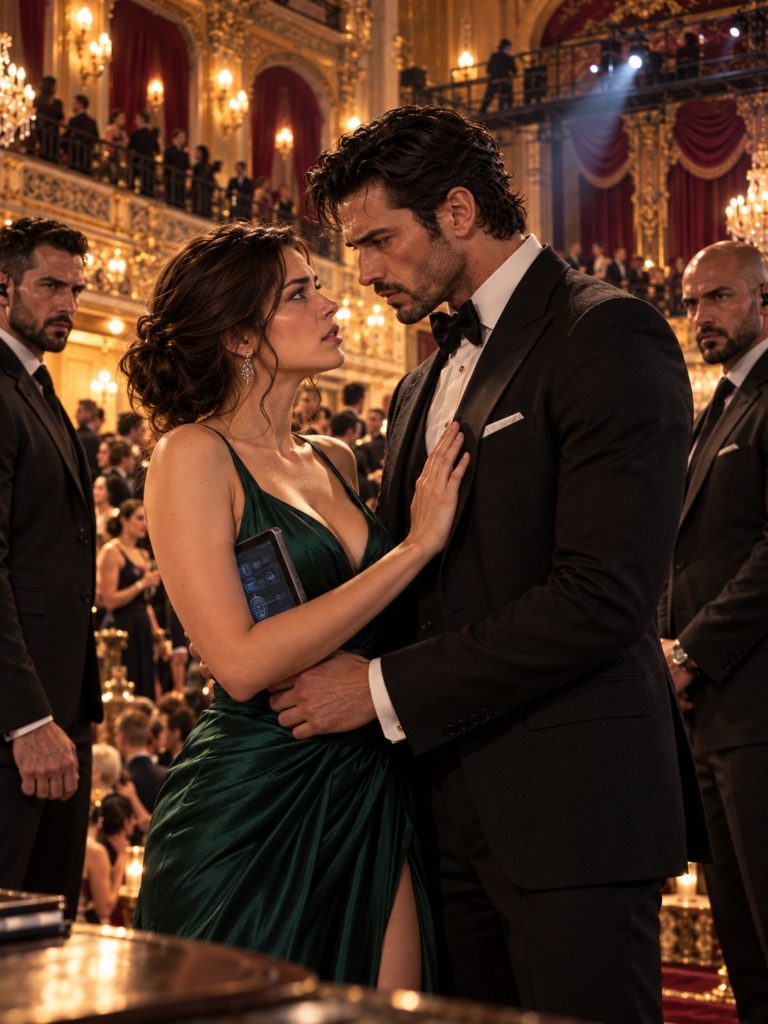
Her finger stopped over a network address that did not belong to the security system.
Nico leaned closer.
“Explain.”
“Roman’s authorization restored your brother’s credential. But the request didn’t come from Roman’s security console.”
Claire enlarged the transaction.
“It came through the theater’s finance network.”
The injured guard looked confused.
“Finance?”
“Accounting computers. Purchase approvals. Administrative systems that should never directly control restricted doors.”
Nico looked at the record.
“Someone used Roman’s identity through another system.”
“Exactly.”
“And Roman?”
“I don’t know yet.”
Nico’s jaw tightened.
“He’s been beside me for eleven years.”
“Then you should want proof before deciding he’s guilty.”
The words were dangerous.
Claire knew exactly who stood beside her.
Nico Vassallo controlled a criminal organization that had survived generations of betrayals.
Men had disappeared from his life for far smaller accusations.
But she had spent her career watching organizations destroy innocent employees because a convenient explanation arrived before a proper investigation.
She refused to repeat that mistake.
“Show me the source,” Nico said.
Claire traced the address.
“Third-floor executive suite.”
The room fell silent.
That suite served the theater’s foundation board.
Only six individuals had authorized access.
Nico.
Roman.
Vince Marrow.
The theater director.
Chief financial officer Martin Kessler.
And Elias Sorrentino.
Nico’s godfather.
A man who had known Gabriel since childhood.
***
Before Claire could examine the executive-suite records, another guard entered.
“Roman’s coming.”
Nico turned toward the door.
Seconds later, Roman D’Amico appeared.
His tuxedo sleeve was torn.
Blood stained his upper arm.
Two guards raised their weapons.
Roman stopped.
“If somebody plans to shoot me, I’d appreciate knowing why.”
Nico studied him.
“Your administrator key restored Gabriel’s badge.”
Roman’s expression changed.
“What?”
Claire watched him closely.
The reaction was not proof of innocence.
But it was not the reaction she expected from someone confidently managing an operation.
“Did you restore the credential?” she asked.
“No.”
“Did you authorize the lockdown?”
“No.”
“Where were you when the first shot was fired?”
“Near the command corridor. Someone in event-staff clothing came out as the lights changed. I followed him. He fired at me and disappeared near wardrobe.”
Claire looked at his injured arm.
“Your credential was used from the finance network.”
Roman stared.
“That isn’t possible.”
“It happened.”
He looked toward Nico.
“Someone copied my authorization.”
Nico’s expression remained hard.
“Can that be done?”
Claire answered.
“Yes. And we need to determine when.”
She searched historical administrative events.
Three maintenance approvals appeared.
All connected to Roman’s authorization.
All processed through the foundation accounting department.
All completed during periods when Roman had been traveling with Nico outside Illinois.
Claire leaned back.
“This started months ago.”
Roman approached the monitor.
“I wasn’t even in Chicago for those jobs.”
“I know.”
Nico looked toward Claire.
“Who approved them?”
She opened the purchase records.
Martin Kessler.
The chief financial officer.
Nico stared at the name.
“Martin has managed our legitimate holdings for nine years.”
Roman swore.
“Then he’s been helping whoever did this.”
“Possibly,” Claire said.
Both men looked at her.
She continued.
“But if Martin deliberately concealed the intrusion for eight months, why leave his own authorization attached to every maintenance request?”
Nico watched her.
“You think he’s being framed.”
“I’m saying we haven’t established who gave the instructions.”
She opened the security camera archive.
Most of the digital footage had been overwritten with repeated sequences.
But an older analog camera near the loading entrance had remained operational.
The theater director had refused to replace it during renovations.
Claire almost smiled.
“Finally, someone saved money in a useful way.”
She reviewed the footage.
Martin Kessler entered the theater shortly after four.
Seven minutes later, Elias Sorrentino arrived.
Both men walked toward the executive offices.
Martin emerged eleven minutes afterward.
Elias remained much longer.
Claire compared the footage with access records.
“There’s no badge event for Elias.”
Roman looked at the screen.
“He knows the mechanical override.”
Nico said nothing.
Elias had been his father’s closest friend.
His adviser.
His godfather.
The man who stood beside him when Gabriel was buried.
For years, Elias had argued that Nico was weakening the organization by shifting power away from old street conflicts toward legitimate businesses.
Nico had dismissed those complaints as nostalgia.
Claire wasn’t ready to accuse him.
Then another alarm appeared.
She opened the scheduled automation queue.
At 9:30, the theater’s fire suppression system would briefly enter maintenance mode.
During that same window, doors around the auditorium would release and relock.
And three motorized stage structures had been programmed to move unexpectedly.
Claire checked the time.
Seven minutes.
Her expression changed.
“Nico.”
He stepped forward.
“What?”
“The shot in the lobby wasn’t necessarily the main attack.”
She rotated the tablet.
“Someone scheduled a second sequence.”
Roman examined the commands.
“Why?”
Claire glanced through the projection-booth window.
Hundreds of guests were still being evacuated.
Among them were three rival criminal leaders invited as donors, each accompanied by a small security detail.
Nico understood.
If those men died inside his theater, every organization involved would look for someone to blame.
And Elias had spent years arguing that peaceful arrangements made Nico weak.
Claire looked at the countdown.
“Six minutes.”
Nico reached for his radio.
“Roman, get the remaining guests toward the street exits.”
Claire stopped him.
“Use people you can verify. Assume the compromised system may expose your movements.”
Roman nodded and left.
Nico turned back toward Claire.
“Can you stop the sequence?”
“Not safely from this terminal. Whoever controls the network may see us cancel it.”
“Then what’s the alternative?”
Claire opened the restoration plans.
“The building still has physical machinery controls beneath the stage. We can isolate the motorized equipment from there.”
Nico looked at her evening gown.
“You’re not going into a machinery basement.”
Claire met his eyes.
“Six hundred people came here tonight because they trusted this building was safe.”
“Claire—”
“My company secured the system. I know where the manual controls are.”
Nico studied her for a long moment.
Then he said, “I’m coming with you.”
They reached the backstage stairs.
Claire removed her heels and started descending.
Nico silently took them from her hand.
She glanced at him.
“You’re carrying my shoes?”
“They seem worth preserving.”
“They cost a hundred and eighty dollars.”
“Then perhaps I should have negotiated.”
Despite the danger, she laughed.
They entered the machinery level.
Claire found the first controller.
Someone had installed an unauthorized wireless module.
She disconnected it.
A sharp metal edge caught her palm.
She hissed.
Nico caught her wrist.
“You’re bleeding.”
“Only a little.”
He wrapped his handkerchief around the cut.
His hands were unexpectedly gentle.
Claire looked at him.
“Do you always carry bandages for engineers?”
“Only when they insist on saving my life.”
She almost smiled.
Then they reached the final controller.
A small black package had been attached inside the open cabinet.
Thin wires connected it to the machinery.
Claire stopped immediately.
“Don’t touch that.”
Nico looked at the package.
“Explosive?”
“Possibly. I’m not qualified to identify or handle it.”
Above them, a warning tone sounded.
The scheduled machinery sequence was approaching.
Claire looked toward the manual emergency shutdown across the room.
“If we leave this equipment active, the moving structures could create a path for attackers.”
Nico followed her gaze.
“And the device?”
“We don’t know what it will do. We need to clear this room and have qualified personnel handle it.”
He nodded.
Then footsteps sounded behind them.
A familiar voice came from the stairwell.
“Neither of you is leaving.”
Claire turned.
Elias Sorrentino stood beneath the red emergency lighting.
A pistol was aimed directly at her.
And Nico’s godfather was smiling.
Elias took another step down the stairs.
“Move away from her, Nico.”
Nico remained beside Claire.
The black package inside the controller cabinet sat only a few feet away.
Above them, the theater’s warning tones continued.
Claire held her injured hand against her chest.
She understood systems.
She understood access controls, maintenance logs, and the limits of redundant networks.
But the object inside the cabinet was outside her expertise.
The pistol in Elias’s hand made attempting anything reckless even less defensible.
“You’re the one behind Gabriel’s badge,” Nico said.
Elias’s expression tightened.
“You always were too sentimental about your brother.”
For an instant, Nico seemed unable to breathe.
“Gabriel died six years ago.”
“I remember.”
“You stood beside his coffin.”
“I helped arrange the funeral.”
Claire watched Nico’s face change.
She had seen anger in him before.
This was something deeper.
The beginning of a truth that threatened to dismantle the last six years of his life.
Nico took one careful breath.
“Did you arrange his death?”
Elias looked almost offended.
“Gabriel brought it on himself.”
Silence filled the basement.
“Answer me,” Nico said.
Elias glanced at the stairs.
Then back at him.
“Your brother found financial records he wasn’t supposed to see. He planned to confront your father.”
“What records?”
“Payments. Business arrangements. Opportunities your father knew better than to question.”
Nico stared.
“Gabriel wanted us out of the old rackets.”
“He wanted to make you weak.”
“He wanted people to stop dying.”
Elias’s expression hardened.
“He never understood what made your family powerful.”
Claire realized what she was hearing.
Gabriel had discovered misconduct connected to Elias.
He had planned to expose it.
And Elias had arranged for him to be silenced.
The bombing had not been random violence.
It had been betrayal disguised as an attack by rivals.
Nico’s voice dropped.
“You killed him.”
Elias did not deny it.
“He gave me no acceptable alternative.”
Claire felt cold despite the machinery-room heat.
Nico’s fingers slowly curled into fists.
She could almost see the choices forming behind his expression.
Elias understood them too.
He shifted the pistol more directly toward Claire.
“Don’t.”
Nico stopped moving.
Elias smiled.
“There. That’s something new.”
Nico looked at him.
“What?”
“You’ve found another person whose loss would destroy you.”
Claire hated the satisfaction in his voice.
He had spent years studying weakness.
Now he thought he had identified Nico’s.
***
Above them, Roman was directing the evacuation.
Security personnel had begun moving guests through manually controlled routes.
The three visiting criminal leaders were being separated from the remaining crowd and guided toward different exits.
The compromised digital commands continued to threaten the building’s operation.
But Elias’s intended chaos depended on more than technology.
He needed people to panic.
He needed the visiting leaders to die.
And he needed Nico either dead or blamed.
Claire looked toward the controller cabinets.
The equipment sequence was nearing activation.
“Elias,” she said.
He turned toward her.
“Quiet.”
“If those stage structures move while the building is evacuating, people could be injured.”
He shrugged.
“Then you should have stayed out of the machinery.”
She looked at him.
“You planned to sacrifice hundreds of innocent guests to restart a criminal war.”
“I planned to restore a necessary balance.”
“A balance where you decide who dies?”
His expression changed.
Nico watched her carefully.
Claire wasn’t trying to provoke him.
She was forcing Elias to confront the scale of his own plan while she searched for a safe way to keep people moving out of danger.
“Your father understood this city,” Elias told Nico.
“Then why did you hide from him?” Nico asked.
Elias went still.
“Gabriel was going to tell him,” Nico continued. “That’s why you killed him.”
For the first time, Elias’s composure cracked.
He raised the gun higher.
A distant noise came from above.
Two sharp reports.
Then silence.
Elias glanced upward.
Claire noticed.
So did Nico.
“Your people aren’t controlling the auditorium anymore,” Nico said.
“You don’t know that.”
“Then why are you still standing here instead of leading them?”
Elias’s jaw tightened.
Outside the machinery room, footsteps approached.
Roman’s voice sounded from the corridor.
“Nico!”
Elias turned toward the sound.
Nico moved Claire behind the concrete support nearest the controller bank.
Elias fired.
The shot struck the wall.
Claire crouched.
Roman and two guards reached the lower landing and forced Elias to retreat behind the stairwell partition.
Nico kept Claire behind cover as the security team secured the immediate corridor.
The confrontation lasted only moments.
When Elias attempted to leave through the opposite passage, Roman blocked his route.
His pistol fell during the struggle.
Elias was restrained.
Claire remained beside the support, breathing hard.
Nico turned toward her.
“Are you hurt?”
She raised her bandaged palm.
“Only this.”
He looked at the blood soaking the handkerchief.
Then at the restrained man near the stairs.
His expression changed.
Elias saw it.
“Go ahead,” he said quietly.
Nico stepped toward him.
Roman tightened his hold.
“Nico.”
Elias smiled bitterly.
“Your father would have finished this himself.”
Nico stopped.
Claire rose slowly.
“Nico.”
He looked back.
She held his gaze.
“He wants you to become the man he’s been trying to recreate.”
Elias laughed.
“You think she understands your family?”
“She understands what you’re asking me to do,” Nico replied.
He looked toward Roman.
“Keep him secured.”
Then he turned away.
For six years, Nico had believed the violent deaths of the men blamed for Gabriel’s bombing had settled the matter.
Now he understood that those killings had helped conceal the actual murderer.
He was not giving Elias the same escape.
***
The machinery-room device remained untouched until the appropriate emergency specialists arrived.
Claire explained what she had observed without pretending she could identify or neutralize it.
The theater’s physical safety systems were assessed independently before staff or guests were allowed back into affected areas.
The evacuation continued.
By the time investigators reached the machinery level, the immediate threat from Elias’s attackers had been contained.
No civilian had been killed.
Two security guards were injured.
Vince Marrow, the surviving guard found on the catwalk, was taken into surgery.
The recovered rifle and Gabriel’s credential were preserved as evidence.
Claire supplied authenticated copies of the access logs and explained how the compromised identity had been restored.
Roman’s administrator credentials had been copied months earlier.
Three suspicious maintenance jobs provided the historical trail.
And the finance network had been used as an unexpected route into the theater’s access-control system.
But the evidence did not stop with Roman.
Martin Kessler’s purchase authorizations connected those jobs to the foundation’s accounting department.
The old camera footage placed Elias in the executive suite shortly before the gala.
His unauthorized entry using the mechanical override contradicted his badge history.
And the surviving financial records linked him to covert payments and individuals involved in Gabriel’s death.
Nico authorized the release of relevant records to investigators.
It was a decision with consequences.
Some records exposed illegal activities connected to the Vassallo organization.
Others revealed questionable arrangements involving businesses that Nico had been trying to separate from criminal operations.
Cooperating would not erase his own past.
He knew that.
But concealing Gabriel’s murder to protect the family name would be another betrayal of everything his brother had wanted.
***
Martin Kessler was questioned about the suspicious purchase orders.
He initially denied knowledge of the credential-cloning work.
Then investigators confronted him with the financial records.
His explanation revealed another layer.
Years earlier, Martin had committed a tax offense.
Elias had discovered it.
He used the evidence to pressure Martin into authorizing the maintenance work that allowed the intrusion.
Martin had known the transactions were improper.
He claimed he had not understood the attack they would eventually enable.
Claire examined the records carefully.
The evidence supported a distinction between his involvement in the unauthorized transactions and Elias’s responsibility for planning the attack.
It did not make Martin innocent.
But it prevented Nico from placing equal blame on everyone whose name appeared in the system.
Roman’s innocence was likewise supported by the historical access records and his verified movements.
His credentials had been misused.
His trust had been exploited.
Nico personally apologized to him.
Roman looked almost uncomfortable.
“You believed the evidence when Claire showed it.”
“I nearly believed the first accusation.”
“Most men would have.”
Nico glanced toward the exhausted cybersecurity engineer seated across the room.
“She wasn’t interested in what most men would do.”
Roman followed his gaze.
“No,” he said. “She certainly wasn’t.”
***
At six fifteen the following morning, Claire sat alone on the edge of the Calder Theater stage.
The chandeliers were dark.
Without music and six hundred guests, the auditorium looked much older.
A borrowed coat covered her damaged green gown.
Her bare feet rested above the orchestra pit.
Her palm had been properly dressed.
She was exhausted.
And although she had spent most of the night focused on preventing another disaster, she was beginning to understand how close everything had come to collapsing.
Footsteps sounded behind her.
Nico approached carrying two coffees.
And her shoes.
Claire stared.
“You kept them?”
“Important evidence.”
“Of what?”
“That you have expensive taste in footwear.”
“They cost a hundred and eighty dollars.”
“I’ve learned not to underestimate that amount.”
He set the shoes beside her.
Then sat down.
For several minutes, they watched the empty auditorium.
Claire sipped her coffee.
Finally, she asked, “How is Vince?”
“Out of surgery. Stable.”
“And Roman?”
“Angry.”
“Understandably.”
“He’s staying to help with the investigation.”
She nodded.
Nico looked down at his hands.
“You saved my life.”
Claire considered.
“I warned you.”
“You pushed me out of the bullet’s path.”
“And you helped me get through that basement.”
“Not as effectively as you helped everyone else.”
She gave him a tired smile.
“Are you always this difficult about accepting assistance?”
“Only when I’m grateful.”
She looked at him.
Nico’s expression had softened.
Without the audience and his security detail, he seemed less like the feared head of a criminal organization.
More like a man who had spent years keeping grief behind a locked door.
“Why did you trust me?” she asked.
He thought about the question.
“At first, I trusted that you had information I didn’t.”
“And later?”
“You refused to give me the answer I wanted.”
“Roman?”
“Yes.”
Claire looked toward the auditorium.
“You wanted someone to blame.”
“I did.”
“And you were prepared to believe the worst.”
“Yes.”
She turned back toward him.
“But you listened.”
Nico looked at her carefully.
“That wasn’t easy.”
“I noticed.”
For the first time that morning, he laughed.
A quiet, surprised sound.
Claire smiled.
***
They spoke for nearly an hour.
Claire told him why she had chosen cybersecurity.
When she was nineteen, a ransomware attack had disrupted the community hospital where her mother worked.
Patients had been diverted.
Staff had struggled with systems they could no longer trust.
Claire had watched frightened people discover that invisible technological failures could have very physical consequences.
The experience changed her plans.
She wanted to build systems that kept people safe.
Nico listened without interruption.
Then he told her about Gabriel.
His brother had wanted the Vassallo family to abandon older criminal practices and move toward legitimate business.
Nico had resisted at first.
After Gabriel’s death, he had gradually made the changes they once argued about.
The restoration of the Calder Theater was part of that effort.
“So this place mattered to you before tonight,” Claire said.
“Yes.”
“Because of Gabriel?”
“Partly.”
Nico looked toward the empty balcony.
“I thought if I built enough things he would have approved of, I might stop feeling that I failed him.”
Claire was quiet.
“You didn’t know what Elias had done.”
“No.”
“But you know now.”
He nodded.
“And now I have to decide what kind of man I want to be with that knowledge.”
Claire studied him.
“That sounds harder than ordering people around.”
“It is.”
She smiled faintly.
“Good.”
Nico turned toward her.
“Good?”
“Hard things sometimes mean you’re finally asking the right questions.”
He looked at her for a long moment.
Then his expression became unexpectedly vulnerable.
“Last night, when Elias aimed that gun at you, I was more afraid than I have been in years.”
Claire’s heartbeat shifted.
“Nico…”
“I know we’ve barely spent time together outside work.”
“That is an understatement.”
“And I know surviving one terrible night doesn’t automatically mean we understand each other.”
She appreciated that.
More than she expected.
He continued.
“But I would like the chance to find out.”
Claire looked down at her coffee.
Then back at him.
“Are you asking me on a date?”
“I’m attempting to.”
“You’re not particularly skilled at it.”
“I’ve been told I have other strengths.”
She laughed.
Then grew serious.
“I have my own company. My own contracts. My own work.”
“I know.”
“And I won’t become another person whose choices you control.”
“I wouldn’t ask you to.”
She studied his expression.
“Then yes.”
Nico blinked.
“Yes?”
“One date.”
He smiled.
The expression transformed his face.
Claire moved closer.
He waited.
She touched his cheek.
Then kissed him.
Gently.
For a few seconds, the damaged theater, the investigation, and the terrible night seemed far away.
When they parted, Claire rested her forehead against his.
“For the record,” she whispered, “next time I tell you to put your hand on my waist, I’d prefer there not to be a rifle above us.”
Nico’s hand settled carefully at her waist.
“I’ll do my best to arrange that.”
***
Three months later, the Calder Theater reopened after repairs and independent safety inspections.
The restoration fund continued under increased oversight.
The foundation had introduced new controls separating financial approvals from security administration.
Independent reviewers examined the compromised systems.
Claire’s company was invited to submit a proposal for ongoing oversight.
She negotiated the terms herself.
The agreement protected her independence, established clear reporting responsibilities, and gave her authority to raise security concerns directly.
Nico did not interfere.
He signed the approved contract after the foundation’s legal review.
That mattered to Claire.
Not because she doubted he admired her.
But because admiration without professional respect would never have been enough.
The investigations into Elias and the financial misconduct continued.
Nico cooperated with the parts that concerned his organization, even when doing so exposed uncomfortable truths.
His world had not suddenly become innocent.
But the direction he intended to take was no longer something he could discuss only in speeches.
He had to prove it through decisions.
***
On reopening night, Claire arrived in a deep blue evening dress.
The theater glittered with restored chandeliers.
Music filled the auditorium.
Guests wandered beneath the balconies where three months earlier armed men had nearly turned a charity event into a catastrophe.
Claire stood near the stage, checking the room with a professional eye.
The upper catwalks were secured.
Emergency exits had been tested.
The access system no longer accepted archived identities without controlled reauthorization.
The old mechanical systems had been inspected.
Her company had documented the changes.
She was satisfied.
Almost.
Across the room, Nico appeared.
He wore a dark tuxedo and the restrained expression that had once frightened her executives.
But when he saw Claire, he smiled.
He crossed the ballroom.
“Everything secure?” he asked.
She glanced toward the balconies.
“The building?”
“Naturally.”
“Yes.”
“And you?”
Claire pretended to consider.
“I still have one unresolved issue.”
Nico raised an eyebrow.
“Which is?”
“You owe me a normal dance.”
His smile deepened.
“That sounds manageable.”
She extended her hand.
He took it.
They stepped onto the dance floor beneath the chandeliers.
For a moment, Claire remembered the first night.
Her green gown.
The archived security alert.
The terrible discovery that Gabriel’s identity had been used to open the catwalk.
And the look on Nico’s face when she asked him to trust her.
Now he placed his hand at her waist.
Not because she needed him to conceal her tablet.
Not because someone was watching from above.
But because she had chosen to dance with him.
He guided her gently through the music.
Claire looked up.
“No dead badges tonight?”
“None.”
“No suspicious equipment cabinets?”
“Not according to your report.”
“No secret gunmen?”
“I sincerely hope not.”
She laughed.
Nico leaned closer.
“Was that your professional assessment?”
“My professional assessment is that the theater is secure.”
“And your personal assessment?”
Claire rested her hand against his shoulder.
“That you make a surprisingly good dance partner.”
He smiled.
“High praise.”
“Don’t get accustomed to it.”
Around them, Chicago’s most powerful donors and business leaders continued their conversations.
Some watched.
Some whispered.
Nico hardly noticed.
Six months earlier, he had met Claire Mercer as a contractor whose confidence irritated his executives.
Three months earlier, she had saved his life by seeing what his most trusted security officers had missed.
And now she stood beside him because she wanted to.
No contract required it.
No debt demanded it.
No danger forced her to remain.
The orchestra moved into a slower passage.
Nico looked at her.
“Claire?”
“Yes?”
“Thank you.”
“For what?”
“For telling me not to look up.”
She smiled.
“You would have looked.”
“I know.”
“And probably gotten yourself killed.”
“Possibly.”
“Then it’s fortunate you listened.”
He drew her a little closer, leaving her room to choose the distance.
Claire accepted.
Above them, the catwalk remained dark and empty.
The doors stayed open.
The building was safe.
And for the first time since Gabriel’s death, Nico Vassallo was no longer trying to preserve his brother’s memory through anger.
He was beginning to honor it through the life he chose to build.
Claire rested her head briefly against his shoulder.
The music continued.
This time, when he placed his hand on her waist, neither of them needed to pretend.
