
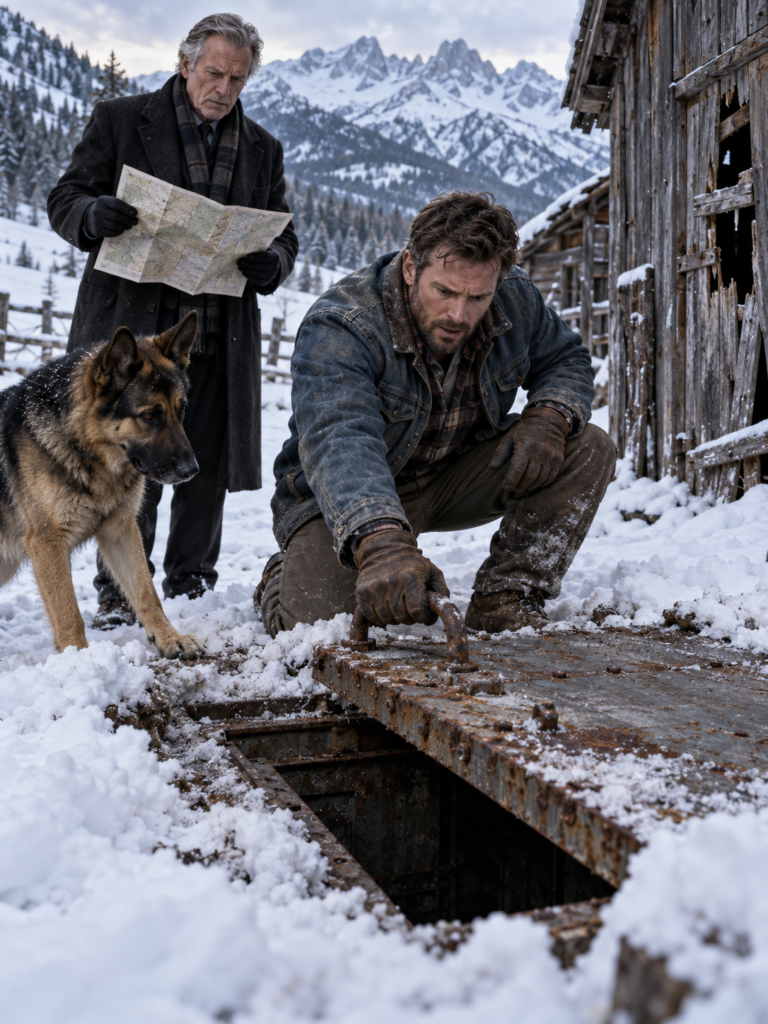
The handle resisted Caleb’s first pull, so he planted one boot against the frozen ground and tried again.
The steel shifted with a harsh grinding noise.
Daniel Reeves crouched beside him.
“Together,” the lawyer said.
They lifted.
The heavy hatch rose slowly, releasing a breath of cold, dry air from the opening beneath it.
A metal ladder descended into darkness.
Caleb leaned forward.
About fifteen feet below, he could make out a concrete floor and the faint glow of emergency lighting.
“This isn’t a storage cellar.”
“No,” Reeves replied.
“Then tell me what it is.”
“The structure was originally built as a fallout shelter in 1962. Harold later renovated it.”
Caleb stared into the opening.
“Why would he renovate something like this?”
Reeves looked at the ladder.
“That’s one of the reasons we’re here.”
Caleb checked the upper rungs before beginning his descent.
He told Atlas to stay beside the hatch.
The German Shepherd obeyed, though his ears remained pointed toward the darkness.
At the bottom, Caleb stepped into a reinforced concrete chamber.
Steel beams supported the ceiling.
Storage shelves lined the walls.
Several old emergency supply containers stood beside water tanks and generator equipment.
Some of the fixtures appeared decades old. Others had clearly been installed more recently.
A low electrical hum traveled through the structure.
Caleb had served in military facilities with less substantial construction.
Reeves descended behind him.
“Harold commissioned renovations about five years ago,” the lawyer explained.
Caleb ran a hand along a clean metal worktable.
“Someone spent serious money maintaining this.”
“Yes.”
“For what?”
Reeves pointed toward the far wall.
A reinforced door stood beyond the rows of shelves.
Beside it, a security light glowed faintly.
Caleb approached.
There were no windows, no markings identifying the room, and no obvious reason anyone would have concealed an entrance beneath a deteriorating barn.
But he noticed something important.
The equipment was not abandoned.
The generator operated.
The lights worked.
The lock had been maintained.
Whatever Harold kept belowground, he hadn’t simply forgotten about it.
“Who else knows this place exists?” Caleb asked.
“A limited number of people involved in Harold’s arrangements.”
“Does Logan?”
“No.”
“Does Natalie?”
“Not to my knowledge.”
Caleb looked at the lawyer.
“And you knew about it while I was losing my marriage and my home?”
Reeves held his gaze.
“Yes.”
That answer hurt more than Caleb expected.
He thought of every uncomfortable holiday dinner, every argument about money, every occasion when Harold had sat quietly while Natalie and Caleb’s relationship deteriorated.
“You could have told me.”
“Harold instructed me not to disclose these arrangements until after his death.”
“That’s not the same as saying you couldn’t have helped.”
Reeves accepted the criticism without defending himself.
“I understand why you’re angry.”
Caleb looked away.
He wasn’t certain Reeves understood at all.
Above them, Atlas gave a short bark.
Caleb returned to the ladder, climbed partway, and checked the dog.
Seeing the animal still waiting beside the open hatch settled him.
He descended again.
Reeves removed a small brass key from his coat.
“Harold left this for the inner room.”
Caleb watched him unlock the reinforced door.
The lock released with a heavy click.
Beyond it lay a smaller chamber cut into the rock.
A steel safe stood against one wall.
Near it was a wooden desk.
And on that desk rested a single envelope.
Caleb approached slowly.
The envelope was clean, protected from the damp and deterioration affecting the old ranch above.
Someone had placed it there deliberately.
He leaned closer.
Across the front, in unmistakable handwriting, was his name.
Harold Whitmore’s handwriting.
Caleb had seen it on birthday cards, notes left beside repair projects, and the small lists Harold made when his illness weakened his memory.
Reeves remained near the doorway.
“He prepared that himself.”
Caleb lifted the envelope.
For a moment, he heard Harold’s voice as clearly as if the old man were standing beside him.
He remembered the porch conversations.
The pauses when Harold appeared ready to say something important, then decided against it.
The strange way he’d sometimes asked Caleb what he would do if a promise required him to disappoint people he cared about.
Caleb had assumed those were questions from a dying man reviewing his life.
Now he wasn’t sure.
“What’s inside the safe?” he asked.
“Records Harold gathered over several years.”
“About Logan?”
Reeves nodded.
Caleb looked again at the envelope.
“So this isn’t just about giving me a ranch.”
“No.”
“Then why give it to me?”
Reeves stepped aside.
“Harold wanted you to hear his reason from him.”
Caleb broke the seal.
He pulled out a folded sheet of paper and opened it under the yellow light.
The first lines thanked him for caring for Harold when other family members were absent.
Then the letter turned toward a subject Harold had never discussed openly.
His son.
His company.
And the financial evidence he had spent years collecting.
Caleb read several sentences, his expression tightening.
Then his eyes reached the amount Harold had placed into a separate protected trust.
Fifty million dollars.
He stopped reading.
“Daniel.”
“Yes?”
Caleb raised his eyes.
“Why would Harold hide fifty million dollars from his own son?”
Reeves looked toward the safe.
“Because the records in there explain what Logan was doing to the company.”
Caleb glanced back at the letter.
His hands tightened around the paper.
He had arrived expecting an abandoned ranch.
Instead, Harold had entrusted him with a secret that could destroy the family business and threaten the livelihoods of thousands of employees.
And the next paragraph appeared to contain a condition Caleb had never agreed to.
He lowered his eyes and began reading it.
Caleb read the paragraph twice.
The fifty million dollars existed in a protected trust, but Harold had not arranged for him to claim it simply by presenting the letter.
The inheritance came with a condition.
Before the funds could be released, Logan Whitmore’s financial misconduct had to be exposed and Logan removed from control of Whitmore Timber.
Caleb stared at the page.
He had expected Harold to leave an explanation.
He hadn’t expected to inherit responsibility for confronting the man’s own son.
“This can’t be what he wanted,” Caleb said.
Reeves stood beside the desk.
“It is.”
Caleb lifted the letter.
“He spent his last months talking about mountains and old dogs. He never told me he was preparing something like this.”
“Harold was afraid Logan had compromised the company.”
“Then why give Logan controlling shares in the public will?”
“Harold believed Logan’s influence over management made a premature confrontation dangerous. He arranged the separate trust and preserved his evidence for the person he expected to act after his death.”
Caleb returned to the letter.
Harold described years of suspicious financial arrangements.
Unauthorized loans.
Transactions routed through shell companies.
Payments flowing into accounts outside the United States.
Contracts that appeared legitimate until someone followed the money beyond the first recipient.
Harold had hired investigators.
Their findings persuaded him that his son was diverting substantial company assets.
By the time he understood the scale, Logan had developed considerable influence over Whitmore Timber’s executives.
Harold believed a chaotic collapse could cost more than four thousand employees their livelihoods.
He had therefore separated private assets from the company and reserved fifty million dollars in a protected trust.
But the money was not an unconditional gift.
It was intended to support the effort to expose the misconduct and preserve the business.
If Caleb refused or failed to satisfy the trust’s terms, the specified alternative disposition would take effect.
Caleb lowered the letter.
“So he left me an ultimatum.”
Reeves hesitated.
“He left you a choice.”
“With thousands of jobs attached.”
“Yes.”
Caleb crossed the room.
For fifteen years, he’d served in the Army Rangers, following orders through places where hesitation could get people killed.
But this was different.
Here, he didn’t know the rules.
The battlefield consisted of contracts, account statements, and people who understood financial systems far better than he did.
His first impulse was to put the letter down.
He wanted to return to his cabin.
Build another fire.
Feed Atlas.
Leave the Whitmore family to settle its own problems.
But the letter contained one detail he couldn’t dismiss.
Harold had identified the workers.
Not just executives or shareholders.
Mill crews.
Truck drivers.
Mechanics.
Logging teams.
People who depended on Whitmore Timber for their paychecks.
Caleb knew what losing a livelihood could do to a family.
He knew what it felt like to lose a home.
He looked at Reeves.
“Show me the evidence.”
The lawyer approached the safe.
Together, they opened its heavy door.
Inside were folders organized by transaction, along with electronic storage devices and financial summaries.
Caleb removed one folder.
The first pages documented payments between Whitmore Timber and companies whose apparent ownership differed from their actual financial connections.
The next pages showed how money moved through additional entities.
Caleb could understand the sequence, but he couldn’t yet evaluate every conclusion.
“These records suggest a pattern,” he said. “Who verified it?”
“Harold’s investigators collected and examined the material. The supporting documentation is preserved here.”
Caleb examined another folder.
He recognized Whitmore Timber’s name repeatedly.
He also recognized Logan’s signature on several documents.
A signature alone wouldn’t prove every allegation.
But it established that Logan had personally approved certain transactions.
Caleb closed the folder.
“Harold knew.”
“He knew enough to become deeply concerned.”
“And instead of confronting his son, he prepared all this.”
“He was trying to preserve a way for the company to survive the truth.”
Caleb looked toward the reinforced door.
He thought about the man who had quietly watched sunsets beside him.
Harold had never appeared afraid of confrontation.
But perhaps a father could face nearly anything except the possibility that his own child had betrayed the people who depended on him.
A bark echoed down from the entrance.
Caleb turned toward the ladder.
Atlas was still waiting above.
“We’re not leaving him there.”
They returned to the main chamber.
With Reeves assisting from the ladder, Caleb carefully helped Atlas down into the shelter.
The dog inspected the unfamiliar floor and followed Caleb toward the inner chamber.
Near the reinforced doorway, Atlas paused.
A corroded metal panel overhead shifted.
Caleb heard the scrape an instant before it fell.
He moved toward the doorway.
Atlas stepped ahead of him.
The panel crashed against the floor.
A loose bracket struck the German Shepherd’s front leg.
Atlas cried out and stumbled backward.
“Atlas!”
Caleb dropped beside him.
The dog held one foreleg off the concrete.
A narrow cut showed through the fur.
Caleb checked the injury and wrapped it with a strip of cloth.
Atlas watched him, ears lowered.
“Easy, buddy. I’ve got you.”
Reeves inspected the fallen panel.
“If he’d been a step farther back, that could have hit you.”
Caleb kept his attention on the dog.
Atlas had saved him before.
Years earlier, after an explosion during their deployment, the German Shepherd had helped pull him from a collapsed structure.
Caleb still remembered the weight of debris.
The dust.
The certainty that he wasn’t getting out.
Then Atlas finding him.
He rested a hand against the dog’s neck.
“You’ve done enough for one lifetime.”
Atlas licked his wrist.
Caleb sat on the floor beside him.
After several minutes, he looked back toward the safe.
“Who else is involved in Harold’s plan?”
Reeves explained that Harold had arranged for two specialists to assist once Caleb accepted the assignment.
Maya Torres, a financial investigator.
Ethan Cole, a cybersecurity analyst.
They had been working on the relevant records and were expected at the ranch.
Caleb looked at the open letter.
“Then call them.”
Reeves studied him.
“You’re agreeing?”
“I’m agreeing to find out what’s true. I’m not promising to ruin a man because someone wrote a letter about him.”
The lawyer nodded.
“Harold would have respected that.”
Caleb wasn’t certain he wanted Harold’s approval anymore.
But he wanted the workers to keep their jobs.
And he wanted to know why a father had spent so much of his final life gathering evidence against his son.
By the time Maya Torres descended into the bunker, Caleb had read more of the records.
She was in her thirties, with dark hair tied back and the composed manner of someone accustomed to being challenged.
Ethan Cole followed her, carrying a laptop.
He was younger, bespectacled, and visibly fascinated by the underground structure.
When Atlas approached him, Ethan stopped.
“Is he okay with strangers?”
“Depends on the stranger,” Caleb said.
Atlas sniffed Ethan’s backpack and wagged his tail.
“Looks like you passed.”
Maya wasted little time.
She spread several financial summaries across the desk and described the pattern Harold’s investigators had identified.
Timber inventory passed through transactions involving supposedly independent buyers.
Several of those businesses connected back to Logan through hidden financial relationships.
The proceeds were then transferred through additional accounts, obscuring their origin.
Caleb listened.
“So inventory belonging to Whitmore Timber was being used to generate money that didn’t return to Whitmore Timber.”
“That’s the central allegation,” Maya replied.
“And what do we need to prove it?”
“Independent confirmation of the shipments. We have transaction records and financial links, but we need to corroborate them against physical inventory activity.”
Ethan opened his laptop.
He had been tracing digital records associated with the network of companies.
Some data supported Maya’s findings.
Other details remained incomplete.
“The transactions become much easier to understand when we match actual shipment identifiers to the records,” he explained.
Maya pointed to a circle on the map.
“Kalispell. Logan’s private storage operation.”
Caleb leaned closer.
“That’s where you believe the inventory passed through?”
“Yes.”
The next pages showed warehouse references, shipment dates, and entities associated with questionable transfers.
Caleb examined the material.
The investigation was no longer an abstract allegation in Harold’s letter.
There was a specific location.
A set of transactions.
A trail that could be tested.
He turned to Maya.
“What happens if Logan discovers we’re looking into this?”
She exchanged a glance with Reeves.
“He already has reason to be concerned about the company’s exposure. And he has a major investment agreement planned for the Jackson Hole charity gala.”
Ethan tapped a date.
“The contract is approaching. If the restructuring and transfers proceed, recovering a clear account of the transactions becomes substantially more difficult.”
Caleb studied the marked calendar.
They had limited time.
“What does Logan gain from that agreement?”
Maya explained how the contemplated investment could move funds through new international arrangements and further complicate the trail investigators were following.
Caleb thought of the laughter in the conference room.
Logan had inherited operational authority while concealing transactions that might threaten the company itself.
Harold, in contrast, had left Caleb a dollar and a responsibility that could destroy what little peace he had recovered.
The more Caleb learned, the less the will looked like a simple distribution of wealth.
It looked like a deliberately divided set of obligations.
Logan had received power.
Caleb had received the means to challenge its misuse.
But he still had one question.
“Why didn’t Harold choose a company executive?”
Reeves answered quietly.
“Because he didn’t believe he could trust the people Logan had surrounded himself with.”
“And why didn’t he simply choose you?”
“Because he wanted someone who understood protecting other people, even when there was no personal reward.”
Caleb looked down at Atlas.
The dog had settled near his boots, carefully extending the bandaged leg.
Harold had seen Caleb at his poorest and most exhausted.
He had also seen him return, week after week, to help an old man who no longer had anything Caleb wanted.
Maybe that was why.
Not because Caleb understood finance.
Because Harold believed he wouldn’t abandon people once the situation became difficult.
Caleb picked up the map.
“Show me everything you’ve got on Kalispell.”
Maya moved the shipment documents beside the financial records.
Ethan brought up the corresponding digital entries.
Together, they began comparing the warehouse information against Harold’s evidence.
As the connections accumulated, one thing became increasingly clear.
The transactions weren’t isolated mistakes.
They formed a repeated pattern.
And Logan Whitmore had approved documents connected to that pattern.
Caleb set the final folder down.
His decision was no longer about whether Harold had loved him enough to leave an inheritance.
It was about whether he could walk away from what he now knew.
He looked toward the bunker entrance.
“Then we find the missing confirmation before Logan signs that agreement.”
Maya nodded.
“And when we have it?”
Caleb studied Harold’s signature at the bottom of the letter.
“We make sure the people who need to see the evidence actually see it.”
He reached for the Kalispell warehouse file and opened it to the first shipment reference.
The first shipment reference carried a warehouse identifier matching a series of questionable transactions Maya had already traced.
Caleb placed it beside the financial summary.
Ethan compared the associated digital entries.
Different documents pointed toward the same chain of activity.
Inventory moved out of Whitmore Timber’s normal accounting structure.
Payments traveled through businesses connected to Logan.
Funds then passed through further accounts, separating them from the original timber shipments.
It was becoming increasingly difficult to explain the pattern as ordinary business activity.
But Caleb insisted they distinguish what the records suggested from what they could demonstrate.
“Harold believed Logan was stealing,” he said. “We still have to prove what actually moved.”
Maya agreed.
That was why the Kalispell yard mattered.
The team needed physical corroboration connecting the shipment identifiers to the inventory operation.
They studied the yard’s layout and available information, then prepared to examine it.
Caleb understood the risks of entering a guarded property without permission.
He also understood the urgency Maya had described.
The arrangement they eventually carried out was dangerous and imperfect, a decision Caleb would later have reason to question.
Two hours after leaving the bunker, their SUV stopped near the Kalispell storage yard.
Snow covered the ground beyond the fence.
Stacks of timber stood between large metal warehouses.
Two security guards were visible near the entrance.
Maya remained with the vehicle.
Ethan monitored the available camera information remotely.
Caleb stepped into the cold with Atlas beside him.
The German Shepherd’s injured foreleg had improved enough for him to walk, although Caleb remained concerned about putting too much strain on it.
He checked the dog’s movement before proceeding.
“Stay close.”
Atlas looked up at him.
They moved along the fence, keeping out of the guards’ immediate view.
Where the wire had loosened near the ground, Atlas passed beneath it.
Caleb followed.
Inside the yard, the smell of diesel exhaust and freshly cut lumber drifted between the stacked timber.
He made his way toward the warehouse Maya had identified.
Through a window, he saw workers handling paperwork beside marked inventory crates.
Several markings corresponded to numbers in the files.
Caleb photographed the visible labels.
He located additional shipment identifiers on crates deeper in the building after entering through a side opening.
More photographs.
More numbers.
The evidence was physical, but Caleb knew its significance would depend on matching it reliably to the financial records.
Then Atlas stopped.
His ears pointed toward the opposite end of the warehouse.
Footsteps approached.
Two security guards had entered.
Caleb crouched behind a stack of crates.
Atlas lowered himself beside him.
A flashlight passed across the concrete.
One of the guards stopped near their hiding place.
Then the beam caught Atlas’s face.
The guard shouted.
Atlas barked and sprang forward.
Caleb reacted immediately, trying to move the guard away from the dog without seriously injuring him.
The second guard rushed toward them.
The confrontation deteriorated in seconds.
Caleb grabbed Atlas’s collar and turned toward the exit.
A gunshot rang through the warehouse.
Atlas jerked.
Caleb heard him cry out.
The dog had been grazed across the shoulder.
“Atlas! Move!”
They reached the outside yard and ran toward the fence.
Maya opened the rear door as they emerged.
Caleb lifted Atlas into the SUV.
Blood darkened the dog’s fur.
Maya accelerated away from the property as alarms began sounding behind them.
Caleb held a cloth against the wound.
His breathing remained controlled, but his hands were shaking.
Atlas lay across the seat and watched him.
“Stay with me, buddy.”
The dog moved his head slightly against Caleb’s wrist.
Caleb felt a flash of anger unlike anything he had experienced since leaving the Army.
He had brought his closest companion into a fight over a wealthy family’s corruption.
And Atlas had been hurt.
For a moment, none of Harold’s explanations seemed sufficient.
Not the trust.
Not the company.
Not even the employees.
He wanted nothing more than to reach safety.
Back at the hidden ranch, Caleb carried Atlas into the bunker.
Ethan hurried to retrieve the first-aid supplies.
Caleb cleaned the wound and inspected the damage.
The bullet had grazed the shoulder without striking bone.
They bandaged it carefully and kept the dog resting.
Atlas’s breathing steadied.
Only then did Caleb look at Maya.
“Nobody takes him anywhere dangerous again.”
She nodded.
“Agreed.”
Caleb sat beside the dog, his palm resting against the thick fur.
He remembered Afghanistan.
He remembered a collapsed building and the terrifying certainty that he would die beneath it.
Atlas had reached him through dust and debris.
For years afterward, when thunder brought those memories back, the dog had been the one constant presence that could bring Caleb back to the room.
Losing the ranch house had hurt.
Losing his marriage had left him feeling discarded.
But losing Atlas was something he could barely imagine.
He leaned down.
“No more warehouses for you.”
Atlas moved his tail once against the floor.
Across the room, Ethan began comparing Caleb’s photographs with the digital records.
Then he stopped.
“Maya. Come look.”
She joined him.
The photographed identifiers matched shipping references that had appeared repeatedly in the suspicious account network.
The same inventory numbers had been connected to transfers involving Logan’s associated companies.
The physical photographs didn’t establish the entire case by themselves.
But combined with the existing records, they provided important corroboration.
Maya worked through the comparisons again, checking that the numbers and dates aligned.
When she finished, she turned toward Caleb.
“The warehouse information supports what Harold’s investigators found.”
Caleb remained beside Atlas.
“Enough?”
“Enough to strengthen the evidence substantially. We still need the full records presented and examined.”
Reeves approached the desk.
“The gala is in five days.”
The charity event in Jackson Hole would bring Logan together with investors, company directors, prominent guests, and reporters.
He intended to use it to celebrate a major investment agreement.
Maya believed the event would also provide an opportunity to expose the transactions before the new arrangements took effect.
Caleb studied the records one last time.
He had spent years in military service learning the importance of evidence, preparation, and timing.
He knew the danger of acting solely because he was angry.
He also knew that allowing someone to continue causing harm could carry its own consequences.
“What has already been provided to investigators?” he asked.
Reeves explained the arrangements for submitting the financial evidence.
Maya reviewed which records were authenticated, which were corroborated, and which remained allegations requiring formal investigation.
Ethan prepared the electronic material so the relevant files could be examined without relying on a handful of photographs displayed at a public event.
Caleb insisted that the distinction remain clear.
He didn’t want Logan convicted by a room full of people before investigators had evaluated the evidence.
But he wanted those people to know that serious concerns existed.
And he wanted Logan prevented from using the investment deal to place more assets beyond scrutiny.
For the next several days, the team worked through the financial trail.
They aligned transaction dates.
Checked identifiers against the warehouse photographs.
Reviewed correspondence associated with the companies.
Examined the documents bearing Logan’s approvals.
Maya built a timeline.
Ethan organized the digital evidence.
Reeves coordinated the legal arrangements.
Caleb spent long hours reviewing their work, demanding explanations whenever a conclusion seemed to go farther than the records supported.
He was not a financial expert.
He didn’t pretend otherwise.
But he knew how to ask whether something had actually been proved.
At night, he stayed beside Atlas.
The dog’s shoulder gradually improved.
The first time Atlas stood without favoring the injured side as heavily, Caleb felt a relief that no amount of money could have purchased.
On the fifth morning, they prepared to leave for Jackson Hole.
Atlas wore a simple black harness.
Caleb inspected the healing wound.
“You don’t have to do this.”
The German Shepherd looked at him.
Caleb sighed.
“Yeah. I know.”
They traveled through Montana and into Wyoming, arriving as evening settled across the mountains.
The Grand Summit Hotel stood bright against the winter darkness.
Inside, the ballroom was filled with investors, executives, reporters, and guests dressed for a formal charity celebration.
Crystal chandeliers reflected across polished floors.
At the center of the gathering stood Logan Whitmore.
He looked entirely comfortable.
Caleb watched him greet guests and laugh beneath the lights.
There was something painful about seeing Logan so confident.
Only days earlier, the same man had laughed at Caleb for receiving one dollar.
Now Caleb knew that Harold had left Logan an inheritance burdened by secrets.
Maya approached beside him.
“Ready?”
Caleb looked toward the stage.
“As much as I can be.”
Logan noticed him a moment later.
His smile narrowed.
He excused himself from a conversation and crossed the ballroom.
“Caleb Ward.”
He glanced down at Atlas.
“Interesting choice of guest.”
Caleb said nothing.
Logan stepped closer.
“I heard there was trouble at one of our storage facilities.”
“I heard the same.”
“Somebody went where they didn’t belong.”
Caleb held his gaze.
“Then maybe the authorities should look closely at everything that happened there.”
For a moment, Logan’s expression hardened.
Then he smiled again.
“You never did understand business.”
Caleb watched him walk away.
“Maybe not,” he murmured.
Atlas remained still beside him.
“But I understand when something doesn’t add up.”
The formal program began.
Logan took the stage.
He spoke about growth.
Confidence.
The company’s long-standing place in communities across the Northwest.
He described the new partnership as an important step into the future.
The guests applauded.
Then Maya gave Ethan the agreed signal.
The large screens behind Logan changed.
Financial records appeared.
Transaction sequences.
Company connections.
Banking documents.
Shipment references.
The room’s applause faded into confused silence.
Logan turned.
His expression changed.
“What is this?”
Maya stepped forward and identified the material as evidence gathered during an investigation into Whitmore Timber’s financial dealings.
She explained the apparent pattern of transactions and stated that the supporting records had been supplied to federal investigators.
Reporters began asking questions.
Several board members moved closer to the stage.
Logan demanded that the presentation stop.
He accused the team of fabricating the evidence.
But the documents remained visible long enough for the audience to recognize the seriousness of the allegations.
Caleb watched the board members study the records.
He had expected anger.
He hadn’t expected the unmistakable look of people realizing that something inside their company might have been concealed from them.
Logan pointed toward Caleb.
“He broke into company property!”
Caleb didn’t deny the warehouse confrontation.
He knew that decision would require its own scrutiny.
Instead, he answered the question that mattered to him.
“The inventory numbers in that warehouse match transactions involving companies connected to you.”
Logan’s face tightened.
“You have no idea what you’re talking about.”
“Then explain the transfers.”
Logan didn’t provide an explanation.
He demanded to speak to the board.
By then, investigators and police officers were moving through the event.
They had received records before the public presentation and were there to advance their inquiry.
The officers approached Logan.
He continued protesting as they asked him to step away from the podium.
The evening was no longer a celebration of his leadership.
It had become a public reckoning with allegations he could not dismiss through confidence alone.
A senior board member approached Reeves.
They spoke privately, reviewing the documentation and the relevant arrangements associated with Harold’s trust.
Other board members joined them.
For Caleb, the waiting was almost unbearable.
Atlas sat against his leg.
At last, the senior director returned.
He announced that the board was taking immediate action in response to the evidence and the risk to the company.
Logan would no longer exercise operational control.
The board would place the business under emergency leadership arrangements and begin financial restructuring.
Under the authority established through Harold’s trust and the board’s decisions, Caleb Ward would assume responsibility for the transition.
Logan stared in disbelief.
“You can’t hand my father’s company to him.”
The director remained composed.
“The company needs leadership that can restore confidence and protect its employees.”
Logan turned toward Caleb.
For a moment, he looked almost like the younger brother-in-law Caleb remembered from family dinners.
Then the anger returned.
“You did this because of the divorce.”
Caleb looked at him.
“No. I did it because of what the records show.”
He reached into his pocket.
The same folded dollar bill was still there.
He had carried it from the lawyer’s office to his cabin.
From the cabin to the hidden ranch.
Through the investigation.
And now into this ballroom.
He placed it on the podium.
Logan looked down.
Caleb spoke quietly.
“Your father wanted this company to survive.”
Logan’s jaw tightened.
“Then he should have trusted his son.”
Caleb thought about Harold sitting on the porch, exhausted from treatments, looking across the mountain valley.
“He wanted to,” Caleb replied.
That was the part of the story no financial document could fully express.
Harold had not spent years collecting evidence because confronting Logan gave him pleasure.
He had struggled to accept what his investigators had uncovered.
He had concealed the trust because he feared Logan’s influence could compromise the effort to preserve the company.
He had divided his estate in a way that publicly recognized Logan’s existing role while privately creating a means to challenge him.
And he had chosen Caleb because the former soldier had demonstrated loyalty without expecting payment.
Caleb finally understood the intention.
But he also understood something Harold had not been able to resolve.
Keeping the truth hidden had hurt people.
It had left Caleb exposed to ridicule.
It had preserved silence where honest conversation might have helped.
And it had placed enormous responsibility on someone who had never asked to join a corporate conflict.
Harold’s plan was not perfect.
Neither had Harold been.
But the evidence made his concerns impossible to ignore.
As Logan was escorted away for further questioning, Caleb looked around the ballroom.
The expressions surrounding him were no longer amused.
They were troubled.
Some were angry.
Others appeared frightened for the company.
One reporter called out.
“What happens to the workers?”
Caleb felt the weight of that question.
He thought of the thousands of people who had never attended an expensive gala.
People working night shifts at mills.
People driving loaded trucks through winter roads.
People whose paychecks supported families and mortgages.
He turned toward Reeves.
“Tell the board the first priority is keeping people employed.”
Reeves nodded.
Maya approached from the side of the stage.
“You did what Harold asked.”
Caleb looked down at Atlas.
“Now we find out if we can do what he hoped.”
The legal investigation continued after that night.
Logan faced federal proceedings concerning the financial misconduct.
The allegations and evidence were subjected to formal examination.
Whitmore Timber underwent substantial restructuring, with new leadership and oversight.
Caleb did not suddenly become an expert in corporate finance.
He relied on qualified people, including Maya, Ethan, Reeves, and the company’s restructured management team.
His contribution was different.
He refused to treat employees as numbers that could be discarded to protect executive reputations.
He demanded that financial decisions be explained plainly.
And he insisted that the evidence remain separate from personal resentment.
He never forgot that his relationship with the Whitmores had ended painfully.
But he also refused to let his experience with Natalie and Logan determine the fate of thousands of workers.
The company survived.
The fifty-million-dollar trust was eventually released according to Harold’s arrangements.
Part of the money helped stabilize Whitmore Timber.
The rest supported a purpose Caleb had begun imagining during the long nights in the bunker.
The abandoned ranch in the Bitterroot Mountains would become a training center for veterans and dogs.
A place for people whose military service had left injuries that didn’t always show.
Caleb understood that kind of injury.
Some days he could speak about Afghanistan calmly.
Other days, a sharp sound could still tighten his chest before he understood what he’d heard.
Atlas had helped him find his way through those moments for years.
He wanted other veterans to have the opportunity to build that same kind of connection.
Six months after the night in Jackson Hole, the old ranch looked almost unrecognizable.
The barn had been repaired.
New fences bordered the training fields.
Small cabins accommodated veterans attending the program.
The concealed bunker remained secured beneath the barn, no longer a secret Caleb needed to fear.
Morning sunlight moved across green fields where snow had once covered the ground.
Caleb stood beside a fence watching a younger veteran work with an anxious German Shepherd.
The man held the leash tightly.
The dog pulled away.
Frustration showed on both sides.
Caleb approached with Atlas following him.
“Try loosening your grip a little.”
The veteran looked embarrassed.
“I can’t get him to listen.”
“He’s paying attention,” Caleb replied. “He’s just not sure what you’re asking yet.”
The man eased his hold.
The dog took a hesitant step toward him.
Atlas walked closer and stood calmly beside the younger animal.
After a moment, the nervous dog stopped pulling.
The veteran looked surprised.
Caleb smiled.
“Sometimes they need to know you’re calm before they can settle down themselves.”
The man looked at Atlas.
“He always like that?”
“Not always,” Caleb said. “But he’s been teaching me patience for a long time.”
Atlas wagged his tail.
The veteran laughed.
Caleb watched them continue.
He remembered how lost he’d felt when he first returned from service.
He remembered the divorce.
The rented cabin.
The night he’d sat beside the woodstove with one dollar in his hand, wondering whether Harold had genuinely thought so little of him.
At the time, he had believed the worst part of his life was behind him.
Now he understood that he had been standing at the beginning of a different responsibility.
By late afternoon, new visitors arrived at the ranch.
Two pickups rolled into the driveway.
Men stepped out uncertainly, studying the training fields and the cabins.
Some moved carefully because of old injuries.
Others looked around with the guarded expressions Caleb recognized from his own difficult years.
Atlas trotted toward them.
One man crouched.
The German Shepherd rested his head against the man’s shoulder.
The visitor closed his eyes.
Caleb watched from beside the fence.
There was nothing dramatic about the exchange.
No grand announcement.
No miracle recovery.
Just a man and a dog standing together in a place where neither needed to explain himself.
For Caleb, that was enough.
Later, as the evening sun lowered behind the Bitterroot Mountains, he stood on the ranch house porch.
Maya came outside carrying two mugs of coffee.
She handed him one.
“Long day?”
Caleb looked toward the training field.
“Good day.”
Maya rested her arms on the railing.
“Reeves says the board wants you to stay on as chairman.”
Caleb chuckled.
“Still doesn’t feel like something a guy like me should be doing.”
“They disagree.”
He took a sip of coffee.
“I spent most of my adult life learning to keep people safe in situations I understood. Somehow, that turned into learning about lumber companies and financial statements.”
Maya smiled.
“Maybe Harold saw a connection.”
Caleb considered that.
“He saw someone who would take responsibility.”
“And?”
Caleb looked toward the cabins.
“He also left me somewhere worth coming home to.”
Atlas appeared at the bottom of the porch steps after playing with a young dog in the field.
He climbed the steps and settled beside Caleb.
The shoulder wound had healed, leaving a small scar beneath the fur.
Caleb rubbed behind his ears.
“Getting tired, old man?”
Atlas yawned.
The screen door opened again.
Daniel Reeves stepped onto the porch carrying a small wooden frame.
“I thought you might want to put this somewhere,” he said.
Caleb turned.
Behind the glass sat a single folded dollar bill.
The same one Caleb had carried into the Jackson Hole ballroom.
Reeves had arranged to preserve it after the investigation began.
Caleb accepted the frame.
For several seconds, he said nothing.
He saw the lawyer’s office again.
The elegant conference table.
Logan’s laughter.
Natalie’s cold expression.
And himself, standing there with an inheritance so small that everyone had assumed it was an insult.
Back then, he had believed money was the only thing the Whitmores understood.
Harold’s hidden arrangements had been deeply flawed in some ways, but they had also revealed how carefully the old man had watched Caleb’s actions.
He had seen loyalty in the repeated hospital trips.
In the repaired fences.
In the evenings when Caleb sat beside him without asking anything in return.
And he had tried to place responsibility for something important in Caleb’s hands.
Caleb looked at Reeves.
“He could have told me.”
The lawyer nodded.
“Yes.”
“I wish he had.”
“I know.”
Caleb ran a thumb along the wooden edge of the frame.
“He put a lot of faith in me.”
“He did.”
Caleb watched Atlas settle against the porch railing.
“I think I spent too much time wondering whether I deserved that faith.”
Maya glanced toward the ranch.
“What do you think now?”
Caleb considered the veterans in the cabins.
The dogs learning beside them.
The company workers who still had jobs.
The people who had helped uncover the financial misconduct.
And Atlas, who had stayed with him through every part of it.
“I think the important thing is what we do with it.”
He carried the frame inside.
The ranch house smelled of fresh wood and coffee.
Sunlight entered through the windows above the fireplace.
Caleb hung the frame where visitors could see it.
An ordinary one-dollar bill.
No expensive decoration.
No explanation engraved beneath it.
Just a small reminder of a terrible afternoon and everything that had followed.
Atlas walked into the room and lay beside the hearth.
Caleb crouched beside him.
He thought about the old shelter beneath the barn.
The letter on the desk.
The protected trust.
The documents Harold had gathered against Logan.
He understood now why the ranch had remained hidden and why Reeves had arrived the morning after the will reading.
He understood that the dollar had been a public symbol of a much more complicated private plan, rather than a literal key that opened a lock.
The true inheritance had been a trust conditioned on protecting the company and exposing wrongdoing.
And the consequences had extended far beyond Caleb himself.
He rested his hand against Atlas’s neck.
“You’ve been with me through some strange places, partner.”
The dog’s tail moved against the floor.
Caleb smiled.
“Think this one’s our favorite.”
Outside, lights began appearing along the paths between the veterans’ cabins.
Soft laughter drifted across the fields.
The repaired barn stood against the mountains, no longer a forgotten building hiding a difficult truth.
The ranch had become a place where people could begin again.
Caleb looked once more at the dollar above the fireplace.
He no longer saw the expression on Logan’s face when the lawyer slid it across the conference table.
He saw Harold on the porch.
He saw the snow-covered hatch.
He saw the records that had exposed a betrayal.
And he saw the veterans beginning to trust the dogs beside them.
The smallest inheritance in the room had led him to a fortune.
But the fortune had only mattered because of what it allowed him to protect and build.
Caleb sat on the hearth beside Atlas.
For a while, neither moved.
There were still difficult days.
There would always be things he remembered and things he wished he could change.
But he had a home now.
He had work that mattered.
And he had the companion who had stayed beside him when everything else disappeared.
Caleb gently scratched Atlas behind the ears.
“Good job, old friend.”
The German Shepherd lifted his head and rested it against Caleb’s shoulder.
Above them, the framed dollar caught the final light of the evening.
And beyond the windows, the ranch continued filling with the quiet sounds of people finding their way home.

