
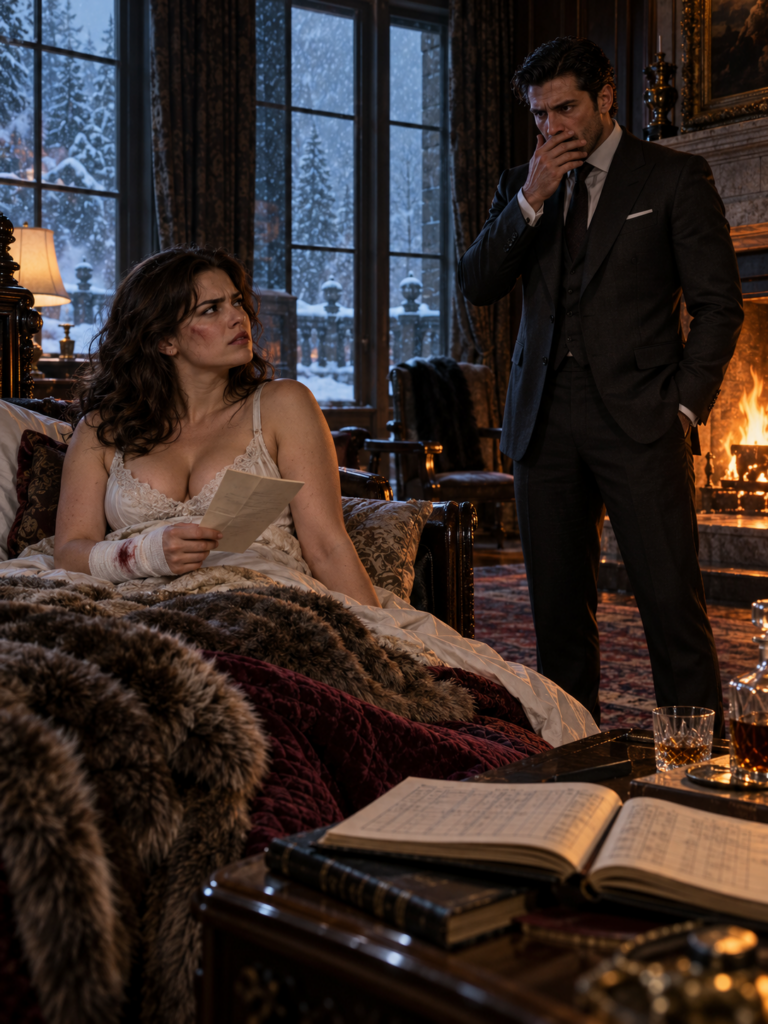
The second sheet slid free, revealing a series of dates that made Josephine’s stomach contract.
Three months earlier, Bradley had persuaded her to increase her life insurance coverage.
Two weeks after that, he had begun transferring money between accounts she didn’t recognize.
And the latest amount matched the debt Lorenzo had just described.
“These aren’t ordinary investment losses,” she said.
Lorenzo moved beside the bed, keeping enough distance for her to examine the pages without feeling crowded.
“What do you see?”
“Transactions designed to conceal where money went. Repeated transfers through businesses that don’t appear to have any legitimate connection to Bradley’s clients.”
Her fingers slowed.
She recognized one of the account references.
Bradley had asked her about it months earlier, claiming he needed advice on a difficult financial reconciliation.
She had refused to work on his professional accounts without proper authorization.
He had accused her of being arrogant.
Now she wondered what he had really wanted.
“Your husband worked with people outside my organization,” Lorenzo said. “Some of those transactions eventually affected money owed to us.”
“Then why is his debt your problem?”
“Because part of the money he mishandled was connected to our business interests.”
Josephine looked directly at him.
“Legitimate interests?”
Lorenzo didn’t answer immediately.
“No,” he admitted. “Not all of them.”
She closed the folder.
It was an answer she needed, even though it made her situation considerably worse.
“Then I can’t assume you’re helping me because you’re a good man.”
“You shouldn’t.”
“Good.”
Something resembling respect crossed his face.
Josephine placed the records on the bed between them.
“I need a telephone. I need to speak with the authorities. And I need to know whether Bradley has reported me missing.”
Lorenzo reached for his phone.
“I can arrange the call.”
“Not arrange what I say.”
He stopped.
“No. That’s your decision.”
When Mateo entered, Lorenzo instructed him to obtain information about the abandoned cabin and Bradley’s reported account of the weekend.
Josephine insisted the original documents remain accessible to her.
She also asked Dr. Rossi to preserve photographs of her injury and record her account while her memory was fresh.
The doctor agreed.
For the next hour, she described the cabin, the locked door, the damaged tires, the snowmobile, and the forged note.
She had barely finished when Mateo returned.
He carried news that transformed her fear into something colder.
Bradley had reported her missing.
According to his account, Josephine had become emotionally unstable and traveled to the cabin alone.
He claimed their marriage had been under enormous strain because of her health.
Josephine stared at the wall.
Those dinner parties.
Those conversations where Bradley had told friends she was exhausted, depressed, and incapable of managing her own life.
He had been building a story about her long before he left her in the snow.
“He made people believe I was falling apart,” she said.
Lorenzo’s jaw tightened.
“That won’t survive your testimony.”
“You don’t know that.”
She looked at him.
“People believed him while I was standing in the room. Imagine what they’ll believe when I’m not there.”
Silence followed.
Then Lorenzo said, “There is something else.”
Josephine waited.
“Bradley has asked for an urgent meeting concerning the money he owes.”
“Where?”
“Manhattan.”
“When?”
“As soon as the payment is available.”
Josephine understood.
Her husband believed he was moving toward freedom.
He expected an insurance settlement, relief from his debt, and a future without the wife he had tried to erase.
“Does he know I’m alive?”
“No.”
“Have you told anyone connected to him?”
“No.”
Josephine considered the advantage of that silence.
Then she shook her head.
“I won’t stay hidden just to help you settle a debt.”
“I’m not asking you to.”
“Then here’s what I want. I make my own statement. I keep copies of anything relevant to my case. And you don’t confront Bradley on my behalf without telling me.”
Lorenzo met her gaze.
“Agreed.”
“And my marriage ends whether you help me or not.”
“That was never mine to decide.”
She studied his face, searching for the condition he might attach.
None came.
For the first time since the cabin, Josephine felt a small piece of control return.
She reached for the telephone Lorenzo had placed beside the bed.
Her fingers trembled, but she dialed anyway.
When a voice answered, Josephine took a steady breath.
“My name is Josephine Hayes,” she said. “My husband reported me missing.”
She looked straight at Lorenzo.
“I’m alive, and I need to report an attempted murder.”
Josephine kept the receiver pressed to her ear while the dispatcher confirmed her name and location.
For several seconds, she could hear only the faint crackling of the fireplace.
Then the questions began.
Was she safe?
Was she injured?
Could she identify the person responsible?
“Yes,” Josephine answered. “My husband.”
Lorenzo remained by the window, listening without interrupting.
It was the first decision she had made since waking that didn’t require his permission, and Josephine intended to keep it that way.
By the time she ended the call, arrangements were being made for officers to take her statement and collect evidence once the road conditions allowed.
She set down the phone.
Lorenzo looked at her.
“Are you certain you want to return to New York so soon?”
“I’m certain I don’t want Bradley controlling the story another day.”
“You’re still healing.”
“Then I’ll heal while the truth comes out.”
He accepted her answer.
It was not the reaction she expected from a man whose reputation depended on absolute authority.
***
The following morning, Josephine requested a laptop.
Dr. Rossi objected to a long working session but approved shorter periods with breaks.
Lorenzo brought her a computer and copies of the financial materials he could safely share.
He did not offer full access to his organization’s private accounts.
Josephine didn’t ask him to pretend they were something they weren’t.
Their interests overlapped.
That did not make them identical.
She was searching for evidence against her husband.
Lorenzo was trying to determine how Bradley’s transactions connected to missing funds.
Both understood that any discovery could expose them to different consequences.
For several days, Josephine studied the records in the guest suite.
The figures were complicated but not unfamiliar.
Before her marriage deteriorated, she had built a successful career investigating financial irregularities for businesses and legal teams.
She knew how dishonest people disguised patterns inside enormous collections of ordinary-looking transactions.
Bradley knew that too.
And he knew she was better at detecting them.
On the fourth evening, Lorenzo found her sitting beside the library fireplace with a pencil between her fingers.
A spreadsheet covered her screen.
“You found something,” he said.
“Possibly.”
She turned the laptop.
“Your people are looking at missing revenue from the shipping routes.”
“Yes.”
“That’s why they’re missing the problem.”
Lorenzo pulled up a chair.
Josephine indicated several entries.
“The expenses are inflated. Fuel charges, in particular. The same pricing differences keep reappearing through a Rotterdam subsidiary.”
“That subsidiary passed internal review.”
“Because someone reviewed each transaction separately.”
She highlighted a sequence of payments.
“Look at the pattern together.”
Lorenzo leaned closer.
A series of seemingly unrelated charges eventually led toward a Manhattan real estate company with no obvious shipping function.
He recognized the company’s name from the folder Mateo had delivered.
“Bradley.”
“At least an account associated with his work,” Josephine corrected. “Don’t confuse a connection with proof of control.”
Lorenzo glanced at her.
“You correct everyone this confidently?”
“Only when they’re wrong.”
For the first time, he laughed.
Not the threatening amusement she had imagined from the newspaper stories.
A brief, surprised laugh that changed his entire face.
Josephine returned to her screen before he could see her smile.
***
They worked until the fire burned low.
When her bandaged arm began aching, Lorenzo noticed her flexing her fingers.
“Enough for tonight.”
Josephine raised an eyebrow.
“That sounded like an order.”
“It was a concern.”
“Then phrase it as one.”
He considered her for a moment.
“Would you consider stopping before you make your injury worse?”
“Yes.”
She closed the laptop.
“See? Effective communication.”
He shook his head, still smiling.
It was a small exchange.
Yet it meant more to Josephine than she wanted to admit.
Bradley had treated every disagreement as evidence that she was difficult.
Lorenzo appeared to regard disagreement as a reason to pay closer attention.
That didn’t make him safe.
But it made him interesting.
***
Over the next week, the authorities documented Josephine’s account and examined the available evidence.
The physical evidence at the cabin, her injuries, and the condition of her vehicle supported important parts of her statement.
Investigators also began examining Bradley’s financial circumstances.
Josephine supplied records she lawfully possessed from her own insurance policy and shared household finances.
She refused to alter anything.
She refused to invent certainty where she had only suspicion.
And when Lorenzo offered to have people pressure Bradley into confessing, she rejected the idea immediately.
“I want evidence that survives scrutiny,” she said.
“I didn’t say anything about hurting him.”
“You didn’t need to. You said pressure.”
Lorenzo folded his arms.
“You’re unusually suspicious of help.”
“I’ve spent four years learning what happens when someone claims to know what’s best for me.”
His expression changed.
“Fair enough.”
The admission caught her off guard.
For a long moment, neither spoke.
Then Lorenzo asked, “What do you need from me?”
“Keep anything connected to your money separate from my personal case. Give investigators what you can legitimately provide. And stop treating Bradley like a problem you can simply make disappear.”
Lorenzo nodded.
“I can do that.”
“Even if the investigation exposes things you would rather keep hidden?”
His silence answered before his words did.
“That,” he said, “is where it becomes expensive.”
Josephine closed her notebook.
“Then we’ll find out what your promises cost.”
***
February brought a slow thaw.
The snow surrounding the estate receded into muddy banks along the drive.
Josephine’s wound began closing, leaving an angry line across her right forearm.
She could walk longer distances without exhaustion.
She also began reclaiming pieces of her ordinary life.
She contacted her attorney.
She reviewed her finances.
She made arrangements to end her marriage.
And she reconnected with professional contacts she had gradually abandoned during Bradley’s years of criticism.
One afternoon, a former colleague told her an independent forensic-accounting practice would be interested in working with her again.
Josephine ended the call with tears in her eyes.
Lorenzo found her standing beside the library window.
“Bad news?”
“No.”
She laughed softly.
“That’s the strange part.”
He waited.
“I thought I had lost my career. Bradley made it sound as though no one wanted to work with me anymore.”
“Was he right?”
“No.”
Her smile trembled.
“He was never right about that.”
Lorenzo watched her for a moment.
“Then you should take the opportunity.”
“What if it means leaving this place?”
“Then you leave.”
She turned toward him.
“Just like that?”
“Josephine, you arrived here because you needed medical care. Not because you signed away your life.”
Something in her chest loosened.
Bradley had spent years turning every practical need into proof she depended on him.
Lorenzo, a man who commanded a criminal organization, had just acknowledged that she could walk away.
It was a more meaningful gesture than any expensive present could have been.
***
Their growing closeness unsettled them both.
They still disagreed about his business.
Josephine refused to involve herself in concealing criminal transactions.
Lorenzo refused to pretend his world was harmless.
But they began sharing quieter moments.
Coffee before breakfast.
A conversation beside the fireplace after an exhausting day.
A walk through the enclosed garden when the weather improved.
Josephine learned that Lorenzo carried responsibility for people who depended on his decisions, even when those decisions were morally compromised.
Lorenzo learned that Josephine had once loved her work so much she forgot to eat lunch, that she disliked being interrupted while calculating, and that she had a dry sense of humor she rarely allowed strangers to see.
One evening, they stood in the library after the staff had retired.
“You’ve been watching me,” she said.
Lorenzo didn’t bother denying it.
“You’re difficult to ignore.”
“Because I’m helping with your accounts?”
“That was the first reason.”
“And the second?”
He looked directly at her.
“Because you keep making me reconsider things I assumed were settled.”
Josephine felt warmth rise into her cheeks.
She had spent years hearing that her body was too large, her voice too strong, her expectations unreasonable.
Now a powerful man stood before her looking uncertain for the first time.
She could have stepped closer.
Instead, she asked the question that mattered.
“Would you still want me here if I stopped working on your books?”
“Yes.”
“What if I moved back to Manhattan?”
“Yes.”
“What if I testified about something I discovered in your business?”
He was silent.
Then he answered carefully.
“I would not like it.”
“That’s not what I asked.”
“No,” he admitted. “But I would have to accept that you make your own decisions.”
She studied him.
“That sounds difficult for you.”
“It is.”
His honesty affected her more than polished compliments.
Still, she stepped away.
“I need time, Lorenzo.”
He nodded.
“Take it.”
***
The next major development came from Bradley.
He had obtained access to the anticipated insurance proceeds.
A large payment had been reported as settled, although the insurer had not yet completed reviewing the newly reported evidence that Josephine was alive.
The money was now the subject of a dispute.
Bradley nevertheless believed he could use the funds to clear his debt.
Through Mateo, Lorenzo received a request for a meeting in Manhattan.
Bradley wanted to make payment in person.
He also wanted assurances about his future relationship with the Moretti organization.
When Lorenzo told Josephine, she stared at him in disbelief.
“He thinks you’re going to reward him.”
“He believes paying what he owes will restore his position.”
“With money he expects to receive because he tried to murder his wife.”
“Yes.”
Josephine walked to the window.
Outside, melting snow dripped from the roof.
For weeks, Bradley had been telling anyone willing to listen that his wife was missing and presumed lost in the wilderness.
He had performed grief.
He had presented himself as the devoted husband of a troubled woman.
And now he was preparing to spend the proceeds of her supposed death.
“What happens if I go to this meeting?” she asked.
Lorenzo’s expression hardened.
“I don’t think you should confront him without the investigators knowing.”
“Neither do I.”
She turned.
“But I want him to hear the truth from me.”
“Josephine—”
“I know. It isn’t safe to improvise in your world.”
She lifted her chin.
“Then we don’t improvise.”
Together, they developed a plan that gave her attorney and the investigating authorities notice of the proposed meeting.
Josephine would not be left alone with Bradley.
Any financial evidence she supplied would be preserved and provided through proper channels.
Lorenzo’s separate dispute with Bradley would remain exactly that: separate.
The setting would be a private function room at the Pierre Hotel in Manhattan, where Bradley expected to meet the man he owed.
Josephine insisted on one condition above all others.
“No one touches him because I ask them to.”
Lorenzo looked at her.
“Even after what he did?”
“Especially after what he did. I refuse to become the excuse for another crime.”
He nodded slowly.
“Understood.”
***
On the afternoon of the meeting, Josephine stood before a mirror in a Manhattan hotel suite.
An emerald evening gown flowed around her full figure.
She had chosen it herself.
Not because Lorenzo wanted her transformed into an ornament, but because she was tired of dressing as though her body required an apology.
Her scar remained visible beneath the sleeve.
She didn’t conceal it.
Lorenzo appeared at the doorway in a dark tailored suit.
For several seconds, he said nothing.
Josephine glanced over her shoulder.
“Well?”
He seemed to search for an answer.
“You look like someone who knows exactly why she’s here.”
She smiled.
“That might be the nicest thing you’ve said to me.”
He approached but stopped at a respectful distance.
“There’s still time to decide against this.”
“I know.”
“Your attorney is downstairs.”
“I know.”
“And if Bradley becomes aggressive—”
“I leave. Mateo keeps the exit clear. The investigators handle anything requiring an arrest.”
Lorenzo exhaled.
“You really did think of everything.”
“Not everything.”
She picked up her clutch.
“But I’ve thought about what matters.”
An hour later, the hotel ballroom glittered beneath chandeliers.
Bradley Hayes entered carrying documents he believed would settle his debt and secure his future.
He smiled when he saw Lorenzo.
He set the briefcase on the table.
And began explaining how fortunate he was to have survived the tragedy of losing his wife.
Lorenzo listened.
Then he glanced toward the staircase.
“Bradley,” he said quietly, “there’s someone you need to see.”
Above them, Josephine stepped into the light.
Josephine placed one hand on the staircase railing.
Below her, Bradley Hayes turned toward the sound of her heels.
For a second, his expression held only annoyance at being interrupted.
Then he recognized her.
His face lost its color.
The briefcase slipped from his hand and struck the carpet.
“Josie?”
Josephine continued down the stairs.
People standing near the private reception area began turning toward her.
Bradley took a step backward.
“No.”
She reached the final step.
“Hello, Bradley.”
His mouth opened, but no words came out.
For weeks, he had told friends that his wife was lost somewhere in the Adirondack wilderness.
He had explained her disappearance through emotional instability.
He had accepted sympathy.
And he had acted as though his future began where hers ended.
Now she stood before him, alive, wearing emerald green, her injured arm healed enough that the scar was plainly visible.
“You’re supposed to be—”
He stopped.
Josephine looked at him.
“Dead?”
The word seemed to shake him.
Lorenzo rose from his chair.
He did not move toward Josephine or put himself between her and Bradley.
She had asked to speak for herself.
He intended to respect that.
***
Bradley looked from Josephine to Lorenzo.
“I don’t understand.”
“Of course you do,” Josephine replied.
She approached the table.
“You remember the cabin.”
“Josie, I thought—”
“You remember locking the door.”
His eyes flicked toward the people watching.
“We shouldn’t discuss this here.”
“You remember taking my phone.”
“You’re confused.”
Josephine stopped.
For four years, those two words had been his favorite defense whenever she challenged him.
Confused.
Oversensitive.
Unreasonable.
Now he was reaching for the same old script.
She refused to participate.
“I’m not confused, Bradley. I remember watching you destroy the tires on my SUV. I remember hearing the snowmobile as you drove away.”
He swallowed.
“That’s not what happened.”
“Then you can explain your version to the investigators.”
Bradley’s gaze darted toward Lorenzo.
“Mr. Moretti, this is a private marital matter.”
Lorenzo’s expression remained cold.
“Attempted murder isn’t a marital disagreement.”
“You don’t understand. She has problems. She’s been struggling for years.”
Josephine almost laughed.
Even now, he was trying to turn her survival into proof of instability.
“You spent years telling people there was something wrong with me,” she said. “You made my weight a joke. You told our friends I couldn’t manage ordinary life.”
“That’s not fair.”
“Neither was leaving me in a cabin without heat.”
A silence settled over the room.
Bradley looked toward the entrance.
Josephine noticed.
She knew that expression.
He was looking for an exit.
***
“I brought the money,” Bradley told Lorenzo suddenly.
He reached for the briefcase.
“The debt is settled. Two and a half million. Everything is ready.”
Lorenzo did not touch the papers.
“The source of those funds is now under investigation.”
Bradley froze.
“What?”
“The insurance claim. The statements you’ve made about Josephine. The financial transactions associated with your accounts.”
His voice remained measured.
“I will not accept that payment.”
Bradley shook his head.
“You gave me a deadline.”
“I did.”
“You said there would be consequences.”
“There will be. But not the ones you expected.”
Josephine turned toward Lorenzo.
This was the moment when she learned whether his promises meant anything.
He could have used Bradley’s desperation to reclaim the money.
He could have quietly settled their criminal dispute and allowed Bradley to continue manipulating the authorities.
Instead, Lorenzo pushed the briefcase away.
Whatever his reasons for confronting Bradley, he was refusing to use the insurance proceeds.
Bradley stared at it.
“You can’t do this.”
Lorenzo regarded him without sympathy.
“I can refuse money that doesn’t lawfully belong to you.”
***
Josephine opened her clutch.
She removed copies of records that had already been provided to investigators through her attorney.
“Do you recognize these dates?”
Bradley glanced at the pages.
His face tightened.
“I don’t know what you’re talking about.”
“Three months before the cabin trip, you increased the insurance coverage.”
“Because we were planning for our future.”
“Then you began transferring money through accounts connected to your business activities.”
“Normal transactions.”
“Some of them overlap with funds that went missing from shipping-related accounts.”
Bradley looked at Lorenzo.
“She’s twisting everything.”
Josephine shook her head.
“No. I’m separating what I know from what still needs to be proven.”
She placed the copies on the table.
“The insurance application has your signature. Our communications establish when you asked me to approve the changes. Investigators have photographs of the cabin, the damaged vehicle, and the injuries I sustained escaping.”
Her voice remained steady.
“And you can explain why the note found inside the cabin was written to make everyone believe I intended to take my own life.”
Bradley backed away.
“You can’t prove I wrote it.”
“That’s something investigators can examine.”
He stopped.
There was a difference between Josephine begging him to admit what he had done and Josephine presenting facts he could no longer dismiss.
For years, he had controlled the conversation by making her doubt herself.
Now she was letting the evidence speak.
***
“What do you want from me?” he demanded.
Josephine stared at the man she had once loved.
She remembered their wedding.
The way he had held her hands when they promised to protect each other.
She remembered the first joke about her weight.
The first apology.
The first time she had changed her clothing to avoid criticism.
The first dinner she had skipped because he made her ashamed of eating.
And she remembered the frozen cabin window breaking beneath the fireplace poker.
“Nothing,” she answered.
Bradley blinked.
“What?”
“I don’t want your money. I don’t want your approval. I don’t want another apology you use to buy yourself time.”
She took a breath.
“I want the truth on the record. I want our marriage ended. And I want to live the life you tried to take away.”
Bradley looked genuinely frightened for the first time.
Not because Lorenzo stood nearby.
Because Josephine no longer needed anything from him.
***
The meeting ended when authorities arrived to question Bradley in connection with Josephine’s allegations and the newly developed evidence.
He attempted to argue.
Then he demanded a lawyer.
His financial documents were preserved for further examination.
The insurance proceeds became the subject of fraud review and recovery proceedings rather than a fortune he could safely spend.
The money was not instantly available for Josephine to redirect, nor could Lorenzo claim it simply because Bradley owed him a debt.
Their accounts, obligations, and legal interests would have to be untangled through the appropriate processes.
Josephine accepted that.
She had spent her career studying financial misconduct.
She understood that justice rarely arrived as neatly as a completed spreadsheet.
But there was satisfaction in watching Bradley leave without the money, without control of her story, and without the wife he had treated as disposable.
***
Later, Josephine stood beside a tall window overlooking Manhattan.
The city lights stretched into the distance.
Her attorney had gone to coordinate the next steps of the case.
Mateo remained near the hallway.
Lorenzo entered carrying two cups of coffee.
“I wasn’t sure how you take it,” he said.
“Black.”
He handed her a cup.
“That surprises me.”
“Why?”
“You seem like someone who enjoys arguing with bitterness.”
Josephine laughed.
It emerged suddenly, without effort.
The sound surprised them both.
She accepted the coffee.
For a while, they watched the city.
Then Lorenzo spoke.
“I owe you an explanation.”
Josephine turned toward him.
“About Bradley?”
“About my involvement.”
She set down the cup.
“Go on.”
***
Lorenzo told her what he had known and when.
Before Josephine reached his estate, Bradley was already a debtor whose financial dealings had damaged interests connected to the Moretti organization.
Lorenzo had pressed for repayment.
He had not known Bradley intended to kill his wife.
He had not known about the cabin, the forged note, or the insurance arrangement until Josephine told him.
But there was something he had not explained fully.
Once she arrived, he realized Bradley’s financial records might also help expose the missing funds in the shipping business.
He had allowed Josephine access to material that could benefit his organization while knowing she was medically and emotionally vulnerable.
He had never threatened her.
But he had benefited from her work before clearly defining the terms.
“I should have asked what you wanted professionally,” he admitted. “Instead of assuming that because you were staying with us, helping me was simply part of our arrangement.”
Josephine studied him.
“That bothered me.”
“I know.”
“Do you?”
“You wanted your life back. I saw an extraordinary accountant sitting beside a set of records my people couldn’t explain.”
She folded her arms.
“And you saw an opportunity.”
“Yes.”
The admission was uncomfortable.
That made her trust it more.
“I should have offered you a proper engagement with independent advice,” he continued. “And I should have made the boundaries clear.”
Josephine looked out over the city.
“What happens if the rest of those transactions reveal crimes connected to your organization?”
Lorenzo didn’t pretend the question was easy.
“Then those facts have consequences.”
“For you?”
“Possibly.”
She turned back.
“Would you try to stop me from telling the truth?”
His answer came slowly.
“No.”
She searched his expression.
“Even if it cost you?”
“Even then.”
Josephine let the silence stretch.
She did not mistake words for proof.
But she knew what they were worth when a man was willing to make them without asking for forgiveness in return.
***
The investigation continued over the following months.
The financial records Josephine examined helped establish how Bradley had concealed transactions through connected companies.
The inflated shipping expenses and Manhattan real estate payments formed part of a broader accounting trail.
Bradley’s professional misconduct, insurance representations, and actions at the cabin became separate but related subjects of scrutiny.
Josephine cooperated through her attorney.
She did not take possession of money she had no right to distribute.
She did not promise results investigators had not yet reached.
And she refused to let her experience be turned into entertainment for the people who had previously believed Bradley’s stories.
When reporters contacted her, she issued a brief statement.
She was alive.
She was recovering.
She was pursuing legal remedies.
She would not discuss the details of an active case.
Then she went back to work.
***
Her first independent consulting contract arrived in March.
She rented a small office in Manhattan with enough room for a desk, shelves, and two chairs.
The building lacked the grandeur of Lorenzo’s Adirondack estate.
She loved it immediately.
The lease was in her name.
The accounts were in her control.
Her professional decisions belonged to her.
On the first morning, she placed a framed qualification certificate on the wall.
Then she sat behind the desk and opened a new client file.
For several minutes, she did nothing but look around.
Four years of being told she was too much.
Too loud.
Too heavy.
Too demanding.
Too difficult.
Now she was surrounded by proof that she had never been too much to build a life.
Her telephone rang.
Lorenzo.
“How’s the office?”
“Small.”
“Do you need anything?”
“No.”
A pause.
Then he said, “Good.”
Josephine smiled.
“You’re learning.”
“Slowly.”
She looked at the certificate on the wall.
“Lorenzo?”
“Yes?”
“Would you like to have dinner with me on Friday?”
Silence.
Then a quiet laugh.
“Are you asking me on a date?”
“I am.”
“I’d like that.”
“And for the record, I choose the restaurant.”
“Of course you do.”
***
Their relationship developed away from the emergency that had brought them together.
Josephine no longer lived under Lorenzo’s protection.
She had her own home, her own work, and a growing circle of people who knew her apart from Bradley or the Moretti family.
Lorenzo had responsibilities she could not romanticize.
She did not pretend his criminal connections disappeared because he was kind to her.
They argued about secrecy.
About the people he trusted.
About the limits of what she could accept.
More than once, Josephine wondered whether affection could survive the difference between their worlds.
Lorenzo wondered too.
But he never asked her to abandon her career.
He never made access to money or security conditional on her staying.
And when she said she would not handle financial records intended to conceal wrongdoing, he respected the boundary.
The legitimate shipping business eventually retained independent professionals to examine its controls and address the weaknesses her preliminary findings had revealed.
Josephine declined to participate in work that might compromise her role as a witness in Bradley’s case.
Lorenzo accepted that decision.
It was not the sweeping transformation of a criminal empire.
It was a smaller, more credible change.
A man accustomed to getting his way was learning that love did not make another person’s choices his property.
***
By autumn, Josephine’s marriage had been legally ended, and Bradley’s criminal and financial proceedings had advanced substantially.
Evidence of his planning, his actions at the cabin, and his misleading account of her disappearance proved difficult for his defense to explain.
The final disposition required legal process rather than a theatrical pronouncement in a ballroom.
Josephine attended the proceedings she was required to attend.
She testified carefully.
She answered difficult questions.
And when it was over, she walked outside into the October sunlight without needing Lorenzo to carry her away.
He stood near the courthouse steps.
Waiting.
Not commanding.
Not deciding where she should go next.
Just waiting.
“How are you?” he asked.
Josephine considered the question.
“Tired.”
He nodded.
“Understandable.”
“Relieved.”
Another nod.
“And hungry.”
He smiled.
“That I can do something about.”
She took his hand.
***
That winter, nearly a year after the cabin, Josephine returned to the Adirondacks.
Not to the place where Bradley had abandoned her.
To the estate whose iron gates she barely remembered touching before collapsing in the snow.
This time, she arrived in daylight.
The road was clear.
She wore a warm coat she had bought herself and carried a folder containing plans for the continued expansion of her accounting practice.
Lorenzo met her at the entrance.
For a moment, neither spoke.
Snowflakes drifted across the stone steps.
Josephine glanced toward the distant gate.
“That night, I thought reaching this place meant someone else would have to save me.”
Lorenzo followed her gaze.
“You had already done the hardest part.”
“I couldn’t have survived without medical care.”
“No,” he agreed. “But you got yourself to the gate.”
She looked down at the thin scar on her right forearm.
It was part of her now.
A reminder of terror.
Of betrayal.
Of a broken window and the decision to keep moving.
Lorenzo gently offered his hand.
She took it.
“Do you know what I want?” she asked.
“Tell me.”
“A life where I never have to make myself smaller to keep someone comfortable.”
“You won’t have to do that for me.”
“And if we disagree?”
“We talk.”
“And if I need to leave?”
“You leave.”
She watched him.
“And if I choose to come back?”
His expression softened.
“Then I’ll be glad to see you.”
Josephine stepped closer.
“I love you, Lorenzo.”
He went completely still.
She smiled.
“Don’t look so surprised.”
“I didn’t want to assume.”
“Good.”
She reached up and kissed him.
It was a choice made without a debt hanging over her head.
Without a locked door.
Without a life insurance policy.
Without fear that she had nowhere else to go.
Lorenzo kissed her back, then rested his forehead gently against hers.
“I love you too.”
Behind them, the front door stood open.
Warm light spilled across the snow.
Josephine looked once more toward the iron gates.
The first time she had crossed that threshold, she had been bleeding, freezing, and terrified that her life was over.
This time she walked inside on her own feet.
Not as a possession.
Not as a woman rescued into permanent dependence.
Not as a queen whose only power came from the man standing beside her.
She was Josephine Hayes, a brilliant accountant, a survivor, and the author of her own future.
And when Lorenzo asked whether she wanted to stay for the weekend, she looked at the snow beyond the windows.
“Yes,” she answered.
“Because I choose to.”


