
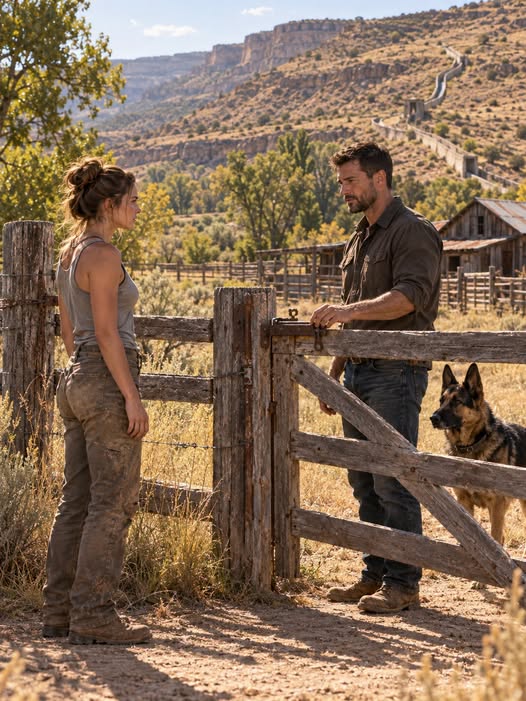
Dylan’s shoulders tightened before Ben could finish explaining what those several days would mean.
“How many people?” Dylan asked.
Ben glanced at Rachel, then back at him. “Four at most for the bank. Maybe three if Rachel’s willing to work.”
“I am.”
Dylan ignored that.
“Machinery?”
“A compact track loader would save us time.”
“No.”
Ben nodded immediately. “Then we do more by hand.”
Rachel watched Dylan’s face.
The answer had come too quickly to be about machinery alone.
Ben paced the broken section, studying the slope.
“We can build the bank back with rock and packed soil. But before anybody spends money on that, I’d want to test the intake.”
Dylan looked at him sharply.
Rachel understood why.
A dry channel could be inspected.
A wet channel could fail.
“If you open it,” she said, “how much water?”
“Very little at first.”
“And if this breach gives way?”
Ben pointed downslope. “It runs onto Hartwell’s lower pasture before it reaches anybody else.”
There it was.
The real cost.
Rachel’s family and three neighbors might gain a reliable supplemental water route.
Dylan carried the first physical risk.
She looked at him.
“You’d be taking the damage if we’re wrong.”
His eyes met hers.
“Yes.”
Ben wandered farther along the lateral to inspect another section, leaving them alone beside the collapsed bank.
Rachel folded her arms.
“Why didn’t you say that at the gate?”
Dylan’s jaw shifted.
“Would it have changed what you wanted?”
“No.”
“Then there wasn’t much point.”
“There was every point.”
He looked away.
Rachel stepped closer but stopped well short of touching him.
“You let me think you were refusing because you didn’t want people on your property.”
“I don’t.”
“That isn’t the whole answer.”
“No.”
The admission landed harder than another refusal would have.
Rachel waited.
Dylan rubbed a hand over the back of his neck.
“My dad spent years keeping this channel alive because everybody below us depended on it. Every spring somebody was up here. Every summer somebody needed something opened, cleaned, adjusted, fixed.”
“That bothered you?”
“No. Him either.”
“Then what did?”
Dylan looked toward the ranch house in the distance.
“When he got sick, everybody still needed something.”
Rachel said nothing.
“They weren’t bad people,” he continued. “That’s the part nobody likes when you tell a story like this. There wasn’t a villain. There were neighbors with farms, bills, trees, families. They called because the water mattered.”
His voice flattened slightly.
“And you were taking care of your father.”
“I was trying to.”
Rachel finally understood the edge she had heard whenever she used words like access and obligation.
Not anger.
Memory.
“What happened when you couldn’t keep doing both?”
“I closed the intake.”
“All of it?”
“Yes.”
“Did people get angry?”
“Some.”
“Were they wrong?”
Dylan considered that.
“No.”
The answer surprised her.
He met her eyes again.
“They needed water. I needed the phone to stop ringing long enough to help my father sit up.”
Rachel’s chest tightened.
There was no accusation in his voice.
That made it worse.
A person could recover from being betrayed by a villain.
It was harder to know what to do with good people whose needs had simply arrived when you had nothing left to give.
Rachel looked at the breached bank.
“So every time somebody asks to reopen this, you hear that phone.”
Dylan’s expression told her she had come too close.
He stepped back.
“That isn’t your problem.”
“No.”
She bent, picked up one of Ben’s small orange marker flags, and pressed it into the dirt at the edge of the breach.
“But this is.”
Dylan looked down at it.
Rachel pointed toward the slope.
“We don’t repair anything until we know exactly what your risk is. Not ours. Yours.”
“You still want the water.”
“Of course I do.”
“And if protecting my pasture means no channel?”
Rachel hated the question because she knew the answer would matter more than every argument she had made at the gate.
She looked him directly in the eye.
“Then no channel.”
His face changed.
Not relief.
Something more vulnerable.
As if he had prepared himself for pressure and did not know what to do with consent.
Ben called from farther up.
“Rachel.”
She turned.
He stood beside an exposed stone junction half-hidden by weeds.
“You need to see this.”
They joined him.
Ben had uncovered a narrow split in the old lateral.
One branch followed the map toward the farms below.
The other angled south.
Toward Hartwell’s orchard.
Rachel crouched.
“That isn’t on the county map.”
“No,” Ben said.
Dylan stared at it.
“My dad added it.”
“You knew?”
“I knew he experimented with a spur. I didn’t know it was still intact.”
Ben checked the grade.
Then he gave a low whistle.
“If this works, reopening the lateral wouldn’t only benefit the farms below.”
Rachel looked at Dylan.
“It could feed your orchard too.”
Dylan said nothing.
Ben continued examining the junction.
“It changes the economics. It also changes the risk. If we rebuild the breach correctly, Hartwell isn’t just granting access to everybody else. He has something to gain.”
Rachel felt excitement flare.
Then she saw Dylan’s expression.
He was not relieved.
He looked trapped.
Because accepting the benefit meant something more dangerous than letting strangers cross his land.
It meant becoming part of the system again.
Rachel stood.
“I’m not asking you to decide now.”
Dylan looked at the old junction, then at the gate far below.
“I already did.”
He took a breath.
“Tomorrow morning. Six-thirty. You and Ortega. We mark the repair zone.”
Rachel started to answer.
Dylan raised a hand.
“One condition.”
She waited.
“If this goes forward, nobody assumes access. Every person comes through me.”
Rachel nodded.
“And one condition from me.”
His eyes narrowed.
“You don’t disappear behind that gate whenever you’re worried and make the decisions for everybody.”
For several seconds, neither moved.
Then Dylan held out his hand.
Rachel looked at it.
So did he.
She placed her palm in his.
“Agreed,” he said.
His grip was brief, warm, controlled.
But when Rachel released him, Dylan did not step away.
Dylan did not step away.
For one suspended second, Rachel became aware of everything between them that had nothing to do with irrigation.
The heat.
The dust.
The steady pressure of his attention.
The fact that a man who guarded every entrance to his life had just agreed to negotiate instead of dictate.
Then Bod shoved his nose between their hands.
Rachel laughed.
The tension broke.
Dylan looked down at the dog.
“Traitor.”
Bod wagged once.
The next morning, Rachel arrived before six-thirty and found the gate already open.
That mattered more than she expected.
Dylan had not made her wait outside for him to decide whether yesterday’s agreement still counted.
Ben arrived five minutes later.
For the next three hours they marked the damaged section, checked elevations, and calculated what could be done without heavy equipment.
Rachel took measurements while Ben called numbers.
Dylan hauled stone from an old pile near the barn.
He worked quietly, but not distantly.
When Rachel disagreed with Ben about where to place the temporary diversion, Dylan listened instead of interrupting.
“What are you seeing?” he asked her.
She pointed to the slope.
“If we divert there, any overflow runs straight toward your equipment shed.”
Ben followed the line.
“She’s right.”
Dylan looked at Rachel again.
Not impressed.
Not surprised.
Simply recalibrating.
Rachel liked that more.
“You do this often?” he asked.
“Grow up on a farm long enough and you learn where water goes after everybody who designed the route has gone home.”
“That sounds bitter.”
“It’s practical.”
“Those aren’t mutually exclusive.”
Rachel smiled despite herself.
By noon they had a repair plan.
Three days of labor.
No permanent construction beyond rebuilding the original bank.
A controlled test at low flow.
If the test failed, the intake would close immediately.
If it worked, the farms below could negotiate a seasonal maintenance agreement.
Negotiate.
Not assume.
Rachel made certain that word stayed in the plan.
The first repair day brought two additional growers, both of whom looked visibly surprised to find Dylan waiting for them at an open gate.
He did not welcome them warmly.
But he did welcome them.
Rachel noticed something else.
He had placed Bod in the ranch house.
He had removed even the possibility that the dog’s presence might feel like a warning.
Nobody commented on it.
Rachel did.
Later, when they were carrying stone together, she said, “You put Bod inside.”
“He likes stealing gloves.”
“No, he doesn’t.”
Dylan glanced at her.
“Maybe I was trying not to make people nervous.”
Rachel shifted the stone in her arms.
“That sounds suspiciously considerate.”
“Don’t spread it around.”
The work changed them.
Not dramatically.
Not all at once.
But shared labor had a way of stripping away the things people performed for each other.
Rachel learned Dylan drank coffee so strong it could have refinished furniture.
Dylan learned Rachel hummed when concentrating and denied it whenever caught.
She discovered he had no patience for people who complained about heat while standing in the shade.
He discovered she was perfectly willing to tell him he was wrong in front of three other men.
On the second afternoon, Dylan tried to move a section of stone alone.
Rachel stepped into his path.
“No.”
He blinked.
“It’s a rock.”
“It’s a rock Ben already said takes two people.”
“I can lift it.”
“That isn’t the point.”
His expression hardened almost reflexively.
Rachel held her ground.
“You wanted people to ask before changing the plan on your property. Fine. You don’t get to demand rules and then ignore them because you think your spine has diplomatic immunity.”
One of the growers coughed into his fist to hide a laugh.
Dylan looked at the stone.
Then at Rachel.
Then he stepped back.
“Help me.”
Two words.
They should not have mattered.
They did.
Rachel moved beside him.
Together they lifted.
That evening, after everyone left, Rachel remained to help Ben cover the exposed bank in case of unexpected rain.
When Ben drove away, she realized her car was still parked inside the gate.
Dylan was coiling hose near the barn.
“You can leave it open,” she called.
He looked toward the entrance.
Usually he closed it the instant the last visitor passed through.
Tonight he did not.
Rachel walked toward him.
“You forgot.”
“No.”
The answer slowed her.
Dylan set the hose down.
“I know you’re still here.”
Rachel waited.
He looked uncomfortable in a way she had never seen when he was handling machinery, water pressure, equipment, or people.
“I spent a lot of years thinking the easiest way not to disappoint anybody was not to give them access in the first place.”
Rachel’s voice softened.
“That works?”
“No.”
“What does it do?”
“Cuts down on scheduling.”
She laughed.
He almost did.
Then his expression changed again.
“My dad used to say the gate was for cattle, not people.”
Rachel looked toward the road.
“When did you start locking it?”
“After he died.”
There it was.
No dramatic confession.
No terrible secret.
Just grief translated into hardware.
Rachel leaned against the fence post.
“Did you want everyone gone?”
“At first.”
“And later?”
Dylan considered the question.
“Later I got used to not having to find out who would stay.”
Rachel felt that answer somewhere uncomfortably deep.
She had spent years doing the opposite.
Saying yes.
Showing up.
Making herself useful enough that nobody could reasonably leave her out.
Different defenses.
Same fear.
“You know what mine is?” she asked.
Dylan looked at her.
“I make plans.”
“I noticed.”
“I organize things until they look solvable.”
“Also noticed.”
“My father says if the house ever catches fire, I’ll probably make a spreadsheet before calling 911.”
“That seems inefficient.”
“Thank you.”
His mouth moved.
Then Rachel said, “The well scared me.”
Dylan’s attention sharpened.
She looked toward the darkening valley.
“It wasn’t just the water. It was realizing there was something happening on our farm I couldn’t fix by working harder. I hate that feeling.”
Dylan’s voice was quiet.
“Most people do.”
“I know. But I really hate it.”
“And the lateral gave you a problem you could solve.”
“Yes.”
He nodded.
“So you kept coming back.”
Rachel looked at him.
“Partly.”
The air changed.
Dylan did not ask what the other part was.
He did not have to.
The next morning, the rebuilt bank was ready for testing.
That was when everything became real.
Ben stood at the intake with one hand on the old control.
Rachel positioned herself near the repaired breach.
Dylan stood several yards below her, where he could watch both the bank and the path toward his lower pasture.
The other growers waited farther downstream.
Ben called, “Ready?”
Dylan looked at Rachel.
Not Ben.
Rachel understood why.
This had been her request.
Her persistence.
And if the test failed, his land took the damage.
She could have nodded.
Instead she walked down to him.
“Your ranch,” she said. “Your call.”
His eyes held hers.
“And if I say no?”
“We pack up.”
“You’d be angry.”
“Yes.”
He almost smiled.
“But you’d leave?”
“Yes.”
The answer settled something in him.
Dylan looked uphill.
“Open it.”
Ben moved the control.
For several seconds, nothing happened.
Then water appeared.
Not a flood.
A thin dark ribbon moving through a channel that had been dry for years.
It slid over the old stones, carrying dust ahead of it.
Rachel walked beside the flow.
The water reached the rebuilt section.
Everyone went silent.
It pressed against the packed bank.
Held.
Moved forward.
Another ten feet.
Twenty.
Thirty.
Then Rachel heard a sound she did not like.
A soft sucking noise beneath her boots.
“Ben!”
She stepped back.
A wet line appeared below the repaired bank.
Dylan was beside her immediately.
“Move uphill.”
Rachel did, but pointed.
“Not the bank. Under it.”
Ben came running.
Water was seeping through an old animal burrow beneath the repair.
“Close the intake!” he shouted.
One of the growers relayed the call.
The flow began to slow.
But the saturated soil under Rachel’s previous position slumped.
Dylan caught her forearm as the edge gave way.
She regained her balance and pulled free as soon as she was stable.
“I’m fine.”
“I know.”
He released her immediately.
That mattered too.
Ben crouched beside the failure.
“This is fixable.”
Nobody answered.
Because the question was no longer whether it could be repaired.
The question was whether Dylan would allow a second attempt.
He stared at the wet soil.
Rachel could almost see the gate closing in his mind.
She did not rush him.
After a minute, one of the growers said, “We can come back tomorrow.”
Dylan’s shoulders tightened.
Rachel stepped between them—not defensively, simply decisively.
“No.”
The grower frowned.
Rachel continued.
“We don’t decide his schedule because we want an answer.”
Dylan looked at her.
She addressed everyone.
“We clean this up. Then we leave. Dylan decides whether there’s another test.”
No one argued.
They spent the next hour securing the bank.
By the time the others drove away, Dylan had barely spoken.
Rachel loaded the last shovel into Ben’s truck.
Ben gave her a look.
“You coming?”
“In a minute.”
He nodded and left.
Rachel found Dylan at the intake.
The control was closed.
He stood with one hand resting on it.
“I’m not going to ask,” she said.
“Good.”
“But I am going to tell you Ben was right. The problem is repairable.”
“I heard him.”
“And the failure wasn’t because you let people in.”
His head turned.
Rachel knew immediately she had touched the actual wound.
“This isn’t therapy, Rachel.”
“No.”
“Then don’t turn an irrigation problem into one.”
“You already did that when you locked the gate.”
The words hung between them.
Dylan’s face went still.
Rachel’s heart started pounding, but she refused to retreat from the truth simply because it had hurt him.
He stepped away from the intake.
“You should go.”
She swallowed.
“All right.”
Rachel walked toward her car.
She made it halfway before Dylan spoke.
“My father fell in that pasture.”
She stopped.
Dylan remained behind her.
“Last year he was alive.”
Rachel turned slowly.
He was staring at the ground.
“I was fixing a pump near the lower field. He told me he was staying on the porch.”
Rachel said nothing.
“He walked up here anyway. Wanted to check the channel after a storm.”
His voice had lost every trace of hardness.
“I found him beside the breach.”
Rachel’s throat tightened.
“Was he hurt?”
“Not badly. But he couldn’t get up.”
Dylan looked toward the slope.
“He kept apologizing because he thought I’d be angry.”
Rachel did not move.
“He’d had a stroke. He was losing pieces of himself every month, and he was apologizing to me because he’d walked across his own land.”
Dylan breathed out.
“That was when I realized I’d started managing everything. His medication. His food. His appointments. Where he walked. When he rested. Who visited. I told myself it was because I was keeping him safe.”
Rachel understood before he said it.
“Sometimes it was.”
“And sometimes I was scared.”
The admission was almost a whisper.
“I couldn’t control what was happening to him, so I controlled everything I could.”
The locked gate.
The inspection rules.
The equipment.
The route.
Rachel saw the pattern now.
Protection had become his reflex because helplessness was intolerable.
Dylan looked at her.
“When you showed up with that form, all I could think was that once I signed something, I’d lose the ability to shut it down.”
Rachel approached carefully.
“You wouldn’t.”
“I know that now.”
“Do you?”
He gave her a tired half-smile.
“Working on it.”
Rachel stopped beside him.
“Then don’t reopen the lateral for me.”
His brow furrowed.
“Or the neighbors.”
She touched the metal control with two fingers.
“Reopen it only if you want to be part of it.”
Dylan looked at her hand.
Then at her face.
“And if I don’t?”
“I’ll find another way.”
“You said the wells are getting worse.”
“They are.”
“So your other way might be expensive.”
“Yes.”
“Or fail.”
“Yes.”
He studied her for a long time.
“You’d really walk away from this?”
Rachel answered carefully.
“I’d walk away from taking it from you.”
Something in Dylan’s expression broke open.
Not completely.
Enough.
He reached past her and placed his hand on the intake control.
“Tomorrow,” he said.
Rachel blinked.
“What?”
“We repair the burrow.”
“You’re sure?”
“No.”
That answer made her smile.
Dylan looked toward the dry channel.
“But I’m choosing it anyway.”
The following afternoon, after hours of digging, packing, and reinforcing the weak soil, the second test began.
The water came slowly.
Reached the repaired bank.
Held.
Passed the buried weakness.
Continued downhill.
Rachel walked beside it.
So did Dylan.
At the junction, Ben diverted part of the flow toward Hartwell’s orchard.
The rest continued toward the farms below.
For the first time in years, Red Mesa water crossed the ranch in both directions of purpose—toward Dylan’s land and beyond it.
Then Bod, finally released from the house, raced along the bank as though the entire project had been designed for him.
Rachel laughed.
Dylan looked at her instead of the water.
She caught him.
“What?”
“Nothing.”
“That was definitely something.”
He shook his head.
Rachel stepped closer.
“Careful, Hartwell. You’re getting bad at hiding.”
His expression softened.
“So are you.”
Before she could answer, Ben called from the lower bend.
“Rachel! Dylan!”
They turned.
Ben was staring downstream.
The water had stopped.
Not slowed.
Stopped.
Dylan’s expression changed instantly.
He and Rachel ran toward him.
At the bend, the old channel disappeared beneath a mat of roots and packed debris.
Ben pointed.
“There’s a blockage under there.”
Rachel crouched.
“How far?”
“I can’t tell.”
Dylan looked at the slope beyond it.
Rachel followed his gaze.
On the other side of the obstruction, the channel crossed the final stretch of Hartwell Ranch before dropping toward her family’s orchard.
They had restored almost everything.
One barrier remained.
Ben reached for his shovel.
Dylan stopped him.
“No.”
Rachel looked up.
For one terrible second, she thought he had changed his mind.
Then Dylan handed Ben a pair of gloves.
“Not alone.”
He picked up another shovel and looked at Rachel.
“You wanted the channel open.”
She took the third.
Dylan’s gaze held hers.
“Let’s finish it.”
Rachel drove her shovel into the packed debris.
Dylan worked beside her.
Ben attacked the blockage from the opposite bank.
Within minutes they understood why the water had stopped.
Years of roots, stones, dried leaves, and collapsed soil had compressed beneath an old wooden crossing until they formed something almost solid.
“This could take hours,” Ben said.
Dylan wiped sweat from his forehead.
“Then it takes hours.”
Rachel looked at him.
Weeks earlier, the same man had refused to allow two people to walk across his upper pasture.
Now he stood ankle-deep in mud helping restore a channel that would connect his land to half a dozen neighbors.
The change would have been easy to romanticize.
Rachel refused to.
Trust was not a personality transplant.
It was work.
Sometimes literal work.
They dug until evening.
When darkness began settling over the valley, Dylan called it.
“We finish tomorrow.”
Rachel leaned on her shovel.
“You’re voluntarily inviting us back?”
“Don’t make this weird.”
“It’s historic.”
Ben laughed.
Dylan gave him a look.
Ben laughed harder.
The next morning, two neighboring growers arrived without being asked.
They stopped at the closed gate.
Nobody honked.
Nobody climbed over.
Nobody called Dylan impatiently.
They waited.
Rachel stood beside Dylan when he saw them from the porch.
“You told them?”
“No.”
He looked at her suspiciously.
“I didn’t.”
They walked down together.
One of the men lifted a hand.
“Ben said you might be finishing the blockage.”
Dylan waited.
The man continued.
“We thought you might want help.”
“Might?”
“We’re learning.”
Rachel lowered her face so Dylan would not see her smile.
He saw anyway.
Dylan unlocked the gate.
“Come in.”
That morning, six people cleared the crossing.
It was not dramatic.
No speeches.
No symbolic applause.
They shoveled.
They hauled debris.
They reset loose stones.
At noon, Martha Jensen arrived with sandwiches and left them on the tailgate of her truck without making a ceremony of it.
Dylan stared at the food.
Rachel handed him one.
“You going to refuse lunch on principle?”
“I’m evaluating.”
“It’s turkey.”
“Complicated.”
She shook her head.
He took the sandwich.
By midafternoon, Ben slid a long-handled rake beneath the crossing and pulled.
A final mass of roots tore loose.
Water surged through.
Not violently.
Not triumphantly.
Simply naturally, following the grade that had always been there.
Everyone stepped back.
The channel filled.
Water slipped beneath the crossing, curved around the final bend, and continued south.
Rachel followed it downhill.
Her pulse quickened as it approached the edge of Hartwell Ranch.
Dylan came beside her.
There was still a gate there.
Not the road gate.
A smaller old water gate rusted partly closed where the lateral divided before leaving the property.
Rachel looked at Dylan.
He looked at the handle.
Ben stopped several feet behind them.
Nobody spoke.
Dylan gripped the iron lever.
It resisted.
Rachel reached toward it, then stopped.
“Want help?”
He glanced at her.
“Yes.”
Together they pulled.
The gate moved with a groan.
Water pushed through.
Rachel watched it disappear beyond the boundary toward her family’s land.
For a moment she could not speak.
She had spent weeks chasing this.
Water.
A practical solution.
A line on a map restored to usefulness.
But standing beside Dylan, she understood that something else had reopened with it.
Not because she had persuaded him.
Because he had been given room to choose.
Ben cleared his throat behind them.
“I’m going to go make sure it actually reaches where we think it does before you two turn this into a movie.”
Rachel turned.
“Ben.”
“What?”
Dylan almost smiled.
Ben walked away.
Rachel looked back at the flowing water.
“My dad’s going to lose his mind.”
“That good?”
“He’ll pretend not to.”
“Family trait?”
She bumped Dylan lightly with her shoulder.
He did not move away.
The Red Mesa lateral reached the Donnelly orchard forty-three minutes later.
Rachel’s father stood beside the receiving ditch with his hands on his hips and watched clear water enter soil that had been drying for weeks.
He looked at Rachel.
Then beyond her at Dylan.
“Never thought I’d see this running again.”
Dylan shifted slightly.
Rachel recognized the instinct.
Accept nothing.
Owe nothing.
Leave before gratitude becomes obligation.
Her father seemed to recognize it too.
So instead of thanking him, he said, “Flow’s a little high.”
Dylan blinked.
“What?”
“You heard me.”
Rachel’s father pointed.
“You’re going to scour that bend if you leave it there.”
Dylan looked.
Ben looked.
Rachel looked.
Her father was right.
Dylan walked toward the control.
“Better?”
After an adjustment, Rachel’s father nodded.
“Better.”
That was all.
Dylan glanced at Rachel.
She smiled.
He stayed.
Over the next two weeks, the farms using the lateral established a maintenance schedule.
Rachel made one thing clear at the first meeting.
“Hartwell Ranch isn’t public property because water crosses it.”
Nobody objected.
Dylan sat at the far end of the table in the Donnelly packing shed.
He had come voluntarily.
That alone made several people look twice.
Rachel continued.
“Access is scheduled. Emergencies are different, but routine work gets coordinated. Nobody drives up there unannounced.”
A grower named Jim asked, “Through Dylan?”
Rachel looked at Dylan.
He answered for himself.
“Through me or Rachel.”
She turned sharply.
That had not been discussed.
Dylan met her eyes.
“Problem?”
“We said you weren’t going to make decisions for everybody.”
“I’m not.”
“You just volunteered me.”
“I thought you’d object if I volunteered myself as sole dictator.”
Several people became extremely interested in their notebooks.
Rachel fought a smile.
“You could have asked.”
“You’re right.”
The room went silent.
Dylan continued, “Rachel, do you want to be the second contact?”
The simplicity of it struck her harder than a grand apology would have.
He had corrected himself in public.
No defensiveness.
No performance.
Just changed behavior.
“Yes,” she said.
“Good.”
Jim cleared his throat.
“So… through Dylan or Rachel?”
“Yes,” they said together.
The meeting moved on.
When it ended, Rachel found Dylan outside beside his truck.
“You did that on purpose.”
“What?”
“Made me call you out.”
“No.”
She stared at him.
“All right,” he said. “Maybe a little.”
“Why?”
He leaned against the truck.
“Because agreeing with you privately is easy.”
Rachel waited.
“Doing it when other people can see me give up control is harder.”
She felt something warm and dangerous move through her.
Not danger in the way people used the word about Dylan.
The opposite.
The danger of believing someone was actually trying to change.
“That sounds suspiciously self-aware.”
“I’ve been spending time with an irritating woman.”
“Poor thing.”
“Relentless.”
“Tragic.”
“Has arrows on her tablet.”
Rachel laughed.
Dylan’s gaze dropped briefly to her mouth.
The moment changed.
This time neither pretended otherwise.
Rachel’s voice softened.
“You keep doing that.”
“What?”
“Looking at me like you’re considering something.”
“I am.”
“Planning?”
“No.”
That answer surprised her.
Dylan straightened.
“I’ve done enough planning around you.”
Rachel’s heartbeat accelerated.
“Then what are you considering?”
He took a step closer.
“Whether asking would ruin it.”
“Asking what?”
Dylan stopped within reach.
He did not touch her.
Rachel appreciated that more than she could explain.
“Whether I can kiss you.”
Every joke disappeared.
Every practical excuse.
Every safe interpretation.
Rachel looked at the man who had once answered her with one word through a locked gate.
Now he was standing in front of her waiting for permission.
She smiled.
“Yes.”
Dylan kissed her carefully.
Too carefully.
Rachel caught the front of his shirt.
He paused.
“Problem?”
“Yes.”
His expression changed.
Rachel pulled him closer.
“You’re overthinking again.”
Something warm entered his eyes.
“Yes, ma’am.”
The second kiss was not cautious.
But it was still a question she was free to answer.
She answered it.
And then, because Rachel Donnelly had never confused a kiss with a completed negotiation, she stepped back.
Dylan looked almost offended.
“That’s it?”
“For today.”
“That seems arbitrary.”
“Boundaries.”
He narrowed his eyes.
“You enjoy this.”
“Immensely.”
He laughed.
It was the first time Rachel heard the sound without restraint.
She carried it home with her.
But romance did not solve the practical problem.
The well remained weak.
The lateral helped, but the valley was still dry, and everyone using the restored channel had to coordinate carefully.
That turned out to be useful.
For years, each farm had handled shortages independently.
Now they had a reason to speak.
Ben created a rotation schedule.
Rachel tracked usage.
Dylan monitored the upper intake.
The arrangement was not perfect.
Twice people forgot to call before adjusting flow.
Once Rachel herself drove through Dylan’s gate without waiting because she saw it standing open.
He found her halfway up the road.
“You didn’t call.”
She stopped.
“The gate was open.”
“That wasn’t the agreement.”
He was right.
Rachel disliked that intensely.
“I’m sorry.”
Dylan studied her.
She folded her arms.
“Don’t enjoy this.”
“I’m trying not to.”
“I can see you failing.”
He smiled.
Rachel took out her phone and called him while standing six feet away.
His phone rang.
Dylan looked at the screen.
Then at her.
She said into her phone, “Hi. I’d like permission to drive up your road.”
He answered his own phone.
“Denied.”
Rachel hung up.
“You are impossible.”
Dylan stepped aside.
“But you can come up.”
Trust, Rachel discovered, was not the absence of rules.
Sometimes it was respecting the ones you had agreed to.
Autumn came slowly.
The orchards survived the worst of the dry spell.
The Red Mesa lateral remained open through the end of irrigation season.
On the final day, Rachel drove to Hartwell Ranch expecting to help Dylan close the intake.
She found the road gate standing open.
Bod came running with the old black rubber bumper.
He dropped it at her feet.
Rachel picked it up.
Then she froze.
The first time Bod had done this, the bumper had rolled beneath a locked fence.
Rachel had refused to reach across the boundary.
Now she stood on the other side.
Dylan was walking down from the barn.
“He remembers you.”
“He remembers anyone gullible enough to throw this.”
Bod stared at her.
Rachel threw.
The dog exploded after it.
Dylan stopped beside her.
“You crossed the gate without calling.”
“It was open.”
His eyebrow lifted.
Rachel immediately reached for her phone.
He caught her wrist lightly.
“No.”
She looked at his hand.
He released her.
“The rule changed.”
“When?”
“Today.”
“That sounds unilateral.”
“For you.”
Rachel frowned.
Dylan took a breath.
Then, because he had learned something too, he corrected himself.
“If you want it to.”
Rachel’s expression softened.
“What exactly are you offering?”
“Access.”
“To the ranch?”
“Yes.”
“That sounds dangerously vague.”
“I knew you’d say that.”
From his pocket, Dylan removed a key.
Rachel stared at it.
The gesture could have gone wrong in a hundred sentimental ways.
He seemed to know that.
“This isn’t a key to move in.”
“Good.”
“Or permission to reorganize my kitchen.”
“I’ve seen your kitchen. It needs intervention.”
“Rachel.”
“Continue.”
“It means if the gate is locked and you want to come up, you don’t have to ask me first.”
She studied the key without taking it.
“Why?”
Dylan looked toward the house.
Then back at her.
“Because I want one person in my life who doesn’t have to stand outside until I decide whether I can handle letting them in.”
The honesty of it silenced her.
Rachel took the key.
Then she closed her fingers around it.
“One condition.”
He sighed.
“Of course.”
“You don’t give me access instead of giving me trust.”
Dylan’s expression sharpened.
“Explain.”
“A key is easy.”
She held it between them.
“You don’t get to hand me this and then shut me out of every hard conversation.”
He was quiet.
“If you’re angry, tell me. If you’re afraid, tell me. If you need space, say that. Don’t disappear and make me guess whether I’ve become another person you regret letting through the gate.”
Dylan looked at her for a long time.
“That’s harder.”
“Yes.”
He nodded.
“Okay.”
Rachel slipped the key into her pocket.
“Then I’ll keep it.”
Bod returned with the bumper.
This time Dylan picked it up.
He threw it toward the pasture.
They watched the dog run.
After a while, Dylan said, “There’s something else.”
Rachel groaned.
“Another condition?”
“No.”
His voice had gone quieter.
“My dad knew the channel would probably be useful again someday.”
Rachel turned.
“How do you know?”
“He told me.”
“When?”
“Near the end.”
Dylan looked toward the upper pasture.
“He said I should reopen it when people needed it.”
Rachel felt her chest tighten.
“And you didn’t.”
“No.”
“Did that bother you?”
“For years.”
“Because you thought you failed him?”
Dylan nodded.
Rachel considered that.
Then she said, “Maybe he was wrong.”
Dylan looked at her sharply.
She continued.
“Maybe you weren’t supposed to open it just because people needed it.”
“He thought—”
“I know what he thought.”
Rachel stepped closer.
“But you were allowed to need something too.”
Dylan’s jaw tightened.
She touched his arm.
“You spent two years caring for him. Closing a water gate while you were exhausted and grieving wasn’t betrayal.”
He looked away.
Rachel did not force his attention back.
After a while, Dylan said, “I should’ve reopened it sooner.”
“Maybe.”
He glanced at her, almost offended.
She smiled gently.
“I’m not going to lie to make you feel better. Maybe you should have.”
His mouth twitched.
“But you opened it now.”
“That enough?”
“For the irrigation system?”
She shrugged.
“Ben would say we need another season of data.”
Dylan laughed softly.
“For you?”
Rachel looked toward the road.
The gate stood open beneath the cottonwoods.
She thought about the first morning she had stood outside it with a folder full of reasons he should say yes.
Back then she had believed the problem was persuasion.
Then she had believed the problem was fear.
Now she understood it differently.
Dylan had never needed someone strong enough to force his gate open.
He had needed someone willing to stand outside without pretending the boundary did not exist.
And Rachel had needed something too.
Not a man who could solve every problem.
Not a protector who decided what was best for her.
She needed a partner who could say no and still listen.
Someone who could ask for help.
Someone who could be wrong without turning disagreement into abandonment.
Someone whose strength included opening his hand.
“The key doesn’t make us anything,” she said.
“I know.”
“The water doesn’t either.”
“I know.”
“And one kiss definitely doesn’t.”
“That one feels unnecessarily harsh.”
Rachel smiled.
Dylan moved closer.
“What would?”
She looked at him.
“Time.”
He nodded.
“Choices.”
Another nod.
“Showing up.”
“I can do that.”
“You already are.”
That was when she kissed him.
Months later, after the first winter snow settled along the Grand Valley, the Red Mesa lateral lay dry again.
But nobody called it abandoned.
A maintenance schedule hung in the Donnelly packing shed.
Dylan had volunteered to oversee the upper section with Ben.
Rachel managed the rotation records with two other growers.
No one person controlled the system.
That had been Dylan’s suggestion.
The following spring, when they reopened the intake, half the valley seemed to appear.
Not because Dylan had become suddenly social.
He still disliked crowds.
He still left gatherings early.
He still preferred fixing a neighbor’s equipment to discussing his feelings about anything.
But the road gate stayed open during work hours.
People knocked before entering the house.
They called before changing the irrigation route.
And when something bothered Dylan, he became increasingly capable of using actual sentences instead of locks.
Rachel considered this substantial progress.
Their relationship grew the same way.
Slowly.
Practically.
With disagreements.
Rachel did not move onto Hartwell Ranch.
Not that year.
She had her own work, her own family operation, and her own plans for expanding the Donnelly orchard’s direct-market business.
Dylan helped when she asked.
He did not assume ownership of the project.
When he had an idea, he offered it.
When Rachel rejected one, he occasionally managed not to look personally betrayed.
Occasionally.
Rachel, in return, learned that asking for help was not surrender.
When a late frost threatened her new trees, she called Dylan at four in the morning.
He arrived twenty minutes later.
He did not take over.
He asked, “What do you need?”
Rachel handed him a stack of covers.
“Start at the west row.”
“Yes, ma’am.”
By sunrise they had saved most of the young trees.
Rachel stood beside him beneath a pale pink sky, exhausted and freezing.
Dylan handed her coffee.
She took a sip.
It was terrible.
“This could remove paint.”
“You keep drinking it.”
“I’m cold.”
“Excuses.”
She leaned into him.
He put an arm around her.
Not around her future.
Not around her choices.
Just around her.
Below them, water moved through the restored lateral.
Rachel could hear it beneath the morning wind.
A year earlier, that sound had been impossible.
So had this.
Dylan reached into his pocket.
Rachel immediately straightened.
“If that’s a ring, I’m throwing you in the ditch.”
He looked horrified.
“It’s a gate hinge bolt.”
She stared.
He held up the metal piece.
“The lower hinge is loose.”
Rachel started laughing so hard she nearly spilled the coffee.
Dylan watched her.
“What?”
“Nothing.”
“That is clearly not nothing.”
She shook her head.
“I love you.”
The words came out before she planned them.
Rachel froze.
So did Dylan.
For once, neither had prepared.
Neither had terms.
Neither had a strategy.
Dylan’s expression changed slowly.
Not triumph.
Not relief.
Something quieter.
Something almost astonished.
He set the bolt on the fence post.
Then he looked at her.
“I love you too.”
Rachel swallowed.
Dylan continued before she could answer.
“And I know that doesn’t mean you owe me anything.”
Her eyes burned.
“That may be the least romantic follow-up to ‘I love you’ in recorded history.”
“I panicked.”
“I noticed.”
“But I mean it.”
“I know.”
Rachel stepped into him.
He touched her face.
“Can I try again?”
“No.”
His eyebrows rose.
She kissed him.
Below them, the old Red Mesa lateral carried water past the ranch, toward the Donnelly orchard and the farms beyond.
Behind them, the gate at the end of the road stood open.
Not because Dylan Hartwell had stopped needing boundaries.
Not because Rachel had defeated them.
Because he had finally learned that a boundary could have a latch instead of a lock.
And Rachel had learned that love was not proving someone should let you in.
It was being trusted with the choice once they did.

