
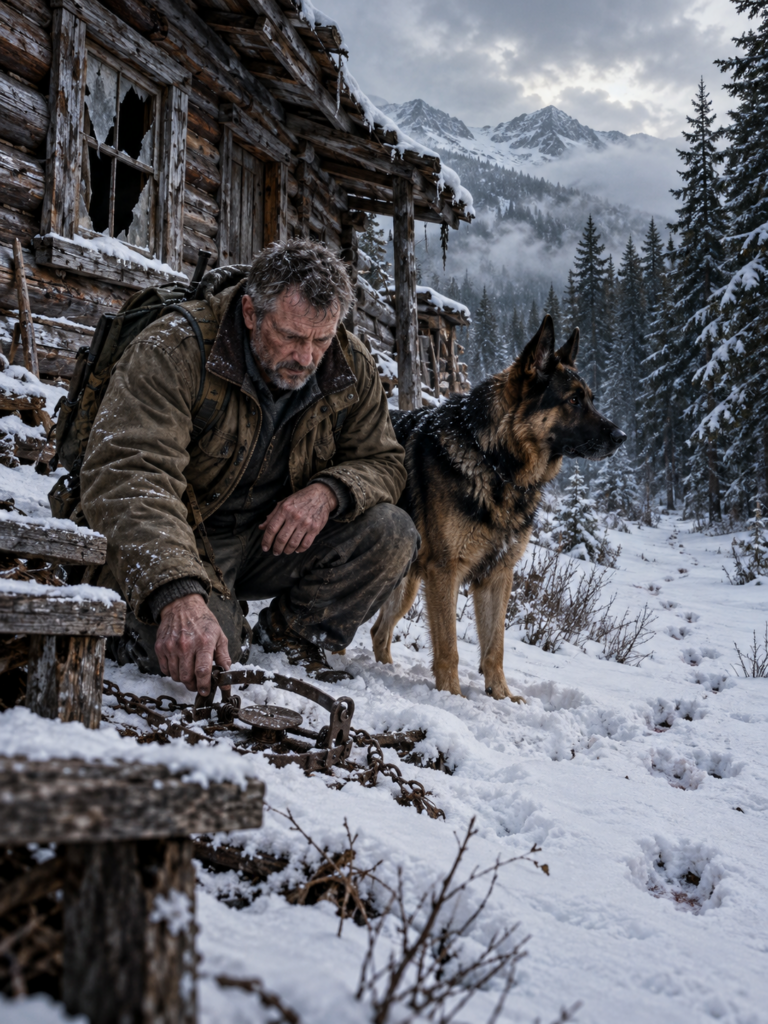
Caleb’s fingers closed around the latch just as Ranger pushed against his leg, forcing him a step away from the doorway.
Outside, Dale Ror looked up.
For one suspended second, the two men stared at each other through the narrow gap.
Ror was holding an open steel trap.
Its heavy jaws caught the faint light coming from inside the cabin.
Caleb could see the position clearly.
Someone stepping outside without noticing it could be seriously injured.
“Get away from my door,” Caleb called.
Ror straightened abruptly.
He snatched up the trap, muttered something Caleb couldn’t make out, and backed toward the trees.
Ranger barked sharply.
“Stay,” Caleb ordered.
The German Shepherd stopped beside him, trembling with alertness.
Ror disappeared between the pines.
Caleb waited until the footsteps faded before cautiously opening the door.
Snow had been disturbed where the man had crouched.
Bootprints led away toward the forest.
The trap was gone.
Caleb stood in the doorway, staring at the tracks.
He no longer had to guess whether Ror was willing to approach the cabin at night.
He’d seen him.
He’d seen the trap.
And the encounter confirmed that the hunter’s earlier warnings were more than unfriendly words.
But Caleb still couldn’t be certain Ror was responsible for every earlier incident.
The cut rope.
The scattered wood.
The first trap.
Those events remained connected by suspicion rather than direct observation.
Caleb looked down at Ranger.
“You kept me from stepping into that.”
The dog nudged his hand.
Caleb crouched beside him.
Only then did he notice a thin mark along Ranger’s front paw.
A small amount of blood had collected between the fur.
The shepherd must have scraped it during the sudden movement near the damaged threshold.
Caleb cleaned the paw as carefully as he could with the few supplies he had.
Ranger remained still, occasionally resting his muzzle against Caleb’s arm.
The cut didn’t appear severe.
But a paw injury could become much worse if ignored, especially when the dog had to walk through snow and rough terrain.
Caleb secured the cabin door again.
Then he sat beside the hearth.
The small fire offered warmth, but it couldn’t take away the realization that someone had deliberately endangered the entrance to his home.
He thought about confronting Ror.
Following the tracks.
Demanding an explanation.
Years earlier, he might have reacted before considering the consequences.
But that would mean entering unfamiliar woods at night, leaving the damaged cabin, and risking another encounter with a man already behaving recklessly.
Ranger needed him.
And Caleb needed to make a decision that would actually protect them.
He watched the fire burn down.
For months, he had tried to survive without asking anyone for help.
Losing his job had been humiliating.
Being put out of the lodge had made him feel disposable.
Buying the cabin for five dollars had given him a small piece of independence.
But independence was beginning to feel dangerously close to isolation.
He remembered Marlene’s kindness.
Callahan’s tools.
The warmth of the diner.
People in Pine Valley had already shown him that not everyone would turn him away.
Maybe they deserved to know what was happening.
Near dawn, Caleb stepped outside.
The snow was pale beneath the weak morning light.
He saw several marks in the clearing, including the disturbed ground near the doorway and the tracks heading into the woods.
Ranger came beside him, favoring his injured paw.
Caleb knelt and examined it again.
The bleeding had stopped, but the dog needed a veterinarian.
He rested his forehead briefly against Ranger’s.
“You’ve done enough protecting me.”
The shepherd gave a quiet whine.
Caleb rose.
He went inside, collected the property paperwork and the small bag containing his belongings, then returned to the doorway.
This time, he wasn’t leaving because someone had ordered him out.
He was going to ask the town for help protecting the home he had bought.
As Ranger stepped carefully onto the snow, Caleb looked once more at the tracks disappearing into the trees.
Then he turned toward Pine Valley.
Caleb turned toward Pine Valley, adjusting his pace so Ranger wouldn’t have to hurry on his injured paw.
The town lay beyond the snowy trail.
Under ordinary conditions, the walk wasn’t particularly difficult for a man accustomed to mountain terrain.
That morning, it felt endless.
Every few minutes Caleb stopped to examine Ranger’s bandage.
The German Shepherd kept trying to walk normally, but the limp was noticeable.
“Don’t be a hero today,” Caleb muttered.
Ranger looked up at him.
Caleb almost smiled.
The dog had never been particularly good at following that instruction.
They reached the first buildings of Pine Valley after the town had begun waking.
Shopkeepers were clearing snow from sidewalks.
A delivery truck stood outside the diner.
Smoke rose from several chimneys.
To anyone watching, Caleb probably looked like the same exhausted stranger who had arrived several days earlier.
Worn jacket.
Unshaven face.
Backpack.
Dog.
But something was different.
He knew where he was going.
Marlene saw him through the diner window.
Before Caleb reached the door, she came outside.
Her expression changed when she noticed Ranger limping.
“What happened?”
Caleb stopped beneath the awning.
“Someone’s been coming around the cabin.”
Marlene looked sharply toward him.
“Who?”
“Dale Ror.”
Her face tightened.
Caleb explained the hunter’s earlier confrontation, the damaged rope, and the first trap he’d found near the porch.
Then he described what happened the previous night.
“I saw him at my door,” Caleb said. “He was holding another trap.”
Marlene stared at him.
“He was putting it outside your door?”
“That’s what it looked like.”
“And Ranger?”
“He scraped his paw. I want someone to check it.”
Marlene immediately opened the diner door.
“Come inside. Both of you.”
She brought water for Ranger and hot coffee for Caleb.
Then she fetched a wool blanket from the back room.
Caleb tried to refuse it.
Marlene placed it over his shoulders anyway.
“You don’t have to earn the right to be warm.”
He looked down at the steaming coffee.
He couldn’t remember the last time someone had said something so simple without making him feel smaller.
***
Word reached Callahan’s Hardware before Caleb finished drinking.
Mr. Callahan entered the diner wearing his heavy work coat, saw Ranger’s paw, and asked what happened.
Caleb repeated the account.
Callahan listened without interrupting.
When Caleb finished, the older man frowned.
“I know Dale Ror.”
“You believe him about the land?”
“I know he thinks he’s entitled to use every hunting trail he’s ever walked.”
Callahan glanced at Ranger.
“But trapping near somebody’s front door is another matter.”
Caleb took the county paperwork from his bag.
“I bought the place at auction.”
Callahan examined it briefly.
“Then we’ll let the sheriff review that, too.”
Caleb hesitated.
“I don’t want a fight.”
“Good,” Callahan answered. “Neither do I.”
He folded the papers carefully and handed them back.
“First, we’re getting your dog looked at.”
***
Doc Avery’s veterinary clinic stood near the edge of town.
The veterinarian was an older woman with a silver braid and a voice that became gentle whenever she addressed an animal.
Ranger allowed her to examine his paw.
Caleb stood beside the table, one hand resting against the dog’s shoulder.
Doc Avery cleaned the wound, inspected it, and applied a fresh dressing.
“No serious damage that I can see,” she told Caleb. “But he needs to rest that foot while it heals.”
Caleb nodded.
“He’ll be staying close to the cabin.”
She looked at him.
“Preferably somewhere safe.”
That word settled heavily between them.
Safe.
It was the reason Caleb had bought the property.
The reason he’d spent days repairing the broken roof and walls.
He hadn’t expected to be dealing with someone trying to drive him away.
“That’s what I’m working on,” he answered.
Doc Avery gave Ranger a final gentle pat.
“He’ll recover. Just don’t let him convince you he’s ready for more than he is.”
Caleb glanced at the shepherd.
“That’s going to be difficult.”
For the first time that morning, he laughed.
***
Sheriff Dalton was waiting outside the clinic when they emerged.
Callahan had contacted him.
The sheriff listened as Caleb described the incidents in sequence.
The hunter’s claim about the land.
The warning to leave.
The cut bracing rope.
The scattered firewood.
The first trap.
The orange tape.
Then the encounter at the doorway.
Dalton asked questions about each event.
Had Caleb seen anyone cut the rope?
No.
Had he witnessed someone disturb the woodpile?
No.
Had he seen Ror place the first trap?
No.
But he had seen Ror crouching at his doorway with a second trap.
“Did he threaten you directly that night?” Dalton asked.
“He didn’t say anything clearly enough for me to understand.”
“What happened when he noticed you?”
“He picked up the trap and left.”
Dalton made notes.
“Did you follow him?”
“No.”
“Good.”
Caleb looked at Ranger.
“I was more concerned about keeping the dog safe.”
The sheriff examined the property paperwork Caleb had brought.
He explained that the county records and the hunter’s claims would need to be assessed through the appropriate channels.
But he was clear about one thing.
Someone could not simply intimidate a resident into abandoning a home because he believed he had a personal claim over the surrounding area.
“I’ll speak to Ror,” Dalton said.
Caleb studied him.
“Will that be enough?”
“I won’t promise something I can’t guarantee.”
The answer surprised Caleb.
He appreciated it.
Dalton continued.
“But I’ll make it clear that the allegations are serious and that further trouble will be documented.”
Caleb nodded slowly.
For the first time since finding the trap, he felt he’d made a decision that might actually improve the situation.
***
When Caleb left the station, several townspeople were gathered nearby.
Some recognized him.
Others had apparently heard what happened.
A man he didn’t know offered to help carry supplies.
A woman handed him a small package of nails.
Someone had set aside a roll of heavy canvas.
Marlene appeared with a thermos.
Callahan stood beside the group with his arms folded.
Caleb stared at them.
He didn’t know what to say.
In the military, assistance came through a chain of command.
In civilian life, he’d gradually begun to believe asking for help meant admitting he had failed.
But nobody standing there seemed interested in judging him.
They were simply concerned about a neighbor.
Callahan broke the silence.
“You’ve still got a roof to fix.”
Caleb looked toward the supplies.
“Yeah.”
“Then you’d better take these.”
He hesitated.
“I can’t pay for all of it.”
“Didn’t ask you to.”
Ranger, standing carefully beside Caleb, wagged his tail.
Marlene reached down and scratched the dog’s neck.
“There’s our brave boy.”
Caleb looked from one face to another.
A few days earlier, he had arrived in Pine Valley convinced there was no place for him.
Now people were offering to help him protect a cabin most of them had thought wasn’t worth five dollars.
He swallowed.
“Thank you.”
It was all he could manage.
And it was enough.
***
Returning to the cabin took longer than usual because Caleb had supplies to carry and Ranger needed frequent rests.
The forest was quiet.
Snow weighed down the branches.
The cabin eventually appeared between the trees, crooked and patched, its roof still uneven against the winter sky.
Caleb stopped at the edge of the clearing.
The building hadn’t changed while he was away.
The doorway still needed work.
The damaged beams were still visible.
The fireplace still smoked if the wind turned.
But Caleb looked at it differently.
For the first time, he wasn’t trying to hold the entire structure together with whatever scraps he could find by himself.
He had support.
He placed the supplies inside.
Then he examined the threshold for anything dangerous before allowing Ranger through.
There was no new trap.
No fresh orange tape.
No sign of Ror.
Caleb didn’t assume the problem was permanently resolved.
But he was relieved.
He made a small fire and unrolled Ranger’s blanket beside it.
“Rest,” he told the dog.
Ranger circled once and lowered himself onto the floor.
Caleb began sorting the materials.
Heavy canvas.
Wood slats.
Rope.
Nails.
A handful of tools.
None was extraordinary on its own.
Together, they meant he could address some of the cabin’s most urgent problems.
***
Over the following days, Caleb worked steadily.
He focused first on the roof.
The storm-damaged beam was too heavy and unstable to treat casually, so he planned the repairs carefully and used the materials available to strengthen the damaged section.
He patched exposed openings and secured loose timber.
Each evening he checked the work before settling beside the fire.
The first time snow fell without drifting onto the floor, he stood beneath the repaired roof and listened.
Nothing leaked.
He smiled.
“That’s one problem solved.”
Ranger looked up from his blanket.
“Only about a hundred to go.”
The dog’s tail thumped against the floor.
Next came the walls.
Caleb filled gaps where cold air entered.
He added wood strips and canvas to reduce drafts.
He repaired the door so it closed more securely.
Callahan’s supplies allowed him to replace some of the makeshift bracing he’d installed after the storm.
The work was exhausting.
There were days when Caleb’s old injuries ached.
Days when a sudden crack of timber made his heart race before he remembered where he was.
Days when he had to sit quietly beside Ranger until his breathing settled.
But there were also mornings when he woke and immediately knew he was in Montana.
In his cabin.
Not overseas.
Not in a place where someone was about to order him to leave.
His own home.
That difference became increasingly important.
***
One afternoon, Caleb carried a bundle of scrap wood outside.
He noticed Ranger staring toward the forest.
The shepherd’s ears were raised.
Caleb set down the wood and listened.
A branch cracked somewhere beyond the clearing.
Then came the faint movement of something through snow.
Caleb held still.
He couldn’t see anyone.
The noise could have been wildlife.
He wasn’t willing to turn every sound into proof that Ror was watching him.
But he remained cautious.
After several minutes, Ranger relaxed.
Caleb returned to work.
The incident reminded him that peace would not come simply from defeating one threat.
He needed to rebuild his sense of safety gradually.
A damaged roof could be repaired with timber.
Fear required a different kind of patience.
***
The next morning, Caleb found footprints near his porch.
His stomach tightened.
For a moment, he expected another warning.
Then he noticed a wooden crate resting beside the steps.
Ranger approached and sniffed it.
Caleb examined the package.
Inside were neatly stacked boards, a roll of insulation, and a thermos of soup.
A folded note lay on top.
The message was from people in Pine Valley.
They wanted him to keep rebuilding.
Caleb read it twice.
He sat down slowly on the step.
Ranger leaned against his knee.
The cabin hadn’t been repaired by some miraculous discovery.
There was no hidden fortune beneath the floor.
No stranger arriving with a check.
No forgotten inheritance that would erase his problems.
There were simply people who had decided he mattered.
People who were willing to help him make a difficult situation better.
Caleb rested a hand on Ranger’s head.
“We’ve got a town looking out for us now.”
The shepherd wagged his tail.
***
As the weeks passed, Ranger’s paw healed.
The limp faded.
Caleb continued repairing the cabin, slowly replacing temporary patches with sturdier work.
The sheriff’s involvement appeared to have discouraged further intimidation.
Ror did not return to confront him.
The traps stopped appearing.
The cut ropes and scattered firewood became memories rather than new problems.
Caleb remained alert, but the clearing gradually became a place where he could work without constantly expecting trouble.
Then, one evening, he finished a repair along the window and stepped back.
The cabin was warm.
The roof held.
The door closed properly.
Ranger lay beside the hearth, watching him.
Caleb turned slowly, examining the room.
The same room that had seemed barely fit for survival now held neatly arranged supplies, a usable hearth, a dry sleeping area, and walls that kept out the worst of the mountain cold.
It wasn’t luxurious.
But it was home.
He looked at Ranger.
“We did all right.”
The dog rose, crossed the room, and dropped a worn glove at Caleb’s feet.
Caleb laughed.
“Now?”
Ranger wagged his tail.
“All right. You’ve earned it.”
They stepped outside into the evening light.
Caleb tossed the glove a short distance across the clearing.
Ranger bounded after it.
For a few moments, there were no memories of the lumberyard, the eviction, the storm, or the hunter.
Only an old soldier laughing while his dog ran through the snow.
Then Caleb noticed something that made him stop.
For the first time since arriving in Pine Valley, he was looking forward to tomorrow.
And the next morning, Mr. Callahan was waiting for him at the hardware store with an offer that would carry the rebuilding far beyond the cabin.
Mr. Callahan stood behind the hardware store counter when Caleb arrived, a pencil tucked behind one ear and a stack of repair orders spread across the wood.
Ranger sat near Caleb’s boots.
The older shopkeeper looked them over.
“You two look considerably better than the last time you came in.”
Caleb smiled.
“The roof isn’t falling on us anymore.”
“That’s a good start.”
Callahan pushed a sheet of paper across the counter.
Caleb glanced down.
Several jobs were listed.
Fence repairs.
A swollen door that wouldn’t close.
A damaged porch.
A shed roof that needed attention.
Callahan watched his expression.
“People around here need things fixed. I’ve seen what you’ve done to that cabin. Think you could do the same kind of work for paying customers?”
Caleb stared at him.
“You offering me a job?”
“Steady work, if you want it.”
For several seconds, Caleb didn’t speak.
He remembered the supervisor at the lumberyard.
The noise.
The way his body had frozen.
The embarrassment of being told he couldn’t be trusted to finish his shift.
He had expected every future employer to see him the same way.
As a risk.
A problem.
Someone likely to disappoint them.
Callahan waited patiently.
Caleb finally asked, “You know I sometimes have trouble with sudden noises?”
“I know.”
“And some days are harder than others.”
“Most people have hard days.”
Caleb looked up.
Callahan continued.
“What matters is whether we can work out how to get the job done safely. You’re good with your hands. You take your time. You don’t quit when something needs fixing.”
Caleb swallowed.
He didn’t want pity.
He wanted a chance to be useful again.
“When do I start?”
Callahan pointed toward the repair orders.
“Now.”
***
The work brought Caleb into parts of Pine Valley he had previously passed without feeling welcome.
He repaired gates at the edges of frozen pastures.
Replaced damaged boards along porches.
Fixed doors that stuck after years of damp winters.
Helped reinforce weathered sheds.
Ranger accompanied him when conditions allowed.
The shepherd seemed delighted with the new routine.
Each morning, Caleb gathered his tools.
Ranger waited near the cabin door.
Together they followed the trail into town.
People began recognizing them.
A woman whose fence Caleb repaired offered warm biscuits.
An elderly man invited him inside for coffee after he finished replacing a broken latch.
A shopkeeper who once barely noticed him stopped to ask how Ranger’s paw was healing.
The gestures were small.
But Caleb had learned that a life could change through small things repeated consistently.
The first paycheck mattered.
It allowed him to buy supplies without having to ask Callahan for scraps.
It helped him improve the cabin’s heating and repair more of its damaged interior.
It gave him the independence he’d nearly lost.
Yet the money wasn’t the most important part.
The work returned something else.
A reason to wake up with a plan.
***
Spring approached slowly.
Snow melted from the lower slopes of the Bitterroot Range.
Water ran along the edges of the mountain trail.
The pines looked darker and greener as winter released its grip.
Caleb stood outside the cabin one morning and examined the building.
He remembered seeing it for the first time.
The sagging roof.
The broken window.
The rotting steps.
The smell of cold damp wood.
He remembered wondering whether he and Ranger could survive a single night inside.
Now the window held glass.
The roof had been reinforced.
The steps were repaired.
The walls no longer leaked cold air through every seam.
Inside, the floor was dry, the hearth usable, and the sleeping area warm.
Caleb had not made the cabin beautiful in an expensive way.
Its logs remained weathered.
The furniture was simple.
Many repairs showed the uneven marks of hand tools.
But the place was solid.
Every improvement represented a problem faced and solved.
And every repair carried a memory.
Callahan’s donated boards.
The rope Caleb had used to keep a wall from shifting.
The canvas left by townspeople.
The nights when Ranger rested beside him while he worked.
The cabin had become a record of how two exhausted survivors had started over.
***
One afternoon, Ranger began barking toward the trail.
Caleb was repairing a shelf near the fireplace.
He set down his hammer and approached the door.
A woman stood on the porch.
She looked uneasy.
Her hands were clasped tightly in front of her coat.
“Are you Caleb Hunter?”
“Yes.”
“I hope I’m not bothering you.”
“What’s wrong?”
She hesitated.
“My brother was in the military.”
Caleb waited.
“He’s been home for a while, but things haven’t been easy. He doesn’t sleep much. Sometimes he won’t talk to anyone.”
Her voice softened.
“Someone at the diner said you might understand.”
Caleb glanced down at Ranger.
The dog approached the visitor and sat quietly beside her.
She reached down and touched his head.
For a moment, her breathing steadied.
Caleb stepped aside.
“Come in. It’s warmer inside.”
***
They sat near the fireplace.
The woman spoke carefully about her brother’s difficulties.
Caleb listened.
He did not pretend he could fix everything.
He didn’t offer simple assurances that time alone would make the problem disappear.
He knew too well that returning from military service could be complicated.
Some memories remained painful long after the events themselves ended.
Certain sounds could trigger physical reactions before a person understood what was happening.
And the loneliness of feeling different from everyone around you could become overwhelming.
“I don’t know exactly what your brother is going through,” Caleb told her.
“But I know what it’s like to come home and discover that part of you still feels as though you’re somewhere else.”
The woman looked toward the fireplace.
“What helped you?”
Caleb considered the question.
He could have mentioned the cabin.
The repairs.
The job.
The kindness of strangers.
But the first thing that came to mind was Ranger.
He looked at the dog resting beside the woman’s chair.
“He stayed close when I couldn’t explain what was wrong.”
The woman stroked Ranger’s fur.
Caleb continued.
“That didn’t make the difficult things disappear. But it gave me something steady while I worked through them.”
He spoke about seeking support, finding routines, and not expecting recovery to happen on a schedule.
The woman listened.
By the time she left, she seemed less alone with her concern.
Caleb watched her walk down the trail.
Ranger stood beside him.
“Well,” Caleb murmured, “that was different.”
The dog wagged his tail.
***
More visitors came.
An older man who had lost his son during military service.
A former Marine who struggled to sleep.
Two brothers who had returned from deployment and found themselves unable to communicate easily with people who hadn’t shared their experiences.
Some wanted to talk about the past.
Others preferred to sit quietly beside the fire.
Caleb never pressured them.
He didn’t turn the cabin into a place where everyone had to explain their worst memories.
Sometimes conversation began with ordinary things.
Weather.
Work.
Dogs.
The difficulty of fixing an old house.
Sometimes someone would ask how he had ended up living so far into the mountains.
Caleb would tell them about the five-dollar auction.
The collapse of the roof.
Callahan’s scrap wood.
The hunter.
The sheriff.
And the people who had helped him survive.
The story usually surprised them.
But it was the cabin itself that held their attention.
They could see the repairs.
The uneven wood.
The reinforced ceiling.
The hearth that had once been filled with old ash.
Nothing about the place suggested a life that had been repaired overnight.
It was evidence of gradual work.
That seemed to matter to the people who visited.
***
One evening, a former Marine sat beside the fireplace while Ranger rested at his feet.
The man had been quiet for most of the visit.
Then he looked around.
“You built this yourself?”
“Mostly,” Caleb answered.
“Looks like it took a lot of work.”
“It did.”
The man studied a rough wooden brace near the ceiling.
“You could’ve torn the whole thing down.”
Caleb nodded.
“Probably.”
“Why didn’t you?”
Caleb thought for a moment.
“Because I needed somewhere to stay. And there was enough here worth saving.”
The man looked toward Ranger.
Then back at the walls.
For a long time, he said nothing.
Finally, he answered.
“I think I understand.”
Caleb didn’t ask him to explain.
Some conversations were better left with room around them.
***
As word traveled, the little cabin became known around Pine Valley as a welcoming place for veterans and others carrying difficult memories.
It wasn’t a hospital.
It wasn’t a replacement for professional treatment.
It was a place where someone could sit beside a fire without being judged for needing a quiet afternoon.
Caleb offered conversation and companionship.
Ranger offered the uncomplicated presence of an old dog who seemed to know how to settle beside someone without demanding anything.
People began asking whether they could return.
Caleb always answered the same way.
“Of course.”
The cabin’s purpose grew naturally from the life he was rebuilding.
He had bought it because he needed somewhere to survive.
Now it was becoming a place where others could feel welcome.
That change surprised him more than anything else.
He had never imagined himself as someone able to help anyone.
Not after losing his job.
Not after being forced from the lodge.
Not while counting his last twelve dollars beside a frozen roadside.
But visitors kept returning.
And with each visit, Caleb discovered that his experiences, painful as they had been, could sometimes help him understand another person’s struggle.
***
The trouble with Dale Ror remained in the past.
After Caleb reported the threats and traps, Sheriff Dalton had intervened.
No further attempts to intimidate Caleb occurred.
The hunter did not return to the clearing.
The county paperwork remained Caleb’s evidence of his purchase, while Ror’s claims about the surrounding land never became a reason for Caleb to abandon his home.
Caleb occasionally thought about the first confrontation.
Ror standing in the snow.
Insisting that the land belonged to someone else.
Calling Caleb an outsider.
At the time, the words had reached a vulnerable part of him.
He had already been made to feel unwelcome at his job and the lodge.
Another man telling him he didn’t belong had nearly confirmed what he feared.
But now the meaning had changed.
Belonging wasn’t something Ror could decide for him.
It had developed through work, friendship, shared responsibility, and the decision to remain part of a community.
The little cabin didn’t become his home merely because a document contained his name.
It became home because he built a life there.
***
One warm afternoon, Caleb was finishing a new shelf when he heard a vehicle approaching along the trail.
Ranger lifted his head.
A pickup appeared between the trees.
It stopped near the clearing.
A young couple climbed out.
The woman carried rolled drawings beneath her arm.
The man looked around at the repaired cabin, then at the mountain clearing.
Caleb stepped onto the porch.
“Can I help you?”
The woman smiled nervously.
“Are you Caleb Hunter?”
“Yes.”
“We heard you’re good at building things.”
Caleb gave a small laugh.
“I try.”
The man glanced at the cabin.
“We also heard about what you did here.”
Caleb looked toward the repaired roof.
“Kept it standing, mostly.”
The woman shook her head.
“More than that.”
She looked through the open doorway.
Inside, sunlight reached across the wooden floor.
The fire had burned down to a quiet glow.
Ranger walked forward and greeted them calmly.
The woman knelt to stroke his head.
“We want to build a home,” she said. “Nothing fancy. Just somewhere we can stay for a long time.”
The man unrolled the drawings.
“We don’t have much money, but we have some land and a plan.”
Caleb examined the pages.
A modest house.
Simple rooms.
A porch.
A design that prioritized sturdiness over size.
“What kind of help do you need?”
“Advice,” the man answered. “And someone who knows how to make limited materials go a long way.”
Caleb looked back at his own cabin.
He remembered the first night.
The missing window.
The broken roof.
The cold floor.
He hadn’t known how he’d survive, much less repair it.
Now people were traveling into the mountains to ask him how to build something that would last.
He smiled.
“I can help with that.”
***
They spent the next hour discussing practical details.
Materials.
Costs.
The condition of the land.
Which tasks required skilled assistance.
What could reasonably be done with their budget.
Caleb did not promise miracles.
He knew better than anyone that a building needed more than determination.
But he could help them plan carefully.
The couple listened.
They asked questions.
They discussed where they might need to compromise and what they should never compromise on.
Ranger stretched out beside the hearth, occasionally lifting his head when someone spoke his name.
By the end of the conversation, the young couple seemed encouraged.
They gathered their drawings.
The woman paused near the door.
“Thank you.”
Caleb nodded.
“Bring those plans back when you’re ready.”
“We will.”
After they drove away, Caleb remained on the porch.
For a long time, he watched the empty trail.
Then he turned and examined the cabin.
The repairs were not perfect.
The wood was mismatched.
The chimney still needed occasional attention.
Some mornings, the cold still found its way inside.
But people who entered the place no longer saw only its damage.
They saw what could be done with patience, care, and enough determination to keep working.
And perhaps that was why they came.
Not because Caleb possessed some secret knowledge.
Because he had been willing to begin when almost nothing seemed possible.
***
Later that evening, the temperature dropped.
Caleb carried another armful of firewood inside.
Ranger followed him, tail moving lazily.
He placed the logs beside the hearth and settled into his familiar chair.
Outside, wind moved through the pine branches.
The sound was softer now than it had been during the terrible first storm.
Caleb looked toward the repaired ceiling.
There had been a time when every creak made him wonder whether the roof would come down.
Now the structure held steady.
He leaned back.
Ranger rested his head against Caleb’s leg.
The dog had aged during their time in the mountains.
His muzzle carried more gray.
He took longer to rise after sleeping.
The old injuries from his working years sometimes made him stiff in the morning.
Caleb noticed every change.
He knew their days of long patrols and dangerous missions were over.
That was how it should be.
Ranger had spent enough of his life protecting people.
Now he deserved warm floors, good meals, and the chance to rest.
Caleb stroked his neck.
“You’ve worked hard enough, buddy.”
The dog sighed contentedly.
***
The following morning, Caleb walked outside with his coffee and found the first wildflowers pushing through the thinning snow near the clearing.
He stood quietly for a moment.
Then he looked back toward the cabin.
The purchase had cost five dollars.
Five dollars for a structure nobody wanted.
Five dollars for a roof that nearly collapsed the first night.
Five dollars for walls that had allowed winter wind to blow straight through.
Five dollars for an uncertain chance at survival.
He had spent far more than that repairing it.
In money.
Labor.
Exhaustion.
Fear.
And yet, given the choice again, he would still raise his hand at the county auction.
Not because buying a ruined cabin was a clever financial decision.
It hadn’t been.
It was a desperate decision made by a man trying to survive.
But it had given him somewhere to begin.
And beginning had been the part he needed most.
***
As spring deepened, Caleb’s life settled into a routine.
He worked for Callahan.
He kept improving the cabin.
He welcomed visitors who needed company.
And every evening, Ranger waited beside the porch steps when Caleb returned from town.
Sometimes the dog brought him the same worn glove.
Sometimes he simply leaned against his leg.
Each time, Caleb remembered the night they had left the lodge.
The locked door.
The snow.
The dangerous road.
The pickup that nearly struck him.
How Ranger had pulled him clear.
And how the dog’s loyalty had remained constant when nearly everything else had disappeared.
He thought, too, about the people who had helped him afterward.
Marlene.
Callahan.
Doc Avery.
Sheriff Dalton.
The residents who left supplies at the cabin.
People who had treated him like a neighbor before he felt comfortable calling himself one.
The cabin had not been restored by Caleb’s strength alone.
It had been rebuilt through his work and the kindness of others.
That was a truth he intended to remember.
***
One evening, Ranger rested beside him on the porch while the last sunlight faded behind the Bitterroot Mountains.
The clearing smelled of pine and damp earth.
A few birds called from the trees.
The cabin stood warm and secure behind them.
Caleb held his coffee in both hands.
He looked across the clearing where, months earlier, he had been afraid to take another step toward a broken front door.
Now the ground was clear.
The steps were solid.
The window reflected the evening sky.
And inside, there was a room where people could come in from the cold, sit down, and feel welcome.
Caleb looked at Ranger.
“You know what I thought when we first saw this place?”
The shepherd lifted his head.
“I thought we might last a few nights.”
Ranger’s tail moved.
“I didn’t think we’d end up with a home.”
He paused.
“Certainly didn’t think people would start coming here because they needed somebody to talk to.”
Ranger leaned against him.
Caleb set down his cup and rested a hand on the dog’s shoulder.
“I thought the cabin was going to save just us.”
He looked toward the warm light inside.
“Turns out it had room for more.”
For a while, they sat without speaking.
The mountains darkened.
The first evening stars appeared.
Caleb thought about all the things he had lost.
His job.
The lodge room.
His confidence.
The belief that people would give him another chance.
Then he thought about what remained.
His skills.
His capacity to work.
His ability to listen.
And the dog who had never once treated him as a burden.
The difference between those two lists no longer felt like a measure of failure.
It felt like a way forward.
Caleb slowly stood.
Ranger rose beside him.
Together they walked toward the cabin door.
Caleb paused before stepping inside.
He looked back across the clearing once more.
Months earlier, Dale Ror had stood among those trees insisting Caleb didn’t belong there.
Caleb had been frightened.
He’d been exhausted.
And he’d had little reason to believe anyone would stand beside him.
Now, if someone walked up the trail needing help, Caleb knew exactly what he would do.
He would open the door.
He would offer a place near the fire.
And he would listen.
Because he remembered what it felt like to need shelter and find none.
He remembered the loneliness of being treated as though his difficulties made him disposable.
And he remembered the first person who offered help without asking him to prove he deserved it.
Caleb placed his hand on the repaired doorframe.
The wood was rough beneath his fingers.
He’d installed that piece himself.
A small part of a much larger effort.
Inside, the fire cast warm light across the floor.
Ranger walked to his usual place near the hearth and settled down.
Caleb followed.
He closed the door.
The latch clicked securely.
For an instant, the sound reminded him of the lodge door locking behind him that freezing night.
But this time, the sound meant something entirely different.
Nobody had thrown him out.
Nobody had told him to leave.
He was closing his own door, in his own home, with his oldest companion waiting safely beside the fire.
Caleb smiled.
He crossed the room and knelt beside Ranger.
“Not bad for five dollars.”
The shepherd lifted one paw and rested it gently against Caleb’s hand.
Outside, the last wind of the evening moved through the pines.
Inside, the cabin remained warm.
It wasn’t a mansion.
It wasn’t a miracle.
It was a small, imperfect home built from damaged wood, donated supplies, steady work, and the refusal to abandon something worth saving.
And for Caleb Hunter, that was more than enough.

