
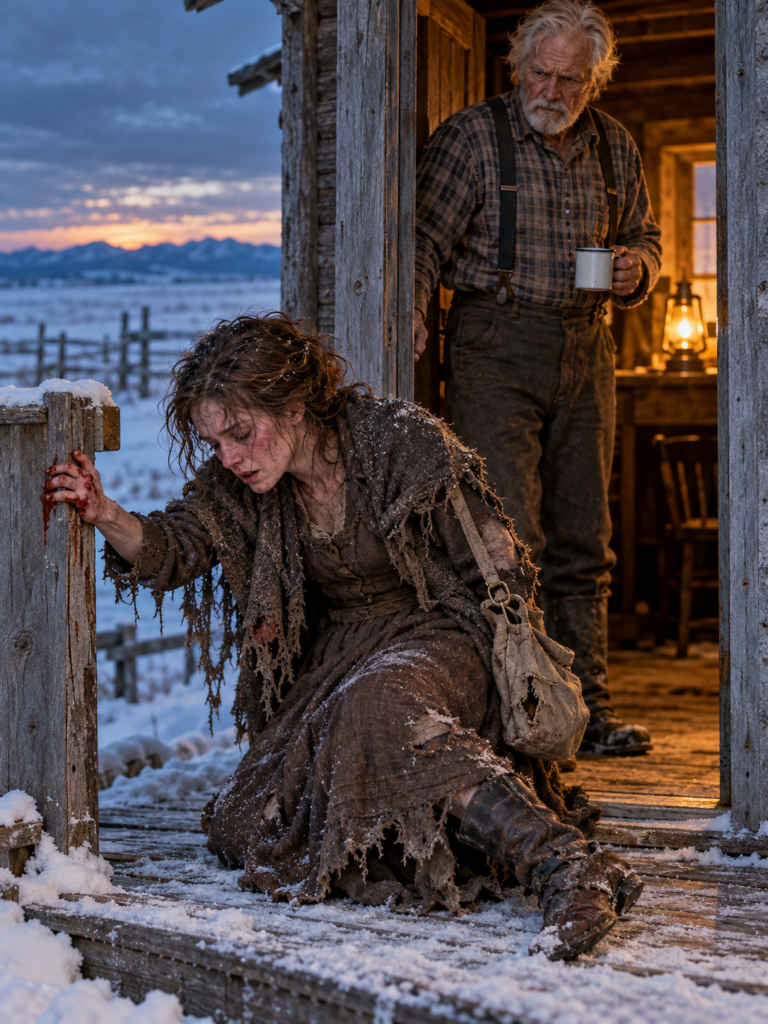
Emma stood motionless as the distant horseman followed the snowy road toward the farmhouse.
Walter looked beyond her shoulder.
The rider was still some distance away, no more than a dark figure against the white fields.
“Someone you know?” he asked.
Emma shook her head too quickly.
“No, sir.”
Her fingers tightened around the broken strap of her canvas bag.
Walter noticed.
“Could be a neighbor. People ride this road from time to time.”
The horseman continued toward the main track instead of turning up Walter’s lane.
Emma watched until he disappeared beyond the cottonwoods.
Only then did she breathe freely.
Walter made no comment.
“Come eat,” he said.
Inside, Emma sat across from him with her hands folded carefully beside her plate.
Walter served the meal.
She thanked him.
But each time the wind rattled the window, she glanced toward the road.
Three weeks later, he knew enough to be worried.
Not because Emma had caused trouble.
Quite the opposite.
She had repaired two more loose boards in the barn, sorted years of misplaced tools, and made the stubborn gate latch work with one hand.
She rose early and finished tasks without requiring constant direction.
Yet she behaved like someone certain the arrangement would end suddenly.
Walter discovered biscuits hidden behind the flour tin.
He said nothing.
He merely moved the tin to a lower shelf where she could reach it easily.
Another morning, the kitchen door slammed in the wind.
Emma recoiled so sharply that she nearly dropped the skillet.
Walter stopped.
“Didn’t mean to frighten you.”
“You didn’t.”
But her hands were shaking.
He changed the loose catch on the door that afternoon.
Then came the day he traveled into Milford for feed.
He returned two hours later to find Emma standing on the porch without her coat.
She was staring down the road.
When she saw his wagon, relief crossed her face.
It vanished almost immediately.
He unharnessed the horse and went inside.
Emma was scrubbing a pot that was already clean.
“Something troubling you?”
“No, Mr. Hayes.”
“Was it my going into town?”
She stopped scrubbing.
“You didn’t say you were leaving.”
“I didn’t reckon I needed to.”
“You don’t. It’s your farm.”
Walter waited.
She set the pot aside.
“I just didn’t know if you were coming back.”
Her voice was so quiet that he nearly missed it.
Walter took off his gloves.
“Next time I’ll tell you when I’m going.”
“You needn’t make arrangements on my account.”
“I can manage a word before leaving my own kitchen.”
She looked at him.
Then nodded.
The following Thursday, Harold Briggs rode up from Milford.
He owned the town’s largest dry-goods store and had known Walter for decades.
Walter was repairing the chicken-house roof when Harold approached.
“People have been asking about that girl.”
“Emma,” Walter corrected.
Harold cleared his throat.
“A young woman living alone with an older man. Folks wonder about the arrangement.”
“She’s my hired worker.”
“Some think she may be taking advantage.”
Walter set down his hammer.
“She earns two dollars a week. Repairs fences, tends the animals, and does work I can’t get finished alone. Tell me where the advantage lies.”
Harold shifted in his saddle.
“It’s appearances, Walter.”
“Then people ought to look at the work instead.”
Harold had no useful answer.
He rode away.
That evening, Walter found Emma washing dishes.
He had been thinking about the hidden food, the frightened glances, and the question she had asked when he returned from town.
“Emma,” he said, “were the people you stayed with in Cheyenne good to you?”
Her hands went still beneath the water.
After a long silence, she answered.
“My mother’s cousin took me in after Mama died.”
“And?”
“They needed work done.”
“Paid work?”
She shook her head.
“They told me my room and meals were payment enough.”
Walter pulled out a chair.
Emma continued washing.
“For four years, everything I did was counted against what I supposedly owed them. Cleaning. Laundry. Carrying water. All of it.”
“Why did you leave?”
“I found paid work at a laundry. I began keeping some money for myself.”
Her voice changed.
“They didn’t like that.”
Walter watched her shoulders stiffen.
“When I finally left, my cousin said I’d regret being ungrateful.”
“Did she threaten you?”
Emma set a plate on the rack.
“She has ways of making people believe her.”
Walter understood that she had told him as much as she could manage.
He stood.
“Your supper won’t disappear if you leave those dishes until morning.”
Emma almost smiled.
“I know.”
But they both knew she did not entirely believe it yet.
The next morning, Walter found her beside the kitchen window, staring at the road.
When she heard him, she turned.
“Mr. Hayes, if someone comes here asking about me, I need you to let me answer for myself.”
Walter studied her face.
“All right.”
“Even if they say I’ve done something wrong.”
He held her gaze.
“All right, Emma.”
At that moment, a horse’s hooves sounded beyond the yard.
She turned sharply toward the window.
And this time, the rider was coming directly to the farmhouse.
The rider came through the gate, and Emma remained beside the window until she recognized Harold Briggs.
Only then did her shoulders ease.
Walter saw the change.
He understood now that her fear was not of strangers in general.
It was of being found.
Harold stopped long enough to deliver a few household supplies and exchange ordinary news. When he departed, Emma went back to preparing breakfast.
Walter did not ask her what she had feared.
Not yet.
But he began watching more carefully how the people of Milford treated his new employee.
It troubled him.
At the general store, Emma was questioned about where she had come from.
At the fence line, Harold’s wife offered advice she had no business offering.
A respectable young woman, she suggested, should be careful about living beneath a bachelor’s roof.
Emma listened without argument.
Then she told Walter.
He set down his coffee.
“What would you like to do?”
The question seemed to perplex her.
“I don’t want to cause difficulties for you.”
“That wasn’t what I asked.”
Emma looked toward the unfinished repairs visible through the window.
“I’d like to stay employed. I want to finish the roof on the chicken house, put the root cellar in order, and get those south fence rails repaired before spring.”
Walter nodded.
“Then that’s the work we’ll do.”
She searched his face.
“You don’t mind what people are saying?”
“I mind that they’re saying it. I don’t agree with it.”
His answer remained with her throughout the day.
She worked on the root cellar, moving stored vegetables away from damp boards and checking the winter provisions.
Walter repaired fence rails.
By evening, both were tired.
They ate at the kitchen table.
The second chair no longer looked as if it belonged to somebody absent.
It had become Emma’s usual place.
A few days later, the gossip worsened.
Emma returned from town with the requested supplies and an expression Walter had learned to recognize.
She unloaded everything before saying a word.
At supper, she finally told him.
“A woman at the store suggested I should find another place before the county decides I’m unwelcome.”
Walter laid down his fork.
“Did she threaten you?”
“She said it would be wiser to leave voluntarily.”
He looked into the stove for several seconds.
Then he rose.
“I have business in Milford tomorrow.”
“Please don’t make enemies on my account.”
“I’m tired of hearing people call cruelty good manners.”
Emma watched him.
The following morning, Walter drove into town.
He spoke first to Harold Briggs.
He reminded his old acquaintance that Emma had been hired openly, paid fairly, and treated as an employee.
He made clear that he would no longer tolerate visitors attempting to frighten her away.
He also explained that years of business friendship did not entitle Harold or his wife to interfere with another person’s livelihood.
Harold listened unhappily.
Walter did not raise his voice.
He had never needed to.
When he returned home, Emma was mending a harness strap.
“Well?” she asked.
“I’ve spoken to Harold.”
“Was he angry?”
“He wasn’t pleased.”
“You’ve known him thirty years.”
“That ought to mean he can listen when I tell him he’s wrong.”
Emma lowered her eyes.
“Thank you.”
Walter removed his coat.
“You don’t need to thank me for telling the truth.”
The matter might have ended there.
But three days later, Deputy Calhoun rode into the yard.
He was a young county officer with a serious manner.
Walter met him near the porch.
“Something wrong?”
“I’ve been asked to inquire about your employee, Mr. Hayes.”
Walter folded his arms.
“On what grounds?”
“A complaint concerning a woman believed to have left Cheyenne under questionable circumstances.”
Inside the kitchen, Emma heard every word.
Her heart began hammering.
She knew before the deputy gave another detail.
There was only one person who would have followed her this far.
Emma opened the door.
“Was it Clara Marsh?”
The deputy looked up.
Walter turned.
Emma came down the steps.
“She’s my mother’s cousin,” she said. “If she’s accusing me of stealing, I’d like to hear exactly what she claims is missing.”
Calhoun hesitated.
“The complaint concerns property allegedly taken from her household.”
Emma gave a small, bitter nod.
“I thought so.”
She stood straight.
“I left with my own clothing, one pair of worn boots, a canvas bag, and forty-two dollars I’d earned working at the laundry.”
Calhoun listened.
“That money belonged to me. Mrs. Marsh wanted it. I wouldn’t give it to her.”
Walter glanced at Emma.
It was the first time he had heard the full amount she had saved.
“Have you been charged?” he asked the deputy.
“No charges at present. There is to be a local hearing concerning the complaint.”
“When?”
“Friday.”
Calhoun explained where they were expected to appear and then departed.
Emma stood on the porch long after his horse disappeared.
Walter waited beside her.
“She found me,” Emma said.
“So it seems.”
“She waited until I had work again.”
Walter looked toward the road.
“Has she accused you before?”
Emma nodded.
“Two years ago, when I first tried leaving. She told people I’d stolen jewelry. Nothing was proved. But the laundry stopped employing me afterward, and I had no way to support myself.”
“So you returned.”
“Yes.”
She swallowed.
“This time I saved enough to get away. I thought if I traveled far enough, she’d leave me alone.”
Walter studied her face.
He understood now why she had knocked on eleven doors instead of returning to a town where she might have found temporary shelter.
He understood the way she watched the road.
The hidden biscuits.
The fear when he left without speaking.
Emma went inside.
When she returned, she carried her canvas bag.
“I should pack before she causes more trouble.”
Walter moved aside so she could pass, but he did not pretend to agree.
“Where would you go?”
“Somewhere else.”
“Would that stop her?”
Emma looked down.
“I don’t know.”
“Then perhaps Friday is your chance to tell the truth where people have to hear it.”
She studied him.
“You don’t know what she’ll say.”
“No.”
“She’ll speak about my character. About how you took me in. She’ll make everything sound shameful.”
Walter considered this.
“Then we’ll answer what is false.”
Emma tightened her grip on the bag.
“You’re willing to stand beside me?”
“If you want me there.”
Her eyes filled.
She looked away before he could notice.
“I’d be grateful.”
Walter nodded.
“Then we’ll go together.”
The days before the hearing passed slowly.
Emma continued working.
She finished the root-cellar shelves, repaired a harness, and carefully counted the remaining supplies.
At night, however, she slept badly.
Every noise from the road made her listen.
Every unfamiliar voice seemed to carry Clara’s accusation.
Walter noticed, but he did not ask her to relive the past simply to reassure him.
Instead, he asked questions about things he could verify.
The name of the laundry.
How long Emma had worked there.
Who had employed her.
Whether the earlier theft allegation had been investigated.
She answered.
He wrote letters.
One went to an acquaintance in Cheyenne who knew the local authorities.
Another went to Ruth Callaway, the woman who had operated the laundry.
Walter asked for information, not for anyone to invent a defense.
He wanted to know what could be established.
The replies began arriving as the hearing approached.
On Thursday night, Emma came downstairs and found Walter sitting alone at the kitchen table.
The stove was burning low.
A cup of coffee stood untouched beside him.
“Can’t sleep?” she asked.
“Not much.”
She sat across from him.
For several minutes, neither spoke.
Then Walter asked something he had wondered about since the night she arrived.
“What would you have done if my door hadn’t opened?”
Emma looked toward the dark window.
“Kept walking.”
“Where?”
“I hadn’t decided.”
“And if you couldn’t walk?”
She ran a thumb along the edge of the table.
“I was very tired that night.”
Walter understood the answer.
It troubled him more than any detailed account might have done.
After a while, he spoke about Margaret.
His wife had died six winters earlier, leaving the farmhouse full of habits that no longer seemed to serve a purpose.
He still sometimes reached for a second coffee cup.
He still remembered the sound of her footsteps.
His son James lived in Colorado, and they had allowed old disagreements and distance to keep them apart.
“I got used to being alone,” he said. “Told myself it suited me.”
Emma listened.
“And does it?”
He looked around the kitchen.
“Not as well as I thought.”
She smiled faintly.
Walter leaned back.
“Margaret used to say a house ought to have room for somebody who needs a chair. I haven’t done much to honor that advice these last few years.”
“You opened the door for me.”
“I nearly didn’t.”
Emma looked at him.
He continued.
“I was tired. I heard knocking and thought of leaving it till morning. Then I reckoned nobody would be out there in weather like that unless they needed something badly.”
A long silence followed.
“Thank you,” Emma whispered.
Walter nodded.
Neither tried to turn the moment into something grander.
The following morning, Emma came downstairs dressed for the hearing.
She wore the dark green coat Walter had given her.
It had belonged to Margaret.
When Emma first borrowed it, she had been afraid to damage it.
Walter had told her that a good coat was meant to be worn.
Now she buttoned it carefully over her plain dress.
Walter had prepared breakfast.
She ate little.
Then came the sound of wagon wheels outside.
Walter looked through the window.
Two wagons had approached the road leading toward town.
In one sat Clara Marsh.
Beside her was a neatly dressed man carrying a leather satchel.
Walter studied them.
“Looks as though she’s brought legal assistance.”
Emma set down her cup.
For a moment, she seemed scarcely able to breathe.
Then she rose.
She picked up her gloves.
And looked directly at Walter.
“Then I intend to speak for myself.”
He stood and reached for his hat.
“Good,” he said. “I’ll be there to hear you.”
Together they walked out toward the waiting buckboard, knowing Clara Marsh had come prepared to destroy everything Emma had begun rebuilding.
The buckboard rocked beneath Emma as Walter guided the horse onto the frozen road toward Milford.
She sat upright, her gloved hands folded tightly in her lap.
The journey seemed longer than it ought to have been.
Fields lay white beneath the pale winter sky.
Fence posts cast narrow shadows across the snow.
Emma recognized several of the farms whose doors she had approached on that dreadful January day.
She looked away from them.
Walter noticed.
“Would you rather I spoke first?”
“Yes,” she answered. “But I need to speak too.”
“Then you shall.”
The county hall stood near the center of Milford.
By the time they arrived, several wagons were already outside.
A gathering had formed.
News of Clara Marsh’s complaint had traveled quickly.
Emma stepped down from the buckboard.
People watched her cross the yard.
Some looked curious.
Others suspicious.
A few seemed embarrassed to recognize the young woman they had turned away only weeks earlier.
Walter walked beside her.
He did not take her arm or hurry her.
Inside, the room smelled of damp coats, wood smoke, and cold boards.
Three local officials sat at a long table.
Clara Marsh waited near the front with her representative, Theodore Ames.
She was dressed in respectable dark wool.
Her expression carried precisely the sort of concern Emma remembered from childhood.
When she saw Emma, she smiled.
Emma felt her stomach tighten.
She had lived beneath that smile for four years.
She knew how easily it could become a weapon.
The chairman, Fletcher, called the meeting to order.
Clara’s complaint was presented.
She alleged that Emma had left her household with money and property that did not belong to her.
Her representative also questioned Emma’s reliability and the propriety of her living at Walter’s farm.
Ames spoke in a measured voice.
His client, he explained, had provided shelter and support to a young relative who had repaid her kindness with ingratitude.
He described Emma as unsettled and impulsive.
He mentioned the earlier inquiry concerning missing household goods.
At every reference, Emma felt the old shame pressing against her ribs.
She knew what he wanted the room to believe.
A poor young woman must be dishonest.
A woman without family protection must be troublesome.
A woman who earned money and wanted to keep it must be ungrateful.
Walter listened until Fletcher invited him to respond.
Then he stood.
The room quieted.
Most of the men present had known him for many years.
He was not given to public speeches.
“Miss Collins arrived at my farm in January,” he began. “She was badly cold, hungry, and looking for work.”
He looked around the room.
“She had asked at eleven places before reaching mine.”
Someone near the back shifted uneasily.
Walter continued.
“I took her inside. The next morning, she was already working. I offered wages, meals, and a room. She accepted.”
Ames rose slightly.
“Mr. Hayes, the concern is not whether she performed a few chores—”
Walter turned toward him.
“I hadn’t finished.”
Fletcher motioned for Ames to sit.
Walter went on.
“She repaired my barn wall. Fixed a gate I had been putting off for months. Organized my feed and supplies. She’s worked honestly every day since.”
He placed a hand on the table.
“I am sixty-seven years old. I know the difference between an employee and somebody taking advantage of me.”
The room remained silent.
“And I know what it looks like when a person has been frightened so often that she expects even decent treatment to be taken away.”
Emma stared at him.
Walter’s voice had not risen.
But she heard the anger he had kept under control.
“That is all I can testify to from my own experience. As for what happened in Cheyenne, I made inquiries.”
He produced a letter.
It came from Bill Tarrant, an acquaintance familiar with the earlier investigation.
The letter confirmed that the previous allegation against Emma had produced no substantiated theft and no charges.
It also referred to accounts from workers who remembered Clara Marsh demanding Emma’s wages at the laundry.
Ames examined the letter.
His confident expression faded slightly.
Clara leaned toward him and whispered.
He listened without answering.
Fletcher then asked Emma whether she wished to speak.
She rose.
Her knees trembled, but she kept her hands steady against the edge of the table.
“My name is Emma Collins,” she began.
“I worked in Mrs. Marsh’s household after my mother died. I cleaned, washed clothes, cooked, and did whatever else was needed.”
She looked at Fletcher.
“I received no regular wages for that work.”
Clara made an indignant sound.
Emma continued.
“When I found employment at the laundry, I began keeping my own earnings. Mrs. Marsh insisted they belonged to her because she had provided me with lodging.”
She paused.
“I tried to leave once before. An accusation of theft followed. Nothing was proved, but I lost my employment.”
Ames stood.
“My client maintains that she was attempting to guide an inexperienced young woman—”
“Then she could have let me keep the wages I earned,” Emma said.
The room went very still.
Emma had surprised herself.
She had never interrupted Clara’s representative before.
Indeed, she had seldom dared interrupt Clara at all.
She drew another breath.
“I returned to Mrs. Marsh’s household because I had nowhere else to go. Later, I found work again and saved forty-two dollars.”
She lifted her chin.
“That money was mine.”
Clara’s face hardened.
“You forget who took you in.”
Emma looked directly at her.
“No, ma’am. I remember every day.”
The words hung between them.
Then Emma spoke of the January morning when she left Cheyenne.
How Clara had refused to let her take the proper winter coat she had worn for years.
How she had traveled in inadequate clothing, trying to reach somewhere she could work without surrendering her wages.
How one door after another had closed.
“I didn’t ask anyone to support me forever,” she said. “I asked for work because I wanted to support myself.”
Her voice grew steadier.
“I am not Mrs. Marsh’s property. And my wages are not hers simply because she once gave me shelter.”
Fletcher listened carefully.
Then a movement near the rear doorway interrupted the room.
A woman had arrived in a traveling coat.
She was broad-shouldered, middle-aged, and plainly impatient with formalities.
“Ruth Callaway,” she announced. “I operated the laundry where Miss Collins worked in Cheyenne.”
Emma stared.
“Mrs. Callaway?”
The woman gave her a short nod.
Walter remained seated.
He had written asking for a statement.
But Ruth had chosen to appear herself.
She explained that Emma had been a dependable employee.
She described the work she had performed.
The wages she had earned.
And the occasions on which Clara Marsh had appeared demanding payment directly from Emma’s earnings.
“On the second visit,” Ruth said, “Mrs. Marsh made it plain that Miss Collins would have difficulty finding work if she refused.”
Clara rose.
“That is not an accurate account!”
Ruth looked at her.
“I was standing in my own laundry when it happened.”
The room fell quiet again.
Ruth described how Emma had tried to preserve her employment despite repeated interference.
She made clear that the young woman’s work had been valued.
Whatever dispute existed between relatives, she had seen no evidence that Emma had stolen from anyone.
When Ruth finished, Clara’s representative gathered his papers.
His earlier certainty was gone.
The panel considered the statements and the available evidence.
The matter was not treated as a grand criminal trial.
But there was sufficient information to conclude that the complaint had not been substantiated.
Fletcher announced that no further action against Emma was warranted on the claims presented.
Clara’s accusations had failed.
Emma listened.
She understood the words.
Yet she remained standing.
For years, every escape had ended with another demand.
Another accusation.
Another door closing.
She was waiting for that familiar reversal.
Walter rose beside her.
“Emma.”
She turned.
“It’s finished here.”
She looked at Clara.
Her cousin was already speaking angrily to Ames, apparently determined to explain why the outcome was unjust.
Emma realized that nothing said in the room would make Clara see her differently.
There might never be an apology.
That knowledge hurt less than she expected.
Because Clara’s opinion was no longer the only one that mattered.
Emma gathered her gloves.
Then she walked toward Ruth Callaway.
“Thank you for coming.”
Ruth took her hand.
“You did good work for me. I wasn’t about to let that be forgotten.”
For the first time that morning, Emma smiled freely.
Outside, Walter helped her onto the buckboard.
They began the journey home.
For several miles, neither spoke.
The horse moved steadily along the winter road.
Finally, Emma turned toward Walter.
“You wrote to Mrs. Callaway.”
“Yes.”
“And Mr. Tarrant.”
“Yes.”
“You made arrangements without telling me.”
Walter looked at her.
“I ought to have told you. I hoped to save you worry, but it was your hearing.”
Emma considered that.
“I would have liked to know.”
“Then next time I’ll tell you.”
She smiled slightly.
“I hope there won’t be a next time.”
“So do I.”
A little farther along, Emma spoke again.
“Ruth traveled all that way.”
“She did.”
“She didn’t have to.”
“No.”
Emma looked across the white fields.
For years, she had believed that only people who wished to control her would go to such trouble.
Now two people had done so simply to tell the truth.
She did not yet know how to receive that kind of loyalty.
But she began to think she might learn.
When they reached the farm, the barn stood solid against the wind.
Smoke rose from the chimney.
The front porch was swept clean.
The same porch where she had collapsed now looked almost ordinary.
Emma climbed down.
She stood looking at it for a moment.
Walter came beside her.
“Something wrong?”
“No.”
She turned toward him.
“Nothing’s wrong.”
It was the first time she had said those words and fully meant them.
In the weeks following the hearing, Milford changed toward her slowly.
Not everyone apologized.
Some still watched her with suspicion.
Others simply stopped talking.
But a few people tried to make amends.
Harold Briggs approached Walter outside his store and admitted that the matter had been mishandled.
His wife ceased visiting the fence line to offer unwelcome advice.
Then Agnes Pruitt arrived at the farmhouse carrying a covered dish.
Emma recognized her immediately.
Agnes had been among the women who refused her employment that first dreadful day.
She stood awkwardly on the porch.
“I thought you might make use of this.”
Emma accepted the dish.
“Thank you.”
Agnes looked toward the yard.
Then back at her.
“I saw you through my window that day. I knew you were cold.”
Emma said nothing.
“I should have opened the door.”
For a moment, neither moved.
Then Emma stepped aside.
“There’s coffee on the stove.”
Agnes entered.
They spoke for nearly two hours.
Emma learned that Agnes had also known hardship, widowhood, and the fear of depending upon other people’s charity.
It did not excuse her earlier refusal.
But it helped Emma understand why some people guarded their own safety by refusing to see anyone else’s suffering.
When Agnes left, she paused at the gate.
“You’ve made quite a place of this farm.”
Emma looked toward the repaired barn.
“There’s still plenty to do.”
“I expect there always will be.”
They exchanged a small smile.
The cold weeks gradually gave way to longer days.
Emma began keeping more of the farm accounts.
She had learned to manage figures while working for wages in Cheyenne.
Walter, who had never cared for paperwork, welcomed the assistance.
One evening she discovered repeated discrepancies in payments to the grain supplier.
She checked the ledger twice.
Then calculated the difference.
“Mr. Hayes?”
Walter looked up from his coffee.
“Something wrong?”
“I believe you’ve been charged too much for grain.”
He leaned closer.
She showed him the entries.
The excess had accumulated over two years.
Between sixty and eighty dollars, by her reckoning.
Walter studied the numbers.
“Jim Carver’s supplied me for years.”
“That doesn’t mean every account is correct.”
He considered her words.
“What would you do?”
Emma had already thought about it.
“Write to him. Explain the figures. Give him the chance to correct them before you take the matter farther.”
Walter nodded.
“Then write it.”
She prepared a careful letter.
He read and signed it.
A week later, a payment of seventy-three dollars arrived.
Walter placed thirty-three dollars on the table before Emma.
She looked at it.
“What’s this?”
“Your share.”
“I already receive wages.”
“You found the discrepancy. A fair portion of the recovered money belongs to the person who did the work.”
Emma picked up the notes slowly.
The amount mattered.
But something else mattered more.
He had asked for her judgment.
Trusted her skill.
And treated its result as something worthy of payment.
In Clara Marsh’s household, every contribution had increased the debt Emma was told she owed.
At Walter’s farm, her contribution had increased what she owned.
She folded the money carefully.
“Thank you.”
Walter raised his cup.
“Now tell me what else you’ve found wrong in those accounts.”
Emma laughed.
By spring, she had saved enough money to make choices she once considered impossible.
She could afford travel.
She could seek work elsewhere.
Ruth Callaway had offered to employ her again.
Emma knew the offer was genuine.
She also knew Walter would not prevent her from taking it.
One evening, she stood on the back step watching the last light over the fields.
Beyond the barn lay a small garden patch that had not been properly tended for years.
Walter joined her.
“Margaret planted flowers there,” he said.
Emma looked toward the neglected ground.
“Would you mind if I worked on it?”
“Mind?”
“I thought I might put it back to use.”
Walter was silent.
Then he said, “I believe she’d have liked that.”
They began clearing the beds.
Walter showed her where Margaret had planted different things.
Emma asked questions.
They turned the soil when it was ready.
Prepared rows.
Planted seedlings.
Some evenings they spoke about Margaret.
Other evenings they simply worked.
Emma never tried to replace the woman Walter had loved.
She understood that affection did not have to erase what came before.
One afternoon, while sorting the root cellar, she discovered a jar of preserved peaches behind an old crate.
Margaret’s handwriting remained faintly visible upon the label.
Emma carried it upstairs.
“I found this.”
Walter held it carefully.
For a long moment, he said nothing.
Then he smiled sadly.
“She always hid the best peaches.”
Emma looked toward the cellar.
“I thought you might want to keep it.”
“I do.”
He placed the jar on a kitchen shelf.
Not tucked away in a dark corner.
Somewhere he could see it.
The household was changing.
There were two people making decisions now.
Two people eating at the table.
Two people attending to the animals, the repairs, and the coming season.
Walter remained the owner of the farm.
Emma remained a paid worker with her own savings and the freedom to depart.
But the arrangement had grown into something neither had expected.
It was not a courtship.
Walter was old enough to be her grandfather.
Their affection had become familial, built from trust, gratitude freely given, and the everyday intimacy of sharing work without keeping score of kindness.
Emma had begun to see him as the steadfast elder she had long lacked.
And Walter had discovered that a household could become lively again without losing the memory of Margaret.
Still, there was a question Emma had never entirely answered.
How long could she stay?
One evening, while they stood near the garden, she finally spoke.
“Walter, I need to tell you something.”
He turned.
She had grown comfortable enough to call him by his first name.
It had happened gradually.
Neither remembered when.
“I’ve decided not to return to Cheyenne.”
He waited.
“Ruth would employ me again. I know that. And I’ve saved enough that I could find another position if I wished.”
Walter nodded.
“You could.”
She looked toward the farmhouse.
“But I don’t want to.”
He said nothing.
“I want to stay here. Keep working. Help with the animals and the accounts. See what comes of the garden.”
Her voice softened.
“I think of this place as home.”
Walter stood beside her for a long moment.
Then he spoke.
“There’s something I ought to tell you as well.”
Emma glanced at him.
“I’ve made arrangements concerning the farm.”
“What arrangements?”
He explained that he had been working with someone qualified to prepare his estate papers.
His son James, living in Colorado, had been considered and would receive the provision already settled for him.
Walter intended Emma to inherit the house and land.
Emma stared.
“All of it?”
“The farm, yes.”
“Walter—”
He lifted a hand.
“Before you tell me I shouldn’t, hear me.”
She closed her mouth.
He gestured toward the barn.
“That wall would still be open to the wind if you hadn’t repaired it.”
“Someone would have fixed it eventually.”
“Perhaps. And those accounts would still be wrong. The cellar would still be a mess. Margaret’s garden would still be lying empty.”
Emma shook her head.
“Those are ordinary things.”
“They’re the things that keep a place alive.”
He looked toward her.
“I’ve lived here long enough to know what that means.”
She struggled to find words.
“It is too much.”
“You aren’t buying the farm with repairs, Emma. Nor am I asking you to stay because of the papers. I wanted to know you had other choices before telling you.”
She looked toward the distant fields.
“Your son?”
“I’ve made provision for James separately. I won’t pretend we understand each other well, but I haven’t forgotten him.”
Emma studied his face.
“Are you certain?”
“I’ve given the matter thought.”
She was silent.
For four years, Clara Marsh had insisted that food and shelter made Emma indebted to her.
Now Walter spoke of leaving her a home without presenting it as a debt.
That difference overwhelmed her.
She looked toward the seedlings in the garden.
“I don’t know what to say.”
“There’s no need to answer this evening.”
“I want to stay whether those papers exist or not.”
Walter smiled.
“That’s what I hoped you’d say.”
She pressed her hands together.
Then, unable to speak further, she simply stood beside him while dusk gathered over the fields.
The following weeks settled into a peaceful rhythm.
Emma managed the household supplies and helped with the farm’s smaller animals.
Walter attended to the heavier work his health allowed.
They checked fences together.
Discussed purchases.
Shared meals.
And spoke openly when they disagreed.
Walter was still stubborn.
Emma was no less determined.
But both had learned that being listened to mattered more than winning every argument.
One night, however, Walter awoke and heard movement downstairs.
He descended and found Emma in the front hallway.
She stood facing the door.
Her hand rested upon the latch.
“Emma?”
She turned.
“Did I wake you?”
“No. What are you doing?”
She looked embarrassed.
“Something foolish.”
Walter came down the final steps.
“Tell me.”
Emma rested her fingers against the door.
“Sometimes I come down here after everyone ought to be asleep.”
He waited.
“I check the latch.”
“Is it broken?”
“No.”
She swallowed.
“I check because I need to know it will open.”
Walter looked at her more closely.
She continued.
“When I lived with Clara, I never knew whether I could leave without being stopped. After I finally got away, I spent so long wondering where I could sleep safely that I began expecting every door to shut against me.”
Her eyes filled.
“I know I can leave here if I choose. You’ve told me often enough.”
“I have.”
“But sometimes I still need to see it.”
Walter walked slowly toward the door.
He placed his palm against the wood.
“Then check it whenever you like.”
Emma looked at him.
He continued.
“You can go to Milford. You can accept Ruth’s work if you change your mind. You can travel wherever your own money and judgment take you.”
Her mouth trembled.
“And if you come back to this porch, you’ll be welcome.”
Emma pressed a hand against her lips.
She had held herself together through hunger.
Through humiliation.
Through eleven refusals.
Through the accusation at the county hall.
But the quiet certainty of that promise reached a place she could no longer guard.
Tears spilled down her face.
She turned away, ashamed of them.
Walter did not tell her to stop.
He stood beside the door and allowed her the dignity of crying without explanation.
After a while, she wiped her cheeks with her sleeve.
“I’m sorry.”
“Nothing to apologize for.”
Emma drew a slow breath.
“I haven’t cried like that in years.”
“Then I reckon you had a good deal saved up.”
She gave an unsteady laugh.
Walter looked toward the small window.
Outside, light snow had begun falling upon the porch.
The boards where Emma had collapsed were clean and dry beneath the overhanging roof.
He remembered opening the door that January evening.
The frail young woman kneeling in the cold.
The stubborn way she had struggled upright.
The insistence that she wanted work rather than pity.
He had believed he was offering a meal and a night’s shelter.
He had not known that allowing her inside would alter his own life.
For six years after Margaret died, the farmhouse had become a place where he lived among memories.
Now there was new work awaiting the morning.
A garden beginning to grow.
A kitchen where laughter sometimes interrupted supper.
And a young woman who no longer had to ask whether she was worth feeding.
Emma followed his gaze.
“Snow again.”
“Won’t last long.”
“We should check the south fence tomorrow.”
Walter nodded.
“And the hens.”
“They’re already on my list.”
“Of course they are.”
She smiled.
Then she glanced once more toward the door.
“Good night, Walter.”
“Good night, Emma.”
She returned to her room.
Walter stood a little longer.
He thought of Margaret, who had always insisted that generosity was worth practicing even when nobody noticed.
He thought of the eleven farmhouses whose owners had refused to see a young woman’s courage beneath her ragged clothing.
And he thought of how close he had come to becoming the twelfth.
Then he turned toward the stairs.
In the morning, there would be fences to inspect and animals to feed.
Emma would probably be awake before him.
She would have opinions about the root cellar, the household accounts, and the garden.
He would listen.
Sometimes he would disagree.
They would argue a little, work a great deal, and eat supper together.
That was the life they had built.
Not a life free from hardship.
Not a life in which every wound vanished.
But one where Emma’s labor was respected, her wages belonged to her, and her right to choose her own future was never in question.
Outside, the last snow of the season drifted over the fields.
It settled along the repaired barn and the porch railing.
Through the farmhouse window, the kitchen lamp cast a warm square of light into the darkness.
Years of loneliness had not been erased.
Margaret was still missed.
Emma’s past could not be undone.
Yet the house held more than memory now.
It held trust.
Work shared fairly.
A future deliberately chosen.
And the certainty that a person might be welcomed without first surrendering the freedom to walk away.
The front door remained unlocked.
Not because Emma was expected to leave.
But because she was finally free to stay.

