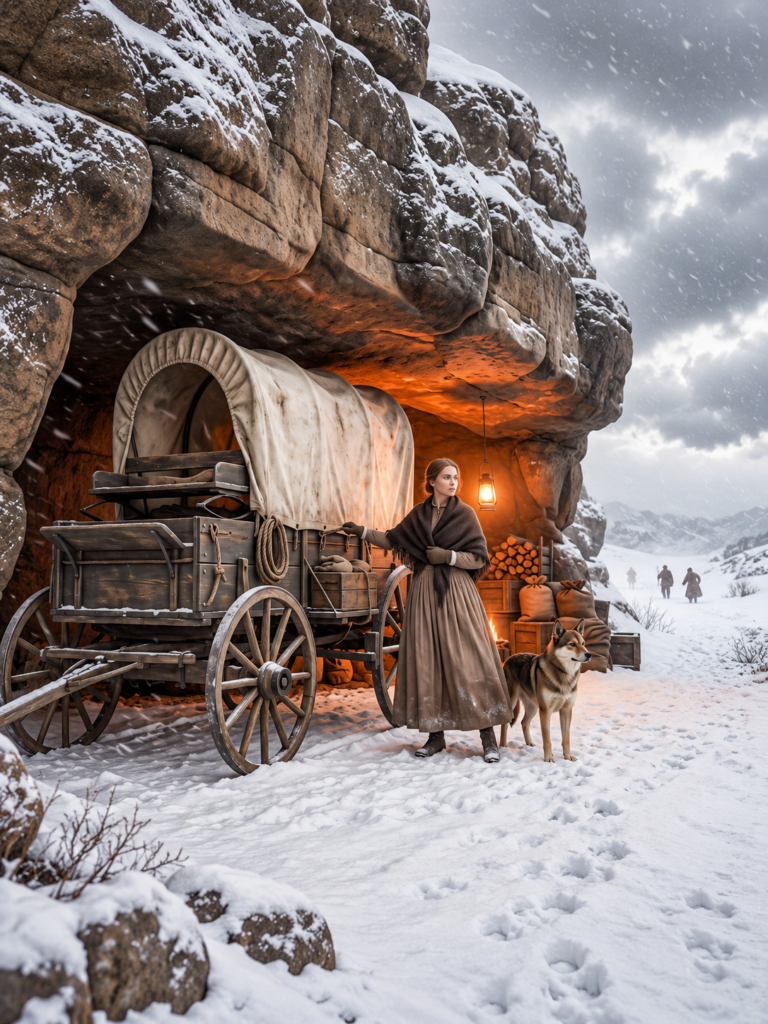
Part 1
The first thing Silas Dunore noticed was that the widow’s wagon was missing.
There had been no shouting in the night. No stolen horses. No broken harnesses or overturned supplies.
Only two narrow wheel tracks cutting away from the main trail, turning toward a gray rock formation that every experienced man in the wagon company had dismissed as useless.
Thirty families were preparing to settle beside the Sweetwater River for the winter.
One woman had chosen to go the other way.
And she had taken an eleven-year-old orphan with her.
“Lord help that child,” Prudence Gatis muttered, standing beside her husband’s wagon. “That woman has finally lost her senses.”
Ezra Cardwell, a seasoned rancher whose face had been hardened by twenty years of Wyoming winters, followed the tracks with his eyes.
“She won’t last a month out there.”
Nobody answered.
The wind was already beginning to sharpen.
And winter was coming early.
Margarite Halverson was twenty-nine years old, although grief had given her the tired eyes of a woman twice that age.
She wore a long white cotton dress, yellowed around the collar and stained brown along the hem from six weeks of traveling through dust and mud. Beneath her wool shawl, her shoulders were narrow but strong.
Her husband had been dead nearly two years.
The fever had taken him in three miserable days, leaving her with a pine trunk, a few tools, one aging ox, and a loneliness she had learned to carry without complaint.
Now she was trying to build a life in Wyoming Territory, where land was plentiful but mercy was not.
Walking beside her wagon was Thomas Bricker, a thin boy everyone called Tam.
His boots were too large, his coat too small, and his face had the wary expression of a child who had learned not to expect kindness.
A shaggy gray dog named Ash followed at his heels.
They had become a strange little traveling family.
Margarite had never formally invited Tam to stay with her. He had appeared beside her wagon one morning after the company passed Fort Kearny, hungry and exhausted.
She had handed him half a biscuit.
The following morning, she handed him another.
By the third day, he was helping unhitch her ox.
Neither mentioned that he had nowhere else to go.
Now, as they approached the gray ledge, Tam looked back toward the river.
“Mrs. Halverson?”
“Yes?”
“Are we really going to stay here?”
She stopped beside the rock.
The formation rose from the ground like the tilted roof of some enormous buried building. Its upper edge leaned over a shallow depression, while its western face stood exposed to miles of open country.
There were no trees nearby.
No running stream.
No obvious shelter.
“That’s what I’m thinking,” she said.
Tam studied the barren ground.
“Mr. Cardwell said people freeze in places like this.”
“He might be right.”
“Then why are we here?”
Margarite knelt.
She placed her palm against the dirt beneath the ledge.
The grass growing there was thin and brown, but it stood straighter than the grass farther away. Frost covered the surrounding ground, yet beneath the stone it appeared only in scattered patches.
She lifted her hand and held it in the air.
Nothing.
Not even the faintest movement.
“Feel that,” she told him.
Tam knelt beside her.
He stretched out his hand.
“The air’s still.”
“Exactly.”
He glanced toward the open prairie, where dry grass bent steadily beneath the wind.
“But it’s blowing out there.”
“Which means something’s keeping it from blowing here.”
She rose slowly and examined the underside of the ledge.
“My father used to say a mountain tells you where to sleep if you’re patient enough to listen.”
Tam smiled faintly.
“Mountains can’t talk.”
“No,” Margarite agreed. “But they leave evidence.”
Her father had worked stone and timber in a Norwegian valley where winters could bury cottages to their roofs.
As a little girl, Margarite had followed him through the woods while he studied slopes, snowdrifts, frozen streams, and the sheltered places where deer gathered.
He showed her that the deepest snow did not always mean the greatest danger.
Sometimes snow gathered where wind had lost its strength.
Sometimes bare ground meant warmth.
Other times it meant the wind had stripped away everything capable of holding it.
He taught her to watch animals.
To notice where frost formed.
To study the shape of hills before deciding where to build.
She had learned those lessons long before she learned to read a proper book.
Years later, when she married and moved to a small American homestead, she had tried explaining some of those things to her husband.
He was a decent man, hardworking and affectionate, but he preferred to make decisions himself.
Twice he rebuilt a fence she had warned him would fail.
Twice the wind tore it apart.
She never reminded him that she had been right.
Then the fever came, and arguments about fences seemed terribly small.
After his death, she discovered something more painful than loneliness.
Men who had once spoken respectfully to her husband now treated her judgment as something to be humored.
Women offered sympathy but seldom listened when she spoke about work.
A widow could mend clothes, cook meals, and bury the dead.
But choosing land?
Building shelter?
Making decisions that might determine whether a family survived?
Those were matters the world believed belonged to men.
Margarite had stopped arguing with the world.
She had not stopped paying attention.
The evening before the wagon company separated, Silas Dunore had called a meeting.
Thirty families gathered around the largest campfire.
Margarite stood opposite him, her hands folded in front of her dress.
“I hear you’re thinking of settling beneath that rock,” he said.
“I am.”
“There’s no water.”
“We can haul some before the ground freezes. Afterward, we’ll melt snow.”
“No timber nearby.”
“There’s timber farther east.”
“Farther east is a long haul in winter.”
“I know.”
Dunore sighed.
“Mrs. Halverson, I’ve led wagon trains through this country for twelve years. The river has water, grazing, and enough room for every family.”
“And the wind?”
“We’ll put up shelters.”
“On open ground?”
Ezra Cardwell stepped forward.
“That rock might shield you from one direction,” he said. “But the weather comes around. One wrong turn of the wind and you’ll be trapped against a wall of stone.”
Margarite nodded.
“That’s possible.”
“Then why risk it?”
“Because I haven’t finished studying it.”
Cardwell stared at her.
“You mean you’re betting your winter on a feeling?”
“No. I’m betting it on things I’ve seen.”
She explained the thin frost, the upright grass, and the protected curve beneath the ledge.
Several men exchanged doubtful glances.
Prudence Gatis leaned toward another woman.
“Grief does strange things to people.”
She spoke loudly enough to be heard.
“Poor child. Imagine trusting your life to a woman who doesn’t know when she’s being foolish.”
Tam’s face turned red.
Margarite felt his hand tighten around her sleeve.
But she did not answer.
Instead, she looked at Dunore.
“I appreciate your warning. Truly. But I’ve made my choice.”
The wagon master removed his hat.
“I can’t spare men to rescue you if things go wrong.”
“I haven’t asked you to.”
“Then God be with you.”
“And with all of you.”
She turned away before anyone could see how badly her hands were trembling.
That night, Tam found her sitting beside the dying fire.
“Are you scared?” he asked.
She looked toward the darkness.
“Yes.”
He seemed surprised.
“I thought you weren’t.”
“Being afraid doesn’t mean you’ve chosen wrong.”
“What if they laugh when we come back?”
Margarite looked at him carefully.
“Would you rather stay with them?”
Tam said nothing.
His eyes dropped to his oversized boots.
At last he whispered, “I don’t want to be left behind again.”
Something tightened painfully in her chest.
She knew very little about the boy’s past, but she understood the meaning of those words.
She reached over and pulled his coat closer around his shoulders.
“Then stay close to me tomorrow.”
“Will you leave?”
“No.”
It was a small promise.
But to Tam, it seemed to fill the entire night.
The following morning, as the first families rolled toward the river, Margarite guided her ox in the opposite direction.
A young Bavarian immigrant named Anton Rilian joined her.
He was eighteen, broad-shouldered but still awkward in his movements, and had lost his family during a disastrous river crossing months earlier.
He had watched Margarite study the rock.
“My grandfather used to do that,” he told her.
“Do what?”
“Look at the ground like it was trying to tell him something.”
She smiled.
“Perhaps your grandfather was a wise man.”
“He kept his village alive through three terrible winters.”
“Then you’d better help me remember what he taught you.”
Anton took the ox’s lead rope.
Together, the woman, the young man, the orphan boy, and the dog walked toward the unwanted rock.
Behind them, thirty families disappeared into the river valley.
Above the northwestern ridge, thin clouds began gathering.
None of them yet knew that the winter would test their decision sooner than anyone expected.
Part 2
Their first night beneath the ledge was miserable.
The wagon canvas snapped and cracked in the wind. Cold seeped through every blanket. Tam curled beside Ash while Anton slept underneath the wagon, wrapped in an old coat.
Margarite barely slept.
Instead, she listened.
The wind arrived from the northwest, struck the open face of the rock, and divided.
Some of it swept across the surrounding prairie.
Some curled around the ledge.
But inside a narrow fold beneath the stone, the air stayed almost perfectly still.
At sunrise, she began marking the ground with small stones.
Anton watched for nearly an hour.
“Shouldn’t we start building?”
“We are.”
He looked around.
“With little rocks?”
“I’m finding the right place for the big ones.”
He rubbed his hands together.
“We don’t have much time.”
“Which is why we can’t afford to build in the wrong place.”
By afternoon, the boy had discovered something neither adult had noticed.
Ash was sniffing along a narrow crack at the base of the ledge.
Tam followed him.
“Mrs. Halverson! Come see!”
Margarite approached.
A line of tiny animal tracks disappeared into a crevice between two stones.
She knelt and felt the air emerging from the opening.
It was cooler than the warmth of a room but far gentler than the wind beyond the ledge.
“A fox,” she murmured.
Tam leaned closer.
“Is that good?”
“Very good.”
“Why?”
“Because foxes don’t waste energy fighting weather when they can hide from it.”
She stood and examined the surrounding curve.
The natural rock formed the rear and part of one side of a shallow enclosed space.
With a low stone wall across the front, they could create a shelter that used the ledge itself as protection.
“Here,” she announced.
Anton looked doubtful.
“The ground is uneven.”
“We’ll level it.”
“The stone is difficult to stack.”
“We’ll choose it carefully.”
“The roof?”
She studied the sloping underside above them.
“We’ll make the snow leave instead of stay.”
For four days, they worked until their arms shook.
Anton hauled loose stone from a slope several hundred yards away.
Margarite selected each piece, fitting it against the next like a puzzle whose only reward was survival.
Tam carried smaller rocks and mixed clay with dried grass to seal the spaces between them.
By the second evening, his fingers were cracked and bleeding.
Margarite saw the blood when he reached for another stone.
“Stop.”
“I’m all right.”
“Your hands disagree.”
He hid them behind his back.
“I can still work.”
“I know you can. That isn’t the question.”
She took him inside the wagon and washed his hands with the last of their warm water.
He watched her wrap his fingers with strips torn from a worn linen cloth.
“Are you angry?”
“Why would I be?”
“Because I’m slowing things down.”
She paused.
“Tam, a person isn’t worth less because they need tending.”
His eyes moved toward the ground.
“Some people think so.”
“Those people are wrong.”
She handed him a piece of bread.
“Tomorrow, your job is to measure the wall openings and help me with the clay. We’ll give those hands a chance to mend.”
He swallowed hard.
“Yes, ma’am.”
The roof required the greatest effort.
Margarite refused to construct a flat covering that would collect snow.
Instead, she directed Anton to set strong poles at an angle beneath the projecting ledge, creating a steep surface that would guide snow down and away.
They covered the frame with canvas, brush, and layers of packed material to reduce drafts, leaving space around their hearth arrangement so smoke could escape.
Near the upper portion, Margarite built a vent that could be checked and adjusted.
Anton questioned it.
“We’re trying to keep warm. Why leave a hole?”
“Because a fire uses air and makes smoke. Sealing it inside would be dangerous.”
“Even in winter?”
“Especially in winter.”
She remembered her father describing families who had shut every crack in their houses during bitter cold, only to become sick from smoke and bad air.
“Warmth is no good if you can’t breathe.”
They finished the basic shelter on the fourth afternoon.
It was twelve feet wide and little taller than a man.
The stone walls were ugly.
The entrance was narrow.
The roof sat awkwardly against the natural rock.
But when the evening wind swept across the open prairie, the shelter remained quiet.
That night, Tam slept without shivering.
Margarite lay awake listening to his breathing.
For the first time in months, she allowed herself a little hope.
The next morning, the western wall began whistling.
At first, it was a faint sound.
Then a stronger gust struck the outer face, and icy air poured through a gap near the floor.
Fine snow followed.
Anton knelt beside the crack.
“The clay has shrunk.”
Margarite ran her fingers over the seam.
He looked at her with an expression that was not accusation but worry.
“What if the whole wall does this?”
Tam stood beside them.
“What if we built it wrong?”
Margarite considered the question.
She could tell them everything would be fine.
She could pretend the crack was unimportant.
But her father’s voice returned to her.
Never ask the land to agree with you. Find out what it’s telling you.
“We found a weakness,” she said. “Now we fix it.”
She spent the day checking every joint.
Using a thin strand of grass, she searched for moving air.
Whenever the grass fluttered, Anton marked the spot.
Tam prepared fresh clay reinforced with tightly packed dry fibers.
By late afternoon, they had found three leaks.
The worst was where the new wall met the ancient stone.
The two surfaces were uneven, and their sealing mixture had dried badly.
Margarite scraped it out and packed the joint again.
At dusk, Anton stood outside while she held her hand against the repaired wall.
“Any air?” he shouted.
“Not yet.”
He moved farther along the wall.
Another gust came.
Nothing entered.
Margarite finally lowered her hand.
“That’ll do for tonight.”
Anton gave a tired smile.
“You say that like tomorrow the wall will find another way to trouble us.”
“It probably will.”
He laughed despite his exhaustion.
Their supplies were another matter.
They had flour, dried beans, cornmeal, salt pork, a little coffee, and enough grain for the ox if carefully rationed.
They did not have enough firewood to be comfortable.
The nearest useful stand of timber was far enough away that every trip consumed most of a day.
Anton made repeated journeys with the wagon while the ground remained passable.
Tam helped him load.
On one return trip, the ox stumbled over frozen ruts, and the wagon tilted dangerously.
A wheel struck a buried stone.
There was a sharp crack.
Anton stopped the animal immediately.
He climbed down and examined the wheel.
One wooden spoke had split.
Tam looked frightened.
“Can we fix it?”
Anton tested the damage.
“We’d better. We can’t spare another wagon.”
They unloaded half the wood before carefully bringing the wagon home.
Margarite inspected the crack.
Her husband had kept a small collection of woodworking tools in the pine trunk.
For months, she had avoided opening it.
The smell of leather, iron, and old wood always brought back the memory of his hands.
Now she knelt before the trunk and lifted the lid.
Inside lay his hammer, drawknife, awl, chisels, and a small box of nails.
At the bottom was a folded piece of cloth.
She recognized it instantly.
A blue handkerchief she had sewn for him their first Christmas together.
For a moment, her hands stopped moving.
Then she placed the handkerchief beside her and lifted out the tools.
“Anton, bring me that spare oak board.”
They worked by lamplight, reinforcing the damaged wheel until it could manage lighter loads.
As she returned the tools to their places, Margarite touched the blue cloth.
Her husband’s absence still hurt.
But for the first time, using what he had left behind felt less like disturbing a grave and more like continuing something unfinished.
A rider appeared four days later.
He was one of Dunore’s younger men, sent from the river settlement.
He stopped before the shelter and stared.
“You built this?”
Margarite nodded.
“With help.”
The rider dismounted and stepped inside.
His expression changed when he felt the difference in temperature.
“Well, I’ll be.”
He turned slowly, examining the walls.
“It’s warmer in here than our tents.”
“We chose a sheltered spot.”
He looked toward the vent.
“Doesn’t that let cold in?”
“Some. But we need fresh air.”
He shook his head.
“I never figured this place for much.”
Over coffee, he told them how things were going at the river.
Thirty families had spread across the bottomland.
The grazing was disappearing faster than expected.
Woodcutting had become a source of arguments.
The best trees were already claimed.
Several families were sheltering cattle beneath canvas awnings that offered little protection from severe wind.
“Mr. Dunore says we’ll manage,” the rider added.
“I hope you do,” Margarite replied.
Before leaving, he hesitated.
“Mrs. Gatis asked after the boy.”
Tam looked up.
“She did?”
The rider shifted awkwardly.
“She said she hoped he wasn’t freezing because of a decision he never got to make.”
Silence settled around the fire.
Margarite thanked the rider and watched him depart.
Later, she found Tam standing outside, staring toward the river valley.
“She thinks I’m going to die,” he said.
Margarite stood beside him.
“She doesn’t know what she’s talking about.”
“What if she’s right?”
The question hurt more than the woman’s insult.
Margarite knelt so their eyes were level.
“I won’t promise you the winter can’t hurt us. That would be a lie.”
Tam waited.
“But I will promise that I won’t stop trying to keep us safe.”
He studied her face.
Then he nodded.
“That’s enough.”
She pulled him close for a moment.
Far beyond the ridge, a flock of dark birds crossed the sky.
They were moving south.
Earlier than she expected.
Margarite watched until they disappeared.
And an old uneasiness began growing inside her.
Part 3
The warning came with the antelope.
It was a bitter morning, cold enough that ice formed around the shelter entrance before sunrise.
Margarite stepped outside to examine the sky.
The distant hills were pale beneath a weak sun.
No storm clouds appeared overhead.
Yet something felt wrong.
Then she saw movement across the high prairie.
Dozens of pronghorn antelope were traveling southeast in a long, steady line.
They did not stop to graze.
They did not scatter.
They simply kept moving.
Anton joined her.
“What’s happening?”
“Watch them.”
He followed her gaze.
“They’re heading out.”
“Yes.”
“Maybe the grazing is better down there.”
“Maybe.”
But Margarite remembered the way her father had studied mountain animals before heavy snow.
An entire herd traveling with such purpose could mean an approaching change in conditions.
It was not certainty.
The animals might be responding to something unrelated to weather.
Still, she refused to ignore the warning.
“Bring in another load of wood today,” she told Anton.
He looked at the distant herd.
“Do you think a storm is coming?”
“I think we ought to be ready if one does.”
They worked harder from that morning onward.
Anton strengthened the roof supports.
Tam stacked firewood against the inner wall.
Margarite checked every repaired seam, especially the vulnerable northern corner.
She cleaned the smoke passage and tested the vent with a small fire.
Outside, they made a sheltered place for the ox against the rock’s protected side.
A heavy iron ring secured into a sound crevice served as an anchor point.
They prepared feed, cleared the animal’s footing, and arranged materials to limit direct exposure to the wind.
Each evening, Margarite counted their supplies.
She measured flour by the cup.
Beans by the handful.
Salt pork by the piece.
She calculated how long the food might last if the weather trapped them.
Tam noticed.
“Are we running out?”
“Not yet.”
“Then why do you keep counting?”
“Because winter doesn’t care how hopeful you feel.”
He thought about that.
“Does it ever get easier?”
“What?”
“Being responsible for everybody.”
Margarite stopped.
She had not realized he understood the burden so clearly.
“Some days.”
“And the other days?”
“You do the work anyway.”
One evening, after a long day hauling wood, Anton found her sitting beside the open pine trunk.
She was holding a photograph.
It showed a young man in a dark suit, his hair carefully parted, standing beside Margarite in a plain white wedding dress.
“Your husband?” Anton asked.
She nodded.
“He looks kind.”
“He was.”
Anton sat on the opposite side of the fire.
“Do you miss him?”
“Every day.”
She studied the photograph.
“He used to sing when he worked. Badly, mostly. But he sang anyway.”
Anton smiled.
“My mother did that.”
Margarite looked at him.
He rarely spoke about his family.
“We crossed a river in spring,” he said. “The current looked manageable from the bank.”
His voice became quieter.
“My father went first. Then my mother and little sister. The wagon tipped.”
Margarite remained still.
“I was behind with another team. I watched it happen.”
He swallowed.
“Everybody told us that crossing was safe.”
After a moment, Margarite said, “I’m sorry.”
Anton looked at the flames.
“I used to think if I’d shouted sooner, perhaps they’d have turned back.”
“Did you know what was going to happen?”
“No.”
“Then you couldn’t have warned them.”
He pressed his palms together.
“I still think about it.”
“I know.”
For a long time, neither spoke.
Then Tam, who had been lying beside Ash, sat up.
“My mother could sing.”
Margarite turned toward him.
“Could she?”
He nodded.
“She sang when she washed clothes.”
“What happened to her?”
“Fever.”
He stared at the floor.
“My little sister got sick first. Then my mother. Then my father.”
His words came slowly.
“There were four of us. Afterward, there was only me.”
Margarite’s heart tightened.
“I went with a man who had a wagon,” Tam continued. “He said I could help with work.”
“What happened?”
“He left before daylight one morning.”
Anton looked up sharply.
“Left you?”
Tam nodded.
“He said I ate more than I earned.”
The room went terribly quiet.
“He took the wagon while I was sleeping.”
Margarite moved beside him.
“How long were you alone?”
“Three days, I think. Then I found your company.”
She thought of the biscuit she had given him.
The way he had eaten it while glancing over his shoulder.
The way he always finished his chores before anyone asked.
“Tam,” she said softly, “you don’t have to earn every meal in this house.”
His lips trembled.
He looked away.
“I know.”
But she could tell he had not believed it until that moment.
She put an arm around his shoulders.
Anton moved closer to the fire.
Ash rested his head across Tam’s boots.
That evening, three lonely people began to understand that they were no longer merely traveling together.
They were becoming a family.
Four days later, the air fell completely still.
Margarite woke before dawn.
The silence was so complete she could hear the ox shifting its weight outside.
She rose from her blankets and approached the entrance.
The stars had disappeared.
The northwestern horizon was a dull metallic gray.
She stood motionless.
Then she went back inside.
“Anton.”
The young man sat upright.
“What is it?”
“Get dressed.”
He recognized her tone immediately.
Tam stirred.
“What’s wrong?”
“The storm’s coming.”
Within minutes, they were working.
Anton brought the remaining wood inside.
Tam secured the ox and checked the feed.
Margarite gathered the flour sacks, blankets, rope, and tools.
She examined the entrance fastenings and confirmed the vent remained clear.
The sky darkened with unnatural speed.
By late morning, the first snow arrived.
It moved sideways.
Not in soft flakes, but as sharp grains driven across the prairie.
The wind rose.
Within an hour, the wagon standing twenty feet beyond the shelter appeared only as a blurred shape.
Then it disappeared behind blowing white.
Anton came inside with snow packed into his eyebrows.
“It’s getting worse.”
Margarite closed the entrance as securely as she could while preserving the necessary air passage.
“Everybody stays close.”
Tam held Ash around the neck.
“How long will it last?”
“I don’t know.”
“A night?”
“Maybe.”
“Two?”
“Possibly.”
Anton looked at the low ceiling.
“And if it’s longer?”
Margarite glanced at their woodpile.
Their food.
Their water containers.
The small fire.
“Then we’ll make what we have last.”
Outside, the wind struck the wall with a force that seemed almost deliberate.
The first night, the stones held.
The second day, the storm grew stronger.
And on the third night, something happened that nearly destroyed everything Margarite had built.
It began with a change in the sound of the vent.
For two days, the opening had produced a low, steady hum as air moved through it.
Margarite had learned to recognize that sound.
She had also learned to check it regularly, knowing that wind and snow could alter its draft.
Near midnight, the hum turned into a sharp whistle.
She opened her eyes.
The fire was small.
Anton slept beside the woodpile.
Tam lay under two blankets with Ash pressed against his legs.
Margarite stood and looked toward the vent.
The wind had shifted.
Instead of flowing past the opening, it was now forcing air inward.
Smoke that should have escaped had begun curling beneath the roof.
She called to Anton.
“Wake up.”
He sat up, coughing.
“What’s wrong?”
“The smoke isn’t drawing.”
Within moments, the haze thickened.
Tam began coughing too.
Ash jumped to his feet, restless and frightened.
Anton reached toward the entrance.
“We need to open it!”
“Carefully,” Margarite said. “The wind could put out the fire.”
She extinguished the flames to stop producing more smoke and opened the entrance enough to get fresh air moving through the shelter.
Cold air rushed inside.
Tam crouched near the opening while she kept him close to the fresh air.
The boy was frightened.
“Are we going to suffocate?”
“No,” Margarite said, although her own heart was pounding. “We’re getting the smoke out.”
She knew their shelter had one terrible weakness.
The vent could not be trusted under every wind direction.
They could not safely relight the fire until they corrected it.
And without heat, the bitter cold would become another danger.
By morning, their answer would have to be better than the one they had built.
Part 4
Margarite had never felt so helpless.
The storm screamed beyond the entrance while the shelter slowly lost heat.
Anton wrapped Tam in another blanket.
Ash pressed against the boy’s legs.
They had fresh air, but the fire was out.
Margarite could feel the temperature dropping.
The problem was not simply the wind.
It was the shape of the opening.
She had designed the vent for the prevailing northwestern weather, positioning it where the moving air usually created an outward draft.
But the blizzard had developed a new current around the rock.
That wind had struck the opening differently, reversing the flow.
Her father had once taught her how a chimney could smoke when wind descended from a ridge at an unexpected angle.
A simple stone baffle could sometimes redirect the current.
She remembered him working on a cottage chimney during a Norwegian winter.
He had stood in the snow, adjusting an angled slab while her mother watched anxiously from the doorway.
“Wind is lazy,” he had told the little girl beside him. “It follows the easiest road it finds.”
Now Margarite searched their stack of building materials.
Beside the hearth lay a flat stone, broad enough to cover much of the vent.
She lifted it.
“Anton, help me.”
He looked at the stone.
“What are you doing?”
“Changing the opening.”
“Will that work?”
“I don’t know.”
They worked carefully from inside, with the fire extinguished and the shelter ventilated.
Margarite positioned the slab at an angle near the vent’s inner mouth, trying to block the direct inward gust without closing the passage.
Anton steadied her as she reached upward.
The wind whistled sharply.
She tilted the stone.
The note changed.
A gust struck again.
She adjusted it a little farther.
The high whistle weakened.
She waited.
Another gust arrived.
This time, the opening drew air outward.
“Hold it there,” Anton said.
Margarite kept one hand against the slab.
They tested the air movement repeatedly before securing the stone.
When she was satisfied the draft had improved, she left the shelter open long enough for the remaining smoke to clear.
Only then did they cautiously restore a small fire and continue watching for any change in the draft.
The smoke rose.
It gathered near the top.
Then it moved outward through the vent.
Margarite waited through another gust.
The smoke continued in the right direction.
Anton let out a long breath.
“You did it.”
She shook her head.
“We found a way that works for this wind.”
He looked at her.
“That’s enough for me.”
“Don’t count on it staying that way.”
She checked Tam.
His coughing had stopped, and he was breathing comfortably in the freshened air.
She held him for a moment.
“You’re all right?”
He nodded.
“Are you?”
She almost laughed.
“Ask me again tomorrow.”
The storm continued.
On the fourth day, their water supply ran low.
Anton collected clean snow from a protected area near the entrance when conditions allowed, and Margarite melted it over the fire.
Their meals became smaller.
Cornmeal in the morning.
Beans at night.
A thin piece of salt pork between them.
The ox consumed feed at an alarming rate.
Twice, Tam helped clear accumulated ice from around its muzzle.
Each time he returned, his cheeks were painfully red.
Margarite rubbed warmth back into his gloved hands.
“You’re doing good work.”
He nodded.
“I’m trying.”
“That’s all anybody can do.”
Outside, the wind kept roaring.
The roof creaked.
Snow piled along the outer walls.
A heavy drift gathered behind the wagon.
At one point, a gust struck hard enough to shake dust from the shelter ceiling.
Tam flinched.
Anton looked toward the roof poles.
Margarite listened.
The supports held.
She remained awake for hours afterward, watching the seams and listening for signs of movement.
There was nothing heroic about those hours.
They were full of exhaustion.
Cold.
Doubt.
And the terrible knowledge that one overlooked weakness could cost them everything.
On the fifth night, Anton found Margarite sitting alone beside the fire.
Her eyes were red from sleeplessness.
Her hands trembled as she adjusted a piece of wood.
“You should rest,” he said.
“I will.”
“You said that yesterday.”
“Did I?”
“And the day before.”
She gave a tired smile.
Anton sat beside her.
“I was wrong about you.”
She glanced up.
“How?”
“When we left the company, I thought you were brave because you weren’t afraid.”
“That would have made me foolish.”
“I know that now.”
He looked around the shelter.
“You’re afraid of everything that can go wrong. You just keep working anyway.”
Margarite watched the fire.
“My father was like that.”
“He must have been a remarkable man.”
“He was a stoneworker who worried about everything.”
“Sounds like a useful way to be.”
She laughed quietly.
Then her smile disappeared.
“I nearly killed us with that vent.”
Anton shook his head.
“You found the trouble before it was too late.”
“I built the trouble in the first place.”
“You also built the walls that are still standing.”
She looked at him.
For the first time, she understood that Anton no longer regarded her as an experienced woman he had chosen to assist.
He regarded her as someone who had taught him to survive.
That realization made her eyes sting.
She looked away before he could notice.
Down in the river valley, the blizzard was doing its own terrible work.
The thirty families had constructed tents and open-sided livestock shelters across the flat ground.
During ordinary autumn weather, the arrangement had seemed practical.
They were near water.
They had room for their wagons.
They could help one another.
But the storm had turned their position into a trap.
Wind swept across the river bottom without obstruction.
Canvas tore.
Tent supports collapsed.
Livestock panicked.
The families crowded into the few structures that remained standing.
Ezra Cardwell worked through the storm trying to protect his cattle.
He had spent twenty years learning how animals behaved in bad weather.
But he could not build walls where none existed.
By the third day, several animals had died.
Others stood huddled behind overturned wagons, their coats thick with snow.
Prudence Gatis’s husband struggled to reinforce their lean-to.
The wooden braces failed during the night.
They lost much of their stock.
Prudence sat inside their damaged tent, listening to the wind and thinking about the widow beneath the rock.
She remembered the white dress.
The thin orphan boy.
The way Margarite had quietly accepted every insult.
She wondered whether they were still alive.
Then she remembered what she herself had said beside the campfire.
That child will pay for her foolishness.
The words tasted bitter now.
On the sixth morning, Margarite woke to a sound she had almost forgotten.
Silence.
She sat upright.
The fire was low.
Anton slept.
Tam lay with one arm around Ash.
The wind had stopped.
For several moments, she did not move.
Then she approached the entrance and loosened the outer covering.
Pale blue light slipped inside.
She opened it farther.
Beyond the threshold, Wyoming lay buried beneath a deep blanket of snow.
The wagon was almost entirely hidden.
Drifts reached nearly to her shoulders along the exposed side of the wall.
But the shelter stood.
Every major stone remained in place.
The angled roof had shed the snow that might otherwise have crushed them.
The ledge had shielded them from the worst wind.
The sheltered side had protected the ox better than anyone had expected.
Margarite stepped into the light.
Anton appeared behind her.
Tam followed.
Ash pushed past them and plunged into the snow.
The dog disappeared almost completely, then emerged shaking and snorting.
Tam burst into laughter.
It was a bright, astonished sound.
Margarite turned toward him.
She had never heard him laugh like that before.
The boy bent over, still laughing as Ash bounded through the drifts.
Anton smiled.
And Margarite, who had held herself together through six days of fear, exhaustion, and bitter cold, began to cry.
Not loudly.
Not dramatically.
She simply stood beneath the great gray ledge with tears running down her face.
They were alive.
All three of them.
And the dog.
And even the old ox.
For that moment, nothing else mattered.
They spent three days digging out.
The wagon wheel needed repair.
Some animal feed had spoiled.
Their firewood was running low.
But the shelter remained sound, and the worst of the storm had passed.
On the fourth morning, Margarite announced that she intended to visit the river camp.
Anton looked concerned.
“The snow is still deep.”
“The crust will hold in most places.”
“We don’t know what happened down there.”
“That’s why we’re going.”
Tam stood beside the ox.
“Can I come?”
Margarite shook her head.
“Someone has to watch the shelter.”
His face fell.
She knelt beside him.
“That means someone I trust.”
He looked up.
“You trust me?”
“More than you know.”
She showed him the supplies, reminded him how to check the vent and the animal’s shelter, and made sure he understood what to do if the weather changed.
“We’ll come back before dark.”
Tam nodded solemnly.
“I’ll take care of everything.”
“I know you will.”
With Ash remaining beside the boy, Margarite and Anton set out toward the river.
As they climbed the final ridge overlooking the valley, Margarite stopped.
Below them lay the camp of thirty families.
And nothing looked the way it had before the storm.
Part 5
The river bottom resembled the aftermath of a battle.
Wagons stood half-buried in snow.
Tent poles protruded from drifts at crooked angles.
Canvas lay frozen against the ground.
Several livestock shelters had collapsed completely.
Smoke rose from scattered fires.
At first, Margarite could not see anyone moving.
Then a man emerged from behind a wagon carrying an armload of firewood.
Another appeared beside a tent.
A woman bent over a cooking pot.
There were survivors.
Margarite released the breath she had been holding.
“Thank God,” she whispered.
Anton looked at the damaged camp.
“They lost so much.”
“Yes.”
They made their way down the slope.
The first person to recognize them was a young girl gathering kindling beside a wagon.
She stared.
Then dropped the wood.
“Pa!”
A man stepped from a tent.
“The widow!” the girl cried. “The widow from the rock!”
Within minutes, people began gathering.
They looked at Margarite’s weathered face, her mud-stained white dress, and Anton’s battered coat.
They looked as though they were seeing ghosts.
Silas Dunore came through the crowd.
He had aged visibly.
His beard was streaked with gray, and his eyes were hollow from exhaustion.
He stopped before Margarite.
For several seconds, he said nothing.
Then he asked one question.
“Everyone?”
Margarite understood.
“All three of us.”
His shoulders dropped.
“The boy?”
“Keeping the shelter warm.”
“And your ox?”
“Alive.”
Dunore looked past her toward the distant ridge.
“The rock held?”
“It did.”
He lowered his eyes.
“We lost livestock,” he said quietly. “A great deal of it.”
“I’m sorry.”
“Several families lost almost everything.”
He swallowed.
“But we didn’t lose a person.”
Margarite nodded.
“Then there’s still something worth building on.”
Dunore looked at her with an expression she could not immediately read.
Perhaps he had expected pride.
Perhaps anger.
Perhaps the satisfaction of a woman who had endured a winter storm after being told she was foolish.
Instead, she asked, “Where do you need help?”
They worked through the afternoon.
Anton helped men free a wagon buried against a fallen tent frame.
Margarite assisted the women tending injured neighbors.
An elderly rancher named Josiah Hollis had suffered severe frostbite.
Two of his fingers had been badly damaged.
He sat near a fire with his hand wrapped in clean cloth.
When Margarite approached, he looked at her in disbelief.
“They said you’d freeze.”
She crouched beside him.
“People say plenty of things when they’re frightened.”
He gave a weak smile.
“Seems they were wrong.”
“Some of them.”
She examined his bandage without disturbing the injured tissue.
“You’ll need someone with proper medical knowledge when we can reach a settlement.”
Hollis nodded.
“I suppose I will.”
He looked toward her hands.
“You built that shelter yourself?”
“With two good helpers.”
“Out of stone?”
“Mostly.”
He shook his head.
“Should’ve listened closer when you talked about that rock.”
Margarite stood.
“There’s always another winter to prepare for.”
Near the damaged livestock shelters, she encountered Prudence Gatis.
The woman looked very different from the one who had stood beside the campfire weeks earlier.
Her cheeks were hollow.
Her dark wool dress was torn along one sleeve.
Her hands trembled as she tried to free a length of canvas frozen beneath a fallen wooden beam.
Margarite bent beside her.
“Here. Lift that corner when I pull.”
Prudence looked up.
Their eyes met.
For a moment, neither spoke.
Then Prudence shifted her grip.
Together, they pulled the canvas free.
“We lost six cattle,” Prudence said.
Margarite stopped.
“I’m sorry.”
“My husband tried to save them.”
She stared at the broken shelter.
“The roof went in the second night.”
Margarite remained quiet.
“We did what everyone said was sensible,” Prudence continued.
“The river. The open ground. Plenty of neighbors.”
“I know.”
Prudence looked at her.
“And you went off to that rock.”
“Yes.”
The woman’s lips tightened.
“I said terrible things about you.”
Margarite said nothing.
“I said that boy would die because you were too foolish to listen.”
“I heard you.”
Prudence’s eyes filled.
“I know you did.”
For a long moment, the only sounds were the scraping of tools and the muffled calls of men clearing snow.
Then Prudence whispered, “Is he well?”
Margarite nodded.
“He’s safe. Warm and fed. And he helped build a shelter that saved our lives.”
Prudence lowered her head.
“I’m sorry.”
The words seemed almost too small for what she wanted to express.
Margarite could have reminded her of every insult.
She could have pointed toward the dead cattle and asked whether this was the sensible choice Prudence had defended so proudly.
For weeks, she had imagined what it might feel like to prove those people wrong.
Now, standing beside a woman who had lost so much, she felt no pleasure in their suffering.
Only sadness.
“The land fooled a lot of experienced people,” she said. “It could have fooled me, too.”
Prudence looked up.
“But it didn’t.”
“Not this time.”
“Why?”
Margarite glanced toward the distant ridge.
“Because I stopped long enough to look.”
Prudence wiped her face.
“Would you show me?”
“Show you what?”
“How you knew.”
Margarite considered her.
“The ground. The wind. Whatever you saw that the rest of us didn’t.”
She smiled faintly.
“Come up to the rock when the snow settles. I’ll show you what I can.”
Prudence looked as though she might cry again.
“I’d be grateful.”
They returned to the frozen canvas.
And for the rest of that hour, they worked side by side.
Ezra Cardwell found Margarite near the livestock lines.
He stood holding his hat, watching Anton repair a broken wooden support.
“Mrs. Halverson.”
She turned.
“Mr. Cardwell.”
He cleared his throat.
“I’d like to ask you something.”
“Of course.”
“About your shelter.”
They walked slowly along the edge of the camp.
He questioned her about the ledge, the protected ground, and the way she had selected the exact place to build.
She explained the frost patterns and the grass.
The fox tracks.
The still air beneath the rock.
The angled roof.
The reinforced wall seams.
And the vent that had nearly failed during the blizzard.
Cardwell listened closely.
When she finished, he shook his head.
“I told you that rock would give you shelter for a day, maybe two.”
“You did.”
“I was certain.”
“You weren’t entirely wrong.”
He glanced at her.
“The wind came around?”
“On the third night. Nearly drove smoke back into the shelter.”
“How’d you manage?”
“We put out the fire, ventilated the place, and changed the opening. It was a close thing.”
He nodded slowly.
“You learned something I hadn’t seen.”
“I learned plenty I hadn’t seen myself.”
Cardwell looked toward the ruined livestock shelters.
“I’ve spent twenty years working this country.”
“I know.”
“And I thought I knew enough to judge that rock from the trail.”
Margarite smiled slightly.
“Sometimes twenty years teaches a person where to look. Sometimes it teaches him where he no longer bothers looking.”
The old rancher was silent.
Then he nodded.
“That’s a fair thing to say.”
He held out his hand.
“You made a good decision, Mrs. Halverson.”
She shook it.
“We made the best decision we could with what we knew.”
He looked her straight in the eyes.
“I’d be proud to learn the rest from you.”
It was the first time since her husband’s death that an experienced rancher had asked her for instruction without embarrassment or condescension.
She felt an old weight ease inside her.
Not because she needed his approval.
But because someone had finally recognized the knowledge she had carried all along.
As they prepared to leave, Silas Dunore approached.
“There’s talk of moving some families toward your ledge.”
Margarite looked surprised.
“Thirty families won’t fit beneath one rock.”
“No. But there may be better ground nearby.”
“There is.”
He studied her.
“You’d help them choose?”
“Of course.”
“Even after how they treated you?”
She looked back toward the camp.
Tired men were lifting broken beams.
Women were carrying water.
Children huddled beside small fires.
They had suffered enough.
“Mr. Dunore, I didn’t build that shelter to win an argument.”
He removed his hat.
“No, ma’am. I suppose you didn’t.”
“I built it so the people depending on me would wake up alive.”
Dunore bowed his head.
“I wish I’d listened more carefully.”
Margarite placed a hand on his arm.
“Then listen carefully next time. That’s all any of us can do.”
The journey back was slow.
The afternoon light turned blue across the snow-covered prairie.
Anton walked beside her, carrying a small bundle of supplies the river families had insisted they take.
For a long while, neither spoke.
Then Anton said, “You could have told them all how wrong they were.”
“Yes.”
“Why didn’t you?”
She watched the distant rock grow larger against the horizon.
“Because they already knew.”
He smiled.
“That simple?”
“Not always.”
She tightened her shawl.
“I spent enough years trying to make people understand that I was capable of deciding things for myself.”
“And now?”
“Now I have a wall that stood through a blizzard, a warm place to sleep, and two people I love waiting for supper.”
Anton glanced at her.
“Two?”
She smiled.
“You and Tam.”
He looked away quickly.
The cold had reddened his face, but she suspected it was not the only reason.
They crossed the final rise just as the shelter appeared.
A thin thread of smoke rose from the vent.
The ox stood quietly beside the protected wall.
Then a small figure emerged from the entrance.
“MRS. HALVERSON!”
Tam came running through the snow.
Ash raced ahead, barking wildly.
The boy threw himself against her.
She staggered slightly, then wrapped both arms around him.
“You came back!”
“I said I would.”
He pulled away just enough to look at her.
“Did everybody live?”
She nodded.
“Every person.”
His face brightened.
“Even Mrs. Gatis?”
“Even Mrs. Gatis.”
He seemed to consider that.
“Did she say anything about me?”
“She asked whether you were safe.”
Tam lowered his eyes.
“And what did you tell her?”
“That you helped save this family.”
The boy looked up.
“Really?”
“Really.”
Margarite glanced toward the shelter.
“And I hear you kept everything in fine order.”
Tam stood straighter.
“I checked the vent. And the ox. And the fire. Ash helped, too.”
“Then we owe you both a good supper.”
Over the following weeks, the valley slowly changed.
Several families moved away from the exposed river bottom and began building shelters where the terrain offered better protection.
Margarite walked the surrounding ground with them.
She showed them places where wind accelerated between hills.
Where snow accumulated.
Where animal tracks suggested protected routes.
Where natural ridges could shield a building.
And where apparently comfortable flat ground might become dangerously exposed during storms.
She never claimed to possess magic or certainty.
When she was unsure, she said so.
When someone found something she had overlooked, she listened.
Prudence Gatis became one of her most attentive students.
So did Ezra Cardwell.
Sometimes the old rancher brought younger men to the ledge.
“Look before you build,” he would tell them.
Then he would point toward Margarite.
“She’ll explain why.”
By late winter, the gray rock that thirty families had dismissed as worthless had become a place people visited for practical lessons.
A few began calling it Widow’s Ledge.
Margarite never cared much for the name.
But Tam liked it.
“It means people remember you,” he told her.
She shook her head.
“I’d rather they remember what they learned.”
Spring finally arrived.
Snow retreated from the valley.
Water returned to the creeks.
The first green grass pushed through the cold soil.
Anton decided to continue west.
He wanted to establish a homestead of his own.
The decision brought Margarite an unexpected sadness.
They had survived too much together for parting to be easy.
On his final morning, Anton stood beside the stone shelter with his belongings packed.
He looked at the wall he had built.
“The first day, I thought we were making a terrible mistake.”
“So did I, some moments.”
He laughed.
“You didn’t show it.”
“Oh, I showed it plenty. You just weren’t always looking.”
He became serious.
“My grandfather would have liked you.”
“I think I would have liked him.”
Anton held out his hand.
She took it.
Then, unexpectedly, he embraced her.
“Thank you.”
“For what?”
“For treating me like I still had a future.”
Margarite closed her eyes.
“You do have one.”
He pulled away.
“I won’t forget what you taught me.”
“Then remember the most important part.”
“Read the ground before you build?”
“That. And when you discover you’ve made a mistake, don’t waste your strength pretending you haven’t.”
Anton smiled.
“Fix it.”
“Exactly.”
He left that morning beneath a clear spring sky.
Years later, word reached Margarite that he had built a sturdy homestead farther west, with a carefully sloped roof and a chimney positioned to draw properly in difficult wind.
He married.
Had children.
And told them about a Norwegian widow who had taught him that experience mattered only when a person remained willing to learn.
Tam stayed.
No one ever seriously discussed another arrangement.
He grew taller.
His cheeks filled out.
His hands became strong from work.
He learned to repair wheels, stack stone, read changing weather, and care for animals.
More importantly, he learned that a home was not something a person had to earn every morning.
It was somewhere he belonged.
One autumn, several years after the blizzard, Margarite found him working beside the ox shelter.
He was trying to construct a wooden windbreak.
The first strong gust knocked it over.
Tam stared at the broken frame.
Then struck the ground with his fist.
“I did everything right!”
Margarite approached.
“Did you?”
He looked up, frustrated.
“I thought I did.”
She studied the fallen boards.
“The wind disagrees.”
Tam sighed.
“I suppose it does.”
“Then what do we do?”
He hesitated.
Then his expression changed.
“We find out why.”
She nodded.
Together, they studied the direction of the gusts.
They moved the supports.
Changed the angle.
Strengthened the joints.
By evening, the windbreak stood firm.
Tam leaned against it, grinning.
“Now it’s right.”
“For this wind,” Margarite reminded him.
He laughed.
“For this wind.”
As the years passed, Margarite never became wealthy.
Her home remained modest.
The old gray ledge weathered slowly, as all stone does.
The shelter required repairs.
The roof was replaced more than once.
The walls settled.
But the knowledge she passed on traveled much farther than the wagon that had brought her there.
Families who had survived that first brutal winter told others about the widow who chose the wrong road, according to thirty experienced households.
Travelers stopped to examine the unusual stone shelter.
Young farmers asked where they should build.
Ranchers sought advice about protecting livestock from winter winds.
And Tam, now a grown man, became known for walking a piece of land carefully before offering his judgment.
He always took his time.
Sometimes people grew impatient.
He would smile.
“My mother taught me that the ground always has something to say.”
When someone asked whether Margarite was truly his mother, Tam never hesitated.
“She’s the one who stayed.”
That was answer enough.
One clear winter evening, long after the terrible blizzard, Margarite stood at the entrance to the old shelter.
Snow covered the prairie.
The sky burned orange beyond the western hills.
Ash, now an old gray dog with a slow gait, lay near the fire.
Tam stood beside her, taller than she was.
The wind came down from the northwest, struck the gray rock, and passed harmlessly around their sheltered home.
Margarite watched the grass bending beyond the ledge.
She remembered the first morning.
The laughter.
The warnings.
The accusations.
The fear she had carried when she turned her wagon away from thirty families and placed her future in a stretch of ground nobody wanted.
She remembered the cold nights, the failing wall, the smoke-filled shelter, and the terrible moment when she feared she would lose the two young people who had trusted her.
Then she looked through the doorway.
Warm firelight shone against the walls.
A pot of supper simmered near the hearth.
The table had room for everyone.
Tam followed her gaze.
“What are you thinking about?”
She smiled.
“Your grandfather.”
He knew she meant the Norwegian stoneworker whose lessons she had passed down.
“What would he say if he saw this place?”
Margarite considered the question.
“He’d probably find three things I ought to repair before spring.”
Tam laughed.
“And after that?”
She looked out across the country where winter still ruled the hills.
“After that, I think he’d be pleased.”
They stood together as daylight faded.
The old dog rose and moved closer to their feet.
Then Tam slipped his arm around her shoulders.
“Come inside, Ma. Supper’s ready.”
Margarite allowed herself one last look at the land.
Thirty families had chosen the river because everyone agreed it was safe.
She had chosen the rock because she saw something they had overlooked.
But the greatest thing she found beneath that ledge was not protection from winter.
It was a home.
A son.
A family rebuilt from the pieces of three broken lives.
And the quiet certainty that a woman’s worth did not begin on the day other people finally recognized it.
She had possessed that worth all along.
She had simply stopped waiting for permission to live by it.
Together, she and Tam went inside.
He closed the door against the wind.
And beneath the gray rock that no one had wanted, the fire burned steadily into another winter night.
The End.