
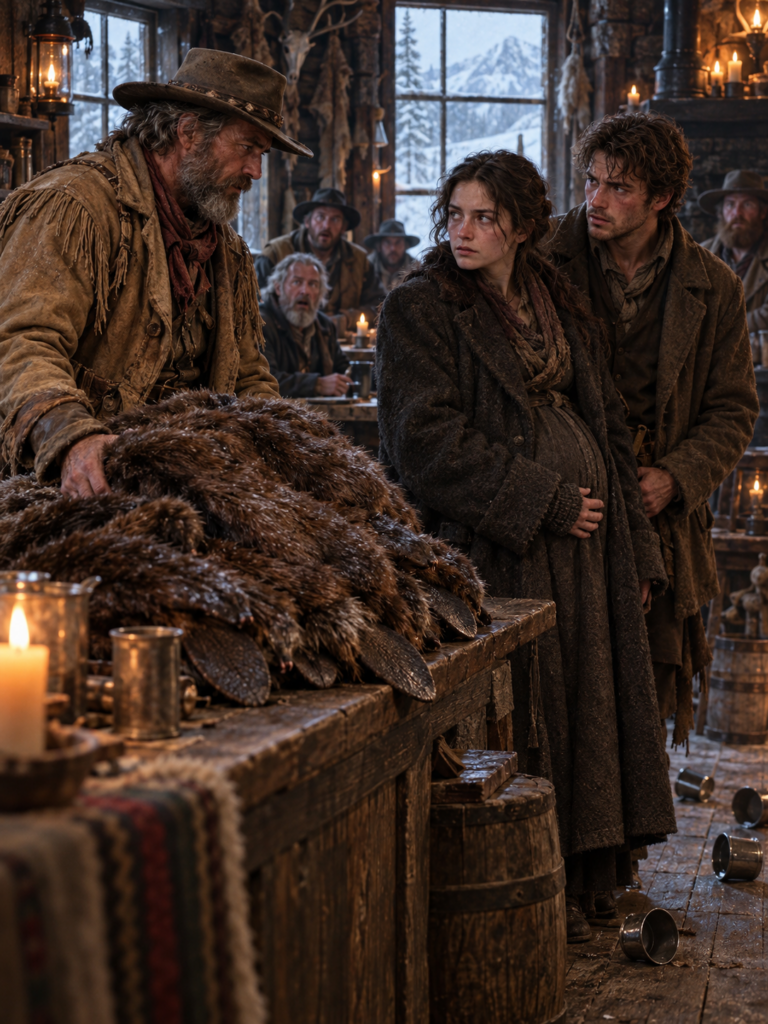
Jack gripped the mule’s lead and guided her around a patch of frozen stone where the trail dropped sharply toward the creek.
The mule stumbled once.
Emma caught the saddle horn, her other arm closing protectively around her middle.
Jack saw the movement.
“Steady,” he told the animal.
They reached the cabin near dusk.
By then the wind had strengthened enough to bend the tops of the pines.
Jack brought the animals into the sheltered lean-to, gave them feed and water, and helped Emma dismount.
Her knees nearly failed beneath her.
He offered his arm.
She accepted it, but only until her boots were firmly on the ground.
Inside, the cabin was cold.
Jack stirred the banked coals and built a fire while Emma stood by the door, taking in the single main room, the wooden table, the neatly arranged tools, and the curtain separating a small sleeping chamber.
“You can sit,” he said.
“I don’t want to be in the way.”
“You’re not.”
He warmed coffee and found the remaining cornbread from his morning meal.
Emma accepted the food with both hands.
She ate slowly, trying to hide how hungry she was.
Jack pretended not to notice.
Afterward, he showed her the back room.
A narrow cot stood against the wall beneath a folded wool blanket.
“The room is yours. You can shut the door. Nobody enters without asking.”
“Where will you sleep?”
“By the stove.”
She studied him.
“Why?”
“Because there’s only one bed.”
For the first time, something faintly amused crossed her face.
Then she looked down.
“Thank you, Mr. Holloway.”
“Jack is sufficient.”
“Then I’m Emma.”
He nodded.
The storm sealed them inside by morning.
Snow pressed against the lower door. The wind rattled the roof, and the trail beyond the cabin had disappeared beneath fresh drifts.
Jack had enough food and firewood for the immediate weather.
But the next several days would require care.
Emma emerged from the back room wearing the spare wool shirt he had left for her.
It hung loosely over her frame.
She looked at the fire, the stacked wood, and a harness waiting for repair.
“What can I help with?”
“Nothing you need to do today.”
“I’d rather keep busy.”
Jack considered her.
“The harness could use mending.”
She sat down with the leather.
Her first attempts were clumsy.
She had sewn cloth all her life, but stiff harness leather required different work.
Jack showed her the proper tools.
Then he left her to try.
By the second evening, she had repaired a torn strap well enough to hold until it could be checked under use.
She also made supper from the cabin’s beans, onions, and salt pork.
Jack washed the dishes.
Neither found it necessary to discuss the arrangement.
On the third night, Emma reached toward the coffee pot and winced.
Jack looked up.
“That pain again?”
She froze.
“It’s nothing.”
“Emma.”
She set the pot down.
His voice remained level.
“If something’s wrong, I’d rather know. There’s no physician close by in this weather.”
She kept her eyes on the stove.
Then she said, “I’m carrying a child.”
Jack became completely still.
Emma folded her hands.
“I’m near seven months along.”
For several seconds, the only sound was the wind.
Jack thought of the oversized coat, her exhaustion, the way she had held herself on the mule.
“Does Daniel know?”
“Yes.”
The answer was quiet.
It was also devastating.
Her brother had known.
He had known she was expecting a baby when he offered her to Silas Greer.
Jack felt anger rising, but he forced himself to remain calm.
“Does the child’s father know?”
Emma nodded.
“He’s gone.”
Jack studied her face.
She had given him everything she intended to say.
He would not demand more.
“Have you had any trouble with the pregnancy?”
“Not that I know of. I’ve been tired. Hungry. Sometimes sore.”
“Then when the weather clears, we ought to arrange whatever care we can.”
She looked at him.
“Are you sending me away?”
“No.”
“Even knowing?”
“Yes.”
Her eyes filled suddenly, though she blinked the tears back.
“You paid a great deal for those pelts.”
Jack shook his head.
“I spent them to settle a debt. Not to purchase you.”
She stared at him.
“And the baby?”
“The baby owes me nothing either.”
Emma turned toward the fire.
For a long while, she said nothing.
Jack let her keep the silence.
Then she stood carefully, crossed to the back-room doorway, and rested her hand against its wooden frame.
“May I ask one more thing?”
“Of course.”
“If the child comes before I can leave this mountain, will you help me?”
Jack looked at the snow pressing against the window.
He knew how far they were from town.
He knew how little experience he had with childbirth.
And he knew that promising an easy outcome would be dishonest.
“I’ll do everything I reasonably can,” he said. “And we’ll make arrangements before that day comes.”
Emma held his gaze.
Then she stepped into the little room and shut the door.
A moment later, he heard the latch slide firmly into place.
The latch settled into its socket, and Jack remained beside the fire, listening to the wind outside and the silence behind Emma’s door.
He was relieved she had used the latch.
It meant she believed it was hers to use.
Three years earlier, his wife Margaret had died after a brief, terrible illness.
She had been expecting their child.
Jack had lost them both.
Afterward, he had moved through life as though every ordinary kindness might open a wound he was determined to keep closed.
He trapped.
He repaired his cabin.
He traded for supplies.
He spoke only when necessary.
And he carefully avoided imagining a future that might ask him to love anyone again.
Now there was a pregnant young woman asleep behind his back-room door.
He was frightened for her.
That frightened him almost as much as the coming birth.
The storm remained for several days.
Jack tended the fire and kept the animals fed from the supplies stored in the lean-to.
Emma made herself useful when she wished, though he soon discovered that she disliked being told to rest.
When he offered to take the mending from her hands, she gave him a look.
“I can mend sitting down.”
“Didn’t say you couldn’t.”
“You were thinking it.”
Jack considered denying the accusation.
Instead, he said, “I was.”
She surprised him by smiling.
It was small, but real.
Later that afternoon, she found a loose board near the hearth.
Jack had intended to repair it for months.
When Emma caught her boot against the raised edge and fell awkwardly to one side, he was beside her almost immediately.
She sat still, one hand against her abdomen.
“Did you hurt yourself?”
“My hip took most of it.”
“Any pain elsewhere?”
“Not beyond what I had before.”
He helped her onto the bench at her request.
Then he fetched his tools and fastened the board securely.
Three strokes of the hammer.
The problem was finished.
Emma watched him.
“You didn’t need to do that immediately.”
“Should have done it before anybody tripped.”
He put away the hammer.
That night she told him why the small repair mattered.
“Daniel always left things broken,” she said. “If the roof leaked, we moved the furniture. If a hinge failed, we learned to lift the door.”
Jack listened.
“Sometimes I began to think asking for something to be fixed was worse than living with it.”
He looked toward the hearth.
“Well, the board was dangerous.”
“I know.”
She paused.
“But you didn’t make me feel foolish for falling.”
Jack said nothing for a moment.
Then he pulled the repaired floorboard once with his boot to make sure it held.
“Wouldn’t have been much sense in that.”
When the weather cleared enough for safe travel, Jack resumed checking his nearest trap lines.
He returned one morning to find Emma examining his account book.
She looked up immediately.
“It was open on the table. I should have asked first.”
“What caught your attention?”
“The way you’ve recorded your pelts.”
He crossed to the table.
She showed him two columns.
His mink and marten catches had been entered by individual skin while some of the selling prices were calculated by bundles.
The figures didn’t agree.
He frowned.
“I’ve been using that book for years.”
“That doesn’t make it correct.”
She explained the discrepancy.
The more he examined it, the clearer her reasoning became.
Over two seasons, he had miscalculated approximately sixty-three dollars of value.
That was a painful sum.
“Where did you learn accounts?”
“My father kept books for several businesses. I helped him from childhood.”
“And Daniel?”
“He preferred spending money to recording where it went.”
Jack nearly smiled.
Emma turned another page.
“I can check the rest, if you like.”
He sat opposite her.
“Show me.”
They worked through the morning.
She corrected several calculations, acknowledged one entry where Jack’s method was sound, and made a clean record of the totals.
Her confidence grew as she worked.
For Jack, the change was striking.
At Greer’s Crossing, Emma had stood almost motionless, as though she expected every stranger to decide her value for her.
Now she argued over arithmetic with the determination of someone who knew precisely what she was doing.
He had offered shelter.
She had offered judgment and skill he genuinely needed.
But he never confused that help with a debt she was required to repay.
Weeks passed.
Emma’s pregnancy became more visible as the borrowed clothing could no longer conceal it.
Jack brought water, kept the woodpile stocked, and adjusted the household work where necessary.
She continued keeping accounts and repairing clothes.
They found comfort in a shared routine that neither had expected.
Then one afternoon, Emma tried to right a water barrel after its metal hoop loosened.
She could not lift it.
When Jack returned, he found her standing beside the leaking barrel, furious with herself.
“I couldn’t manage it.”
He examined the broken hoop.
“It needed tools.”
“I thought I could fix it.”
“Some things require more strength than a person has available.”
She looked at him.
“You’re being kind.”
“I’m explaining a barrel.”
He repaired it.
When he turned around, Emma was still watching him with troubled eyes.
“What happens when the baby comes?” she asked.
“We’ll need more supplies. And somebody nearby who can help if there’s trouble.”
“That’s not what I mean.”
Jack stopped.
Emma clasped her hands.
“What if you decide we’re too much?”
He understood then.
She had been waiting for kindness to end.
Waiting for the moment when the cost of helping her became greater than somebody was willing to bear.
Jack drew out a chair.
“Sit with me a minute.”
She did.
“I don’t know what the future holds,” he admitted. “But I won’t turn you out because a child is born. And I won’t make you earn food or shelter through work.”
Emma lowered her head.
“Men have changed their minds before.”
“I expect they have.”
He waited until she looked at him again.
“You can judge me by what I do. I don’t ask you to take the rest on faith.”
That answer stayed with her.
So did the way he mended the barrel without making it proof of her inadequacy.
But the quiet life they were building soon faced a threat that had nothing to do with the weather.
Jack’s neighbor, Angstrom, came up the mountain with news from Greer’s Crossing.
A trapper named Pruit had been spreading stories about Emma.
He claimed Daniel Carter still had some right to her labor and that Jack was keeping her in his cabin unwillingly.
A new land agent, Whitfield, had also been asking questions about Jack’s property and trap lines.
Jack’s expression hardened.
“What’s Whitfield after?”
“The supply route,” Angstrom replied. “And the ground beside Cutters Creek.”
Emma had been listening from the table.
She spoke before Jack could respond.
“They’re using me because they believe you’re easier to trouble through a woman than through your records.”
Jack turned.
“That’s what I reckon.”
“Then show me those records.”
He hesitated.
She held out her hand.
“Jack, I know how to read an account. I know how to compare documents. Let me see what you have before you start fighting men whose business is paperwork.”
He looked at her for a long moment.
Then he gathered the documents.
That evening they laid them across the table.
Original homestead papers.
Boundary notes.
Trap-line records.
Later survey descriptions.
Emma arranged the sheets by date.
For three days, she examined them carefully, stopping when fatigue required it and returning when she could concentrate.
On the second day, she found the discrepancy.
Jack’s older documents described the eastern boundary as following the main channel of Cutters Creek.
A later notation placed it along a tributary.
She pointed out the difference.
“Those aren’t the same watercourse.”
Jack leaned closer.
“No.”
“What’s between them?”
“Some of my best trap lines. And the approach to the supply trail.”
Emma looked at the later record’s date.
“Eight months ago.”
“After Whitfield started working here.”
She nodded.
“Then this may be how he intends to challenge your holdings.”
Jack stared at the page.
A few changed words threatened years of labor.
The cabin.
The ground where Margaret was buried.
The work that had kept him alive after losing her.
“How do we prove the earlier line was correct?”
“We need the original territorial survey.”
“Where?”
“The records office at the county seat.”
It was a difficult ride, too much for Emma in her condition.
She knew that.
“You’ll have to go,” she said. “I’ll prepare the description and the questions the clerk needs to answer.”
Jack looked toward the window.
He disliked leaving her.
But she was right.
With Angstrom checking the cabin and the weather settled enough for travel, they agreed upon the arrangement.
Before dawn, Jack saddled his horse.
Emma handed him a folded sheet.
“Don’t accept a document merely because it looks older. Check the creek name and the boundary description.”
He nodded.
“And Jack?”
“Yes?”
“Bring back what the record says. Not what either of us hopes it says.”
He took the paper.
“That I can do.”
He rode for the county seat.
The journey took a day and a half.
At the territorial records office, a clerk named Hadley examined Emma’s instructions and located an earlier survey.
It described the boundary along Cutters Creek’s main channel.
Jack paid for a certified copy.
Then he returned through the high country, protecting the document inside his coat.
Emma was waiting at the table when he arrived.
He laid the paper in front of her.
She opened it slowly.
Her eyes found the description.
She checked the wording against the homestead claim.
Then she looked up.
“Main creek,” she said softly.
Jack nodded.
“Main creek.”
For the first time since the dispute began, she smiled without restraint.
They had not finished the matter.
But they finally had proof worth bringing before the authorities.
Jack took the certified record to Greer’s Crossing with Angstrom and other concerned trappers.
He confronted Whitfield and his lawyer with the contradictory documents and gave notice that he would pursue a formal complaint.
The lawyer’s reaction suggested the discrepancy could no longer be dismissed easily.
Whitfield offered the possibility of an administrative error.
Jack answered that the proper officials could determine its cause.
He returned home with the certified copy secured and the complaint underway.
Emma met him at the door.
“Well?”
“The record holds. They know we’re challenging the change.”
She closed her eyes briefly.
When she opened them, there was relief in her expression.
Jack realized then that his satisfaction wasn’t merely about saving the trap lines.
He had come home to someone who understood exactly why the work mattered.
They shared coffee by the fire.
Outside, the wind turned colder.
After a while, Emma said, “You still haven’t told me much about Margaret.”
Jack looked toward the stove.
“My wife,” he said. “She died three Aprils ago.”
“I know.”
He swallowed.
“She was expecting our child.”
Emma put down her cup.
“I’m sorry.”
He told her about the fever, the helpless waiting, and the empty cabin afterward.
She listened without trying to offer an easy explanation.
Then she said, “You loved her very much.”
“Yes.”
“You can still love her.”
He looked at her.
Emma continued gently.
“Remembering her doesn’t mean you have to remain alone forever.”
Jack stared at the fire.
For the first time, the thought of a future beyond grief no longer seemed impossible.
And when Emma reached across the table and rested her hand beside his, he slowly turned his own hand and took it.
Jack’s fingers closed gently around Emma’s hand.
For a moment, neither spoke.
The fire was low, and the wind pressed against the cabin walls.
Then Emma looked toward the back room.
“I should get some rest.”
Jack released her hand immediately.
“Of course.”
She rose carefully.
At the doorway, she paused.
“Jack?”
“Yes?”
“I’m glad you told me about Margaret.”
He nodded.
“And I’m glad you listened.”
When the back-room door closed, he remained at the table.
For three years he had avoided speaking his wife’s name whenever possible.
He had convinced himself that silence protected what remained of her.
But tonight, he had spoken about Margaret without feeling that he was betraying her memory.
He had remembered their happiness.
He had remembered their loss.
And he had done it with another person sitting beside him.
Something about that felt less like letting go than finally being able to carry his grief without being crushed by it.
The following week brought a different difficulty.
Daniel Carter appeared at the cabin.
Emma heard his horse before she saw him.
She stood near the window, watching her brother dismount in the yard.
Jack came from the lean-to, where he had been checking the mule’s feed.
He stopped a few yards from Daniel.
“What brings you here?”
Daniel looked toward the cabin.
“My sister.”
Jack considered him.
“Then she’ll decide whether she wants to speak.”
He went inside.
Emma stood beside the table.
“Is it him?”
“Yes.”
She looked toward the window.
For several seconds, she seemed to be measuring a decision.
Then she took her coat from its peg.
“I’ll speak to him outside.”
Jack nodded.
“Do you want me nearby?”
“At the doorway. Not beside me.”
“All right.”
Emma stepped onto the porch.
Daniel removed his hat.
He looked worse than she remembered.
His cheeks were hollow, and his coat hung loosely from his shoulders.
“Emma.”
“Daniel.”
His eyes lowered toward her rounded abdomen.
“I came to see whether you were alive.”
The words struck her harder than she expected.
She kept her voice steady.
“Did you think I wouldn’t be?”
Daniel looked away.
“I didn’t know what else to do.”
“That was true the day you left me at Greer’s.”
He swallowed.
“I was desperate.”
“So was I.”
There was a long silence.
Daniel finally looked at her.
“I shouldn’t have done it.”
“No.”
“I’ve thought about it every day.”
Emma drew her coat around herself.
“I don’t doubt that you have.”
He seemed relieved for an instant.
Then she continued.
“But your regret doesn’t undo what happened.”
Daniel lowered his head.
She looked toward the familiar mountain trail.
For months she had carried anger toward him.
Some of it had kept her alive.
But she no longer wanted the task of carrying his conscience, too.
“The baby is doing well,” she said. “And so am I.”
Daniel looked at her.
“He’s treating you right?”
“Jack has treated me with respect.”
She paused.
“But don’t mistake that for the whole of it. I’ve worked to make a life here. I’ve learned what I can do. I’ve made decisions for myself.”
Daniel nodded slowly.
“I know.”
“No, I don’t think you do. But you may someday.”
He stared at her.
“I’m sorry, Emma.”
She accepted the words without offering an answer he hadn’t earned.
“When the child is born and the weather is better, you may come back. We’ll talk then.”
“Will you forgive me?”
“I don’t know.”
He looked as though the uncertainty hurt him.
Emma did not soften it.
“It’s the truth.”
Daniel placed his hat on his head.
Then he mounted and rode away.
She watched until he disappeared into the trees.
Jack came onto the porch.
“How are you?”
“Tired.”
“Want to talk?”
“Not yet.”
He nodded.
She went back inside, and he followed.
They sat at the table while the afternoon light faded.
Jack did not tell her she had been generous.
He did not insist that family must forgive family.
He allowed her decision to remain hers.
Three days later, he was badly hurt.
The northern trap line ran near a ridge where alternating thaw and frost had weakened a shelf of snow.
Jack was checking a set when part of the shelf broke loose.
It struck him from the side, knocking him against the rocks and sweeping him downhill.
He managed to stop his slide before reaching the steeper ground below.
But when he tried to rise, pain cut through his chest.
He lay still for a moment, trying to determine what he could move.
His left side hurt badly.
Breathing deeply was difficult.
His shoulder ached.
He had suffered broken ribs before.
He feared he had done so again.
The route home was long.
He moved slowly, resting whenever the pain became too great.
By the time the cabin came into view, he was exhausted, chilled, and struggling to remain upright.
Emma heard the horse before she saw him.
She opened the door.
Jack nearly fell as he stepped inside.
“Jack!”
She caught his arm, then immediately understood that she could not support his full weight.
“Sit. Slowly.”
He lowered himself onto the bench.
She saw the blood near his hairline and the way he guarded his ribs.
“What happened?”
“Snow shelf gave way.”
“Can you breathe?”
“Enough.”
She did not accept the answer without watching him.
He was pale.
His breaths were shallow.
She brought him water, helped him remove his outer coat without twisting his injured side, and examined what she could without causing unnecessary pain.
She knew the limits of her experience.
There was no physician nearby, and winter travel was uncertain.
She could not promise that the injury was simple.
For the next several days, Jack rested while Emma kept the fire, managed the food and supplies, and watched for signs that his breathing was worsening.
Angstrom came when the trail permitted.
He helped with the heavier work and checked the injured man.
Emma refused to pretend she could manage every task alone.
That was another kind of strength she had learned.
Knowing when help was needed.
Jack disliked being confined to his sleeping roll.
He disliked depending on another person still more.
One afternoon, he tried to rise and reach for his boots.
Emma appeared in the doorway.
“Where are you going?”
“Woodpile.”
“No.”
“Emma—”
“You can hardly stand without holding your ribs.”
“The fire needs wood.”
“I’ve brought enough inside. Angstrom stacked more by the door.”
Jack sat back.
She looked at him.
“Let somebody else do the work you can’t do today.”
He gave her a rueful look.
“Sounds familiar.”
“It should.”
She placed a cup beside him.
Then she returned to the accounts.
The days continued.
Jack’s pain gradually eased, though he could not resume his trap lines immediately.
Emma corrected the records, noted supplies that needed replacing, and checked the documents concerning the boundary dispute.
She did the work because it mattered to their shared livelihood, not because shelter had become something she owed.
One evening, she sat beside Jack after finishing the books.
He looked at her.
“There’s something I need to say.”
She folded her hands.
“I’m listening.”
“I want you here after the baby is born.”
Emma remained still.
Jack continued.
“Not because you’ve kept the accounts or repaired things I neglected. Not because I need somebody to tend me when I’m hurt.”
He took a careful breath.
“I want you here because I care for you. And because when I think about the years ahead, I find myself hoping you’ll be part of them.”
She watched him with her steady dark eyes.
He allowed her the time she needed.
“The baby isn’t yours,” she said.
“I know.”
“I don’t want a man claiming him out of pity.”
“Neither do I.”
Jack looked toward the small room where she slept.
“If you choose to stay, I want to help raise him. Not because I can replace his father, but because I can choose what sort of man I’ll be to him.”
Emma looked down.
For months she had measured men by the damage they might do.
Now she was measuring one by the care he had shown even when there was no reward in sight.
She had seen him fix a dangerous floorboard.
She had watched him ask for her judgment.
She had seen him travel to the county seat because her reading of the records gave them a chance to defend the property.
And she had watched him accept help when injury stripped away his usual independence.
Still, she needed one more thing.
“Ask me again when the child is here,” she said.
Jack nodded.
“I will.”
“When the weather clears and I’m able to make plans without the mountain deciding them for me.”
“Then.”
She touched his hand.
“It isn’t a refusal.”
“I understand.”
And she believed he did.
As winter began loosening its hold on the high country, Emma prepared for the birth.
She reviewed the supplies available at the cabin and arranged what she could.
Jack made the necessary journey to Greer’s Crossing when conditions permitted.
He returned with the items she had requested.
Angstrom knew the baby was due soon and agreed to check on them.
The nearest medical assistance remained distant, a fact neither Jack nor Emma treated lightly.
They spoke about what might happen and what help could realistically be reached.
Jack listened when Emma explained what she wanted him to do.
He remembered.
And he worried.
The night labor began, the sky was clear.
No storm.
No violent wind.
Only the cold quiet of a mountain beginning to thaw beneath its winter snow.
Emma came from the back room with one hand against the doorframe.
Jack looked up from the account book.
“Emma?”
She breathed slowly.
“I think it’s time.”
He stood.
His ribs still gave him discomfort, but he was moving more easily than he had weeks earlier.
“Tell me what you need.”
She looked at him.
“First, put the kettle on.”
He did.
The hours passed slowly.
Emma’s labor was difficult and exhausting.
Jack stayed beside her, helping as she directed and offering water when she asked.
He did not pretend he could make the pain disappear.
He could only remain useful, attentive, and calm.
There were moments when fear nearly overwhelmed him.
He remembered Margaret.
He remembered the night he had lost her.
But he forced himself to see Emma as she was, not as another ending he had already suffered.
When she told him to stop talking, he stopped.
When she reached for his hand, he gave it.
When she needed another moment to gather herself, he waited.
They endured the long night together.
Shortly before three in the morning, a baby’s cry filled the cabin.
A boy.
Small, warm, and very much alive.
Jack wrapped him and placed him in Emma’s arms.
For a moment, Emma could only stare.
She was exhausted, trembling, and overwhelmed.
Then tears came.
Not the quiet tears of someone trying to hide suffering.
Open tears.
Jack sat beside her, his own hands unsteady.
“He’s here,” he whispered.
Emma looked up.
“He’s here.”
She held the child close, then slowly offered him to Jack.
“Would you like to hold him?”
Jack nodded.
He received the baby with almost reverent care.
The child’s tiny face tightened.
A small cry escaped him.
Jack adjusted his hold.
“Well,” he murmured, “you’ve got a good strong voice.”
Emma laughed through her tears.
The sound surprised both of them.
For years, Jack had known the cabin mainly as the place he returned to after trapping.
It had protected him from cold, hunger, and the unwanted company of others.
Now it held something different.
A woman who had chosen to trust him.
A child who knew nothing of the bargains and cruelties that had preceded his birth.
And a man discovering that grief had not taken away his ability to love.
Emma watched him.
“I’ve been thinking about a name.”
Jack looked up.
“Miller,” she said.
He repeated it quietly.
“Miller.”
“Greer’s Crossing was where things began to turn. I want the name to remind me that one terrible day doesn’t have to decide an entire life.”
Jack considered the child in his arms.
“Miller’s a good name.”
Emma studied him.
Then he asked, “Would you still consider what we talked about?”
“About staying?”
“Yes.”
She was silent for a moment.
Then she smiled.
“I’ve already given it thought.”
Jack waited.
She looked at the baby.
“I knew I wanted this life before tonight. I only needed to know you’d ask me when I could answer freely.”
He sat beside her.
“And your answer?”
“Yes.”
Jack’s eyes closed briefly.
Emma touched his arm.
“I want to stay with you, Jack. Not because there’s nowhere else I can go. Because there’s nowhere else I’d rather build my life.”
He bent his head.
When he looked up again, his eyes were wet.
“If you wish it,” he said, “I’d like him to bear my name.”
Emma looked down at the boy.
“Miller Holloway.”
She said it slowly.
Then nodded.
“Yes.”
They sat together while the fire settled into glowing coals.
Outside, dawn approached over the mountains.
Inside, Miller made a small indignant noise and demanded his mother’s attention.
Emma took him back into her arms.
Jack watched them both.
For the first time since Margaret died, the future was something he looked toward rather than something he merely endured.
The weeks after the birth were not effortless.
Emma needed rest and recovery.
Jack took on the heavier chores.
Angstrom helped when necessary.
The cabin required constant attention, and the demands of a newborn altered every familiar routine.
Jack learned how frequently a small child could interrupt sleep.
Emma learned that she could ask him to take Miller without having to explain why she was tired.
They made mistakes.
They corrected them.
They spoke honestly when one of them was overwhelmed.
And gradually the cabin found a new rhythm.
Spring brought running water back to the creeks.
The tracks through the snow became mud, then earth.
Jack returned to his work cautiously as his ribs healed.
Emma resumed the accounts when she felt strong enough.
Their boundary claim remained supported by the certified older survey, and the formal dispute continued through the proper records.
Whitfield’s attempt to rely on the altered tributary notation had been challenged successfully.
The supply route and trap-line boundaries could no longer be casually treated as his.
Emma kept copies of every important paper.
Jack no longer dismissed that work as a nuisance.
One afternoon, he came home to find her sitting at the table with Miller sleeping nearby.
She was examining a new timber-rights filing.
“That document came from Greer’s?” he asked.
“Yes. I wanted to check it against the older records before you signed.”
Jack sat opposite her.
“Anything wrong?”
“Nothing I can find. But look at this section.”
She explained the terms.
He listened.
They discussed the risks, the work required, and what the decision would mean for the coming season.
It was no longer a man making every decision while a woman merely kept his home.
They were building a livelihood together.
Later that spring, Daniel came back up the mountain.
Emma met him on the porch with Miller in her arms.
Jack remained inside until she asked him to join them.
Daniel looked at the child for a long while.
“He’s beautiful.”
Emma nodded.
“His name is Miller.”
Daniel swallowed.
“I’m glad you’re both well.”
They spoke carefully.
Emma did not pretend the past had been forgotten.
She told her brother that he could begin rebuilding trust through his conduct, not through repeated apologies.
He accepted the terms.
It was a beginning.
Nothing more.
And for the first time, Emma felt no obligation to make the beginning easier for him.
That evening, Jack carried Miller up the eastern slope.
The snow had withdrawn far enough to expose Margaret’s grave marker.
He stood before it with the child resting securely against him.
For a long while, he said nothing.
Then he spoke about the woman buried there.
He told Miller that Margaret had loved the mountain, that she had shared Jack’s first years of happiness there, and that her memory would always belong to the place.
He did not imagine that the boy understood.
It mattered to Jack to say it anyway.
He looked toward the cabin, where smoke rose gently from the chimney.
“I’m not alone now,” he said.
The words did not erase his grief.
They simply made room beside it.
Jack remained a while, then turned toward home.
Emma looked up when he entered.
She saw his face and seemed to understand where he had been.
“All right?” she asked.
He nodded.
“All right.”
He placed Miller carefully beside her and sat down at the table.
The timber-rights papers were waiting.
Emma handed him the pen.
“Here. This is the part we agreed upon.”
He read the passage once more, signed, and passed it back.
She checked the signature and added the document to their records.
Outside, the creek ran strongly with the thaw.
Inside, a child slept while two people considered the next season of work.
A patched harness hung near the door.
Jack still wore the socks Emma had repaired during the first storm.
The troublesome floorboard remained solid beneath their feet.
None of those things was grand.
But every one held a memory of something repaired, chosen, or trusted.
Jack thought of the day he had entered Greer’s Crossing for provisions.
He had seen a woman whose brother was trying to exchange her freedom for supplies.
At first, he had believed he was simply preventing one terrible wrong.
He hadn’t known the young woman could keep accounts better than he could, read property documents he barely understood, or find the courage to challenge men who expected her silence.
He hadn’t known she was carrying Miller.
He hadn’t known how much her presence would change the mountain.
Most of all, he hadn’t understood that offering someone a way out was only the beginning.
The harder work was making sure she remained free once she reached safety.
Emma looked across the table.
“What are you thinking?”
Jack glanced at the child.
“That we’ll need more room before long.”
She smiled.
“Perhaps another shelf first.”
“Another shelf?”
“For the records. We’ve more coming.”
Jack laughed.
It was an ordinary laugh, easy and unguarded.
Emma looked pleased to hear it.
Then she reached across the table and took his hand.
Outside, spring sunlight moved across the pines.
For three years, the mountain had been the place where Jack Holloway hid from the life he had lost.
Now it was the place where Emma Carter had reclaimed her future, where Miller Holloway had entered the world, and where a man who once believed he had nothing left to give had learned that love was not possession, pity, or obligation.
It was the daily willingness to stay, to listen, to work, and to let another person remain fully herself.
Emma looked toward the open window.
“The weather’s turning pleasant.”
Jack nodded.
“We could take Miller onto the porch.”
“In a moment,” she said.
She pointed toward the final column of the ledger.
“First, you’ve added this incorrectly.”
Jack looked down.
Then he smiled.
“Show me.”
And she did.

