
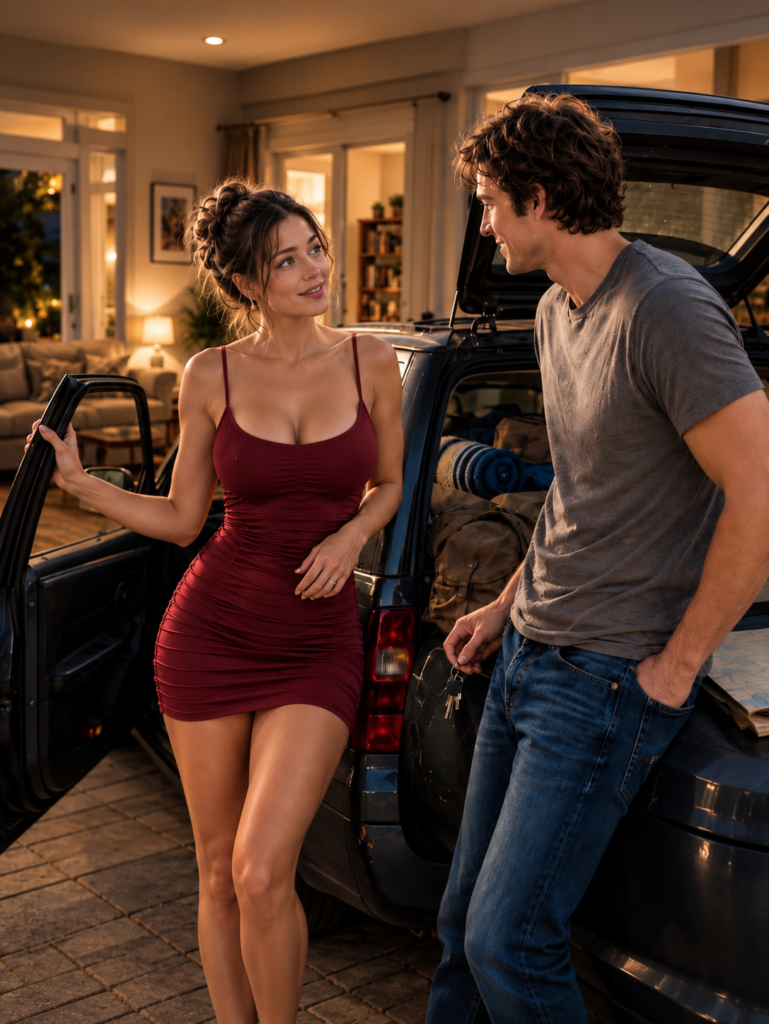
PART 3
No polite excuses.
No wondering whether the other person was only being friendly because we shared a sidewalk.
Emma looked directly at me.
“Do you ever wonder what would happen if we stopped pretending?”
My heart accelerated.
“Pretending what?”
“That we’re just neighbors.”
I did not answer.
Emma smiled nervously.
It was the first nervous expression I had seen from her all trip.
“I think about you more than I should.”
I swallowed.
“I think about you too.”
“How much?”
“That feels dangerous.”
“Probably.”
I sat on the other bed, facing her.
“I notice when you’re not home.”
Her eyes stayed on mine.
“I notice when someone else’s car is in your driveway.”
Emma smiled slightly.
“That was my cousin last month.”
“I know that now.”
“You were jealous?”
“I was curious.”
“Sure.”
I laughed.
“I keep finding reasons to talk to you outside.”
“So do I.”
“You baked cookies when I was sick.”
“I bake cookies for lots of people.”
“That sounded defensive.”
“I specifically chose your favorite kind.”
“I never told you my favorite.”
“You always take oatmeal first at neighborhood cookouts.”
I stared.
“You noticed that?”
Emma looked almost embarrassed.
“I notice a lot.”
The rain continued.
Neither of us moved.
Then I asked, “Why haven’t we done anything?”
Emma considered the question.
“Because if this went badly, I’d still see you every morning.”
“That was my reason too.”
“And because…”
She hesitated.
“What?”
“My last relationship ended badly.”
I waited.
She had never mentioned it.
“We were together four years. Almost engaged.”
“What happened?”
“He accepted a job in another state.”
I almost laughed at the irony, but Emma’s expression stopped me.
“He assumed I would go.”
“Without asking?”
“He asked eventually. After accepting.”
She looked down.
“It wasn’t just the move. It was realizing that he had already pictured his future and assigned me a place in it.”
I thought about Dallas.
Emma continued.
“I said I wanted time. He told me if I loved him, I’d know.”
“What did you do?”
“I stayed.”
“In Denver?”
She nodded.
“He left.”
“How long ago?”
“Three years.”
The loop she had described at breakfast suddenly made more sense.
“And now you’re afraid of getting pulled into somebody else’s plan again.”
“Maybe.”
She looked at me.
“And you’re considering Dallas.”
There it was.
“I am.”
“Does that mean this is terrible timing?”
“Possibly.”
Emma nodded slowly.
For a moment, I thought the conversation had ended.
Then she said, “I still don’t wish I stayed home.”
“Neither do I.”
She smiled.
“Good.”
Nothing physical happened that night.
No dramatic kiss.
No crossing the space between the beds.
That mattered.
We had finally told the truth.
It was enough.
The next morning, sunlight came through the curtains.
The storm had passed.
The town mechanic found a loose electrical connection and a failing alternator.
He could repair enough to get us home safely, but the part he wanted would take a day.
Instead of ending the trip, we changed the route.
That felt appropriate.
We drove toward Grand Lake.
By noon, the mountains opened around us.
Blue water stretched beneath a bright sky, surrounded by dark forests and snow still clinging to the highest peaks.
Emma stepped out of the SUV and simply stared.
“Okay.”
“What?”
“This was worth the terrible coffee.”
We spent the afternoon walking along the shoreline.
No schedule.
No destination.
At one point, Emma removed her shoes and stepped into the freezing water.
She immediately jumped backward.
“That was a mistake.”
“I could have told you.”
“You could have prevented it.”
“You specifically said you didn’t want men planning your decisions.”
She pointed at me.
“Do not weaponize emotional honesty.”
I laughed.
We sat on a fallen log and ate sandwiches from the cooler.
Later, we hiked a short trail above the lake.
The entire time, something between us had changed.
We no longer had to pretend we didn’t know it existed.
That did not make everything easier.
It made everything more real.
Near sunset, Emma stopped on the trail.
“I don’t want this trip to end.”
“Neither do I.”
She looked at me.
“Then don’t let it.”
“What are you suggesting? Kidnapping?”
“I’m suggesting maybe this wasn’t a road trip.”
“What was it?”
Emma stepped closer.
“A beginning.”
I reached for her hand.
Slowly enough that she could decide.
She didn’t pull away.
Her fingers closed around mine.
We stood there while wind moved through the pines.
For the first time in two years, neither of us pretended.
I wanted to kiss her.
Badly.
Emma probably knew.
But I didn’t.
Not yet.
Because there was still something we needed to talk about.
Dallas.
That night, sitting beside a campfire at our campsite, Emma finally asked.
“When do you have to decide?”
“Tuesday.”
“Do you want the job?”
“I want parts of it.”
“That isn’t the same answer.”
“I know.”
She held her hands toward the fire.
“What parts?”
“More responsibility. Better projects. Money.”
“And Dallas?”
“I’ve never wanted Dallas.”
Emma smiled.
“Nothing against Dallas.”
“Of course.”
“What happens if you say no?”
“I stay where I am. Maybe another opportunity comes later.”
“And if you say yes?”
“I leave in six weeks.”
Emma looked toward the flames.
I wanted to tell her I would stay for her.
The sentence nearly came out.
Then I remembered what she had told me about her ex.
A man creating a future and assigning her a role inside it.
So I stopped.
Emma noticed.
“What?”
“I almost said something stupid.”
“What?”
“That I could turn it down because of you.”
Her expression changed.
“That isn’t stupid.”
“It would be after one road trip.”
“Fair.”
I continued.
“But pretending you don’t matter to the decision would also be dishonest.”
Emma nodded.
“That’s fair too.”
“I don’t know what we are yet.”
“Neither do I.”
“But I want to find out.”
“So do I.”
I looked at her.
“That matters.”
She smiled.
“It does.”
The next morning, we woke early and walked to the water before breakfast.
The lake was almost perfectly still.
Emma stood beside me wearing my extra fleece because she had underestimated mountain mornings.
“You know,” I said, “technically you’re stealing my clothes now.”
“I’m cold.”
“Strong legal defense.”
“You invited me camping.”
“That argument is becoming very flexible.”
She turned.
Then, without warning, she kissed me.
Not my cheek.
Not almost.
Actually kissed me.
For half a second, I forgot every thought in my head.
Then I kissed her back.
Her hands rested against my chest.
Mine found her waist.
The kiss lasted maybe ten seconds.
Maybe thirty.
Time became unreliable.
When we separated, Emma’s cheeks were pink from more than cold.
“I got tired of waiting.”
“I appreciate the initiative.”
“You were overthinking.”
“I was being respectful.”
“You were definitely overthinking.”
I smiled.
“Can we do that again?”
“Yes.”
So we did.
The drive home felt completely different from the drive out.
Emma fell asleep after lunch, curled slightly toward the passenger window.
Every few minutes, I glanced over.
For two years, she had lived twenty yards from me.
Two years of good mornings.
Two years of mailboxes.
Porch lights.
Cookies.
Conversations stretched longer than necessary.
Two years of pretending that wanting her did not count because doing something about it might become complicated.
Sometimes life gives you a ridiculous opportunity to stop being afraid.
Mine began with a joke.
Come on my road trip.
Three days later, we turned onto our street.
Emma woke.
She blinked.
“Are we home?”
“Yeah.”
She looked toward her house.
Then back at me.
“That’s unfortunate.”
I laughed.
I parked in my driveway.
She opened the passenger door.
“Same time next weekend?” I asked. “Another road trip?”
Emma stepped out.
“No.”
My stomach dropped slightly.
Then she leaned back inside.
“Next weekend is our first real date.”
I smiled.
“That sounds more expensive.”
“It doesn’t have to be.”
“Dinner?”
“You plan it.”
She closed the distance and kissed my cheek.
“Tuesday.”
“What about Tuesday?”
“Your job.”
I nodded.
“Decide for yourself.”
Then she walked toward her house.
I sat in the SUV smiling like an idiot.
The next morning, I found a note taped to my front door.
Pack light. I’m choosing the destination next time.

I looked across the lawn.
Emma stood on her porch holding coffee.
She lifted the mug.
I laughed.
For the first time, home did not feel like the place where the adventure ended.
It felt like the place where it had started.
Tuesday morning, I called my manager.
I turned down Dallas.
Not because of Emma.
That distinction mattered.
The promotion was good.
The life attached to it wasn’t one I wanted.
The road trip had forced me to admit something I had been avoiding long before Emma stepped into the SUV.
I had spent most of my thirties assuming progress meant leaving something behind.
Bigger job.
Different city.
New title.
More money.
But when I pictured Dallas honestly, I did not feel excited.
I felt obligated.
I wanted harder work.
I did not necessarily want a different life.
My manager surprised me.
“You sure?”
“Yes.”
“Any particular reason?”
“I finally figured out I like where I am.”
He was silent for a second.
“That’s either very wise or very stupid.”
“I’ll let you know.”
That evening, I knocked on Emma’s door.
She opened almost immediately.
“Well?”
“I’m staying.”
Her expression changed.
“Because of me?”
“No.”
I watched her face carefully.
“Good answer.”
“I’m staying because I don’t want Dallas.”
She nodded.
“And separately, I’m very glad staying means I get to see where this goes.”
Her smile appeared.
“Better answer.”
Then she kissed me.
Our first real date happened Friday.
Dinner at a small Mexican restaurant downtown.
No mountains.
No broken vehicle.
No hotel-room confession.
Just two people sitting across from each other while somebody at the next table argued loudly about parking.
It was better than the road trip in a different way.
Because ordinary life was the real test.
Emma and I had known we could like each other beside a mountain lake.
Now we had to discover whether we liked each other on Wednesdays when traffic was bad and somebody had forgotten to buy milk.
We did.
Mostly.
Dating your neighbor came with advantages.
There was no forty-minute drive after dates.
If I made too much chili, Emma got half.
If she needed help moving something heavy, I was available.
It also came with rules we had to invent.
We did not assume being home meant being available.
We knocked.
We texted.
We kept our own spaces.
Emma had spent too long feeling like relationships automatically consumed independence.
I had spent too long treating independence as an excuse to avoid relationships.
Finding the middle required practice.
Our first real argument happened three months later.
Emma had a brutal week at the hospital system.
Layoffs were being discussed.
Nothing final.
She was exhausted.
I came home Friday and saw her sitting alone on the porch.
I crossed the lawn.
“Want dinner?”
“No.”
“Want company?”
“No.”
“Okay.”
I went home.
Twenty minutes later, my phone rang.
“Are you mad?”
“No.”
“You just left.”
“You asked me to.”
Silence.
Then Emma sighed.
“My ex used to stay when I asked him to leave because he said I didn’t really mean it.”
“I assumed you meant it.”
“I did.”
Another pause.
“I just didn’t expect you to believe me that easily.”
I smiled sadly.
“I can come back if you’re asking now.”
“Yes.”
So I returned.
We sat on the porch.
She leaned against my shoulder.
Neither of us talked about work for an hour.
That argument taught us something.
Respecting independence did not mean withholding comfort.
It meant waiting until comfort was chosen.
Six months after the road trip, Emma’s company offered her a transfer.
Seattle.
The irony was almost offensive.
She came to my house holding the email.
“You’re laughing.”
“I’m trying not to.”
“This isn’t funny.”
“It is a little funny.”
She sat at my kitchen table.
The position was excellent.
Better salary.
Better role.
A chance to lead an entire employee-relations team.
Unlike Dallas, Emma actually wanted Seattle.
That scared both of us.
“What are you thinking?” I asked.
“That six months ago, I told you not to make career decisions around me.”
“You did.”
“And now I hate that advice.”
I laughed.
She did too.
Then the laughter stopped.
“Do you want the job?”
“Yes.”
That hurt.
I nodded.
“Then we figure out what yes means.”
“You’re not going to ask me to stay?”
“I want you to stay.”
Her eyes filled.
“But I’m not going to pretend wanting that gives me the right to make the decision.”
Emma reached across the table.
“What if I go?”
“Then we decide whether we want to try long distance.”
“And do you?”
“Yes.”
The answer surprised neither of us.
Emma accepted the position.
She moved to Seattle two months later.
For almost a year, we became experts in airports.
Denver to Seattle.
Seattle to Denver.
Friday-night flights.
Sunday-evening goodbyes.
Video calls.
Delayed planes.
Bad moods.
Missed birthdays because flights were canceled.
It was hard.
There were weeks when being together felt like maintaining a complicated transportation system.
But neither of us treated difficulty as proof we had chosen wrong.
That was new for both of us.
Then my firm won a major Colorado infrastructure contract.
Instead of relocating, they offered me a senior regional role based in Denver.
I accepted.
Emma’s organization announced hybrid restructuring around the same time.
Her position could eventually move.
One evening during a video call, she said, “I can come back.”
I froze.
“Do you want to?”
“Yes.”
“Not because of me?”
She smiled.
“Separately because of you. But mostly because I miss Colorado, I miss my friends, I hate Seattle winters more than I expected, and my job no longer requires me there.”
“That’s a very thorough answer.”
“I work in HR.”
She moved back three months later.
Not into my house.
Back into hers.
Our neighbors found this confusing.
We didn’t.
We had learned not to turn milestones into requirements.
One year later, we sold both houses and bought one together.
Not because somebody needed to prove commitment.
Because maintaining two lawns while spending nearly every night in the same place had finally become absurd.
We chose a house west of Denver with a view of the foothills.
The driveway was wide enough for my old SUV.
Emma insisted that was not a selling point.
I disagreed.
The SUV was still running.
Barely.
On the second anniversary of our first road trip, Emma came outside and found me loading camping equipment.
She crossed her arms.
“Oh no.”
“What?”
“Not that car.”
“It has sentimental value.”
“It stranded us in the mountains.”
“Which worked out very well.”
“For the relationship. Not mechanically.”
“You should come.”
Emma stared.
“Just you and me?”
I smiled.
“Yeah.”
She stepped closer.
“I might be brave enough.”
That became our joke.
And our tradition.
Every year, three days.
Different destination.
No work unless absolutely necessary.
Sometimes camping.
Sometimes hotels because Emma eventually convinced me indoor plumbing did not represent moral weakness.
We returned to Grand Lake once.
We found the same trail.
The same shoreline.
The same small town where the SUV had broken down.
The hotel was still there.
So was the diner.
The mechanic had retired.
Nobody remembered us.
That felt right.
Places do not have to remember what happened there.
People do.
Three years after the first trip, I proposed beside the lake.
Not on the trail where Emma called the trip a beginning.
That would have been too obvious.
Instead, we were sitting beside the water eating sandwiches.
Emma had mustard on her thumb.
I had carried the ring in my backpack for two days waiting for a perfect moment.
Then I realized perfection was exactly the kind of thing our relationship had never required.
“Emma.”
She looked up.
“What?”
“Remember when I invited you on that road trip as a joke?”
“You’ve mentioned it approximately twelve thousand times.”
“I wasn’t joking.”
“I know.”
“I don’t think I’ve been joking since.”
She narrowed her eyes.
“That sounds ominous.”
I took out the ring.
Her hand flew to her mouth.
“Oh.”
“Yeah.”
“Ethan.”
“I had a speech.”
“You look like you forgot it.”
“I did.”
Emma started laughing and crying simultaneously.
So I told her the only thing I could remember.
“I don’t want you in my life because you fit into some plan.”
Her expression softened immediately.
“I want us to keep making the plan together.”
I held out the ring.
“Will you marry me?”
“Yes.”
I blinked.
“That was fast.”
“I’ve had three years.”
Fair.
We married the following summer in a small ceremony near Boulder.
My brothers argued over who technically deserved credit for encouraging me to ask Emma out years earlier.
Neither did.
Emma’s parents told the story of how she had hated camping as a child despite never actually camping.
My mother gave us a framed photograph of the old SUV.
Emma threatened to throw it away.
She never did.
Marriage did not transform us into people who suddenly agreed on everything.
Emma still thought I overpacked.
I still believed three flashlights were reasonable.
She wanted detailed travel itineraries after our first adventure taught her exactly how inconvenient being stranded could be.
I still liked leaving one afternoon unplanned.
We compromised.
Two flashlights.
One open afternoon.
Years later, when our son Caleb was six, he found the framed photograph of the SUV in our hallway.
“Why do we have a picture of Dad’s old car?”
Emma looked at me.
I smiled.
“Because your mother fell in love with me in that car.”
“I absolutely did not.”
Caleb looked confused.
“You said you did.”
“I said the trip mattered.”
“Same thing.”
Emma rolled her eyes.
Then she told him the story.
Not all the details.
Just enough.
Dad invited Mom on a road trip.
The car broke.
They got lost.
They saw a lake.
Eventually they figured out they liked each other.
Caleb considered this.
“Why didn’t you know before?”
Excellent question.
Emma answered.
“Sometimes grown-ups are very good at pretending.”
“Why?”
“Because they’re scared.”
“What were you scared of?”
She looked at me.
“Changing something that was already good.”
Caleb frowned.
“But then it got better.”
I smiled.
“Yes.”
“Then being scared was dumb.”
Emma laughed.
“Also yes.”
Children have a way of making years of adult emotional complexity sound unnecessarily inefficient.
Maybe they’re right.
Looking back, the strangest thing is not that Emma accepted the road-trip invitation.
It is how long we lived beside each other before either of us made one.
Two years.
Hundreds of mornings.
Dozens of porch conversations.
Cookies.
Light bulbs.
Thunderstorms.
Mailboxes.
All that time believing that naming what we wanted was more dangerous than continuing not to have it.
Then I made one joke.
You should come.
Emma asked one question.
Just you and me?
And suddenly there was nowhere for either of us to hide.
That trip did not make us fall in love.
It gave us enough distance from our routine to notice that we already had.
The breakdown mattered.
The rain mattered.
The hotel mattered.
The lake mattered.
But mostly because those things interrupted the comfortable pattern we had been using as protection.
Eventually, we had to go home.
That was where the real relationship began.
At home, where there were jobs.
Bills.
Career choices.
Annoying habits.
Family responsibilities.
Distance.
Bad timing.
The things that do not disappear just because two people kiss beside a mountain lake.
We learned that love is not choosing the same direction every time.
Sometimes Emma went to Seattle.
Sometimes I stayed in Denver.
Sometimes one person needed space.
Sometimes the other needed reassurance.
The important part was that neither of us confused being together with owning the other person’s choices.
That became the difference between us and the relationships we had feared repeating.
One summer evening, many years after the original trip, Emma found me loading camping equipment into our newer SUV.
She stood beside the driveway holding two cups of coffee.
“How long?”
“Three days.”
“Where?”
“Not telling you.”
“That’s concerning.”
“You trust me?”
“Historically, your vehicles have not earned that.”
I laughed.
Caleb came running from the house carrying his backpack.
Emma looked at me.
“I thought this was just you and me.”
“Change of plans.”
Caleb climbed into the back seat.
Emma handed me coffee.
Then she looked at the road beyond our neighborhood.
“You know something?”
“What?”
“I still get excited leaving.”
“So do I.”
She smiled.
“But I like coming home more now.”
I understood.
Home was no longer the place where the road trip ended.
It had not been for a very long time.
Home was where we kept choosing what came next.
Sometimes the next thing was a highway.
Sometimes a lake.
Sometimes a job in another city.
Sometimes staying.
Sometimes returning.
And sometimes it was nothing more dramatic than standing in the driveway beside the person who once lived next door, realizing the biggest adventure of your life began because you accidentally told the truth while pretending to make a joke.
“Ready?” I asked.
Emma looked at me with the same expression she had worn all those years earlier.
“Just you and me?”
Caleb shouted from the back seat.
“I’m literally right here.”
Emma laughed.
I did too.
Then we got in the car and drove toward the mountains.
The End.


