
PART 3
Temporary shelving.
East corridor inaccessible between September 11 and September 18.
Wing C opened September 21.
Elaine searched archived maintenance records.
Nothing appeared immediately because facilities logs from the flood were stored separately.
Marcus said:
“I can show you where.”
They pulled the old maintenance archive.
Paper.
Because six years earlier not everything had been digitized.
Work orders.
Water-damage reports.
Access restrictions.
Environmental testing.
Door replacement schedules.
There it was.
EAST BASEMENT EVIDENCE STORAGE: CLOSED TO ALL NON-EMERGENCY ACCESS, SEPTEMBER 11–18.
Temporary Wing C authorization:
September 21.
Elaine read it twice.
Then the notebook again.
Three Brooks Biomedical evidence transfers were listed as occurring September 14, 15, and 17 into Wing C.
Impossible.
At least according to the official maintenance record.
Elaine did not say:
“You found the truth.”
She said:
“We need security and records counsel.”
That was how real problems moved.
Slowly at first.
Then quickly.
Within an hour, the courthouse clerk, security supervisor, federal records liaison, and attorneys from both sides were notified that historical storage dates connected to the case might be inconsistent.
Judge Whitcomb was told before the next session.
The government requested a short delay to verify chain-of-custody records.
Evelyn’s lawyers requested preservation of all underlying storage documentation.
The judge ordered both.
Reporters saw attorneys moving quickly through hallways.
Nobody knew why.
That evening, a deeper review began.
The error turned out to be larger than one notebook.
During the flood six years earlier, several evidence boxes had been moved multiple times.
Some barcodes were water-damaged.
A retiring records contractor named Harold Finch later reconstructed transfer histories from handwritten temporary logs.
Harold had done the work under intense pressure.
Hundreds of boxes.
Incomplete labels.
Two different temporary numbering systems.
He made mistakes.
Not fraud.
Not sabotage.
Mistakes.
Some transfer dates reflected when data was entered.
Others reflected estimated movement dates.
Several storage-room codes were applied retroactively after temporary rooms received permanent labels.
In other words, a box recorded as entering “Wing C” on September 14 may have physically been in another temporary room that later became administratively associated with Wing C.
That alone did not prove Brooks Biomedical’s missing reports were there.
But it destroyed the certainty of the government’s existing chain-of-custody reconstruction.
Investigators expanded the search.
Old flood photographs.
Temporary box manifests.
Security access logs.
Environmental contractor records.
Email.
One forgotten pallet inventory stored on a retired server.
Then came the discovery.
A sealed group of inspection packets collected from Brooks Biomedical had been transferred during the flood to a temporary document-recovery facility.
Most returned.
Several did not.
They remained attached to a batch mistakenly categorized under another medical-device investigation with similar internal numbering.
The missing Brooks Biomedical inspection reports had not vanished inside Evelyn’s company.
They had been misplaced after federal collection.
That did not make Brooks Biomedical blameless.
Its internal copy-retention system was still poor.
Several scans should have existed and didn’t.
Graham Voss’s compliance controls were inadequate.
Two plants followed different procedures.
The company had real weaknesses.
But the central accusation—that Brooks Biomedical intentionally concealed failed safety reports—lost its strongest evidentiary foundation.
Worse for the government, the recovered reports told a more nuanced story.
Yes, several patient monitors failed initial calibration inspection.
They were quarantined.
Reworked.
Retested.
Then passed before shipment.
No evidence showed failed units knowingly sold.
The documents Evelyn needed had existed all along.
In government custody.
Misfiled.
The hearing resumed two days later.
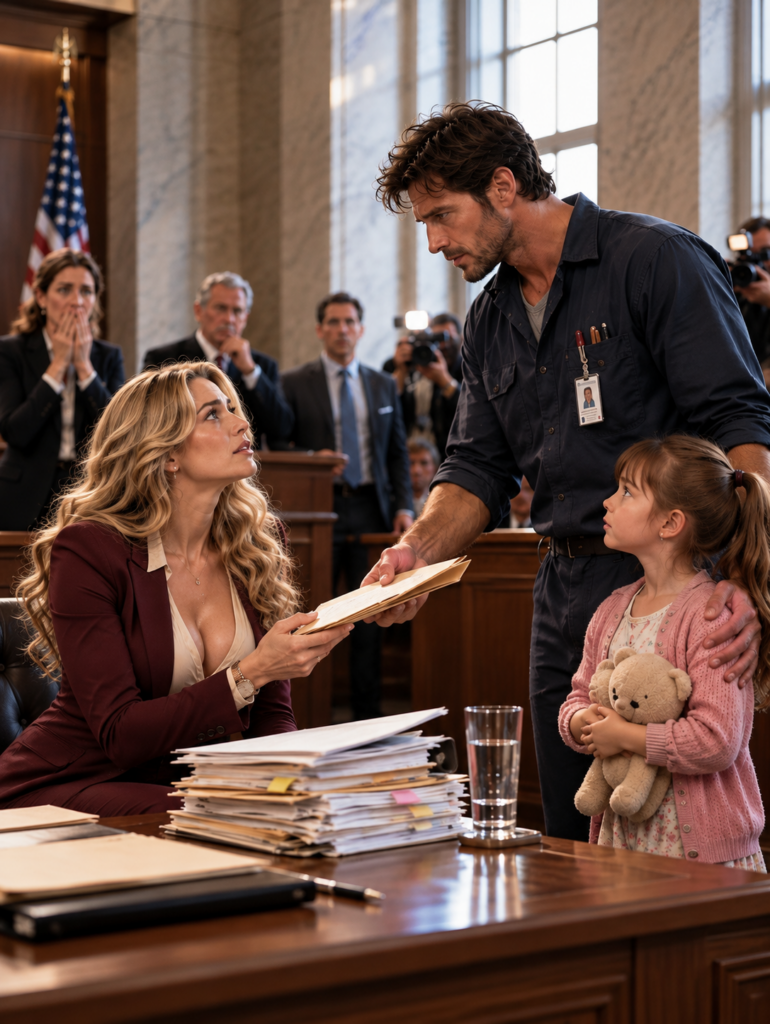
That was when Marcus arrived at the courtroom doors with the copied maintenance logs, accompanied by security and records staff.
He had not come to testify dramatically.
He had been asked to confirm one facilities detail for the records administrator.
The courtroom only happened to be in session when the final verification reached the judge.
The government attorney stood.
“Your Honor, the United States requests a recess.”
Judge Whitcomb looked toward defense counsel.
Martin Reeves said:
“We join the request.”
Evelyn stared.
“What happened?”
Martin leaned toward her.
“I think they found the reports.”
She stopped breathing.
The judge recessed proceedings for the day.
By evening, both sides had the recovered documents.
By Monday, the government amended several allegations and conceded that the earlier evidence-transfer timeline was unreliable.
The case did not disappear instantly.
There were still document-retention failures.
Still regulatory questions.
Still arguments about whether Brooks Biomedical’s internal controls met contractual obligations.
But intentional concealment became impossible to prove on the existing record.
Weeks later, the court approved a negotiated resolution focused on compliance remediation, reporting obligations, and civil penalties tied to actual process failures—not intentional safety fraud.
Brooks Biomedical kept its federal eligibility subject to oversight.
The company survived.
Barely.
The damage outside court was harder.
Contracts lost during the scandal did not automatically return.
One investor exited permanently.
A major hospital system demanded additional audit rights.
Banks raised questions.
Employee morale cratered.
Evelyn knew a favorable legal outcome could not rewind public suspicion.
The afternoon the government formally acknowledged the evidence-storage error, reporters crowded the courthouse steps.
Evelyn should have gone directly to the cameras.
Her communications director had prepared a statement.
Instead, she walked downstairs.
Past the public elevators.
Into the service corridor.
Marcus was replacing a trash liner near the vending machines.
He looked up.
Recognized her.
Not personally.
From television.
“Ms. Brooks.”
“You’re Marcus Hill.”
He glanced toward his cart.
“That’s me.”
Evelyn stopped.
For a moment, the CEO who had answered hostile questions for six weeks seemed unable to find a sentence.
Then:
“You saved my company.”
Marcus shook his head.
“No, ma’am.”
“You found the dates.”
“I found one date.”
“Then you kept looking.”
“I reported it.”
“That mattered.”
Marcus tied the trash bag.
“I wasn’t trying to help your company.”
“I know.”
Something in her expression softened.
“That’s why it mattered.”
He frowned.
“You protected something bigger than Brooks Biomedical.”
“I cleaned a conference room.”
Evelyn almost laughed.
“You noticed something that didn’t fit.”
Marcus shrugged.
“That’s the job.”
“No.”
She looked toward the courthouse hallway.
“That should be everybody’s job.”
He became uncomfortable.
Praise made him suspicious.
Evelyn understood and backed away from making the moment larger.
“Thank you.”
Marcus nodded.
“You’re welcome.”
Then:
“You should probably go upstairs.”
“Why?”
“Reporters.”
She smiled tiredly.
“You noticed those too?”
“Hard to miss.”
Outside, Evelyn faced cameras.
She did not claim complete vindication.
That was important.
“The recovered records confirm Brooks Biomedical did not intentionally conceal failed inspection reports.”
Then:
“They also reveal weaknesses in our own document systems.”
Several reporters looked surprised.
Evelyn continued.
“We were right about the missing evidence.”
“We were wrong to believe our internal controls were strong enough.”
“We will correct both.”
That statement became the first step in rebuilding trust.
Not celebration.
Accountability.
The story of Marcus leaked several days later.
A courthouse employee told someone.
Then a local reporter confirmed the maintenance-log discovery through public filings.
The headline:
COURTHOUSE CUSTODIAN’S MEMORY HELPED EXPOSE EVIDENCE TIMELINE ERROR.
Marcus hated the word hero.
He told Lily that night.
They were eating macaroni and cheese at their apartment.
“People keep calling.”
Lily’s eyes widened.
“News people?”
“Yes.”
“Are you famous?”
“No.”
“Are we rich?”
“Definitely no.”
She considered.
“Can I tell Mrs. Hall?”
“No.”
“Why?”
“Because I want to go to work tomorrow without people making it weird.”
Lily stared at him.
“They’re already making it weird.”
Fair.
A local television station requested an interview.
Marcus declined.
Then the courthouse administration asked whether he would participate in a short internal recognition event.
Declined.
Then Lily intervened.
“You always say doing the right thing isn’t about being noticed.”
“Yes.”
“Then let people notice this time.”
Marcus looked at her.
“That argument makes no sense.”
“It does.”
“How?”
“Because people notice celebrities for wearing dresses.”
Marcus tried not to laugh.
“So they can notice somebody for remembering a door was closed.”
Nine-year-old logic.
Strangely effective.
He agreed to one courthouse recognition ceremony.
Nothing national.
Nothing theatrical.
The chief judge thanked facilities staff generally.
Marcus specifically.
Elaine Porter from records received recognition too.
So did Joan Ramsey from security.
That mattered to Marcus.
The discovery had not been one man’s miracle.
He noticed.
Joan logged it.
Elaine verified it.
Records counsel escalated it.
Lawyers reviewed it.
Investigators found the misplaced documents.
Institutions work when people respect each link.
Marcus said exactly that when asked to speak.
“Small jobs can carry big consequences.”
He looked uncomfortable at the podium.
“But so can small mistakes.”
A few people smiled.
“The point isn’t that custodians should investigate legal cases.”
“That would be a terrible idea.”
Laughter.
“The point is if something looks wrong, tell the right person.”
He glanced toward Joan and Elaine.
“And if somebody whose job title seems unrelated tells you something looks wrong, don’t assume their title makes the observation unimportant.”
That quote traveled farther than Marcus expected.
Schools invited him to speak.
He declined most.
Accepted two after Lily insisted.
He never gave motivational speeches about courage.
He talked about maintenance.
Checklists.
Reporting.
Asking questions.
Why people should not hide mistakes.
One middle-school student asked:
“How do you remember dates so well?”
Marcus smiled.
“I don’t.”
“Then how did you remember that one?”
“My daughter started kindergarten.”
Lily sat in the front row.
Proud enough to embarrass him.
Brooks Biomedical recovered slowly.
Very slowly.
The court resolution required independent compliance monitoring for three years.
Evelyn welcomed it publicly.

Privately, she hated parts of it.
Extra cost.
External auditors.
Quarterly reporting.
Corrective-action deadlines.
Then she reminded herself that inconvenience was not the same as unfairness.
The company had gaps.
Real ones.
So Evelyn rebuilt.
First, document control.
Every inspection result would exist in a secure digital archive linked to product serial numbers.
Original documents scanned immediately.
Access logs.
Automatic backups.
No single department could remove or alter records without an audit trail.
Second, compliance independence.
Graham Voss resigned six months later.
Not as a scapegoat.
He accepted responsibility for weak systems.
His replacement reported functionally to the board audit committee, not only to Evelyn.
She disliked having a senior executive she could not fully control.
That was partly the point.
Third, internal reporting.
Evelyn created a process-integrity channel allowing employees at every level to report concerns directly to compliance or the board hotline.
Not only safety issues.
Process failures.
Records problems.
Unusual workarounds.
Data inconsistencies.
Near misses.
The first proposal called it the Marcus Hill Integrity Program.
Marcus refused.
Absolutely.
Evelyn called him.
First conversation after the courthouse.
“Why?”
“Because I don’t work there.”
“That’s not the issue.”
“It is for me.”
“Your observation changed the case.”
“A lot of people changed the case.”
“Marcus.”
“No.”
He was firm.
“I don’t want employees thinking integrity means becoming a hero.”
Evelyn went quiet.
“That is a good point.”
“It should mean doing your normal job carefully and speaking up when something doesn’t fit.”
The program was renamed:
Open Record.
Simple.
Boring.
Useful.
The first employee honored under it was an overnight cleaning supervisor named Janice Lee.
She reported that sterilization logs in one manufacturing area were being copied forward from prior shifts instead of entered fresh.
No patient harm occurred.
No scandal.
The practice stopped.
That was exactly the kind of outcome Evelyn wanted.
Catch small problems before they become courtroom problems.
The company still created an internal annual recognition for process integrity.
Not Marcus’s name.
His idea.
No hierarchy requirement.
The first recipient was Janice.
The second, a shipping clerk.
The third, a maintenance technician who noticed two pressure gauges with matching incorrect readings and suspected a calibration issue.
Evelyn attended every ceremony she could.
Not because awards fixed culture.
Because attention signals what leadership values.
Still, she learned not to over-celebrate whistleblowing while underfunding systems.
Recognition without protection is theater.
So Brooks Biomedical added anti-retaliation tracking.
Anonymous follow-up.
Independent review.
Training for supervisors on how to respond when employees report concerns.
And, most importantly, consequences when managers punished people for raising problems.
The company lost money during those years.
Not existentially.
Enough to matter.
Some federal contracts returned.
Others didn’t.
Several hospital networks demanded discounts.
Investors remained cautious.
Brooks Biomedical’s valuation recovered more slowly than competitors.
Evelyn stopped resenting that.
Trust is not owed because the worst accusation was wrong.
Her company had still allowed poor systems to create doubt.
Hospitals had been right to ask questions.
Patients deserved cautious buyers.
That humility changed how Evelyn led.
Marcus’s life did not transform financially.
That disappointed reporters looking for a better ending.
Evelyn offered nothing extravagant.
Correctly.
She asked whether the courthouse employee assistance fund could accept a donation from Brooks Biomedical.
The courthouse ethics office said yes under conditions because the donation would support employees broadly, not Marcus personally.
Brooks Biomedical made a modest contribution.
No giant check.
No press release.
Marcus found out months later.
He was annoyed for approximately five minutes.
Then learned the fund had helped a courthouse security officer after a house fire.
He stopped complaining.
His own promotion came separately.
The courthouse facilities director retired two years later.
Marcus applied for assistant facilities supervisor.
Normal process.
Interview panel.
Civil service requirements.
No Evelyn Brooks phone call.
He got the job.
Slightly higher salary.
Daytime schedule.
Fewer apartment-maintenance nights.
That changed more for Lily than national attention ever had.
He could attend school events.
Eat dinner before eight.
Help with homework while both were awake.
The first Wednesday after his schedule changed, Marcus made spaghetti.
Lily looked at the plate.
“You’re home.”
“That is generally required for cooking.”
“No.”
She smiled.
“You’re home-home.”
Marcus understood.
That was the reward he valued.
Not headlines.
Time.
Evelyn and Marcus did not become best friends.
They did not fall in love.
They did not begin having mysterious weekly dinners because fate required social categories to collapse theatrically.
They exchanged occasional messages.
Birthdays once they learned them.
Holiday cards.
A short note from Evelyn when Lily started middle school.
A photograph from Marcus when Lily won a science fair.
Their connection remained specific.
One extraordinary intersection.
Then respect.
Years later, Evelyn invited Marcus and Lily to tour Brooks Biomedical headquarters.
Not because Marcus needed corporate inspiration.
Because Lily, by thirteen, had become interested in engineering.
Marcus asked:
“Is this special treatment?”
Evelyn sighed.
“It’s a public family open house.”
“Then why invite us?”
“Because I thought she might like it.”
Lily attended.
So did eighty other children.
Good.
She spent forty minutes fascinated by a biomedical engineer explaining pressure sensors.
Evelyn watched from a distance.
Did not offer an internship.
Did not create a scholarship with Lily’s name.
Boundaries preserve dignity better than generosity without limits.
Lily eventually studied mechanical engineering.
Not biomedical.
Automotive systems.
Marcus blamed a school robotics club.
Evelyn sent a graduation card.
Inside:
Pay attention to the numbers people assume are correct.
Lily framed it.
Years passed.
Brooks Biomedical became stronger.
Not invulnerable.
No company is.
A manufacturing recall seven years later forced Evelyn to confront a different problem.
A supplier provided faulty pressure regulators used in several hundred devices.
This time, the company detected the issue internally.
Open Record report.
A line technician noticed a pattern.
The company stopped shipment.
Notified regulators.
Issued recall notices before injuries occurred.
Expensive.
Embarrassing.
Correct.
During the board meeting afterward, one director complained:
“We may be overreacting.”
Evelyn looked at him.
“Maybe.”
Then:
“But we will know we overreacted after we verify the facts.”
That sentence would have been impossible for her younger self.
Before the courthouse case, Evelyn associated good leadership with confidence.
Afterward, she associated it more with correction.
Being right matters.
Being correctable matters too.
Marcus’s philosophy evolved similarly.
He had always believed attention prevented mistakes.
Then he learned attention also meant accepting that mistakes happen.
The retiring records contractor who entered incorrect transfer dates, Harold Finch, became a controversial figure during the case.
News reports initially blamed him.
Marcus hated that.
Harold had made errors.
Serious ones.
But the system had required one exhausted employee to reconstruct hundreds of flood-damaged records manually without enough independent verification.
Evelyn agreed.
The failure was not one old man typing wrong dates.
It was a process that treated uncertainty as certainty.
Marcus later met Harold once.
At a courthouse records event.
Harold recognized him.
“You’re the guy.”
Marcus smiled awkwardly.
“Apparently.”
Harold looked ashamed.
“I almost ruined that woman’s company.”
Marcus shook his head.
“You made mistakes.”
“That’s not better.”
“No.”
Marcus did not lie.
“But people built a system where your mistake could become a fact without anybody checking the building records.”
Harold stared.
“That helped?”
“A little.”
“Good.”
Marcus understood something then.
Integrity is not assigning shame efficiently.
It is making truth easier to recover.
At sixty, Evelyn stepped down as CEO.
Brooks Biomedical employed nearly two thousand people by then.
Still focused on affordable clinical equipment.
Still privately controlled.
Still not the largest company in its sector.
Evelyn preferred it that way.
At her retirement ceremony, the communications team created a timeline.
Founding.
First federal contract.
Manufacturing expansion.
Product launches.
The regulatory crisis appeared too.
Evelyn insisted.
Her staff suggested omitting it.
“Why?”
“Celebration.”
“It happened.”
“But—”
“Then put it there.”
The slide read:
Year 15: Federal evidence dispute and compliance restructuring.
No heroic language.
No “darkest hour.”
Just truth.
After the event, Evelyn walked through headquarters alone.
Near the main entrance stood a bronze plaque installed years earlier.
Not large.
Not named for Marcus.
The wording came from something he said during one of his courthouse talks.
Integrity is often carried by the people no one expects to be watching.
Employees touched it occasionally before difficult meetings.
New hires asked what it meant.
The story evolved.
Some versions became ridiculous.
Marcus burst into court and stopped the judge from signing an order.
False.
Marcus discovered a secret conspiracy.
False.
Marcus personally searched government warehouses and found the missing reports.
Definitely false.
Evelyn corrected people when she heard it.
“He noticed a date.”
They often looked disappointed.
“That’s it?”
“That was enough.”
The simplicity bothered people.
We prefer dramatic causes for dramatic consequences.
But institutions are often changed by tiny details.
A wrong date.
A missing scan.
A breakroom complaint.
A maintenance log.
A person who asks:
Why doesn’t this match?
The bigger lesson was not that custodians secretly know everything.
They do not.
It was that expertise exists in places hierarchy does not always respect.
Marcus knew building access history because that was his work.
Elaine knew records procedure.
Joan knew security escalation.
Evelyn knew the company.
Government lawyers knew regulatory requirements.
The case changed because those kinds of knowledge eventually met.
Not because one person became extraordinary.
Marcus remained deeply ordinary.
He liked that.
When Lily graduated college, he sat in the audience beside his sister wearing a suit he bought for the occasion.
Evelyn attended only through a card.
Correct again.
Lily crossed the stage.
Mechanical engineering degree.
Marcus cried immediately.
His sister whispered:
“Your wife would be proud.”
“I know.”
Afterward Lily hugged him.
“Remember when you became famous?”
“No.”
“You absolutely became courthouse famous.”
“Temporary disease.”
She laughed.
“You know what I remember?”
“What?”
“You still went to work the next day.”
Marcus shrugged.
“What else was I supposed to do?”
Lily smiled.
“Exactly.”
Years later, she would tell her own children the story.
Not about the CEO.
Not first.
About her father.
“He cleaned a courthouse.”
“What did he find?”
“A mistake.”
“What did he do?”
“Told someone.”
“That’s all?”
Lily smiled.
“That’s usually how important things start.”
Marcus retired at sixty-four.
No national articles.
No bronze statue.
Courthouse employees held a small party in the same conference level where he once found the notebook.
Judge Whitcomb had retired years earlier.
Joan Ramsey came.
Elaine Porter came.
Several clerks.
Security officers.
New custodians Marcus had trained.
Evelyn sent a handwritten letter.
Marcus read it alone later.
It said:
You once told me you only found one wrong date.
I have thought about that sentence for twenty-six years.
Brooks Biomedical survived because one person respected a small fact enough not to dismiss it.
More importantly, we changed because the experience taught us not to wait for heroes.
We built systems where ordinary attention had somewhere to go.
Thank you for reminding me that truth becomes stronger when everyone is allowed to carry part of it.
Marcus folded the letter.
Put it inside the same worn leather notebook he had carried for decades.
The notebook did not contain secret evidence.
Mostly maintenance notes.
Phone numbers.
Lily’s school pickup times from years earlier.
Measurements.
A grocery list.
One page from the week of the Brooks case:
4C conference.
Lost spiral notebook → security.
Check east basement closure dates.
Nothing dramatic.
Just work.
Marcus smiled.
That was the story.
Not a janitor rescuing a billionaire.
Not fate.
Not some grand confrontation where the powerless man suddenly becomes the only person smarter than every attorney in the room.
Something more believable.
And, to Marcus, more important.
A company had weak internal controls.
The government had flawed evidence records.
A retired contractor had reconstructed dates incorrectly.
A flood had disrupted storage.
Lawyers built arguments using the best timeline available.
A custodian noticed one date did not match the building he knew.
Then the right people investigated.
Truth emerged because someone treated the inconsistency as worth reporting.
That was all.
That was enough.
Years after Evelyn retired, visitors still paused beside the plaque at Brooks Biomedical headquarters.
Some employees touched it before audit meetings.
Others ignored it.
Most had no idea who Marcus Hill was.
That would have pleased him.
The company’s orientation material told the story differently now.
Not:
A janitor saved us.
Instead:
A maintenance employee outside our company noticed a records inconsistency that exposed weaknesses in both the federal evidence chain and our own compliance systems.
The lesson:
Do not confuse confidence with certainty.
Do not confuse job title with relevance.
Do not confuse the absence of bad news with the presence of good systems.
And never punish the person who tells you something does not fit.
Evelyn approved that version personally before retirement.
Marcus never saw it.
He would have approved too.
On the last day of his courthouse career, he pushed an empty cleaning cart down the service hallway one final time.
Not because he still needed to.
Tradition.
Lily had taken the afternoon off to pick him up.
She waited near security.
Marcus checked the old conference-room corridor.
Light.
Door.
Vent.
Trash.
Everything ordinary.
Then he smiled.
For most of his life, he had believed maintenance meant keeping things from breaking.
He knew better now.
Things break.
Pipes.
Records.
Companies.
Families.
Trust.
Systems.
The work is noticing early enough that repair remains possible.
Sometimes the person who notices has a law degree.
Sometimes an engineering degree.
Sometimes a CEO title.
Sometimes none of those.
Sometimes truth arrives through a maintenance log carried by a widowed father who remembers a date because his daughter started kindergarten that week.
Marcus reached the lobby.
Lily stood.
“You ready?”
He looked back once.
Then forward.
“Yes.”
They walked outside together.
No cameras.
No applause.
No courtroom doors flying open.
Just an ordinary man finishing an ordinary job he had done carefully for decades.
And somewhere far away, inside a company that still made affordable equipment for rural hospitals, people continued using systems built partly because he once refused to ignore one small thing that did not make sense.
That was enough legacy for him.
The End.


