
PART 2
When I opened my eyes, I had no idea I was married.
I didn’t know seven bullets remained inside my body because removing them immediately would have caused more damage than leaving them where they were.
I didn’t know Isabella Rossi had spent two nights sleeping in a chair outside my room.
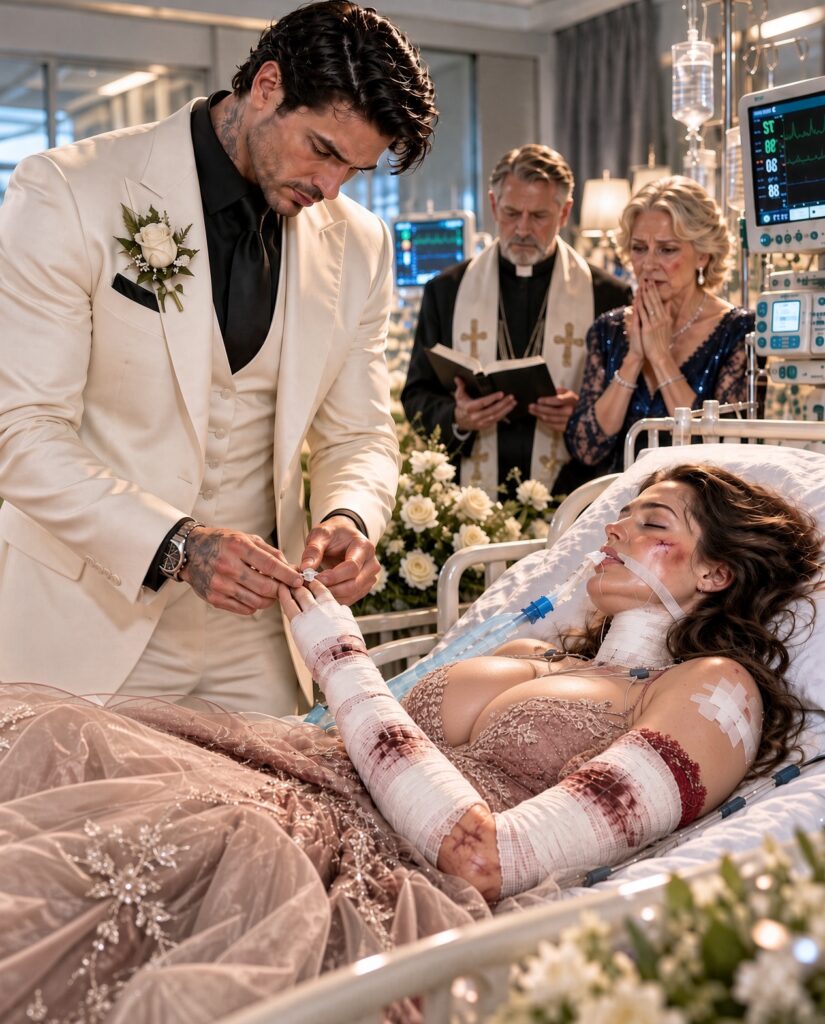
And I certainly didn’t know Dominic Rossi had stood beside my bed while a priest spoke words I couldn’t hear and slipped a gold ring onto my swollen finger.
The first thing I knew was pain.
Not sharp pain.
Something heavier.
It felt as though someone had replaced my entire body with wet concrete.
I tried to move my hand.
A machine began beeping.
“Easy.”
The voice was unfamiliar.
A nurse appeared beside me.
“You’re at St. Catherine Medical Center. You’re safe.”
My throat burned.
“Mom?”
The nurse leaned closer.
“What did you say?”
“My mother.”
“I’ll find out.”
I closed my eyes.
Then another memory surfaced.
Silver hair.
A champagne tray.
A gun.
“The lady…”
The nurse’s expression softened.
“Mrs. Rossi is fine.”
Relief moved through me before fear did.
I slept again.
When I woke the second time, sunlight was coming through the blinds.
And Dominic Rossi was sitting beside my bed.
Without the tuxedo, he looked different.
Less like the frightening stranger from the ballroom and more like a man who hadn’t slept in several days.
His white shirt was wrinkled.
His tie was gone.
A cup of untouched coffee sat beside him.
He stood immediately.
“Lily.”
I stared at him.
That was the first time he had said my name.
“How do you know my name?”
Something passed across his face.
Too quickly for me to understand.
“Your employee file.”
That answer sounded reasonable.
Later, I would realize it wasn’t.
“Your mother?”
“She’s completely fine.”
I closed my eyes.
“Good.”
When I opened them again, Dominic was still watching me.
“You saved her life.”
“I pushed someone.”
“You took seven bullets protecting someone you’d known for ten minutes.”
His voice changed slightly.
“That is not the same thing.”
I didn’t know what to say.
So I looked away.
That was when I noticed the ring.
Gold.
Simple.
Beautiful.
Wrong.
I lifted my hand slightly.
“What is this?”
Dominic went completely still.
I looked from the ring to him.
“Why am I wearing a wedding ring?”
Silence.
Then Dominic pulled the chair closer.
“There are things I need to explain.”
Every woman knows that sentence means nothing good follows.
“Take it off.”
“Lily—”
“Take it off.”
He didn’t touch me.
Instead, he reached toward the bedside table and pressed the call button.
The nurse came in.
Dominic said quietly, “She wants the ring removed.”
The nurse used soap and cool water because my fingers were still swollen.
The moment the ring slid free, Dominic took it.
He didn’t argue.
He didn’t put it back.
He simply closed his hand around it.
“What did you do?” I whispered.
He looked at me.
“I arranged a ceremony while you were unconscious.”
I stared at him.
“You married me?”
“Yes.”
“You can’t marry an unconscious person.”
“No.”
His answer surprised me.
“No?”
“The ceremony has no legal validity without your consent.”
I stared harder.
“Then why?”
Dominic looked toward the window.
“I believed attaching my name to yours would discourage anyone connected to Costa from approaching you.”
“You could have hired security.”
“I did.”
“You could have moved me.”
“I did that too.”
“You could have asked me when I woke up.”
His jaw tightened.
“Yes.”
That single word told me he already understood the problem.
“You made a decision about my life while I couldn’t speak.”
“Yes.”
“Don’t ever do that again.”
He met my eyes.
“I won’t.”
I expected excuses.
Instead, he said, “I was wrong.”
That stopped me.
Dominic Rossi did not look like a man accustomed to saying those words.
But I was too tired to care.
“Leave.”
He left.
No argument.
No warning.
He simply walked out.
Isabella arrived an hour later carrying flowers.
She didn’t pretend nothing had happened.
“My son is an idiot.”
I almost laughed, but my ribs objected.
Isabella sat carefully beside me.
“I told him protecting someone and deciding for someone are different things.”
“Did you know?”
“About the ceremony?”
“Yes.”
Her expression changed.
“I did.”
I looked away.
“I should have stopped him.”
“Yes.”
She nodded.
“You should have.”
There was something strangely comforting about people who didn’t defend themselves when they knew they’d been wrong.
Isabella reached into her purse.
“I also brought something else.”
She placed a phone on the table.
“Your mother.”
My heart jumped.
“She’s okay?”
“She knows you’re injured. She doesn’t know every detail because her doctors don’t want unnecessary stress.”
I picked up the phone with shaking fingers.
“Mom?”
“Lily?”
Hearing Ellen’s voice nearly broke something inside me.
“Oh, sweetheart.”
“I’m okay.”
“You don’t sound okay.”
“I’ve sounded worse after double shifts.”
She laughed and cried at the same time.
That was Mom.
Even from a treatment center hundreds of miles away, she could somehow make a hospital room feel like home.
Then she said something strange.
“Is Isabella there?”
I looked at Isabella.
“How do you know her name?”
Silence.
“Mom?”
Ellen cleared her throat.
“The hospital told me.”
But Isabella had gone pale.
I noticed.
So did she.
After the call ended, I asked, “You’ve met my mother?”
“No.”
The answer came quickly.
Too quickly.
I watched her.
“Then why did you react like that?”
Isabella looked toward the door.
“Because Ellen Carter is not an unfamiliar name to me.”
My heartbeat accelerated.
“Why?”
She hesitated.
Then she stood.
“Dominic needs to explain that.”
My anger returned immediately.
“Apparently Dominic needs to explain half my life.”
Isabella didn’t disagree.
Recovery came slowly.
Doctors told me I had been extraordinarily fortunate. Several bullets had passed through without striking anything immediately fatal. Others remained where surgery would currently create more risk than benefit.
There would be months of follow-up care.
Possibly future procedures.
I didn’t think about months.
I thought about rent.
Mom’s treatment.
The four hundred dollars I had never been paid.
My apartment.
My job.
Normal things.
Things I understood.
Three days later, Enzo entered carrying a laptop.
He was quieter than Dominic.
Maybe thirty-five.
Dark hair.
Calm eyes.
He placed the computer on the table.
“Your employer paid your wages.”
“All four hundred?”
“All four hundred.”
“Good.”
His mouth almost smiled.
“And Mr. Rossi has covered the medical expenses resulting from the incident.”
“No.”
Enzo blinked.
“No?”
“I have insurance.”
“You have a deductible larger than your savings.”
I stared at him.
“How do you know what my savings are?”
Enzo froze.
That was mistake number one.
I leaned forward despite the discomfort.
“You people know too much about me.”
“Lily—”
“How long have you had a file on me?”
Silence.
That was mistake number two.
“Before the gala?”
Enzo looked toward the door.
“Ask Dominic.”
I laughed without humor.
“Everyone keeps saying that.”
That evening Dominic came himself.
I didn’t ask about the fake marriage.
I asked the only question that mattered now.
“How long?”
He closed the door.
“Three weeks.”
My stomach dropped.
“You had a file on me three weeks before the gala?”
“Yes.”
“Why?”
Dominic took the chair but didn’t sit until I nodded.
“Because your mother contacted my family.”
I stared at him.
“My mother doesn’t know your family.”
“She knew my father.”
The room became strangely quiet.
Dominic continued.
“Twenty-seven years ago, your mother worked for Rossi Import Holdings.”
“My mother was a bookkeeper.”
“Yes.”
“In Cleveland.”
“Before Cleveland.”
I shook my head.
“No.”
Dominic removed a folded document from his jacket.
He placed it on the table.
It was an employment record.
ROSSI IMPORT HOLDINGS.
Employee: Ellen Carter.
I stared at the date.
Twenty-seven years earlier.
“She never told me.”
“I know.”
“Why did she contact you?”
Dominic’s expression became more complicated.
“Six weeks ago, your mother wrote to Isabella.”
“About what?”
“You.”
The word landed softly.
That somehow made it worse.
Dominic opened the folder.
Inside was a letter.
The handwriting belonged to my mother.
I recognized it instantly.
Dear Isabella,
I hoped I would never need to write this.
But my health has become uncertain, and Lily deserves to know the truth if I am no longer here to tell her myself.
I stopped reading.
My hands began trembling.
“What truth?”
Dominic looked at me.
“Your mother asked us to wait.”
“Wait for what?”
“For her to tell you herself.”
“Then why investigate me?”
“Because the letter mentioned my father.”
I stared at him.
“What does your father have to do with me?”
Dominic didn’t answer immediately.
And for the first time since meeting him, the powerful, controlled man in front of me looked genuinely uncertain.
“My father died eight years ago,” he finally said. “But before he died, he created a private trust.”
“What kind of trust?”
“One containing enough money to cover your mother’s medical care for the rest of her life.”
I stared at him.
“That doesn’t make sense.”
“No.”
Dominic’s eyes held mine.
“It didn’t make sense to me either.”
“So you investigated us.”
“Yes.”
“Did you think my mother was trying to steal money?”
“At first, I didn’t know what to think.”
The honesty hurt more than a polished answer would have.
“And now?”
“Now I think my father owed your mother something.”
“What?”
“I don’t know.”
I studied his face.
“You’re telling the truth?”
“Yes.”
“Everything?”
His pause was barely noticeable.
But I noticed it.
“No.”
I looked away.
“Leave.”
“Lily.”
“Until you can tell me everything, leave.”
He stood.
Before walking out, he placed my mother’s letter on the table.
“I won’t keep anything else from you.”
“You already did.”
“I know.”
Then he left.
The next morning, I called Mom.
This time I didn’t pretend.
“Tell me about Rossi Import Holdings.”
Silence.
Then Mom sighed.
“So they told you.”
“Not enough.”
“Lily…”
“Please.”
My mother’s voice became tired.
“I worked there when I was twenty-two.”
“For Dominic’s father?”
“For Antonio Rossi.”
“What happened?”
“He helped me during a very difficult year.”
“How?”
Another silence.
“He gave me work when nobody else would.”
“That doesn’t explain a trust.”
“No.”
“Mom.”
“I made him a promise.”
“What promise?”
“That I wouldn’t tell you until I was certain the truth would help you rather than burden you.”
My frustration rose.
“I’m twenty-six.”
“I know.”
“I’m lying in a hospital because I saved Isabella Rossi, and somehow the family I saved already had a file on me.”
Mom began crying quietly.
Immediately my anger softened.
“Mom.”
“I wanted you to have an ordinary life.”
“I did.”
“That was the point.”
Something about those words chilled me.
“What happened twenty-seven years ago?”
She took a breath.
“Ask Isabella about the photograph.”
“What photograph?”
“She’ll know.”
The call ended shortly afterward because Mom needed treatment.
I waited.
Isabella arrived that afternoon.
I repeated Mom’s words.
Her expression changed immediately.
Without speaking, she opened her handbag.
From an inside pocket, she removed an old photograph.
Four people stood outside a warehouse.
A much younger Isabella.
Antonio Rossi.
My mother.
And a fourth person.
A young man.
Tall.
Fair-haired.
Smiling.
I took the photograph.
“Who is he?”
Isabella sat beside me.
“His name was Daniel Carter.”
My breath caught.
“My father.”
“Yes.”
I had grown up believing my father died before I was born.
Mom rarely discussed him.
I studied the photograph.
“He worked for your family?”
“He was Antonio’s closest friend.”
I looked at Isabella.
“Then why has nobody ever told me?”
“Because Daniel didn’t die before you were born.”
The room seemed to tilt.
“What?”
Isabella’s eyes filled with sadness.
“He lived long enough to hold you.”
My fingers tightened around the photograph.
“My mother lied?”
“She protected a promise.”
“From what?”
Isabella shook her head.
“That part belongs to Ellen.”
I looked down again.
Then I noticed something written on the back.
Four words.
For Lily, when ready.
Below them was a date.
My first birthday.
But my father had supposedly been dead for nearly two years by then.
I looked at Isabella.
“Who wrote this?”
“Daniel.”
I could barely breathe.
Then Isabella reached into her bag again.
“There is one more thing.”
She placed a small brass key in my palm.
“Daniel gave this to Antonio twenty-five years ago.”
“What does it open?”
“We didn’t know.”
“Didn’t?”
Isabella looked toward the door.
“Enzo found out this morning.”
I waited.
“A safe-deposit box in Cleveland.”
My heart began pounding.
“What’s inside?”
“No one knows.”
“Who owns it?”
Isabella swallowed.
“You do.”
And suddenly the mystery was no longer why Dominic Rossi had investigated me.
It was why my father had left something waiting for me for twenty-five years—and why my mother had spent my entire life making sure I never knew it existed.
PART 3
I didn’t go to Cleveland immediately.
For the first time in my life, I chose patience.
Maybe nearly dying teaches you that some answers deserve to be approached carefully.
Or maybe I was simply tired of other people deciding when I should know my own history.
Two weeks passed before doctors allowed me to leave New York.
During that time, Dominic kept his distance.
Not completely.
Flowers appeared once.
No card.
I knew they were from him because Isabella rolled her eyes when she saw them.
“He spent twenty minutes choosing those.”
“They’re flowers.”
“Exactly.”
I almost smiled.
Dominic never entered my room unless I invited him.
He stopped asking about security arrangements and instead gave me choices.
“This apartment is available if you’d prefer privacy.”
“This rehabilitation center has excellent specialists.”
“Enzo can drive you, or I can arrange someone else.”
Each time, the final decision remained mine.
It didn’t erase what he’d done.
But I noticed.
One afternoon I found him outside my room speaking quietly with my doctor.
When he saw me watching, he immediately stepped away.
“Sorry.”
“For what?”
“I should have asked whether you wanted me involved.”
That was new.
I studied him.
“You’re learning.”
“Slowly.”
“Very slowly.”
A faint smile appeared.
It changed his whole face.
Then I remembered the ring.
And the file.
And everything he still hadn’t explained.
The smile disappeared from mine.
Dominic understood.
He didn’t push.
When I finally traveled to Cleveland, Isabella came with me.
Dominic didn’t.
That surprised me.
“He wanted to,” Isabella explained.
“Why didn’t he?”
“Because you didn’t ask.”
Something inside me shifted.
Mom looked smaller when I saw her.
That frightened me more than anything.
Ellen Carter had raised me alone while working two jobs.
She could repair a leaking faucet, stretch twenty dollars across five dinners, and convince a frightened six-year-old that thunder was just clouds moving furniture.
Seeing her beneath a hospital blanket made the world feel unfairly fragile.
I hugged her carefully.
“You look terrible,” she whispered.
“So do you.”
She laughed.
Then we both cried.
Isabella waited outside.
For nearly an hour, Mom and I talked about everything except Daniel Carter.
Finally, I placed the photograph between us.
Mom touched my father’s face.
Her expression softened.
“I loved him very much.”
“Why did you tell me he died before I was born?”
“Because I thought a clean grief would hurt less than a complicated one.”
“What happened?”
Mom stared toward the window.
“Your father was a good man who made one terrible decision.”
I waited.
“He worked with Antonio Rossi when they were young. Their business wasn’t what it became later. They imported restaurant equipment, specialty foods, wine, textiles.”
“Normal things?”
“Mostly.”
That word mattered.
“Mostly?”
Mom sighed.
“Daniel discovered one of their partners was using shipments to hide financial fraud. He wanted to report it.”
“Antonio?”
“No. Antonio supported him.”
That surprised me.
“Then what happened?”
“The partner threatened to destroy the company and everyone connected to it. Daniel became frightened that you and I would be dragged into years of legal trouble.”
“So he disappeared?”
“No.”
Mom’s eyes filled.
“He cooperated with investigators.”
I slowly understood.
“That’s why we left New York.”
“Yes.”
“Witness protection?”
“Nothing so dramatic. We simply relocated privately while the investigation continued.”
“And Dad?”
“He stayed behind.”
I looked at the photograph.
“He visited?”
“Once.”
“When I was one?”
Mom nodded.
“He came to Cleveland for your birthday.”
My throat tightened.
“What was he like with me?”
Mom smiled through tears.
“Terrified.”
I laughed softly.
“He held you like you were made of glass. You pulled his hair.”
“Good.”
“He deserved it.”
We laughed together.
It felt strangely healing.
“How did he die?”
“A car accident when you were almost two.”
No conspiracy.
No hidden enemy.
No sensational secret.
Just rain, a highway, and terrible luck.
Some truths hurt precisely because nobody can be blamed for them.
“Why didn’t you tell me?”
“Because after he died, I wanted the past buried.”
Mom reached for my hand.
“Antonio offered money. I refused. He created the trust anyway.”
“For me?”
“For both of us.”
“Why?”
“Because Daniel had helped save his company and his reputation. Antonio considered him family.”
I thought about Dominic.
“Then why did you contact Isabella now?”
Mom looked embarrassed.
“My medical bills.”
My chest tightened.
“I couldn’t keep watching you destroy your life paying them.”
“I wasn’t destroying anything.”
“You worked sixty hours a week.”
“You raised me.”
“That doesn’t mean you owe me your future.”
That sentence silenced me.
Mom touched my hand.
“I finally wrote Isabella because I wanted to accept what Antonio left. Not for myself.”
“For me?”
“For you to stop being afraid of every bill.”
The next morning we went to the bank.
The safe-deposit box was surprisingly small.
Inside were three envelopes.
A watch.
A photograph.
And a letter addressed:
Lily Carter — when she is old enough to understand that adults sometimes make imperfect choices for loving reasons.
I opened it.
The handwriting matched the back of the photograph.
My father.
Dear Lily,
If you’re reading this, I probably didn’t get the chance to explain myself.
That possibility frightens me.
Not because I need you to think I was brave.
I wasn’t always.
Not because I need forgiveness.
You owe me nothing.
I only want you to know that leaving you and your mother temporarily was the hardest choice I ever made.
Your mother wanted honesty.
I wanted safety.
Antonio wanted justice.
We argued about all three.
Eventually, we learned that sometimes people can love one another deeply and still disagree about what love requires.
Remember that.
Do not confuse protection with control.
Do not confuse sacrifice with silence.
And never let someone tell you they made a decision for you because they loved you unless they are also willing to admit that love doesn’t erase your right to choose.
I stopped reading.
Dominic.
The irony was impossible to miss.
My father had written those words twenty-five years before Dominic put a ring on my unconscious hand.
Mom saw it too.
“Oh,” she whispered.
Isabella covered her mouth.
I continued.
Antonio has promised to establish something for you. Your mother will probably refuse it because she is stubborn.
“Accurate,” I muttered.
Mom laughed through tears.
But if someday you need it, accept without shame.
It isn’t payment.
It’s gratitude.
And gratitude should never become a chain.
The letter ended simply.
Be kinder than I was.
Be braver than I was.
And choose your own life.
Love,
Dad
For a long time, nobody spoke.
Then Isabella said quietly, “Dominic needs to read that.”
“No.”
She looked at me.
I folded the letter.
“He needs to hear it from me.”
I returned to New York three days later.
Dominic was waiting in Isabella’s library.
I handed him the letter.
He read it twice.
Then he placed it carefully on the table.
“My father knew Daniel.”
“Yes.”
“He never told me.”
“Apparently our parents were very talented at secrets.”
Dominic almost smiled.
Then I asked, “Why did you really marry me?”
His expression became serious.
“I told you.”
“You told me part.”
He looked down.
Finally, he reached into his jacket.
The gold ring.
He placed it between us.
“This belonged to my grandmother.”
I stared.
“So it wasn’t some convenient ring.”
“No.”
“Why that one?”
Dominic sat across from me.
“Because three weeks before the gala, when Enzo brought me your file, there was a photograph attached.”
“What photograph?”
“You leaving the Cleveland treatment center with your mother.”
“That doesn’t explain anything.”
“No.”
His voice softened.
“I recognized you.”
“From where?”
“Your father’s photograph.”
I frowned.
Then Dominic retrieved something from a drawer.
Another photograph.
Antonio Rossi and Daniel Carter standing together.
Behind them, almost hidden, was a little girl sitting on Antonio’s shoulders.
Isabella.
Dominic pointed to Daniel.
“My father kept this on his desk.”
“So?”
“Daniel was family history in our house. The friend my father lost.”
He looked at me.
“When I discovered you were his daughter, you stopped being a stranger.”
My anger softened slightly.
But only slightly.
“That still doesn’t explain the ring.”
“No.”
Dominic took a breath.
“When I saw you protecting my mother, I panicked.”
“Dominic Rossi panics?”
“Apparently.”
I waited.
“I spent most of my adult life believing responsibility meant control. If something mattered, I handled it. If someone needed protection, I decided how.”
His eyes dropped to the ring.
“That night, I convinced myself marrying you was protection.”
“And?”
“And underneath that excuse was something less noble.”
“What?”
“I didn’t want you to disappear.”
The room became very quiet.
“You didn’t even know me.”
“I knew enough to want the opportunity.”
I stared at him.
“That is possibly the worst proposal I’ve ever heard.”
His mouth twitched.
“It wasn’t a proposal.”
“No. Proposals generally involve the woman being awake.”
He laughed.
Actually laughed.
I had never heard that sound from him.
Then he became serious again.
“I am sorry.”
“I know.”
“I don’t expect forgiveness.”
“I know that too.”
I picked up the ring.
It was beautiful.
Old gold.
Tiny engraving inside.
I turned it toward the light.
“What does this say?”
Dominic answered.
“Scegli ogni giorno.”
Italian.
“What does it mean?”
“Choose every day.”
I looked at him.
His grandmother’s wedding ring carried those words.
Choose every day.
I placed it back on the table.
“Then that’s what I’m going to do.”
His face changed.
“What?”
“Choose.”
I stood carefully.
“Today I’m choosing not to marry you.”
Dominic nodded.
“Fair.”
“I’m choosing to keep recovering.”
“Yes.”
“I’m choosing to accept the trust my father left.”
“Good.”
“And I’m choosing dinner.”
He blinked.
“With you.”
Dominic stared at me.
“Dinner?”
“One dinner.”
A smile slowly appeared.
“No bodyguards at the table.”
“Agreed.”
“No investigating me.”
“Agreed.”
“No deciding what I eat.”
His eyebrow lifted.
“Lily.”
“Dominic.”
“Fine.”
“And absolutely no priests.”
He laughed again.
“Agreed.”
Dinner became another dinner.
Then coffee.
Then walks during physical therapy.
We learned ordinary things about each other.
Dominic hated olives.
I hated jazz.
He read history books before sleeping.
I watched terrible cooking competitions.
He had been thirteen when his father first taught him chess.
I had been twelve when Mom taught me how to change a tire.
Our relationship didn’t transform overnight.
It grew awkwardly.
Honestly.
Sometimes painfully.
And something else changed too.
Dominic began changing his own life.
Several businesses he’d inherited had operated through traditions he no longer wanted.
He began restructuring them.
Closing questionable partnerships.
Hiring outside compliance teams.
Moving the Rossi organization toward legitimate investments.
It wasn’t because I demanded it.
I never did.
One evening he told me why.
“My father spent years trying to clean up the mistakes of his generation.”
“And you?”
“I don’t want someone I love wondering which version of me is coming home.”
I looked at him.
“Someone you love?”
Dominic went still.
“Yes.”
Neither of us spoke for a while.
Three months after the gala, Mom’s doctors approved a new treatment funded through the trust.
Her condition stabilized.
I began walking without assistance.
And Isabella became something between an aunt and an extremely opinionated second mother.
Then Enzo arrived one afternoon carrying another envelope.
“What now?” I asked.
He smiled.
“Something good, hopefully.”
The envelope had been discovered among Antonio Rossi’s estate papers.
It was addressed jointly.
To Dominic Rossi and Lily Carter.
Dominic opened it.
Inside was a legal document.
Not money.
Not property.
A deed.
To a small building in Brooklyn.
Dominic frowned.
“I’ve never seen this.”
Attached was a note written by Antonio.
Daniel and I bought this place when we were twenty-three.
We once planned to turn it into a neighborhood restaurant.
Life happened instead.
If someday our families find each other again, I hope this building becomes something better than another secret.
I looked at Dominic.
He looked at me.
“A restaurant?” he asked.
“I can’t cook.”
“Neither can I.”
From the doorway Isabella said, “Thank God.”
We laughed.
But beneath the deed was one final page.
A handwritten list of names.
Daniel Carter.
Antonio Rossi.
Ellen Carter.
Isabella Rossi.
And beside each name was an amount of money.
At the bottom, Antonio had written:
This was never meant for us.
It was meant for the families who helped us survive our hardest years.
I stared at the page.
“What families?”
Isabella looked at the list.
Then she began crying.
Not from fear.
Recognition.
“I know these names,” she whispered.
“Who are they?”
She touched one.
“Employees from the original warehouse.”
Another.
“A widow Antonio helped.”
Another.
“A family Daniel supported.”
Dominic looked at me.
The abandoned Brooklyn building wasn’t an inheritance.
It was an unfinished promise.
And suddenly I understood that the past hadn’t returned merely to tell us who our parents had been.
It had returned to ask us what kind of people we wanted to become.
PART 4 (The End)
We didn’t build a restaurant.
At least not exactly.
Six months later, the old Brooklyn building reopened as The Carter-Rossi House.
The ground floor contained a neighborhood café.
Upstairs were offices for a nonprofit that helped hospitality workers facing medical emergencies, temporary housing problems, or sudden family crises.
The idea came from me.
The money came partly from the old trust.
The building came from our fathers.
The name came from Isabella.
And Dominic complained about it for approximately three days.
“Carter should come second,” he said.
“Why?”
“Alphabetically.”
“That isn’t how the alphabet works.”
“I know.”
“So?”
“I wanted to see whether you’d argue.”
“I always argue.”
“I know.”
He smiled.
That became our rhythm.
The first person we helped was a dishwasher whose wife needed surgery.
The second was a hotel housekeeper who needed temporary childcare while her husband recovered from an accident.
Then came a waitress who reminded me painfully of myself.
Twenty-four.
Exhausted.
Three jobs.
A mother receiving treatment.
When I approved her emergency grant, I sat alone in my office afterward and cried.
Dominic found me.
He didn’t ask why.
He simply sat beside me.
That was another thing he’d learned.
Not every problem needed fixing.
Sometimes love meant sitting quietly beside someone until they were ready to stand.
Mom moved back to New York the following spring.
Her treatment had worked better than doctors initially expected.
She wasn’t cured.
Life rarely gives gifts that simple.
But she was stronger.
Stable.
Laughing more.
Worrying less.
She moved into a small apartment three blocks from Carter-Rossi House and immediately became everyone’s unofficial financial adviser.
“You spent how much on coffee beans?” she demanded during our first monthly meeting.
Dominic looked genuinely nervous.
I enjoyed every second.
“They’re premium beans.”
“They’re beans.”
“They’re ethically sourced.”
“They better come with retirement benefits.”
Isabella nearly fell out of her chair laughing.
Mom and Isabella became friends.
That surprised me most.
Two women who had carried the same history differently for twenty-five years somehow found forgiveness easier than the rest of us.
One afternoon I overheard them in the kitchen.
“I should have called you after Daniel died,” Isabella said.
“You were grieving Antonio’s problems too.”
“I still should have.”
Mom was quiet.
Then she said, “We were young.”
“That isn’t an excuse.”
“No.”
Another pause.
“But sometimes understanding isn’t the same thing as excusing.”
I never forgot that sentence.
It helped me understand Dominic.
Forgiveness wasn’t pretending something hadn’t happened.
It wasn’t rewriting the past.
It wasn’t surrender.
Sometimes forgiveness was simply deciding the past would no longer make every decision about the future.
My relationship with Dominic grew slowly.
Painfully slowly, according to Isabella.
“I’m getting older,” she complained.
“You’re sixty-one.”
“Exactly. Practically ancient.”
Dominic sighed.
“Mother.”
“What?”
“You’re pressuring Lily.”
“No. I’m pressuring you.”
I laughed.
By then, a year had passed since the gala.
I still wore no ring.
Dominic never mentioned marriage.
Not once.
That mattered.
He had learned that wanting something did not give him the right to rush it.
Instead, he showed up.
When I had another surgery to remove two of the remaining bullets, he sat in the waiting room.
When I woke, he wasn’t beside my bed.
Isabella was.
I looked around.
“Where’s Dominic?”
“He said you should decide whether you wanted him here.”
I smiled.
“Tell him to come in.”
He appeared thirty seconds later.
“You were standing outside?”
“Yes.”
“For how long?”
“Three hours.”
“You’re ridiculous.”
“Probably.”
I held out my hand.
He took it.
That was all.
Months later, during physical therapy, I ran for the first time.
Not far.
Maybe thirty yards.
But after everything my body had survived, those thirty yards felt like crossing a continent.
Dominic waited at the end.
I reached him breathless.
“I did it.”
“You did.”
Then he kissed my forehead.
No dramatic speech.
No crowd.
Just pride.
My pride.
His happiness for me.
That evening, Mom gave me another letter.
“I found this inside Daniel’s old Bible.”
I opened it.
There were only three paragraphs.
Most were about ordinary things.
He hoped I would love books.
He hoped I inherited Mom’s patience rather than his.
I hadn’t.
But the final paragraph stayed with me.
Someday, Lily, you may meet someone who makes you feel safe.
That is good.
But I hope you meet someone who also makes you feel free.
The best love isn’t a shelter you cannot leave.
It is a door you can walk through in either direction, knowing you will still be respected.
I read it twice.
Then I went looking for Dominic.
I found him at Carter-Rossi House helping Enzo assemble a bookshelf.
Helping was generous.
Enzo was assembling it.
Dominic was holding instructions upside down.
“What are you doing?”
Dominic looked at the paper.
“Apparently failing.”
Enzo stood.
“I’m leaving.”
“Coward,” Dominic said.
“Survivor.”
After Enzo disappeared, I sat beside Dominic.
“Do you still have your grandmother’s ring?”
His entire body became still.
“Yes.”
“Where?”
“Safe.”
“Can I see it?”
He stared at me for several seconds.
Then he walked upstairs.
When he returned, he carried the same small velvet box.
He placed it in my palm.
I opened it.
Gold.
Simple.
Choose every day.
I looked at him.
“Ask me.”
Dominic didn’t move.
“What?”
“You heard me.”
“Lily.”
“Dominic.”
He looked genuinely frightened.
That amused me.
The feared Dominic Rossi, terrified of one waitress.
Finally he lowered himself onto one knee.
I immediately shook my head.
“No.”
He froze.
I smiled.
“Stand up.”
Confusion crossed his face.
“I’m not marrying someone who’s kneeling like he’s asking permission to exist.”
He stood.
I took both his hands.
“Try again.”
Dominic looked at me.
No performance.
No audience.
No assumption.
“Lily Carter, will you marry me?”
I let him wait three seconds.
Possibly four.
He deserved at least that.
“Yes.”
His eyes closed briefly.
Then he laughed.
“That’s it?”
“What were you expecting?”
“I don’t know.”
“Seven bullets and an unconscious wedding weren’t dramatic enough?”
“Fair point.”
He slid the ring onto my finger.
This time I was awake.
This time I was standing.
This time I chose it.
And that made everything different.
We married four months later.
Small ceremony.
Forty guests.
No ballroom.
No politicians.
No extravagant security.
Just family.
Friends.
People from Carter-Rossi House.
Mom walked me down the aisle.
Halfway there, she whispered, “Your father would have loved this.”
I squeezed her hand.
“I think he’s here.”
Not literally.
But in the choices that brought us there.
Antonio too.
Two complicated men whose friendship had survived mistakes, fear, distance, and death.
Isabella cried before the ceremony even started.
Enzo handed her tissues.
“I haven’t begun,” she warned him.
“I brought three boxes.”
When I reached Dominic, he smiled.
Not the controlled half-smile I’d first seen at the gala.
Something warmer.
Human.
Our vows were simple.
Dominic went first.
“I spent most of my life believing love meant protecting what mattered.”
He looked at me.
“You taught me something better.”
His voice became quieter.
“Love means protecting someone’s right to choose—even when you’re afraid of what they might choose.”
My eyes filled.
“I can’t promise I’ll never make mistakes.”
“Good,” I whispered.
Several guests laughed.
Dominic smiled.
“But I promise I will never again confuse loving you with owning your decisions.”
Then it was my turn.
“I spent most of my life believing strength meant handling everything alone.”
I glanced at Mom.
She was crying.
“So I learned something too.”
I looked back at Dominic.
“Accepting help doesn’t make me weak.”
I squeezed his hands.
“Trusting someone doesn’t mean surrendering myself.”
Then I smiled.
“And forgiveness isn’t forgetting.”
Dominic nodded.
“No.”
“It means believing people can become better than the worst choice they’ve made.”
We exchanged rings.
The priest pronounced us husband and wife.
And somewhere behind us Isabella whispered loudly enough for everyone to hear:
“Finally.”
The room erupted in laughter.
Three years later, Carter-Rossi House had expanded into four locations.
The original Brooklyn building remained my favorite.
We preserved the brick walls.
Antonio and Daniel’s photograph hung beside the entrance.
Underneath was a small plaque:
GRATITUDE SHOULD NEVER BECOME A CHAIN.
We never explained the entire story.
We didn’t need to.
Mom volunteered twice a week.
Isabella volunteered whenever she felt like ordering everyone around.
Enzo eventually became executive director.
He claimed it was the only legal way to escape Dominic.
And Dominic?
He changed.
Not completely.
People don’t become different humans because love enters their lives.
Real change is slower.
He still liked control.
He still planned everything.
He still checked restaurant reservations three times.
But now he asked.
“Do you want advice?”
“Would you like me there?”
“Is this my decision?”
Sometimes I answered yes.
Sometimes no.
And he respected both.
One rainy November evening, I was closing the café when a young waitress approached my office.
Her name was Maria.
She had recently received one of our emergency grants.
“I wanted to thank you.”
“You don’t owe us thanks.”
“Yes, I do.”
“No.”
I smiled.
“You owe somebody else kindness someday.”
She looked confused.
I pointed toward the plaque.
“That is how this works.”
After she left, I found Dominic standing near the window.
“You stole that from your father.”
“I improved it.”
“Of course.”
He slipped his hand into mine.
Outside, Brooklyn glowed beneath rain.
“Ready to go home?” he asked.
Home.
For years, that word had meant whatever apartment I could afford.
Then it meant Mom.
Then survival.
Now it meant something larger.
Not Dominic’s house.
Not money.
Not protection.
Home was the life we’d deliberately built.
“Yes.”
We stepped outside.
Halfway to the car, Dominic stopped.
“What?”
He pointed toward my hand.
The ring was catching the streetlight.
“Do you ever think about the first one?”
“The fake wedding?”
He winced.
“I wouldn’t phrase it that way.”
“I would.”
He laughed.
Then I became serious.
“Sometimes.”
“Do you regret meeting me?”
I looked at him.
“No.”
His shoulders relaxed.
“But?”
“I regret what happened.”
“So do I.”
“I regret that you thought protecting me gave you permission to choose for me.”
“I know.”
“But I don’t regret what came afterward.”
He squeezed my hand.
Neither of us spoke.
Then I remembered something.
“Seven.”
Dominic frowned.
“What?”
“Seven bullets were still inside me when you married me the first time.”
He groaned.
“Are we really doing this?”
“Yes.”
“Lily.”
“And now?”
“Two.”
“Exactly.”
Five had eventually been safely removed.
Two remained where doctors expected they would stay permanently.
I had once hated knowing they were there.
Now I rarely thought about them.
They weren’t symbols of heroism.
They weren’t proof that fate had chosen me.
They were simply part of a body that had survived.
Like scars.
Like memories.
Like mistakes.
Not everything from the past has to disappear before life can become beautiful again.
Sometimes healing means learning that what remains doesn’t control you.
Dominic opened the car door.
Before I climbed inside, I looked back at Carter-Rossi House.
Warm light filled its windows.
Inside, employees were laughing as they finished closing.
A photograph of two young friends hung near the entrance.
Two men who had made mistakes.
Two families who had kept secrets.
And somehow, decades later, something good had grown from all of it.
I thought about my father’s final advice.
Choose your own life.
So I had.
I chose to forgive Mom for hiding a complicated truth until she believed I was ready.
I chose to accept Antonio’s gift without allowing money to define me.
I chose to forgive Isabella for helping Dominic make one terrible decision during the worst night of my life.
And eventually, I chose Dominic.
Not because he saved me.
He didn’t.
Doctors saved me.
Nurses saved me.
My own stubborn body saved me.
I chose Dominic because after making a decision for me once, he spent years proving he understood why he never should have.
He learned.
He changed.
He waited.
And when the moment finally came, he asked.
That was the difference between the first ring and the second.
The first was placed on my finger while I couldn’t answer.
The second remained inside a velvet box until I said yes.
Dominic climbed into the car beside me.
“Home?”
I smiled.
“Home.”
He reached for my hand.
And as New York moved beyond the rain-streaked windows, I looked at the gold ring on my finger and finally understood the words engraved inside it.
Choose every day.
Not once.
Not because of fear.
Not because someone else believes they know what’s best.
Every day.
That was how my parents had eventually learned to love me.
That was how Dominic learned to love me.
And that was how I learned to love myself.
By choosing.
Again.
And again.
And again.


