
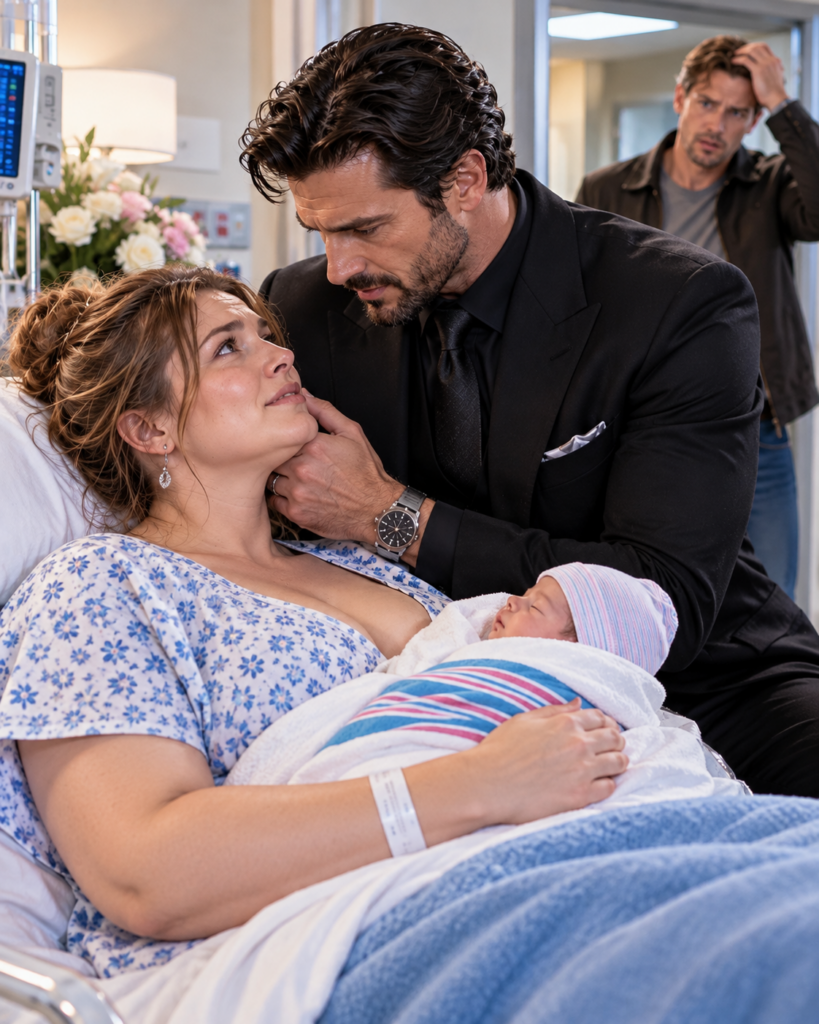
Seven weeks pregnant, Iris came to the Moretti mansion carrying a resignation letter and nowhere else to go.
The married man who fathered her baby had ordered her to disappear—and threatened her with Dante Moretti’s name.
But when the most feared man in New York learned what had happened beneath his roof, he did not fire the maid; he summoned the father.

PART 1 — THE RESIGNATION LETTER IN HER POCKET
The scent of lemon polish clung to Iris Bennett’s fingers as she worked a soft cloth across the grand piano.
Three hours into her morning shift, her lower back ached with the dull persistence she had felt for two weeks. She pressed one hand discreetly against it, careful not to let the other employees see.
The Moretti mansion covered twelve thousand square feet of calculated intimidation. Crystal chandeliers scattered morning light across Renaissance paintings, while black marble reflected Iris in her gray uniform—a pale, tired twenty-one-year-old moving through rooms she would never own.
For fourteen months, she had been invisible there.
That invisibility once made her feel safe.
Now a resignation letter burned inside her apron pocket.
She had written it before dawn, after another night spent hearing Leo Marchetti’s threat.
Disappear before Dante finds out.
Leo managed the Moretti organization’s accounts. For six months, he had pursued Iris with careful smiles and whispered promises. She believed him because loneliness made tenderness persuasive.
Then she showed him the pregnancy test.
Two pink lines.
Leo looked at it with disgust.
“You can’t be serious.”
“I’m seven weeks.”
“We were careful.”
“Not careful enough.”
He turned away. “There’s nothing to discuss.”
“The baby is yours.”
“I’m married, Iris. My wife is pregnant too.”
The revelation made the room tilt.
“You never told me.”
“You never asked.”
When Iris demanded that he acknowledge the child, Leo laughed.
“What did you think this was? A fairy tale where the accountant marries the maid?”
Then he used Dante’s name.
He warned her that their employer had strict ideas about loyalty and honor. If Dante discovered a servant had caused a scandal beneath his roof, Iris might lose more than her position.
So she wrote the letter.
She intended to leave it in Dante’s study and vanish before anyone asked questions.
Iris raised her hand toward the carved study door.
It opened before she knocked.
Dante Moretti stood in the threshold.
He was tall, broad-shouldered, and dressed in a white shirt with the sleeves rolled over powerful forearms. Silver threaded the dark hair at his temples, while his nearly black eyes seemed to absorb the light around him.
The city told stories about those eyes.
Iris lowered her gaze. “I came to clean the study.”
“You’ve been crying.”
It was not a question.
“I’m sorry.”
“For some time, apparently.”
She stepped backward, but he placed one hand against the frame, blocking the hallway without touching her.
“Come inside.”
The study smelled of leather, old paper, and cedar smoke. Dante closed the door and gestured toward a chair.
“Tell me why someone employed under my roof is terrified.”
The resignation letter pressed against Iris’s thigh.
She should have handed it to him.
Instead, the truth escaped.
She told him about Leo’s pursuit, the secret meetings, the pregnancy, the wife she never knew existed, and the threat delivered in Dante’s name.
When she finished, the room had become unnaturally cold.
“Leo Marchetti,” Dante said.
Iris nodded.
“My accountant.”
“Yes.”
Dante picked up his phone and pressed one button.
“Marchetti. My study. Now.”
“Mr. Moretti, please. I didn’t come to cause trouble.”
“You did not bring trouble into my house.”
His voice dropped until it carried more danger than a shout.
“He did.”
Minutes later, Leo entered wearing the easy confidence of a man who believed the powerless woman he had threatened was already gone.
Then he saw Iris.
The color drained from his face.
Dante rose behind the desk.
“Is she carrying your child?”
Leo opened his mouth.
Dante’s gaze became merciless.
“This is the last simple question you will receive today. Answer it.”
PART 2 — THE MAN EVERYONE FEARED CHOSE TO PROTECT HER
Leo looked toward Iris as if she had betrayed him.
That expression almost made her laugh. He had lied about his wife, denied their child, and threatened her livelihood, yet somehow expected her silence to remain loyal.
“It’s complicated,” he said.
Dante moved around the desk.
“No. Pregnancy can involve complications. Paternity is generally simpler.”
Leo’s lips tightened. “The child is probably mine.”
“Probably?”
“Iris and I were together.”
Dante stopped an arm’s length from him.
“While your wife was expecting your fourth child.”
Leo flinched.
Iris stared at him.
“Fourth?”
Leo did not look at her.
He had told Iris almost nothing about his private life. Now each fact emerged like another concealed room in a house she had mistaken for empty.
Dante’s hands remained at his sides.
“Did you tell Iris to resign?”
“I suggested it would be best for everyone.”
“Did you threaten her using my name?”
“I warned her that a scandal could create consequences.”
“For whom?”
Leo swallowed.
Dante stepped closer.
“For the married man who deceived an employee beneath my roof? Or for the young woman carrying a child you refuse to acknowledge?”
“Boss, I can explain.”
“You used my reputation to frighten her into disappearing.”
Dante’s voice remained controlled, but the muscles along his jaw hardened.
“You made me the weapon in your threat without my permission.”
“I was protecting the organization.”
“You were protecting yourself.”
Leo glanced toward the door.
Dante noticed.
“Leaving before I dismiss you would be unwise.”
The warning stopped him.
Iris sat rigidly in the leather chair. She had entered expecting to lose her job. Instead, the most feared man in the city was demanding accountability from someone she thought untouchable.
Dante returned to the desk and opened a file.
“You have one hour to clear your office. Your access to every company account ends immediately. Independent auditors will review your work from the day you were hired.”
Leo’s face changed.
“My accounts are clean.”
“Then the auditors will bore themselves.”
“You can’t fire me over a private relationship.”
“I’m firing you because you demonstrated dishonesty, coercion, and catastrophic judgment while controlling sensitive finances.”
Dante looked toward Iris.
“The private relationship merely revealed the professional risk.”
Leo’s nostrils flared.
“You’re taking a maid’s word over mine?”
The silence following that sentence was total.
Dante slowly closed the folder.
“In my house, every person has a name.”
Leo recognized his mistake too late.
Dante continued. “Mrs. Cavallo will escort you while you gather your belongings. You will not contact Iris. You will not approach her room, her physician, or any member of my staff seeking information.”
“What about the baby?”
“You surrendered the right to ask that question when your first response was to erase her.”
Leo turned toward Iris.
“You’ve destroyed my career.”
Iris’s hands trembled, but she lifted her chin.
“No. I told the truth.”
Dante pressed the intercom. Mrs. Cavallo appeared within seconds, her silver hair fixed in its severe knot.
“Mr. Marchetti is leaving,” Dante said. “Ensure that he takes nothing belonging to this household.”
Mrs. Cavallo looked at Leo without surprise.
“This way.”
He hesitated at the door.
“My wife doesn’t need to know.”
Dante’s eyes darkened.
“Your wife deserves the truth from you. If you deny it to her, she will receive it from counsel with documentation.”
Leo left.
The door closed.
Iris’s strength vanished with him. She gripped the chair as the room swayed.
“Breathe,” Dante said.
“I’m going to be sick.”
He placed a wastebasket beside her and poured water from a glass bottle. He did not touch her, but he lowered himself into the chair opposite, bringing his imposing height closer to her level.
When the nausea passed, Iris wiped her mouth.
“I’m sorry.”
“Stop apologizing for his conduct.”
She reached into her pocket and removed the folded resignation letter.
“I still need to leave.”
Dante glanced at it but did not take it.
“No.”
“Mr. Moretti—”
“I refuse your resignation.”
“You can’t.”
A faint shadow of amusement crossed his face. “People rarely tell me what I cannot do in my own study.”
“This isn’t safe for me.”
“Leo is gone.”
“He knows where I work.”
“Which is why you are safer here than alone in an apartment he can reach.”
Iris looked at him.
“What are you suggesting?”
“You will remain under this roof until the child is born. You will receive medical care, suitable food, and secure accommodations. Your duties will be adjusted according to your health.”
Suspicion moved through her.
“What do you want in return?”
“Nothing.”
“Nobody offers this much for nothing.”
Dante’s gaze drifted toward the rain beginning beyond the windows.
“I was eight when my mother was killed. I learned what it meant to have no one standing between you and the wolves.”
He looked back at her.
“You are twenty-one, pregnant, and alone. I have the means to protect you. Refusing because your suffering is inconvenient would make me no better than the man I just dismissed.”
Iris pressed both hands against her abdomen.
She had considered leaving New York. She had even considered ending the pregnancy because she could not imagine raising a child on a maid’s salary without family.
Dante offered no romantic promises.
Only safety.
For the first time in weeks, safety felt possible.
“All right,” she whispered.
Dante nodded once. “Mrs. Cavallo will arrange the east-wing room. Dr. Ferrara will examine you tomorrow.”
“I can’t afford a private physician.”
“You are not being billed.”
“Why?”
“I already answered.”
His expression softened almost imperceptibly.
“Do not disappear in the night, Iris.”
The fact that he used her name steadied her.
“I won’t.”
The weeks that followed felt unreal.
Her new room overlooked the gardens. Fresh flowers appeared each morning, though no card identified the sender. The cooks prepared meals rich in iron and folate, and Dr. Elena Ferrara examined Iris with warm, efficient hands.
“No heavy lifting,” the doctor ordered. “No ladders. No harsh chemicals.”
“I still need to work.”
“Then work intelligently.”
Mrs. Cavallo reassigned Iris to the library, silver room, and flower arrangements.
The other employees asked few questions. In the Moretti house, curiosity survived only when privately managed.
Iris watched Dante from a distance.
He took coffee black in public but added honey when alone. He worked past midnight, and the lights in his study often burned until dawn. In one drawer, he kept a worn photograph of a dark-haired woman holding a laughing boy.
His mother.
Five weeks after Leo’s dismissal, pregnancy insomnia drew Iris into the kitchen after midnight.
She found carrots, celery, herbs, and chicken stock. Her grandmother had taught her that soup was not merely food. It was attention transformed into something warm.
Iris carried a steaming bowl to the study.
The door stood partly open.
Dante sat surrounded by contracts, his shirt rumpled and his hair disordered. He looked less like a legendary crime lord than a man who had forgotten his body required rest.
“It’s after midnight,” he said.
“You noticed.”
His gaze fell on the tray.
“I made soup.”
“Why?”
“You look like you need something repaired.”
He studied her for a long moment before accepting the spoon.
Iris waited while he tasted it.
His expression barely changed, but the tension in his shoulders eased. He finished every drop.
“Thank you.”
The words sounded unfamiliar in his mouth.
“You’re welcome.”
She should have left.
Instead, she asked, “Why don’t you sleep?”
The room became still.
“Because sleep requires trust.”
“In what?”
“That you will wake. That the world will remain as you left it. That the nightmares will eventually end.”
He turned toward the dark windows.
“I learned young that none of those things are guaranteed.”
Iris sat opposite him.
“What happened to your mother?”
“You’ve heard the stories.”
“Stories aren’t the same as knowing.”
Dante’s fingers tightened around the spoon.
“I found her in the kitchen. I hid in a pantry and called the police. I was eight, and I thought if I stayed quiet enough, I could find a way to save her.”
His voice thinned at the edges.
“I failed.”
“You were a child.”
“I know.”
“That was not your failure.”
“Knowing and believing are different languages.”
Iris reached across the desk, brushing her fingers against his hand.
“Then maybe you need someone to translate.”
Dante froze beneath the contact, but he did not withdraw.
“What about you?” he asked. “Why do you wander the halls?”
She placed one hand against her still-small belly.
“Every time I close my eyes, I imagine everything that can go wrong. I don’t know how I’ll support her or whether I’ll be a good mother.”
“Her?”
“I think she’s a girl.”
“You want a daughter?”
“I want someone to love who might stay.”
The sentence escaped before Iris could protect it.
“My father left before I was born. My mother died when I was nineteen. My grandmother followed six months later. Leo was only the newest person who found me easy to abandon.”
Dante’s eyes remained on hers.
“Your daughter won’t think you’re easy to leave.”
“How can you know?”
“Because you fought for her before she had a name.”
Something cracked inside Iris.
Not painfully.
Like ice beginning to thaw.
When she rose, Dante said, “Use my name.”
She paused.
“If we are going to speak honestly after midnight, ‘Mr. Moretti’ seems unnecessary.”
“Good night, Dante.”
“Good night, Iris.”
Midnight soup became a ritual.
Sometimes Iris brought bread or fruit. Sometimes she carried only herbal tea and sat while Dante finished working. Their conversations moved slowly from grief to books, business, childhood, and the futures neither had expected to discuss with another person.
Iris began filling the mansion with flowers.
She cut roses from the garden and placed them in the foyer. Wildflowers appeared on the dining table. White peonies softened the library’s dark wood.
Mrs. Cavallo pretended to disapprove.
“This isn’t part of your duties.”
“The house needs something living.”
Mrs. Cavallo glanced toward the flowers.
“It did.”
One morning, Dante paused beside the foyer arrangement and touched a pale pink petal.
“My mother kept flowers in every room.”
“Why did they stop?”
“My father removed them after she died. The scent hurt him.”
“And you?”
“I forgot what I missed.”
That afternoon, ten varieties of bulbs arrived with instructions that Iris direct their planting.
The garden gave her purpose as her pregnancy became visible. She planned colors by season, researched perennials, and spent afternoons with the groundskeeper marking beds that would bloom in spring.
Dante sometimes watched from the terrace.
He also began joining her for dinner.
Their relationship remained undefined. Iris was no longer treated as ordinary staff, but Dante never used his protection as a claim upon her.
That restraint mattered.
Leo had disguised appetite as affection.
Dante offered care without demanding payment.
One winter evening, they sat before the library fire. Iris was six months pregnant, her daughter kicking strongly beneath a green wool dress.
“You could still become a teacher,” Dante said.
“How do you remember that?”
“You said it once.”
“Months ago.”
“I listen.”
The simplicity of the answer made her chest ache.
“After the baby, I could arrange tutoring work,” he continued. “Or introductions to private schools.”
“I can’t see that far yet.”
“One day at a time.”
Iris watched firelight move across his face.
“Is that how you run your empire?”
“No. I spent years planning for every possible threat.”
“Did it make you feel safe?”
“It gave me control.”
“That wasn’t my question.”
Dante looked at her.
She had borrowed the tone he often used with others.
A reluctant smile touched his mouth.
“No. It never made me feel safe.”
“Then why continue?”
“I inherited a world built on the belief that power is protection. I thought if I became strong enough, no one could ever take another person from me.”
He stared into the flames.
“But grief was already inside. I built walls around it.”
“Walls don’t keep grief out,” Iris said. “They trap you inside with it.”
Dante turned.
“How do you see things no one else sees?”
“Maybe because I’m looking. Everyone else is too frightened of your reputation.”
“And you aren’t?”
She answered honestly.
“I’m afraid of giving birth. I’m afraid of failing my daughter. I’m afraid Leo will return someday.”
Her hand rested over the baby.
“But I’m not afraid of you.”
Dante’s hand moved across the sofa, palm upward.
Iris placed hers in it.
His fingers closed carefully, as though she were something he could break by holding too tightly.
“You’re the first person to say that since my mother died.”
Their first kiss did not happen that night.
Neither of them rushed what was growing. Dante never entered Iris’s room without permission, and she never confused gratitude with love.
But love came anyway.
It appeared in practical gestures: the blanket he placed over her when she slept in the library, the way she remembered his honey, the medical texts he read privately before every appointment, and the lavender sachet she slipped beneath his pillow after learning the scent calmed nightmares.
Then March arrived.
Iris was in the garden when pain tore across her abdomen.
The pruning shears fell from her hand.
She tried to stand, but another contraction folded her forward.
“Dante!”
He reached her before the guards. One moment she was kneeling in damp earth; the next she was against his chest.
“It’s too early.”
“I’ve got you.”
“She’s not ready.”
“Then we’ll make her ready.”
At the hospital, fluorescent lights blurred above Iris as nurses wheeled her through double doors. Dante followed until someone tried to stop him.
“Family only.”
“I am her family.”
The certainty in his voice ended the argument.
Labor lasted through the night.
Dante remained beside her while contractions took apart every illusion of control. Iris cursed, cried, and begged for relief. He offered his hand and never once asked her to be quiet.
“You can break my fingers,” he said.
“I’m trying.”
“That’s my girl.”
When fear overwhelmed her, he pressed his forehead to hers.
“Stay with me.”
“What if something happens?”
“Then it happens to both of us. You are not doing this alone.”
Near dawn, a thin, furious cry filled the delivery room.
Dr. Ferrara lifted a tiny infant.
“A girl. Early, but strong.”
The baby was placed on Iris’s chest.
Dark hair lay damp against her head. Her eyes opened briefly, unfocused and entirely new.
“Nina,” Iris whispered. “Her name is Nina.”
Dante stood beside the bed with every defense stripped from his face.
“She’s perfect.”
Tears filled his eyes.
Iris had never seen him cry.
The sight frightened her more than violence would have because it revealed how much he already stood to lose.
After the doctors confirmed Nina was stable, a hospital administrator brought the birth certificate forms.
“We need the father’s information.”
Iris looked at the blank line.
Leo’s face returned: contempt, denial, and the order to disappear.
Her daughter deserved better than an empty space filled by a coward’s name.
“I’ll sign it,” Dante said.
The administrator looked up. “Are you the biological father?”
“No.”
“Then this requires legal procedures. You cannot simply declare paternity without appropriate consent and acknowledgment.”
“My counsel will handle every lawful requirement.”
Dante faced Iris.
“The biological father rejected her. I want to assume legal responsibility, if you permit it. She will have my name, my protection, and every right any child of mine would receive.”
Iris looked at Nina.
Then at the man who had stayed through the night.
“Why?”
“Because she deserves a father who appears when she cries.”
His gaze held hers.
“And because I love you both.”
The words left the room silent.
It was not a proposal.
It was not ownership.
It was a truth spoken without demanding an answer.
Iris’s eyes filled.
“Yes.”
Dante signed the necessary acknowledgment while his attorneys began the formal process. His distinctive handwriting moved across the page.
Nina Moretti.
Later, when they were alone, Iris touched his face.
“You didn’t have to do that.”
“I know.”
“What happens now?”
Dante sat beside her.
“Whatever you choose. I will not turn protection into obligation. But I am not leaving.”
He kissed her forehead.
“I have lost enough people because I was powerless. I refuse to lose you because I was afraid to say what you mean to me.”
Nina stirred in the bassinet.
Dante rose immediately.
He lifted the baby with surprising competence, settling her against his chest.
Iris watched the most feared man in the city whisper to a six-pound child.
“You are safe,” he said. “Both of you are.”
Then the door opened.
Mrs. Cavallo entered carrying an envelope delivered by private courier.
Dante read it once.
His tenderness vanished beneath cold focus.
“What is it?” Iris asked.
He folded the message.
“My brother is coming home.”
“Why?”
“To claim everything I’ve spent years trying to turn into something clean.”
He looked down at Nina.
“And if Luca cannot take it from me, he will try to destroy what I love.”
PART 3 — THE FLOWERS THAT GREW IN A HOUSE OF SHADOWS
Dante increased security around the hospital, but Luca did not appear.
Not then.
The message remained a warning suspended over the family’s first fragile weeks.
Iris returned to the estate with Nina on a cold March afternoon. Rain silvered the drive, and every employee stood inside the foyer waiting.
Mrs. Cavallo accepted the baby first.
The stern housekeeper’s entire face softened.
“Welcome home, little miss.”
Nina wrapped one tiny hand around her finger.
Mrs. Cavallo blinked rapidly.
“Dust,” she said.
“There’s no dust,” Iris replied.
“There could be.”
Dante watched from behind them, smiling.
The mansion adjusted around Nina.
Security men learned to walk quietly near the nursery. Business meetings ended when she cried. Dante, who once permitted no interruption, could abandon a room of powerful men halfway through a sentence if Iris sent a message about the baby.
At night, he carried Nina through the halls while Iris slept.
She once woke and found him beside the nursery window. Moonlight touched the silver at his temples, and the child lay against his shoulder.
“What are you doing?” Iris whispered.
“Negotiating.”
“With a newborn?”
“She refuses sleep.”
“What are her terms?”
“Walking continuously and never sitting down.”
“Severe.”
“I respect a disciplined opponent.”
Iris laughed softly.
Dante looked toward her.
The distance between them changed.
Their first kiss happened a year later in the garden.
By then, Nina had learned to walk and regarded flowers as objects intended for determined investigation. Dante and Iris had spent a year building trust without pretending their differences did not exist.
He was still a dangerous man.
His businesses still operated along boundaries Iris did not entirely approve of. Yet she watched him close illegal divisions, move revenue into legitimate property development, and remove men who treated violence as entertainment.
Change came slowly.
It cost him alliances.
One summer evening, they found Nina asleep on a blanket beneath the roses.
Dante covered the child, then turned toward Iris.
“I have been trying not to ask for more than you want to give.”
“I know.”
“But?”
“But restraint has become its own dishonesty.”
He moved closer.
“I love you.”
Iris had known for months. Still, the words entered her like sunlight through an opened door.
“I love you too.”
His kiss was careful at first, a question.
Her hands moved to his shoulders.
The answer deepened.
Three months later, Dante woke from a nightmare with his mother’s name in his throat. Iris held him until his breathing steadied.
“I love you,” he whispered in the dark.
She placed a lavender sachet beneath his pillow.
“Then sleep.”
When Nina turned two, Iris moved into the master suite.
When she turned three, Dante proposed in the library.
No orchestra. No crowd.
Only a simple ring, firelight, and the room where midnight soup first became trust.
“I want forever with you,” he said. “With Nina. With whatever comes next.”
Iris looked at the man kneeling before her.
“Stand up.”
His expression tightened.
She smiled.
“I want to say yes while you’re looking at me as an equal.”
Dante rose.
“Yes,” she said. “I’ll marry you.”
Two months before the wedding, Luca Moretti returned to New York.
He was six years younger than Dante, handsome in a sharper, more restless way. Their father had separated them after their mother’s death, raising Dante as heir while sending Luca abroad among relatives who taught him that neglect was weakness and affection was debt.
Luca requested a meeting.
“He claims he wants reconciliation,” Dante told Iris while fastening his cuff links.
“Do you believe him?”
“No.”
“Then why go?”
“Refusal would signal fear.”
“Are you afraid?”
Dante’s hands stopped.
“Not for myself.”
His eyes moved toward the garden, where Nina crouched beside Mrs. Cavallo, studying a ladybug.
“For you.”
Iris straightened his tie.
“Come home.”
He kissed her as though the promise required no words.
Dante returned after midnight.
Luca’s terms were impossible: full control of the family’s remaining operations, with Dante reduced to a ceremonial figurehead. In exchange, Luca promised not to interfere with the legitimate companies.
“You refused,” Iris said.
“Of course.”
“What happens now?”
“We prepare.”
The first warehouse burned two nights later.
It was empty, but the message was clear.
Then two security men were attacked outside a Moretti property. Days afterward, a vehicle inspection uncovered an explosive device beneath Dante’s car before he entered it.
Iris stood in the garage staring at the disarmed mechanism lying inside an evidence container.
Her knees weakened.
Nina had ridden in that car the previous morning.
Dante caught Iris by the waist.
“I’ll end this.”
“How?”
He said nothing.
She read the answer in his face.
“No.”
“He threatened you and Nina.”
“If you kill him, his people retaliate. Someone kills them, then someone else. When does it stop?”
“When no one remains willing to challenge us.”
“That is not peace. That is temporary silence purchased with bodies.”
Dante stepped away.
“What would you have me do? Wait until the next device works?”
“Let me speak to him.”
“No.”
“I am the one person he doesn’t understand.”
“He called you a servant.”
“Exactly.”
Dante turned.
“In Luca’s calculations, I am beneath notice. That makes me the only person who can enter without looking like an attack.”
“I will not use you as bait.”
“You won’t. You’ll be nearby.”
His jaw hardened.
“Iris—”
“Trust me.”
The words stopped him.
For a man who once believed trust was a luxury, they demanded more courage than violence ever had.
The meeting took place in the Moretti dining room. Security waited beyond sight, and Dante remained in the adjoining study.
Iris sat at the head of the long table.
Luca entered with two guards and laughed when he saw her.
“Where is my brother?”
“Close.”
“I didn’t come to negotiate with a maid.”
“I’m not asking what job you think I have.”
His smile disappeared.
Iris gestured toward the chair across from her.
“I’m asking what you want.”
“Everything Dante stole.”
“What did he steal?”
“My inheritance. My position. My name.”
“You still have your name.”
“He made it mean submission.”
Iris studied him.
Luca expected fear or moral outrage. She offered neither.
“You don’t want territory,” she said. “Territory is simply where you’ve stored your anger.”
He leaned back.
“You think you understand me?”
“I think you’ve fought your brother’s shadow since childhood. You believed if you became more ruthless, nobody could send you away again.”
His fingers tightened against the table.
“You know nothing about my childhood.”
“I know your mother died violently. I know Dante stayed and you were sent away. Children rarely understand arrangements made by frightened adults. They understand only who was kept and who was removed.”
Luca’s expression changed.
The cruelty in it did not vanish.
But something younger appeared beneath it.
“My father said Dante needed preparation to lead.”
“And what did he say you needed?”
“Discipline.”
The word carried years of pain.
Iris lowered her voice.
“You were both wounded. Dante turned grief into control. You turned abandonment into war.”
Luca looked toward the windows.
Outside, flowers moved in the evening wind.
“You think this can be fixed by discussing feelings?”
“No. I think feelings ignored long enough become bombs beneath cars.”
His gaze returned sharply.
“You have courage.”
“I have a daughter.”
“That’s the same thing?”
“Sometimes.”
Luca almost smiled.
“What are you proposing?”
“Separate territories. Separate authority. A binding ceasefire witnessed by neutral parties. Neither side absorbs the other.”
“Dante wants me gone.”
“He wants his family alive.”
“And his legitimate empire?”
“You retain your existing operations, but gain access to advisers who can help move them toward legal industries if you choose.”
“I don’t need his charity.”
“It isn’t charity. It is an exit.”
Luca’s face hardened again. “From what?”
“A life where every car door might kill you.”
The negotiation lasted hours.
Dante joined after Luca accepted the possibility of terms. The brothers argued over assets, betrayals, and memories older than either man’s present power.
At one point, Luca stood.
“This is pointless.”
Iris remained seated.
“If you leave, the attacks continue. Dante retaliates. Eventually, one of you dies, and whichever brother survives spends the rest of his life pretending victory doesn’t feel like grief.”
Luca stopped.
Dante looked at her.
“What would our mother think?” Iris asked.
Both men went silent.
The question accomplished what threats could not.
By midnight, they had a ceasefire.
It was imperfect, heavily conditioned, and supported by consequences neither brother wanted to test. Yet it created a path neither had believed available.
At the door, Luca looked at Iris.
“You’re not what I expected.”
“Good.”
“What did Dante promise you?”
“Nothing.”
“Then why stay?”
“Because he learned that love is not ownership.”
Luca’s eyes shifted toward his brother.
“Maybe one of us did.”
After the doors closed, Dante pulled Iris into his arms.
“How did you do that?”
“I listened.”
“He could have killed you.”
“So could you when I walked into your study with a resignation letter.”
“I would never have harmed you.”
“I know.”
Dante held her tighter.
“I love you.”
“Then keep proving there is another way.”
“I will.”
Their wedding remained small.
Iris wore a cream dress with flowers from the garden woven into her hair. Nina served as flower girl, releasing petals in enthusiastic clumps rather than scattering them evenly.
Mrs. Cavallo cried and blamed pollen.
When Dante began his vows, his voice remained steady, but tears shone in his eyes.
“I was a ghost haunting my own life,” he said. “You brought color into a house that had forgotten it. You gave me a daughter I did not expect and a love I did not believe I deserved.”
He held Iris’s hands.
“I promise to spend my life becoming the man you already see.”
“You don’t have to earn love every morning,” Iris whispered. “You only have to live honestly inside it.”
They kissed while Nina cheered.
The years that followed proved change was possible, though never effortless.
Dante closed dangerous operations gradually. Some men resisted. Others welcomed the chance to earn money without fearing prison or burial.
Moretti property developments created affordable housing. Anonymous donations became public foundations with audited accounts. Schools opened in neighborhoods where the family name had once inspired only fear.
Dante’s enemies called him weak.
His employees began calling him respected.
There was a difference.
Nina grew into a curious child with dark curls and a will capable of stopping adults mid-sentence. Dante attended tea parties in tailored suits, accepted imaginary cakes, and read bedtime stories using voices Iris never expected him to possess.
One night, Iris watched from the nursery door as he tucked Nina beneath her blankets.
“You’re good at this,” she said.
“Fatherhood?”
“Yes.”
“I had no model.”
“Neither did I.”
Dante brushed a curl from Nina’s forehead.
“I’m making it up as I go.”
“Aren’t we all?”
When Nina was eight, Iris discovered she was pregnant again.
She told Dante over dinner.
He stared at the test.
Then at her.
“Are you certain?”
“Dr. Ferrara confirmed it.”
Fear crossed his face before joy.
Iris understood. Love still entered Dante accompanied by the terror of losing it.
She placed his hand against her stomach.
“This is not a threat.”
“I know.”
“It is not something the universe is lending us temporarily.”
“I know.”
“Do you believe it?”
He covered her hand with his.
“I’m learning.”
Their son Marco arrived on a rain-washed morning with Dante’s dark hair and Nina’s stubborn lungs.
Three weeks later, sunlight filled the nursery. Iris stood in the doorway while Dante leaned over the white crib.
“He has your nose,” Dante murmured.
“Poor child.”
Dante looked back, offended.
“I was hoping your jawline might compensate.”
Marco stirred.
Dante rested one finger against his tiny palm. The baby grasped it.
Even after a decade, wonder transformed Dante’s face whenever one of his children chose contact.
“I need to tell you something,” he said.
Iris’s stomach tightened.
“Luca called.”
“What happened?”
“He wants to dissolve the territorial agreement.”
She went still.
“Why?”
“To move everything remaining into legitimate business.”
Iris stared at him.
Dante’s mouth curved slightly.
“His wife is pregnant. Twins.”
The brothers had spent six years moving from hostile peace toward cautious affection. Luca attended Nina’s birthdays. Dante quietly helped him purchase legal properties without making the aid feel like charity.
“He said watching our family showed him what our mother might have wanted for both of us,” Dante continued.
Tears rose in Iris’s eyes.
“What does he want from you?”
“To combine our charitable operations. A foundation in our mother’s name.”
Dante found her hand.
“I told him I would discuss it with my wife.”
The words still moved her.
The man who once trusted no one now treated partnership as instinct.
“I think she would have loved that,” Iris said. “And I think she would be proud of both of you.”
Dante looked toward the crib.
“She would have loved you.”
“You don’t know that.”
“I know she loved flowers. She would have understood the woman who planted them in every room.”
He cupped Iris’s face.
“You saved me.”
“You saved yourself.”
“You opened the door.”
“You chose to walk through.”
He pressed his forehead to hers.
“I was becoming the monster everyone expected.”
“You were wounded. There is a difference.”
Marco made a soft sound, demanding attention.
Iris lifted him from the crib and settled him against her chest.
“What do you want to do with your free day?” she asked.
“Nina’s garden tour.”
“She has been rehearsing for a week.”
“She informed my security chief that attendance was mandatory.”
“An inherited leadership style.”
“From you.”
They descended the staircase together.
The mansion had changed without losing its shape. Flowers bloomed in every room. Children’s paintings hung beside Renaissance canvases. Sunlight warmed marble once chosen to intimidate.
In the garden, Nina stood before carefully arranged pots. Two guards and the gardener listened with grave attention.
“This is lavender,” she announced. “Mommy planted it because it helps Daddy sleep. She puts it inside his pillow when the nightmares come.”
Dante stopped.
Iris slipped her hand into his.
“She notices everything,” he murmured.
“So did you.”
“So did you.”
Nina ran toward them.
“Daddy, you missed the annuals.”
“I apologize.”
“You have to start over.”
Dante, feared by judges, criminals, and politicians, bowed to his daughter.
“Of course.”
He carried Marco in one arm and allowed Nina to drag him back toward the flowers with the other.
Iris watched from the terrace.
Ten years earlier, she had stood in that mansion with a resignation letter in her pocket, believing herself disposable.
Now she understood the truth.
Leo had mistaken her youth for weakness. He believed abandonment made her easy to erase. Instead, it sharpened her ability to recognize the lonely places inside other people.
She did not redeem Dante by tolerating cruelty.
She loved him because he accepted the responsibility of changing.
That distinction mattered.
Later, the family gathered for lunch beneath a shaded garden awning. Nina had arranged handmade decorations to celebrate the anniversary of her parents’ first kiss.
Mrs. Cavallo pretended she had not helped.
After cake, Dante found Iris in the study.
She sat in the same chair she had occupied during their first conversation.
“What are you thinking?” he asked.
“About the resignation letter.”
“I kept it.”
“You what?”
Dante opened the bottom desk drawer and removed a folded page.
The paper had yellowed slightly at the edges.
“You never gave this back.”
“You never asked.”
She unfolded it.
Her younger handwriting filled half the page.
Dear Mr. Moretti, due to unexpected personal circumstances, I must resign immediately…
The rest blurred behind sudden tears.
“I thought my life was over.”
“I know.”
“I was so afraid of you.”
“You said you weren’t.”
“Not of you. Of what your world could do.”
Dante knelt before her.
“I tried to protect you with power.”
“You did.”
“But you taught me protection without tenderness becomes another kind of prison.”
Iris touched the silver at his temple.
“And you taught me that being protected does not have to mean being owned.”
Outside, Nina’s laughter rose from the garden. Marco answered with an infant cry.
Dante folded the resignation letter and placed it in Iris’s palm.
“What should we do with it?”
She considered.
“Keep it.”
“Why?”
“Because it reminds us where we began.”
Dante smiled.
“With you trying to quit?”
“With you refusing to let a frightened woman disappear.”
He kissed her hands.
“I would still burn the world to protect you.”
“I know.”
“But?”
“But now I understand that building something safer is harder—and more worthy—than burning what frightens me.”
Iris leaned forward.
“That is why I stayed.”
His kiss tasted of coffee, honey, and the life they had made one deliberate choice at a time.
When they returned to the garden, Nina placed a crown of daisies on Dante’s head. He accepted it with the solemn dignity of a king receiving state regalia.
Marco slept against Iris’s shoulder.
Luca would arrive the following week with his pregnant wife. The brothers would establish a foundation in their mother’s name, and more pieces of the old empire would move from shadow into light.
There would still be difficulties.
Dante’s nightmares had not vanished completely. Iris still sometimes woke fearing that safety could be taken from her without warning.
Healing had never meant forgetting.
It meant refusing to let the wound choose every future decision.
As evening settled, the garden glowed gold. Roses climbed the stone walls, peonies bowed beneath their own weight, and lavender moved in the warm breeze.
Ten years earlier, Iris had planted the first bulbs because the mansion needed something living.
Now life overflowed from every corner.
Nina sang to herself while arranging petals. Dante rocked Marco gently beneath the terrace light. Mrs. Cavallo argued with the chef about whether one more slice of cake constituted spoiling.
Iris stood among them and felt the old resignation letter inside her pocket.
Once, it had represented escape.
Now it represented the night she chose truth and found that truth did not always lead to ruin. Sometimes it exposed the person willing to stand beside you when the easier choice was to turn away.
Dante approached and wrapped one arm around her waist.
“I love you.”
The words no longer sounded difficult in his mouth.
“I love you too.”
“More?”
“Impossible.”
His laugh crossed the garden.
The sound still surprised her—not because it was rare anymore, but because she remembered the man who once believed joy was a weakness enemies could exploit.
Iris looked at the house behind them.
Flowers glowed in its windows. Children’s voices echoed through halls once ruled by silence. A home had grown where there had been only power.
She had entered as a maid carrying a broken heart and another man’s child.
She remained as a wife, mother, teacher, and partner—not because Dante claimed her when she had nothing, but because when she finally understood her own worth, he never asked her to become smaller to stand beside him.
The resignation letter stayed folded in her pocket as the family walked inside.
No one in that house would ever again mistake a frightened woman’s silence for surrender.
And the flowers she had planted in its darkest rooms continued to bloom.

