
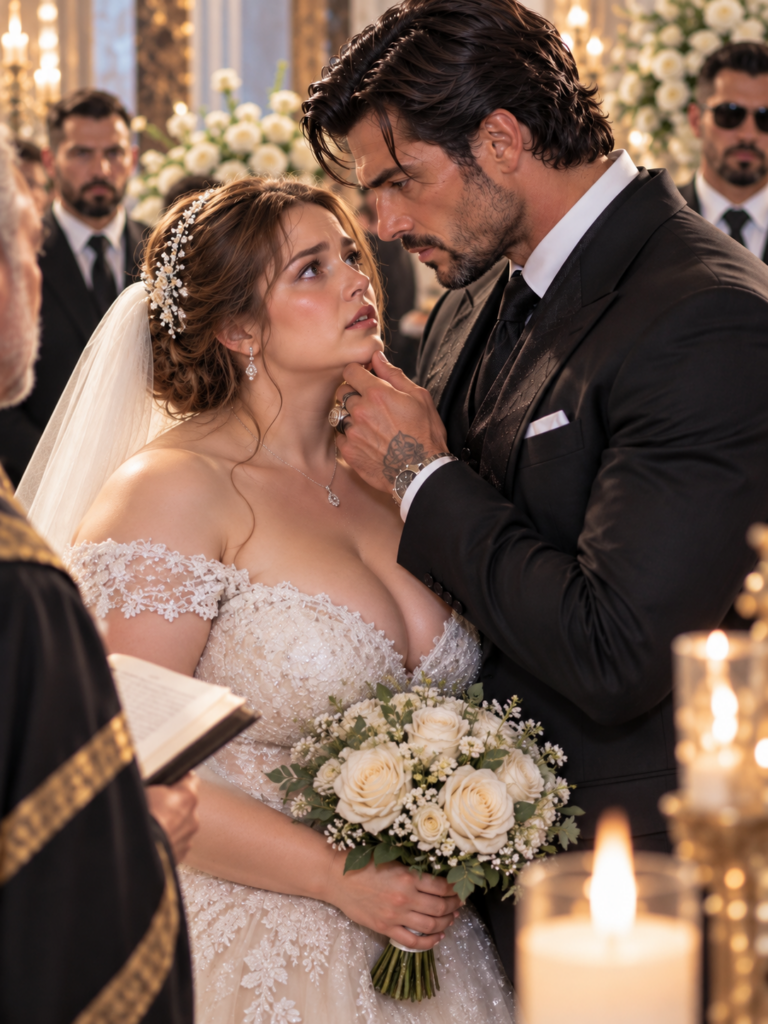
Sophia dropped a coffee cup, cut her palm, and bled across the shoes of the most feared man in the city.
Before the blood dried, he erased every debt attached to her name and ordered her into his car.
Then he whispered the sentence that frightened her more than any threat: “You were never a stranger to me.”

PART 1 — THE MAN WHO KNEW HER NAME
Rain had battered Bellhaven for three days, flooding gutters and turning the morning sky the color of dirty wool. Inside Moretti’s Bakery, the air smelled of burnt sugar, wet coats, and yeast.
Sophia Chen pressed dough beneath aching palms. At twenty-four, she should have been building a life. Instead, she worked twelve-hour shifts and spent every paycheck covering rent, utilities, and the gambling debts her aunt Marie had accumulated.
“Table seven,” Mrs. Moretti snapped. “And stop moving like a funeral procession.”
Sophia filled the coffee pot. She had eaten half a dinner roll since yesterday, and the hot glass trembled against her fingers.
Table seven sat behind the old espresso machine. A man occupied the corner chair, his black suit immaculate against the bakery’s peeling wallpaper. Two broad-shouldered men stood behind him, silent enough to make the other customers whisper.
Sophia approached with her eyes lowered.
The cup slipped.
Porcelain shattered against the marble. Coffee splashed across the stranger’s polished shoes, and Sophia dropped to her knees.
“I’m sorry.”
She gathered the fragments with bare hands. A sharp edge sliced her palm.
Blood welled instantly.
“Stop.”
The man’s voice was quiet, but the entire bakery obeyed.
Sophia looked up.
He appeared to be in his early thirties, with dark hair swept from a severe face and eyes that made stillness feel dangerous. He was not looking at the mess.
He was staring at her blood.
“You’re hurt.”
“It’s nothing.”
“Look at me.”
Her chin lifted before pride could stop it.
“What is your name?”
“Sophia Chen.”
He repeated it with unsettling familiarity. “Sophia.”
One of his men returned with a leather medical case. The stranger opened it himself, taking Sophia’s wrist with warm, controlled fingers.
“This needs stitches.”
“I can’t afford stitches.”
His jaw tightened.
“Call Dr. Rosini,” he told the man beside him. “Have him meet us at the estate.”
Sophia pulled back. “I’m not going anywhere.”
The stranger rose, and the bakery seemed to shrink around him.
Mrs. Moretti hurried from the kitchen. “Mr. Caruso, I didn’t realize—”
Caruso.
The name struck Sophia harder than fear.
Everyone in Bellhaven knew the Caruso family. Their companies owned half the waterfront. Their influence reached police stations, council offices, and neighborhoods where people learned not to ask questions.
Alessandro Caruso turned toward Mrs. Moretti. “How much does Sophia’s family owe?”
Sophia’s breath stopped.
Mrs. Moretti’s face emptied. “I wouldn’t know.”
Alessandro glanced at the man behind him. “Dante.”
Dante produced a phone.
“Find every creditor connected to Marie Chen,” Alessandro said. “Names, amounts, interest, threats. Everything.”
“No.” Sophia stood too quickly and swayed. “You don’t understand. Those men are dangerous.”
Alessandro steadied her by the elbow.
“Those men answer to me.”
The bakery fell silent except for rain against the windows.
“Why do you know about my aunt?”
His thumb rested near her racing pulse.
“You’re coming with me.”
“That isn’t an answer.”
“No. It is the only way I can keep you alive while I give you one.”
He turned to Mrs. Moretti. “Prepare Sophia’s final paycheck and twelve weeks’ severance.”
“You can’t fire me,” Sophia said.
“I didn’t.”
“You just ended my job.”
“I ended this job.”
He wrapped a white handkerchief around her palm. His movements were gentle, but the authority behind them felt immovable.
“I don’t belong to you.”
Pain crossed his face so quickly she almost missed it.
“No,” he said. “And that is the mistake I have four years to explain.”
Outside, a black SUV waited beneath sheets of rain.
Sophia stopped on the curb. “Four years?”
Alessandro opened the rear door.
Before she could demand another answer, a gunshot cracked from the building across the street.
The bakery window exploded.
Alessandro threw himself over her, forcing her behind the SUV as glass rained onto the sidewalk. His men drew weapons while customers screamed inside.
Another bullet struck the vehicle.
Alessandro lifted his head, fury turning his features cold.
“They found her sooner than expected,” Dante said.
Sophia stared at him. “Who found me?”
Alessandro looked down at the blood soaking through her bandage.
“The people who killed your father.”
PART 2 — THE HOUSE BUILT FROM SECRETS
The SUV accelerated before Sophia had fully climbed inside.
Dante fired through the open passenger door while another guard dragged it shut. Tires tore through standing water, sending gray sheets across the sidewalk.
Sophia crouched against the leather seat. Alessandro covered her with his body until the bakery disappeared behind rain and traffic.
“Get off me.”
He moved instantly.
That obedience surprised her.
She pressed herself against the opposite door, clutching her bleeding hand. “My father died in a factory accident.”
“That is what you were told.”
“He fell from scaffolding.”
“The scaffolding was cut.”
Sophia stared at him.
Alessandro’s white shirt had torn at the shoulder. A shallow line of blood crossed his temple where flying glass had struck him, but he seemed unaware of it.
“Who would kill a maintenance worker?”
“Your father was not a maintenance worker.”
“Then what was he?”
“A forensic accountant.”
The answer was so far from the man in Sophia’s memories that she almost laughed. Her father had worn oil-stained work shirts. His hands had smelled of metal and machine grease. He had packed her school lunches and left the crusts on her sandwiches because she liked them.
“You’re lying.”
“I wish I were.”
“Why would my mother tell me he worked in a factory?”
“To protect you.”
“My mother died six months after he did.”
“I know.”
The quiet certainty in his voice made her skin tighten.
“How much do you know about my family?”
“Enough to have failed them.”
Sophia’s phone vibrated.
A message from Aunt Marie appeared.
WHERE ARE YOU? MEN ARE IN THE APARTMENT.
Sophia tried to call. No answer.
“We have to go home.”
“No.”
“My aunt is there.”
“My people are already moving her.”
“You sent people to my apartment before the shooting?”
Alessandro’s gaze held hers. “Yes.”
“You knew this would happen.”
“I knew it could.”
“You let me walk into work anyway?”
“I had surveillance on the bakery.”
“And that worked beautifully.”
The sarcasm struck. His jaw flexed, but he did not defend himself.
“Why today?” she demanded. “Why did you appear after four years?”
“Because at midnight, the last legal restriction preventing me from contacting you expired.”
“What restriction?”
“Your mother’s will.”
Sophia stopped breathing.
The city blurred beyond the dark windows. They crossed the river, leaving the cramped streets of South Bellhaven for a district of old estates and iron gates.
“My mother had a will?”
“Yes.”
“She left me nothing.”
“She left you information, but she ordered it sealed until your twenty-fourth birthday.”
Sophia’s birthday had been yesterday.
Aunt Marie had bought a grocery-store cupcake, eaten half of it, and gone to bed with a bottle of vodka.
“What information?”
Alessandro looked toward Dante. “Do we have Marie?”
Dante listened to his earpiece. “Secured. Frightened, intoxicated, but uninjured.”
“I want to speak to her.”
“When we reach the estate.”
“Now.”
A phone appeared in Alessandro’s hand.
He called Dante’s team and placed the conversation on speaker.
Marie answered with a slurred sob. “Sophia?”
“I’m here. Are you hurt?”
“No. These men broke my door.”
“We knocked,” a guard said in the background.
“For approximately four seconds,” Marie shouted.
Sophia closed her eyes. That sounded like her aunt.
“Go with them,” she said. “I’ll explain when I understand.”
“Is Caruso with you?”
Sophia looked at Alessandro. “Yes.”
Marie went silent.
“Aunt Marie?”
“You shouldn’t be near him.”
“Why?”
“He’s the reason your father is dead.”
The call ended.
Alessandro did not move.
Sophia slowly lowered the phone. “Tell the driver to stop.”
“That would expose you.”
“I don’t care.”
“I do.”
“My aunt says your family killed my father.”
“My family did.”
The confession struck harder than denial.
Sophia’s fingers went numb. “And you expect me to enter your house?”
“I expect you to hate me after you know the complete truth.”
“Then save time. I hate you now.”
Pain entered his eyes, but he nodded.
“That is fair.”
The Caruso estate emerged behind black iron gates. Rain silvered the ancient trees, and the stone mansion rose from mist like a fortress designed to imitate a home.
When the SUV stopped beneath the portico, Dante opened Sophia’s door.
She remained seated.
Alessandro waited beside her without reaching inside.
“Is my aunt here?”
“She is being brought through the western entrance.”
“Can I leave after my hand is treated?”
“Yes.”
Dante looked at his employer.
Alessandro did not look away from Sophia. “She can leave whenever she chooses.”
“Without being followed?”
His silence returned.
“That isn’t leaving,” she said.
“The men who fired at you remain free.”
“Then explain the risk and let me decide.”
Something shifted in his expression.
“You are right.”
He stepped back from the door. “You choose.”
Sophia climbed out.
The entrance hall smelled of roses, beeswax, and smoke from a wood fire. Marble reflected the chandeliers overhead. Portraits watched from paneled walls, generations of Carusos painted in dark suits and darker expressions.
An elegant woman descended the staircase.
She was in her early sixties, silver threaded through her black hair. Her silk dress moved without sound, but recognition struck her face when she saw Sophia.
“Daniel’s daughter,” she whispered.
Sophia turned to Alessandro. “She knew my father.”
“My mother, Isabella.”
Isabella reached the final step. Her eyes fixed on Sophia’s cut hand, then the blood on Alessandro’s collar.
“You waited too long,” she told her son.
“I honored Elaine’s will.”
“You hid behind it.”
Alessandro’s voice cooled. “Not now.”
“Four years of watching that girl exhaust herself while you called distance protection. When would be convenient?”
Sophia’s stomach tightened. “Watching me?”
Isabella’s expression changed as she realized what she had exposed.
A doctor arrived from the study carrying a black medical bag. Alessandro guided Sophia toward him, but she pulled away.
“No one touches me until I get an answer.”
Rain struck the tall windows. Staff members became suddenly fascinated by the floor.
Isabella looked at her son. “Tell her.”
Alessandro’s control thinned.
“I first saw you four years ago,” he said. “At your father’s funeral.”
Sophia remembered black umbrellas, mud beneath her shoes, and strangers murmuring around a closed coffin. She had been twenty, stunned by the death of the only parent who made her feel safe.
“You were there?”
“At a distance.”
“Why?”
“Because my father ordered Daniel’s death.”
The words entered the hall like winter.
Isabella closed her eyes.
Alessandro continued. “Your father discovered financial records proving my father used Caruso shipping companies to move illegal weapons. Daniel intended to give the evidence to federal investigators. My father learned of it first.”
“And killed him.”
“Yes.”
Sophia could feel her heartbeat inside the cut in her palm.
“What happened to your father?”
“He died seven months later.”
“Convenient.”
“Not for him.”
Isabella looked sharply at her son.
Sophia heard what he had not said. “Did you kill him?”
“No.”
“Did you want to?”
“Every day after I learned the truth.”
The honesty frightened her.
“Why watch me?”
“Your mother asked me to.”
Sophia laughed once, a broken sound. “My mother hated this family.”
“She did. She also knew the men who worked for my father might come after you if Daniel’s evidence was not found.”
“What evidence?”
“A ledger containing account numbers, names, and routes. It disappeared after your father died.”
“And you think I have it?”
“I think the men who shot at us believe you do.”
The doctor cleared his throat. “If I may, Miss Chen’s hand should be treated before the anesthetic window becomes more complicated.”
Sophia allowed him to lead her into the study.
The room was warm, lined with books and dark wood. A fire cracked beneath a marble mantel. Alessandro stood several feet away while Dr. Rosini cleaned the wound.
“You may feel pressure,” the doctor said.
The needle entered Sophia’s skin.
She refused to flinch.
Alessandro did.
His hand clenched at his side, an involuntary reaction he seemed annoyed to have revealed.
“How closely did you watch me?” Sophia asked.
“Security reports.”
“How often?”
“Monthly at first. Weekly after Marie’s debt increased.”
“You knew I was working two jobs?”
“Yes.”
“That I was skipping meals?”
His gaze dropped. “Yes.”
“That loan collectors came to the apartment?”
“Yes.”
“Yet you did nothing.”
“Your mother explicitly forbade financial intervention before you turned twenty-four.”
“My mother was dead.”
“Her wishes were not.”
Sophia looked at the mansion around her. “Convenient morality from a man whose family murders accountants.”
Alessandro accepted the blow.
“I paid two of Marie’s creditors anonymously,” he admitted. “The ones who threatened physical harm. I prevented an eviction last winter by purchasing your building’s mortgage through a holding company.”
Dr. Rosini paused.
Sophia stared at Alessandro. “You own my apartment?”
“The bank owned it. I own the note.”
“You stood back and watched me struggle while secretly owning the roof over my head.”
“I ensured no one could remove it.”
“Did you ever consider telling me?”
“Every day.”
“Then why didn’t you?”
“Because your mother believed dependence on my family would destroy your freedom.”
Sophia looked at the heavy door, armed guards beyond it, and Alessandro positioned between her and every exit.
“She understood you.”
The doctor finished the final stitch.
Alessandro looked as though the thread had been pulled through him.
A commotion sounded in the hall.
Marie stumbled into the study with two guards behind her. Her coat hung open over a stained nightgown, and mascara streaked her cheeks.
She crossed the room and slapped Alessandro.
The sound cracked against the bookshelves.
Every guard moved.
Alessandro raised one hand, stopping them.
Marie’s palm reddened. “You promised Elaine.”
“I kept Sophia alive.”
“You kept her poor, frightened, and watched.”
“I did what Elaine required.”
“No. You did what cowards do. You obeyed the letter so you could avoid the truth.”
Sophia stood. “What truth?”
Marie turned.
For years, alcohol had blurred her features and dulled her voice. Now terrible clarity entered both.
“Your mother did not die from an aneurysm.”
Sophia gripped the edge of the desk.
“She was poisoned,” Marie said. “And I know where your father hid the ledger.”
Before anyone could respond, the power failed.
The fire became the room’s only light.
A gunshot exploded in the hall.
Marie jerked backward.
A red stain opened across her coat.
Sophia screamed.
Alessandro caught Marie before she struck the floor. Guards flooded the study while glass shattered in the corridor.
“Lock the estate!” Dante shouted.
Marie gripped Sophia’s sleeve, blood bright between her fingers.
“The bakery,” she gasped. “Your father hid it where the bread never rises.”
Her eyes rolled shut.
Dr. Rosini dropped to his knees.
Alessandro pulled Sophia behind the desk as more shots cut through the dark.
Someone inside the Caruso estate had opened the gates.
The attack ended in eleven minutes.
It felt longer.
Sophia crouched beneath Alessandro’s body while gunfire moved through the western corridor. Smoke seeped beneath the study doors, bitter with cordite and burned fabric.
When silence came, it did not feel safe.
Dr. Rosini worked on Marie beside the hearth. The bullet had passed through her upper shoulder, missing the artery by less than an inch. She remained unconscious but breathing.
“Hospital,” the doctor ordered.
“No public routes,” Dante said. Blood ran from a cut above his eyebrow. “We use the private clinic.”
Sophia moved toward her aunt, but Alessandro caught himself before reaching for her.
“You can ride with Marie,” he said.
“I’m going to the bakery.”
“No.”
The word came from instinct.
Sophia turned.
Alessandro’s face hardened as he forced the next sentence out differently. “The bakery may be under surveillance. Going now would be dangerous.”
“Someone just entered your fortress and shot my aunt.”
“Yes.”
“So explain why staying is safer.”
He had no answer.
“Your mother knows the bakery,” Isabella said from the doorway.
A fine layer of plaster dust covered her silk dress. She held a small pistol with perfect familiarity.
“Mrs. Moretti was once Elaine’s closest friend.”
Sophia stared. “My employer knew my mother?”
“She gave Elaine work when your family first entered protective hiding,” Isabella said. “The bakery belonged to Daniel’s cousin before the Morettis purchased it.”
Another secret. Another room built around her without a door.
“Does Mrs. Moretti know about the ledger?” Sophia asked.
“She may,” Alessandro said.
“And she let me work there because—”
“Because your mother asked her to keep you close to where Daniel hid it.”
Sophia remembered every insult, every docked paycheck, every time Mrs. Moretti called her slow and ungrateful.
“That was protection?”
“No,” Isabella said. “That was resentment wearing an old promise.”
Dante entered. “Three attackers are dead. Two escaped through the service road.”
“How did they enter?” Alessandro asked.
“Someone disabled the north gate and internal cameras.”
“Who had authorization?”
Dante hesitated. “Family-level access.”
Isabella’s grip tightened on the pistol.
Alessandro’s expression turned unreadable. “Luca?”
“Missing.”
Luca had stood behind Alessandro at the bakery, summoned the doctor, and followed every order without hesitation. He had been inside the family since childhood.
Sophia understood. “He works for whoever killed my parents.”
“We do not know that,” Dante said.
“But you suspect it.”
“Yes.”
Marie was placed on a stretcher.
Sophia bent beside her. Her aunt smelled of cheap vodka, rain, and antiseptic. For years, Sophia had believed Marie’s drinking came from selfishness. Now she wondered how much of it had begun with fear.
“I’ll find it,” Sophia whispered.
Marie did not move.
Alessandro arranged two vehicles. One carried Marie and the doctor to the clinic. The other took Sophia, Dante, and him toward the bakery through back streets slick with rain.
The city slept uneasily beneath flashing emergency lights.
“You should stay in the vehicle when we arrive,” Alessandro said.
Sophia looked at him.
“Recommendation,” he corrected.
“I know that building better than any of you.”
“Yes.”
“She said where bread never rises. The old proofing cabinet.”
“Mrs. Moretti replaced it last year,” Dante said.
“No. She told the health inspector she replaced it. She painted the original and changed the thermostat.”
Alessandro studied Sophia. “How do you know?”
“Because I repaired it every morning by striking the left side.”
Dante almost smiled.
They parked one block away.
The bakery’s front windows were boarded where the gunfire had shattered them. Rain had slowed to a fine mist, and police tape fluttered across the entrance.
The back door stood open.
Inside, the air was cold. Trays remained where employees had abandoned them. A half-shaped loaf lay beneath a cloth, its surface dried and cracked.
Sophia crossed the kitchen.
“Proofing cabinet,” she said.
The old metal unit stood near the flour storage, painted cream over decades of rust. She struck the left side.
Nothing happened.
She struck it again.
The thermostat light flickered.
Dante examined the rear panel. “New screws.”
Alessandro removed his jacket and knelt. He used a kitchen knife to loosen them while Sophia held a flashlight.
Behind the panel was a narrow cavity.
Inside lay a plastic-wrapped notebook and a brass key.
Sophia touched the package.
A photograph rested beneath it.
Her father stood beside a younger Alessandro in front of the Caruso shipping office. They were shaking hands.
On the back, Daniel had written:
ALESSANDRO DOES NOT KNOW. IF I FAIL, TELL HIM HIS FATHER USED US BOTH.
Sophia looked at him.
“You knew my father.”
Alessandro’s face had lost all color. “He was my financial tutor.”
“You said you first saw me at his funeral.”
“I did.”
“You never mentioned knowing him.”
“I was nineteen when he disappeared from the company. My father said Daniel stole money and fled.”
“He attended your funeral.”
A woman’s voice came from the kitchen doorway.
Mrs. Moretti stood there holding a shotgun.
Her gray hair had come loose from its bun, and flour coated the front of her black dress.
She aimed at Alessandro.
“Daniel attended your funeral,” she continued, “because you were supposed to be in the warehouse your father burned.”
Alessandro slowly rose.
“What warehouse?”
“The one where Salvatore stored the weapons. Daniel pulled you from the building before the roof collapsed. He saved your life, and your father repaid him by ordering his death.”
Sophia’s throat closed.
Mrs. Moretti shifted the shotgun toward her.
“And now you found what everyone has killed to possess.”
“Put the gun down,” Dante said.
“No.”
“You kept Sophia here for years,” Alessandro said. “Why?”
Mrs. Moretti’s mouth trembled. “Elaine promised to take me with her when she entered protection. She left me behind.”
“So you punished her daughter.”
“I fed her. Employed her.”
“You starved her in a kitchen full of bread,” Alessandro said.
Shame flickered across the older woman’s face, then hardened into bitterness.
“My husband owed Salvatore. I had no choices.”
“Everyone has choices,” Sophia said. “Some are simply expensive.”
The shotgun shifted.
Alessandro moved in front of Sophia.
Mrs. Moretti laughed softly. “Just like Daniel. Men always decide a woman requires a body between her and the truth.”
“Who poisoned my mother?” Sophia asked.
The older woman’s eyes filled.
“Luca.”
The name barely left her mouth before a shot cracked from the pantry.
Mrs. Moretti fell.
Dante shoved Sophia behind the steel cabinet as Luca stepped into the kitchen with a silenced pistol.
He wore no coat. Rain darkened his shoulders, and his expression was almost apologetic.
“I hoped Marie would stay drunk,” he said.
Dante fired.
Luca disappeared behind the pantry wall. Bullets punched through metal shelves, exploding flour bags into white clouds.
Alessandro pulled Sophia toward the rear exit.
“The ledger,” she said.
He seized the notebook from the cavity.
They ran into the alley as smoke and flour billowed from the bakery. Dante followed seconds later, firing toward the door.
“Mrs. Moretti?” Sophia asked.
“Dead.”
The word struck strangely. Sophia had resented the woman for years, yet death erased neither cruelty nor the few mornings Mrs. Moretti had silently left food beside her station.
Sirens approached.
Luca emerged on the roof.
He aimed at Sophia.
Alessandro saw him first.
He pushed her behind the SUV.
The bullet struck his side.
His body jerked.
For a suspended instant, he remained standing, disbelief crossing his face.
Then he collapsed into Sophia’s arms.
Dante returned fire. Luca vanished behind the roofline.
Sophia pressed both hands against Alessandro’s wound. Blood flooded through her fingers, hot and relentless.
“Stay with me.”
His breathing became shallow.
“The ledger,” he said.
“I don’t care about the ledger.”
“You have to.”
“Stop talking.”
His hand closed weakly over hers.
“You asked why I watched you for four years.” Pain cut across his face. “It wasn’t only guilt.”
“Tell me later.”
“I thought loving you from a distance was the one decent thing I could do.”
“You don’t love someone you’ve never spoken to.”
“I know.” His eyes searched hers. “That is why I waited to call it love.”
The sirens grew louder.
Sophia bent over him, rain cooling the blood on her hands.
“Then live long enough to learn the difference.”
His mouth moved in the shadow of a smile.
“For you,” he whispered, “I will try.”
The brass key led to a private deposit box at Bellhaven Federal Bank.
But the bank would not open until morning, and Alessandro might not survive the night.
Dr. Rosini operated at the Caruso clinic while Sophia sat in a corridor beneath unforgiving fluorescent lights. Alessandro’s blood had dried beneath her nails. His jacket covered her shoulders, heavy with rain and the scent of cedar smoke.
Isabella paced.
Dante stood near the window, making calls in a voice stripped of emotion. Luca remained missing. Police units searched the warehouse district, though no one trusted the official search to remain confidential.
At three in the morning, Dr. Rosini emerged.
“The bullet missed the liver,” he said. “There was significant blood loss, but he is stable.”
Isabella closed her eyes.
Sophia gripped the chair until her fingers hurt.
“Can I see him?”
The doctor studied her. “Five minutes.”
Alessandro lay surrounded by machines. Without the black suit and controlled posture, he looked younger. Human.
Sophia sat beside him.
His eyes opened slightly.
“You stayed.”
“My aunt is down the hall, and you stole my jacket.”
“Mine,” he murmured.
She leaned closer. “Do not start that.”
“The jacket.”
Despite everything, a laugh broke from her.
Alessandro’s eyes closed again, but his fingers found hers.
“Bank,” he whispered.
“Dante and I will go when it opens.”
“No.”
“You have been shot. Your authority is temporarily suspended.”
“Luca will know.”
“He doesn’t know we have the key.”
“He saw the cavity.”
Sophia looked at the IV line dripping steadily into his arm. “Why would my father hide the key in a bakery and the evidence in a bank?”
“Because Salvatore controlled every private vault in the city except one.”
“Bellhaven Federal?”
“Daniel helped audit it. The manager owed him.”
Sophia stood.
Alessandro’s hand tightened weakly.
“Choose your own guards,” he said. “Not mine.”
It was the clearest evidence yet that he understood her.
At seven-thirty, Sophia entered the bank with Dante and a federal investigator named Grace Miller. Marie had named Miller years earlier in an unsent letter found among her belongings. She had investigated the Caruso companies before being pushed out of the case.
Miller was in her fifties, with tired eyes and silver hair cut at the jaw.
“I trusted the wrong prosecutor once,” she said. “This time, we copy everything before anyone knows it exists.”
The brass key opened box 417.
Inside lay a flash drive, the original shipping ledger, insurance documents, and a sealed letter addressed to Sophia.
She opened the letter first.
Her father’s handwriting tilted across the page.
Sophia, if you are reading this, then I failed to come home.
Her vision blurred.
Daniel explained that he had uncovered Salvatore’s illegal network while tutoring Alessandro in business finance. Alessandro had found irregular payments and unknowingly drawn Daniel toward the truth.
The son is not the father, Daniel wrote. But guilt may convince him otherwise. Do not give him forgiveness because he protects you, and do not deny it merely because of his name. Judge what he chooses after the truth costs him something.
Sophia read the line twice.
The ledger implicated judges, officers, customs agents—and Luca Bianchi. His father had served Salvatore. Luca inherited the role and poisoned Elaine after she refused to reveal the bank key.
The flash drive contained Elaine’s recorded testimony.
Miller copied the evidence onto two encrypted drives.
“We have enough for arrests,” she said.
“Can your office be trusted?”
“No office can be trusted entirely.” Miller handed one copy to Sophia. “That is why evidence survives in more than one hand.”
Sophia placed the drive inside Alessandro’s jacket pocket.
Her phone rang.
Marie’s number.
She answered.
Luca spoke.
“Bring the original ledger to Pier Nine.”
Sophia’s blood chilled.
“Where is my aunt?”
“Awake. Confused. Very disappointed in you.”
“You’re inside the clinic.”
“People see uniforms and stop seeing faces.”
Dante reached for the phone, but Sophia stepped away.
“What do you want?”
“The book and key. No copies.”
“You know there are copies.”
“Then bring Agent Miller too.”
Miller’s expression did not change.
“Thirty minutes,” Luca said. “If I see police, Marie dies. If Alessandro wakes and sends his army, Marie dies. If you are late, she dies.”
The call ended.
Dante took out his weapon. “We tell Alessandro.”
“No.”
“He will destroy the pier to get her back.”
“Exactly.”
Sophia looked at Miller. “Can you help without alerting local police?”
The agent nodded. “Two federal teams. Quiet approach from the river.”
Dante shook his head. “Luca knows every Caruso tactic.”
“Then we don’t use Caruso tactics,” Sophia said.
She carried the original ledger.
Not because Miller agreed, but because Luca would inspect the weight and paper. The agent inserted a tracking strip beneath the binding and photographed every page.
Pier Nine stretched into a gray river beneath a cold morning sky. Abandoned warehouses lined the shore. Rusted cranes leaned above shipping containers like skeletal birds.
Sophia walked alone along the wet concrete.
Luca waited beside a black sedan.
Marie sat in the passenger seat, pale beneath a borrowed coat. One shoulder was heavily bandaged.
“Let her go,” Sophia said.
“Ledger first.”
She held it up.
Luca approached. He looked ordinary now—no expensive suit, no obedient posture behind Alessandro. That ordinariness made him more frightening.
“You poisoned my mother.”
“She was offered protection.”
“From the people threatening her?”
“From consequences.”
“She refused.”
“She was stubborn.”
Sophia tightened her grip on the ledger. “So you killed her.”
“I gave her a choice.”
“No. You gave her an ultimatum and renamed it choice.”
Something cold passed through his eyes.
“You sound like Alessandro.”
“No. He is finally learning the difference.”
Luca extended his hand. “The book.”
“Marie gets out first.”
He opened the passenger door.
Marie stumbled onto the pier. Her eyes found Sophia, filled with shame and fear.
“Walk,” Luca told her.
Marie took several uneven steps.
Halfway between them, Luca raised his gun.
Not toward Marie.
Toward Sophia.
“You were never part of the agreement,” he said.
Dante’s shot struck the weapon from his hand.
Chaos erupted.
Federal agents appeared between containers. Luca dragged Marie backward and pressed a knife against her throat. Dante advanced from behind a forklift, weapon steady.
“Drop it,” he ordered.
Luca smiled. “You always did prefer commands.”
Sophia looked toward the river.
A cargo hook hung from a crane above them. Its control pendant dangled beside a stack of chained pallets.
During three years at the bakery, Sophia had learned to move heavy flour shipments using nearly identical controls.
She took one slow step sideways.
Luca noticed. “Stop.”
Sophia stopped.
Marie’s gaze dropped toward the pendant, then returned to Sophia.
She understood.
Marie drove her heel into Luca’s shin.
At the same instant, Sophia seized the control.
The crane jerked.
The suspended hook swung across the pier, striking Luca’s shoulder and throwing him away from Marie. Dante reached him before he could stand.
His fist drew back.
“Alive,” Sophia shouted.
Dante froze.
For a moment, rage fought loyalty across his face.
Then he lowered his hand.
Agents cuffed Luca against the wet concrete.
Marie collapsed into Sophia’s arms.
“I’m sorry,” she sobbed. “For drinking. For taking your money. For letting fear become your responsibility.”
Sophia held her carefully, mindful of the wound.
“You need help.”
“I know.”
“I can’t save you by covering everything anymore.”
Marie nodded against her shoulder. “I know.”
The words hurt because they were honest.
A black SUV entered the pier.
Alessandro stepped out.
His face was colorless, and one hand pressed against the bandage beneath his coat. Dr. Rosini shouted from another vehicle behind him.
Sophia stared in disbelief. “You left the clinic?”
Alessandro’s gaze moved over her, checking for injuries. He saw Marie, Dante, the agents, and Luca in cuffs.
Only then did he breathe.
“You suspended my authority,” he said. “You did not imprison me.”
“You could have reopened the wound.”
“I nearly did.”
Dr. Rosini reached him and began swearing in Italian.
Sophia crossed the space between them.
She wanted to strike Alessandro.
She wanted to hold him.
She did neither.
“You trusted me enough to choose my own guards,” she said. “Why couldn’t you trust me enough to finish this?”
“Because trust is new,” he replied. “Fear is not.”
It was the right answer, and she resented it.
Alessandro looked at the ledger in her hand. “You found it.”
“My father left me a letter.”
“What did he say?”
“That I should judge you by what you choose after the truth costs you something.”
Luca laughed from the ground. “Then watch his choice. He’ll kill me before trial.”
Every eye turned toward Alessandro.
This was the moment his world understood: Caruso justice or lawful consequence.
Alessandro walked to Luca.
The injured man stared up at him.
“You killed Elaine,” Alessandro said.
“Yes.”
“You opened my gates.”
“Yes.”
“You ordered Sophia’s death.”
Luca smiled. “And if your father were alive, he would call me loyal.”
Alessandro’s hand curled.
Sophia did not plead with him. Her father’s words remained between them.
Judge what he chooses.
Alessandro stepped back.
“Agent Miller,” he said, “I will provide every record tied to my father’s network, including evidence against my own companies.”
Isabella, who had arrived with the doctor, went still.
Dante lowered his eyes.
Luca’s smile vanished.
Alessandro continued. “He receives a public trial. Every family he harmed hears the truth. No quiet disappearance. No legend.”
Miller nodded. “That cooperation will carry consequences for you.”
“I know.”
“How severe?”
“That is not mine to negotiate before the evidence is read.”
The admission cost him.
Sophia saw it.
His power had always allowed him to decide how every story ended. Now he was surrendering the final page.
Luca was taken away.
The rain finally stopped.
Sunlight broke through the clouds in narrow silver bands, illuminating the river and the rusted cranes.
Alessandro swayed.
Sophia caught his arm.
“You’re bleeding again.”
“I noticed.”
“Back to the clinic.”
“Is that an order?”
“Yes.”
A faint smile reached his exhausted eyes. “I find that unexpectedly appealing.”
She rolled her eyes and helped him into the SUV.
The criminal case consumed Bellhaven for months.
Luca Bianchi was charged with two murders, conspiracy, attempted murder, racketeering, and obstruction. The ledger exposed officers, judges, business owners, and members of the old Caruso network.
Alessandro testified for eleven days.
His cooperation dismantled the illegal shipping division his father had built. The government seized three warehouses, two companies, and a significant portion of the family fortune. Alessandro accepted financial penalties, years of federal oversight, and restrictions that removed his control over the port.
He avoided prison because the evidence confirmed he had shut down the weapons routes after inheriting the organization. But legality did not make him innocent of everything he had done to enforce his authority.
Sophia insisted on knowing those truths too.
They sat in his study one evening after his stitches were removed. The room smelled of leather and rain-damp earth from the open windows.
“Have you killed anyone?” she asked.
Alessandro did not look away. “Yes.”
“How many?”
“Three directly.”
“Were they threatening you?”
“Two were.”
“And the third?”
“A man who betrayed my father.”
The answer settled heavily.
“Did he deserve to die?”
“At the time, I believed he did.”
“And now?”
“Now I believe I wanted certainty more than justice.”
Sophia wrapped both hands around her tea.
“You understand that loving you does not require me to excuse that.”
“Yes.”
“Do I love you?”
“I hope you might someday.”
His restraint affected her more deeply than possession ever could.
Marie entered residential treatment. Sophia refused to pay the facility through Caruso accounts, using funds recovered from her father’s life-insurance policy instead.
“You don’t have to prove independence by rejecting help,” Alessandro told her.
“And I don’t have to prove love by accepting it.”
He nodded. “Fair.”
Sophia moved into a small apartment near the university and enrolled in an accounting program. Her father’s notebooks had awakened something in her—a respect for numbers as witnesses that did not become intimidated or forget what they had seen.
Alessandro offered her a wing of the estate.
She declined.
He offered a driver.
She selected one herself from an independent company and paid half the cost.
He hated the arrangement.
He honored it.
They began dating six months after the pier.
Real dates.
Alessandro arrived at her door and knocked. Sometimes Sophia let him in. Sometimes she met him downstairs. He asked before ordering wine for her and learned that she preferred inexpensive takeout to restaurants where servers trembled at his name.
One Friday night, they returned to Moretti’s Bakery.
Marco Bellini, Mrs. Moretti’s nephew, had taken over after her death. The walls had been repainted a warm cream. Employees received breaks, meals, and proper insurance.
Table seven remained in the corner.
Sophia sat where Alessandro had once watched her bleed.
“How does it feel?” he asked.
“Smaller.”
“The room?”
“The fear.”
He placed a small envelope on the table.
Sophia did not open it immediately.
“What is this?”
“The ownership papers.”
“For what?”
“The bakery.”
She pushed it back.
“No.”
“It belonged to your father’s cousin.”
“That does not make it mine.”
“I purchased the building from the estate. I thought—”
“You decided.”
Alessandro stopped.
Around them, cups clinked and the espresso machine hissed. Marco pretended not to listen while polishing an already clean counter.
“You’re right,” Alessandro said.
He took the envelope back.
Sophia studied him. “What will you do with it?”
“Ask Marco whether he wants to purchase the business under a reasonable payment plan. If not, sell it.”
“No gift?”
“No leverage disguised as generosity.”
The words showed he understood.
Sophia reached across the table and touched his hand.
“Thank you.”
“For withdrawing a gift?”
“For listening before defending.”
He turned his palm beneath hers.
The first snow arrived two months later.
Alessandro invited her to dinner at the estate. No hidden guests, no formal table, no armed meeting afterward. Isabella cooked badly and blamed the oven. Dante opened wine and told stories that made Alessandro threaten to fire him three times.
After dinner, Sophia wandered into the library.
Thousands of books lined the walls. A fire glowed beneath the mantel, and snow gathered along the dark windows.
Alessandro found her holding a worn copy of Jane Eyre.
“My mother said you might like this room,” he said.
“Your mother has been campaigning for me to move in.”
“She has also selected curtains for a nursery, which I have asked her to stop doing.”
Sophia smiled. “Did she?”
“No.”
He approached, then remained an arm’s length away.
“I have something to show you.”
He opened a drawer and removed a velvet box.
Sophia’s muscles tightened.
Alessandro noticed. “Not a proposal.”
“That is exactly what a man says before opening a ring box.”
“It is too large.”
Inside lay a sapphire-and-diamond necklace. The stones caught the firelight, scattering blue across the walls.
“My grandmother wore this on her wedding day,” he said. “For years, every Caruso man presented it as a promise that his wife would belong to the family.”
Sophia looked up.
“I had the original engraving removed,” he continued.
He turned the necklace.
New words had been etched into the clasp:
NOT OWNED. CHOSEN.
Sophia touched the sapphire at its center.
“It’s beautiful.”
“It remains family property unless you decide otherwise. I will not place it on you.”
He closed the box and set it beside her.
“No expectation?”
“Considerable hope. No expectation.”
She laughed softly.
“Turn around,” she said.
Alessandro’s breath changed.
Sophia lifted the necklace from the velvet and handed it to him. His fingers trembled slightly as he fastened it around her throat.
The weight settled against her skin.
Not a collar.
Not yet a promise.
A question she had chosen to answer for one evening.
They stood together before the library window.
In the reflection, Sophia saw no frightened waitress and no untouchable king. She saw a woman who had learned the price of her own decisions and a man still learning that love could survive an unlocked door.
“May I kiss you?” Alessandro asked.
She turned.
“Yes.”
His mouth met hers slowly.
He did not seize. He did not claim.
He waited for her to lean closer.
She did.
A year passed.
Sophia completed her first year of school and began working part-time with Agent Miller’s financial-crimes nonprofit. They helped small-business employees identify wage theft, debt coercion, and money-laundering schemes.
Numbers became Sophia’s language of resistance.
Alessandro converted the estate’s western wing into offices for a restitution fund. He hired independent administrators and signed away personal control.
At times, old instincts returned.
When Sophia worked late, he called twice.
When she ignored him, he sent Dante.
Sophia found Dante waiting outside the nonprofit office one night, attempting to look casual beside a black SUV.
She folded her arms. “Did Alessandro send you?”
Dante considered lying.
“Yes.”
“Tell him I’m safe.”
“I did.”
“And?”
“He asked me to confirm with my eyes.”
Sophia handed Dante her phone. “Call him.”
Alessandro answered immediately.
“Sophia?”
“You sent a man to check whether I was lying.”
Silence.
“I was concerned.”
“You were controlling.”
“Yes.”
The speed of the admission startled her.
“Tell Dante to go home.”
“Dante, go home.”
Dante looked relieved.
Sophia continued, “I will come by tomorrow, but tonight I need space.”
“I understand.”
“Do you?”
“No,” Alessandro said honestly. “But I will respect it while I learn.”
The next morning, she found him at the estate breakfast table with untouched coffee before him.
“You didn’t sleep,” she said.
“No.”
“Why?”
“Because my mind invents disasters when I cannot see you.”
“That sounds painful.”
“It is not your responsibility to cure.”
Sophia sat across from him.
“What would help?”
“A message when you expect to work late.”
“That’s reasonable.”
“And access to your building’s security cameras.”
“No.”
“I assumed not.”
They negotiated.
She would text when plans changed. He would not deploy guards unless she missed an agreed check-in or requested help. Their compromise satisfied neither of them completely.
That was how Sophia knew it was real.
Two years after the shooting at Moretti’s, Luca’s trial began.
Sophia testified about her mother, the bakery, Marie’s shooting, and Pier Nine. Alessandro sat behind the prosecution team, restrained from looking at Luca except when directly addressed.
The defense attorney tried to portray Sophia as a dependent young woman manipulated by Caruso wealth.
“Mr. Caruso paid your aunt’s debts, didn’t he?”
“He canceled debts held by criminal lenders connected to his former organization.”
“He provided security.”
“At first without meaningful consent. Later under terms I selected.”
“He gave you jewelry.”
Sophia touched the sapphire at her throat.
“I borrowed a family necklace.”
“Do you love him?”
The prosecutor objected.
The judge allowed the question only to test bias.
Sophia looked at Luca.
“Yes,” she said. “I love Alessandro Caruso. Love does not alter bank records, ballistics, recorded testimony, or the defendant’s voice on three calls. If your argument depends on my heart changing the evidence, you should find a better argument.”
The jury convicted Luca on every major count.
Outside the courthouse, rain polished the granite steps.
Marie stood beside Sophia. Rehab had sharpened her features and returned steadiness to her hands. She still had bad days. Recovery had not transformed her into a different person; it had simply made honesty possible.
“I’m going back to Ohio,” Marie said.
“For how long?”
“I don’t know. There’s a program there. They need peer counselors.”
Sophia searched her face. “Are you ready?”
“No.”
It was the right answer.
They embraced.
“I should have protected you,” Marie whispered.
“You should have told me the truth.”
“I know.”
“Protecting me would have meant trusting me with it.”
Marie nodded against her shoulder.
When she left, Alessandro approached but remained several feet away.
Sophia held out her hand.
He took it.
They walked through the rain to a small neighborhood restaurant where no one feared his name. They ate pasta beneath warm yellow lights and listened to the couple at the next table argue about paint colors.
“This is strangely peaceful,” Alessandro said.
“This is normal.”
“I remain suspicious of it.”
Sophia smiled.
After dinner, they returned to her apartment. Alessandro removed his coat and hung it beside hers. He had stopped leaving expensive belongings there as silent claims. Everything present had a practical reason.
Sophia poured two glasses of water.
Alessandro remained near the window.
“What?” she asked.
“I had planned something.”
“That sounds ominous.”
“I changed my mind.”
“Why?”
“Because the plan involved the estate garden, musicians, my grandmother’s ring, and enough roses to concern local agriculture.”
Sophia stared.
“You planned to propose.”
“Yes.”
“And changed your mind?”
“During the trial, the defense attorney described every gift I gave you as proof I purchased influence. I know he was wrong, but I realized I had designed a proposal around wealth and spectacle.”
“Things you control.”
“Yes.”
“What do you have when those are gone?”
Alessandro crossed the room.
“My word. My history. My failures. The work I have done to become a man who can ask without assuming.”
He knelt on the worn rug.
No ring appeared.
“Sophia Chen, I loved an idea of you before I knew you. I watched from a distance and called silence respect when part of it was fear. Then I met you, and the real woman was braver, angrier, more intelligent, and far less obedient than anything I imagined.”
Tears gathered in Sophia’s eyes.
“You owe me nothing,” he continued. “Not gratitude for protection. Not forgiveness for my family. Not permanence because I waited. I am asking whether you will build a life with me while remaining entirely yourself.”
Sophia touched the sapphire necklace.
“Do you understand that I will keep working?”
“Yes.”
“That I will maintain my own accounts?”
“Yes.”
“That your mother gets no vote on children, curtains, or anything else?”
He hesitated. “I can promise she gets no official vote.”
Sophia laughed through her tears.
“And if I ever feel trapped?”
“I open the door.”
“Even if it destroys you?”
His face tightened.
“Yes.”
That answer decided her.
“Then ask me plainly.”
Alessandro drew a breath.
“Will you marry me?”
“Yes.”
He closed his eyes.
For a moment, the man who had faced armed rivals and federal prosecutors could not move.
Sophia knelt in front of him.
“You may kiss me now.”
His hands framed her face, waiting until she leaned forward.
Their kiss held two years of correction, conflict, longing, and choice.
When it ended, Alessandro rested his forehead against hers.
“The ring is in the car,” he admitted.
“How large?”
“Unreasonably.”
“We can exchange it.”
He looked genuinely alarmed.
Sophia laughed again.
They married six months later in the estate garden.
The guest list contained sixty people, not three hundred. No politicians attended. No business rivals arrived to measure power. Foundation staff, bakery employees, investigators, friends, and the few relatives who had learned the difference between loyalty and silence filled the chairs.
Marie walked Sophia halfway down the aisle.
At Sophia’s request, she stopped beneath the first arch.
“This part is yours,” Marie said.
Sophia continued alone.
She did not need to be transferred from one guardian to another. She approached the man she had chosen under her own power.
Alessandro waited beneath an arch of white roses.
The sight of her stripped every practiced expression from his face. His eyes shone. His hands remained at his sides, but she could see how badly he wanted to reach for her.
Sophia reached first.
During the vows, Alessandro’s voice broke.
“I promise never to confuse fear with devotion, secrecy with protection, or possession with love. I promise to tell you the truth before deciding whether you can bear it. I promise that every door in our home opens from both sides.”
Sophia’s throat tightened.
“I promise not to punish you forever for the man you were,” she replied. “But I will remind you when he returns. I promise to protect my own voice instead of expecting you to guess what silence means. And I promise to choose you honestly—not because you saved me, but because you learned I was never yours to save.”
They exchanged rings.
The sapphire necklace rested against Sophia’s collarbone, its altered engraving warm against her skin.
When the officiant invited Alessandro to kiss her, he whispered, “May I?”
The guests laughed softly.
Sophia smiled. “Yes.”
He kissed her beneath the roses while afternoon light poured across the garden.
The reception unfolded without danger.
Marco served bread from the bakery. Agent Miller offered a toast about evidence, accountability, and Sophia’s terrifying ability to locate hidden financial records. Isabella danced with Dante and denied enjoying herself.
At dusk, Alessandro and Sophia slipped away from the crowd.
They walked into the library, where the fire burned low and two glasses of champagne waited on the table.
“Did you arrange this?” Sophia asked.
“I requested it.”
“Growth.”
“I am capable of miracles.”
She removed her shoes and curled onto the leather sofa.
Alessandro sat beside her, leaving space.
For years, his love had been defined by vigilance: knowing where she was, anticipating threats, and constructing walls. Now the space between them contained something more difficult.
Trust.
Sophia crossed it.
She rested her head against his chest. Beneath her ear, his heartbeat accelerated.
“Nervous?” she asked.
“Terrified.”
“Of me?”
“Of happiness. It creates things to lose.”
Sophia lifted her head. “Everything meaningful can be lost.”
“That is not comforting.”
“It isn’t supposed to be. Safety is not the absence of risk. It is knowing you will not become the danger when you are afraid.”
Alessandro absorbed the words.
“I will remember.”
“You’ll forget sometimes.”
“Then remind me.”
“I will.”
He kissed her forehead.
Outside, music drifted through the garden. The house no longer felt like a fortress. Offices occupied one wing. Staff doors remained unlocked during daylight. The north gate—the gate Luca had opened—had been replaced, but Sophia knew its code.
She had chosen it.
Six months into their marriage, winter covered Bellhaven in snow.
Sophia sat in the library with an accounting textbook open across her lap. Sunlight turned the frost on the windows into white fire.
Alessandro entered after a morning meeting.
He crossed the room, stopped beside her chair, and waited.
Sophia looked up. “You may kiss your wife.”
He did.
It had become a private ritual—not because he required formal permission for every touch, but because neither of them wanted to forget how their story had begun.
Alessandro settled on the sofa and drew her feet into his lap.
“What are you reading?”
“Forensic auditing.”
“Romantic.”
“More romantic than weapons ledgers.”
“That standard is low.”
Sophia closed the book.
Something troubled his face.
“What happened?”
“Nothing.”
“That answer is no longer permitted.”
He looked toward the windows.
“Luca’s final appeal was denied.”
“Good.”
“Yes.”
“But?”
“He sent a letter.”
“To you?”
“To us.”
Alessandro handed it over.
Luca’s handwriting filled one page.
Caruso men do not change. They pause. One day fear will return, and he will close his hand around your life. When that happens, remember I warned you.
Sophia read it twice.
Then she folded it.
Alessandro watched her carefully. “Does he frighten you?”
“His warning?”
“Yes.”
“No.”
“Why not?”
“Because part of it is possible.”
Pain tightened his face.
Sophia placed the letter on the table. “You could become controlling again. I could become silent again. Marie could relapse. Love does not make any of us immune to our worst habits.”
“That sounds frightening.”
“It is.”
She touched his hand.
“But the difference is that we see them now.”
Alessandro turned his palm upward.
“I ask you every week whether you’re happy,” he said. “I know it annoys you.”
“It does.”
“I ask because part of me still expects to look away and find you gone.”
“I might leave a room. I might travel. I might need solitude. None of that means abandonment.”
“I am learning.”
Sophia moved onto his lap, facing him.
“I am happy,” she said. “Not because this house is beautiful. Not because your name protects me. Not because you erased Marie’s debts or paid for doctors.”
His hands rested lightly at her waist.
“I am happy because when I told you no, you learned to stop. When I asked for truth, you opened records that cost you power. When I left, you let me build a life that did not depend on you.”
Snow fell beyond the windows.
“And because I came back,” Sophia continued, “you know I am here by choice.”
Alessandro pressed his forehead to hers.
“I still don’t deserve you.”
“Marriage is not a prize for deserving people.”
“What is it?”
“Work.”
He smiled faintly. “I have always been good at work.”
“You are difficult, obsessive, proud, and occasionally impossible.”
“Occasionally?”
“I’m being generous.”
“And you love me.”
“Yes.”
The word no longer felt like surrender.
It felt like an act she could repeat without losing herself.
That spring, Sophia graduated.
She wore a black gown over a blue dress and found Alessandro, Marie, Isabella, Dante, Marco, and Agent Miller occupying an entire row of the auditorium.
Alessandro held no flowers.
He had asked.
Sophia had said she preferred a new calculator.
He gave her both.
After the ceremony, she began work with Miller full-time. Their unit recovered stolen wages, exposed predatory lending networks, and helped employees understand the numbers used to trap them.
On her office wall, Sophia framed her father’s sentence:
Judge what he chooses after the truth costs him something.
Beside it hung no portrait of Alessandro.
She did not need one. He existed in her life, not as its center, but as a person walking beside her.
Years later, Moretti’s Bakery still kept table seven in the corner.
On rainy mornings, Sophia sometimes stopped there before work. Marco would bring coffee without asking and complain that accountants tipped badly.
One autumn morning, Alessandro joined her.
He arrived alone, carrying his own umbrella. Gray had begun to appear near his temples, softening none of his intensity.
He sat in the chair where he had first watched her cut her hand.
“Do you remember what you said?” Sophia asked.
“I said, ‘Stop.’”
“You were very commanding.”
“I was terrified.”
“Of a broken cup?”
“Of seeing your blood.”
She traced the faint scar across her palm.
“Why?”
“Because I had spent four years ensuring danger remained at a distance. Then one piece of porcelain proved how little control I had.”
“And your response was to put me in a car.”
“I was not at my best.”
“You were impossible.”
“Yet memorable.”
Rain moved down the bakery windows in silver lines. The espresso machine hissed, cups touched saucers, and warm bread scented the room.
Alessandro reached across the table but stopped before covering her scar.
Sophia turned her hand over and laced their fingers together.
“Do you ever wish you hadn’t watched me?” she asked.
“Yes.”
The answer surprised her.
“I wish I had found a lawful way to warn you,” he continued. “I wish you had learned about your parents from someone you already trusted. I wish our first meeting had belonged equally to both of us.”
“Do you wish we never met?”
“No.”
“Neither do I.”
Outside, a young employee struggled beneath a tray. A customer grabbed her arm and demanded faster service.
Marco appeared before Sophia could rise.
“Take your hand off my employee,” he said.
The customer released her.
The waitress looked startled by the defense.
Sophia smiled.
Small systems could change. A bakery could become a safe workplace. A criminal estate could become a restitution center. A frightened young woman could become the person who read hidden numbers aloud.
And a man raised to believe that love meant guarding, claiming, and avenging could learn to open his hand.
Not perfectly.
Not once.
Every day.
When they left the bakery, the rain had weakened to mist. Alessandro opened the umbrella, and Sophia stepped beneath it.
He offered his arm.
She took it.
They walked toward the courthouse, where she was due to testify in a wage-theft case and he planned to sit quietly in the back row.
At the corner, the traffic signal changed.
Sophia paused beside a puddle reflecting the gray sky.
Years ago, she had believed Alessandro rescued her from drowning. Later, she understood that no one could rescue her by replacing one dependency with another.
He had not made her real.
She had always been real.
He had not given her worth.
He had learned to recognize what existed before him.
Love did not turn a cage into salvation.
Love opened it.
Sophia looked at the man beside her—the former heir to a violent empire, the difficult husband who still checked the locks twice, the wounded son who had chosen public truth over inherited power.
“Ready?” he asked.
She nodded.
Together they crossed the street, neither leading nor following.
Behind them, Moretti’s Bakery glowed against the rainy morning. Inside, table seven stood empty, the marble beneath it clean.
The place where Sophia once bled and apologized had become only a table.
The scar remained.
The fear did not.
And when Alessandro tightened his fingers around hers, he did not hold on because she belonged to him.
He held her hand because she had placed it there.

