
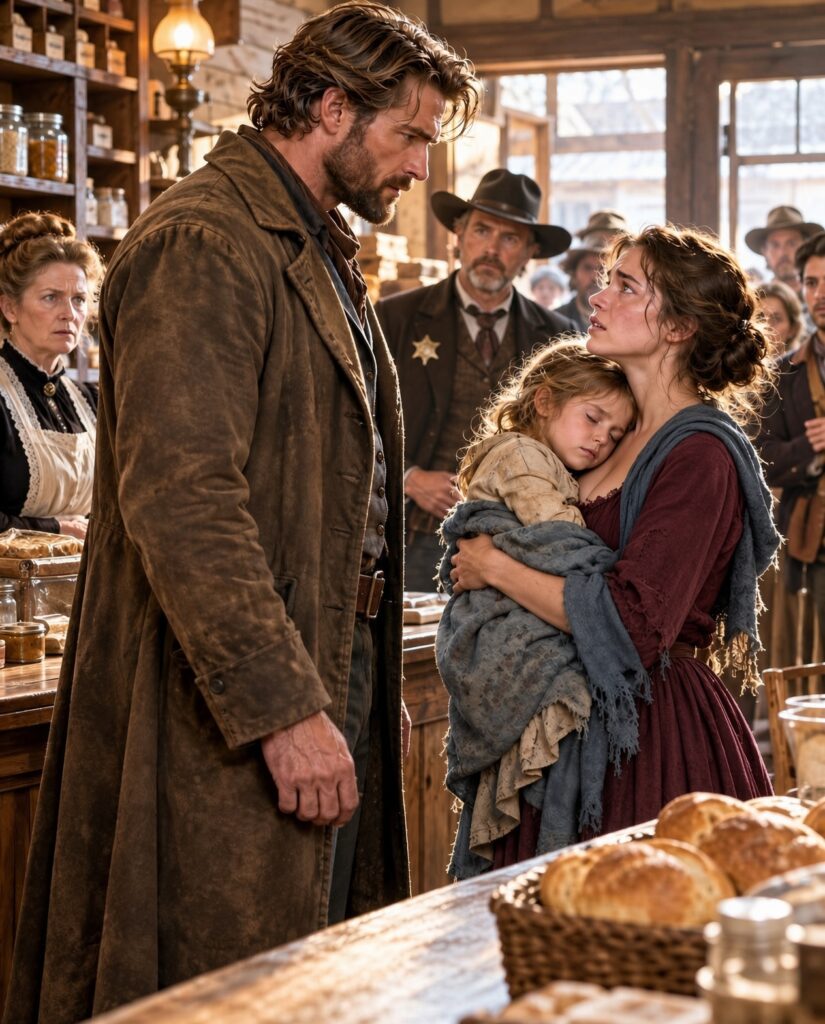
Seven cents lay in Clara’s palm while her starving daughter barely breathed against her chest.
Lily had not eaten in five days, and now Sheriff Brennan was suggesting that Clara might lose the only person she had left.
Then Gideon Ashford stepped forward and asked one question that silenced the entire store.
Three months earlier, Clara had buried her husband.
The mining company had given her only twenty-four hours after his funeral to leave their company house.
They needed it for another working family, they explained, as though the years Clara had spent scrubbing floors and keeping a home together meant nothing.
She sold everything she could.
Her mother’s china.
Her winter coat.
Even the quilt her grandmother had sewn by hand.
By that bitter morning, all she had left was seven cents.
A loaf of bread cost twelve.
Milk cost eight.
Clara stood outside Hargrave’s General Store, staring through the cold glass at shelves filled with food she could no longer afford.
Lily shifted weakly in her arms.
The little girl had grown frighteningly light.
Her cheeks were hollow, and yesterday she had stopped crying.
That terrified Clara more than the crying ever had.
“Please,” Clara whispered.
“Just a little longer.”
Finally, she pushed open the store door.
Warm air surrounded her, carrying the smell of bread and coffee.
Mrs.
Hargrave looked at Clara’s torn dress and bare feet, then at the exhausted child in her arms.
“We don’t give charity here,” she said.
Clara swallowed her pride.
“My daughter hasn’t eaten in five days.
I have seven cents.
Could I have some bread?
Or a little milk?”
Customers turned toward her.
Their whispers were not quiet enough.
“She shouldn’t have children if she can’t feed them.”
“Look at the state of her.”
Clara held Lily tighter.
“I’ll work for it,” she said.
“I can scrub floors.
Clean.
Anything.”
Mrs.
Hargrave shook her head.
“Hard work builds character.
Handouts don’t.”
Clara had already searched for work everywhere—the bakery, the laundry, the boarding house.
Nobody wanted a desperate widow carrying a sick child.
Then the bell above the door rang.
The room became silent.
A massive man stepped inside.
Gideon Ashford looked as though years of ranch work and brutal weather had carved him from stone.
His shoulders nearly filled the doorway, but his storm-gray eyes immediately settled on Lily.
“Afternoon, Mr.
Ashford,” Sheriff Brennan said.
Gideon did not answer.
He watched Lily’s shallow breathing.
His jaw tightened.
Mrs.
Hargrave folded her arms.
“Don’t start feeling sorry for her, Gideon.
Some people create their own problems.”
Still, Gideon said nothing.
Then Sheriff Brennan cleared his throat.
“Ma’am, we’ve discussed this.
A child needs proper care.
If you can’t provide it…”
Clara understood.
The poorhouse.
They could take Lily away.
“No,” Clara whispered.
“Please.
She’s all I have.”
Lily’s breathing became even shallower.
Clara felt the room spinning around her.
Then Gideon moved.
His heavy boots crossed the wooden floor until he stood at the counter.
Everyone watched him.
Mrs.
Hargrave opened her mouth, but Gideon spoke first.
His voice was calm.
Deep.
Absolute.
“How much for everything she needs?”
Clara stared at him.
For the first time in months, someone was not looking at her as though poverty were a crime.
And Gideon Ashford was not finished.

“How much for everything she needs?”
The store went so quiet that Clara could hear the faint rattle of the stove.
Mrs.
Hargrave blinked.
“Everything?”
Gideon Ashford nodded.
“Bread.
Milk.
Eggs.
Meat.
Medicine.”
He looked at Lily.
“And whatever that child needs to eat tonight.”
Mrs.
Hargrave glanced around the store.
“She hasn’t got money.”
“I didn’t ask whether she had money.”
A murmur passed through the customers.
Sheriff Brennan shifted uneasily.
“Gideon, you don’t want to get involved in—”
“I asked a question.”
His storm-gray eyes settled on the sheriff.
“What exactly are you planning to do with that child?”
Brennan straightened.
“If the mother can’t provide proper food and shelter, county law permits us to—”
“Take her?”
“Yes.”
Gideon’s jaw tightened.
“Then you can explain something to me.”
The sheriff frowned.
“What?”
Gideon pointed toward Lily.
“Who decided taking a starving child from her mother was easier than feeding her?”
Nobody answered.
Gideon turned to Mrs.
Hargrave.
“Ring it up.”
The shopkeeper swallowed.
She began gathering food.
Bread.
Milk.
Beans.
Eggs.
Flour.
Dried apples.
Salted beef.
Then Gideon stopped her.
“And that.”
He pointed to a small tin of peaches.
Mrs.
Hargrave hesitated.
“Those are imported.”
“Put them in.”
“They’re expensive.”
“I can afford them.”
Clara’s eyes filled with tears.
“Mr.
Ashford…”
He looked at her.
She lowered her voice.
“I can’t pay you back.”
“I didn’t ask you to.”
“I’ll work.”
“Later.”
“I can cook.
Clean.
Wash clothes.
Anything.”
“Later.”
His voice wasn’t harsh.
It was simply final.
“Right now, you feed your daughter.”
Clara couldn’t speak.
Mrs.
Hargrave finished the order.
Gideon paid.
Then he looked at Clara.
“Can she walk?”
Clara shook her head.
“Not anymore.”
He nodded once.
“Then give her to me.”
Clara froze.
“No.”
Something flashed in his eyes.
Not anger.
Understanding.
“You think I’m going to take her from you?”
Clara’s grip tightened around Lily.
“I don’t know what you’re going to do.”
“Good.”
Gideon crouched slowly so he wasn’t towering over her.
“Don’t trust strangers.”
His voice softened.
“But trust this.”
He held out his hand.
“I won’t let your daughter die in a store while everyone stands around discussing whether she deserves to live.”
Clara stared at him.
Then Lily made a tiny sound.
A weak whimper.
That broke something inside Clara.
She let Gideon take the child.
He lifted Lily carefully, as though she were made of glass.
The little girl’s head fell against his shoulder.
Gideon’s entire expression changed.
He looked down at her.
“She’s burning.”
Clara touched Lily’s forehead.
“She had a fever yesterday.”
“And you haven’t seen a doctor?”
“I couldn’t pay.”
Gideon stood.
“Brennan.”
The sheriff looked at him.
“Fetch Doc Miller.”
“He’s at the clinic.”
“Then ride.”
Brennan hesitated.
Gideon’s gaze hardened.
“Now.”
The sheriff left.
They carried Lily to the back room of the store.
Gideon laid her on a folded blanket.
Clara knelt beside her.
“Please wake up.”
Lily’s eyes fluttered.
“Mama?”
“I’m here.”
“I’m hungry.”
Clara covered her mouth.
Those two words nearly destroyed her.
Gideon turned away.
His hands curled into fists.
Mrs.
Hargrave brought warm milk.
Clara tried to give Lily a sip.
The girl swallowed once.
Then coughed.
Gideon immediately stopped her.
“Slow.”
Clara nodded.
She waited.
Another sip.
Another.
After twenty minutes, Lily managed half a cup.
The color slowly returned to her face.
Gideon watched every swallow.
When Lily finally fell asleep, he looked at Clara.
“How long has it been this bad?”
Clara stared at the floor.
“Since my husband died.”
“Three months?”
“Yes.”
“Where have you been living?”
“A room above the old bakery.”
“Why aren’t you there now?”
“The owner sold the building.”
Gideon looked at her bare feet.
“You’re walking through February weather without shoes.”
Clara glanced down.
She hadn’t noticed the pain anymore.
“I sold them.”
Gideon was silent.
Then he took off his coat.
He wrapped it around her shoulders.
She immediately shook her head.
“No.”
“Keep it.”
“But you’ll be cold.”
“I’ve got another.”
She knew he didn’t.
Everyone in town knew Gideon owned one coat good enough for winter.
He simply didn’t care.
Dr.
Miller arrived twenty minutes later.
He examined Lily carefully.
When he finally stood, his expression was grave.
“She is severely malnourished.”
Clara closed her eyes.
“But she’s going to live?”
“If she eats properly and gets rest, yes.”
Clara nearly collapsed.
The doctor continued.
“But the next few weeks matter.”
Gideon nodded.
“What does she need?”
“Small meals.
Frequently.
Milk.
Eggs.
Broth.
Soft vegetables.
No heavy food yet.”
“I’ll handle it.”
The doctor looked at him.
“You?”
Gideon nodded.
“You’ll handle the cooking?”
“No.”
He looked at Clara.
“She will.”
Clara frowned.
“What?”
“I have a ranch.”
“I know.”
“I need someone to cook.”
She stared at him.
“I don’t understand.”
“You said you’d work.”
“Yes.”
“Then work for me.”
Clara’s heart raced.
“As what?”
“My cook.”
Her eyes narrowed.
“You’re offering me charity.”
“No.”
“You’re giving me money because you feel sorry for me.”
“No.”
“Then why?”
Gideon looked at Lily.
“Because my ranch needs someone who knows how to keep a child alive.”
Clara stared at him.
It was the strangest job offer she’d ever heard.
“What would you pay?”
“Twenty dollars a month.”
Her mouth fell open.
“That much?”
“You’ll have a room.”
She blinked.
“A room?”
“And meals.”
She looked at Lily.
“And my daughter?”
“She comes with you.”
Clara couldn’t believe it.
“Mr.
Ashford…”
“Gideon.”
She hesitated.
“Gideon.”
He nodded.
“There’s one more thing.”
“What?”
“You don’t work until your daughter is strong enough to walk.”
Clara stared at him.
“That isn’t a job.”
“It is now.”
Ashford Ranch sat five miles outside town.
It was enormous.
Three thousand acres of rolling grassland, cottonwood groves, rocky hills, and winter-bare fields.
Clara had heard stories.
Everyone had.
Gideon Ashford was the biggest rancher in the county.
He owned more cattle than anyone else.
His men feared him.
His competitors respected him.
Women in town whispered about him.
Some said he had a heart made of stone.
Others said his wife had died years earlier and he’d never smiled properly afterward.
Clara expected a mansion.
Instead, she found a sprawling but weathered ranch house surrounded by barns.
There were six cowboys outside.
They all stopped working when Gideon’s wagon arrived.
Gideon climbed down.
“That’s Clara.”
Every man looked at her.
“She’ll be cooking.”
One cowboy glanced at Lily.
“Who’s the little one?”
“My daughter.”
The man immediately removed his hat.
“Ma’am.”
Clara nodded.
Gideon carried their bags inside.
The kitchen was enormous.
But almost empty.
Clara stared.
“You really need a cook.”
Gideon almost smiled.
“I told you.”
“You have nothing.”
“We have flour.”
She opened a cupboard.
“Two sacks.”
“Exactly.”
“And beans.”
“Three sacks.”
“Salt.”
“Enough.”
Clara turned toward him.
“You’ve got thirty men on this ranch.”
“Twenty-seven.”
“Who feeds them?”
“They do.”
She looked at him.
“They cook?”
Gideon nodded.
“What do they eat?”
“Whatever doesn’t kill them.”
Clara almost laughed.
It was the first time she had smiled in months.
Gideon noticed.
Something softened in his expression.
“Good,” he said.
“What?”
“You still remember how.”
“How what?”
“To smile.”
The first week passed quietly.
Lily slept.
She ate.
Slowly.
Carefully.
A spoonful of porridge.
Half an egg.
A little broth.
A piece of bread soaked in milk.
Every day she became stronger.
The ranch hands began leaving small offerings outside the kitchen.
A wooden horse.
A blue ribbon.
A red apple.
A carved bird.
Lily collected them all.
The toughest cowboy on the ranch, Amos, pretended not to notice when she followed him around the barn.
One afternoon, Clara found him teaching Lily how to feed a calf.
“You hold the bottle like this.”
Lily giggled.
Clara froze.
She hadn’t heard that sound in months.
Gideon stood in the doorway behind her.
He watched them.
“She likes him,” Clara said.
“She likes everyone.”
“No.”
She shook her head.
“She doesn’t.”
Gideon smiled faintly.
“She likes you.”
Clara looked at him.
“Thank you.”
“For what?”
“For giving her a chance.”
Gideon looked away.
“You did that.”
“I almost lost her.”
“But you didn’t.”
Clara lowered her eyes.
“I didn’t know how I was going to survive.”
Gideon was silent.
Then he said something that stayed with her.
“You don’t have to survive alone anymore.”
Three weeks later, Clara noticed something strange.
Gideon had become protective of Lily.
Not possessive.
Not intrusive.
Protective.
He checked whether she had eaten.
He asked whether she slept.
He repaired the broken wooden horse himself.
One evening, Clara found him sitting beside Lily’s bed.
The little girl was asleep.
Gideon was holding the wooden horse.
“You made that?”
He looked up.
“Yes.”
“You’re good with your hands.”
He raised an eyebrow.
“I run a ranch.”
Clara smiled.
“I know.”
He stood.
“I should go.”
“Gideon.”
He stopped.
“Why are you doing this?”
He didn’t answer.
“Really,” Clara said.
“Why?”
His face changed.
“My wife was pregnant when she died.”
Clara’s heart tightened.
“I didn’t know.”
“No one talks about her.”
“Why?”
“Because I don’t.”
He looked toward Lily.
“She was supposed to have a little girl.”
Clara understood.
“Oh.”
“She died before the baby was born.”
“What happened?”
“Fever.”
His voice was quiet.
“I couldn’t save either of them.”
Clara stepped closer.
“You don’t have to explain.”
“I know.”
He looked at her.
“But I want you to understand.”
“Understand what?”
“Why I couldn’t stand there and watch another little girl disappear.”
Clara’s eyes filled.
She whispered, “I’m sorry.”
Gideon nodded.
“Me too.”
Spring came early.
Lily grew stronger.
Clara became indispensable.
She organized the kitchen, taught the cowboys to eat vegetables, repaired the pantry, and somehow reduced the ranch’s food expenses while improving every meal.
Gideon noticed.
So did the men.
One evening, he walked into the kitchen and found Clara studying a stack of receipts.
“You’re doing bookkeeping?”
She looked up.
“I noticed your feed costs are wrong.”
He took the papers.
“What do you mean?”
“The supplier is charging you twice for delivery.”
Gideon’s eyes narrowed.
“How long?”
“Six months.”
He looked at her.
“How did you see that?”
“You’re paying for shipments on Tuesdays and Fridays.”
“So?”
“The ranch only receives feed on Tuesdays.”
Silence.
Gideon stared at the invoices.
Then at Clara.
“You’re sure?”
“Yes.”
He grabbed his coat.
“Where are you going?”
“To see my supplier.”
She smiled.
“Try not to shoot him.”
Gideon stopped.
“I wasn’t planning to.”
“Good.”
He looked at her.
“Would you have?”
“No.”
A beat.
“Probably.”
He laughed.
Clara stared.
It was the first time she’d heard him laugh.
And she realized something dangerous.
She liked the sound.
The next morning, Gideon returned with a confession.
“You were right.”
Clara smiled.
“I usually am.”
He looked impressed.
“That’s going to be a problem.”
“For who?”
“Me.”
Their eyes met.
For a moment, neither moved.
Then Lily ran into the kitchen.
“Mama!”
The moment broke.
Clara caught her.
Gideon smiled.
And neither noticed the man watching them from the barn.
A man who had been watching the ranch for weeks.
His name was Everett Shaw.
He represented Blackridge Mining.
The same company that had employed Clara’s husband.
The same company that had evicted Clara after his death.
And now Blackridge wanted something from Gideon.
His land.
A geological survey had revealed rich copper deposits beneath Ashford Ranch.
Gideon refused to sell.
So Blackridge changed tactics.
Three days later, a letter arrived.
A lawsuit.
They claimed Gideon’s grandfather had obtained part of the property through an invalid land transfer.
Gideon read the papers.
Clara watched him.
“What are you going to do?”
“Fight.”
“How much will it cost?”
“Too much.”
She looked at the documents.
“Let me see.”
He handed them over.
She read silently.
Then she stopped.
“This signature.”
“What about it?”
“It isn’t your grandfather’s.”
Gideon frowned.
“You’re sure?”
“My husband taught me to recognize signatures.
He handled mine leases.”
She pointed.
“The spacing is wrong.”
Gideon looked at her.
“You think it’s forged?”
“I know it is.”
His eyes hardened.
“Blackridge.”
“Yes.”
He stared at the document.
Then at Clara.
“You just saved my ranch.”
She shook her head.
“No.”
She smiled.
“We saved it.”
They found the proof in the county archive.
The original land deed.
The original signature.
The forged copy.
And a chain of payments connecting Blackridge executives to the county clerk who had altered the records.
But there was more.
Clara found her husband’s name in the documents.
He hadn’t died in an accident.
He had been investigating the same fraud.
He had discovered Blackridge was trying to seize land from widows and small ranchers by forging deeds.
When he threatened to expose them, his mine shaft had mysteriously collapsed.
Clara couldn’t breathe.
“My husband didn’t die by accident.”
Gideon stood beside her.
“No.”
She covered her mouth.
“He knew.”
“Yes.”
“He was trying to protect me.”
Gideon reached for her hand.
She didn’t pull away.
“I thought he abandoned us.”
“He didn’t.”
Tears rolled down her face.
“I spent three months thinking he left me with nothing.”
Gideon squeezed her hand.
“He left you with the truth.”
The trial lasted two weeks.
Blackridge brought lawyers from Denver.
Gideon brought evidence.
Clara brought the original documents.
The county clerk confessed.
Two mining executives were arrested.
The judge dismissed the land claim.
Then he referred the wrongful-death evidence to the state prosecutor.
Blackridge collapsed within months.
Clara’s husband’s name was cleared.
The town finally learned the truth.
And Sheriff Brennan came to Clara’s door.
“I owe you an apology.”
She looked at him.
“For what?”
“For threatening to take Lily.”
He lowered his head.
“I should have helped you.”
Clara nodded.
“Yes.”
He accepted it.
“I hope you can forgive me.”
“I hope you can forgive yourself.”
Summer arrived.
Lily was no longer the fragile child who had barely breathed in Hargrave’s store.
She ran.
She laughed.
She climbed fences.
She chased chickens.
And she called Gideon “Mr.
G.”
Until one afternoon, she asked him something that made everyone freeze.
“Can I call you Papa?”
Gideon went still.
Clara’s heart stopped.
Lily looked embarrassed.
“You don’t have to.”
Gideon crouched.
“Why would you want to?”
“Because you take care of Mama.”
His eyes filled.
“And me.”
Gideon looked at Clara.
She nodded.
“If that’s what you want.”
He looked back at Lily.
“Yes.”
The little girl smiled.
“Papa.”
Gideon pulled her into his arms.
Clara turned away to hide her tears.
But Gideon saw them.
Later that evening, he found her by the porch.
“You’re crying.”
“I know.”
“Why?”
“Because I never thought I’d hear my daughter call someone that.”
He stepped closer.
“Does it bother you?”
“No.”
She looked at him.
“It scares me.”
“Why?”
“Because I love you.”
The words escaped before she could stop them.
Silence.
Clara’s face went red.
“I shouldn’t have said that.”
Gideon shook his head.
“Don’t take it back.”
She looked up.
“I love you too.”
Her breath caught.
“You do?”
“I have for a while.”
“How long?”
He smiled.
“Probably since you told me my pantry was pathetic.”
She laughed through her tears.
“That was accurate.”
“It was.”
He reached for her hand.
This time, she took his.
They married the following autumn.
There was no grand ceremony.
No wealthy guests.
No expensive dress.
Clara wore a simple cream gown.
Lily carried wildflowers.
Gideon wore his best black suit.
Twenty-seven ranch hands stood behind him.
Sheriff Brennan came.
Mrs.
Hargrave came.
Even Dr.
Miller came.
After the ceremony, Gideon took Clara’s hand.
“I promised myself I’d never love again.”
She looked at him.
“What changed?”
He looked toward Lily.
“Then you walked into that store with seven cents.”
Clara laughed.
“That isn’t very romantic.”
“It is to me.”
He squeezed her hand.
“Because you had almost nothing.”
He looked at Lily.
“And you still asked for bread for someone else before yourself.”
Clara’s eyes filled.
“I was her mother.”
“And I was a man who had forgotten what it felt like to have something worth fighting for.”
He kissed her forehead.
“You reminded me.”
Years later, people in town still told the story.
They said Gideon Ashford had walked into Hargrave’s General Store one cold morning and bought enough food to feed a starving family.
That wasn’t the real story.
The real story was that he had seen Clara when everyone else saw poverty.
He had seen Lily when everyone else saw a burden.
He had asked the question nobody else thought to ask.
Not:
“Why can’t she afford it?”
Not:
“Who is responsible?”
Not:
“What did she do wrong?”
He had asked:
“How much does she need?”
And that question changed three lives.
Clara never forgot the seven cents in her palm.
She kept one of those coins in a small wooden box.
Years later, when Lily was grown and had children of her own, she asked her mother why she kept it.
Clara smiled.
“Because once, I thought seven cents was all I had.”
Lily touched the coin.
“What was it really?”
Clara looked across the porch.
Gideon was sitting beneath the old cottonwood tree, repairing a saddle while their grandchildren played around him.
She smiled.
“It was proof that I survived.”
Then she looked at her daughter.
“And proof that sometimes your life changes because one person decides you are worth helping.”
Lily hugged her.
Across the yard, Gideon looked up.
“Clara!”
She smiled.
“Yes?”
“Dinner?”
She laughed.
“Coming!”
She walked toward him.
Gideon reached for her hand.
And for a moment, Clara remembered the woman she’d once been.
The widow with two garbage bags.
The mother with a starving child.
The woman standing in a general store with seven cents and no idea what tomorrow would bring.
She had thought she was asking for bread.
She had been asking for a chance.
And the biggest rancher in town had given her one.
Not because he pitied her.
Not because she was helpless.
But because he saw something everyone else had missed.
A woman who was still standing.
A child who was still fighting.
And a family that had not yet realized it was waiting for one another.


